Vladimir S. Aslanov
               aslanov_vs@mail.ru


THE DYNAMICS AND CONTROL OF
     VARIABLE STUCTURE
  AXIAL SATELLITE GYROSTAS

      Theoretical Mechanics Department
                 www.termech.ru

   Samara State Aerospace University, Russia
                  www.ssau.ru


                      2012
Statement of the problem
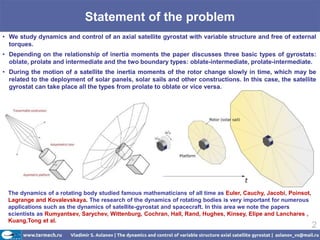
• We study dynamics and control of an axial satellite gyrostat with variable structure and free of external
  torques.
• Depending on the relationship of inertia moments the paper discusses three basic types of gyrostats:
  oblate, prolate and intermediate and the two boundary types: oblate-intermediate, prolate-intermediate.
• During the motion of a satellite the inertia moments of the rotor change slowly in time, which may be
  related to the deployment of solar panels, solar sails and other constructions. In this case, the satellite
  gyrostat can take place all the types from prolate to oblate or vice versa.


 The dynamics of a rotating body studied famous mathematicians of all time as Euler, Cauchy, Jacobi, Poinsot,
 Lagrange and Kovalevskaya. The research of the dynamics of rotating bodies is very important for numerous
 applications such as the dynamics of satellite-gyrostat and spacecraft. In this area we note the papers
 scientists as Rumyantsev, Sarychev, Wittenburg, Cochran, Hall, Rand, Hughes, Kinsey, Elipe and Lanchares ,
 Kuang,Tong et al.
                                                                                                                2
Statement of the problem

The purpose of this report is to find the control for the satellite gyrostat. The
control law should allow keeping a stable motion in the vicinity of the equilibrium
position for slowly changing of the rotor inertia moments in time. The main idea
of ​the stabilization method is conservation of the stable position by selecting the
internal torque.

We solve the following tasks:

• The dynamics of the satellite is described by using ordinary differential
equations with Serret-Andoyer canonical variables.
• The equations of motion have a simple dimensionless form and contain a small
parameter.
• For undisturbed motion, when the inertia moments of the satellite gyrostat aren’t
changed and the internal torque is equal to zero the stationary solutions are
found, and their stability is studied.
• For disturbed motion of the gyrostat with variable structure the control law
obtained on the basis of the stationary solutions.
• Several numerical simulations are given to confirm effectiveness of the founded
control law.
                                                                                  3
The motion equations
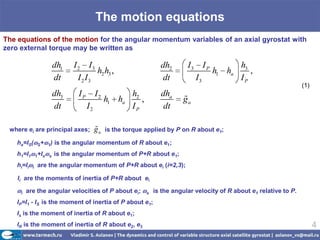
The equations of the motion for the angular momentum variables of an axial gyrostat with
zero external torque may be written as

                           dh1    I 2 I3                                dh2       I3        IP           h3
                                           h2 h3 ,                                               h1 ha      ,
                           dt       I 2 I3                               dt            I3                IP
                                                                                                                             (1)
                           dh3     IP        I2            h2           dha
                                                  h1 ha       ,                 
                                                                                ga
                           dt           I2                 IP            dt

 where ei are principal axes;                
                                             ga   is the torque applied by P on R about e1;

    ha=IS(       S+    1)   is the angular momentum of R about e1;
    h1=I1       1+Is   s    is the angular momentum of P+R about e1;
    hi=Ii   i   are the angular momentum of P+R about ei (i=2,3);

    Ii are the moments of inertia of P+R about ei

     i   are the angular velocities of P about ei;                s   is the angular velocity of R about e1 relative to P.
    IP=I1 - IS is the moment of inertia of P about e1;
    Is is the moment of inertia of R about e1;
    IR is the moment of inertia of R about e2, e3                                                                                  4
The motion equations
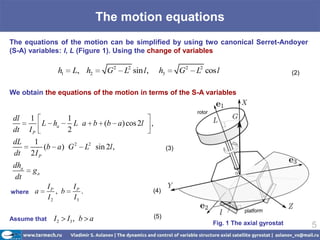
The equations of the motion can be simplified by using two canonical Serret-Andoyer
(S-A) variables: l, L (Figure 1). Using the change of variables

                 h1     L, h2          G2    L2 sin l ,     h3         G2   L2 cos l                         (2)


We obtain the equations of the motion in terms of the S-A variables


 dl    1               1
          L ha           L a b (b a ) cos 2l ,
 dt    IP              2
 dL     1
            (b a) G 2          L2 sin 2l ,                       (3)
 dt    2I P
 dha
       ga
  dt
              IP        IP
where a          , b       .                              (4)
              I2        I3

Assume that     I2     I3 , b a                           (5)
                                                                                 Fig. 1 The axial gyrostat         5
The motion equations
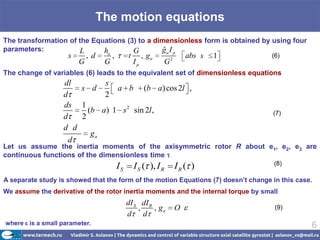
The transformation of the Equations (3) to a dimensionless form is obtained by using four
parameters:           L      ha       G         
                                               ga I p
                    s       , d        ,        t        , ga       2
                                                                            abs s   1   (6)
                        G          G                Ip          G
The change of variables (6) leads to the equivalent set of dimensionless equations
                  dl        s
                      s d      a b (b a) cos 2l ,
                  d         2
                  ds 1
                        (b a) 1 s 2 sin 2l ,                                            (7)
                  d   2
                  d d
                         ga
                    d
Let us assume the inertia moments of the axisymmetric rotor R about e1, e2, e3 are
continuous functions of the dimensionless time
                                                                                        (8)
                                           IS       I S ( ), I R        IR ( )
A separate study is showed that the form of the motion Equations (7) doesn’t change in this case.
We assume the derivative of the rotor inertia moments and the internal torque by small
                                                dI S dI R
                                                    ,     , ga          O                (9)
                                                d d
where is a small parameter.                                                                     6
The undisturbed motion
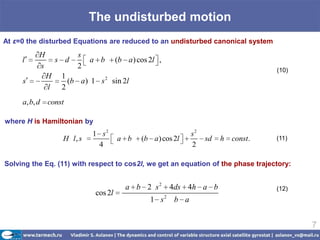
At ε=0 the disturbed Equations are reduced to an undisturbed canonical system
           H             s
     l             s d       a b       (b a ) cos 2l ,
           s             2                                                           (10)
               H    1
     s                (b a ) 1 s 2 sin 2l
               l    2
     a, b, d   const

where H is Hamiltonian by
                             1 s2                             s2
                    H l, s             a b     (b a) cos 2l        sd   h   const.   (11)
                              4                               2

Solving the Eq. (11) with respect to cos2l, we get an equation of the phase trajectory:


                                          a b 2 s 2 4ds 4h a b                       (12)
                              cos 2l
                                                  1 s2 b a


                                                                                            7
The undisturbed motion

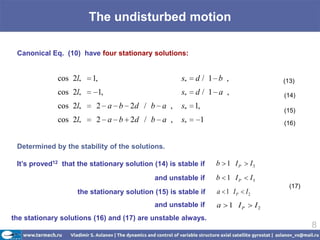
 Canonical Eq. (10) have four stationary solutions:


              cos 2l*    1,                          s*   d/ 1 b ,                    (13)
              cos 2l*         1,                     s*   d/ 1 a ,                    (14)
              cos 2l*     2 a b 2d / b a ,           s* 1,
                                                                                      (15)
              cos 2l*     2 a b 2d / b a ,           s*    1                          (16)


 Determined by the stability of the solutions.

 It’s proved12 that the stationary solution (14) is stable if   b 1 IP       I3
                                            and unstable if     b 1 IP       I3
                                                                                        (17)
                    the stationary solution (15) is stable if   a 1 IP      I2
                                            and unstable if     a    1 IP        I2
the stationary solutions (16) and (17) are unstable always.
                                                                                               8
The undisturbed motion
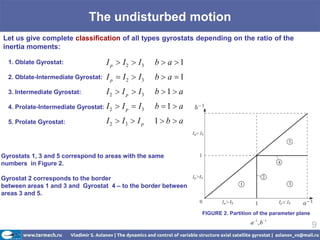
Let us give complete classification of all types gyrostats depending on the ratio of the
inertia moments:

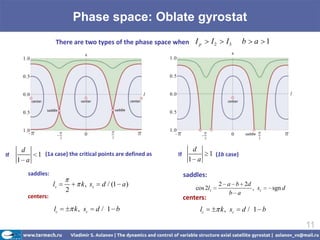
  1. Oblate Gyrostat:                 Ip   I2   I3   b   a 1
  2. Oblate-Intermediate Gyrostat:    Ip   I2   I3   b   a 1
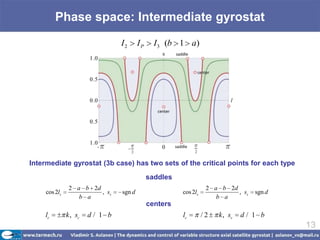
  3. Intermediate Gyrostat:           I2   Ip   I3   b 1 a
  4. Prolate-Intermediate Gyrostat:   I2   Ip   I3   b 1 a
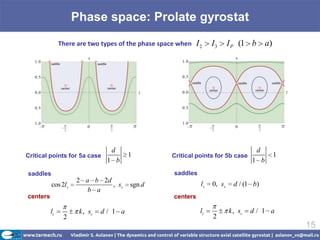
  5. Prolate Gyrostat:                I2   I3   Ip   1 b   a


Gyrostats 1, 3 and 5 correspond to areas with the same
numbers in Figure 2.

Gyrostat 2 corresponds to the border
between areas 1 and 3 and Gyrostat 4 – to the border between
areas 3 and 5.


                                                               FIGURE 2. Partition of the parameter plane
                                                                                 a 1, b   1
                                                                                                            9
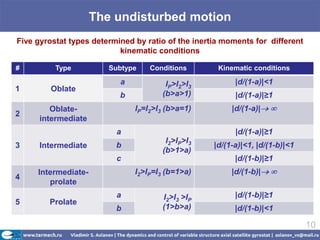
The undisturbed motion
Five gyrostat types determined by ratio of the inertia moments for different
                           kinematic conditions

#         Type          Subtype    Conditions        Kinematic conditions
                           a           IP>I2>I3           |d/(1-a)|<1
1        Oblate
                           b          (b>a>1)             |d/(1-a)|≥1
         Oblate-               IP=I2>I3 (b>a=1)          |d/(1-a)|
2
      intermediate
                          a                               |d/(1-a)|≥1
                                       I2>IP>I3
3     Intermediate        b                         |d/(1-a)|<1, |d/(1-b)|<1
                                      (b>1>a)
                          c                               |d/(1-b)|≥1
     Intermediate-             I2>IP=I3 (b=1>a)          |d/(1-b)|
4
        prolate
                          a           I2>I3 >IP           |d/(1-b)|≥1
5       Prolate
                          b           (1>b>a)             |d/(1-b)|<1

                                                                               10
Phase space: Oblate gyrostat
                      There are two types of the phase space when I p          I2     I3     b   a 1


      d                                                               d
If           1 (1a case) the critical points are defined as   If               1 (1b case)
     1 a                                                            1 a
          saddles:                                                 saddles:
                     ls          k , ss    d / (1 a)                                2 a b 2d
                          2                                            cos 2ls               , ss      sgn d
                                                                                       b a
          centers:                                                 centers:
                     lc       k , sc      d/ 1 b                          lc        k , sc   d/ 1 b

                                                                                                               11
Phase space: Oblate-intermediate (2), Intermediate (3.a)
       There is the same phase space for the oblate-intermediate and intermediate gyrostats


                                                                                             abs s     1


  Oblate-intermediate (case 2)                            Intermediate (case 3.a)

  IP    I2    I3 (b a 1)                                  I2      IP     I3 (b a 1), d / (1 a) 1
  Critical points                                              Critical points

        saddles                                                        saddles
                       2 a b 2d                                                     2 a b 2d
             cos 2ls            , ss     sgn d                            cos 2ls            , ss          sgn d
                          b a                                                          b a
        centers                                                        centers

             lc        k , sc   d/ 1 b                                     lc       k , sc    d/ 1 b
                                                                                                              12
Phase space: Intermediate gyrostat
                                 I2      IP     I3 (b 1 a)


Intermediate gyrostat (3b case) has two sets of the critical points for each type
                                              saddles
                2 a b 2d                                           2 a b 2d
     cos 2ls             , ss    sgn d                  cos 2ls             , ss   sgn d
                   b a                                                b a
                                              centers
    lc         k , sc   d/ 1 b                          lc        /2   k , sc   d/ 1 b
                                                                                           13
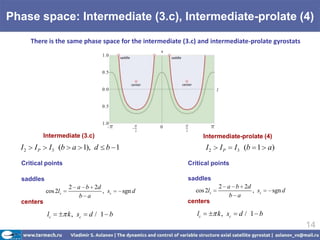
Phase space: Intermediate (3.c), Intermediate-prolate (4)
       There is the same phase space for the intermediate (3.c) and intermediate-prolate gyrostats


             Intermediate (3.c)                                     Intermediate-prolate (4)
  I2    IP     I3 (b a 1), d        b 1                             I2   IP       I3 (b 1 a)

  Critical points                                           Critical points

  saddles                                                   saddles
                       2 a b 2d                                          2 a b 2d
             cos 2ls            , ss      sgn d               cos 2ls             , ss         sgn d
                          b a                                               b a
  centers                                                  centers

              lc       k , sc   d/ 1 b                         lc        k , sc    d/ 1 b
                                                                                                       14
Phase space: Prolate gyrostat

               There are two types of the phase space when I 2     I3      I P (1 b a)


                                d                                                    d
Critical points for 5a case            1            Critical points for 5b case           1
                               1 b                                                  1 b
saddles                                             saddles
                    2 a b 2d
          cos 2ls            , ss      sgn d                  ls   0, ss     d / (1 b)
                       b a
centers                                             centers

          lc         k , sc   d/ 1 a                          lc           k , sc   d/ 1 a
                2                                                  2
                                                                                              15
Variable moments of inertia
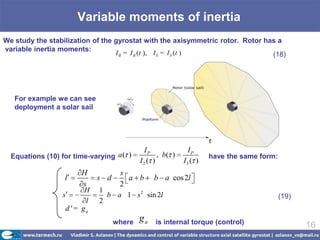
We study the stabilization of the gyrostat with the axisymmetric rotor. Rotor has a
variable inertia moments:
                                  I R = I R (t ), I S = I S (t )                (18)


   For example we can see
   deployment a solar sail


                                             IP              IP
  Equations (10) for time-varying a ( )           , b( )            have the same form:
                                           I2 ( )          I3 ( )
                       H            s
                  l          s d      a b       b a cos 2l
                       s            2
                         H   1
                 s             b a 1 s 2 sin 2l                                           (19)
                         l   2
                  d ' = ga
                                   where   ga   is internal torque (control)                     16
Phase space deformation of gyrostat with
                 variable moments of inertia
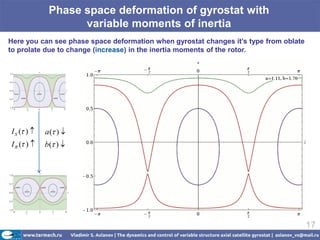
Here you can see phase space deformation when gyrostat changes it’s type from oblate
to prolate due to change (increase) in the inertia moments of the rotor.


IS ( )    a( )
IR ( )    b( )


                                                                                       17
Gyrostat stabilization
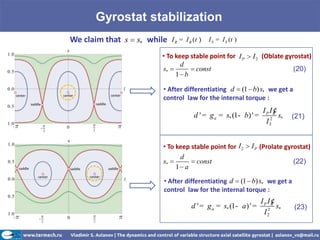
We claim that s s* while   I R = I R (t )   I S = I S (t )

                      • To keep stable point for I P         I 2 (Oblate gyrostat)
                             d
                      s*          const                                       (20)
                           1 b

                       • After differentiating d (1 b) s* we get a
                       control law for the internal torque :
                                                                 IP IR ¢
                                     d ' = g a = s* (1- b) ' =           s*   (21)
                                                                  I 32


                       • To keep stable point for I 2        I P (Prolate gyrostat)
                             d
                       s*          const                                      (22)
                            1 a

                       • After differentiating d (1 b) s* we get a
                       control law for the internal torque :
                                                                 IPIR¢
                                    d ' = g a = s* (1- a ) ' =     2
                                                                       s*     (23)
                                                                  I2
Numerical example
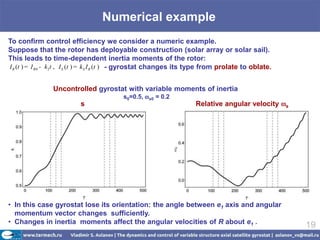
To confirm control efficiency we consider a numeric example.
Suppose that the rotor has deployable construction (solar array or solar sail).
This leads to time-dependent inertia moments of the rotor:
I R (t ) = I R 0 - k2t , I S (t ) = kS I R (t ) - gyrostat changes its type from prolate to oblate.


                Uncontrolled gyrostat with variable moments of inertia
                                           s0=0.5,   s0   = 0.2
                           s                                          Relative angular velocity       s


• In this case gyrostat lose its orientation: the angle between e1 axis and angular
  momentum vector changes sufficiently.
• Changes in inertia moments affect the angular velocities of R about e1 .
                                                                                                          19
Numerical example
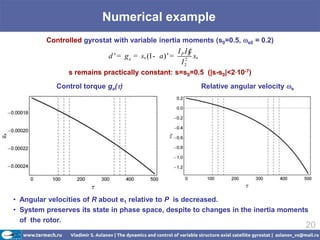
         Controlled gyrostat with variable inertia moments (s0=0.5,               s0   = 0.2)
                                                         IPIR¢
                            d ' = g a = s* (1- a ) ' =     2
                                                               s*
                                                          I2
                s remains practically constant: s=s0=0.5 (|s-s0|<2 10-7)
            Control torque ga( )                                    Relative angular velocity   s


• Angular velocities of R about e1 relative to P is decreased.
• System preserves its state in phase space, despite to changes in the inertia moments
  of the rotor.
                                                                                                    20
Numerical example
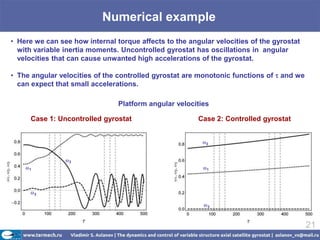
• Here we can see how internal torque affects to the angular velocities of the gyrostat
  with variable inertia moments. Uncontrolled gyrostat has oscillations in angular
  velocities that can cause unwanted high accelerations of the gyrostat.

• The angular velocities of the controlled gyrostat are monotonic functions of   and we
  can expect that small accelerations.

                                Platform angular velocities

      Case 1: Uncontrolled gyrostat                     Case 2: Controlled gyrostat


                                                          2


                 2

     1                                                    1


         3


                                                           3


                                                                                          21
Conclusion

1. The dynamics of the dual-spin gyrostat spacecraft is described by using
   ordinary differential equations with Serret-Andoyer canonical variables.
2. The equations of motion have a simple dimensionless form and contain a small
   parameter.
3. For undisturbed motion the stationary solutions are found, and their stability is
   studied for the all the types of the gyrostats.
4. For disturbed motion of the gyrostat with variable structure the control law
   obtained on the basis of the stationary solutions.
5. It’s shown that uncontrolled gyrostat satellite can lose its axis orientation and
   because of change in moments of inertia of the rotor.
6. The oscillations of the angular velocities and accelerations of the gyrostat
   accompany changes in moments of inertia of the rotor.
7. Obtained internal torque keeps axis orientation of the gyrostat and get angular
   velocities and accelerations monotonic functions of time.


                                                                                       22
References
[1] Cochran, J. E. Shu, P.-H. and Rew, S. D. “Attitude Motion of Asymmetric Dual-Spin Spacecraft”
Journal of Guidance, Control, and Dynamics, V. 5, n 1, 1982, pp. 37-42.
[2] Hall, C. D. and Rand, R. H.: “Spinup Dynamics of Axial Dual-Spin Spacecraft” Journal of Guidance,
Control, and Dynamics. V. 17, n. 1, 1994, pp. 30-37.
[3] Hall C.D. “Escape from gyrostat trap states” J. Guidance Control Dyn. V. 21. 1998. pp. 421-426.
[4] A. Elipe and Lanchares “Exact solution of a triaxial gyrostat with one rotor” Celestial Mechanics and
Dynamical Astronomy V. 101 (1-2). 2008. pp. 49-68.
[5] Lanchares, V., Iñarrea, M., Salas, J.P. “Spin rotor stabilization of a dual-spin spacecraft with time
dependent moments of inertia” Int. J. Bifurcat. Chaos 8. 1998. pp. 609-617.
[6] Hughes, P.C. “Spacecraft Attitude Dynamics” Wiley, New York, 1986.
[7] Kinsey K.J., Mingori D.L., Rand R.H. “Non-linear control of dual-spin spacecraft during despin
through precession phase lock” J. Guidance Control Dyn. 19, 1996, 60-67.
[8] Kane,T.R. “Solution of the Equations of rotational motion for a class of torque-free gyrostats” AIAA
Journal. V. 8. n 6. 1970. pp. 1141-1143.
[9] El-Gohary, A. I. “On the stability of an equilibrium position and rotational motion of a gyrostat” Mech.
Res. Comm. 24. 1997. pp. 457-462.

                                                                                                            23
References
[10] Neishtadt A.I., Pivovarov M.L. “Separatrix crossing in the dynamics of a dual-spin satellite” J. of
Applied Mathematics and Mechanics. 64. 2000. pp. 741-746.
[11] Aslanov, V. S., Doroshin, A.V. “Chaotic dynamics of an unbalanced gyrostat” J. of Applied
Mathematics and Mechanics 74. 2010. pp. 524-535.
[12] Aslanov, V. S. “Integrable cases in the dynamics of axial gyrostats and adiabatic invariants”
Nonlinear Dynamics, Volume 68, Issue 1 (2012), Page 259-273 (DOI 10.1007/s11071-011-0225-x).
[13] Aslanov, V. S. “Dynamics of free dual-spin spacecraft” Engineering Letters (International
Association of Engineers). 19. 2011. pp. 271–278.
[14] Sarychev, V. A., Guerman, A. D., and Paglione, P. “The Influence of Constant Torque on Equilibria of
Satellite in Circular Orbit” Celestial Mechanics and Dynamical Astronomy, Vol. 87, No. 3, 2003.
[15] J. Wittenburg Dynamics of Systems of Rigid Bodies. B.G. Teubner Stuttgard, 1977.
[16] V. A. Sarychev and S. A. Mirer “Relative equilibria of a gyrostat satellite with internal angular
momentum along aprincipal axis” Acta Astronautica, 49(11). 2001. pp. 641–644.
[17] Rumyantsev V. V. “On the Lyapunov’s methods in the study of stability of motions of rigid bodies
with fluid-filled cavities” Adv. Appl. Mech. 8. 1964. pp. 183-232.
[18] Serret, J.A., “Me moiresurl'emploi de la me thode de la variation des arbitrairesdans theorie des
mouvementsde rotations”. Memoires de l’Academie des sciences de Paris, Vol. 35, 1866, pp. 585-616.
[19] Andoyer H. “Cours de Mechanique Celeste” Vol. 1, Gauthier-Villars. 1923.

                                                                                                           24