Submitted to
Technical Training Institute
HAL-TAD, Kanpur
In partial fulfillment of the requirements
For
BATCHELOR OF TECHNOLOGY
IN
AERONAUTICAL ENGINEERING
Training period: 1st
july – 20th
july 2015
CERTIFICATE
This is to certify that Mr. ……………………. student of ……………………………….
pursuing B.Tech in Aeronautical Engineering, has completed his vocational training
successfully in HINDUSTAN AERONAUTICAL LIMITED, Transport Aircraft Division,
Kanpur during the period from 1st july to 20th july 2015.
DATE: 20TH JULY 2015
PLACE: KANPUR
Chief Manager (Training) H.R. officer (Training)
Technical Training Institute Technical Training Institute
HAL-TAD, KANPUR HAL-TAD, KANPUR
Acknowledgement
I take the opportunity to express our gratitude to all concerned people whole have
directly or in directly contributed toward completion of this project. I am very thankful to
chief Manager (TRAINING), HAL-TAD Kanpur, for arranging the training in efficient way
and give me the opportunity to enhance the knowledge and skills.
I express my gratitude towards (Dy. Manager-design), (manager-design) for his
valuable guidance throughout the training period.
SIGNATURE SIGNATURE
(MANAGER-DESIGN) (Dy. Manager-DESIGN)
CONTENT
S.No. Topic Page
1 History of HAL
2 HAL IN INDIA
3 HAL PRODUCT
4 HAL-TAD, Kanpur
5 AIRCRAFT MANUFACTURE AT HAL-TAD, KANPUR
6 Aircraft overhauling at HAL-TAD, Kanpur
7 Aircraft Design Process
Conclusion
Reference
HISTORY OF HAL
HINDUSTAN AERONAUTICS LIMITED (HAL) came into existence on 1st October 1964.
The company traces its roots to the pioneering effort of an industrialist with
extraordinary vision, the late Sath Walchand Hirachand, who set up Hindustan Aircraft
Limited at Bangalore in association with the government of Mysore in 23 December
1940. The Government of India became one of the shareholder in the company holding
1/3 of its paid-up capital in March 1941 and took over the management in 1942.
In Dec 1945, the company was placed under the administrative control of Min. of
Industry & Supply. In January 1951, Hindustan Aircraft Private Limited was placed
under the Administrative control of Ministry Of Defence.
The Company had built aircraft and engines of foreign design under licence, such as
Prentice, Vampire and Gnat aircraft. In August 1951, the HT-2 Trainer aircraft, designed
and produced by the company under the able leadership of Dr. V.M.Ghatge flew for the
first time. Nearly 200 Trainers were manufactured and supplied to the Indian Air Force
and other customers. With the gradual building up of its design capability, the company
successfully designed and developed four other aircraft i.e.
 Two seater Pushpak suitable for flying clubs
 Krishak for Air Observatory Post (AOP) role
 HF-24 Jet Fighter (Marut) and
 HJT-16 Basic Jet Trainer (Kiran)
Meanwhile, in August 1963, Aeronautics India Limited (AIL) was incorporated as a
Company wholly owned by the Government of India to undertake the manufacture
of the MiG-21 aircraft under licence. In June 1964, the Aircraft Manufacturing Depot
which was set up in 1960 as an Air Force unit to produce the Airframe for the HS-748
transport aircraft was transferred to AIL. Soon thereafter, the Government decided to
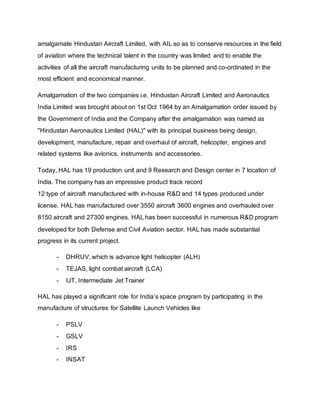
amalgamate Hindustan Aircraft Limited, with AIL so as to conserve resources in the field
of aviation where the technical talent in the country was limited and to enable the
activities of all the aircraft manufacturing units to be planned and co-ordinated in the
most efficient and economical manner.
Amalgamation of the two companies i.e. Hindustan Aircraft Limited and Aeronautics
India Limited was brought about on 1st Oct 1964 by an Amalgamation order issued by
the Government of India and the Company after the amalgamation was named as
"Hindustan Aeronautics Limited (HAL)" with its principal business being design,
development, manufacture, repair and overhaul of aircraft, helicopter, engines and
related systems like avionics, instruments and accessories.
Today, HAL has 19 production unit and 9 Research and Design center in 7 location of
India. The company has an impressive product track record
12 type of aircraft manufactured with in-house R&D and 14 types produced under
license. HAL has manufactured over 3550 aircraft 3600 engines and overhauled over
8150 aircraft and 27300 engines. HAL has been successful in numerous R&D program
developed for both Defense and Civil Aviation sector. HAL has made substantial
progress in its current project.
- DHRUV, which is advance light helicopter (ALH)
- TEJAS, light combat aircraft (LCA)
- IJT, Intermediate Jet Trainer
HAL has played a significant role for India’s space program by participating in the
manufacture of structures for Satellite Launch Vehicles like
- PSLV
- GSLV
- IRS
- INSAT
HAL has formed the following joint venture (JVs)
- IRAL (Indo-Russian Aviation Limited)
- Sneema HAL aerospace Pvt. Ltd.
- BAEHAL software limited
- SAMTEL HAL Display System Limited
- HALBIT Avionics Pvt. Ltd.
- INFOTECH HAL Ltd.
Apart from these seven, other major diversification project are Industrial Marine Gas
Turbine and airport services. Several Co – production and joint ventures with
international participation are under consideration. HAL’s supplies/ services are mainly
to Indian Defense Services, Coast Guards and BSF (Border Security Force). Transport
Aircraft and Helicopters have also been supplied to airlines as well as State
Government of India. The company has also achieved a foothold in export in more than
30 countries, having demonstrated its quality and price competitiveness. HAL has won
several International & National Awards for achievement in R&D, technology,
managerial performance, Export, Energy conservation, Quality and Fulfillment of Social
Responsibilities.
HAL was awarded the “INTERNATIONAL GOLD MEDAL AWARD” for Corporate
Achievement in Quality and Efficiency at the International Summit (Global Rating
Leaders 2003), London, UK by M/s Global Rating, UK in conjunction with the
International Information and Marketing Centre (IIMC).HAL was present the
International – “ARCH OF EUROPE” Award in Gold category in recognition for its
commitment to quality, leadership, technology and innovation. At the national level, HAL
won the “GOLD TROPHY” for the excellence in public sector management, institute by
the standing conference of public Enterprises (SCOPE)
The company scaled new height in the financial year 2006-07 with a turnover of Rs
7783.61 crores
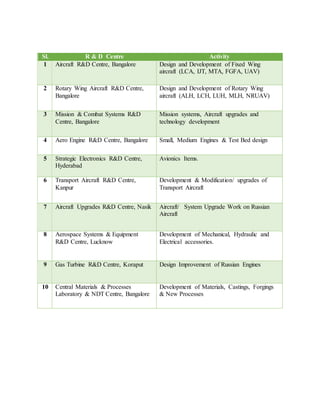
Sl. R & D Centre Activity
1 Aircraft R&D Centre, Bangalore Design and Development of Fixed Wing
aircraft (LCA, IJT, MTA, FGFA, UAV)
2 Rotary Wing Aircraft R&D Centre,
Bangalore
Design and Development of Rotary Wing
aircraft (ALH, LCH, LUH, MLH, NRUAV)
3 Mission & Combat Systems R&D
Centre, Bangalore
Mission systems, Aircraft upgrades and
technology development
4 Aero Engine R&D Centre, Bangalore Small, Medium Engines & Test Bed design
5 Strategic Electronics R&D Centre,
Hyderabad
Avionics Items.
6 Transport Aircraft R&D Centre,
Kanpur
Development & Modification/ upgrades of
Transport Aircraft
7 Aircraft Upgrades R&D Centre, Nasik Aircraft/ System Upgrade Work on Russian
Aircraft
8 Aerospace Systems & Equipment
R&D Centre, Lucknow
Development of Mechanical, Hydraulic and
Electrical accessories.
9 Gas Turbine R&D Centre, Koraput Design Improvement of Russian Engines
10 Central Materials & Processes
Laboratory & NDT Centre, Bangalore
Development of Materials, Castings, Forgings
& New Processes
HAL IN INDIA
HAL Bangalore is the corporate office. In 1940 it was established name as AMD
(Aircraft Maintenance Department / Aircraft Manufacturing Department) by Hirachand
Walchand. In 1964, named changed as AIL (Aeronautics Hindustan Limited) and then in
1968 again name changes to HAL (HINDUSTAN AERONAUTICS LIMITED). It has 8
sub division
1. Aircraft division
2. Engine division
3. Overhaul division
4. Aerospace division
5. Helicopter division
6. Aircraft system and testing division
7. Industrial and Marine Gas turbine division
8. Foundry & Forge division
HAL Nasik is MIG complex
HAL Korwa is Instrument division
HAL Lucknow is accessories division
HAL Koraput is engine overhaul division
HAL Kanpur is Transport Aircraft Division
I. Manufacturing and Maintenance unit
 HAL Bangalore
 HAL Nasik
 HAL Koraput
 HAL Kanpur
 HAL Lucknow
 HAL Hyderabad
 HAL Korwa
II. Design centers
 Bangalore
 Hyderabad
 Nasik
 kanpur
III. Liaison offices
 Mumbai
 Delhi
 Chennai
 Visakapatnam
 London
 Moscow
HAL PRODUCT
AIRCRAFT DESIGN AND DEVEOPED BY HAL
HT-2 - Piston engine trainer
Pushpak - light aircraft for flying clubs
Krishak - air observation post
Marut (HF-24) - ground attack jet fighter
Marut trainer - operational trainer
Kiran MK I, MK IA and MK II - basic jet trainer
BASANT - agriculture aircraft
AJEET - light fighter
HPT- 32 - piston engine trainer
HTT-34 - turboprop variant
Aircraft produce under license at HAL:
Percival Prentice - trainer
Vampire - fighter, bomber
Gnat - interceptor
MIG-21 c FL - interceptor
MIG-21 bis - ground attack
Jaguar - multi-role fighter
MIG-27 - ground attack
AVRO (HS-748) - medium transport
DORNIER (DO-228) - light transport
CHETAK - utility helicopter
CHEETAH - R&O/ light logistic helicopter
HAL-TAD, KANPUR
Transport Aircraft Division (TAD) of HAL was set up in 1960 to manufacture the HS-748,
a medium haul turbo-prop passenger transport aircraft. Over the year, it has vastly
developed its infrastructure and capability and undertaken the manufacture of variety of
aircraft and structural assemblies and component for both domestic and international
market. The total number of aircraft delivered are as follows:
S.No. PRODUCT PERIOD QUANTITY
1
2
3
4
5
6
HS-748 aircraft
Glider
Basant aircraft (HA-31)
HPT-32 aircraft
ATP Tail-plane
Dornier-228 aircraft
1960-83
1963-86
1975-78
1983-98
1987-95
1985 onwards
89
164
19
142
24
125
Along with the manufacturing activities TAD has developed extensive facilities for repair,
overhaul and modification of these aircraft as well as for about 400 types of retables
fitting on these aircraft.
Apart from the above, division is doing Depot Level Maintenance of engines and
hydraulic system of unmanned air vehicles (UAV), Searcher-I, Searcher-II and Heron
since JAN’2004 under transfer of technology Agreement with Malat division of Israel.
Aircraft Industries and Servicing of AN-32 & Canberra aircraft at its detachment
workplace at Agra from 200 onward.
Research and Development (R&D) center located in this division carried out product
updation, role modification and other R&D activities. Over the year it has vastly
developed its capabilities and is today considered a pioneer in the field of manufacture
and overhaul of transport category aircraft in the country. The plant accommodates
73500 sq. meters and the total strength of kanpur division employees are 2200.
In HAL kanpur division, following are the facilities are available:
Machining Facility:
5 axes 3 spindle heavy-duty Gantry type CNC profiler, 3 axes CNC milling machine,
vertical machining center, horizontal machining center, Turning, Milling, grinding,
Thread Rolling, Honing etc.
Composites/Plastics:
1. Hot air autoclave
2. Vacuum forming
3. Deep drawing machine
Sheet metal, welding and surface treatment:
1. Rubber press, break press, pipe bending machine, routers, horizontal stretching
machine.
2. Gas, Argon and Spot Welding
3. Anodising, Chrome plating, copper plating Electro chemical milling, control
temperature paintings
Assembly and Paint Hangar:
1. Large and spacious hangars for assembly, overhaul, repair and maintenance of
transport aircraft
2. Exclusive paint hangar with dust free and controlled environment
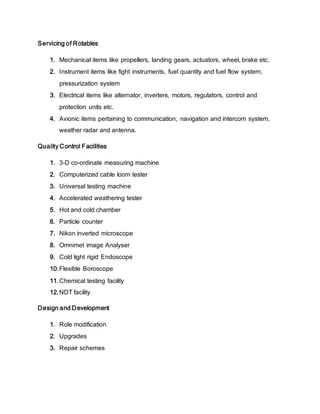
Servicing of Rotables
1. Mechanical items like propellers, landing gears, actuators, wheel, brake etc.
2. Instrument items like fight instruments, fuel quantity and fuel flow system,
pressurization system
3. Electrical items like alternator, inverters, motors, regulators, control and
protection units etc.
4. Avionic items pertaining to communication, navigation and intercom system,
weather radar and antenna.
Quality Control Facilities
1. 3-D co-ordinate measuring machine
2. Computerized cable loom tester
3. Universal testing machine
4. Accelerated weathering tester
5. Hot and cold chamber
6. Particle counter
7. Nikon inverted microscope
8. Omnimet image Analyser
9. Cold light rigid Endoscope
10.Flexible Boroscope
11.Chemical testing facility
12.NDT facility
Design and Development
1. Role modification
2. Upgrades
3. Repair schemes
Services
Upgradation of aircraft and role equipment integration
The transport aircraft R&D center is involved in carrying out aircraft upgrade,
modification and role equipment integration. Our major projects in the past include:
1. Mid-life upgrade of HS-748 Navigation & communication system
2. Integration machine wing fuel tank of HPT-32 aircraft replacing rubber flexible fuel
tank
3. Integration of TCAS, MOD’S’, EGPWS on Boeing, HS-748, Do-228 and AN-32
aircraft
4. Integration of maritime radar Elta and Supermarec radar on DO-228 aircraft.
5. Integration of search light pod, gun pod and IR/UV scanner on DO-228 aircraft
6. Modification on DO-228 aircraft for high altitude operation & para dropping/ para
jumping
Aircraft overhaul, repair and modification
 Extensive facilities and expertise are available for the overhaul, repair,
maintenance and modification of
i. HS-748 medium capacity aircraft
ii. DO-228 light transport aircraft
iii. HPT-32 basic trainer aircraft
iv. Servicing of AN-32
v. Servicing of Canberra aircraft
vi. Depot level maintenance of Un-manned Air Vehicles (UAV-
Searcher-I, Searcher-II and Heron)
 Services offered include major overhauls, scheduled and unscheduled
maintenance, repairs, embodiment of SB's, cabin refurbishing etc.
 Runway adjacent hangars
 Full range of facilities for quality control, inspection and testing
 Site repair and retrieval of damaged aircraft
Aircraft Painting
 Exclusive Paint hangar with dust-free and controlled environment can
accommodate aircraft up to 50 seater capacity. Expertise is available for various
types of aircraft painting systems like Poly-urethane, Epoxy, Cellulose, etc.
 Full range of facilities for testing of paint, paint thickness measurement
Rotables Overhaul And Repair
 Extensive facilities for over 400 types of Rotables of different aircraft including
HS-748, DO -228, HPT-32 and other medium category aircraft
 Rich experience of overhauling more than 50,000 Rotables in the past
 Competent and qualified workforce to meet the exacting requirement of the
Aviation industry
 Shops built to clean room specifications and equipped with the complete range of
Test Equipment
Range of rotables which can be overhauled and repaired include the following
 Mechanical items like propellers, landing gears, actuators, wheel-brake
assembly, hydraulics, fuel and de-icing systems and accessories
 Instrument items like flight instruments, fuel quantity and fuel flow system,
pressurisation system instruments, Autopilot and all types of pressure switches
and gauges
 Electrical items like alternators, invertors, motors, regulators, control and
protection units, booster pumps, actuators, fans, batteries and voltage regulators
 Avionic items pertaining to communication, navigation, and intercom systems,
weather radar and antenna
Future Plans
 Series production of 73 Intermediate Jet Trainer aircraft (HJT-36 “SITARA”) for
Indian Air Force against agreement signed in March, 2010. Production started.
Delivery is scheduled to be commenced from March, 2013.
 Production of Turbo Prop Trainer aircraft (HTT-40) as a replacement plan of
HPT-32-Deepak, aircraft supplied to Indian Air Force. Project is presently at
Design phase.
 Series production of 100 seater Multi Role Transport aircraft will be taken up by
TAD Kanpur. The aircraft is under co-design and development at HAL's Aircraft
Research and Design Centre, Bangalore in association with Russian partners.
 Production of 14 seater Saras aircraft.
AIRCRAFT MANUFACTURE AT HAL-TAD, KANPUR
 DORNIER DO-228
The 19 seater HAL - DO - 228 aircraft is a highly versatile multi-purpose light transport
aircraft. It has been developed specifically to meet the manifold requirements of utility
and commuter transport, third level services and air-taxi operations, coast guard duties
and maritime surveillance.
The Dornier Do 228 is a twin-turboprop STOL utility aircraft, manufactured by Dornier
GmbH (later DASA Dornier, Fairchild-Dornier) from 1981 until 1998. In 1983, Hindustan
Aeronautics (HAL) bought a production licence and manufactured 125 aircraft for the
Asian market sphere.
SPECIFICATION
S.No. Dimension
1 Normal seating capacity 15/19
2 Wing span 16.97 m
3 Overall length 15.04/16.56 m
4 Overall height 4.86 m
5 Propeller diameter 2.69 m
6 Propeller clearance 1.08 m
7 Cabin length 6.30/ 7.08 m
8 Cabin width 1.35 m
9 Cabin height 1.55 m
10 Passenger door 1.34x0.64 m
11 Cargo door 1.34x1.60 m
12 Take-off distance 655 m
13 Accelerated stop distance 762 m
14 Landing distance 536 m
15 Engine model GARRET TPE 331-5-252D
16 Take-off power 2x715 SHP; flat rated to ISA+18°C
17 Fuel capacity 2850 lit (2250 kg)
18 Fuel consumption 213 kg/hr (max range cruse 1000ft)
19 Max landing weight 6100 kg
20 Max zero fuel weight 5590 kg
21 Max payload 1903 kg
22 Rate of climb 97 m/sec
23 Max cruse speed 428 km/hrs
24 Max range 333 km/hr
25 Max take-off weight 6400 kg
Avionic instrument in DO-228
1. MSS-500 (maritime surveillance system)
2. Maritime situational awareness utilizing SATCOM and AIS
i. AIS INFO contain a number of parameter
(a) Ship ID
(b) Speed over ground
(c) True heading
(d) Rate of turn
(e) Destination ETA
(f) Position
(g) Course over ground
(h) Navigation system
ii. IAF DO-228 avionic upgrade
(a) RAM indicator
(b) EGPWS ASSY
(c) GPS ANNUNCIATOR
(d) AHRS CCU
(e) WXR INDICATOR
(f) TCAS VSI
(g) FDR LAMP
(h) EHSI
3. Glass cockpit
4. Four 8x6 inch LCD display
5. ISIS (integrated standby instrument system)
6. FMS (flight management system) coupled with autopilot
7. Engine indication and crew alerting system
8. EGPWS
9. TCAS-II
10. AHRS
11. DADC
ROLE
 Maritime Surveillance
 Pollution Prevention
 Troop Transport
 Aerial Survey
 Search and Rescue
 Commuter Transport
 Calibration of airport NAV-COM Aids
 Remote Sensing Applications
 Causality Evacuation
 Executive Transport
 Cargo & Logistics Support
 IJT
i. HJT-36 “SITARA”)
The Intermediate Jet Trainer (IJT) christened as HJT-36 is indigenously designed and
developed by HAL to replace ageing fleet of KIRAN Jet Trainer aircraft in service with Indian Air
Force for Stage II training of its pilots. IJT will be fitted with AL-55i Jet engines produced in
house at Engine Division Koraput. IJT incorporates the simplicity necessary for ease of
conversion from Basic Piston Trainer and the sophistication required for quick conversion to the
complexities of an Advanced Jet Trainer.
Specification of HPT-36
S.No. Dimension
1. Crew 2
2. Wing span 10.0 m
3. Length 11 m
4. Height 4.40 m
5. Empty weight 4250 kg
6. Max. take-off weight 5400 kg
7. Max. usable fuel(without drop tank) 900 kg
8. Max. usable fuel (with drop tank) 1370 kg
9. Fuselage length 11.00 m
10. Max. width (without intake) 1.00 m
11. Max. height 1.82 m
12. Turbo fan with thrust >17 kN at SLS,ISA
13. Bypass ratio ~0.55
14. SFC <0.72 kg/hr
15. Max rate of climb >1500 m/min
16. Max permitted load factors +7.0/-2.5 g
17. Stall speed <185 km/h
18. Take-off distance <500 m
19. Landing roll <500 m
20. Max speed/ Mach no. 750 kmph / 0.75
Roles
 Pilot Training
 General flying
 Navigation formation flying
 Instrument & cloud flying
 Basic air to ground & air to air weapon aiming
 Tactical flying
 Night flying
ii. HPT-32 “Deepak”
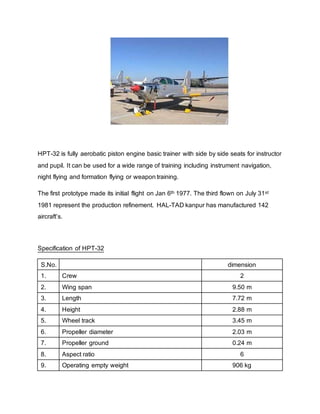
HPT-32 is fully aerobatic piston engine basic trainer with side by side seats for instructor
and pupil. It can be used for a wide range of training including instrument navigation,
night flying and formation flying or weapon training.
The first prototype made its initial flight on Jan 6th 1977. The third flown on July 31st
1981 represent the production refinement. HAL-TAD kanpur has manufactured 142
aircraft’s.
Specification of HPT-32
S.No. dimension
1. Crew 2
2. Wing span 9.50 m
3. Length 7.72 m
4. Height 2.88 m
5. Wheel track 3.45 m
6. Propeller diameter 2.03 m
7. Propeller ground 0.24 m
8. Aspect ratio 6
9. Operating empty weight 906 kg
10. Crew weight(including parachutes) 174 kg
11. Fuel (max. useable with integral function) 172 kg
12. Fuel (max. useable with flexible) 151 kg
13. Max. take-off weight 1270 kg
14. Max landing weight 1270 kg
15. Max speed at S.L. 264 km/h
16. Stall speed (clean) 115 km/h
18. Stall speed (with flap) 110 km/h
19. Take-off distance 450 m
20. Landing distance 512 m
Role: Offering a wide range of operational flexibility, at the minimum cost, the aircraft
caters to variety type of role including:
1. Ab-intio training
2. Instrument flying
3. Night flying
4. Formation flying
5. Observation
6. Liaison
7. Sport flying
Aircraft overhauling at HAL-TAD, Kanpur
HS-748 (AVRO)
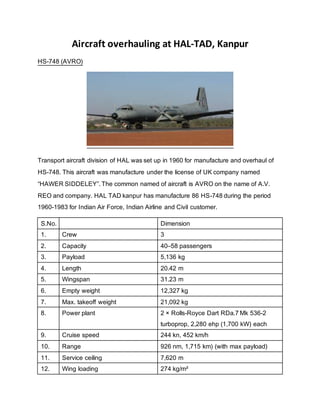
Transport aircraft division of HAL was set up in 1960 for manufacture and overhaul of
HS-748. This aircraft was manufacture under the license of UK company named
“HAWER SIDDELEY”. The common named of aircraft is AVRO on the name of A.V.
REO and company. HAL TAD kanpur has manufacture 86 HS-748 during the period
1960-1983 for Indian Air Force, Indian Airline and Civil customer.
S.No. Dimension
1. Crew 3
2. Capacity 40–58 passengers
3. Payload 5,136 kg
4. Length 20.42 m
5. Wingspan 31.23 m
6. Empty weight 12,327 kg
7. Max. takeoff weight 21,092 kg
8. Power plant 2 × Rolls-Royce Dart RDa.7 Mk 536-2
turboprop, 2,280 ehp (1,700 kW) each
9. Cruise speed 244 kn, 452 km/h
10. Range 926 nm, 1,715 km) (with max payload)
11. Service ceiling 7,620 m
12. Wing loading 274 kg/m²
13. Power/mass 0.161 kW/kg
14. Height 7.57 m
15. Wing area 77 m²
16. Incidence angle 3o
17 Dihedral angle 7o
18 Wheel base 20’1”
19. Main wheel tyre pressure 65/85 psi
20. Nose wheel tyre pressure 55 psi
21. Jet thrust 485 lbs
22. Water methanol capacity 2*30 imp. Gal
23. Fuel capacity 2*570 imp. Gal
Work task In HS-748
Basically three task take place for HS-748
(A) OVERHAULING
In this process the firstly overview of snags sent by customer is taken into account and
afterward new list is prepared by HAL’s investigators
(B) SERVICING
In HAL-TAD Kanpur, 3rd level of servicing of AVRO is carried out. 3rd level service refer
to the completion of 1500 hrs/ 4 year (which ever first).
(C)GROUND RUN
In this checking engine power, electrical and avionic system are checked under ground
running condition.
(D)Test flight
The C.T.P. (Chief test pilot) of the division checks the aircraft in air as a flying trail.
Aircraft Design Process
The aircraft design process is an engineering design process by which aircraft are
designed. These depend on many factors such as customer and manufacturer demand,
safety protocols, physical and economic constraints etc. For some types of aircraft the
design process is regulated by national airworthiness authorities.
Aircraft design is a compromise between many competing factors and constraints and
accounts for existing designs and market requirements to produce the best aircraft.
Design constraints:
(a) Purpose: The design process starts with the aircraft's intended purpose.
Commercial airliners are designed for carrying a passenger or cargo payload, long
range and greater fuel efficiency whereas fighter jets are designed to perform high
speed maneuvers and provide close support to ground troops. Some aircraft have
specific missions, for instance, amphibious airplanes have a unique design that allows
them to operate from both land and water, some fighters, like the Harrier Jump Jet,
have VTOL (Vertical Take-off and Landing) ability, helicopters have the ability to hover
over an area for a period of time. The purpose may be to fit a specific requirement, e.g.
as in the historical case of a British Air Ministry specification, or fill a perceived "gap in
the market"; that is, a class or design of aircraft which does not yet exist, but for which
there would be significant demand.
(b) Aircraft regulations: Another important factor that influences the design of the
aircraft are the regulations put forth by national aviation airworthiness authorities.
Airports may also impose limits on aircraft, for instance, the maximum wingspan allowed
for a conventional aircraft is 80 m to prevent collisions between aircraft while taxiing.
(c) Environmental factors: An increase in the number of aircraft also means greater
carbon emissions. Environmental scientists have voiced concern over the main kinds of
pollution associated with aircraft, mainly noise and emissions. Aircraft engines have
been historically notorious for creating noise pollution and the expansion of airways over
already congested and polluted cities have drawn heavy criticism, making it necessary
to have environmental policies for aircraft noise. Environmental limitations also affect
airfield compatibility. Airports around the world have been built to suit the topography of
the particular region. Space limitations, pavement design, runway end safety areas and
the unique location of airport are some of the airport factors that influence aircraft
design.
Design aspects:
The main aspects of aircraft design are:
1. Aerodynamics
2. Propulsion
3. Controls
4. Mass
5. Structure
All aircraft designs involve compromises of these factors to achieve the design mission.
Wing design:
Fuselage:
Propulsion: The main parameters of engine design are:
 Maximum engine thrust available
 Fuel consumption
 Engine mass
 Engine geometry
The thrust provided by the engine must balance the drag at cruise speed and be greater
than the drag to allow acceleration. The engine requirement varies with the type of
aircraft. For instance, commercial airliners spend more time in cruise speed and need
more engine efficiency. High-performance fighter jets need very high acceleration and
therefore have very high thrust requirements.
Weight:
Structure:
Design process and simulation
1. Conceptual Design
The first design step, involves sketching a variety of possible aircraft configurations that
meet the required design specifications. By drawing a set of configurations, designers
seek to reach the design configuration that satisfactorily meets all requirements as well
as go hand in hand with factors such as aerodynamics, propulsion, flight performance,
structural and control systems. This is called design optimization. Fundamental aspects
such as fuselage shape, wing configuration and location, engine size and type are all
determined at this stage. Constraints to design like those mentioned above are all taken
into account at this stage as well. The final product is a conceptual layout of the aircraft
configuration on paper or computer screen, to be reviewed by engineers and other
designers.
2. Preliminary design phase
The design configuration arrived at in the conceptual design phase is then tweaked and
remodeled to fit into the design parameters. In this phase, wind tunnel testing and
computational fluid dynamic calculations of the flow field around the aircraft are done.
Major structural and control analysis is also carried out in this phase. Aerodynamic flaws
and structural instabilities if any are corrected and the final design is drawn and
finalized. Then after the finalization of the design lies the key decision with the
manufacturer or individual designing it whether to actually go ahead with the production
of the aircraft. At this point several designs, though perfectly capable of flight and
performance, might have been opted out of production due to their being economically
nonviable.
3. Detail design phase
This phase simply deals with the fabrication aspect of the aircraft to be manufactured. It
determines the number, design and location of ribs, spars, sections and other structural
elements. All aerodynamic, structural, propulsion, control and performance aspects
have already been covered in the preliminary design phase and only the manufacturing
remains. Flight simulators for aircraft are also developed at this stage.
Conclusion
Hindustan Aeronautical Limited is a leading aerospace company of India engaged in
design, manufacture & overhaul of a variety of aviation products from basic air trainer
aircraft to highly sophisticated fighter, bomber, helicopters, transport A/C, power plant.
Since its inception in 1940, the company has grown into a giant aviation complex
spread all over India and employing a versatile work force of trained, highly skilled &
experienced persons. It enjoy a monopoly in India.
Recently a light combat aircraft (LCA) has been developed in the country with the
cooperation of various agencies. It is double that of MIG-21. With the advancement of
new technology & highly skilled scientists. A time will come when India too will have
stood in the world market of aircraft.
I hope it will show it’s ability for new technology in world level. It’s contribution in
defense is incredible.
Reference
www.hal-india.com
www.wikipedia.org

REPORT ON IN-PLANT TRAINING AT HAL KANPUR

  • 1.
    Submitted to Technical TrainingInstitute HAL-TAD, Kanpur In partial fulfillment of the requirements For BATCHELOR OF TECHNOLOGY IN AERONAUTICAL ENGINEERING Training period: 1st july – 20th july 2015
  • 2.
    CERTIFICATE This is tocertify that Mr. ……………………. student of ………………………………. pursuing B.Tech in Aeronautical Engineering, has completed his vocational training successfully in HINDUSTAN AERONAUTICAL LIMITED, Transport Aircraft Division, Kanpur during the period from 1st july to 20th july 2015. DATE: 20TH JULY 2015 PLACE: KANPUR Chief Manager (Training) H.R. officer (Training) Technical Training Institute Technical Training Institute HAL-TAD, KANPUR HAL-TAD, KANPUR
  • 3.
    Acknowledgement I take theopportunity to express our gratitude to all concerned people whole have directly or in directly contributed toward completion of this project. I am very thankful to chief Manager (TRAINING), HAL-TAD Kanpur, for arranging the training in efficient way and give me the opportunity to enhance the knowledge and skills. I express my gratitude towards (Dy. Manager-design), (manager-design) for his valuable guidance throughout the training period. SIGNATURE SIGNATURE (MANAGER-DESIGN) (Dy. Manager-DESIGN)
  • 4.
    CONTENT S.No. Topic Page 1History of HAL 2 HAL IN INDIA 3 HAL PRODUCT 4 HAL-TAD, Kanpur 5 AIRCRAFT MANUFACTURE AT HAL-TAD, KANPUR 6 Aircraft overhauling at HAL-TAD, Kanpur 7 Aircraft Design Process Conclusion Reference
  • 5.
    HISTORY OF HAL HINDUSTANAERONAUTICS LIMITED (HAL) came into existence on 1st October 1964. The company traces its roots to the pioneering effort of an industrialist with extraordinary vision, the late Sath Walchand Hirachand, who set up Hindustan Aircraft Limited at Bangalore in association with the government of Mysore in 23 December 1940. The Government of India became one of the shareholder in the company holding 1/3 of its paid-up capital in March 1941 and took over the management in 1942. In Dec 1945, the company was placed under the administrative control of Min. of Industry & Supply. In January 1951, Hindustan Aircraft Private Limited was placed under the Administrative control of Ministry Of Defence. The Company had built aircraft and engines of foreign design under licence, such as Prentice, Vampire and Gnat aircraft. In August 1951, the HT-2 Trainer aircraft, designed and produced by the company under the able leadership of Dr. V.M.Ghatge flew for the first time. Nearly 200 Trainers were manufactured and supplied to the Indian Air Force and other customers. With the gradual building up of its design capability, the company successfully designed and developed four other aircraft i.e.  Two seater Pushpak suitable for flying clubs  Krishak for Air Observatory Post (AOP) role  HF-24 Jet Fighter (Marut) and  HJT-16 Basic Jet Trainer (Kiran) Meanwhile, in August 1963, Aeronautics India Limited (AIL) was incorporated as a Company wholly owned by the Government of India to undertake the manufacture of the MiG-21 aircraft under licence. In June 1964, the Aircraft Manufacturing Depot which was set up in 1960 as an Air Force unit to produce the Airframe for the HS-748 transport aircraft was transferred to AIL. Soon thereafter, the Government decided to
  • 6.
    amalgamate Hindustan AircraftLimited, with AIL so as to conserve resources in the field of aviation where the technical talent in the country was limited and to enable the activities of all the aircraft manufacturing units to be planned and co-ordinated in the most efficient and economical manner. Amalgamation of the two companies i.e. Hindustan Aircraft Limited and Aeronautics India Limited was brought about on 1st Oct 1964 by an Amalgamation order issued by the Government of India and the Company after the amalgamation was named as "Hindustan Aeronautics Limited (HAL)" with its principal business being design, development, manufacture, repair and overhaul of aircraft, helicopter, engines and related systems like avionics, instruments and accessories. Today, HAL has 19 production unit and 9 Research and Design center in 7 location of India. The company has an impressive product track record 12 type of aircraft manufactured with in-house R&D and 14 types produced under license. HAL has manufactured over 3550 aircraft 3600 engines and overhauled over 8150 aircraft and 27300 engines. HAL has been successful in numerous R&D program developed for both Defense and Civil Aviation sector. HAL has made substantial progress in its current project. - DHRUV, which is advance light helicopter (ALH) - TEJAS, light combat aircraft (LCA) - IJT, Intermediate Jet Trainer HAL has played a significant role for India’s space program by participating in the manufacture of structures for Satellite Launch Vehicles like - PSLV - GSLV - IRS - INSAT
  • 7.
    HAL has formedthe following joint venture (JVs) - IRAL (Indo-Russian Aviation Limited) - Sneema HAL aerospace Pvt. Ltd. - BAEHAL software limited - SAMTEL HAL Display System Limited - HALBIT Avionics Pvt. Ltd. - INFOTECH HAL Ltd. Apart from these seven, other major diversification project are Industrial Marine Gas Turbine and airport services. Several Co – production and joint ventures with international participation are under consideration. HAL’s supplies/ services are mainly to Indian Defense Services, Coast Guards and BSF (Border Security Force). Transport Aircraft and Helicopters have also been supplied to airlines as well as State Government of India. The company has also achieved a foothold in export in more than 30 countries, having demonstrated its quality and price competitiveness. HAL has won several International & National Awards for achievement in R&D, technology, managerial performance, Export, Energy conservation, Quality and Fulfillment of Social Responsibilities. HAL was awarded the “INTERNATIONAL GOLD MEDAL AWARD” for Corporate Achievement in Quality and Efficiency at the International Summit (Global Rating Leaders 2003), London, UK by M/s Global Rating, UK in conjunction with the International Information and Marketing Centre (IIMC).HAL was present the International – “ARCH OF EUROPE” Award in Gold category in recognition for its commitment to quality, leadership, technology and innovation. At the national level, HAL won the “GOLD TROPHY” for the excellence in public sector management, institute by the standing conference of public Enterprises (SCOPE) The company scaled new height in the financial year 2006-07 with a turnover of Rs 7783.61 crores
  • 8.
    Sl. R &D Centre Activity 1 Aircraft R&D Centre, Bangalore Design and Development of Fixed Wing aircraft (LCA, IJT, MTA, FGFA, UAV) 2 Rotary Wing Aircraft R&D Centre, Bangalore Design and Development of Rotary Wing aircraft (ALH, LCH, LUH, MLH, NRUAV) 3 Mission & Combat Systems R&D Centre, Bangalore Mission systems, Aircraft upgrades and technology development 4 Aero Engine R&D Centre, Bangalore Small, Medium Engines & Test Bed design 5 Strategic Electronics R&D Centre, Hyderabad Avionics Items. 6 Transport Aircraft R&D Centre, Kanpur Development & Modification/ upgrades of Transport Aircraft 7 Aircraft Upgrades R&D Centre, Nasik Aircraft/ System Upgrade Work on Russian Aircraft 8 Aerospace Systems & Equipment R&D Centre, Lucknow Development of Mechanical, Hydraulic and Electrical accessories. 9 Gas Turbine R&D Centre, Koraput Design Improvement of Russian Engines 10 Central Materials & Processes Laboratory & NDT Centre, Bangalore Development of Materials, Castings, Forgings & New Processes
  • 9.
    HAL IN INDIA HALBangalore is the corporate office. In 1940 it was established name as AMD (Aircraft Maintenance Department / Aircraft Manufacturing Department) by Hirachand Walchand. In 1964, named changed as AIL (Aeronautics Hindustan Limited) and then in 1968 again name changes to HAL (HINDUSTAN AERONAUTICS LIMITED). It has 8 sub division 1. Aircraft division 2. Engine division 3. Overhaul division 4. Aerospace division 5. Helicopter division 6. Aircraft system and testing division 7. Industrial and Marine Gas turbine division 8. Foundry & Forge division HAL Nasik is MIG complex HAL Korwa is Instrument division HAL Lucknow is accessories division HAL Koraput is engine overhaul division HAL Kanpur is Transport Aircraft Division
  • 10.
    I. Manufacturing andMaintenance unit  HAL Bangalore  HAL Nasik  HAL Koraput  HAL Kanpur  HAL Lucknow  HAL Hyderabad  HAL Korwa II. Design centers  Bangalore  Hyderabad  Nasik  kanpur III. Liaison offices  Mumbai  Delhi  Chennai  Visakapatnam  London  Moscow
  • 11.
    HAL PRODUCT AIRCRAFT DESIGNAND DEVEOPED BY HAL HT-2 - Piston engine trainer Pushpak - light aircraft for flying clubs Krishak - air observation post Marut (HF-24) - ground attack jet fighter Marut trainer - operational trainer Kiran MK I, MK IA and MK II - basic jet trainer BASANT - agriculture aircraft AJEET - light fighter HPT- 32 - piston engine trainer HTT-34 - turboprop variant Aircraft produce under license at HAL: Percival Prentice - trainer Vampire - fighter, bomber Gnat - interceptor MIG-21 c FL - interceptor MIG-21 bis - ground attack Jaguar - multi-role fighter MIG-27 - ground attack AVRO (HS-748) - medium transport DORNIER (DO-228) - light transport CHETAK - utility helicopter CHEETAH - R&O/ light logistic helicopter
  • 12.
    HAL-TAD, KANPUR Transport AircraftDivision (TAD) of HAL was set up in 1960 to manufacture the HS-748, a medium haul turbo-prop passenger transport aircraft. Over the year, it has vastly developed its infrastructure and capability and undertaken the manufacture of variety of aircraft and structural assemblies and component for both domestic and international market. The total number of aircraft delivered are as follows: S.No. PRODUCT PERIOD QUANTITY 1 2 3 4 5 6 HS-748 aircraft Glider Basant aircraft (HA-31) HPT-32 aircraft ATP Tail-plane Dornier-228 aircraft 1960-83 1963-86 1975-78 1983-98 1987-95 1985 onwards 89 164 19 142 24 125 Along with the manufacturing activities TAD has developed extensive facilities for repair, overhaul and modification of these aircraft as well as for about 400 types of retables fitting on these aircraft. Apart from the above, division is doing Depot Level Maintenance of engines and hydraulic system of unmanned air vehicles (UAV), Searcher-I, Searcher-II and Heron since JAN’2004 under transfer of technology Agreement with Malat division of Israel. Aircraft Industries and Servicing of AN-32 & Canberra aircraft at its detachment workplace at Agra from 200 onward. Research and Development (R&D) center located in this division carried out product updation, role modification and other R&D activities. Over the year it has vastly developed its capabilities and is today considered a pioneer in the field of manufacture
  • 13.
    and overhaul oftransport category aircraft in the country. The plant accommodates 73500 sq. meters and the total strength of kanpur division employees are 2200. In HAL kanpur division, following are the facilities are available: Machining Facility: 5 axes 3 spindle heavy-duty Gantry type CNC profiler, 3 axes CNC milling machine, vertical machining center, horizontal machining center, Turning, Milling, grinding, Thread Rolling, Honing etc. Composites/Plastics: 1. Hot air autoclave 2. Vacuum forming 3. Deep drawing machine Sheet metal, welding and surface treatment: 1. Rubber press, break press, pipe bending machine, routers, horizontal stretching machine. 2. Gas, Argon and Spot Welding 3. Anodising, Chrome plating, copper plating Electro chemical milling, control temperature paintings Assembly and Paint Hangar: 1. Large and spacious hangars for assembly, overhaul, repair and maintenance of transport aircraft 2. Exclusive paint hangar with dust free and controlled environment
  • 14.
    Servicing of Rotables 1.Mechanical items like propellers, landing gears, actuators, wheel, brake etc. 2. Instrument items like fight instruments, fuel quantity and fuel flow system, pressurization system 3. Electrical items like alternator, inverters, motors, regulators, control and protection units etc. 4. Avionic items pertaining to communication, navigation and intercom system, weather radar and antenna. Quality Control Facilities 1. 3-D co-ordinate measuring machine 2. Computerized cable loom tester 3. Universal testing machine 4. Accelerated weathering tester 5. Hot and cold chamber 6. Particle counter 7. Nikon inverted microscope 8. Omnimet image Analyser 9. Cold light rigid Endoscope 10.Flexible Boroscope 11.Chemical testing facility 12.NDT facility Design and Development 1. Role modification 2. Upgrades 3. Repair schemes
  • 15.
    Services Upgradation of aircraftand role equipment integration The transport aircraft R&D center is involved in carrying out aircraft upgrade, modification and role equipment integration. Our major projects in the past include: 1. Mid-life upgrade of HS-748 Navigation & communication system 2. Integration machine wing fuel tank of HPT-32 aircraft replacing rubber flexible fuel tank 3. Integration of TCAS, MOD’S’, EGPWS on Boeing, HS-748, Do-228 and AN-32 aircraft 4. Integration of maritime radar Elta and Supermarec radar on DO-228 aircraft. 5. Integration of search light pod, gun pod and IR/UV scanner on DO-228 aircraft 6. Modification on DO-228 aircraft for high altitude operation & para dropping/ para jumping Aircraft overhaul, repair and modification  Extensive facilities and expertise are available for the overhaul, repair, maintenance and modification of i. HS-748 medium capacity aircraft ii. DO-228 light transport aircraft iii. HPT-32 basic trainer aircraft iv. Servicing of AN-32 v. Servicing of Canberra aircraft vi. Depot level maintenance of Un-manned Air Vehicles (UAV- Searcher-I, Searcher-II and Heron)  Services offered include major overhauls, scheduled and unscheduled maintenance, repairs, embodiment of SB's, cabin refurbishing etc.  Runway adjacent hangars  Full range of facilities for quality control, inspection and testing
  • 16.
     Site repairand retrieval of damaged aircraft Aircraft Painting  Exclusive Paint hangar with dust-free and controlled environment can accommodate aircraft up to 50 seater capacity. Expertise is available for various types of aircraft painting systems like Poly-urethane, Epoxy, Cellulose, etc.  Full range of facilities for testing of paint, paint thickness measurement Rotables Overhaul And Repair  Extensive facilities for over 400 types of Rotables of different aircraft including HS-748, DO -228, HPT-32 and other medium category aircraft  Rich experience of overhauling more than 50,000 Rotables in the past  Competent and qualified workforce to meet the exacting requirement of the Aviation industry  Shops built to clean room specifications and equipped with the complete range of Test Equipment Range of rotables which can be overhauled and repaired include the following  Mechanical items like propellers, landing gears, actuators, wheel-brake assembly, hydraulics, fuel and de-icing systems and accessories  Instrument items like flight instruments, fuel quantity and fuel flow system, pressurisation system instruments, Autopilot and all types of pressure switches and gauges  Electrical items like alternators, invertors, motors, regulators, control and protection units, booster pumps, actuators, fans, batteries and voltage regulators  Avionic items pertaining to communication, navigation, and intercom systems, weather radar and antenna
  • 17.
    Future Plans  Seriesproduction of 73 Intermediate Jet Trainer aircraft (HJT-36 “SITARA”) for Indian Air Force against agreement signed in March, 2010. Production started. Delivery is scheduled to be commenced from March, 2013.  Production of Turbo Prop Trainer aircraft (HTT-40) as a replacement plan of HPT-32-Deepak, aircraft supplied to Indian Air Force. Project is presently at Design phase.  Series production of 100 seater Multi Role Transport aircraft will be taken up by TAD Kanpur. The aircraft is under co-design and development at HAL's Aircraft Research and Design Centre, Bangalore in association with Russian partners.  Production of 14 seater Saras aircraft.
  • 18.
    AIRCRAFT MANUFACTURE ATHAL-TAD, KANPUR  DORNIER DO-228 The 19 seater HAL - DO - 228 aircraft is a highly versatile multi-purpose light transport aircraft. It has been developed specifically to meet the manifold requirements of utility and commuter transport, third level services and air-taxi operations, coast guard duties and maritime surveillance. The Dornier Do 228 is a twin-turboprop STOL utility aircraft, manufactured by Dornier GmbH (later DASA Dornier, Fairchild-Dornier) from 1981 until 1998. In 1983, Hindustan Aeronautics (HAL) bought a production licence and manufactured 125 aircraft for the Asian market sphere.
  • 19.
    SPECIFICATION S.No. Dimension 1 Normalseating capacity 15/19 2 Wing span 16.97 m 3 Overall length 15.04/16.56 m 4 Overall height 4.86 m 5 Propeller diameter 2.69 m 6 Propeller clearance 1.08 m 7 Cabin length 6.30/ 7.08 m 8 Cabin width 1.35 m 9 Cabin height 1.55 m 10 Passenger door 1.34x0.64 m 11 Cargo door 1.34x1.60 m 12 Take-off distance 655 m 13 Accelerated stop distance 762 m 14 Landing distance 536 m 15 Engine model GARRET TPE 331-5-252D 16 Take-off power 2x715 SHP; flat rated to ISA+18°C 17 Fuel capacity 2850 lit (2250 kg) 18 Fuel consumption 213 kg/hr (max range cruse 1000ft) 19 Max landing weight 6100 kg 20 Max zero fuel weight 5590 kg
  • 20.
    21 Max payload1903 kg 22 Rate of climb 97 m/sec 23 Max cruse speed 428 km/hrs 24 Max range 333 km/hr 25 Max take-off weight 6400 kg Avionic instrument in DO-228 1. MSS-500 (maritime surveillance system) 2. Maritime situational awareness utilizing SATCOM and AIS i. AIS INFO contain a number of parameter (a) Ship ID (b) Speed over ground (c) True heading (d) Rate of turn (e) Destination ETA (f) Position (g) Course over ground (h) Navigation system ii. IAF DO-228 avionic upgrade (a) RAM indicator (b) EGPWS ASSY (c) GPS ANNUNCIATOR (d) AHRS CCU (e) WXR INDICATOR (f) TCAS VSI (g) FDR LAMP (h) EHSI
  • 21.
    3. Glass cockpit 4.Four 8x6 inch LCD display 5. ISIS (integrated standby instrument system) 6. FMS (flight management system) coupled with autopilot 7. Engine indication and crew alerting system 8. EGPWS 9. TCAS-II 10. AHRS 11. DADC ROLE  Maritime Surveillance  Pollution Prevention  Troop Transport  Aerial Survey  Search and Rescue  Commuter Transport  Calibration of airport NAV-COM Aids  Remote Sensing Applications  Causality Evacuation  Executive Transport  Cargo & Logistics Support
  • 22.
     IJT i. HJT-36“SITARA”) The Intermediate Jet Trainer (IJT) christened as HJT-36 is indigenously designed and developed by HAL to replace ageing fleet of KIRAN Jet Trainer aircraft in service with Indian Air Force for Stage II training of its pilots. IJT will be fitted with AL-55i Jet engines produced in house at Engine Division Koraput. IJT incorporates the simplicity necessary for ease of conversion from Basic Piston Trainer and the sophistication required for quick conversion to the complexities of an Advanced Jet Trainer. Specification of HPT-36 S.No. Dimension 1. Crew 2 2. Wing span 10.0 m 3. Length 11 m 4. Height 4.40 m 5. Empty weight 4250 kg 6. Max. take-off weight 5400 kg 7. Max. usable fuel(without drop tank) 900 kg
  • 23.
    8. Max. usablefuel (with drop tank) 1370 kg 9. Fuselage length 11.00 m 10. Max. width (without intake) 1.00 m 11. Max. height 1.82 m 12. Turbo fan with thrust >17 kN at SLS,ISA 13. Bypass ratio ~0.55 14. SFC <0.72 kg/hr 15. Max rate of climb >1500 m/min 16. Max permitted load factors +7.0/-2.5 g 17. Stall speed <185 km/h 18. Take-off distance <500 m 19. Landing roll <500 m 20. Max speed/ Mach no. 750 kmph / 0.75 Roles  Pilot Training  General flying  Navigation formation flying  Instrument & cloud flying  Basic air to ground & air to air weapon aiming  Tactical flying  Night flying ii. HPT-32 “Deepak”
  • 24.
    HPT-32 is fullyaerobatic piston engine basic trainer with side by side seats for instructor and pupil. It can be used for a wide range of training including instrument navigation, night flying and formation flying or weapon training. The first prototype made its initial flight on Jan 6th 1977. The third flown on July 31st 1981 represent the production refinement. HAL-TAD kanpur has manufactured 142 aircraft’s. Specification of HPT-32 S.No. dimension 1. Crew 2 2. Wing span 9.50 m 3. Length 7.72 m 4. Height 2.88 m 5. Wheel track 3.45 m 6. Propeller diameter 2.03 m 7. Propeller ground 0.24 m 8. Aspect ratio 6 9. Operating empty weight 906 kg
  • 25.
    10. Crew weight(includingparachutes) 174 kg 11. Fuel (max. useable with integral function) 172 kg 12. Fuel (max. useable with flexible) 151 kg 13. Max. take-off weight 1270 kg 14. Max landing weight 1270 kg 15. Max speed at S.L. 264 km/h 16. Stall speed (clean) 115 km/h 18. Stall speed (with flap) 110 km/h 19. Take-off distance 450 m 20. Landing distance 512 m Role: Offering a wide range of operational flexibility, at the minimum cost, the aircraft caters to variety type of role including: 1. Ab-intio training 2. Instrument flying 3. Night flying 4. Formation flying 5. Observation 6. Liaison 7. Sport flying
  • 26.
    Aircraft overhauling atHAL-TAD, Kanpur HS-748 (AVRO) Transport aircraft division of HAL was set up in 1960 for manufacture and overhaul of HS-748. This aircraft was manufacture under the license of UK company named “HAWER SIDDELEY”. The common named of aircraft is AVRO on the name of A.V. REO and company. HAL TAD kanpur has manufacture 86 HS-748 during the period 1960-1983 for Indian Air Force, Indian Airline and Civil customer. S.No. Dimension 1. Crew 3 2. Capacity 40–58 passengers 3. Payload 5,136 kg 4. Length 20.42 m 5. Wingspan 31.23 m 6. Empty weight 12,327 kg 7. Max. takeoff weight 21,092 kg 8. Power plant 2 × Rolls-Royce Dart RDa.7 Mk 536-2 turboprop, 2,280 ehp (1,700 kW) each 9. Cruise speed 244 kn, 452 km/h 10. Range 926 nm, 1,715 km) (with max payload) 11. Service ceiling 7,620 m 12. Wing loading 274 kg/m²
  • 27.
    13. Power/mass 0.161kW/kg 14. Height 7.57 m 15. Wing area 77 m² 16. Incidence angle 3o 17 Dihedral angle 7o 18 Wheel base 20’1” 19. Main wheel tyre pressure 65/85 psi 20. Nose wheel tyre pressure 55 psi 21. Jet thrust 485 lbs 22. Water methanol capacity 2*30 imp. Gal 23. Fuel capacity 2*570 imp. Gal Work task In HS-748 Basically three task take place for HS-748 (A) OVERHAULING In this process the firstly overview of snags sent by customer is taken into account and afterward new list is prepared by HAL’s investigators (B) SERVICING In HAL-TAD Kanpur, 3rd level of servicing of AVRO is carried out. 3rd level service refer to the completion of 1500 hrs/ 4 year (which ever first). (C)GROUND RUN In this checking engine power, electrical and avionic system are checked under ground running condition. (D)Test flight The C.T.P. (Chief test pilot) of the division checks the aircraft in air as a flying trail.
  • 28.
    Aircraft Design Process Theaircraft design process is an engineering design process by which aircraft are designed. These depend on many factors such as customer and manufacturer demand, safety protocols, physical and economic constraints etc. For some types of aircraft the design process is regulated by national airworthiness authorities. Aircraft design is a compromise between many competing factors and constraints and accounts for existing designs and market requirements to produce the best aircraft. Design constraints: (a) Purpose: The design process starts with the aircraft's intended purpose. Commercial airliners are designed for carrying a passenger or cargo payload, long range and greater fuel efficiency whereas fighter jets are designed to perform high speed maneuvers and provide close support to ground troops. Some aircraft have specific missions, for instance, amphibious airplanes have a unique design that allows them to operate from both land and water, some fighters, like the Harrier Jump Jet, have VTOL (Vertical Take-off and Landing) ability, helicopters have the ability to hover over an area for a period of time. The purpose may be to fit a specific requirement, e.g. as in the historical case of a British Air Ministry specification, or fill a perceived "gap in the market"; that is, a class or design of aircraft which does not yet exist, but for which there would be significant demand. (b) Aircraft regulations: Another important factor that influences the design of the aircraft are the regulations put forth by national aviation airworthiness authorities. Airports may also impose limits on aircraft, for instance, the maximum wingspan allowed for a conventional aircraft is 80 m to prevent collisions between aircraft while taxiing. (c) Environmental factors: An increase in the number of aircraft also means greater carbon emissions. Environmental scientists have voiced concern over the main kinds of pollution associated with aircraft, mainly noise and emissions. Aircraft engines have been historically notorious for creating noise pollution and the expansion of airways over
  • 29.
    already congested andpolluted cities have drawn heavy criticism, making it necessary to have environmental policies for aircraft noise. Environmental limitations also affect airfield compatibility. Airports around the world have been built to suit the topography of the particular region. Space limitations, pavement design, runway end safety areas and the unique location of airport are some of the airport factors that influence aircraft design. Design aspects: The main aspects of aircraft design are: 1. Aerodynamics 2. Propulsion 3. Controls 4. Mass 5. Structure All aircraft designs involve compromises of these factors to achieve the design mission. Wing design: Fuselage: Propulsion: The main parameters of engine design are:  Maximum engine thrust available  Fuel consumption  Engine mass  Engine geometry The thrust provided by the engine must balance the drag at cruise speed and be greater than the drag to allow acceleration. The engine requirement varies with the type of aircraft. For instance, commercial airliners spend more time in cruise speed and need
  • 30.
    more engine efficiency.High-performance fighter jets need very high acceleration and therefore have very high thrust requirements. Weight: Structure: Design process and simulation 1. Conceptual Design The first design step, involves sketching a variety of possible aircraft configurations that meet the required design specifications. By drawing a set of configurations, designers seek to reach the design configuration that satisfactorily meets all requirements as well as go hand in hand with factors such as aerodynamics, propulsion, flight performance, structural and control systems. This is called design optimization. Fundamental aspects such as fuselage shape, wing configuration and location, engine size and type are all determined at this stage. Constraints to design like those mentioned above are all taken into account at this stage as well. The final product is a conceptual layout of the aircraft configuration on paper or computer screen, to be reviewed by engineers and other designers.
  • 31.
    2. Preliminary designphase The design configuration arrived at in the conceptual design phase is then tweaked and remodeled to fit into the design parameters. In this phase, wind tunnel testing and computational fluid dynamic calculations of the flow field around the aircraft are done. Major structural and control analysis is also carried out in this phase. Aerodynamic flaws and structural instabilities if any are corrected and the final design is drawn and finalized. Then after the finalization of the design lies the key decision with the manufacturer or individual designing it whether to actually go ahead with the production of the aircraft. At this point several designs, though perfectly capable of flight and performance, might have been opted out of production due to their being economically nonviable. 3. Detail design phase This phase simply deals with the fabrication aspect of the aircraft to be manufactured. It determines the number, design and location of ribs, spars, sections and other structural elements. All aerodynamic, structural, propulsion, control and performance aspects have already been covered in the preliminary design phase and only the manufacturing remains. Flight simulators for aircraft are also developed at this stage.
  • 32.
    Conclusion Hindustan Aeronautical Limitedis a leading aerospace company of India engaged in design, manufacture & overhaul of a variety of aviation products from basic air trainer aircraft to highly sophisticated fighter, bomber, helicopters, transport A/C, power plant. Since its inception in 1940, the company has grown into a giant aviation complex spread all over India and employing a versatile work force of trained, highly skilled & experienced persons. It enjoy a monopoly in India. Recently a light combat aircraft (LCA) has been developed in the country with the cooperation of various agencies. It is double that of MIG-21. With the advancement of new technology & highly skilled scientists. A time will come when India too will have stood in the world market of aircraft. I hope it will show it’s ability for new technology in world level. It’s contribution in defense is incredible.
  • 33.