Exploring the Solar System:
all about spacecraft/spaceflight
I. How can we explore the Solar System?
- types of space missions

II. How do we get there?
- launch & orbits
- gravity assist
- fuel/propulsion

III. Onboard Systems
- everything but the kitchen sink…
29 Sept 03

Solar System - Dr. C.C. Lang

1
1. Flyby Missions
• usually the first phase of exploration
(remember Mars & Mariner 4?)
• spacecraft following continuous orbit
- around the Sun
- escape trajectory
(heading off into deep space)

29 Sept 03

Solar System - Dr. C.C. Lang

2
Famous Example: VOYAGER 2
- launch 1977 with VOYAGER 1
- flew by Jupiter in 1979
- Saturn in 1980/1981
- Uranus (V2) in 1986
- Neptune in 1989
- will continue to interstellar space
- study of interplanetary space particles (Van Allen)
- data expected until 2020

Clouds on Neptune
Interplanetary
29 Sept 03
Solar System - Dr. C.C. Lang Space & the Solar Wind
3
Other Flyby examples:
Underway: Stardust Comet return mission
- launched in 1999
- interstellar dust collection
- asteroid Annefrank flyby
- Comet encounter (Jan 2004)
- Earth/sample return (Jan 2006)

29 Sept 03

Solar System - Dr. C.C. Lang

4
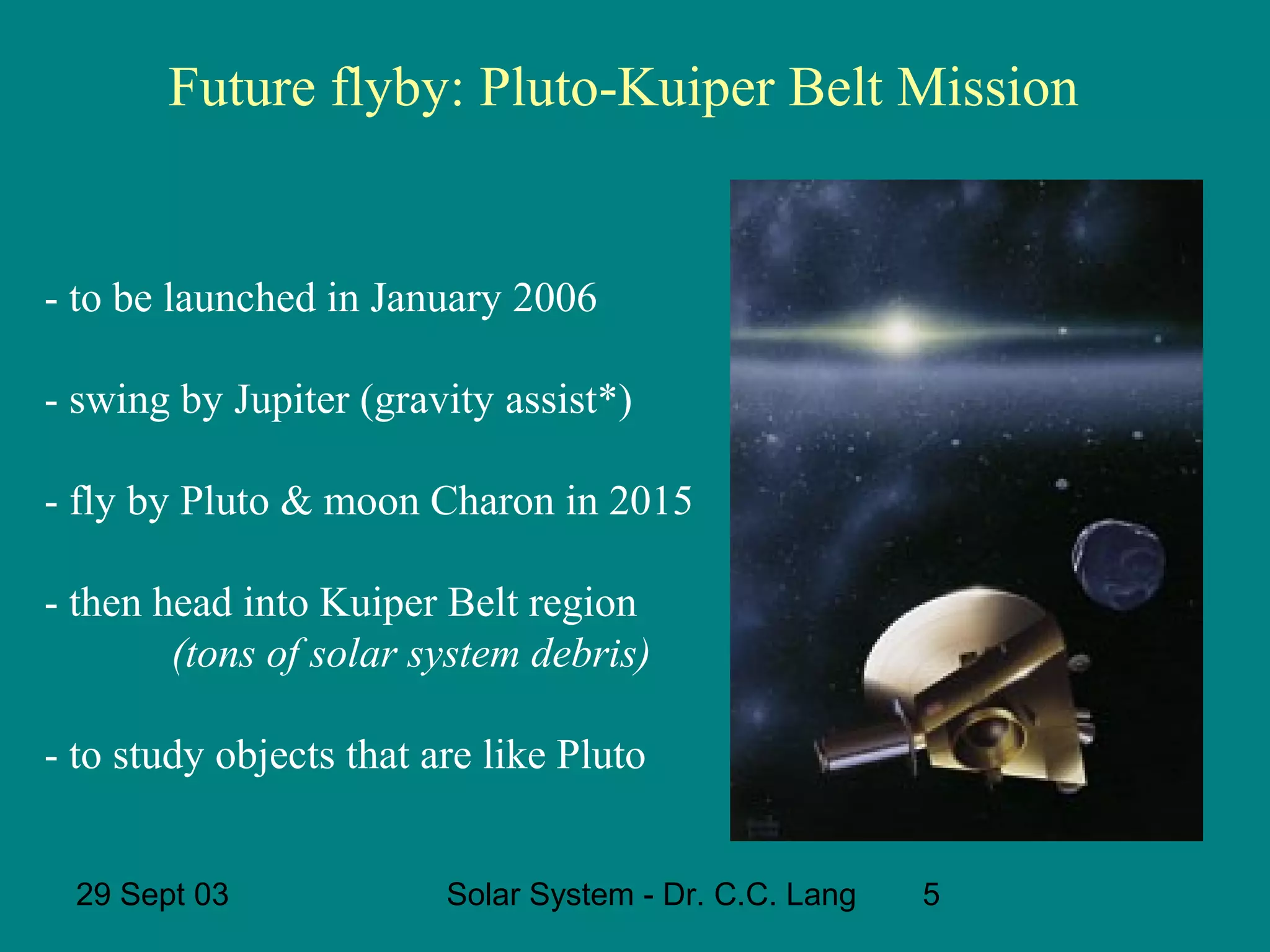
Future flyby: Pluto-Kuiper Belt Mission

- to be launched in January 2006
- swing by Jupiter (gravity assist*)
- fly by Pluto & moon Charon in 2015
- then head into Kuiper Belt region
(tons of solar system debris)
- to study objects that are like Pluto
29 Sept 03

Solar System - Dr. C.C. Lang

5
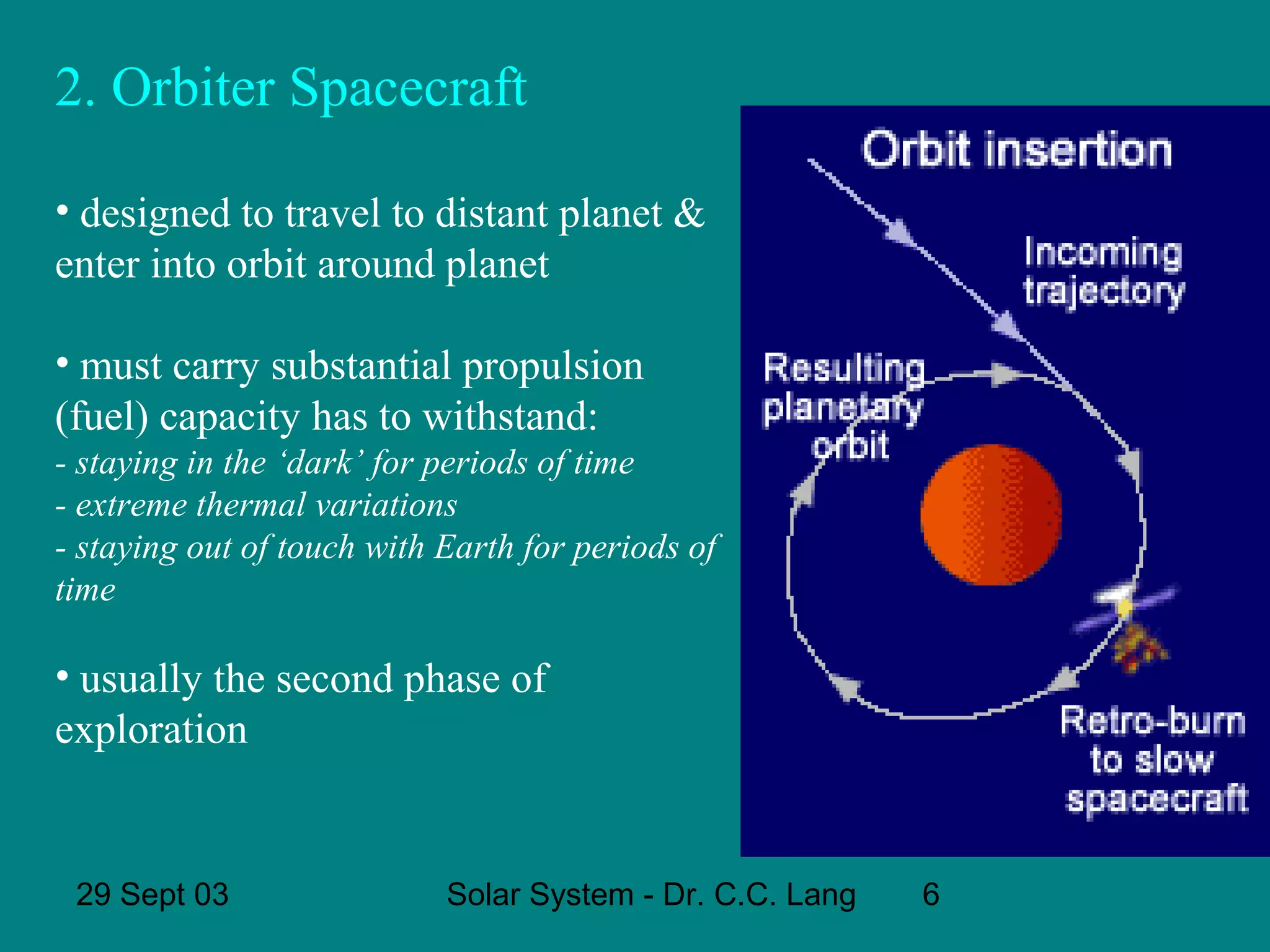
2. Orbiter Spacecraft
• designed to travel to distant planet &
enter into orbit around planet
• must carry substantial propulsion
(fuel) capacity has to withstand:
- staying in the ‘dark’ for periods of time
- extreme thermal variations
- staying out of touch with Earth for periods of
time

• usually the second phase of
exploration

29 Sept 03

Solar System - Dr. C.C. Lang

6
Famous Example: Galileo
- why would a mission to Jupiter be called Galileo?
- launched in 1989 aboard Atlantis Space Shuttle
- entered into Jupiter’s orbit in 1995
- highly successful study of Jupiter & its moons
Burned up in Jupiter’s atmosphere last week!

29 Sept 03

Solar System - Dr. C.C. Lang

7
3. Atmospheric Spacecraft
- relatively short mission
- collect data about the atmosphere of a planet or planet’s moon
- usually piggy back on a bigger craft
- needs no propulsion of its own
- takes direct measurements of atmosphere
- usually is destroyed; rest of spacecraft continues its mission

Example:
Galileo’s atmospheric probe

29 Sept 03

Solar System - Dr. C.C. Lang

8
Example: Galileo’s atmospheric probe

- traveled with Galileo for nearly six years
- took five months from release to contact with atmosphere
- collected 1 hour’s data IN Jupiter’s atmosphere

29 Sept 03

Solar System - Dr. C.C. Lang

9
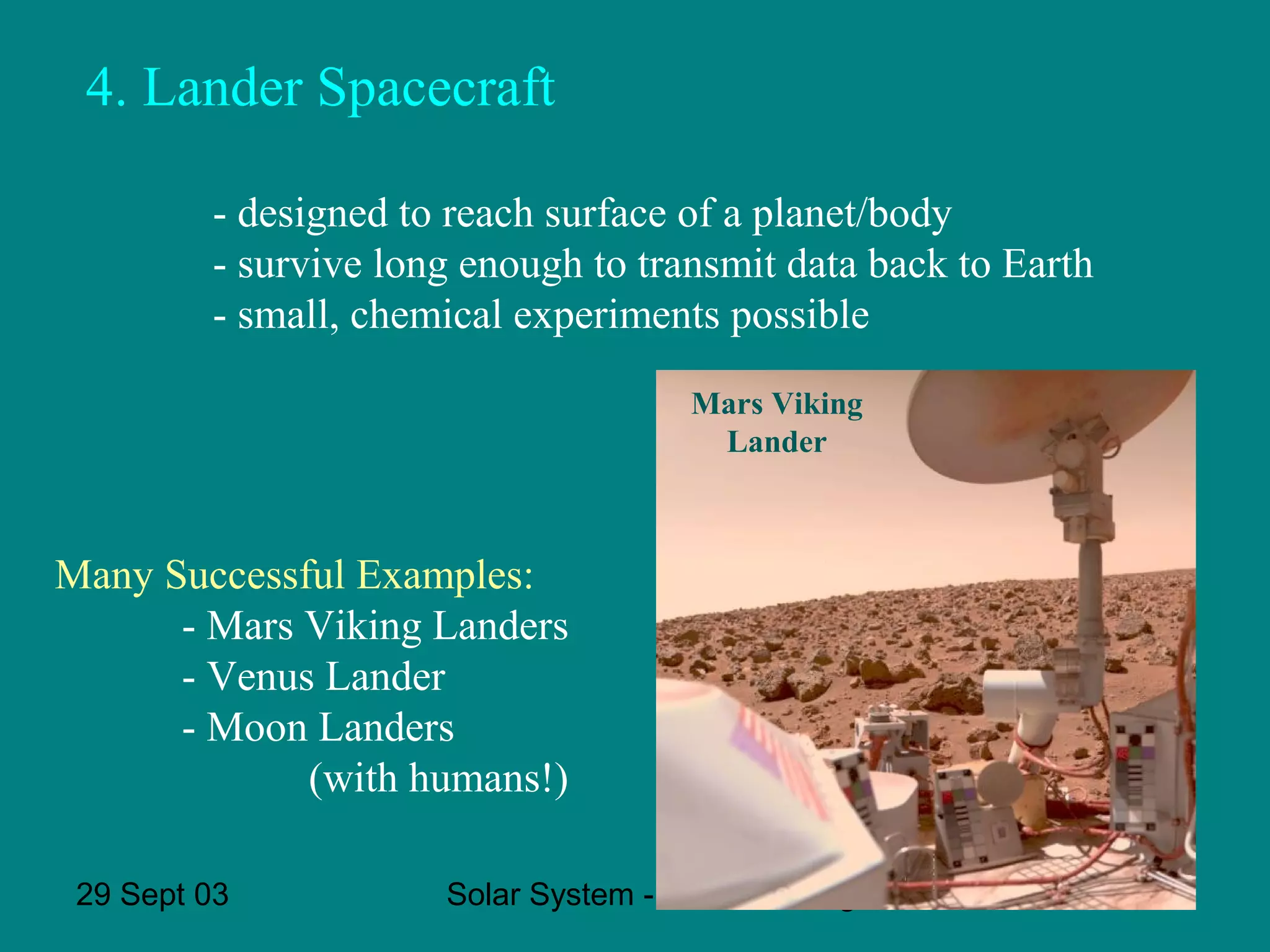
4. Lander Spacecraft
- designed to reach surface of a planet/body
- survive long enough to transmit data back to Earth
- small, chemical experiments possible
Mars Viking
Lander

Many Successful Examples:
- Mars Viking Landers
- Venus Lander
- Moon Landers
(with humans!)
29 Sept 03

Solar System - Dr. C.C. Lang

10
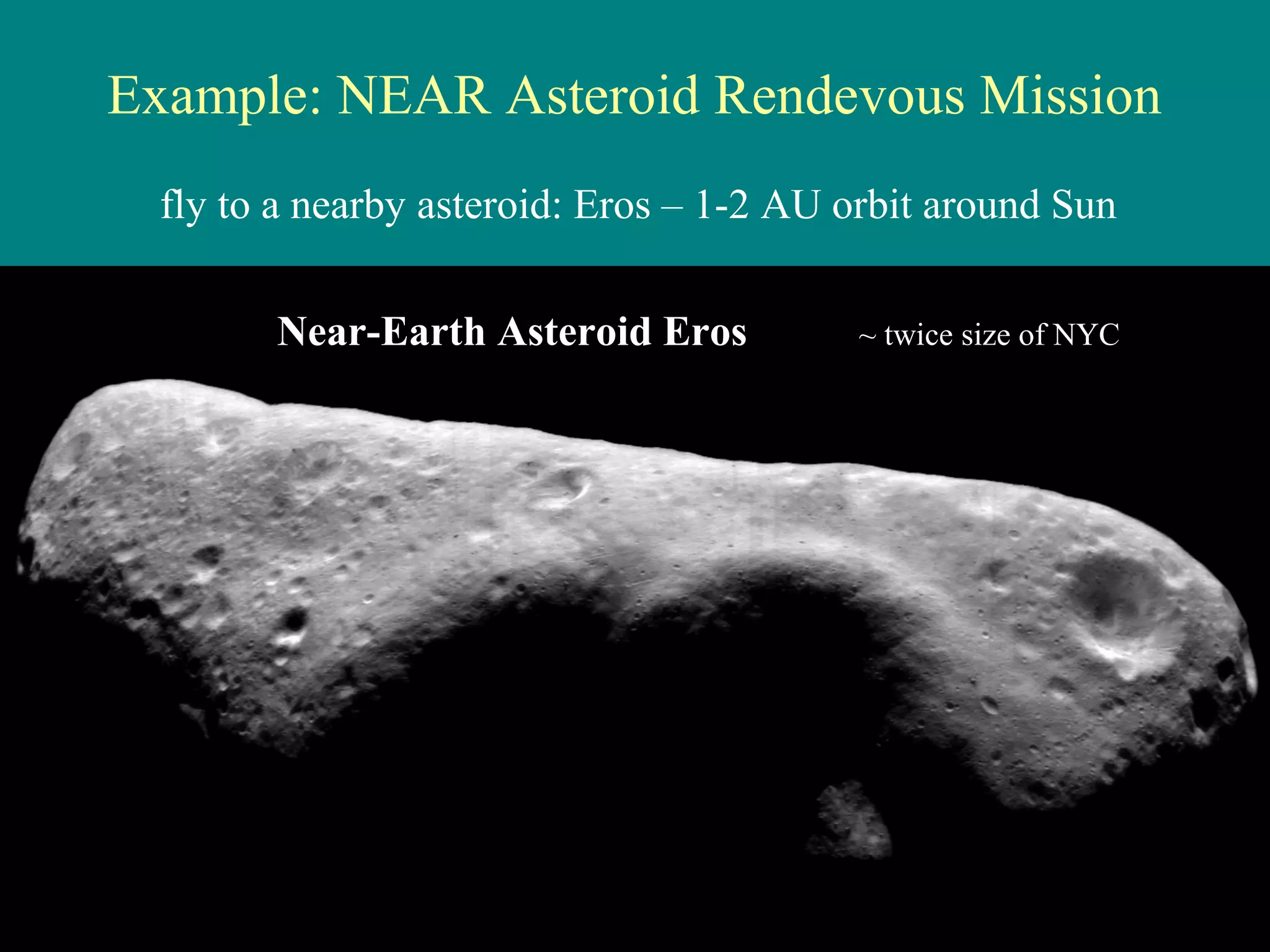
Example: NEAR Asteroid Rendevous Mission
fly to a nearby asteroid: Eros – 1-2 AU orbit around Sun
Near-Earth Asteroid Eros

29 Sept 03

Solar System - Dr. C.C. Lang

~ twice size of NYC

11
29 Sept 03

Solar System - Dr. C.C. Lang

12
29 Sept 03

Solar System - Dr. C.C. Lang

13
5. Penetrator Spacecraft
- designed to penetrate the surface of a planet/body
- must survive the impact of many times the gravity on Earth
- measure properties of impacted surface

No Currently Successful Examples:
- Deep Space 2 (lost with Mars Polar Lander)
But more to come in future:
- “Ice Pick” Mission to Jupiter’s Moon Europa
- “Deep Impact” Mission to a Comet
29 Sept 03

Solar System - Dr. C.C. Lang

14
29 Sept 03

Solar System - Dr. C.C. Lang

15
6. Rover Spacecraft
- electrically powered, mobile rovers
- mainly designed for exploration of Mars’ surface
- purposes: taking/analyzing samples with possibility of return
- Pathfinder was test mission – now being heavily developed
Mars Pathfinder

29 Sept 03

Mars Exploration Rovers

Solar System - Dr. C.C. Lang

16
7. Observatory Spacecraft
- in Earth orbit (or at Lagrange points)
- NASA’s “Great Observatories”:
- Hubble (visible)
- Chandra (X-ray)
- SIRTF (infrared)
- Compton (gamma-rays)

SOHO

-Large, complex scientific instruments
- up to 10-20 instruments on board

- designed to last > 5-10 years

SIRTF (near-IR)

29 Sept 03

Chandra (X-ray)

Solar System - Dr. C.C. Lang

17
How do we get there?

using LEAST amount of
fuel – saves big $$$ to be light

1. First must leave the Earth’s surface
- must ‘escape’ into orbit
- gets an initial boost via rocket
to go into Earth’s orbit – needs
an acceleration of 5 miles/sec
- during orbit, you sometimes
need to adjust height of orbit
by increasing/decreasing energy:
- practically: firing onboard rocket
thrusters
- a speed of 19,000 miles/hr
willSept 03 in orbit around Earth
keep craft
29
Solar System - Dr. C.C. Lang

18
How do we get there?

using LEAST amount of
fuel – saves big $$$ to be light

2. To get to an outer orbit: Mars
- spacecraft already in orbit (around Sun)
- need to adjust the orbit – boost via rocket –
so that the spacecraft gets transferred from
Earth’s orbit around Sun to Mars’ orbit around Sun
- but you want spacecraft to intercept Mars on
Mars’ orbit
- matter of timing: small window every 26 months
- to be captured by Mars – must decelerate
- to LAND on Mars – must decelerate further &
useSept 03 mechanism Solar System - Dr. C.C. Lang
29 braking

19
How do we get there?

using LEAST amount of
fuel – saves big $$$ to be light

3. To get to an inner orbit: Venus
- spacecraft already in orbit (around Sun) on Earth
- need to adjust the orbit once off Earth to head
inwards to Venus
- instead of SLOWING down (you’d fall to Earth),
you use reverse motion in your solar orbit, effectively
slowing down to land on Venus’ orbit
- but you want spacecraft to intercept Venus on
Venus’ orbit
- matter of timing: small window every 19 months
29 Sept 03

Solar System - Dr. C.C. Lang

20
How do we get there?

using LEAST amount of
fuel – saves big $$$ to be light

4. Gravity Assist
- can use the law of gravity to help spacecraft
propel themselves further out in the SS
- Voyager: its trajectory was aimed at getting
to Jupiter’s orbit just after Jupiter
- Voyager was gravitationally attracted to
Jupiter, and fell in towards Jupiter
- Jupiter was “tugged on” by Voyager and its
orbital energy decreased slightly
-then Voyager had more energy than was
needed to stay in orbit around Jupiter, and
was propelled outward!
29 Sept 03

- repeated at Saturn & Uranus

Solar System - Dr. C.C. Lang

21
At what speeds are these things traveling through space?
The currently fastest spacecraft speeds are
around 20 km per second (72,000 km per/hr)
For example, Voyager 1 is now moving
outwards from the solar system at a speed of
16 km per second. At this rate, it would
take 85,000 years to reach the nearest star
-3,000 human generations!
Even assuming that we could reach a speed
of 1/10th of the velocity of light, it would
still take a minimum of 40 years or so to
reach our nearest star.

29 Sept 03

Solar System - Dr. C.C. Lang

22
How do we get there?

using LEAST amount of
fuel – saves big $$$ to be light

5. Concerns about energy sources
- traditional energy boost: chemical thrusters
- most of energy is provided on launch – very costly!
especially for large, heavy, complex instruments
- a few times per year spacecraft fires short
bursts from its thrusters to make adjustments
- mostly free falling in orbit, coasting to destination

29 Sept 03

Solar System - Dr. C.C. Lang

23
How do we get there?

using LEAST amount of
fuel – saves big $$$ to be light

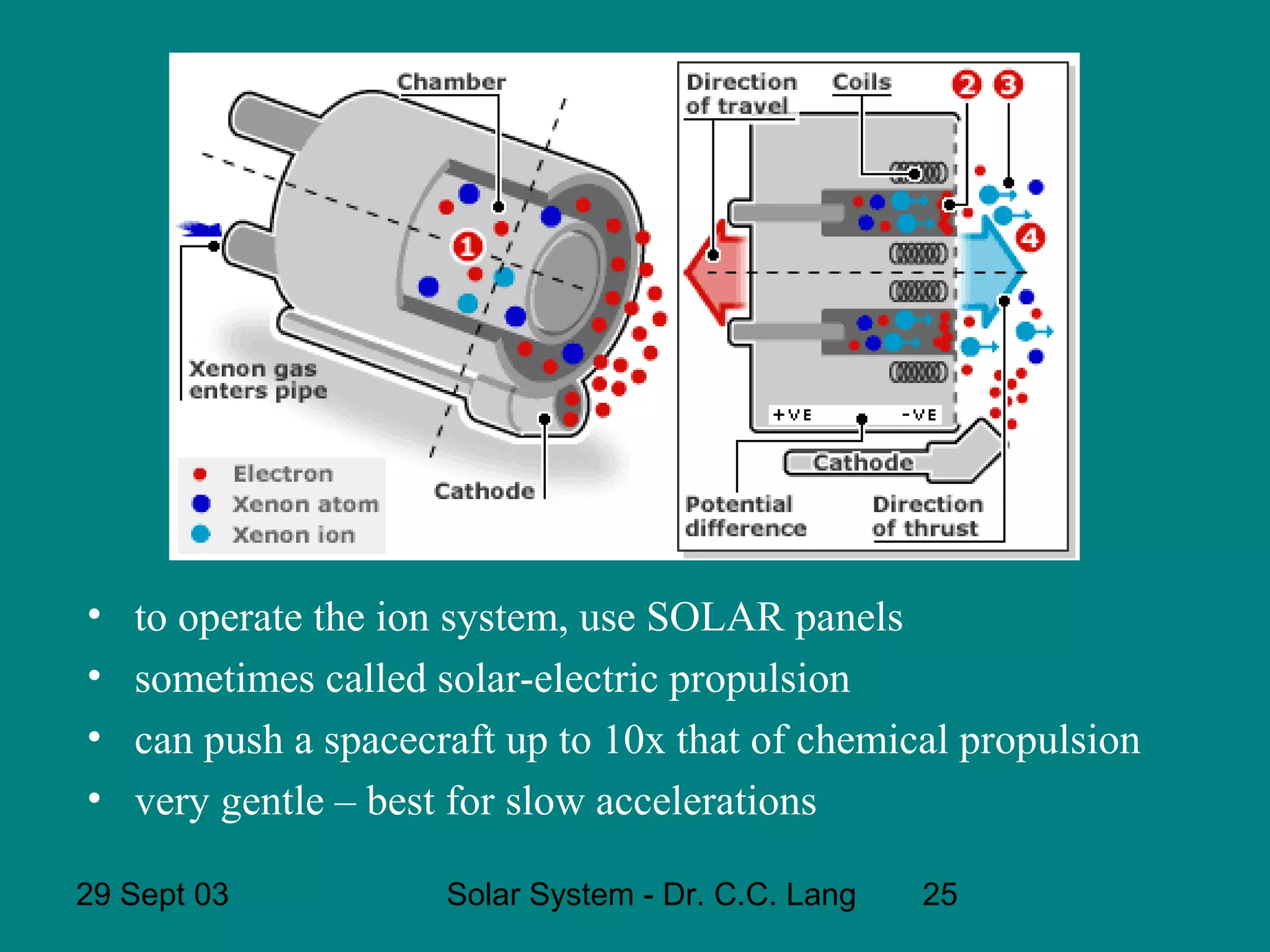
5. The Future: Ion Propulsion
- Xenon atoms are made of protons (+) and electrons (-)
- bombard a gas with electrons (-) to change charge
- creates a build up of IONS (+)
- use magnetic field to direct charged particles
- the IONS are accelerated out the back of craft
- this pushes the craft in the opposite direction
29 Sept 03

Solar System - Dr. C.C. Lang

24
•
•
•
•

to operate the ion system, use SOLAR panels
sometimes called solar-electric propulsion
can push a spacecraft up to 10x that of chemical propulsion
very gentle – best for slow accelerations

29 Sept 03

Solar System - Dr. C.C. Lang

25
HISTORY of ION PROPULSION
• first ion propulsion engine – built in 1960
• over 50 years in design/development at NASA
• very new technology
• has been used successfully on test mission:

Deep Space 1

29 Sept 03

Solar System - Dr. C.C. Lang

26
Europe’s Lunar Explorer: Smart 1 Probe
- launched 27 September 2003 (Saturday)
- 2-2.5 year mission
- will study lunar geochemistry
- search for ice at south Lunar pole
- **testing/proving of ion propulsion drives!**

29 Sept 03

Solar System - Dr. C.C. Lang

27
Onboard Systems on Most Spacecraft: Galileo

1. data handling
2. flight control 3. telecommunications
4. electrical power 5. particle shields
6. temperature control
7. propulsion mechanism System - Dr. C.C. Lang
8. mechanical devices28
(deployment)
29 Sept 03
Solar
Time & Money Considerations
Planning for a new spacecraft
- plans start about ~10 years before projected launch date
- must make through numerous hurdles/reviews
- very competitive: 1/10-25 average acceptance rate
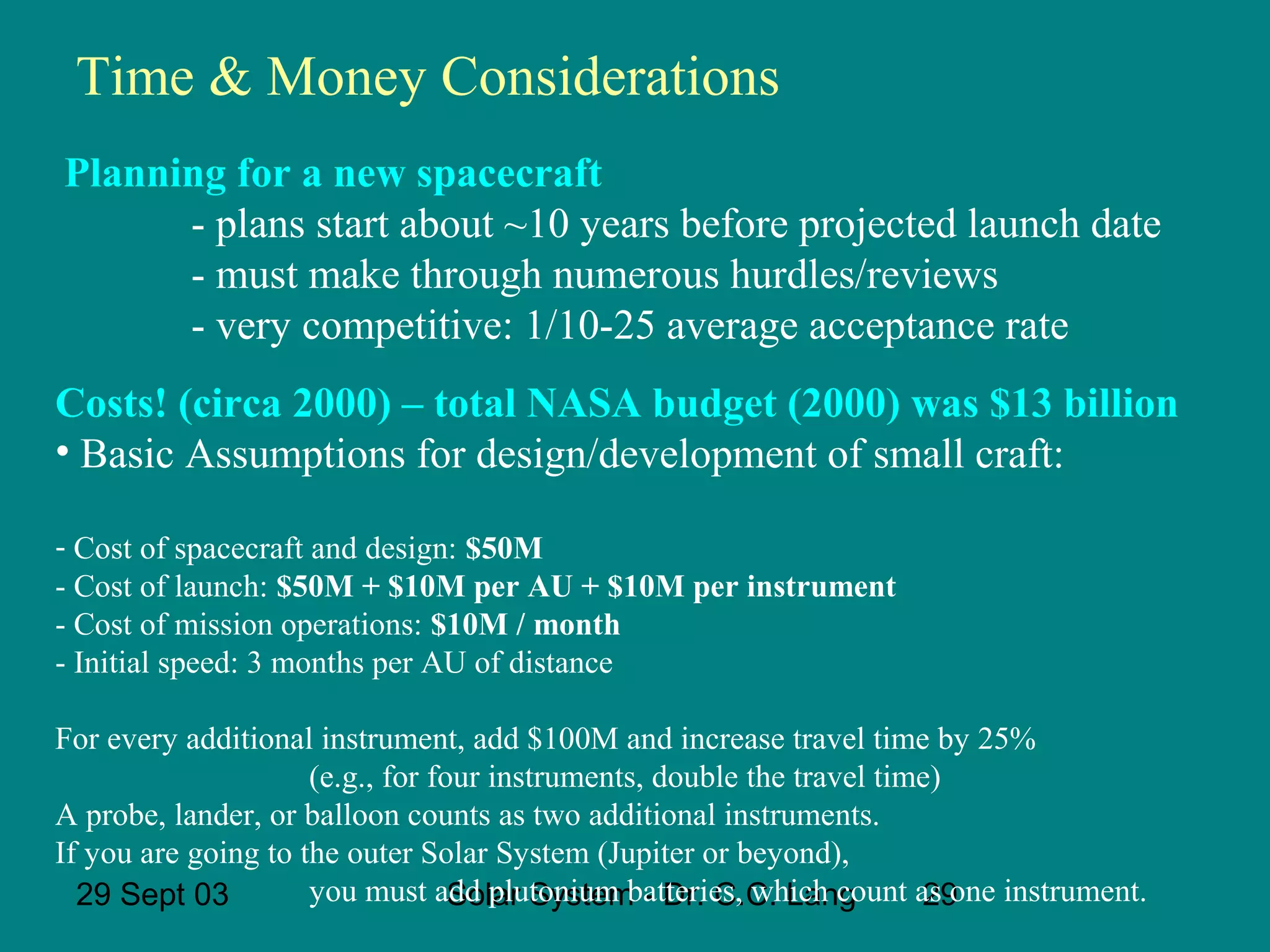
Costs! (circa 2000) – total NASA budget (2000) was $13 billion
• Basic Assumptions for design/development of small craft:
- Cost of spacecraft and design: $50M
- Cost of launch: $50M + $10M per AU + $10M per instrument
- Cost of mission operations: $10M / month
- Initial speed: 3 months per AU of distance
For every additional instrument, add $100M and increase travel time by 25%
(e.g., for four instruments, double the travel time)
A probe, lander, or balloon counts as two additional instruments.
If you are going to the outer Solar System (Jupiter or beyond),
you must add plutonium batteries, which count as one instrument.
29 Sept 03
Solar System - Dr. C.C. Lang
29
This powerpoint was kindly donated to
www.worldofteaching.com

http://www.worldofteaching.com is home to over a
thousand powerpoints submitted by teachers. This is a
completely free site and requires no registration. Please
visit and I hope it will help in your teaching.

29 Sept 03

Solar System - Dr. C.C. Lang

30

29sept03 notes

  • 1.
    Exploring the SolarSystem: all about spacecraft/spaceflight I. How can we explore the Solar System? - types of space missions II. How do we get there? - launch & orbits - gravity assist - fuel/propulsion III. Onboard Systems - everything but the kitchen sink… 29 Sept 03 Solar System - Dr. C.C. Lang 1
  • 2.
    1. Flyby Missions •usually the first phase of exploration (remember Mars & Mariner 4?) • spacecraft following continuous orbit - around the Sun - escape trajectory (heading off into deep space) 29 Sept 03 Solar System - Dr. C.C. Lang 2
  • 3.
    Famous Example: VOYAGER2 - launch 1977 with VOYAGER 1 - flew by Jupiter in 1979 - Saturn in 1980/1981 - Uranus (V2) in 1986 - Neptune in 1989 - will continue to interstellar space - study of interplanetary space particles (Van Allen) - data expected until 2020 Clouds on Neptune Interplanetary 29 Sept 03 Solar System - Dr. C.C. Lang Space & the Solar Wind 3
  • 4.
    Other Flyby examples: Underway:Stardust Comet return mission - launched in 1999 - interstellar dust collection - asteroid Annefrank flyby - Comet encounter (Jan 2004) - Earth/sample return (Jan 2006) 29 Sept 03 Solar System - Dr. C.C. Lang 4
  • 5.
    Future flyby: Pluto-KuiperBelt Mission - to be launched in January 2006 - swing by Jupiter (gravity assist*) - fly by Pluto & moon Charon in 2015 - then head into Kuiper Belt region (tons of solar system debris) - to study objects that are like Pluto 29 Sept 03 Solar System - Dr. C.C. Lang 5
  • 6.
    2. Orbiter Spacecraft •designed to travel to distant planet & enter into orbit around planet • must carry substantial propulsion (fuel) capacity has to withstand: - staying in the ‘dark’ for periods of time - extreme thermal variations - staying out of touch with Earth for periods of time • usually the second phase of exploration 29 Sept 03 Solar System - Dr. C.C. Lang 6
  • 7.
    Famous Example: Galileo -why would a mission to Jupiter be called Galileo? - launched in 1989 aboard Atlantis Space Shuttle - entered into Jupiter’s orbit in 1995 - highly successful study of Jupiter & its moons Burned up in Jupiter’s atmosphere last week! 29 Sept 03 Solar System - Dr. C.C. Lang 7
  • 8.
    3. Atmospheric Spacecraft -relatively short mission - collect data about the atmosphere of a planet or planet’s moon - usually piggy back on a bigger craft - needs no propulsion of its own - takes direct measurements of atmosphere - usually is destroyed; rest of spacecraft continues its mission Example: Galileo’s atmospheric probe 29 Sept 03 Solar System - Dr. C.C. Lang 8
  • 9.
    Example: Galileo’s atmosphericprobe - traveled with Galileo for nearly six years - took five months from release to contact with atmosphere - collected 1 hour’s data IN Jupiter’s atmosphere 29 Sept 03 Solar System - Dr. C.C. Lang 9
  • 10.
    4. Lander Spacecraft -designed to reach surface of a planet/body - survive long enough to transmit data back to Earth - small, chemical experiments possible Mars Viking Lander Many Successful Examples: - Mars Viking Landers - Venus Lander - Moon Landers (with humans!) 29 Sept 03 Solar System - Dr. C.C. Lang 10
  • 11.
    Example: NEAR AsteroidRendevous Mission fly to a nearby asteroid: Eros – 1-2 AU orbit around Sun Near-Earth Asteroid Eros 29 Sept 03 Solar System - Dr. C.C. Lang ~ twice size of NYC 11
  • 12.
    29 Sept 03 SolarSystem - Dr. C.C. Lang 12
  • 13.
    29 Sept 03 SolarSystem - Dr. C.C. Lang 13
  • 14.
    5. Penetrator Spacecraft -designed to penetrate the surface of a planet/body - must survive the impact of many times the gravity on Earth - measure properties of impacted surface No Currently Successful Examples: - Deep Space 2 (lost with Mars Polar Lander) But more to come in future: - “Ice Pick” Mission to Jupiter’s Moon Europa - “Deep Impact” Mission to a Comet 29 Sept 03 Solar System - Dr. C.C. Lang 14
  • 15.
    29 Sept 03 SolarSystem - Dr. C.C. Lang 15
  • 16.
    6. Rover Spacecraft -electrically powered, mobile rovers - mainly designed for exploration of Mars’ surface - purposes: taking/analyzing samples with possibility of return - Pathfinder was test mission – now being heavily developed Mars Pathfinder 29 Sept 03 Mars Exploration Rovers Solar System - Dr. C.C. Lang 16
  • 17.
    7. Observatory Spacecraft -in Earth orbit (or at Lagrange points) - NASA’s “Great Observatories”: - Hubble (visible) - Chandra (X-ray) - SIRTF (infrared) - Compton (gamma-rays) SOHO -Large, complex scientific instruments - up to 10-20 instruments on board - designed to last > 5-10 years SIRTF (near-IR) 29 Sept 03 Chandra (X-ray) Solar System - Dr. C.C. Lang 17
  • 18.
    How do weget there? using LEAST amount of fuel – saves big $$$ to be light 1. First must leave the Earth’s surface - must ‘escape’ into orbit - gets an initial boost via rocket to go into Earth’s orbit – needs an acceleration of 5 miles/sec - during orbit, you sometimes need to adjust height of orbit by increasing/decreasing energy: - practically: firing onboard rocket thrusters - a speed of 19,000 miles/hr willSept 03 in orbit around Earth keep craft 29 Solar System - Dr. C.C. Lang 18
  • 19.
    How do weget there? using LEAST amount of fuel – saves big $$$ to be light 2. To get to an outer orbit: Mars - spacecraft already in orbit (around Sun) - need to adjust the orbit – boost via rocket – so that the spacecraft gets transferred from Earth’s orbit around Sun to Mars’ orbit around Sun - but you want spacecraft to intercept Mars on Mars’ orbit - matter of timing: small window every 26 months - to be captured by Mars – must decelerate - to LAND on Mars – must decelerate further & useSept 03 mechanism Solar System - Dr. C.C. Lang 29 braking 19
  • 20.
    How do weget there? using LEAST amount of fuel – saves big $$$ to be light 3. To get to an inner orbit: Venus - spacecraft already in orbit (around Sun) on Earth - need to adjust the orbit once off Earth to head inwards to Venus - instead of SLOWING down (you’d fall to Earth), you use reverse motion in your solar orbit, effectively slowing down to land on Venus’ orbit - but you want spacecraft to intercept Venus on Venus’ orbit - matter of timing: small window every 19 months 29 Sept 03 Solar System - Dr. C.C. Lang 20
  • 21.
    How do weget there? using LEAST amount of fuel – saves big $$$ to be light 4. Gravity Assist - can use the law of gravity to help spacecraft propel themselves further out in the SS - Voyager: its trajectory was aimed at getting to Jupiter’s orbit just after Jupiter - Voyager was gravitationally attracted to Jupiter, and fell in towards Jupiter - Jupiter was “tugged on” by Voyager and its orbital energy decreased slightly -then Voyager had more energy than was needed to stay in orbit around Jupiter, and was propelled outward! 29 Sept 03 - repeated at Saturn & Uranus Solar System - Dr. C.C. Lang 21
  • 22.
    At what speedsare these things traveling through space? The currently fastest spacecraft speeds are around 20 km per second (72,000 km per/hr) For example, Voyager 1 is now moving outwards from the solar system at a speed of 16 km per second. At this rate, it would take 85,000 years to reach the nearest star -3,000 human generations! Even assuming that we could reach a speed of 1/10th of the velocity of light, it would still take a minimum of 40 years or so to reach our nearest star. 29 Sept 03 Solar System - Dr. C.C. Lang 22
  • 23.
    How do weget there? using LEAST amount of fuel – saves big $$$ to be light 5. Concerns about energy sources - traditional energy boost: chemical thrusters - most of energy is provided on launch – very costly! especially for large, heavy, complex instruments - a few times per year spacecraft fires short bursts from its thrusters to make adjustments - mostly free falling in orbit, coasting to destination 29 Sept 03 Solar System - Dr. C.C. Lang 23
  • 24.
    How do weget there? using LEAST amount of fuel – saves big $$$ to be light 5. The Future: Ion Propulsion - Xenon atoms are made of protons (+) and electrons (-) - bombard a gas with electrons (-) to change charge - creates a build up of IONS (+) - use magnetic field to direct charged particles - the IONS are accelerated out the back of craft - this pushes the craft in the opposite direction 29 Sept 03 Solar System - Dr. C.C. Lang 24
  • 25.
    • • • • to operate theion system, use SOLAR panels sometimes called solar-electric propulsion can push a spacecraft up to 10x that of chemical propulsion very gentle – best for slow accelerations 29 Sept 03 Solar System - Dr. C.C. Lang 25
  • 26.
    HISTORY of IONPROPULSION • first ion propulsion engine – built in 1960 • over 50 years in design/development at NASA • very new technology • has been used successfully on test mission: Deep Space 1 29 Sept 03 Solar System - Dr. C.C. Lang 26
  • 27.
    Europe’s Lunar Explorer:Smart 1 Probe - launched 27 September 2003 (Saturday) - 2-2.5 year mission - will study lunar geochemistry - search for ice at south Lunar pole - **testing/proving of ion propulsion drives!** 29 Sept 03 Solar System - Dr. C.C. Lang 27
  • 28.
    Onboard Systems onMost Spacecraft: Galileo 1. data handling 2. flight control 3. telecommunications 4. electrical power 5. particle shields 6. temperature control 7. propulsion mechanism System - Dr. C.C. Lang 8. mechanical devices28 (deployment) 29 Sept 03 Solar
  • 29.
    Time & MoneyConsiderations Planning for a new spacecraft - plans start about ~10 years before projected launch date - must make through numerous hurdles/reviews - very competitive: 1/10-25 average acceptance rate Costs! (circa 2000) – total NASA budget (2000) was $13 billion • Basic Assumptions for design/development of small craft: - Cost of spacecraft and design: $50M - Cost of launch: $50M + $10M per AU + $10M per instrument - Cost of mission operations: $10M / month - Initial speed: 3 months per AU of distance For every additional instrument, add $100M and increase travel time by 25% (e.g., for four instruments, double the travel time) A probe, lander, or balloon counts as two additional instruments. If you are going to the outer Solar System (Jupiter or beyond), you must add plutonium batteries, which count as one instrument. 29 Sept 03 Solar System - Dr. C.C. Lang 29
  • 30.
    This powerpoint waskindly donated to www.worldofteaching.com http://www.worldofteaching.com is home to over a thousand powerpoints submitted by teachers. This is a completely free site and requires no registration. Please visit and I hope it will help in your teaching. 29 Sept 03 Solar System - Dr. C.C. Lang 30

Editor's Notes