Presented by 
Shivam Singh 
1106447076
About H.A.L. 
Hindustan Aeronautics Limited (HAL) came into existence on 1st 
October 1964. The Company was formed by the merger of 
Hindustan Aircraft Limited with Aeronautics India Limited and 
Aircraft Manufacturing Depot, Kanpur 
HAL was conferred NAVRATNA status by the Government of 
India on 22nd June 2007. 
The Company scaled new heights in the Financial Year 2010-11 
with Turnover of Rs.13, 116 Crores.
VISION 
" To become a significant global player in the aerospace 
industry. “ 
MISSION 
" To achieve self reliance in design, development, manufacture, 
upgrade and maintenance of aerospace equipment diversifying 
into related areas and managing the business in a climate of 
growing professional competence to achieve world class 
performance standards for global competitiveness and growth 
in exports. ".
PRODUCTS BY H.A.L. LUCKNOW 
ejection seats Canopy 
Under carriage
CONTRIBUTION TO AEROSPACE 
 PSLV: (POLAR SATELLITE LAUNCH VEHICLE) 
 GSLV: (GEO-SYCHRONOUS SATELLITE 
LAUNCH VEHICLE) MK II 
 INDIAN NATIONAL SATELLITE 
 INDIAN REMOTE SENSING SATELLITE
FLIGHT MANAGEMENT SYSTEM- AN OVERVIEW 
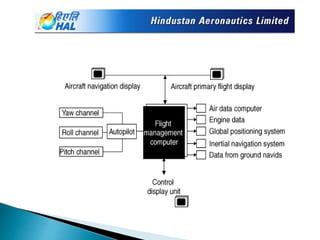
A flight management system (FMS) is a fundamental component 
of a modern airliner's avionics. An FMS is a specialized 
computer system that automates a wide variety of in-flight 
tasks, reducing the workload on the flight crew to the point that 
modern aircraft no longer carry flight engineers or navigators.
Basic Flight Management System
The flight management system provides the primary navigation, 
flight planning, and optimized route determination and en 
route guidance for the aircraft and is typically comprised of the 
following interrelated functions: navigation, flight planning, 
trajectory prediction, performance computations, and guidance.
1)The navigation function – responsible for determining the 
best estimate of the current state of the aircraft. 
2)The flight planning function – allows the crew to establish 
a specific routing for the aircraft. 
3)The trajectory prediction function — responsible for 
computing the predicted aircraft profile along the entire 
specified routing. 
3)The performance function — provides the crew with 
aircraft unique performance information such as takeoff 
speeds, altitude capability, and profile optimization advisories. 
4)The guidance functions — responsible for producing 
commands to guide the aircraft along both the lateral and 
vertical computed profiles.
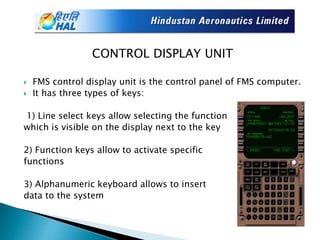
CONTROL DISPLAY UNIT 
 FMS control display unit is the control panel of FMS computer. 
 It has three types of keys: 
1) Line select keys allow selecting the function 
which is visible on the display next to the key 
2) Function keys allow to activate specific 
functions 
3) Alphanumeric keyboard allows to insert 
data to the system
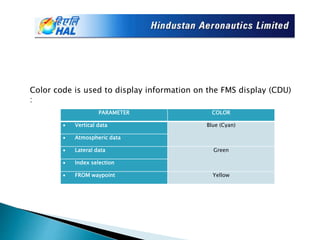
Color code is used to display information on the FMS display (CDU) 
: 
PARAMETER COLOR 
 Vertical data Blue (Cyan) 
 Atmospheric data 
 Lateral data Green 
 Index selection 
 FROM waypoint Yellow
NAVIGATION DATABASE 
 Waypoints/Intersection 
 Airways (highways in the sky) 
 Radio navigation aids including distance 
measuring equipment (DME), VHF omni 
directional range (VOR), non-directional beacons 
(NDBs) and instrument landing systems (ILSs). 
 Airports 
 Runways 
 Standard instrument departure (SID) 
 Standard terminal arrival (STAR)
OUTSOURCING 
In order to make sure the overall development 
H.A.L. promotes process of outsourcing so that 
local vendor near the plant can grow up and 
ultimately add to the nation’s growth
Areas of outsourcing 
 Machining of components involving turning 
turning, milling, drilling, jig boring, grinding, 
centre-less grinding, lapping etc. 
 Machining / Fabrication of tools, jigs and fixtures. 
 Specialized processes like Ion - Nitriding, 
Tungsten Carbide Coating, Laser Beam Welding, 
Electron Beam Welding, Moulding etc.
CONCLUSION 
Basically the flight management system is one of the most 
important that can not be compromised at any cost as it plays 
an important role in guiding routes to the pilots as well as 
keeps an check on various system through flight management 
computer. 
Day by day H.A.L. is trying to improve its FMS by incorporating 
more feature into it.
Thank you

H.A.L. INDUSTRIAL TRAINING PRESENTATION

  • 1.
    Presented by ShivamSingh 1106447076
  • 2.
    About H.A.L. HindustanAeronautics Limited (HAL) came into existence on 1st October 1964. The Company was formed by the merger of Hindustan Aircraft Limited with Aeronautics India Limited and Aircraft Manufacturing Depot, Kanpur HAL was conferred NAVRATNA status by the Government of India on 22nd June 2007. The Company scaled new heights in the Financial Year 2010-11 with Turnover of Rs.13, 116 Crores.
  • 3.
    VISION " Tobecome a significant global player in the aerospace industry. “ MISSION " To achieve self reliance in design, development, manufacture, upgrade and maintenance of aerospace equipment diversifying into related areas and managing the business in a climate of growing professional competence to achieve world class performance standards for global competitiveness and growth in exports. ".
  • 4.
    PRODUCTS BY H.A.L.LUCKNOW ejection seats Canopy Under carriage
  • 5.
    CONTRIBUTION TO AEROSPACE  PSLV: (POLAR SATELLITE LAUNCH VEHICLE)  GSLV: (GEO-SYCHRONOUS SATELLITE LAUNCH VEHICLE) MK II  INDIAN NATIONAL SATELLITE  INDIAN REMOTE SENSING SATELLITE
  • 6.
    FLIGHT MANAGEMENT SYSTEM-AN OVERVIEW A flight management system (FMS) is a fundamental component of a modern airliner's avionics. An FMS is a specialized computer system that automates a wide variety of in-flight tasks, reducing the workload on the flight crew to the point that modern aircraft no longer carry flight engineers or navigators.
  • 7.
  • 8.
    The flight managementsystem provides the primary navigation, flight planning, and optimized route determination and en route guidance for the aircraft and is typically comprised of the following interrelated functions: navigation, flight planning, trajectory prediction, performance computations, and guidance.
  • 10.
    1)The navigation function– responsible for determining the best estimate of the current state of the aircraft. 2)The flight planning function – allows the crew to establish a specific routing for the aircraft. 3)The trajectory prediction function — responsible for computing the predicted aircraft profile along the entire specified routing. 3)The performance function — provides the crew with aircraft unique performance information such as takeoff speeds, altitude capability, and profile optimization advisories. 4)The guidance functions — responsible for producing commands to guide the aircraft along both the lateral and vertical computed profiles.
  • 11.
    CONTROL DISPLAY UNIT  FMS control display unit is the control panel of FMS computer.  It has three types of keys: 1) Line select keys allow selecting the function which is visible on the display next to the key 2) Function keys allow to activate specific functions 3) Alphanumeric keyboard allows to insert data to the system
  • 12.
    Color code isused to display information on the FMS display (CDU) : PARAMETER COLOR  Vertical data Blue (Cyan)  Atmospheric data  Lateral data Green  Index selection  FROM waypoint Yellow
  • 13.
    NAVIGATION DATABASE Waypoints/Intersection  Airways (highways in the sky)  Radio navigation aids including distance measuring equipment (DME), VHF omni directional range (VOR), non-directional beacons (NDBs) and instrument landing systems (ILSs).  Airports  Runways  Standard instrument departure (SID)  Standard terminal arrival (STAR)
  • 14.
    OUTSOURCING In orderto make sure the overall development H.A.L. promotes process of outsourcing so that local vendor near the plant can grow up and ultimately add to the nation’s growth
  • 15.
    Areas of outsourcing  Machining of components involving turning turning, milling, drilling, jig boring, grinding, centre-less grinding, lapping etc.  Machining / Fabrication of tools, jigs and fixtures.  Specialized processes like Ion - Nitriding, Tungsten Carbide Coating, Laser Beam Welding, Electron Beam Welding, Moulding etc.
  • 16.
    CONCLUSION Basically theflight management system is one of the most important that can not be compromised at any cost as it plays an important role in guiding routes to the pilots as well as keeps an check on various system through flight management computer. Day by day H.A.L. is trying to improve its FMS by incorporating more feature into it.
  • 17.