1
PHARMACEUTICAL
AEROSOLS
By
SUNILBOREDDY
Definition
Packaging of therapeutic active
ingredients in a pressurized system.
Aerosols are depends on the power of
compressed or liquefied gas to expel the
contents from containers.
3
Advantages
A dose can be removed with out contamination of
materials.
The medication can be delivered directly to the affected
area in a desired form, such as spray, steam, quick
breaking foam or stable foam.
Irritation produced by the mechanical application of
topical medication is reduced or eliminated.
Ease of convenience of application.
Application of medication in thin layer
4
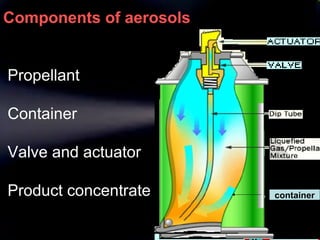
Components of aerosols
Propellant
Container
Valve and actuator
Product concentrate container
5
Propellant
#It is responsible for developing the power pressure with in the
container and also expel the product when the valve is
opened and in the atomization or foam production of the
product.
# For oral and inhalation eg.
Fluorinated hydrocarbons
Dichlorodifluromethane (propellent 12)
Dichlorotetrafluromethane (propellent 114)
# Topical preparation
Propane
Butane
Isobutane
# Compound gases
Nitrogen
Carbon di oxide
Nitrous oxide
6
Containers
They must be stand at pressure as high as 140 to 180
psig (pounds per sq. inch gauge) at 1300 F.
A. Metals
1. Tinplated steel
(a) Side-seam (three pieces)
(b) Two-piece or drawn
(c) Tin free steel
2. Aluminium
(a) Two-piece
(b) One-piece (extruded or drawn)
3. Stainless steel
B. Glass
1. Uncoated glass
2. Plastic coated glass
7
Physiochemical properties of
propellants
Vapor pressure
Boiling points
Liquid density
8
Valves
To delivered the drug in desired form.
To give proper amount of medication.
Not differ from valve to valve of medication in
pharmaceutical preparation.
Types
- Continuous spray valve
- High speed production technique.
- Metering valves
Dispersing of potent medication at proper
dispersion/ spray approximately 50 to 150 mg
±10 % of liquid materials at one time use of same
valve.
9
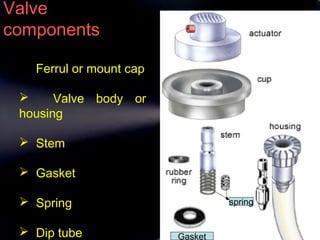
Valve
components
 Ferrul or mount cap
 Valve body or
housing
 Stem
 Gasket
 Spring
 Dip tube Gasket
spring
10
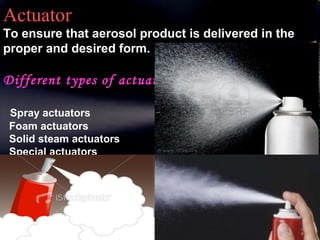
Actuator
To ensure that aerosol product is delivered in the
proper and desired form.
Different types of actuators
Spray actuators
Foam actuators
Solid steam actuators
Special actuators
11
Formulation of pharmaceutical aerosols
Contains two essential components
• Product concentrate
• Propellant
Product concentrate
Product concentrate contains ingredients or mixture of active
ingredients and other such as solvents, antioxidants and surfactants.
Propellant
May be single or blend of various propellants
 Blends of propellant used in a p’ceutical formulation to achieve
desired solubility characteristics or various surfactants are mixed to
give the proper HLB value for emulsion system.
 To give the desired vapor pressure, solubility & particle size.
12
Parameters consideration
 Physical, chemical and p’ceutical properties of
active ingredients.
 Site of application
13
Types of system
Solution system
Water based system
Suspension or Dispersion systems
Foam systems
1. Aqueous stable foams
2. Nonaqueous stable foams
3. Quick-breaking foams
4. Thermal foams
Intranasal aerosols
14
Manufacturing of Pharmaceutical Aerosols
Apparatus
 Pressure filling apparatus
 Cold filling apparatus
 Compressed gas filling apparatus
15
Quality control for pharmaceutical
aerosols
Propellants
Valves, actuator and dip tubes
Testing procedure
Valve acceptance
Containers
Weight checking
Leak testing
Spray testing
16
Evaluation parameters of pharmaceutical aerosols
A. Flammability and combustibility
1. Flash point
2. Flame extension, including flashback
B. Physiochemical characteristics
1. Vapor pressure
• Density
• Moisture content
• Identification of propellant(s)
• Concentrate-propellant ratio
C. Performance
1. Aerosol valve discharge rate
1. Spray pattern
2. Dosage with metered valves
3. Net contents
4. Foam stability
5. Particle size determination
6. Leakage
D. Biologic characteristics
E. Therapeutic activity
17
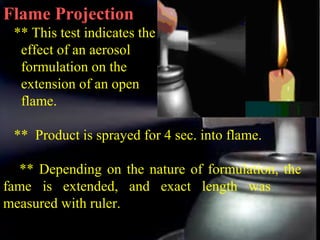
Flame Projection
** This test indicates the
effect of an aerosol
formulation on the
extension of an open
flame.
** Product is sprayed for 4 sec. into flame.
** Depending on the nature of formulation, the
fame is extended, and exact length was
measured with ruler.
18
Flash point
• Determined by using standard Tag Open Cap
Apparatus.
Step involves are 
• Aerosol product is chilled to temperature of
- 25 0
F and transferred to the test apparatus.
• Temperature of test liquid increased slowly,
and the temperature at which the vapors ignite
is taken a flash point.
• Calculated for flammable component, which
in case of topical hydrocarbons.
19
Vapor pressure
Determined by pressure gauge
Variation in pressure indicates the presence of air in
headspace.
A can punctuating device is available for accurately
measuring vapor pressure.
20
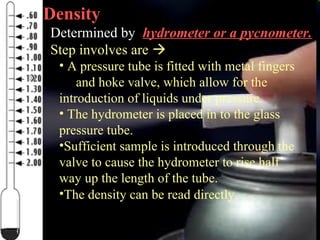
Density
Determined by hydrometer or a pycnometer.
Step involves are 
• A pressure tube is fitted with metal fingers
and hoke valve, which allow for the
introduction of liquids under pressure.
• The hydrometer is placed in to the glass
pressure tube.
•Sufficient sample is introduced through the
valve to cause the hydrometer to rise half
way up the length of the tube.
•The density can be read directly.
21
Moisture content
Method used — Karl Fischer method
 G. C has also been used
Identification of propellants
 G.C,
 I.R spectrophotometry
Aerosol valve discharge rate
Determined by taking an aerosol known weight and
discharging the contents for given time using standard
apparatus.
By reweighing the container after time limit has expired,
the change in weight per time dispensed is discharge
rate,
Expressed as gram per seconds.
22
Dosage with metered valves
Amt. of medication actually received by the patient.
Reproducibility has been determined by assay
technique,
Another method is that, involves accurate weighing
of filled container fallowed by dispersing of several
doses, container can reweighed, and difference in
weight divided by No. of dose, gives the average
dosage.
Reproducibility of dosage each time the valve is
dispersed
23
Net contents
•Weight method
•Filled full container, and dispensing the contents
Foam stability
• Visual evaluation
• Time for a given mass to penetrate the foam
• Times for given rod that is inserted into the
foam to fall
• The use of rotational viscometers
24
Particle size determination
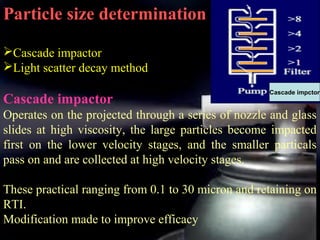
Cascade impactor
Light scatter decay method
Cascade impactor
Operates on the projected through a series of nozzle and glass
slides at high viscosity, the large particles become impacted
first on the lower velocity stages, and the smaller particals
pass on and are collected at high velocity stages.
These practical ranging from 0.1 to 30 micron and retaining on
RTI.
Modification made to improve efficacy
Cascade impctor
25
Porush, Thiel and Young used light scattering
method to determine particle size.
As aerosols settle in turbulent condition , the change
in light intensity of Tyndall beam is measured
Sciarra and Cutie developed method based on
practical size distribution.
26
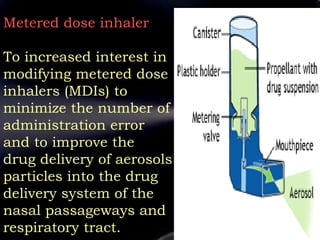
Metered dose inhaler
To increased interest in
modifying metered dose
inhalers (MDIs) to
minimize the number of
administration error
and to improve the
drug delivery of aerosols
particles into the drug
delivery system of the
nasal passageways and
respiratory tract.
27
DRY POWDER
INHALERS(DPIs)
• In DPI systems, drug is inhaled as a cloud of fine
particles. The drug is either preloaded in an inhalation
device or filled into hard gelatin capsule or foil blister
discs which are loaded in to a device prior to use.
• Dry powder inhalers are devices through which dry
powder formulation of an active drug is delivered for
local or systemic action via pulmonary route.
• They are bolus drug delivery systems that contain solid
drug substance that is suspended or dissolved in a non-
polar propellant that is fluidized when the patient inhales.
28
Ideal DPI
• Effective dosing
uniform dose
targeted delivery
operable at low inhalation flow rates
• Efficient device
• Easy to use
29
FORMULATION
• DPI formulations are generally engineered
composites, containing a drug material of
micron size formulated with or without a
large carrier material. The formulation is
formulated around a device that when
actuated by patient is capable of
producing a respirable aerosol cloud that
penetrates the respiratory tract and
reaches the site of action.
30
STEPS INVOLVED IN
FORMULATION
• Active Pharmaceutical
Ingredient(API) production.
• Formulation of API with or without
carriers.
• Integration of the formulation into
device.
31
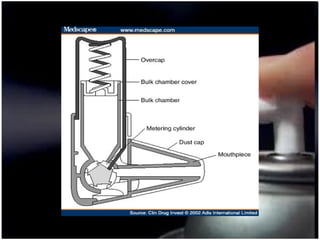
DPI design issues
• Inhaler design, especially the geometry of
the mouth piece, is critical for patients to
produce an air flow sufficient to lift the
drug from the dose chamber, break up the
agglomerates in the turbulant air stream
and deliver the drug dose to the lungs as
therapeutically effective fine particles.
32
33
Principle of operation
• When the patient actuates the DPI and
inhales, airflow though the device creates
shear and turbulence; air is introduced in
to the powder bed and the static powder
blend is fluidized and enters the patient
airways. There the drug particles separate
from the carrier particles and are carried
deep into the lungs to exert the effects.
34
Evaluation
• Appearance
• Identity
• Microbial limits
• Water content
• Extractives
• Drug related impurities
• Particle analysis
• Drug content per unit dose/dose delivery
35
Advantages
• Propellant free design
• Less need for patient coordination
• Less potential for formulation problems
• Environmental sustainability
• Less potential for extractable from device
components
36
Disadvantages
• Dependency on patient inspiration flow
rate and profile
• Device resistance and other device issues
• More expensive than pressurized MDI
• Complex development and manufacture
• Not available world wide
• Greater potential problems in dose
uniformity
37

Aerosol's

  • 1.
  • 2.
    Definition Packaging of therapeuticactive ingredients in a pressurized system. Aerosols are depends on the power of compressed or liquefied gas to expel the contents from containers.
  • 3.
    3 Advantages A dose canbe removed with out contamination of materials. The medication can be delivered directly to the affected area in a desired form, such as spray, steam, quick breaking foam or stable foam. Irritation produced by the mechanical application of topical medication is reduced or eliminated. Ease of convenience of application. Application of medication in thin layer
  • 4.
    4 Components of aerosols Propellant Container Valveand actuator Product concentrate container
  • 5.
    5 Propellant #It is responsiblefor developing the power pressure with in the container and also expel the product when the valve is opened and in the atomization or foam production of the product. # For oral and inhalation eg. Fluorinated hydrocarbons Dichlorodifluromethane (propellent 12) Dichlorotetrafluromethane (propellent 114) # Topical preparation Propane Butane Isobutane # Compound gases Nitrogen Carbon di oxide Nitrous oxide
  • 6.
    6 Containers They must bestand at pressure as high as 140 to 180 psig (pounds per sq. inch gauge) at 1300 F. A. Metals 1. Tinplated steel (a) Side-seam (three pieces) (b) Two-piece or drawn (c) Tin free steel 2. Aluminium (a) Two-piece (b) One-piece (extruded or drawn) 3. Stainless steel B. Glass 1. Uncoated glass 2. Plastic coated glass
  • 7.
    7 Physiochemical properties of propellants Vaporpressure Boiling points Liquid density
  • 8.
    8 Valves To delivered thedrug in desired form. To give proper amount of medication. Not differ from valve to valve of medication in pharmaceutical preparation. Types - Continuous spray valve - High speed production technique. - Metering valves Dispersing of potent medication at proper dispersion/ spray approximately 50 to 150 mg ±10 % of liquid materials at one time use of same valve.
  • 9.
    9 Valve components  Ferrul ormount cap  Valve body or housing  Stem  Gasket  Spring  Dip tube Gasket spring
  • 10.
    10 Actuator To ensure thataerosol product is delivered in the proper and desired form. Different types of actuators Spray actuators Foam actuators Solid steam actuators Special actuators
  • 11.
    11 Formulation of pharmaceuticalaerosols Contains two essential components • Product concentrate • Propellant Product concentrate Product concentrate contains ingredients or mixture of active ingredients and other such as solvents, antioxidants and surfactants. Propellant May be single or blend of various propellants  Blends of propellant used in a p’ceutical formulation to achieve desired solubility characteristics or various surfactants are mixed to give the proper HLB value for emulsion system.  To give the desired vapor pressure, solubility & particle size.
  • 12.
    12 Parameters consideration  Physical,chemical and p’ceutical properties of active ingredients.  Site of application
  • 13.
    13 Types of system Solutionsystem Water based system Suspension or Dispersion systems Foam systems 1. Aqueous stable foams 2. Nonaqueous stable foams 3. Quick-breaking foams 4. Thermal foams Intranasal aerosols
  • 14.
    14 Manufacturing of PharmaceuticalAerosols Apparatus  Pressure filling apparatus  Cold filling apparatus  Compressed gas filling apparatus
  • 15.
    15 Quality control forpharmaceutical aerosols Propellants Valves, actuator and dip tubes Testing procedure Valve acceptance Containers Weight checking Leak testing Spray testing
  • 16.
    16 Evaluation parameters ofpharmaceutical aerosols A. Flammability and combustibility 1. Flash point 2. Flame extension, including flashback B. Physiochemical characteristics 1. Vapor pressure • Density • Moisture content • Identification of propellant(s) • Concentrate-propellant ratio C. Performance 1. Aerosol valve discharge rate 1. Spray pattern 2. Dosage with metered valves 3. Net contents 4. Foam stability 5. Particle size determination 6. Leakage D. Biologic characteristics E. Therapeutic activity
  • 17.
    17 Flame Projection ** Thistest indicates the effect of an aerosol formulation on the extension of an open flame. ** Product is sprayed for 4 sec. into flame. ** Depending on the nature of formulation, the fame is extended, and exact length was measured with ruler.
  • 18.
    18 Flash point • Determinedby using standard Tag Open Cap Apparatus. Step involves are  • Aerosol product is chilled to temperature of - 25 0 F and transferred to the test apparatus. • Temperature of test liquid increased slowly, and the temperature at which the vapors ignite is taken a flash point. • Calculated for flammable component, which in case of topical hydrocarbons.
  • 19.
    19 Vapor pressure Determined bypressure gauge Variation in pressure indicates the presence of air in headspace. A can punctuating device is available for accurately measuring vapor pressure.
  • 20.
    20 Density Determined by hydrometeror a pycnometer. Step involves are  • A pressure tube is fitted with metal fingers and hoke valve, which allow for the introduction of liquids under pressure. • The hydrometer is placed in to the glass pressure tube. •Sufficient sample is introduced through the valve to cause the hydrometer to rise half way up the length of the tube. •The density can be read directly.
  • 21.
    21 Moisture content Method used— Karl Fischer method  G. C has also been used Identification of propellants  G.C,  I.R spectrophotometry Aerosol valve discharge rate Determined by taking an aerosol known weight and discharging the contents for given time using standard apparatus. By reweighing the container after time limit has expired, the change in weight per time dispensed is discharge rate, Expressed as gram per seconds.
  • 22.
    22 Dosage with meteredvalves Amt. of medication actually received by the patient. Reproducibility has been determined by assay technique, Another method is that, involves accurate weighing of filled container fallowed by dispersing of several doses, container can reweighed, and difference in weight divided by No. of dose, gives the average dosage. Reproducibility of dosage each time the valve is dispersed
  • 23.
    23 Net contents •Weight method •Filledfull container, and dispensing the contents Foam stability • Visual evaluation • Time for a given mass to penetrate the foam • Times for given rod that is inserted into the foam to fall • The use of rotational viscometers
  • 24.
    24 Particle size determination Cascadeimpactor Light scatter decay method Cascade impactor Operates on the projected through a series of nozzle and glass slides at high viscosity, the large particles become impacted first on the lower velocity stages, and the smaller particals pass on and are collected at high velocity stages. These practical ranging from 0.1 to 30 micron and retaining on RTI. Modification made to improve efficacy Cascade impctor
  • 25.
    25 Porush, Thiel andYoung used light scattering method to determine particle size. As aerosols settle in turbulent condition , the change in light intensity of Tyndall beam is measured Sciarra and Cutie developed method based on practical size distribution.
  • 26.
    26 Metered dose inhaler Toincreased interest in modifying metered dose inhalers (MDIs) to minimize the number of administration error and to improve the drug delivery of aerosols particles into the drug delivery system of the nasal passageways and respiratory tract.
  • 27.
    27 DRY POWDER INHALERS(DPIs) • InDPI systems, drug is inhaled as a cloud of fine particles. The drug is either preloaded in an inhalation device or filled into hard gelatin capsule or foil blister discs which are loaded in to a device prior to use. • Dry powder inhalers are devices through which dry powder formulation of an active drug is delivered for local or systemic action via pulmonary route. • They are bolus drug delivery systems that contain solid drug substance that is suspended or dissolved in a non- polar propellant that is fluidized when the patient inhales.
  • 28.
    28 Ideal DPI • Effectivedosing uniform dose targeted delivery operable at low inhalation flow rates • Efficient device • Easy to use
  • 29.
    29 FORMULATION • DPI formulationsare generally engineered composites, containing a drug material of micron size formulated with or without a large carrier material. The formulation is formulated around a device that when actuated by patient is capable of producing a respirable aerosol cloud that penetrates the respiratory tract and reaches the site of action.
  • 30.
    30 STEPS INVOLVED IN FORMULATION •Active Pharmaceutical Ingredient(API) production. • Formulation of API with or without carriers. • Integration of the formulation into device.
  • 31.
    31 DPI design issues •Inhaler design, especially the geometry of the mouth piece, is critical for patients to produce an air flow sufficient to lift the drug from the dose chamber, break up the agglomerates in the turbulant air stream and deliver the drug dose to the lungs as therapeutically effective fine particles.
  • 32.
  • 33.
    33 Principle of operation •When the patient actuates the DPI and inhales, airflow though the device creates shear and turbulence; air is introduced in to the powder bed and the static powder blend is fluidized and enters the patient airways. There the drug particles separate from the carrier particles and are carried deep into the lungs to exert the effects.
  • 34.
    34 Evaluation • Appearance • Identity •Microbial limits • Water content • Extractives • Drug related impurities • Particle analysis • Drug content per unit dose/dose delivery
  • 35.
    35 Advantages • Propellant freedesign • Less need for patient coordination • Less potential for formulation problems • Environmental sustainability • Less potential for extractable from device components
  • 36.
    36 Disadvantages • Dependency onpatient inspiration flow rate and profile • Device resistance and other device issues • More expensive than pressurized MDI • Complex development and manufacture • Not available world wide • Greater potential problems in dose uniformity
  • 37.

Editor's Notes

  • #28 The propellants used in MDI formulations are liquefied gases, chlorofluo rocarbons (CFC),