AEROSOL
Nirmal Raj Marasine (Clinical Pharmacist,
M.Pharma)
WHSA
The advantages of Aerosol over other
dosage forms
• A portion of medication may be easily withdrawn from
the container without contamination or exposure to the
remaining materials
• Due to its hermetic character, the aerosol container
protects the product from adverse effects of
atmospheric air and moisture.
• Being opaque, the aerosol container also protects the
drugs from light throughout the shelf life
• Topical aerosols may be applied in a uniform thin layer
to the skin without touching the affected.
DEFINITION
• "Aerosol is a pressurized dosage forms containing one
or more therapeutic active ingredients which upon
actuation emit a fine dispersion of liquid and/or solid
materials in a gaseous medium.
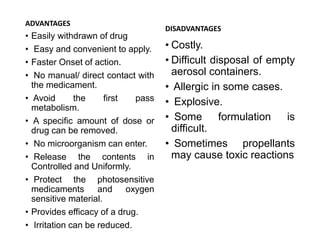
ADVANTAGES
• Easily withdrawn of drug
• Easy and convenient to apply.
• Faster Onset of action.
• No manual/ direct contact with
the medicament.
• Avoid the first pass
metabolism.
• A specific amount of dose or
drug can be removed.
• No microorganism can enter.
• Release the contents in
Controlled and Uniformly.
• Protect the photosensitive
medicaments and oxygen
sensitive material.
• Provides efficacy of a drug.
• Irritation can be reduced.
DISADVANTAGES
• Costly.
• Difficult disposal of empty
aerosol containers.
• Allergic in some cases.
• Explosive.
• Some formulation is
difficult.
• Sometimes propellants
may cause toxic reactions
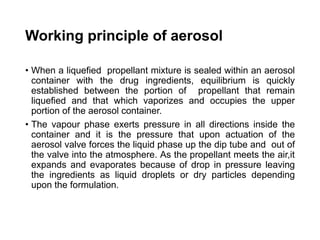
Working principle of aerosol
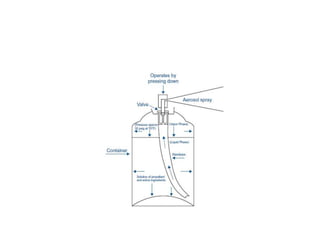
• When a liquefied propellant mixture is sealed within an aerosol
container with the drug ingredients, equilibrium is quickly
established between the portion of propellant that remain
liquefied and that which vaporizes and occupies the upper
portion of the aerosol container.
• The vapour phase exerts pressure in all directions inside the
container and it is the pressure that upon actuation of the
aerosol valve forces the liquid phase up the dip tube and out of
the valve into the atmosphere. As the propellant meets the air,it
expands and evaporates because of drop in pressure leaving
the ingredients as liquid droplets or dry particles depending
upon the formulation.
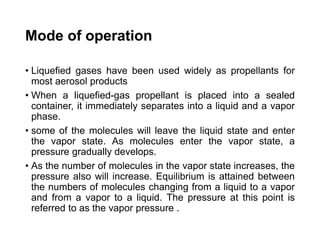
Mode of operation
• Liquefied gases have been used widely as propellants for
most aerosol products
• When a liquefied-gas propellant is placed into a sealed
container, it immediately separates into a liquid and a vapor
phase.
• some of the molecules will leave the liquid state and enter
the vapor state. As molecules enter the vapor state, a
pressure gradually develops.
• As the number of molecules in the vapor state increases, the
pressure also will increase. Equilibrium is attained between
the numbers of molecules changing from a liquid to a vapor
and from a vapor to a liquid. The pressure at this point is
referred to as the vapor pressure .
• This vapor pressure is exerted equally in all directions and is
independent of the quantity of liquefied gas present
• The pressure exerted against the liquid phase is sufficient to
push the latter up a dip tube and against the valve.
• When the valve is opened, the liquid phase is emitted and
comes into contact with the warm air at atmospheric pressure
and propellant immediately reverts to the vapor state.
• As the contents of the container are expelled, the volume within
the container occupied by the vaporized propellant increases,
causing a temporary fall in pressure
• However, as soon as the pressure decreases, a sufficient
number of molecules change from the liquid state to the vapor
state and restore the original pressure.
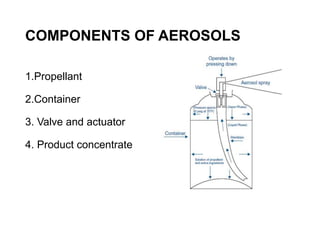
COMPONENTS OF AEROSOLS
1.Propellant
2.Container
3. Valve and actuator
4. Product concentrate
1.PROPELLANTS
• Responsible for developing proper pressure within the
container.
• Provide driving force to expel the product from the
container.
TYPES OF PROPELLANTS
• Compounds useful as propellants can be classified as the
following:
• Liquefied gases
• Chlorofluorocarbons (CFC)
• Hydrochlorofluorocarbons (HCFC)
• Hydrofluorocarbons (HFC) or Hydrofluoroalkaines (HFA)
• Hydrocarbons (HC)
• Hydrocarbon ethers
• Compressed gases
2.CONTAINERS
• They must be able to withstand pressures as high as
140 to 180 psig (pounds per sq. inch gauge) at 130 ° F.
AEROSOL CONTAINERS
A . Metals
1. Tinplated steel
2. Aluminum
3. Stainless steel
B. Glass
1. Uncoated glass
2. Plastic coated glass
3.VALVES
• Easy to open and close .
• Capable of delivering the content in the desired form
such as spray, foam, solid stream etc.
• It can deliver a given amount of medicament .
TYPES OF VALVES :
• 1.Continuous spray valve
• 2.Metering valves
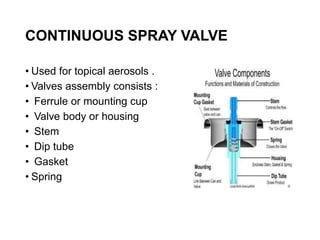
CONTINUOUS SPRAY VALVE
• Used for topical aerosols .
• Valves assembly consists :
• Ferrule or mounting cup
• Valve body or housing
• Stem
• Dip tube
• Gasket
• Spring
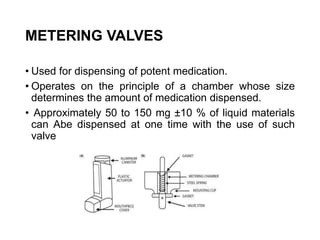
METERING VALVES
• Used for dispensing of potent medication.
• Operates on the principle of a chamber whose size
determines the amount of medication dispensed.
• Approximately 50 to 150 mg ±10 % of liquid materials
can Abe dispensed at one time with the use of such
valve
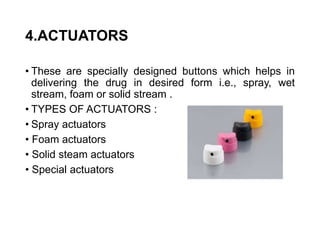
4.ACTUATORS
• These are specially designed buttons which helps in
delivering the drug in desired form i.e., spray, wet
stream, foam or solid stream .
• TYPES OF ACTUATORS :
• Spray actuators
• Foam actuators
• Solid steam actuators
• Special actuators
• SPRAY ACTUATORS:
• It can be used for topical preparation, such as antiseptics,
local anesthetics and spray on bandages etc.
• It allows the stream of product concentrate and propellant to
pass through various openings and dispense as spray.
FOAM ACTUATORS :
• It consist of large orifice which ranges from 0.070—0.125
inch .
SOLID STREAM ACTUATORS :
• These actuators are required for dispensing semi solid
products such as ointments .
SPECIAL ACTUATORS :
• These are used for a specific purpose.
• It delivers the medicament to the appropriate site of action
such as throat, nose, dental and eyes etc.
5.PRODUCT CONCENTRATE
• Other excipients are perfumes, flavoring, preservatives,
antioxidant buffering agents, surfactants etc.
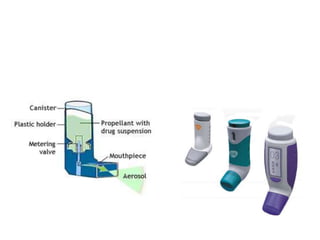
METERED DOSE INHALERS
• Used to minimize the number of administration errors.
• To improve the drug delivery of aerosolized particles into the
nasal passageways and respiratory tract.
Advantages of MDI:
• It delivers specified amount of dose .
• Portable and compact.
• Quick to use , no contamination of product.
• Dose-dose reproducibility is high.
Disadvantages of MDI :
• Low lung deposition ; high pharyngeal deposition .
• Coordination of MDI actuation and patient inhalation is
needed.
Dry powder inhaler
• DPI are devices through which a dry powder formulation of an
active drug is delivered for local or systemic effect via the
pulmonary route
• Used to treat respiratory diseases such as asthma, COPD,
bronchitis etc.
• Dry powders for inhalation are formulated either as loose
agglomerates of micronized drug particles with aerodynamic
particle sizes of less than 5 μm
• Where as for systemic effects particle size of less than 2 μm is
needed for drug deposition in the small peripheral airways.
why use Inhalers?
• Rapid action Smaller dose is required Portable (Easy
to handle)
• No co-ordination required Suitable for all patient Easy
to administration of drug Avoid 1 st pass metabolism
Good bioavailability
• No dose counter is required
Advantages
• Propellants free design.
• Provides rapid drug action.
• High drug dose carrying capacities, reproducibility
(Monodisperse).
• low device retention and low exhaled loss.
• Provides local action within the respiratory tract and
are non-invasive.
• Better patient compliance, simple to use and
convenient to carry and do not require spacers.
• Less potential for formulation problems.
Disadvantages
• Deposition efficiency depends on patients inspiratory
airflow.
• Greater potential problems in dose uniformity.
• Less protection from environmental effects, Humidity
may cause powders to aggregate and capsules to
soften.
• Dose lost if patient inadvertently exhales into the DPI
• More expensive than pressurized metered dose
inhalers

Aerosol

  • 1.
    AEROSOL Nirmal Raj Marasine(Clinical Pharmacist, M.Pharma) WHSA
  • 2.
    The advantages ofAerosol over other dosage forms • A portion of medication may be easily withdrawn from the container without contamination or exposure to the remaining materials • Due to its hermetic character, the aerosol container protects the product from adverse effects of atmospheric air and moisture. • Being opaque, the aerosol container also protects the drugs from light throughout the shelf life • Topical aerosols may be applied in a uniform thin layer to the skin without touching the affected.
  • 3.
    DEFINITION • "Aerosol isa pressurized dosage forms containing one or more therapeutic active ingredients which upon actuation emit a fine dispersion of liquid and/or solid materials in a gaseous medium.
  • 4.
    ADVANTAGES • Easily withdrawnof drug • Easy and convenient to apply. • Faster Onset of action. • No manual/ direct contact with the medicament. • Avoid the first pass metabolism. • A specific amount of dose or drug can be removed. • No microorganism can enter. • Release the contents in Controlled and Uniformly. • Protect the photosensitive medicaments and oxygen sensitive material. • Provides efficacy of a drug. • Irritation can be reduced. DISADVANTAGES • Costly. • Difficult disposal of empty aerosol containers. • Allergic in some cases. • Explosive. • Some formulation is difficult. • Sometimes propellants may cause toxic reactions
  • 5.
    Working principle ofaerosol • When a liquefied propellant mixture is sealed within an aerosol container with the drug ingredients, equilibrium is quickly established between the portion of propellant that remain liquefied and that which vaporizes and occupies the upper portion of the aerosol container. • The vapour phase exerts pressure in all directions inside the container and it is the pressure that upon actuation of the aerosol valve forces the liquid phase up the dip tube and out of the valve into the atmosphere. As the propellant meets the air,it expands and evaporates because of drop in pressure leaving the ingredients as liquid droplets or dry particles depending upon the formulation.
  • 7.
    Mode of operation •Liquefied gases have been used widely as propellants for most aerosol products • When a liquefied-gas propellant is placed into a sealed container, it immediately separates into a liquid and a vapor phase. • some of the molecules will leave the liquid state and enter the vapor state. As molecules enter the vapor state, a pressure gradually develops. • As the number of molecules in the vapor state increases, the pressure also will increase. Equilibrium is attained between the numbers of molecules changing from a liquid to a vapor and from a vapor to a liquid. The pressure at this point is referred to as the vapor pressure .
  • 8.
    • This vaporpressure is exerted equally in all directions and is independent of the quantity of liquefied gas present • The pressure exerted against the liquid phase is sufficient to push the latter up a dip tube and against the valve. • When the valve is opened, the liquid phase is emitted and comes into contact with the warm air at atmospheric pressure and propellant immediately reverts to the vapor state. • As the contents of the container are expelled, the volume within the container occupied by the vaporized propellant increases, causing a temporary fall in pressure • However, as soon as the pressure decreases, a sufficient number of molecules change from the liquid state to the vapor state and restore the original pressure.
  • 9.
    COMPONENTS OF AEROSOLS 1.Propellant 2.Container 3.Valve and actuator 4. Product concentrate
  • 10.
    1.PROPELLANTS • Responsible fordeveloping proper pressure within the container. • Provide driving force to expel the product from the container. TYPES OF PROPELLANTS • Compounds useful as propellants can be classified as the following: • Liquefied gases • Chlorofluorocarbons (CFC) • Hydrochlorofluorocarbons (HCFC) • Hydrofluorocarbons (HFC) or Hydrofluoroalkaines (HFA) • Hydrocarbons (HC) • Hydrocarbon ethers • Compressed gases
  • 11.
    2.CONTAINERS • They mustbe able to withstand pressures as high as 140 to 180 psig (pounds per sq. inch gauge) at 130 ° F. AEROSOL CONTAINERS A . Metals 1. Tinplated steel 2. Aluminum 3. Stainless steel B. Glass 1. Uncoated glass 2. Plastic coated glass
  • 12.
    3.VALVES • Easy toopen and close . • Capable of delivering the content in the desired form such as spray, foam, solid stream etc. • It can deliver a given amount of medicament . TYPES OF VALVES : • 1.Continuous spray valve • 2.Metering valves
  • 13.
    CONTINUOUS SPRAY VALVE •Used for topical aerosols . • Valves assembly consists : • Ferrule or mounting cup • Valve body or housing • Stem • Dip tube • Gasket • Spring
  • 14.
    METERING VALVES • Usedfor dispensing of potent medication. • Operates on the principle of a chamber whose size determines the amount of medication dispensed. • Approximately 50 to 150 mg ±10 % of liquid materials can Abe dispensed at one time with the use of such valve
  • 15.
    4.ACTUATORS • These arespecially designed buttons which helps in delivering the drug in desired form i.e., spray, wet stream, foam or solid stream . • TYPES OF ACTUATORS : • Spray actuators • Foam actuators • Solid steam actuators • Special actuators
  • 16.
    • SPRAY ACTUATORS: •It can be used for topical preparation, such as antiseptics, local anesthetics and spray on bandages etc. • It allows the stream of product concentrate and propellant to pass through various openings and dispense as spray. FOAM ACTUATORS : • It consist of large orifice which ranges from 0.070—0.125 inch . SOLID STREAM ACTUATORS : • These actuators are required for dispensing semi solid products such as ointments . SPECIAL ACTUATORS : • These are used for a specific purpose. • It delivers the medicament to the appropriate site of action such as throat, nose, dental and eyes etc.
  • 17.
    5.PRODUCT CONCENTRATE • Otherexcipients are perfumes, flavoring, preservatives, antioxidant buffering agents, surfactants etc.
  • 18.
    METERED DOSE INHALERS •Used to minimize the number of administration errors. • To improve the drug delivery of aerosolized particles into the nasal passageways and respiratory tract. Advantages of MDI: • It delivers specified amount of dose . • Portable and compact. • Quick to use , no contamination of product. • Dose-dose reproducibility is high. Disadvantages of MDI : • Low lung deposition ; high pharyngeal deposition . • Coordination of MDI actuation and patient inhalation is needed.
  • 20.
    Dry powder inhaler •DPI are devices through which a dry powder formulation of an active drug is delivered for local or systemic effect via the pulmonary route • Used to treat respiratory diseases such as asthma, COPD, bronchitis etc. • Dry powders for inhalation are formulated either as loose agglomerates of micronized drug particles with aerodynamic particle sizes of less than 5 μm • Where as for systemic effects particle size of less than 2 μm is needed for drug deposition in the small peripheral airways.
  • 21.
    why use Inhalers? •Rapid action Smaller dose is required Portable (Easy to handle) • No co-ordination required Suitable for all patient Easy to administration of drug Avoid 1 st pass metabolism Good bioavailability • No dose counter is required
  • 22.
    Advantages • Propellants freedesign. • Provides rapid drug action. • High drug dose carrying capacities, reproducibility (Monodisperse). • low device retention and low exhaled loss. • Provides local action within the respiratory tract and are non-invasive. • Better patient compliance, simple to use and convenient to carry and do not require spacers. • Less potential for formulation problems.
  • 23.
    Disadvantages • Deposition efficiencydepends on patients inspiratory airflow. • Greater potential problems in dose uniformity. • Less protection from environmental effects, Humidity may cause powders to aggregate and capsules to soften. • Dose lost if patient inadvertently exhales into the DPI • More expensive than pressurized metered dose inhalers

Editor's Notes

  • #8 hese compounds are useful for this purpose, since they are gases at room temperature and atmospheric pressure.