Download to read offline
![IJRET: International Journal of Research in Engineering and Technology eISSN: 2319-1163 | pISSN: 2321-7308
__________________________________________________________________________________________
Volume: 02 Issue: 10 | Oct-2013, Available @ http://www.ijret.org 500
ADVISEDLY DELAYED PACKET ATTACK ON TCP-BASED MOBILE
AD-HOC NETWORKS
Romil Nehra1
, Narendra Yadav2
1, 2
Department of Computer Science and Engineering, Sri Balaji College of Engineering and Technology, Jaipur,
Rajasthan, India, romil.nehra@gmail.com, narensinghyadav@yahoo.com
Abstract
Efficient routing in mobile ad-hoc networks (MANETs) is a challenging task due to its varying physical channel characteristics,
dynamic topology and un-centralized communication. Furthermore, multihop routing is required when the source-destination pairs
are not in each other’s communication range. Due to the above challenges these networks are vulnerable to various types of attacks
on various layers of the TCP/IP protocol stack. In this thesis, we implement and analyze an attack called advisedly delay packet attack
on ad-hoc on-demand distance vector (AODV) routing protocol. The advisedly delay packet attack is an attack that effects the TCP-
based as well as UDP-based data transmissions but in this thesis we will also see how it exploits the TCP congestion control
mechanism to decrease the throughput of the network. In this attack, the attacker exploit the period of retransmission time out (RTO)
of the sender and attack in such a way so the sender is always transmitting in the slow start phase.
Keywords- MANETs; Multimedia Streaming; Routing protocols; QoS; Topology; Node Mobility; Network Scalability
----------------------------------------------------------------------***-----------------------------------------------------------------------
1. INTRODUCTION
Mobile ad-hoc network is a dynamic network formed by
independent system of randomly moving mobile nodes. Nodes
are connected through wireless links without utilizing the
existing network infrastructure or any form of centralized
administration. Each node is able to communicate directly
with nodes in its transmission range. For nodes outside
communication range, intermediate nodes are used to relay the
message hop by hop. Hence, such networks are called “multi-
hop” networks.
In an ad-hoc network, it is required that a node forwards or
routes data packets on behalf of other nodes. Each node,
therefore, acts as a host and a router, necessitating use of
routing protocols to make routing decisions. Many routing
protocols have been proposed by the researchers. The biggest
challenge for routing protocols is to establish and re-establish
routes in the face of dynamically varying network topology
and network partitions due to node mobility. Depending on
how the mobile nodes acquire and maintain routing
information, MANET routing protocols can be classified as
either reactive or proactive.
This paper is organized in the following manner. In Section II,
we present the related work done in our area which includes
the papers that are proposed the effective routing methods.
This is followed by the proposed work for efficient routing for
delay-sensitive applications in Section III. We also
summarize the key features, basic operation, as well as major
pros and cons of our proposed approach. In Section IV, We
will conclude the paper with present state of the art and future
work.
2. RELATED WORK
In this section, we discuss the past works done in MANET
that includes the evolution of many new attacks.
In [1] and [2], the attack is one of the most serious attacks on
MANETs. In wormhole attack at least two attackers are
required to perform the attack very effectively. These two
attackers resides on different areas of the network makes a
tunnel through the network to communicate with each other.
The attackers broadcast the wrong information to the other
nodes in the network that the destination is only one hop away
from them. Sometimes they also broadcast the wrong
information that they are true neighbors of each other due to
this the attacker one which is near to source node is easily
selected on the route between the source destination pair when
the route is discovered on the basis of lowest number of hops
on the route.
In [3], the attacker when received a route request (RREQ)
message it modifies the sequence number in the RREQ
message to perform the attack. The attacker increases the
sequence number more than the usual number and reply back
to the source to make it believe that it has the better and
fresher route to the destination node. Once the source node got
this reply it start the transmission of data packet on the route
which consists of the attacker i.e., one of the intermediate
node of the established route is the attacker. Till now half of](https://image.slidesharecdn.com/advisedlydelayedpacketattackontcp-basedmobile-140805052922-phpapp02/75/Advisedly-delayed-packet-attack-on-tcp-based-mobile-1-2048.jpg)
![IJRET: International Journal of Research in Engineering and Technology eISSN: 2319-1163 | pISSN: 2321-7308
__________________________________________________________________________________________
Volume: 02 Issue: 10 | Oct-2013, Available @ http://www.ijret.org 501
the attack is performed by the attacker by spreading the false
information and making himself the part of the route. Now
when the data communication is started using the route the
attacker will drop all the data packets that reaches to it that is
when the attacker got the data packet for forwarding it drops
the packet without forwarding any of the data packets.
In [4], Flooding attack is the simplest attack to implement but
it is one of the most dangerous attacks. In this attack, the
attacker broadcast the false control or data packets in the
network due to which the network bandwidth is wasted largely
and the non-false packets are not able to reach their
destinations.
In [5]: As the communication in MANETs is multi hop
therefore the intermediate nodes plays an important role in
data communication over MANETs. The intermediate nodes
can become selfish by either using the wireless channel
unnecessary due to which the other nearby channels has to
contend more time to access the channel.
In [6] has analyzed the impact of packet re-ordering attack
over various TCP-variants using the MANET routing
protocols named AODV and DSR. Although authors claim
that they have investigated various versions of TCP but the
simulation results show graphs for TCP-Reno and TCP-
NewReno. Furthermore, the effect of packet re-ordering is not
analyzed in UDP-based data communications. Also, the
author’s uses only network throughput as an metric for the
performance evaluation but other important metric such as
number of retransmissions which greatly increases network
congestion and delay in the network is not examined. Finally,
it is not understandable that why the authors uses and
compares AODV and DSR routing protocols in his paper
because the re-ordering attack is used to effect the close-loop
attacks only and are independent on the underlying protocol
used for the routing.
3. PROPOSED METHODOLOGY
In proposed advisedly delayed data packets attack an attacker
node delays some or all packets with randomly or selectively
chosen delay periods during the data communication process.
The attacker node should be one of the intermediate nodes on
the route between the source destination pair to effectively
perform this attack. The attacker can perform the proposed
delaying attack in one of the following two ways:
a) The attacker can delay a percentage of the total
number of packets it receives in a fixed amount of
time all the delay time can be chosen same or
differently over a range. For example, the attacker
can delay 200 data packets from every 1000 data
packets it receives for the forwarding towards the
destination. Also, it can delay 100 packets from these
200 packets with the fixed delay period say 200
milliseconds while the other 100 packets are delayed
by selected a random period from 100 to 300
milliseconds.
b) The second way in which the attacker node can
perform the delayed attack is by delaying all data
packets that are arrived for a fixed period of time
each time from a fixed amount of time. For example,
the attacker node will start delaying all the packets it
receives in the first 100 milliseconds of every second.
Again the delayed period can either be fixed or
variable chosen from a given interval of time.
When the above mentioned packet delaying attack is
performed on a data communication session that is
transmitting data packets using the TCP protocol The
following can be result: due to the data packets delays at
intermediate nodes the retransmission time out of delayed data
packets triggers their retransmissions at the source node either
due to the time out of the RTO used by the source TCP.
Figure1 Packet dropping attack
Pseudo Code for proposed Delay-Aware Routing
Protocol
Processing of data packet received by an attacker
node
Variable used:
////////////////////////////////////
S = Source node
D = Destination node
A = Attacker node
I = Intermediate node
T_window = time window from which the attacker node
selects the delay period
T_period = delay duration selected randomly from the
T_window
//////////////////////////////////
IF1 (I got a data packet)
I check its AODV routing table
IF2 (Route is present in the routing table)](https://image.slidesharecdn.com/advisedlydelayedpacketattackontcp-basedmobile-140805052922-phpapp02/75/Advisedly-delayed-packet-attack-on-tcp-based-mobile-2-2048.jpg)
![IJRET: International Journal of Research in Engineering and Technology eISSN: 2319-1163 | pISSN: 2321-7308
__________________________________________________________________________________________
Volume: 02 Issue: 10 | Oct-2013, Available @ http://www.ijret.org 503
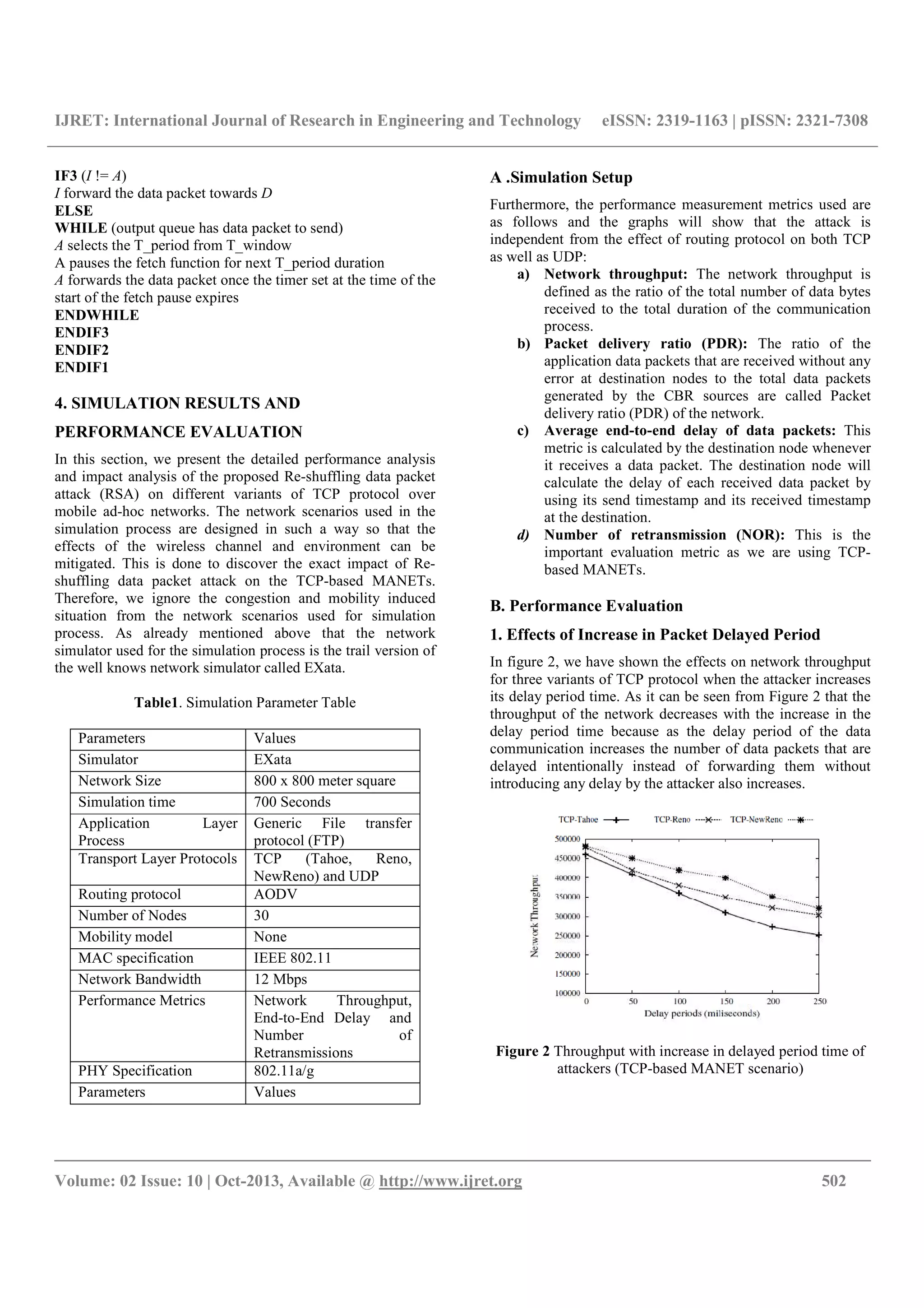
Figure 3 Number of retransmissions with increase in
percentage drop time of attackers (TCP-based MANET
scenario)
2. Effects of Increase Number of Attackers in TCP-
Based Manets
In this section, we analyze the performance of three TCP
protocol variants with the increase in the number of attackers
in an active route between any source-destination pair. The
metrics used for the analysis are network throughput and
number of re-transmissions caused during the whole duration
of data communication of a data session.
Figure 4 Throughput with increase in number of attackers on
the route (TCP-based MANET scenario)
Figure 5 Number of retransmissions with increase in number
of attackers on the route (TCP-based MANET scenario)
CONCLUSIONS AND FUTURE WORK
In this section, we have presented the conclusion and future
work for the paper. To perform the work proposed in this
thesis we start with the basics of the mobile ad-hoc networks.
We have studied about the MANETs and its characteristics
and its challenges and issues that are faced by the researchers
when performing the routing over these networks. After the
in-depth introduction of MANETs we started the related work
which is similar to our proposed work in this thesis. For this
we have studied all forms of existing attacks over Mobile ad-
hoc networks. As it can be easily seen from the work
presented in Chapter 4 that the proposed Advisedly Delaying
Packet (ADP) attack is a simple yet very powerful denial of
service (DoS) attack that is effective on both TCP and UDP
based MANETs. The simulation results clearly show the
impact of proposed attack on the network throughput,
bandwidth wastage and end-to-end delay data quality. It has
also been observed that even though the TCP congestion
control is adaptable to the packet losses but in case of the
forced delayed attack it is fully unable to detect whether the
packet is dropped or delayed and these are the result of the
attacker misbehaving or it is due to the congestion or other
wireless environmental problem. For this we have studied all
forms of existing attacks over Mobile ad-hoc networks. The
simulation results clearly show the impact of proposed attack
on the network throughput, bandwidth wastage and received
data quality.
For the future work, we will try to discover a detection
mechanism for the attacker nodes so that they can be removed
from further communications. Once detected the source node
or network has to make sure that this attacker will not become
the part of any active routes in the network. Also, we will try
to figure out the other closely related attacks that can be
possible to induce by a simple modification on our attack.
REFRENCES
[1] George Hoffman, Yoko Ono, Akiko Kawakami,
Kenichi Kusano, and Takashi Manabe Japan
Communications 2012 Top 10 Predictions
http://www.idc.com/getdoc.jsp?containerId=JP1376002
U.
[2] Trends — Survey Says Wireless Net- works Expand for
Mobile Growth.
http://edtechdigest.wordpress.com/2011/10/18/trends-
survey-says-wirele
[3] Raza, I. and Hussain, S.A. and Ali, A. and Hassan
Raza, M. : Persistent packet reordering attack in TCP
based Ad hoc wireless networks, Information and
Emerging Technologies (ICIET), 2010 International
Conference, 2010.
[4] C. Perkins and E. Royer. Ad hoc on-demand distance
vector routing. 1999.](https://image.slidesharecdn.com/advisedlydelayedpacketattackontcp-basedmobile-140805052922-phpapp02/75/Advisedly-delayed-packet-attack-on-tcp-based-mobile-4-2048.jpg)
![IJRET: International Journal of Research in Engineering and Technology eISSN: 2319-1163 | pISSN: 2321-7308
__________________________________________________________________________________________
Volume: 02 Issue: 10 | Oct-2013, Available @ http://www.ijret.org 504
[5] A. Mishra, R. Jaiswal, and S. Sharma. A novel
approach for detecting and eliminating cooperative
black hole attack using advanced dri table in ad hoc
network. In Advance Computing Conference (IACC),
2013 IEEE 3rd International, 2013.
[6] Yih-Chun Hu; Perrig, A.; Johnson, D.B., "Wormhole
attacks in wireless networks," Selected Areas in
Communications, IEEE Journal on , vol.24, no.2,
pp.370,380, Feb. 2006.
[7] Hoang Lan Nguyen and Uyen Trang Nguyen. A study
of different types of attacks in mobile ad hoc networks.
In Electrical Computer Engineering (CCECE), 2012
25th IEEE Canadian Conference on, 2012.
[8] M.T.Refaei V.Srivastava L.Dasilva and M.Eltoweissy.
A reputation-based mechanism for isolating selfish
nodes in ad hoc networks. In International Conference
on Mobile and Ubiquitous Systems, Networking and
Services, July 2005.
[9] Ping Yi; Zhoulin Dai; Yi-ping Zhong; Shiyong Zhang,
"Resisting flooding attacks in ad hoc networks,"
Information Technology: Coding and Computing, 2005.
ITCC 2005. International Conference on , vol.2, no.,
pp.657,662 Vol. 2, 4-6 April 2005.
[10] Carl, G.; Kesidis, G.; Brooks, R.R.; Rai, S., "Denial-of-
service attack-detection techniques," Internet
Computing, IEEE , vol.10, no.1, pp.82,89, Jan.-Feb.
2006.
[11] JOHNSON David B. The dynamic source routing
protocol for mobile ad hoc networks (dsr). Internet-
Draft, 2004.
[12] Chen, S., Nahrstedt, K.: Distributed quality-of-service
routing in ad hoc networks. Selected Areas in
Communications, IEEE Journal 17, 1488–1505 (1999).
[13] Zeadally, Sherali and Hunt, Ray and Chen, Yuh-Shyan
and Irwin, Angela and Hassan, Aamir,” Vehicular ad
hoc networks (VANETS): status, results,
and challenges”, Telecommunication Systems, Springer
US, 2012.
[14] Chakrabarti, S., Mishra, A.: QoS issues in ad hoc
wireless networks. Communications Magazine, IEEE
39, 142–148 (2001).
[15] Imrich Chlamtac, Marco Conti, and Jennifer J.-N. Liu.
Mobile ad hoc networking: imperatives and challenges.
Ad Hoc Networks, 1(1):13 – 64, 2003.
[16] Tsu-Wei Chen and Gerla, M.: Global state routing: a
new routing scheme for ad-hoc wireless networks,
Communications, 1998. ICC 98. Conference Record.
1998 IEEE International Conference.
[17] E.M. Royer and Chai-Keong Toh. A review of current
routing protocols for ad hoc mobile wireless networks.
Personal Communications, IEEE, 6(2):46 –55, apr
1999.
[18] P. Jacquet, P. Mhlethaler, T. Clausen, A. Laouiti, A.
Qayyum, and L. Viennot. Optimized link state routing
protocol for ad hoc networks. 3626, 2001.
[19] Charles E. Perkins and Pravin Bhagwat. Highly
dynamic destination-sequenced distance-vector routing
(dsdv) for mobile computers. SIGCOMM Comput.
Commun. Rev., 24:234–244, October 1994.](https://image.slidesharecdn.com/advisedlydelayedpacketattackontcp-basedmobile-140805052922-phpapp02/75/Advisedly-delayed-packet-attack-on-tcp-based-mobile-5-2048.jpg)

The paper analyzes the 'advisedly delayed packet attack' on TCP-based mobile ad-hoc networks (MANETs), highlighting its impact on data transmission by exploiting TCP's congestion control mechanisms. It discusses the challenges of efficient routing in MANETs, including dynamic topologies and the vulnerabilities these networks face to various attacks. The findings suggest that the proposed attack significantly decreases network throughput and increases packet retransmissions, prompting future work on detection mechanisms for such vulnerabilities.


