Pack-em or stack-em: Advantages of running
OpenShift on Power
—
Mithun HR
Software Engineer - Cognitive Systems
Krishna Harsha Voora
Software Engineer - Cognitive Systems
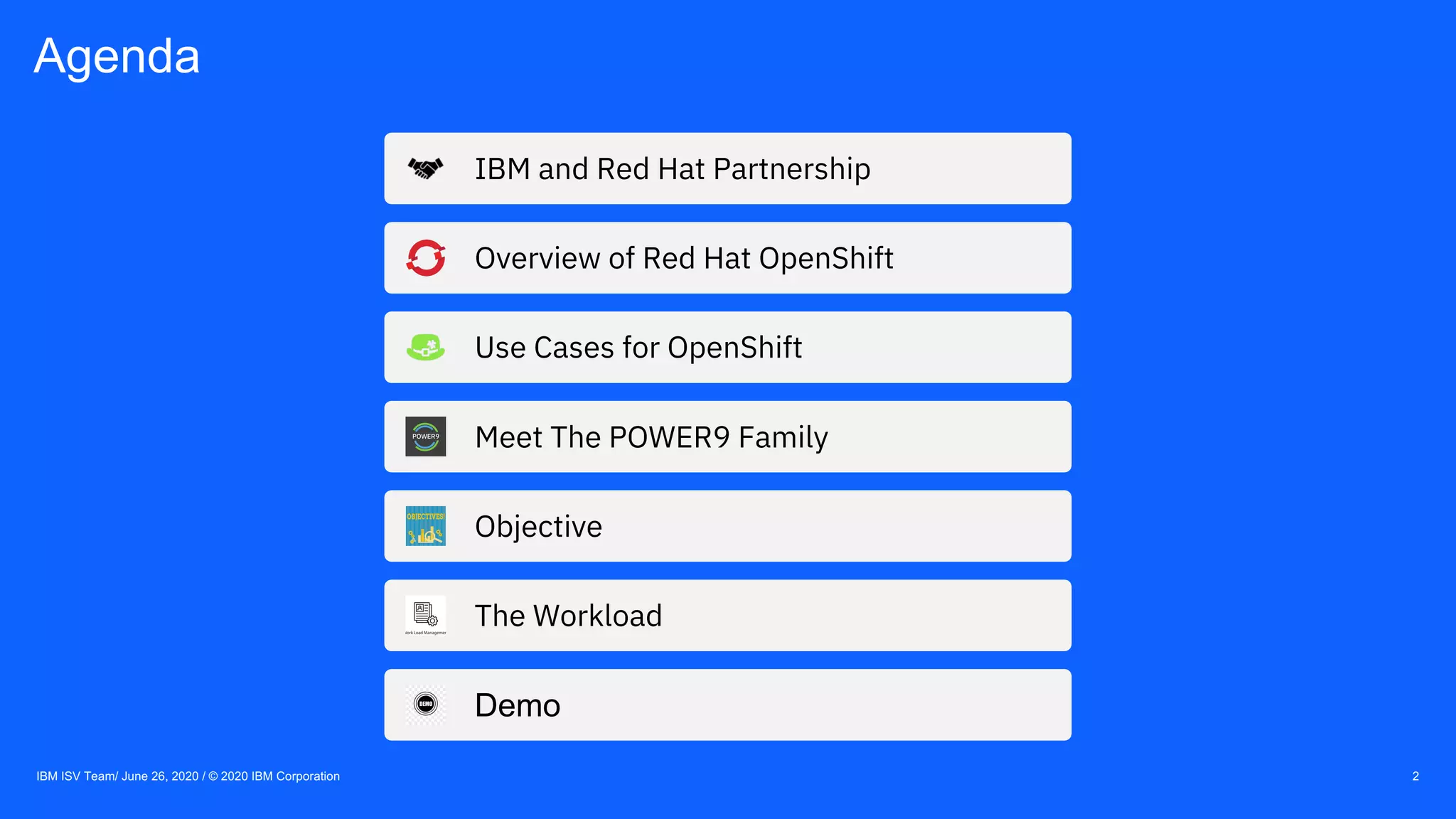
Agenda
IBM ISV Team/ June 26, 2020 / © 2020 IBM Corporation 2
IBM and Red Hat Partnership
Overview of Red Hat OpenShift
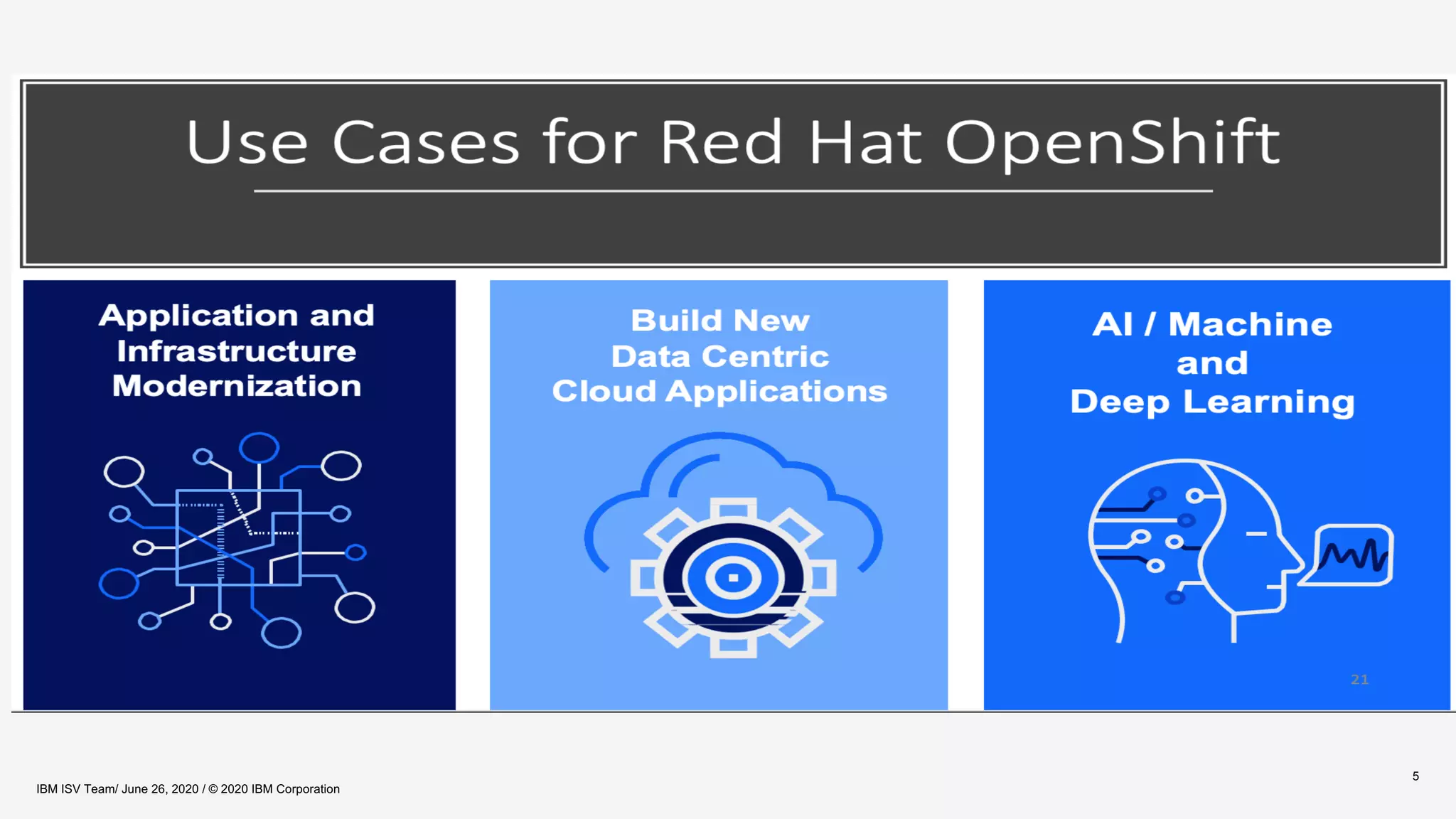
Use Cases for OpenShift
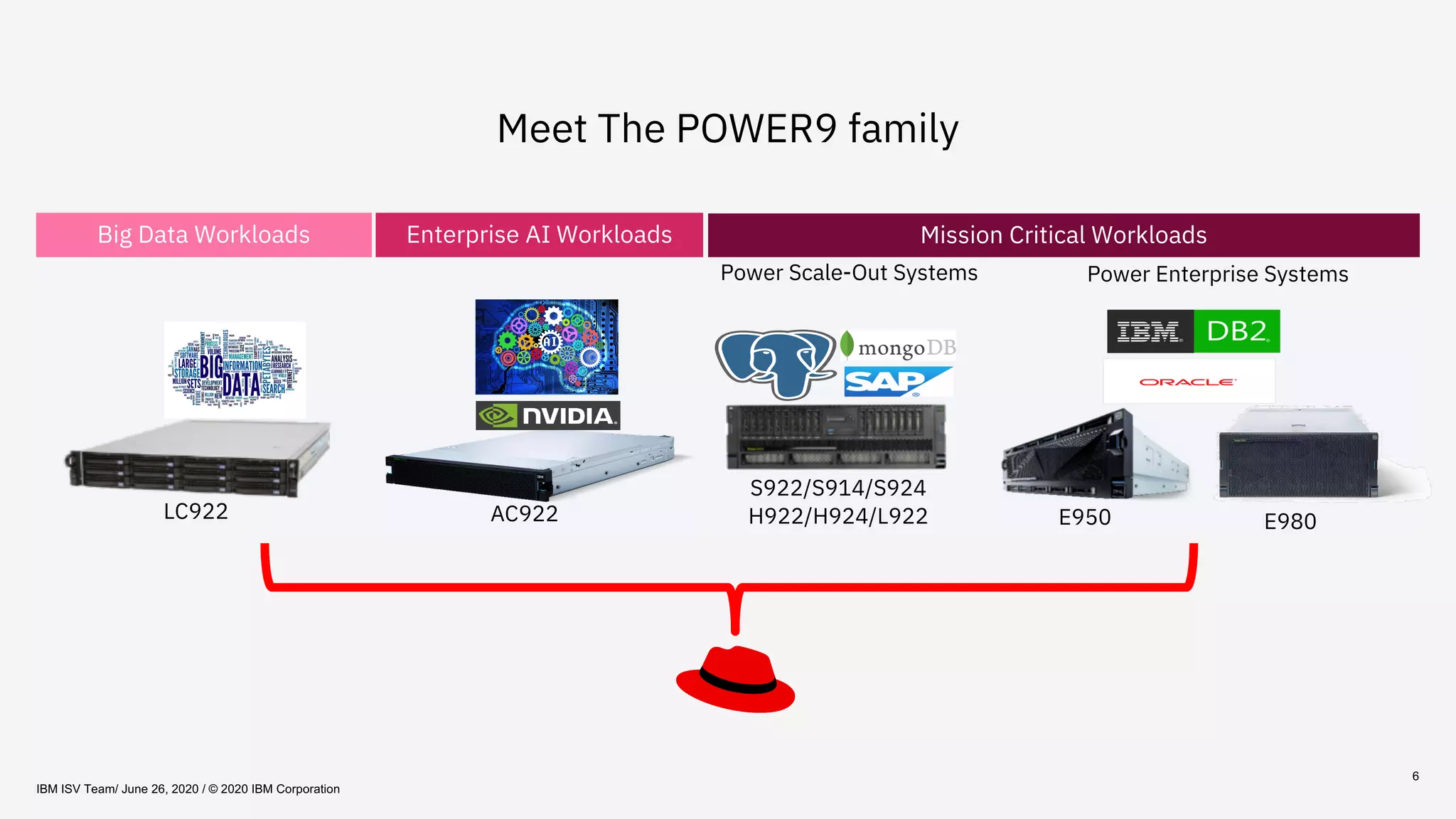
Meet The POWER9 Family
Objective
The Workload
Demo
3
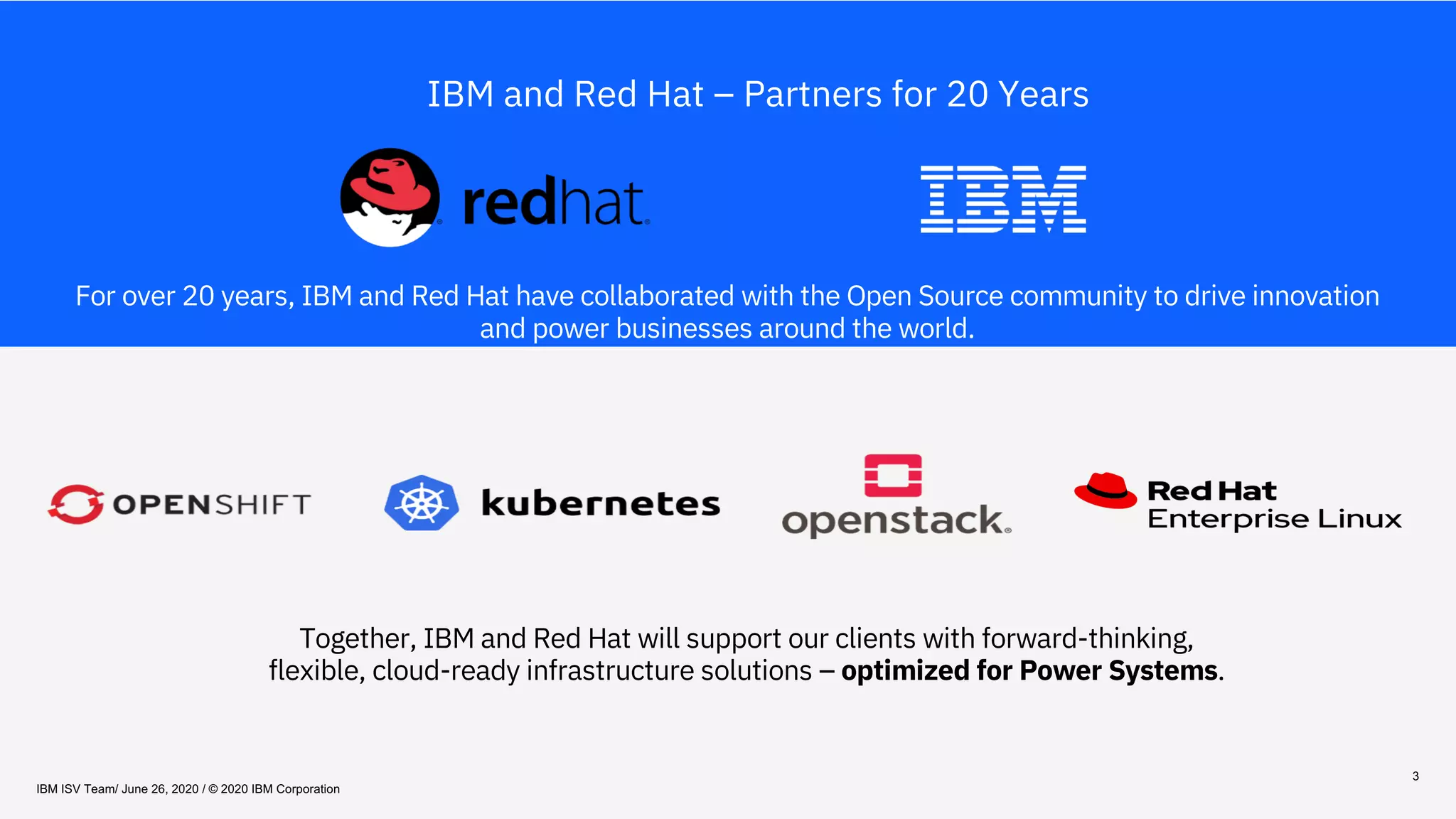
Together, IBM and Red Hat will support our clients with forward-thinking,
flexible, cloud-ready infrastructure solutions – optimized for Power Systems.
IBM and Red Hat – Partners for 20 Years
For over 20 years, IBM and Red Hat have collaborated with the Open Source community to drive innovation
and power businesses around the world.
IBM ISV Team/ June 26, 2020 / © 2020 IBM Corporation
4
Overview of Red Hat
OpenShift
IBM ISV Team/ June 26, 2020 / © 2020 IBM Corporation
5
IBM ISV Team/ June 26, 2020 / © 2020 IBM Corporation
6
Meet The POWER9 family
Big Data Workloads Enterprise AI Workloads
LC922 AC922
Mission Critical Workloads
S922/S914/S924
H922/H924/L922
Power Enterprise SystemsPower Scale-Out Systems
IBM ISV Team/ June 26, 2020 / © 2020 IBM Corporation
E950 E980
7
ppc64le for Data intensive workloads
IBM ISV Team/ June 26, 2020 / © 2020 IBM Corporation
8
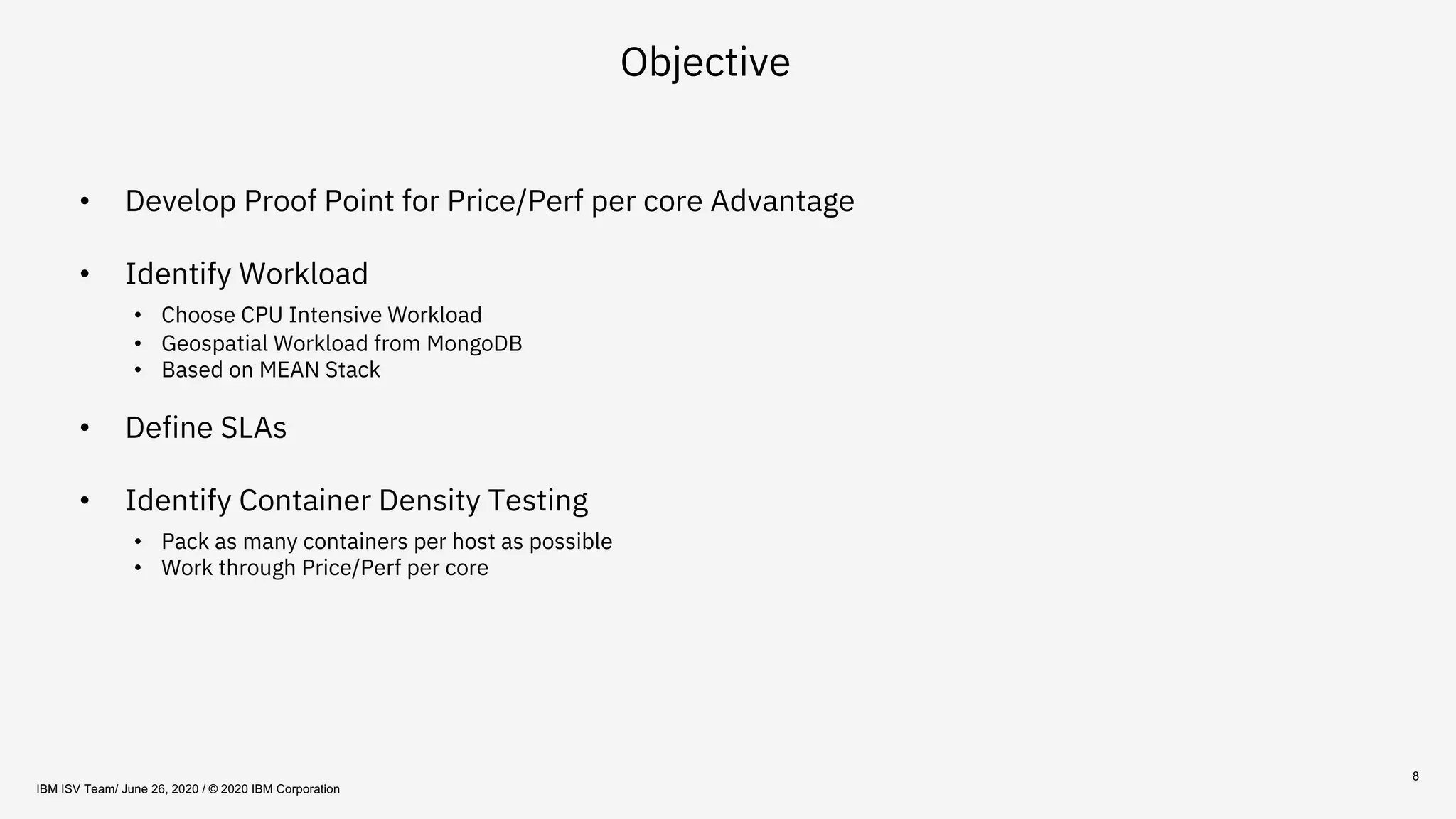
Objective
• Develop Proof Point for Price/Perf per core Advantage
• Identify Workload
• Choose CPU Intensive Workload
• Geospatial Workload from MongoDB
• Based on MEAN Stack
• Define SLAs
• Identify Container Density Testing
• Pack as many containers per host as possible
• Work through Price/Perf per core
IBM ISV Team/ June 26, 2020 / © 2020 IBM Corporation
9
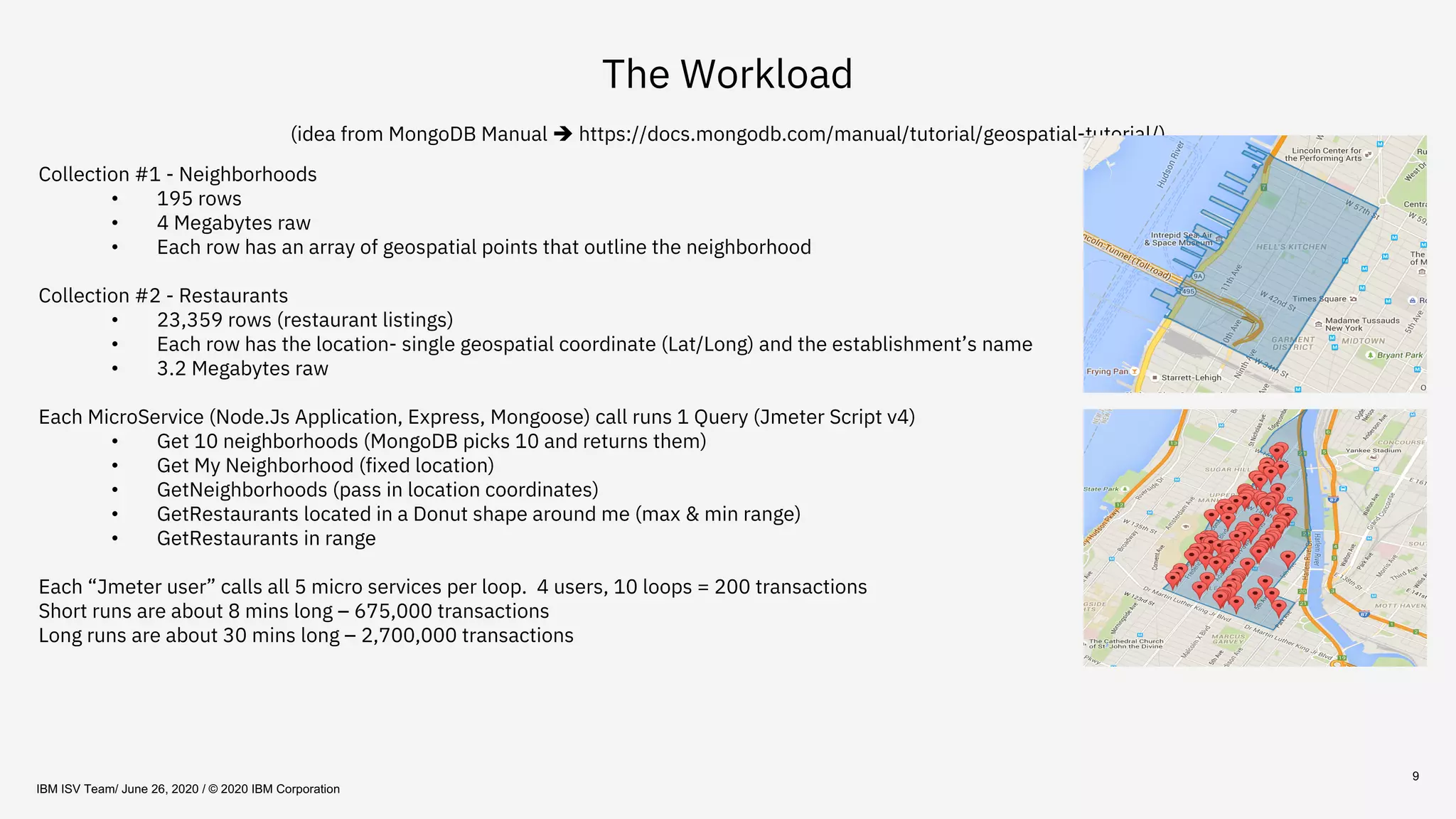
The Workload
(idea from MongoDB Manual è https://docs.mongodb.com/manual/tutorial/geospatial-tutorial/)
Collection #1 - Neighborhoods
• 195 rows
• 4 Megabytes raw
• Each row has an array of geospatial points that outline the neighborhood
Collection #2 - Restaurants
• 23,359 rows (restaurant listings)
• Each row has the location- single geospatial coordinate (Lat/Long) and the establishment’s name
• 3.2 Megabytes raw
Each MicroService (Node.Js Application, Express, Mongoose) call runs 1 Query (Jmeter Script v4)
• Get 10 neighborhoods (MongoDB picks 10 and returns them)
• Get My Neighborhood (fixed location)
• GetNeighborhoods (pass in location coordinates)
• GetRestaurants located in a Donut shape around me (max & min range)
• GetRestaurants in range
Each “Jmeter user” calls all 5 micro services per loop. 4 users, 10 loops = 200 transactions
Short runs are about 8 mins long – 675,000 transactions
Long runs are about 30 mins long – 2,700,000 transactions
IBM ISV Team/ June 26, 2020 / © 2020 IBM Corporation
10
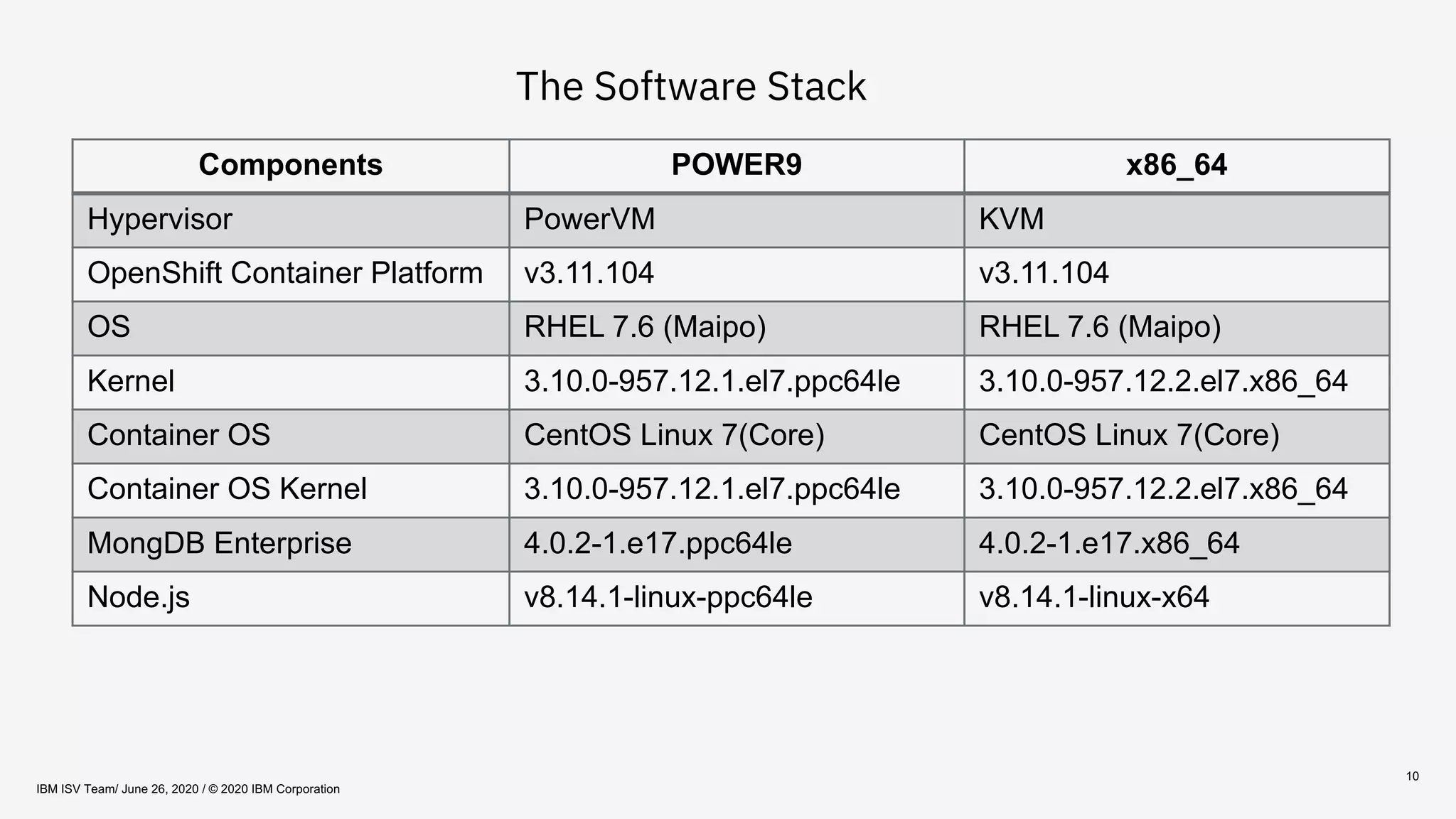
Components POWER9 x86_64
Hypervisor PowerVM KVM
OpenShift Container Platform v3.11.104 v3.11.104
OS RHEL 7.6 (Maipo) RHEL 7.6 (Maipo)
Kernel 3.10.0-957.12.1.el7.ppc64le 3.10.0-957.12.2.el7.x86_64
Container OS CentOS Linux 7(Core) CentOS Linux 7(Core)
Container OS Kernel 3.10.0-957.12.1.el7.ppc64le 3.10.0-957.12.2.el7.x86_64
MongDB Enterprise 4.0.2-1.e17.ppc64le 4.0.2-1.e17.x86_64
Node.js v8.14.1-linux-ppc64le v8.14.1-linux-x64
The Software Stack
IBM ISV Team/ June 26, 2020 / © 2020 IBM Corporation
11
IBM ISV Team/ June 26, 2020 / © 2020 IBM Corporation
12
IBM ISV Team/ June 26, 2020 / © 2020 IBM Corporation
13
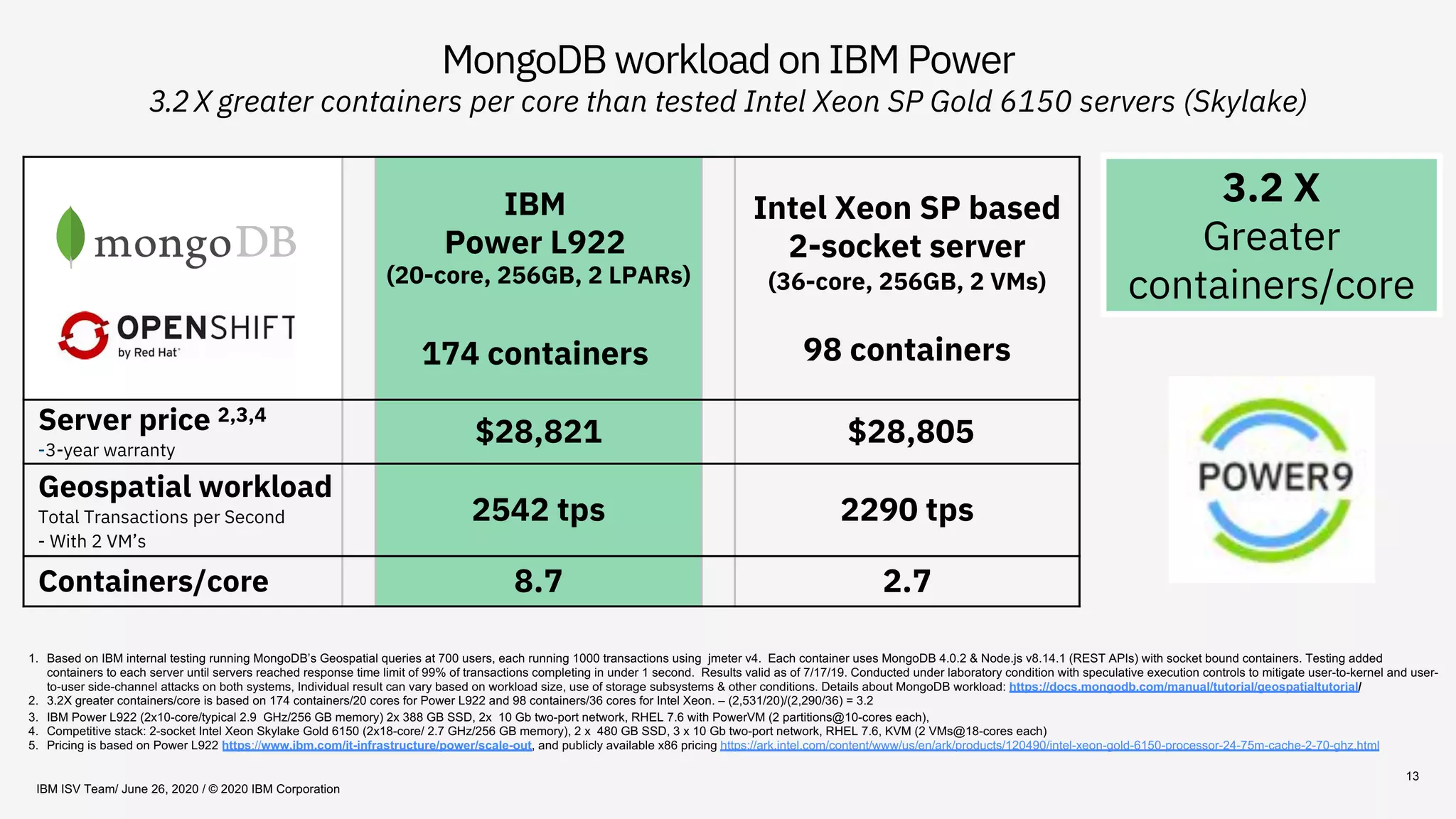
MongoDB workload on IBM Power
3.2X greater containers per core than tested Intel Xeon SP Gold 6150 servers (Skylake)
IBM
Power L922
(20-core, 256GB, 2 LPARs)
174 containers
Intel Xeon SP based
2-socket server
(36-core, 256GB, 2 VMs)
98 containers
Server price 2,3,4
-3-year warranty
$28,821 $28,805
Geospatial workload
Total Transactions per Second
- With 2 VM’s
2542 tps 2290 tps
Containers/core 8.7 2.7
3.2 X
Greater
containers/core
1. Based on IBM internal testing running MongoDB’s Geospatial queries at 700 users, each running 1000 transactions using jmeter v4. Each container uses MongoDB 4.0.2 & Node.js v8.14.1 (REST APIs) with socket bound containers. Testing added
containers to each server until servers reached response time limit of 99% of transactions completing in under 1 second. Results valid as of 7/17/19. Conducted under laboratory condition with speculative execution controls to mitigate user-to-kernel and user-
to-user side-channel attacks on both systems, Individual result can vary based on workload size, use of storage subsystems & other conditions. Details about MongoDB workload: https://docs.mongodb.com/manual/tutorial/geospatialtutorial/
2. 3.2X greater containers/core is based on 174 containers/20 cores for Power L922 and 98 containers/36 cores for Intel Xeon. – (2,531/20)/(2,290/36) = 3.2
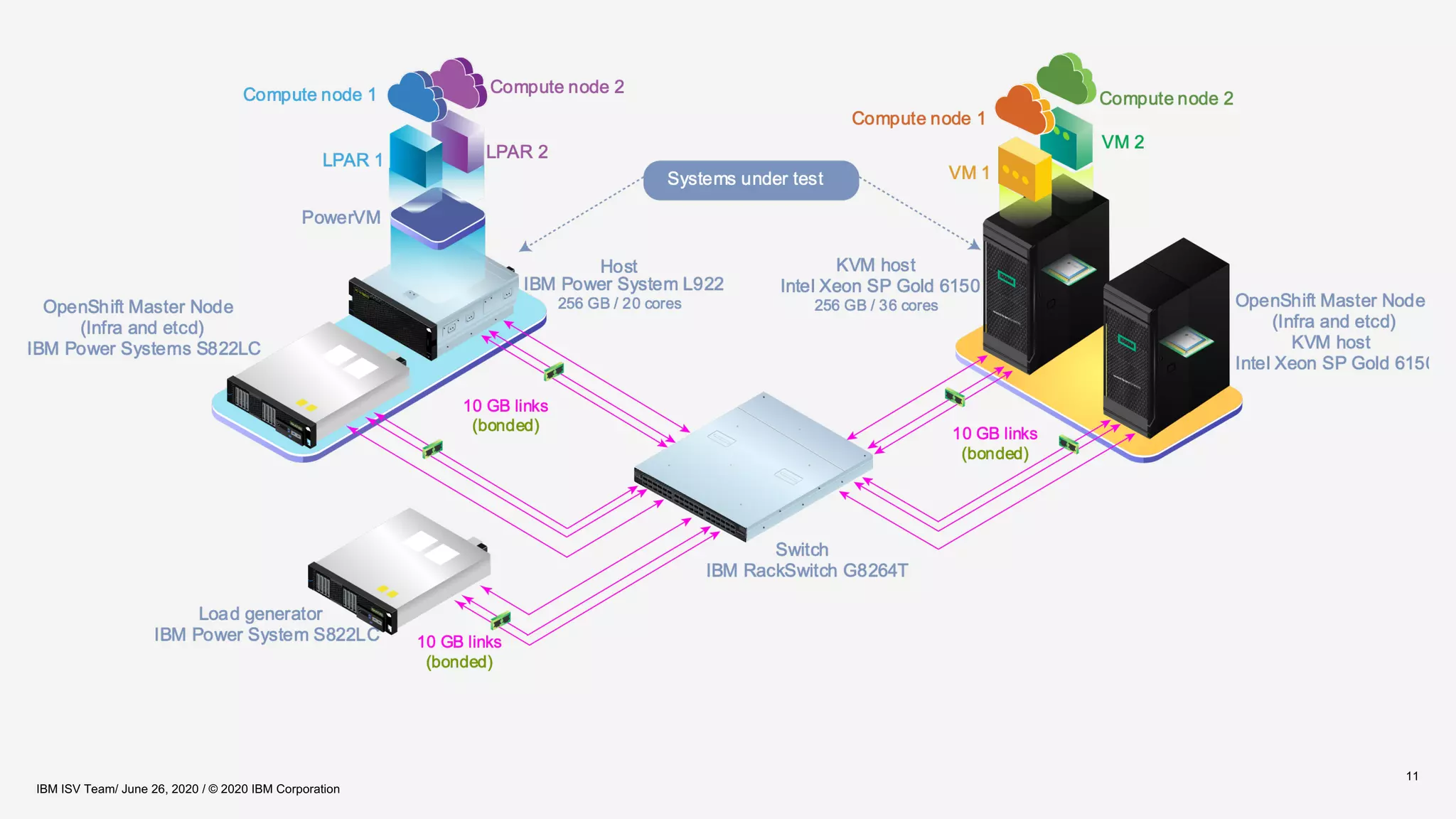
3. IBM Power L922 (2x10-core/typical 2.9 GHz/256 GB memory) 2x 388 GB SSD, 2x 10 Gb two-port network, RHEL 7.6 with PowerVM (2 partitions@10-cores each),
4. Competitive stack: 2-socket Intel Xeon Skylake Gold 6150 (2x18-core/ 2.7 GHz/256 GB memory), 2 x 480 GB SSD, 3 x 10 Gb two-port network, RHEL 7.6, KVM (2 VMs@18-cores each)
5. Pricing is based on Power L922 https://www.ibm.com/it-infrastructure/power/scale-out, and publicly available x86 pricing https://ark.intel.com/content/www/us/en/ark/products/120490/intel-xeon-gold-6150-processor-24-75m-cache-2-70-ghz.html
IBM ISV Team/ June 26, 2020 / © 2020 IBM Corporation
14
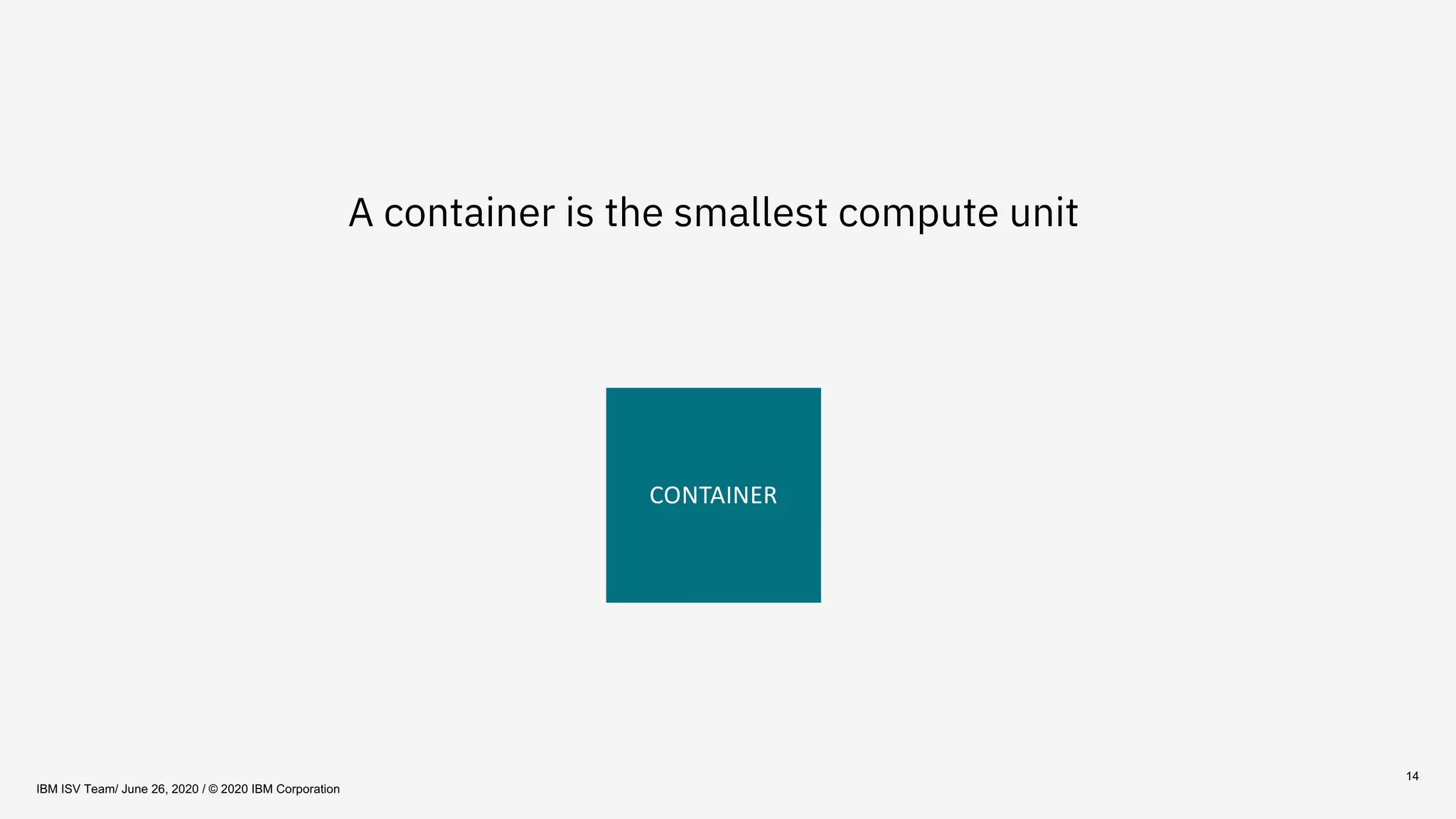
A container is the smallest compute unit
CONTAINER
IBM ISV Team/ June 26, 2020 / © 2020 IBM Corporation
15
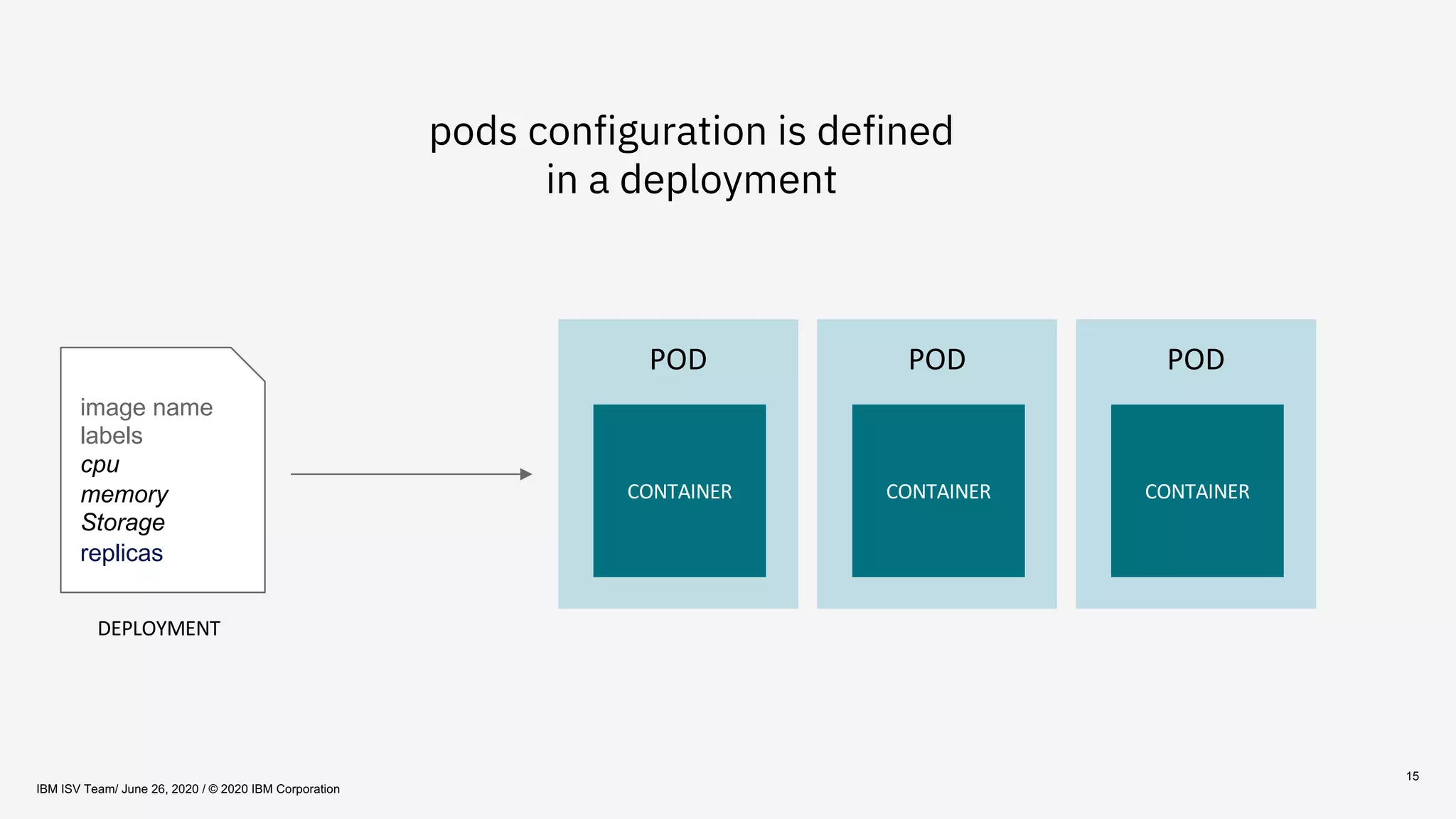
image name
labels
cpu
memory
Storage
replicas
POD
CONTAINER
POD
CONTAINER
POD
CONTAINER
DEPLOYMENT
pods configuration is defined
in a deployment
IBM ISV Team/ June 26, 2020 / © 2020 IBM Corporation
16
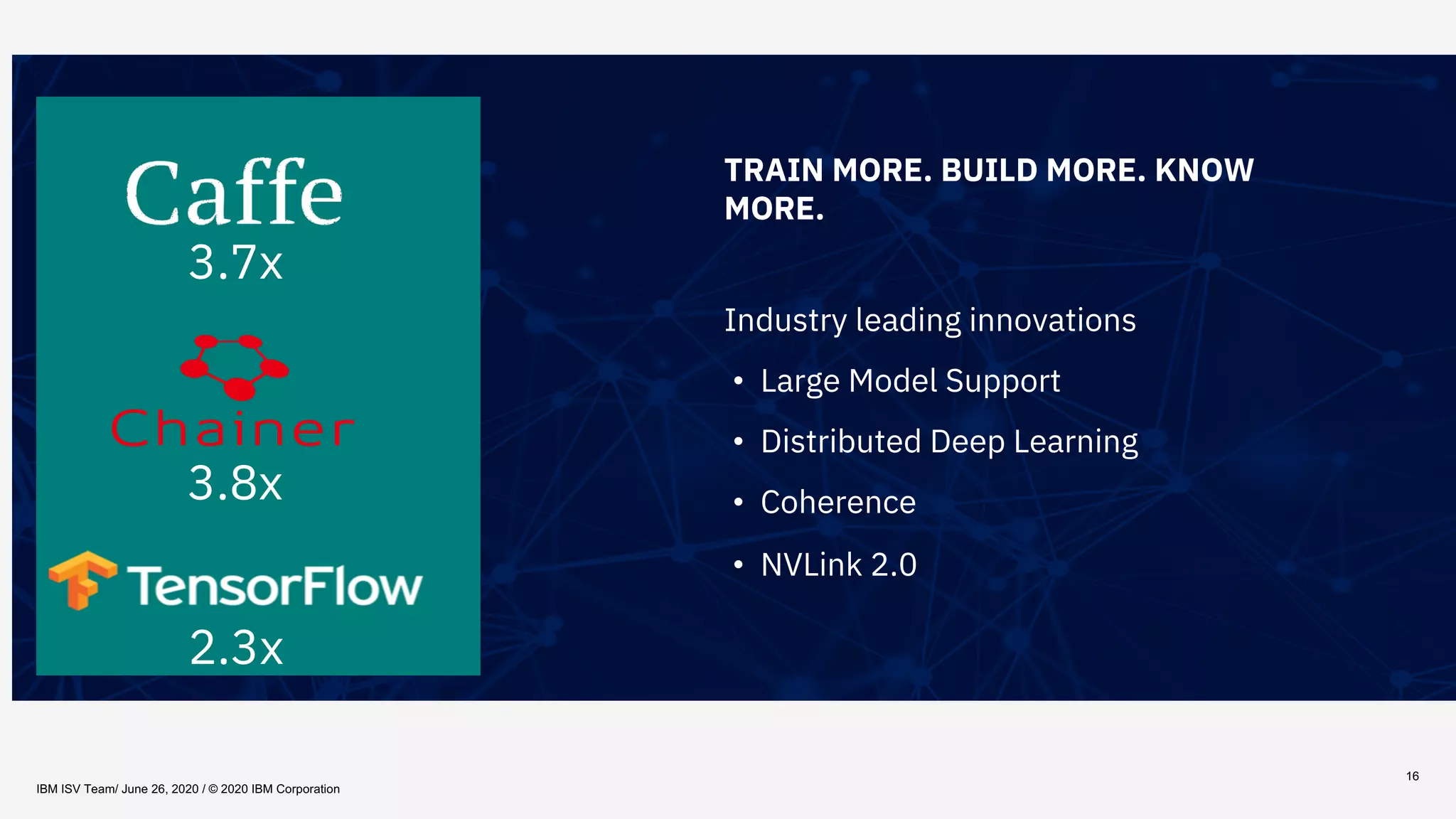
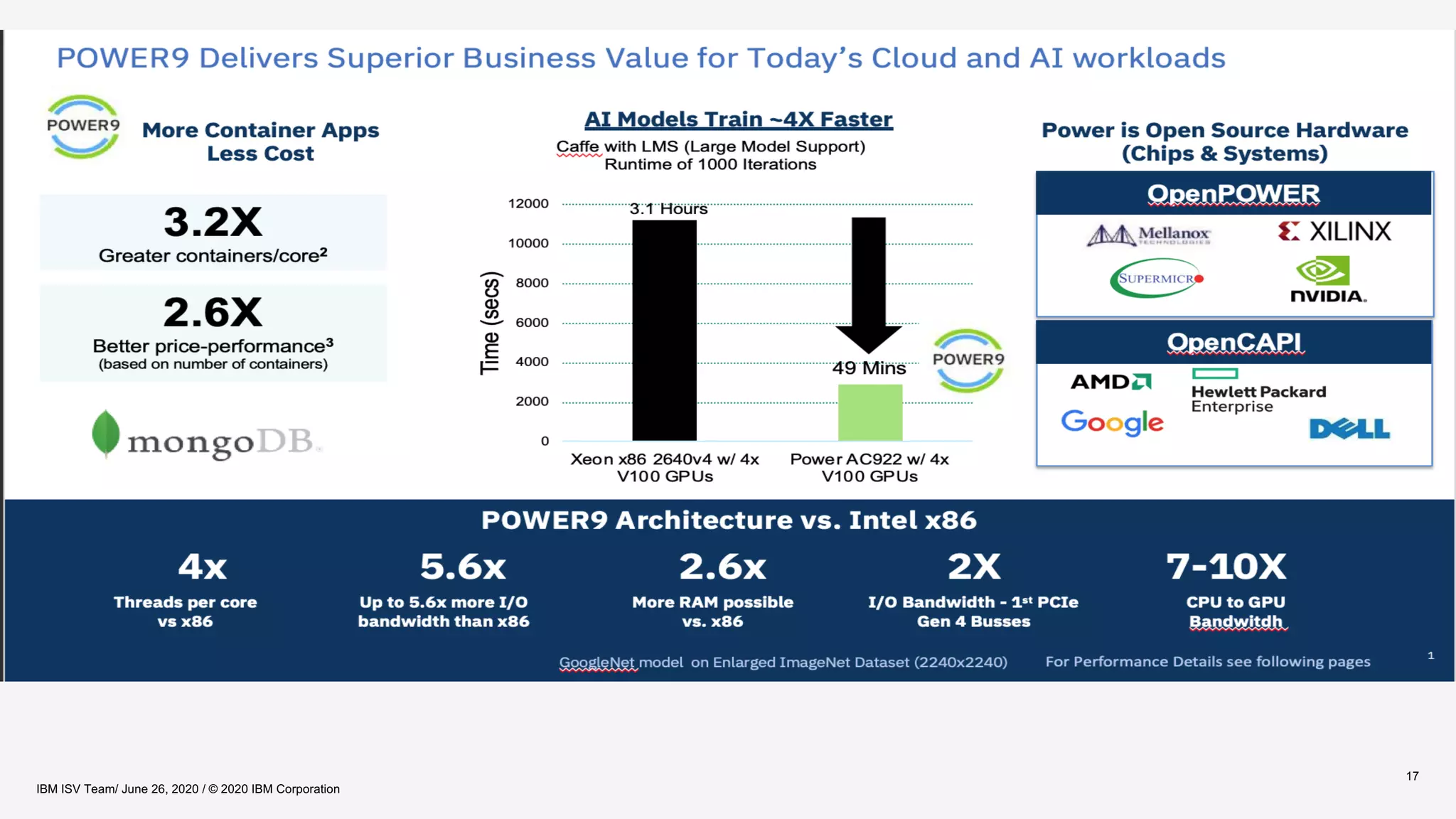
TRAIN MORE. BUILD MORE. KNOW
MORE.
Industry leading innovations
• Large Model Support
• Distributed Deep Learning
• Coherence
• NVLink 2.0
3.7x
2.3x
3.8x
IBM ISV Team/ June 26, 2020 / © 2020 IBM Corporation
17
IBM ISV Team/ June 26, 2020 / © 2020 IBM Corporation
18
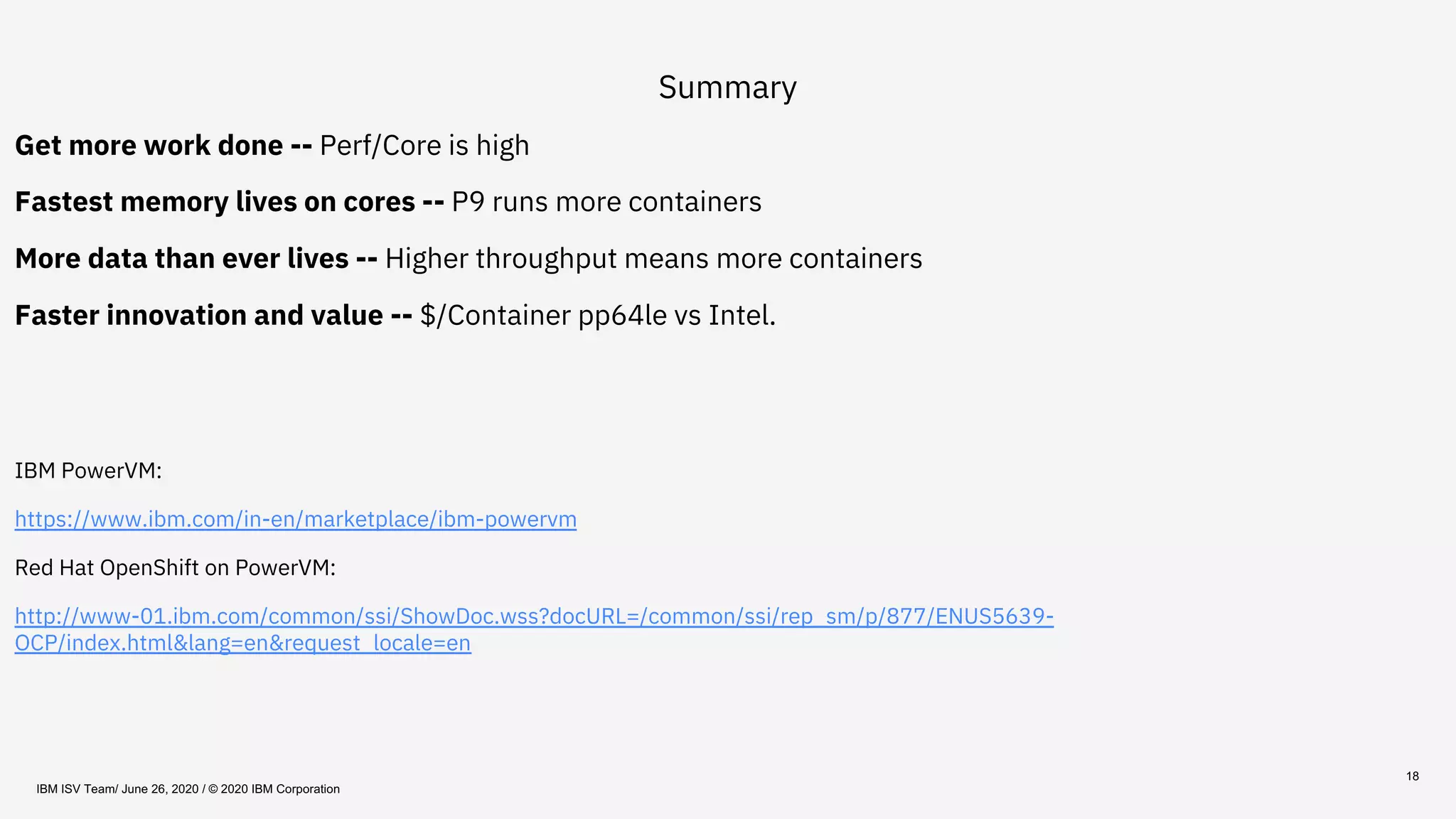
Summary
Get more work done -- Perf/Core is high
Fastest memory lives on cores -- P9 runs more containers
More data than ever lives -- Higher throughput means more containers
Faster innovation and value -- $/Container pp64le vs Intel.
IBM PowerVM:
https://www.ibm.com/in-en/marketplace/ibm-powervm
Red Hat OpenShift on PowerVM:
http://www-01.ibm.com/common/ssi/ShowDoc.wss?docURL=/common/ssi/rep_sm/p/877/ENUS5639-
OCP/index.html&lang=en&request_locale=en
IBM ISV Team/ June 26, 2020 / © 2020 IBM Corporation
Demo
19IBM ISV Team/ June 26, 2020 / © 2020 IBM Corporation
https://github.com/krishvoor/cloud_interop
https://developer.ibm.com/tutorials/mongodb-nodejs-on-openshift/
Group Name / DOC ID / Month XX, 2020 / © 2020 IBM Corporation 20

Advantages of running OpenShift on Power/OpenPOWER systems

  • 1.
    Pack-em or stack-em:Advantages of running OpenShift on Power — Mithun HR Software Engineer - Cognitive Systems Krishna Harsha Voora Software Engineer - Cognitive Systems
  • 2.
    Agenda IBM ISV Team/June 26, 2020 / © 2020 IBM Corporation 2 IBM and Red Hat Partnership Overview of Red Hat OpenShift Use Cases for OpenShift Meet The POWER9 Family Objective The Workload Demo
  • 3.
    3 Together, IBM andRed Hat will support our clients with forward-thinking, flexible, cloud-ready infrastructure solutions – optimized for Power Systems. IBM and Red Hat – Partners for 20 Years For over 20 years, IBM and Red Hat have collaborated with the Open Source community to drive innovation and power businesses around the world. IBM ISV Team/ June 26, 2020 / © 2020 IBM Corporation
  • 4.
    4 Overview of RedHat OpenShift IBM ISV Team/ June 26, 2020 / © 2020 IBM Corporation
  • 5.
    5 IBM ISV Team/June 26, 2020 / © 2020 IBM Corporation
  • 6.
    6 Meet The POWER9family Big Data Workloads Enterprise AI Workloads LC922 AC922 Mission Critical Workloads S922/S914/S924 H922/H924/L922 Power Enterprise SystemsPower Scale-Out Systems IBM ISV Team/ June 26, 2020 / © 2020 IBM Corporation E950 E980
  • 7.
    7 ppc64le for Dataintensive workloads IBM ISV Team/ June 26, 2020 / © 2020 IBM Corporation
  • 8.
    8 Objective • Develop ProofPoint for Price/Perf per core Advantage • Identify Workload • Choose CPU Intensive Workload • Geospatial Workload from MongoDB • Based on MEAN Stack • Define SLAs • Identify Container Density Testing • Pack as many containers per host as possible • Work through Price/Perf per core IBM ISV Team/ June 26, 2020 / © 2020 IBM Corporation
  • 9.
    9 The Workload (idea fromMongoDB Manual è https://docs.mongodb.com/manual/tutorial/geospatial-tutorial/) Collection #1 - Neighborhoods • 195 rows • 4 Megabytes raw • Each row has an array of geospatial points that outline the neighborhood Collection #2 - Restaurants • 23,359 rows (restaurant listings) • Each row has the location- single geospatial coordinate (Lat/Long) and the establishment’s name • 3.2 Megabytes raw Each MicroService (Node.Js Application, Express, Mongoose) call runs 1 Query (Jmeter Script v4) • Get 10 neighborhoods (MongoDB picks 10 and returns them) • Get My Neighborhood (fixed location) • GetNeighborhoods (pass in location coordinates) • GetRestaurants located in a Donut shape around me (max & min range) • GetRestaurants in range Each “Jmeter user” calls all 5 micro services per loop. 4 users, 10 loops = 200 transactions Short runs are about 8 mins long – 675,000 transactions Long runs are about 30 mins long – 2,700,000 transactions IBM ISV Team/ June 26, 2020 / © 2020 IBM Corporation
  • 10.
    10 Components POWER9 x86_64 HypervisorPowerVM KVM OpenShift Container Platform v3.11.104 v3.11.104 OS RHEL 7.6 (Maipo) RHEL 7.6 (Maipo) Kernel 3.10.0-957.12.1.el7.ppc64le 3.10.0-957.12.2.el7.x86_64 Container OS CentOS Linux 7(Core) CentOS Linux 7(Core) Container OS Kernel 3.10.0-957.12.1.el7.ppc64le 3.10.0-957.12.2.el7.x86_64 MongDB Enterprise 4.0.2-1.e17.ppc64le 4.0.2-1.e17.x86_64 Node.js v8.14.1-linux-ppc64le v8.14.1-linux-x64 The Software Stack IBM ISV Team/ June 26, 2020 / © 2020 IBM Corporation
  • 11.
    11 IBM ISV Team/June 26, 2020 / © 2020 IBM Corporation
  • 12.
    12 IBM ISV Team/June 26, 2020 / © 2020 IBM Corporation
  • 13.
    13 MongoDB workload onIBM Power 3.2X greater containers per core than tested Intel Xeon SP Gold 6150 servers (Skylake) IBM Power L922 (20-core, 256GB, 2 LPARs) 174 containers Intel Xeon SP based 2-socket server (36-core, 256GB, 2 VMs) 98 containers Server price 2,3,4 -3-year warranty $28,821 $28,805 Geospatial workload Total Transactions per Second - With 2 VM’s 2542 tps 2290 tps Containers/core 8.7 2.7 3.2 X Greater containers/core 1. Based on IBM internal testing running MongoDB’s Geospatial queries at 700 users, each running 1000 transactions using jmeter v4. Each container uses MongoDB 4.0.2 & Node.js v8.14.1 (REST APIs) with socket bound containers. Testing added containers to each server until servers reached response time limit of 99% of transactions completing in under 1 second. Results valid as of 7/17/19. Conducted under laboratory condition with speculative execution controls to mitigate user-to-kernel and user- to-user side-channel attacks on both systems, Individual result can vary based on workload size, use of storage subsystems & other conditions. Details about MongoDB workload: https://docs.mongodb.com/manual/tutorial/geospatialtutorial/ 2. 3.2X greater containers/core is based on 174 containers/20 cores for Power L922 and 98 containers/36 cores for Intel Xeon. – (2,531/20)/(2,290/36) = 3.2 3. IBM Power L922 (2x10-core/typical 2.9 GHz/256 GB memory) 2x 388 GB SSD, 2x 10 Gb two-port network, RHEL 7.6 with PowerVM (2 partitions@10-cores each), 4. Competitive stack: 2-socket Intel Xeon Skylake Gold 6150 (2x18-core/ 2.7 GHz/256 GB memory), 2 x 480 GB SSD, 3 x 10 Gb two-port network, RHEL 7.6, KVM (2 VMs@18-cores each) 5. Pricing is based on Power L922 https://www.ibm.com/it-infrastructure/power/scale-out, and publicly available x86 pricing https://ark.intel.com/content/www/us/en/ark/products/120490/intel-xeon-gold-6150-processor-24-75m-cache-2-70-ghz.html IBM ISV Team/ June 26, 2020 / © 2020 IBM Corporation
  • 14.
    14 A container isthe smallest compute unit CONTAINER IBM ISV Team/ June 26, 2020 / © 2020 IBM Corporation
  • 15.
    15 image name labels cpu memory Storage replicas POD CONTAINER POD CONTAINER POD CONTAINER DEPLOYMENT pods configurationis defined in a deployment IBM ISV Team/ June 26, 2020 / © 2020 IBM Corporation
  • 16.
    16 TRAIN MORE. BUILDMORE. KNOW MORE. Industry leading innovations • Large Model Support • Distributed Deep Learning • Coherence • NVLink 2.0 3.7x 2.3x 3.8x IBM ISV Team/ June 26, 2020 / © 2020 IBM Corporation
  • 17.
    17 IBM ISV Team/June 26, 2020 / © 2020 IBM Corporation
  • 18.
    18 Summary Get more workdone -- Perf/Core is high Fastest memory lives on cores -- P9 runs more containers More data than ever lives -- Higher throughput means more containers Faster innovation and value -- $/Container pp64le vs Intel. IBM PowerVM: https://www.ibm.com/in-en/marketplace/ibm-powervm Red Hat OpenShift on PowerVM: http://www-01.ibm.com/common/ssi/ShowDoc.wss?docURL=/common/ssi/rep_sm/p/877/ENUS5639- OCP/index.html&lang=en&request_locale=en IBM ISV Team/ June 26, 2020 / © 2020 IBM Corporation
  • 19.
    Demo 19IBM ISV Team/June 26, 2020 / © 2020 IBM Corporation https://github.com/krishvoor/cloud_interop https://developer.ibm.com/tutorials/mongodb-nodejs-on-openshift/
  • 20.
    Group Name /DOC ID / Month XX, 2020 / © 2020 IBM Corporation 20