© 2009 IBM Corporation 
Emily K. Hugenbruch – Advisory Software Engineer 
18 September 2014 
OpenStack 
and 
z/VM
Trademarks 
The following are trademarks of the International Business Machines Corporation in the United States and/or other countries. 
System z10* 
Tivoli* 
z10 BC 
z9* 
z/OS* 
z/VM* 
z/VSE 
zEnterprise* 
IBM* 
IBM Logo* 
DB2* 
DS8000* 
Dynamic Infrastructure* 
FICON* 
GDPS* 
HiperSockets 
HyperSwap* 
Parallel Sysplex* 
PR/SM 
RACF* 
System z* 
* Registered trademarks of IBM Corporation 
System z196 
System z114 
System zEC12 
System zBC12 
The following are trademarks or registered trademarks of other companies. 
OpenSolaris, Java and all Java-based trademarks are trademarks of Sun Microsystems, Inc. in the United States, other countries, or both. 
Microsoft, Windows, Windows NT, and the Windows logo are trademarks of Microsoft Corporation in the United States, other countries, or both. 
INFINIBAND, InfiniBand Trade Association and the INFINIBAND design marks are trademarks and/or service marks of the INFINIBAND Trade Association. 
UNIX is a registered trademark of The Open Group in the United States and other countries. 
Linux is a registered trademark of Linus Torvalds in the United States, other countries, or both. 
All other products may be trademarks or registered trademarks of their respective companies. 
Notes: 
Performance is in Internal Throughput Rate (ITR) ratio based on measurements and projections using standard IBM benchmarks in a controlled environment. The actual throughput that any user will experience will vary 
depending upon considerations such as the amount of multiprogramming in the user's job stream, the I/O configuration, the storage configuration, and the workload processed. Therefore, no assurance can be given that 
an individual user will achieve throughput improvements equivalent to the performance ratios stated here. 
IBM hardware products are manufactured from new parts, or new and serviceable used parts. Regardless, our warranty terms apply. 
All customer examples cited or described in this presentation are presented as illustrations of the manner in which some customers have used IBM products and the results they may have achieved. Actual 
environmental costs and performance characteristics will vary depending on individual customer configurations and conditions. 
This publication was produced in the United States. IBM may not offer the products, services or features discussed in this document in other countries, and the information may be subject to change without notice. 
Consult your local IBM business contact for information on the product or services available in your area. 
All statements regarding IBM's future direction and intent are subject to change or withdrawal without notice, and represent goals and objectives only. 
Information about non-IBM products is obtained from the manufacturers of those products or their published announcements. IBM has not tested those products and cannot confirm the performance, compatibility, or any 
other claims related to non-IBM products. Questions on the capabilities of non-IBM products should be addressed to the suppliers of those products. 
Prices subject to change without notice. Contact your IBM representative or Business Partner for the most current pricing in your geography. 
© Copyright IBM Corporation 2014
Disclaimer 
The information contained in this document has not been submitted to any formal IBM test and is distributed on an "AS IS" basis 
without any warranty either express or implied. The use of this information or the implementation of any of these techniques is a 
customer responsibility and depends on the customer's ability to evaluate and integrate them into the operational environment. 
While each item may have been reviewed by IBM for accuracy in a specific situation, there is no guarantee that the same or 
similar results will be obtained elsewhere. Customers attempting to adapt these techniques to their own environments do so at 
their own risk. 
In this document, any references made to an IBM licensed program are not intended to state or imply that only IBM's licensed 
program may be used; any functionally equivalent program may be used instead. 
Any performance data contained in this document was determined in a controlled environment and, therefore, the results which 
may be obtained in other operating environments may vary significantly. Users of this document should verify the applicable 
data for their specific environments. 
All statements regarding IBM's plans, directions, and intent are subject to change or withdrawal without notice, and represent 
goals and objectives only. This is not a commitment to deliver the functions described herein 
© Copyright IBM Corporation 2014 3
OpenStack and z/VM 
Background about z/VM 
 A 40 year history 
 Supports Linux, as well as other IBM Operating Systems like z/OS, zVSE, zTPF. 
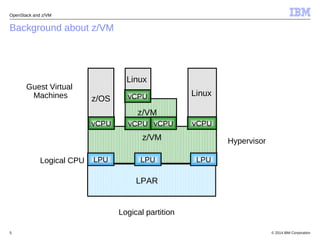
 Part of a 2-layer approach to virtualization with logical partitioning 
 Strengths: memory overcommitment, I/O, ability to run hundreds to thousands of guests on a 
single hypervisor 
 Examples of workloads that we run: web servers, databases 
 Examples of customers: banks, insurance companies, government agencies 
© 2014 4 IBM Corporation
OpenStack and z/VM 
Background about z/VM 
Linux 
vCPU 
z/VM 
vCPU vCPU 
vCPU vCPU 
z/VM 
z/OS 
Linux 
LPU LPU 
LPAR 
LPU 
Logical partition 
Guest Virtual 
Machines 
Logical CPU 
Hypervisor 
© 2014 5 IBM Corporation
OpenStack and z/VM 
Challenges for z/VM customers 
 No native GUI interface for setting up/managing guests or applications, many customers 
were writing their own 
 Virtual machine sprawl 
 Virtual configuration sprawl 
 All system z shops have other platforms as well and they want solutions that manage across 
the different platforms 
 A standardized interface would make it easier to bring new applications to z 
© 2014 6 IBM Corporation
OpenStack and z/VM 
Cloud and self-service 
 System z customers tend to be worried about security and track their virtual machines very 
closely for auditing purposes, even those used for development and test 
 That process can be very time-consuming 
 It also leads to extra virtual machines being left around, no one wants to give up a resource 
if it takes a long time to get new machines 
 Self-service for guest creation could save time/money, submit one request for a pool of 
resources and let developers create what they need 
 Of course this has to still have the security and auditing necessary 
 System z customers are interested in the savings, but wary of the auditing and performance 
implications of cloud 
© 2014 7 IBM Corporation
OpenStack and z/VM 
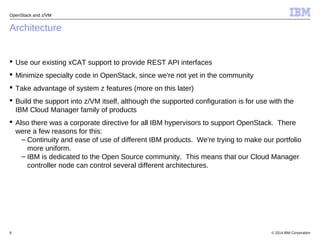
Architecture 
 Use our existing xCAT support to provide REST API interfaces 
 Minimize specialty code in OpenStack, since we're not yet in the community 
 Take advantage of system z features (more on this later) 
 Build the support into z/VM itself, although the supported configuration is for use with the 
IBM Cloud Manager family of products 
 Also there was a corporate directive for all IBM hypervisors to support OpenStack. There 
were a few reasons for this: 
– Continuity and ease of use of different IBM products. We're trying to make our portfolio 
more uniform. 
– IBM is dedicated to the Open Source community. This means that our Cloud Manager 
controller node can control several different architectures. 
© 2014 8 IBM Corporation
OpenStack and z/VM 
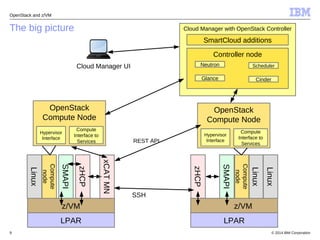
The big picture 
Cloud Manager with OpenStack Controller 
SmartCloud additions 
Controller node 
Neutron 
Cloud Manager UI Scheduler 
Glance Cinder 
OpenStack 
Compute Node 
Compute 
Interface to 
Services 
z/VM 
Hypervisor 
Interface 
LPAR 
OpenStack 
Compute Node 
Hypervisor 
Interface 
Compute 
Interface to 
Services REST API 
z/VM 
LPAR 
xCAT MN 
SSH 
© 2014 9 IBM Corporation
OpenStack and z/VM 
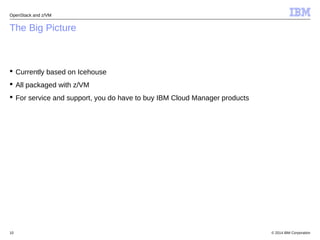
The Big Picture 
 Currently based on Icehouse 
 All packaged with z/VM 
 For service and support, you do have to buy IBM Cloud Manager products 
© 2014 10 IBM Corporation
OpenStack and z/VM 
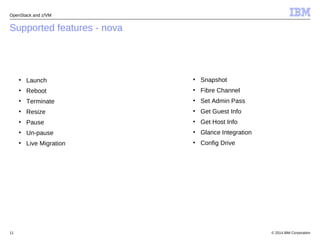
Supported features - nova 
● Launch 
● Reboot 
● Terminate 
● Resize 
● Pause 
● Un-pause 
● Live Migration 
● Snapshot 
● Fibre Channel 
● Set Admin Pass 
● Get Guest Info 
● Get Host Info 
● Glance Integration 
● Config Drive 
© 2014 11 IBM Corporation
OpenStack and z/VM 
Supported features - neutron 
● Right now the z/VM agent only supports Layer 2 
● VLAN Networking 
● Flat Networking 
© 2014 12 IBM Corporation
OpenStack and z/VM 
Supported features - cinder 
● Attach Volume 
● Detach Volume 
● Right now support is only for storage in the IBM Storwize family/SVC 
© 2014 13 IBM Corporation
OpenStack and z/VM 
Advantages of OpenStack on z/VM 
 Ease of installation: 
– Instead of buying lots of extra products that you have to configure, you only need to 
know: 
• Disk configuration 
• An IP address for OpenStack 
• An OSA card address for OpenStack 
– Installation and configuration of SMAPI, xCAT, and OpenStack is done automatically 
 Because we own and configure the whole stack, we can take advantage of data sharing, like 
having nova and glance share images 
 We can also use system z special features, like our super-fast copy (Flashcopy) for copying 
an image to a volume. 
 Because we're supporting OpenStack APIs, it means that new applications written to use 
them will work on z, no porting required 
© 2014 14 IBM Corporation
OpenStack and z/VM 
Cloud Manager with OpenStack 
 System z support announced September 9, 2014, scheduled to release Friday, September 
19 
 For managing system z instances from z, or for managing z from other platforms 
 Supports 
– openstack/KVM on RHELs 6.5/x86_64 
– openstack/HyperV on Microsoft Windows 2012 (R2) x86_64 and HyperVServer 2012 
(R2) 
– openstack/KVM on ppcon (Power 8) 
– PowerVM (via PowerVC) 
 Linux images managed can be SuSE or Red Hat 
 Features: 
– Integrated Chef-based deployer 
– IBM DB2 database software support 
– Platform Resource Scheduler (PRS) for advanced placement 
– Enhanced self-service portal that adds billing, approvals and resource expiration, among 
other features 
Source: http://www.ibm.com/developerworks/servicemanagement/cvm/sce/ 
© 2014 15 IBM Corporation
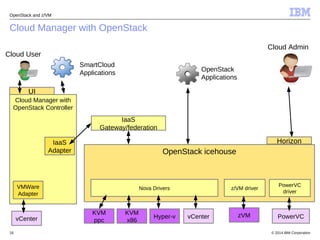
OpenStack and z/VM 
Cloud Manager with OpenStack 
SmartCloud 
Applications OpenStack 
Applications 
OpenStack icehouse 
Gateway/federation 
Cloud Admin 
Horizon 
Nova Drivers z/VM driver PowerVC 
driver 
KVM 
ppc 
IaaS 
KVM 
x86 Hyper-v vCenter zVM PowerVC 
Cloud User 
UI 
Cloud Manager with 
OpenStack Controller 
IaaS 
Adapter 
VMWare 
Adapter 
vCenter 
© 2014 16 IBM Corporation
OpenStack and z/VM 
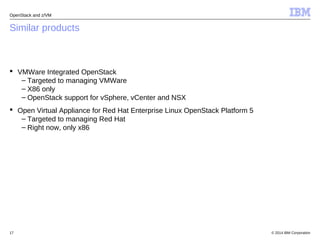
Similar products 
 VMWare Integrated OpenStack 
– Targeted to managing VMWare 
– X86 only 
– OpenStack support for vSphere, vCenter and NSX 
 Open Virtual Appliance for Red Hat Enterprise Linux OpenStack Platform 5 
– Targeted to managing Red Hat 
– Right now, only x86 
© 2014 17 IBM Corporation
OpenStack and z/VM 
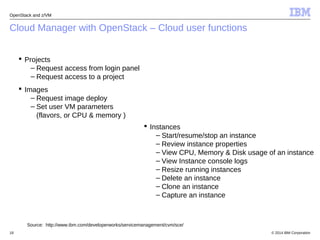
Cloud Manager with OpenStack – Cloud user functions 
 Projects 
– Request access from login panel 
– Request access to a project 
 Images 
– Request image deploy 
– Set user VM parameters 
(flavors, or CPU & memory ) 
 Instances 
– Start/resume/stop an instance 
– Review instance properties 
– View CPU, Memory & Disk usage of an instance 
– View Instance console logs 
– Resize running instances 
– Delete an instance 
– Clone an instance 
– Capture an instance 
Source: http://www.ibm.com/developerworks/servicemanagement/cvm/sce/ 
© 2014 18 IBM Corporation
OpenStack and z/VM 
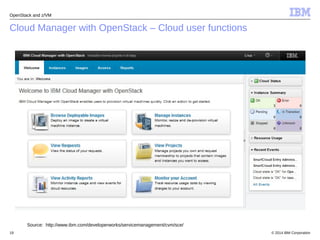
Cloud Manager with OpenStack – Cloud user functions 
Source: http://www.ibm.com/developerworks/servicemanagement/cvm/sce/ 
© 2014 19 IBM Corporation
OpenStack and z/VM 
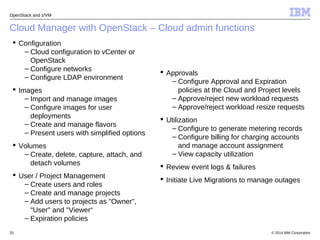
Cloud Manager with OpenStack – Cloud admin functions 
 Configuration 
– Cloud configuration to vCenter or 
OpenStack 
– Configure networks 
– Configure LDAP environment 
 Images 
– Import and manage images 
– Configure images for user 
deployments 
– Create and manage flavors 
– Present users with simplified options 
 Volumes 
– Create, delete, capture, attach, and 
detach volumes 
 User / Project Management 
– Create users and roles 
– Create and manage projects 
– Add users to projects as "Owner", 
"User" and "Viewer“ 
– Expiration policies 
 Approvals 
– Configure Approval and Expiration 
policies at the Cloud and Project levels 
– Approve/reject new workload requests 
– Approve/reject workload resize requests 
 Utilization 
– Configure to generate metering records 
– Configure billing for charging accounts 
and manage account assignment 
– View capacity utilization 
 Review event logs & failures 
 Initiate Live Migrations to manage outages 
© 2014 20 IBM Corporation
OpenStack and z/VM 
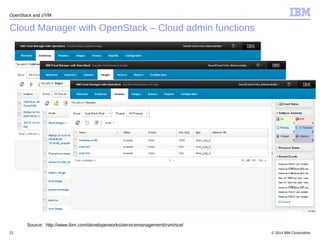
Cloud Manager with OpenStack – Cloud admin functions 
Source: http://www.ibm.com/developerworks/servicemanagement/cvm/sce/ 
© 2014 21 IBM Corporation
OpenStack and z/VM 
Summary 
 IBM Cloud Manager with OpenStack has new support for system z 
– As of tomorrow, this support comes with z/VM 
– Allows z to be managed from z or from different platforms 
 The cloud journey at IBM continues! 
Emily Hugenbruch 
ekhugen@us.ibm.com 
@ekhugen on Twitter 
Ekhugen on IRC 
© 2014 22 IBM Corporation

z/VM and OpenStack

  • 1.
    © 2009 IBMCorporation Emily K. Hugenbruch – Advisory Software Engineer 18 September 2014 OpenStack and z/VM
  • 2.
    Trademarks The followingare trademarks of the International Business Machines Corporation in the United States and/or other countries. System z10* Tivoli* z10 BC z9* z/OS* z/VM* z/VSE zEnterprise* IBM* IBM Logo* DB2* DS8000* Dynamic Infrastructure* FICON* GDPS* HiperSockets HyperSwap* Parallel Sysplex* PR/SM RACF* System z* * Registered trademarks of IBM Corporation System z196 System z114 System zEC12 System zBC12 The following are trademarks or registered trademarks of other companies. OpenSolaris, Java and all Java-based trademarks are trademarks of Sun Microsystems, Inc. in the United States, other countries, or both. Microsoft, Windows, Windows NT, and the Windows logo are trademarks of Microsoft Corporation in the United States, other countries, or both. INFINIBAND, InfiniBand Trade Association and the INFINIBAND design marks are trademarks and/or service marks of the INFINIBAND Trade Association. UNIX is a registered trademark of The Open Group in the United States and other countries. Linux is a registered trademark of Linus Torvalds in the United States, other countries, or both. All other products may be trademarks or registered trademarks of their respective companies. Notes: Performance is in Internal Throughput Rate (ITR) ratio based on measurements and projections using standard IBM benchmarks in a controlled environment. The actual throughput that any user will experience will vary depending upon considerations such as the amount of multiprogramming in the user's job stream, the I/O configuration, the storage configuration, and the workload processed. Therefore, no assurance can be given that an individual user will achieve throughput improvements equivalent to the performance ratios stated here. IBM hardware products are manufactured from new parts, or new and serviceable used parts. Regardless, our warranty terms apply. All customer examples cited or described in this presentation are presented as illustrations of the manner in which some customers have used IBM products and the results they may have achieved. Actual environmental costs and performance characteristics will vary depending on individual customer configurations and conditions. This publication was produced in the United States. IBM may not offer the products, services or features discussed in this document in other countries, and the information may be subject to change without notice. Consult your local IBM business contact for information on the product or services available in your area. All statements regarding IBM's future direction and intent are subject to change or withdrawal without notice, and represent goals and objectives only. Information about non-IBM products is obtained from the manufacturers of those products or their published announcements. IBM has not tested those products and cannot confirm the performance, compatibility, or any other claims related to non-IBM products. Questions on the capabilities of non-IBM products should be addressed to the suppliers of those products. Prices subject to change without notice. Contact your IBM representative or Business Partner for the most current pricing in your geography. © Copyright IBM Corporation 2014
  • 3.
    Disclaimer The informationcontained in this document has not been submitted to any formal IBM test and is distributed on an "AS IS" basis without any warranty either express or implied. The use of this information or the implementation of any of these techniques is a customer responsibility and depends on the customer's ability to evaluate and integrate them into the operational environment. While each item may have been reviewed by IBM for accuracy in a specific situation, there is no guarantee that the same or similar results will be obtained elsewhere. Customers attempting to adapt these techniques to their own environments do so at their own risk. In this document, any references made to an IBM licensed program are not intended to state or imply that only IBM's licensed program may be used; any functionally equivalent program may be used instead. Any performance data contained in this document was determined in a controlled environment and, therefore, the results which may be obtained in other operating environments may vary significantly. Users of this document should verify the applicable data for their specific environments. All statements regarding IBM's plans, directions, and intent are subject to change or withdrawal without notice, and represent goals and objectives only. This is not a commitment to deliver the functions described herein © Copyright IBM Corporation 2014 3
  • 4.
    OpenStack and z/VM Background about z/VM  A 40 year history  Supports Linux, as well as other IBM Operating Systems like z/OS, zVSE, zTPF.  Part of a 2-layer approach to virtualization with logical partitioning  Strengths: memory overcommitment, I/O, ability to run hundreds to thousands of guests on a single hypervisor  Examples of workloads that we run: web servers, databases  Examples of customers: banks, insurance companies, government agencies © 2014 4 IBM Corporation
  • 5.
    OpenStack and z/VM Background about z/VM Linux vCPU z/VM vCPU vCPU vCPU vCPU z/VM z/OS Linux LPU LPU LPAR LPU Logical partition Guest Virtual Machines Logical CPU Hypervisor © 2014 5 IBM Corporation
  • 6.
    OpenStack and z/VM Challenges for z/VM customers  No native GUI interface for setting up/managing guests or applications, many customers were writing their own  Virtual machine sprawl  Virtual configuration sprawl  All system z shops have other platforms as well and they want solutions that manage across the different platforms  A standardized interface would make it easier to bring new applications to z © 2014 6 IBM Corporation
  • 7.
    OpenStack and z/VM Cloud and self-service  System z customers tend to be worried about security and track their virtual machines very closely for auditing purposes, even those used for development and test  That process can be very time-consuming  It also leads to extra virtual machines being left around, no one wants to give up a resource if it takes a long time to get new machines  Self-service for guest creation could save time/money, submit one request for a pool of resources and let developers create what they need  Of course this has to still have the security and auditing necessary  System z customers are interested in the savings, but wary of the auditing and performance implications of cloud © 2014 7 IBM Corporation
  • 8.
    OpenStack and z/VM Architecture  Use our existing xCAT support to provide REST API interfaces  Minimize specialty code in OpenStack, since we're not yet in the community  Take advantage of system z features (more on this later)  Build the support into z/VM itself, although the supported configuration is for use with the IBM Cloud Manager family of products  Also there was a corporate directive for all IBM hypervisors to support OpenStack. There were a few reasons for this: – Continuity and ease of use of different IBM products. We're trying to make our portfolio more uniform. – IBM is dedicated to the Open Source community. This means that our Cloud Manager controller node can control several different architectures. © 2014 8 IBM Corporation
  • 9.
    OpenStack and z/VM The big picture Cloud Manager with OpenStack Controller SmartCloud additions Controller node Neutron Cloud Manager UI Scheduler Glance Cinder OpenStack Compute Node Compute Interface to Services z/VM Hypervisor Interface LPAR OpenStack Compute Node Hypervisor Interface Compute Interface to Services REST API z/VM LPAR xCAT MN SSH © 2014 9 IBM Corporation
  • 10.
    OpenStack and z/VM The Big Picture  Currently based on Icehouse  All packaged with z/VM  For service and support, you do have to buy IBM Cloud Manager products © 2014 10 IBM Corporation
  • 11.
    OpenStack and z/VM Supported features - nova ● Launch ● Reboot ● Terminate ● Resize ● Pause ● Un-pause ● Live Migration ● Snapshot ● Fibre Channel ● Set Admin Pass ● Get Guest Info ● Get Host Info ● Glance Integration ● Config Drive © 2014 11 IBM Corporation
  • 12.
    OpenStack and z/VM Supported features - neutron ● Right now the z/VM agent only supports Layer 2 ● VLAN Networking ● Flat Networking © 2014 12 IBM Corporation
  • 13.
    OpenStack and z/VM Supported features - cinder ● Attach Volume ● Detach Volume ● Right now support is only for storage in the IBM Storwize family/SVC © 2014 13 IBM Corporation
  • 14.
    OpenStack and z/VM Advantages of OpenStack on z/VM  Ease of installation: – Instead of buying lots of extra products that you have to configure, you only need to know: • Disk configuration • An IP address for OpenStack • An OSA card address for OpenStack – Installation and configuration of SMAPI, xCAT, and OpenStack is done automatically  Because we own and configure the whole stack, we can take advantage of data sharing, like having nova and glance share images  We can also use system z special features, like our super-fast copy (Flashcopy) for copying an image to a volume.  Because we're supporting OpenStack APIs, it means that new applications written to use them will work on z, no porting required © 2014 14 IBM Corporation
  • 15.
    OpenStack and z/VM Cloud Manager with OpenStack  System z support announced September 9, 2014, scheduled to release Friday, September 19  For managing system z instances from z, or for managing z from other platforms  Supports – openstack/KVM on RHELs 6.5/x86_64 – openstack/HyperV on Microsoft Windows 2012 (R2) x86_64 and HyperVServer 2012 (R2) – openstack/KVM on ppcon (Power 8) – PowerVM (via PowerVC)  Linux images managed can be SuSE or Red Hat  Features: – Integrated Chef-based deployer – IBM DB2 database software support – Platform Resource Scheduler (PRS) for advanced placement – Enhanced self-service portal that adds billing, approvals and resource expiration, among other features Source: http://www.ibm.com/developerworks/servicemanagement/cvm/sce/ © 2014 15 IBM Corporation
  • 16.
    OpenStack and z/VM Cloud Manager with OpenStack SmartCloud Applications OpenStack Applications OpenStack icehouse Gateway/federation Cloud Admin Horizon Nova Drivers z/VM driver PowerVC driver KVM ppc IaaS KVM x86 Hyper-v vCenter zVM PowerVC Cloud User UI Cloud Manager with OpenStack Controller IaaS Adapter VMWare Adapter vCenter © 2014 16 IBM Corporation
  • 17.
    OpenStack and z/VM Similar products  VMWare Integrated OpenStack – Targeted to managing VMWare – X86 only – OpenStack support for vSphere, vCenter and NSX  Open Virtual Appliance for Red Hat Enterprise Linux OpenStack Platform 5 – Targeted to managing Red Hat – Right now, only x86 © 2014 17 IBM Corporation
  • 18.
    OpenStack and z/VM Cloud Manager with OpenStack – Cloud user functions  Projects – Request access from login panel – Request access to a project  Images – Request image deploy – Set user VM parameters (flavors, or CPU & memory )  Instances – Start/resume/stop an instance – Review instance properties – View CPU, Memory & Disk usage of an instance – View Instance console logs – Resize running instances – Delete an instance – Clone an instance – Capture an instance Source: http://www.ibm.com/developerworks/servicemanagement/cvm/sce/ © 2014 18 IBM Corporation
  • 19.
    OpenStack and z/VM Cloud Manager with OpenStack – Cloud user functions Source: http://www.ibm.com/developerworks/servicemanagement/cvm/sce/ © 2014 19 IBM Corporation
  • 20.
    OpenStack and z/VM Cloud Manager with OpenStack – Cloud admin functions  Configuration – Cloud configuration to vCenter or OpenStack – Configure networks – Configure LDAP environment  Images – Import and manage images – Configure images for user deployments – Create and manage flavors – Present users with simplified options  Volumes – Create, delete, capture, attach, and detach volumes  User / Project Management – Create users and roles – Create and manage projects – Add users to projects as "Owner", "User" and "Viewer“ – Expiration policies  Approvals – Configure Approval and Expiration policies at the Cloud and Project levels – Approve/reject new workload requests – Approve/reject workload resize requests  Utilization – Configure to generate metering records – Configure billing for charging accounts and manage account assignment – View capacity utilization  Review event logs & failures  Initiate Live Migrations to manage outages © 2014 20 IBM Corporation
  • 21.
    OpenStack and z/VM Cloud Manager with OpenStack – Cloud admin functions Source: http://www.ibm.com/developerworks/servicemanagement/cvm/sce/ © 2014 21 IBM Corporation
  • 22.
    OpenStack and z/VM Summary  IBM Cloud Manager with OpenStack has new support for system z – As of tomorrow, this support comes with z/VM – Allows z to be managed from z or from different platforms  The cloud journey at IBM continues! Emily Hugenbruch ekhugen@us.ibm.com @ekhugen on Twitter Ekhugen on IRC © 2014 22 IBM Corporation