Laser interferometery
By
Naresh.B
 Introduction:
interferometer uses ac laser as light
source and thus used to measure large distance,the
laser beam wavelength is exact and pure for highly
accurate measurements.
Principle:
1.Optical technique
2.Digital electronics
construction
1.Two frequency Zeeman laser
2.Beam splitter
3.Fixed internal cube corners
4.External cube corners
5.Photo detector
6.Amplifiers
7.Pulse converter
Description
 Two Frequency laser: Two frequency laser one is
polarized vertically and the other is polarized
horizontally.
 Beam spliter: splites beam
 Cube coners: 2 cube corners required one is
placed externally and the other is placed
internally,both are used to reflect laser beam.
 Photo detector: receives signal from splitter and
change into electrical signals.
 Amplifiers: it is used to separate frequency
difference
 Pulse converter: It is used to extract information
as pulse signal.
 Laser interferometery has the following
Advantages.
 High repeatability
 High accuracy
 Long range optical path
 Easy intallations
 Wear and tear
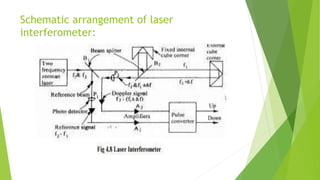
Schematic arrangement of laser
interferometer:
working
 The above shown is the schematic diagram of laser
interferometer.
 Two frequency Zeeman laser generates light of two
slightlydifferent frequencies with opposite circular
polarisation.
 These beams get split up by beam splitter B One part
travels towards B and from there to external cube
corner here the displacement is to the easued.
 The interferometer uses cube corner reflectors which
reflect light parallel to its angle of incidence.
 Beam splitter B2 optically seperates the frequency J
which alone is sent to the movable cube corner
reflector.
 The second frequency from B2 is sent to a fixed reflector
which then rejoins f1 at the beam splitter B2 to produce
alternate light and dark interference flicker at about 2
Mega cycles per second.
 Now if the movable reflector moves, then the returning
beam frequency Doppler-shifted slightly up Thus the
light beams moving towards photo detector P2 have
frequencies f2 and (f1 ± Δf1) and P2 changes these
frequencies int signal from beam splitter B2 and changes
the reference beam frequencies f1 and f2 into electrical
signal.
 An AC amplifier A separates frequency. Difference signal
f2 –f1 and A2 separates frequency difference signal.
 The pulse converter extracts i. one cycle per half
wavelength of motion. The up-down pulses are counted
electronically and displayed in analog or digital form.
Use of laser in interferometery
 The laser in interferometery is used to find
accurate measurements of length.
 The accuracy of laser measurement is in order of
0.1µm in 100m
 In modified laser design, a single frequency is
selected from coherent beam and used for
interferometric measurement.
 Time consumption is Less
Measure other things apart from
distance
 Straightness Measurement
 Combined straightness and displacement
measurement
 Straightness measurement via autocollimation
 Flatness via autocollimation
thank you

Laser interferometery

  • 1.
  • 2.
     Introduction: interferometer usesac laser as light source and thus used to measure large distance,the laser beam wavelength is exact and pure for highly accurate measurements. Principle: 1.Optical technique 2.Digital electronics
  • 3.
    construction 1.Two frequency Zeemanlaser 2.Beam splitter 3.Fixed internal cube corners 4.External cube corners 5.Photo detector 6.Amplifiers 7.Pulse converter
  • 4.
    Description  Two Frequencylaser: Two frequency laser one is polarized vertically and the other is polarized horizontally.  Beam spliter: splites beam  Cube coners: 2 cube corners required one is placed externally and the other is placed internally,both are used to reflect laser beam.  Photo detector: receives signal from splitter and change into electrical signals.
  • 5.
     Amplifiers: itis used to separate frequency difference  Pulse converter: It is used to extract information as pulse signal.  Laser interferometery has the following Advantages.  High repeatability  High accuracy  Long range optical path  Easy intallations  Wear and tear
  • 6.
    Schematic arrangement oflaser interferometer:
  • 7.
    working  The aboveshown is the schematic diagram of laser interferometer.  Two frequency Zeeman laser generates light of two slightlydifferent frequencies with opposite circular polarisation.  These beams get split up by beam splitter B One part travels towards B and from there to external cube corner here the displacement is to the easued.  The interferometer uses cube corner reflectors which reflect light parallel to its angle of incidence.  Beam splitter B2 optically seperates the frequency J which alone is sent to the movable cube corner reflector.
  • 8.
     The secondfrequency from B2 is sent to a fixed reflector which then rejoins f1 at the beam splitter B2 to produce alternate light and dark interference flicker at about 2 Mega cycles per second.  Now if the movable reflector moves, then the returning beam frequency Doppler-shifted slightly up Thus the light beams moving towards photo detector P2 have frequencies f2 and (f1 ± Δf1) and P2 changes these frequencies int signal from beam splitter B2 and changes the reference beam frequencies f1 and f2 into electrical signal.  An AC amplifier A separates frequency. Difference signal f2 –f1 and A2 separates frequency difference signal.  The pulse converter extracts i. one cycle per half wavelength of motion. The up-down pulses are counted electronically and displayed in analog or digital form.
  • 9.
    Use of laserin interferometery  The laser in interferometery is used to find accurate measurements of length.  The accuracy of laser measurement is in order of 0.1µm in 100m  In modified laser design, a single frequency is selected from coherent beam and used for interferometric measurement.  Time consumption is Less
  • 10.
    Measure other thingsapart from distance  Straightness Measurement  Combined straightness and displacement measurement  Straightness measurement via autocollimation  Flatness via autocollimation
  • 11.