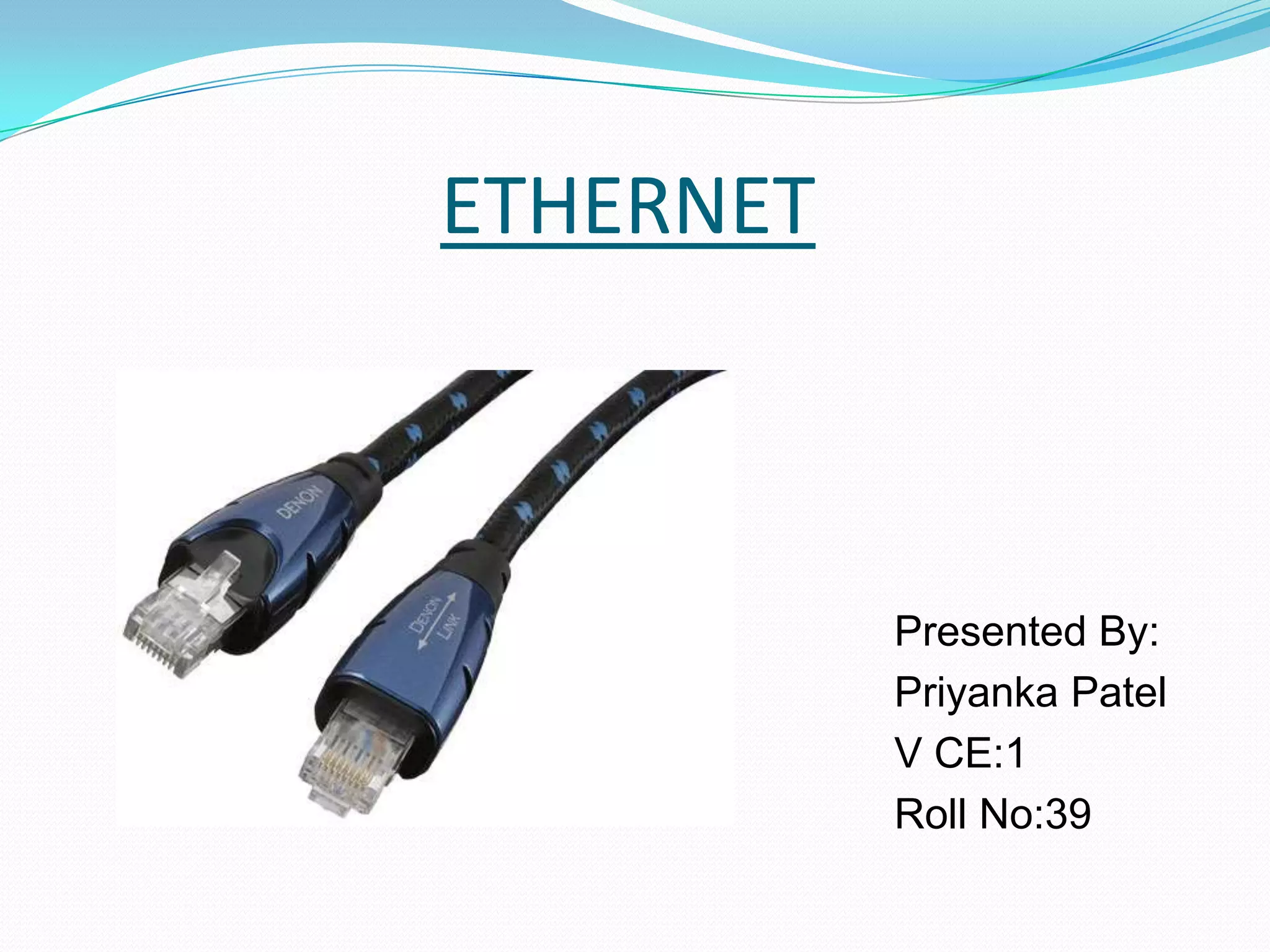



ETHERNET                                                                      Presented By:Priyanka Patel                                                                      V CE:1                                                                       Roll No:39
IntroductionEthernet BasicsEthernet TerminologyEthernet MediumCSMA/CDCollision Detection Limitations of EthernetRepeaters Segmentation BridgesRouters: Logical SegmentationSwitched EthernetFull-duplex Ethernet
INTRODUCTIONEthernet:Ethernet is the most widely-installed local area network ( LAN) technology. Xerox Corporation’s Specifid in a standard,IEEE 802.3An Ethernet LAN typically uses        ->coaxial cable       ->twisted pair wires       ->Fiber Optics
Vrious types of ethernet      ->10Base2      ->10base5     ->10baseT      ->10baseF10Base2 speed 10MbpsFast ethernet (100BASET):100Mbps
The first mass produced personal computers featuring the 1000BASE-T connection.Gigabit ethernet:1GbpsEthernet is also used in wireless LANs
ETHERNET BASICSEthernet networks traditionally operating within a single building, connecting devices in close proximity.These devices could have only a few hundred meters of cable between them. Increased these distances  to span tens of kilometers
There are many technologies that allow you to get connected to the Internet, including this wireless Internet card.
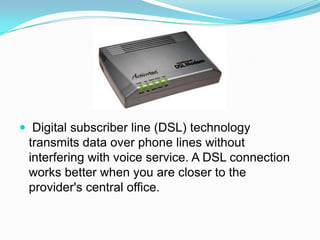
 Digital subscriber line (DSL) technology transmits data over phone lines without interfering with voice service. A DSL connection works better when you are closer to the provider's central office.
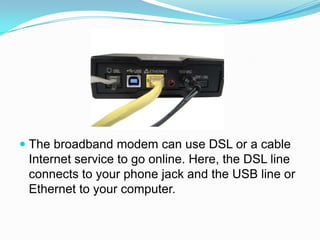
The broadband modem can use DSL or a cable Internet service to go online. Here, the DSL line connects to your phone jack and the USB line or Ethernet to your computer.
ETHERNET  TERMINOLOGYMedium - Ethernet devices attach to a common medium that provides a path along which the electronic signals will travel.Previously this medium has been coaxial copper cable,but today it is more commonly a twisted pair or fiber optic cabling. Segment - We refer to a single shared medium as an Ethernet segment.
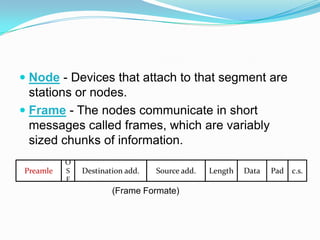
Node - Devices that attach to that segment are stations or nodes. Frame - The nodes communicate in short messages called frames, which are variably sized chunks of information.                                      (Frame Formate)PreamleOSFDestination add.Source add.LengthDataPadc.s.
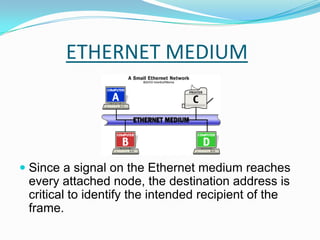
ETHERNET MEDIUMSince a signal on the Ethernet medium reaches every attached node, the destination address is critical to identify the intended recipient of the frame.
CSMA/CDCSMA/CD signifies carrier-sense multiple access with collision detection,describes how the Ethernet protocol regulates communication among nodes.Before a station transmits, it checks if another station is transmitting. If the medium is quiet, the station recognizes that this is an appropriate time to transmit.
LIMITATION OF ETHERNETElectrical signals propagate along a cable very quickly, but they weaken as they travel, and electrical interference from neighboring devices can scramble the signal. Distance limitation on the maximum separation between two devices (called the network diameter) on an Ethernet network.In CSMA/CD only a single device can transmit at a given time.
REPEATERSThe first Ethernet medium was a copper coaxial cable known as "thicknet.“  length of a thicknet cable was 500 meters. Not enougth for building or campus environment.  Repeaters connect multiple Ethernet segments, listening to each segment and repeating the signal heard on one segment onto every other segment connected to the repeater. By running multiple cables and joining them with repeaters, you can significantly increase your network diameter.
SEGMENTATIONEthernet networks faced congestion problems as they increased in size. If a large number of stations connected to the same segment and each generated a sizable amount of traffic, many stations may attempt to transmit whenever there was an opportunity.To reduce congestion would be to split a single segment into multiple segments, thus creating multiple collision domains.
separate segments are not able to share information with each other
BRIDGESBridges connect two or more network segments.Increasing the network diameter as a repeater does,also help regulate traffic.Incrase diameter of network. They can send and receive transmissions just like any other node, but they do not function the same as a normal node. The bridge does not originate any traffic of its own; like a repeater.
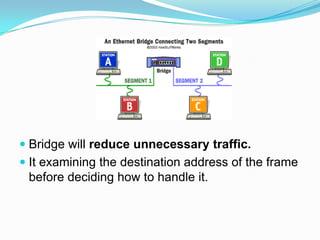
Bridge will reduce unnecessary traffic.It examining the destination address of the frame before deciding how to handle it.
ROUTERSRouters are advanced networking components .Also called Logical Segmentation.Both local and wide area, and has led to their widespread deployment in connecting devices around the world as part of the global Internet.Routers operate based on protocols that are independent of the specific networking technology.
FULL DUPLEX ETHERNETFull-duplex is a data communications term that refers to the ability to send and receive data at the same time.In a totally switched network, nodes only communicate with the switch and never directly with each other. Switched networks also employ either twisted pair or fiber optic cabling, both of which use separate conductors for sending and receiving data.
This allows end stations to transmit to the switch at the same time that the switch transmits to them, achieving a collision-free environment.
REFERENCEwww.howstuffworks.comwww.google.com
THANK YOU…

39 ethernet

  • 1.
    ETHERNET Presented By:Priyanka Patel V CE:1 Roll No:39
  • 2.
    IntroductionEthernet BasicsEthernet TerminologyEthernetMediumCSMA/CDCollision Detection Limitations of EthernetRepeaters Segmentation BridgesRouters: Logical SegmentationSwitched EthernetFull-duplex Ethernet
  • 3.
    INTRODUCTIONEthernet:Ethernet is themost widely-installed local area network ( LAN) technology. Xerox Corporation’s Specifid in a standard,IEEE 802.3An Ethernet LAN typically uses ->coaxial cable ->twisted pair wires ->Fiber Optics
  • 4.
    Vrious types ofethernet ->10Base2 ->10base5 ->10baseT ->10baseF10Base2 speed 10MbpsFast ethernet (100BASET):100Mbps
  • 5.
    The first massproduced personal computers featuring the 1000BASE-T connection.Gigabit ethernet:1GbpsEthernet is also used in wireless LANs
  • 6.
    ETHERNET BASICSEthernet networkstraditionally operating within a single building, connecting devices in close proximity.These devices could have only a few hundred meters of cable between them. Increased these distances to span tens of kilometers
  • 7.
    There are manytechnologies that allow you to get connected to the Internet, including this wireless Internet card.
  • 8.
    Digital subscriberline (DSL) technology transmits data over phone lines without interfering with voice service. A DSL connection works better when you are closer to the provider's central office.
  • 9.
    The broadband modemcan use DSL or a cable Internet service to go online. Here, the DSL line connects to your phone jack and the USB line or Ethernet to your computer.
  • 10.
    ETHERNET TERMINOLOGYMedium- Ethernet devices attach to a common medium that provides a path along which the electronic signals will travel.Previously this medium has been coaxial copper cable,but today it is more commonly a twisted pair or fiber optic cabling. Segment - We refer to a single shared medium as an Ethernet segment.
  • 11.
    Node - Devicesthat attach to that segment are stations or nodes. Frame - The nodes communicate in short messages called frames, which are variably sized chunks of information. (Frame Formate)PreamleOSFDestination add.Source add.LengthDataPadc.s.
  • 12.
    ETHERNET MEDIUMSince asignal on the Ethernet medium reaches every attached node, the destination address is critical to identify the intended recipient of the frame.
  • 13.
    CSMA/CDCSMA/CD signifies carrier-sensemultiple access with collision detection,describes how the Ethernet protocol regulates communication among nodes.Before a station transmits, it checks if another station is transmitting. If the medium is quiet, the station recognizes that this is an appropriate time to transmit.
  • 14.
    LIMITATION OF ETHERNETElectricalsignals propagate along a cable very quickly, but they weaken as they travel, and electrical interference from neighboring devices can scramble the signal. Distance limitation on the maximum separation between two devices (called the network diameter) on an Ethernet network.In CSMA/CD only a single device can transmit at a given time.
  • 15.
    REPEATERSThe first Ethernetmedium was a copper coaxial cable known as "thicknet.“ length of a thicknet cable was 500 meters. Not enougth for building or campus environment. Repeaters connect multiple Ethernet segments, listening to each segment and repeating the signal heard on one segment onto every other segment connected to the repeater. By running multiple cables and joining them with repeaters, you can significantly increase your network diameter.
  • 16.
    SEGMENTATIONEthernet networks facedcongestion problems as they increased in size. If a large number of stations connected to the same segment and each generated a sizable amount of traffic, many stations may attempt to transmit whenever there was an opportunity.To reduce congestion would be to split a single segment into multiple segments, thus creating multiple collision domains.
  • 17.
    separate segments arenot able to share information with each other
  • 18.
    BRIDGESBridges connect twoor more network segments.Increasing the network diameter as a repeater does,also help regulate traffic.Incrase diameter of network. They can send and receive transmissions just like any other node, but they do not function the same as a normal node. The bridge does not originate any traffic of its own; like a repeater.
  • 19.
    Bridge will reduceunnecessary traffic.It examining the destination address of the frame before deciding how to handle it.
  • 20.
    ROUTERSRouters are advancednetworking components .Also called Logical Segmentation.Both local and wide area, and has led to their widespread deployment in connecting devices around the world as part of the global Internet.Routers operate based on protocols that are independent of the specific networking technology.
  • 21.
    FULL DUPLEX ETHERNETFull-duplexis a data communications term that refers to the ability to send and receive data at the same time.In a totally switched network, nodes only communicate with the switch and never directly with each other. Switched networks also employ either twisted pair or fiber optic cabling, both of which use separate conductors for sending and receiving data.
  • 22.
    This allows endstations to transmit to the switch at the same time that the switch transmits to them, achieving a collision-free environment.
  • 23.
  • 24.