Creating The Sprott-Shaw Advantage The Virtual Environment Teaching Initiative
Creating the new e-learning environment Introduction: Two Case Studies I. Foundations of the new e-learning environment II. Designing the new e-learning environment III. Constructing the new e-learning environment Conclusion: Implementing the new e-learning environment
Introduction: Two Case Studies “ Growing Esteem”: The Melbourne Model Moving to Moodle: The Royal Roads Experience
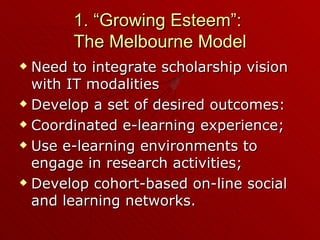
1. “Growing Esteem”:  The Melbourne Model Need to integrate scholarship vision with IT modalities Develop a set of desired outcomes: Coordinated e-learning experience; Use e-learning environments to engage in research activities; Develop cohort-based on-line social and learning networks.
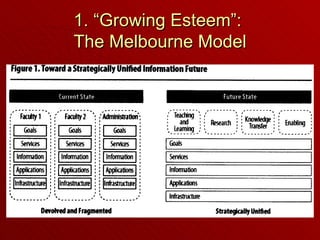
1. “Growing Esteem”:  The Melbourne Model
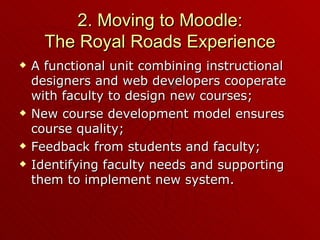
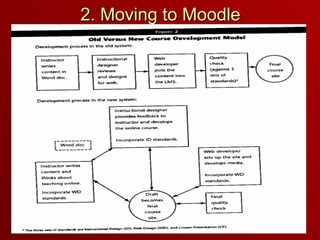
2. Moving to Moodle: The Royal Roads Experience A functional unit combining instructional designers and web developers cooperate with faculty to design new courses; New course development model ensures course quality; Feedback from students and faculty; Identifying faculty needs and supporting them to implement new system.
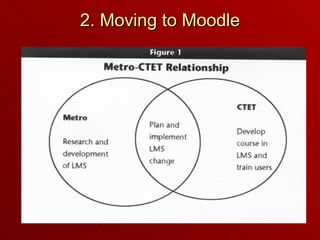
2. Moving to Moodle
2. Moving to Moodle
Part I: Foundations of new e-learning environment   1. SSDC Vision Statement 2. Turning Ideas Into Action 3. Outline of 5 Core Principles
1. SSDC Vision Statement We offer better, faster quality degree experiences in business and hospitality. We make a difference through small class sizes,  quality teaching and imaginative learning . We offer our degrees through  a combination of in-class and online learning . We partner for our degrees with businesses and non profit organizations who help our students learn and hire our graduates when the complete their degrees. We have a  second to none reputation for quality, flexibility  and partnerships. We offer credit recognition, block credit transfer and work-based learning credit as well as  flexible programming through independent study  to accommodate adult students at different stages of their learning journey.
2. Turning Ideas Into Action We will embrace current  blended learning methods – using classrooms, intensive learning experiences, online learning   and focused used of placements and co-op experiences.  We will pursue quality in all of our activities and  engage the Faculty in the pursuit of quality . We will leverage the work being undertaken within the Community College on Moodle and use this as  basis of  fast tracking students world-wide (the first two years online) and focus on innovative learning in years 3 and 4 of the degree . We will ensure that  the Sprott Shaw experience for learners is remarkable  and the basis of quality word of mouth marketing. We can’t get to where we want to be by remaining where we are!
3. Outline of 5 Core Principles Developing a  continuous, week-long learning process  for each course; Articulating  face-to-face and online with synchronous and asynchronous modes of learning; Motivating students to learn autonomously and to participate actively  in the development of their own courses; Introducing  creative and innovative teaching tools  which will enable students to take initiative and work as a team; and Preparing students for the  highly interactive business environment of tomorrow .
Part II: Designing the new e-learning environment 1. Need Finding 2. Requirements Identification 3. Project Formulation 4. Prototype Design
1. Need Finding A. The Emerging Student Experience B. Learning Technologies C. The Blended Learning Environment
A. The Emerging Student Experience Classrooms are not the only form of learning space; Social interaction is a growing part of learning; Technology is natural; Internet resources can bypass peer review; Learning can occur out of sequence; Students construct content rather than just consuming it.
B. Learning Technologies Virtual Technologies: -  Online presence; - Online resources.  Installed Appliances : - Media presentation systems; - Remote interaction systems; -  Room-scale peripherals. Mobile Devices: -  Personal information and communication devices.
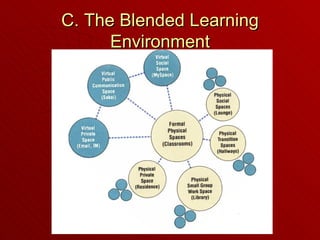
C. The Blended Learning Environment
2. Requirements Identification Facilitate learning process; Integrate synchronous and asynchronous teaching methods; Provide a multi-media teaching, learning and research experience; Diversify the teaching/learning experience; Increase interaction and feedback between students and faculty.
3. Project Formulation Move from a weekly 3 ½ hour in-class teaching session to a week-long multi-modal learning experience; Use Moodle as platform; New course development method; Facilitate students’ learning process; Interactive asynchronous learning; Synchronous virtual and real support
4. Prototype Design All course materials available online; Additional multi-media learning and research tools; Monitored on-line assignments; Real-time feedback and support; Student participation in developing course content and materials; Line-of-sight connection between e-learning efforts and course outcomes
Part III: Constructing the new e-learning environment  New course design demonstration; Student feedback and input; Integration with classroom teaching and tutorials; Linkage with synchronous and asynchronous communication tools; Developing contacts with industry-specific organisations.
Conclusion: Implementing the new e-learning environment Assisting faculty with new environment learning and course design; Moving from 3 ½ hours class session to 3-hour Plus session: online monitoring and feedback, tutorials Enhancing Moodle interactive features (e-mail, chat, conferences, video); Reviewing faculty workload and compensation.
Conclusion: Implementing the new e-learning environment Course management systems and their implementation are a work in progress. They promise to significantly reduce the restrictions of time and space on learning for students and faculty, in much the same way their predecessor enterprise administrative systems did for student administrative services. Used properly, they have the potential to greatly improve student access to information and to communicate with their instructors, enhance the quality of learning, and increase learning productivity.
Conclusion: Implementing the new e-learning environment Course management systems can enhance learning quality by enabling instructors to convey information more effectively, helping instructors meet the needs of students with varied learning styles, as well as enriching the interactions students have with each other and with their instructors. That is the promise. However, the students in this study called our attention to performance by noting an uneven diffusion of innovation using this technology. This may be due, in part, to faculty or student skill. It may also be due to a lack of institutional recognition of innovation, especially as the successful use of course management systems affects or does not affect faculty tenure, promotion, and merit decisions. Educating the Net Generation Diana G. Oblinger and James L. Oblinger, Editors EDUCAUSE 2005:  www.educause.edu/educatingthenetgen /

Ascele Presentation

  • 1.
    Creating The Sprott-ShawAdvantage The Virtual Environment Teaching Initiative
  • 2.
    Creating the newe-learning environment Introduction: Two Case Studies I. Foundations of the new e-learning environment II. Designing the new e-learning environment III. Constructing the new e-learning environment Conclusion: Implementing the new e-learning environment
  • 3.
    Introduction: Two CaseStudies “ Growing Esteem”: The Melbourne Model Moving to Moodle: The Royal Roads Experience
  • 4.
    1. “Growing Esteem”: The Melbourne Model Need to integrate scholarship vision with IT modalities Develop a set of desired outcomes: Coordinated e-learning experience; Use e-learning environments to engage in research activities; Develop cohort-based on-line social and learning networks.
  • 5.
    1. “Growing Esteem”: The Melbourne Model
  • 6.
    2. Moving toMoodle: The Royal Roads Experience A functional unit combining instructional designers and web developers cooperate with faculty to design new courses; New course development model ensures course quality; Feedback from students and faculty; Identifying faculty needs and supporting them to implement new system.
  • 7.
  • 8.
  • 9.
    Part I: Foundationsof new e-learning environment 1. SSDC Vision Statement 2. Turning Ideas Into Action 3. Outline of 5 Core Principles
  • 10.
    1. SSDC VisionStatement We offer better, faster quality degree experiences in business and hospitality. We make a difference through small class sizes, quality teaching and imaginative learning . We offer our degrees through a combination of in-class and online learning . We partner for our degrees with businesses and non profit organizations who help our students learn and hire our graduates when the complete their degrees. We have a second to none reputation for quality, flexibility and partnerships. We offer credit recognition, block credit transfer and work-based learning credit as well as flexible programming through independent study to accommodate adult students at different stages of their learning journey.
  • 11.
    2. Turning IdeasInto Action We will embrace current blended learning methods – using classrooms, intensive learning experiences, online learning and focused used of placements and co-op experiences. We will pursue quality in all of our activities and engage the Faculty in the pursuit of quality . We will leverage the work being undertaken within the Community College on Moodle and use this as basis of fast tracking students world-wide (the first two years online) and focus on innovative learning in years 3 and 4 of the degree . We will ensure that the Sprott Shaw experience for learners is remarkable and the basis of quality word of mouth marketing. We can’t get to where we want to be by remaining where we are!
  • 12.
    3. Outline of5 Core Principles Developing a continuous, week-long learning process for each course; Articulating face-to-face and online with synchronous and asynchronous modes of learning; Motivating students to learn autonomously and to participate actively in the development of their own courses; Introducing creative and innovative teaching tools which will enable students to take initiative and work as a team; and Preparing students for the highly interactive business environment of tomorrow .
  • 13.
    Part II: Designingthe new e-learning environment 1. Need Finding 2. Requirements Identification 3. Project Formulation 4. Prototype Design
  • 14.
    1. Need FindingA. The Emerging Student Experience B. Learning Technologies C. The Blended Learning Environment
  • 15.
    A. The EmergingStudent Experience Classrooms are not the only form of learning space; Social interaction is a growing part of learning; Technology is natural; Internet resources can bypass peer review; Learning can occur out of sequence; Students construct content rather than just consuming it.
  • 16.
    B. Learning TechnologiesVirtual Technologies: - Online presence; - Online resources. Installed Appliances : - Media presentation systems; - Remote interaction systems; - Room-scale peripherals. Mobile Devices: - Personal information and communication devices.
  • 17.
    C. The BlendedLearning Environment
  • 18.
    2. Requirements IdentificationFacilitate learning process; Integrate synchronous and asynchronous teaching methods; Provide a multi-media teaching, learning and research experience; Diversify the teaching/learning experience; Increase interaction and feedback between students and faculty.
  • 19.
    3. Project FormulationMove from a weekly 3 ½ hour in-class teaching session to a week-long multi-modal learning experience; Use Moodle as platform; New course development method; Facilitate students’ learning process; Interactive asynchronous learning; Synchronous virtual and real support
  • 20.
    4. Prototype DesignAll course materials available online; Additional multi-media learning and research tools; Monitored on-line assignments; Real-time feedback and support; Student participation in developing course content and materials; Line-of-sight connection between e-learning efforts and course outcomes
  • 21.
    Part III: Constructingthe new e-learning environment New course design demonstration; Student feedback and input; Integration with classroom teaching and tutorials; Linkage with synchronous and asynchronous communication tools; Developing contacts with industry-specific organisations.
  • 22.
    Conclusion: Implementing thenew e-learning environment Assisting faculty with new environment learning and course design; Moving from 3 ½ hours class session to 3-hour Plus session: online monitoring and feedback, tutorials Enhancing Moodle interactive features (e-mail, chat, conferences, video); Reviewing faculty workload and compensation.
  • 23.
    Conclusion: Implementing thenew e-learning environment Course management systems and their implementation are a work in progress. They promise to significantly reduce the restrictions of time and space on learning for students and faculty, in much the same way their predecessor enterprise administrative systems did for student administrative services. Used properly, they have the potential to greatly improve student access to information and to communicate with their instructors, enhance the quality of learning, and increase learning productivity.
  • 24.
    Conclusion: Implementing thenew e-learning environment Course management systems can enhance learning quality by enabling instructors to convey information more effectively, helping instructors meet the needs of students with varied learning styles, as well as enriching the interactions students have with each other and with their instructors. That is the promise. However, the students in this study called our attention to performance by noting an uneven diffusion of innovation using this technology. This may be due, in part, to faculty or student skill. It may also be due to a lack of institutional recognition of innovation, especially as the successful use of course management systems affects or does not affect faculty tenure, promotion, and merit decisions. Educating the Net Generation Diana G. Oblinger and James L. Oblinger, Editors EDUCAUSE 2005: www.educause.edu/educatingthenetgen /