

Adjustment Disorder Case Study
Using the PACER Method
Counselor Toolbox Podcast Episode 442
Dr. Dawn-Elise Snipes PhD, LPC-MHSP, LMHC
Executive Director, AllCEUs.com
Podcast Host: Counselor Toolbox and Case Management Toolbox
Copyright 2019 Counselor Toolbox Podcast: Overview of the PACER Method and Transdiagnostic Assessment 1
Objectives
 Review a case study using the transdiagnostic,
transtheoretical PACER approach
Counselor Toolbox Podcast: Overview of the PACER Method and Transdiagnostic Assessment 2
 As they say on Law and Order…
 The following story is fictional and does not depict any
actual person or event.”
Counselor Toolbox Podcast: Overview of the PACER Method and Transdiagnostic Assessment 3
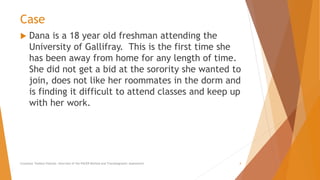
Case
 Dana is a 18 year old freshman attending the
University of Gallifray. This is the first time she
has been away from home for any length of time.
She did not get a bid at the sorority she wanted to
join, does not like her roommates in the dorm and
is finding it difficult to attend classes and keep up
with her work.
Counselor Toolbox Podcast: Overview of the PACER Method and Transdiagnostic Assessment 4
Physical
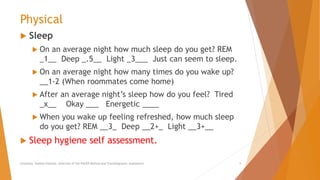
 Sleep
 On an average night how much sleep do you get? REM
_1__ Deep _.5__ Light _3___ Just can seem to sleep.
 On an average night how many times do you wake up?
__1-2 (When roommates come home)
 After an average night’s sleep how do you feel? Tired
_x__ Okay ___ Energetic ____
 When you wake up feeling refreshed, how much sleep
do you get? REM __3_ Deep __2+_ Light __3+__
 Sleep hygiene self assessment.
Counselor Toolbox Podcast: Overview of the PACER Method and Transdiagnostic Assessment 5
Physical
 Nutrition
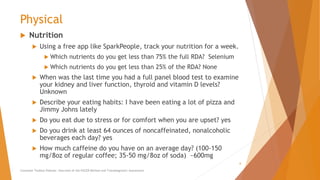
 Using a free app like SparkPeople, track your nutrition for a week.
 Which nutrients do you get less than 75% the full RDA? Selenium
 Which nutrients do you get less than 25% of the RDA? None
 When was the last time you had a full panel blood test to examine
your kidney and liver function, thyroid and vitamin D levels?
Unknown
 Describe your eating habits: I have been eating a lot of pizza and
Jimmy Johns lately
 Do you eat due to stress or for comfort when you are upset? yes
 Do you drink at least 64 ounces of noncaffeinated, nonalcoholic
beverages each day? yes
 How much caffeine do you have on an average day? (100-150
mg/8oz of regular coffee; 35-50 mg/8oz of soda) ~600mg
Counselor Toolbox Podcast: Overview of the PACER Method and Transdiagnostic Assessment
6
Physical
 Nutrition
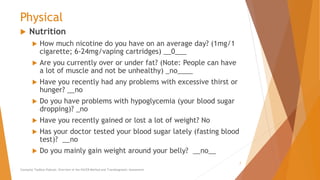
 How much nicotine do you have on an average day? (1mg/1
cigarette; 6-24mg/vaping cartridges) __0___
 Are you currently over or under fat? (Note: People can have
a lot of muscle and not be unhealthy) _no____
 Have you recently had any problems with excessive thirst or
hunger? __no
 Do you have problems with hypoglycemia (your blood sugar
dropping)? _no
 Have you recently gained or lost a lot of weight? No
 Has your doctor tested your blood sugar lately (fasting blood
test)? __no
 Do you mainly gain weight around your belly? __no__
Counselor Toolbox Podcast: Overview of the PACER Method and Transdiagnostic Assessment
7
Physical
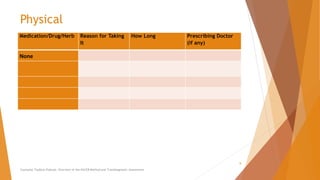
Medication/Drug/Herb Reason for Taking
It
How Long Prescribing Doctor
(if any)
None
Counselor Toolbox Podcast: Overview of the PACER Method and Transdiagnostic Assessment
8
Physical
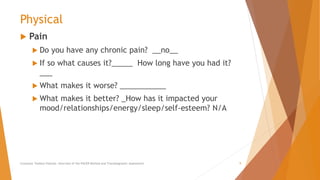
 Pain
 Do you have any chronic pain? __no__
 If so what causes it?_____ How long have you had it?
___
 What makes it worse? ___________
 What makes it better? _How has it impacted your
mood/relationships/energy/sleep/self-esteem? N/A
Counselor Toolbox Podcast: Overview of the PACER Method and Transdiagnostic Assessment 9
Physical
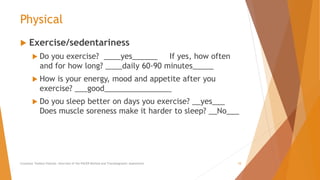
 Exercise/sedentariness
 Do you exercise? ____yes______ If yes, how often
and for how long? ____daily 60-90 minutes_____
 How is your energy, mood and appetite after you
exercise? ___good________________
 Do you sleep better on days you exercise? __yes___
Does muscle soreness make it harder to sleep? __No___
Counselor Toolbox Podcast: Overview of the PACER Method and Transdiagnostic Assessment 10
Physical
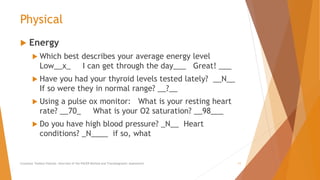
 Energy
 Which best describes your average energy level
Low__x_ I can get through the day___ Great! ___
 Have you had your thyroid levels tested lately? __N__
If so were they in normal range? __?__
 Using a pulse ox monitor: What is your resting heart
rate? __70_ What is your O2 saturation? __98___
 Do you have high blood pressure? _N__ Heart
conditions? _N____ if so, what
Counselor Toolbox Podcast: Overview of the PACER Method and Transdiagnostic Assessment 11
Physical
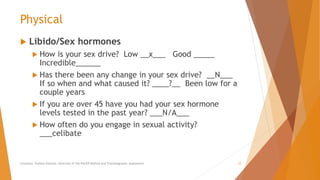
 Libido/Sex hormones
 How is your sex drive? Low __x___ Good _____
Incredible______
 Has there been any change in your sex drive? __N___
If so when and what caused it? ____?__ Been low for a
couple years
 If you are over 45 have you had your sex hormone
levels tested in the past year? ___N/A___
 How often do you engage in sexual activity?
___celibate
Counselor Toolbox Podcast: Overview of the PACER Method and Transdiagnostic Assessment 12
Physical
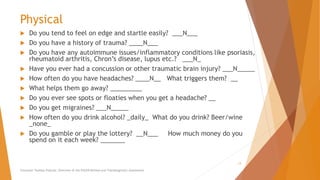
 Do you tend to feel on edge and startle easily? ___N___
 Do you have a history of trauma? ____N___
 Do you have any autoimmune issues/inflammatory conditions like psoriasis,
rheumatoid arthritis, Chron’s disease, lupus etc.? ___N_
 Have you ever had a concussion or other traumatic brain injury? ___N_____
 How often do you have headaches? ____N__ What triggers them? __
 What helps them go away? _________
 Do you ever see spots or floaties when you get a headache? __
 Do you get migraines? ___N_____
 How often do you drink alcohol? _daily_ What do you drink? Beer/wine
_none_
 Do you gamble or play the lottery? __N___ How much money do you
spend on it each week? _______
Counselor Toolbox Podcast: Overview of the PACER Method and Transdiagnostic Assessment
13
Affective
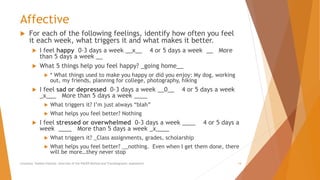
 For each of the following feelings, identify how often you feel
it each week, what triggers it and what makes it better.
 I feel happy 0-3 days a week __x__ 4 or 5 days a week __ More
than 5 days a week __
 What 5 things help you feel happy? _going home__
 * What things used to make you happy or did you enjoy: My dog, working
out, my friends, planning for college, photography, hiking
 I feel sad or depressed 0-3 days a week __0__ 4 or 5 days a week
_x___ More than 5 days a week ____
 What triggers it? I’m just always “blah”
 What helps you feel better? Nothing
 I feel stressed or overwhelmed 0-3 days a week ____ 4 or 5 days a
week ____ More than 5 days a week _x____
 What triggers it? _Class assignments, grades, scholarship
 What helps you feel better? __nothing. Even when I get them done, there
will be more…they never stop
Counselor Toolbox Podcast: Overview of the PACER Method and Transdiagnostic Assessment 14
Affective
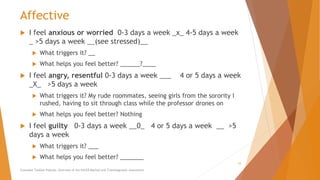
 I feel anxious or worried 0-3 days a week _x_ 4-5 days a week
_ >5 days a week __(see stressed)__
 What triggers it? __
 What helps you feel better? ______?____
 I feel angry, resentful 0-3 days a week ___ 4 or 5 days a week
_X_ >5 days a week
 What triggers it? My rude roommates, seeing girls from the sorority I
rushed, having to sit through class while the professor drones on
 What helps you feel better? Nothing
 I feel guilty 0-3 days a week __0_ 4 or 5 days a week __ >5
days a week
 What triggers it? ___
 What helps you feel better? _______
Counselor Toolbox Podcast: Overview of the PACER Method and Transdiagnostic Assessment
15
Affective
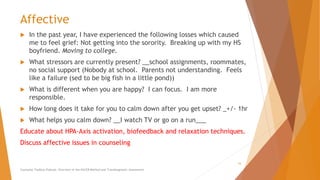
 In the past year, I have experienced the following losses which caused
me to feel grief: Not getting into the sorority. Breaking up with my HS
boyfriend. Moving to college.
 What stressors are currently present? __school assignments, roommates,
no social support (Nobody at school. Parents not understanding. Feels
like a failure (sed to be big fish in a little pond))
 What is different when you are happy? I can focus. I am more
responsible.
 How long does it take for you to calm down after you get upset? _+/- 1hr
 What helps you calm down? __I watch TV or go on a run___
Educate about HPA-Axis activation, biofeedback and relaxation techniques.
Discuss affective issues in counseling
Counselor Toolbox Podcast: Overview of the PACER Method and Transdiagnostic Assessment
16
Cognitive
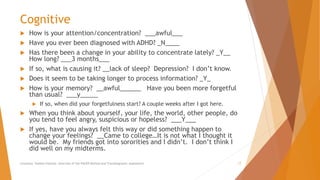
 How is your attention/concentration? ___awful___
 Have you ever been diagnosed with ADHD? _N____
 Has there been a change in your ability to concentrate lately? _Y__
How long? ___3 months___
 If so, what is causing it? __lack of sleep? Depression? I don’t know.
 Does it seem to be taking longer to process information? _Y_
 How is your memory? __awful______ Have you been more forgetful
than usual? ___y_____
 If so, when did your forgetfulness start? A couple weeks after I got here.
 When you think about yourself, your life, the world, other people, do
you tend to feel angry, suspicious or hopeless? ___Y___
 If yes, have you always felt this way or did something happen to
change your feelings? __Came to college…It is not what I thought it
would be. My friends got into sororities and I didn’t. I don’t think I
did well on my midterms.
Counselor Toolbox Podcast: Overview of the PACER Method and Transdiagnostic Assessment 17
Cognitive
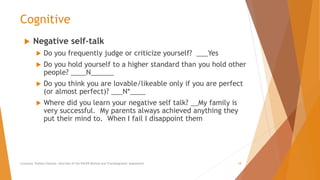
 Negative self-talk
 Do you frequently judge or criticize yourself? ___Yes
 Do you hold yourself to a higher standard than you hold other
people? ____N______
 Do you think you are lovable/likeable only if you are perfect
(or almost perfect)? ___N*____
 Where did you learn your negative self talk? __My family is
very successful. My parents always achieved anything they
put their mind to. When I fail I disappoint them
Counselor Toolbox Podcast: Overview of the PACER Method and Transdiagnostic Assessment 18
Cognitive
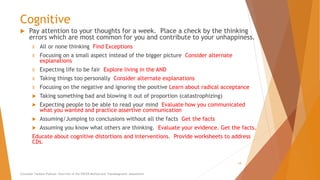
 Pay attention to your thoughts for a week. Place a check by the thinking
errors which are most common for you and contribute to your unhappiness.
X All or none thinking Find Exceptions
X Focusing on a small aspect instead of the bigger picture Consider alternate
explanations
X Expecting life to be fair Explore living in the AND
X Taking things too personally Consider alternate explanations
X Focusing on the negative and ignoring the positive Learn about radical acceptance
 Taking something bad and blowing it out of proportion (catastrophizing)
 Expecting people to be able to read your mind Evaluate how you communicated
what you wanted and practice assertive communication
 Assuming/Jumping to conclusions without all the facts Get the facts
 Assuming you know what others are thinking. Evaluate your evidence. Get the facts.
Educate about cognitive distortions and interventions. Provide worksheets to address
CDs.
Counselor Toolbox Podcast: Overview of the PACER Method and Transdiagnostic Assessment
19
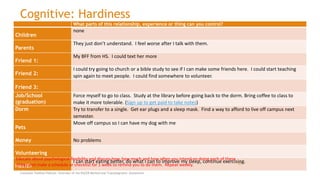
Cognitive: Hardiness
What parts of this relationship, experience or thing can you control?
Children
none
Parents
They just don’t understand. I feel worse after I talk with them.
Friend 1:
My BFF from HS. I could text her more
Friend 2:
I could try going to church or a bible study to see if I can make some friends here. I could start teaching
spin again to meet people. I could find somewhere to volunteer.
Friend 3:
Job/School
(graduation)
Force myself to go to class. Study at the library before going back to the dorm. Bring coffee to class to
make it more tolerable. (Sign up to get paid to take notes)
Dorm Try to transfer to a single. Get ear plugs and a sleep mask. Find a way to afford to live off campus next
semester.
Pets
Move off campus so I can have my dog with me
Money No problems
Volunteering
Health
I can start eating better, do what I can to improve my sleep, continue exercising.
Counselor Toolbox Podcast: Overview of the PACER Method and Transdiagnostic Assessment
20
Educate about psychological flexibility and discuss how, how much and how often you intend on doing each of these
things and make a schedule or checklist for 1 week to remind you to do them. Repeat weekly.
Cognitive
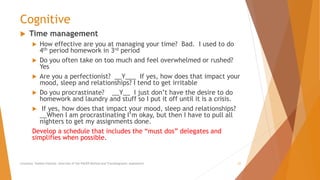
 Time management
 How effective are you at managing your time? Bad. I used to do
4th period homework in 3rd period
 Do you often take on too much and feel overwhelmed or rushed?
Yes
 Are you a perfectionist? __Y___ If yes, how does that impact your
mood, sleep and relationships? I tend to get irritable
 Do you procrastinate? __Y__ I just don’t have the desire to do
homework and laundry and stuff so I put it off until it is a crisis.
 If yes, how does that impact your mood, sleep and relationships?
__When I am procrastinating I’m okay, but then I have to pull all
nighters to get my assignments done.
Develop a schedule that includes the “must dos” delegates and
simplifies when possible.
Counselor Toolbox Podcast: Overview of the PACER Method and Transdiagnostic Assessment 21
Environmental
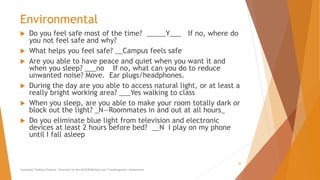
 Do you feel safe most of the time? _____Y___ If no, where do
you not feel safe and why?
 What helps you feel safe? __Campus feels safe
 Are you able to have peace and quiet when you want it and
when you sleep? ___no If no, what can you do to reduce
unwanted noise? Move. Ear plugs/headphones.
 During the day are you able to access natural light, or at least a
really bright working area? ___Yes walking to class
 When you sleep, are you able to make your room totally dark or
block out the light? _N—Roommates in and out at all hours_
 Do you eliminate blue light from television and electronic
devices at least 2 hours before bed? __N I play on my phone
until I fall asleep
Counselor Toolbox Podcast: Overview of the PACER Method and Transdiagnostic Assessment
22
Environmental
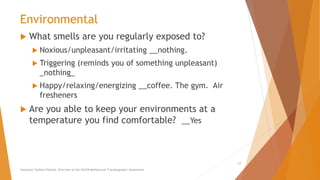
 What smells are you regularly exposed to?
 Noxious/unpleasant/irritating __nothing.
 Triggering (reminds you of something unpleasant)
_nothing_
 Happy/relaxing/energizing __coffee. The gym. Air
fresheners
 Are you able to keep your environments at a
temperature you find comfortable? __Yes
Counselor Toolbox Podcast: Overview of the PACER Method and Transdiagnostic Assessment
23
Relationships
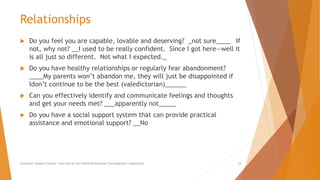
 Do you feel you are capable, lovable and deserving? _not sure____ If
not, why not? __I used to be really confident. Since I got here—well it
is all just so different. Not what I expected._
 Do you have healthy relationships or regularly fear abandonment?
____My parents won’t abandon me, they will just be disappointed if
Idon’t continue to be the best (valedictorian)______
 Can you effectively identify and communicate feelings and thoughts
and get your needs met? ___apparently not_____
 Do you have a social support system that can provide practical
assistance and emotional support? __No
Counselor Toolbox Podcast: Overview of the PACER Method and Transdiagnostic Assessment 24
Summary
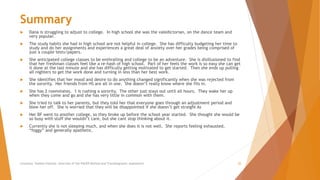
 Dana is struggling to adjust to college. In high school she was the valedictorian, on the dance team and
very popular.
 The study habits she had in high school are not helpful in college. She has difficulty budgeting her time to
study and do her assignments and experiences a great deal of anxiety over her grades being comprised of
just a couple tests/papers.
 She anticipated college classes to be enthralling and college to be an adventure. She is disillusioned to find
that her freshman classes feel like a re-hash of high school. Part of her feels the work is so easy she can get
it done at the last minute and she has difficulty getting motivated to get started. Then she ends up pulling
all nighters to get the work done and turning in less than her best work.
 She identifies that her mood and desire to do anything changed significantly when she was rejected from
the sorority. Her friends from HS are all in one. She doesn’t really know where she fits in.
 She has 2 roommates. 1 is rushing a sorority. The other just stays out until all hours. They wake her up
when they come and go and she has very little in common with them.
 She tried to talk to her parents, but they told her that everyone goes through an adjustment period and
blew her off. She is worried that they will be disappointed if she doesn’t get straight As
 Her BF went to another college, so they broke up before the school year started. She thought she would be
so busy with stuff she wouldn’t care, but she cant stop thinking about it.
 Currently she is not sleeping much, and when she does it is not well. She reports feeling exhausted,
“foggy” and generally apathetic.
Counselor Toolbox Podcast: Overview of the PACER Method and Transdiagnostic Assessment 25
Tx. Plan Goals
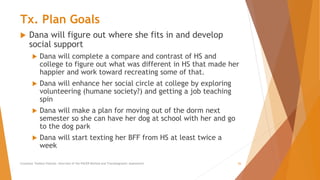
 Dana will figure out where she fits in and develop
social support
 Dana will complete a compare and contrast of HS and
college to figure out what was different in HS that made her
happier and work toward recreating some of that.
 Dana will enhance her social circle at college by exploring
volunteering (humane society?) and getting a job teaching
spin
 Dana will make a plan for moving out of the dorm next
semester so she can have her dog at school with her and go
to the dog park
 Dana will start texting her BFF from HS at least twice a
week
Counselor Toolbox Podcast: Overview of the PACER Method and Transdiagnostic Assessment 26
Tx. Plan Goals
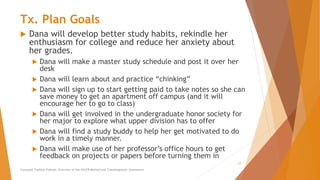
 Dana will develop better study habits, rekindle her
enthusiasm for college and reduce her anxiety about
her grades.
 Dana will make a master study schedule and post it over her
desk
 Dana will learn about and practice “chinking”
 Dana will sign up to start getting paid to take notes so she can
save money to get an apartment off campus (and it will
encourage her to go to class)
 Dana will get involved in the undergraduate honor society for
her major to explore what upper division has to offer
 Dana will find a study buddy to help her get motivated to do
work in a timely manner.
 Dana will make use of her professor’s office hours to get
feedback on projects or papers before turning them in
Counselor Toolbox Podcast: Overview of the PACER Method and Transdiagnostic Assessment
27
Tx. Plan Goals
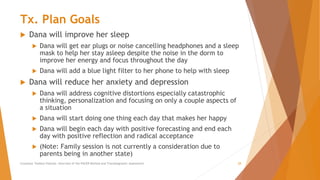
 Dana will improve her sleep
 Dana will get ear plugs or noise cancelling headphones and a sleep
mask to help her stay asleep despite the noise in the dorm to
improve her energy and focus throughout the day
 Dana will add a blue light filter to her phone to help with sleep
 Dana will reduce her anxiety and depression
 Dana will address cognitive distortions especially catastrophic
thinking, personalization and focusing on only a couple aspects of
a situation
 Dana will start doing one thing each day that makes her happy
 Dana will begin each day with positive forecasting and end each
day with positive reflection and radical acceptance
 (Note: Family session is not currently a consideration due to
parents being in another state)
Counselor Toolbox Podcast: Overview of the PACER Method and Transdiagnostic Assessment 28
Tx. Plan Goals
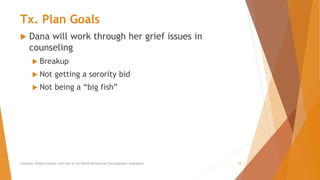
 Dana will work through her grief issues in
counseling
 Breakup
 Not getting a sorority bid
 Not being a “big fish”
Counselor Toolbox Podcast: Overview of the PACER Method and Transdiagnostic Assessment 29
Reassessment
 Dana made the school schedule and started “chunking” She found
that it helped her to get her work done if she made herself go to the
library instead of going back to the dorm
 Dana has started using her professor’s office hours and feels more
confident in her ability to do her work.
 Getting paid to take notes has significantly increased her motivation
to go to class and pay attention. She is not sure if it will help with
her grades, but she is not falling nearly as far behind and hasn’t
pulled an all nighter in 2 months.
 Dana still hates the dorm, but she talked with her parents and they
have agreed to help her move off campus next semester and bring her
dog to school. This improved her outlook.
 When comparing to high school, Dana realized that there she felt
noticed and appreciated. Dana has found a couple extracurricular
groups that she enjoys going to. She hasn’t met any real “friends”
yet, but she does feel a little more connected.
Counselor Toolbox Podcast: Overview of the PACER Method and Transdiagnostic Assessment 30
Reassessment
 Dana reports that she still hates her classes but she now sees them as
a way to pad her GPA before upper division.
 Dana still holds some bitterness toward the sorority, but realizes that
holding on to that anger is not going to change anything. She does her
best to avoid those women right now and focus her attention on her
new activities.
 She has worked through some of the grief related to her breakup. She
recognized that it represented another rejection (in addition to the
sorority) and was focusing on that because she thought it was
something she might be able to change.
 Dana has found positive forecasting and reflection and radical
acceptance helps her to focus on the bigger picture which has also
reduced her catastrophizing.
Counselor Toolbox Podcast: Overview of the PACER Method and Transdiagnostic Assessment 31
Summary
 Unlike depression and anxiety disorders which generally
have no identifiable trigger, adjustment disorders
typically have a clear “cause”
 When life changes (even for the better) it throws our
world out of balance and we have to adjust.
 Dana recognized how college was more than just a
different school and identified ways to bring her
“world” back into balance.
Counselor Toolbox Podcast: Overview of the PACER Method and Transdiagnostic Assessment
32

Adjustment disorder case study

  • 1.
    Adjustment Disorder CaseStudy Using the PACER Method Counselor Toolbox Podcast Episode 442 Dr. Dawn-Elise Snipes PhD, LPC-MHSP, LMHC Executive Director, AllCEUs.com Podcast Host: Counselor Toolbox and Case Management Toolbox Copyright 2019 Counselor Toolbox Podcast: Overview of the PACER Method and Transdiagnostic Assessment 1
  • 2.
    Objectives  Review acase study using the transdiagnostic, transtheoretical PACER approach Counselor Toolbox Podcast: Overview of the PACER Method and Transdiagnostic Assessment 2
  • 3.
     As theysay on Law and Order…  The following story is fictional and does not depict any actual person or event.” Counselor Toolbox Podcast: Overview of the PACER Method and Transdiagnostic Assessment 3
  • 4.
    Case  Dana isa 18 year old freshman attending the University of Gallifray. This is the first time she has been away from home for any length of time. She did not get a bid at the sorority she wanted to join, does not like her roommates in the dorm and is finding it difficult to attend classes and keep up with her work. Counselor Toolbox Podcast: Overview of the PACER Method and Transdiagnostic Assessment 4
  • 5.
    Physical  Sleep  Onan average night how much sleep do you get? REM _1__ Deep _.5__ Light _3___ Just can seem to sleep.  On an average night how many times do you wake up? __1-2 (When roommates come home)  After an average night’s sleep how do you feel? Tired _x__ Okay ___ Energetic ____  When you wake up feeling refreshed, how much sleep do you get? REM __3_ Deep __2+_ Light __3+__  Sleep hygiene self assessment. Counselor Toolbox Podcast: Overview of the PACER Method and Transdiagnostic Assessment 5
  • 6.
    Physical  Nutrition  Usinga free app like SparkPeople, track your nutrition for a week.  Which nutrients do you get less than 75% the full RDA? Selenium  Which nutrients do you get less than 25% of the RDA? None  When was the last time you had a full panel blood test to examine your kidney and liver function, thyroid and vitamin D levels? Unknown  Describe your eating habits: I have been eating a lot of pizza and Jimmy Johns lately  Do you eat due to stress or for comfort when you are upset? yes  Do you drink at least 64 ounces of noncaffeinated, nonalcoholic beverages each day? yes  How much caffeine do you have on an average day? (100-150 mg/8oz of regular coffee; 35-50 mg/8oz of soda) ~600mg Counselor Toolbox Podcast: Overview of the PACER Method and Transdiagnostic Assessment 6
  • 7.
    Physical  Nutrition  Howmuch nicotine do you have on an average day? (1mg/1 cigarette; 6-24mg/vaping cartridges) __0___  Are you currently over or under fat? (Note: People can have a lot of muscle and not be unhealthy) _no____  Have you recently had any problems with excessive thirst or hunger? __no  Do you have problems with hypoglycemia (your blood sugar dropping)? _no  Have you recently gained or lost a lot of weight? No  Has your doctor tested your blood sugar lately (fasting blood test)? __no  Do you mainly gain weight around your belly? __no__ Counselor Toolbox Podcast: Overview of the PACER Method and Transdiagnostic Assessment 7
  • 8.
    Physical Medication/Drug/Herb Reason forTaking It How Long Prescribing Doctor (if any) None Counselor Toolbox Podcast: Overview of the PACER Method and Transdiagnostic Assessment 8
  • 9.
    Physical  Pain  Doyou have any chronic pain? __no__  If so what causes it?_____ How long have you had it? ___  What makes it worse? ___________  What makes it better? _How has it impacted your mood/relationships/energy/sleep/self-esteem? N/A Counselor Toolbox Podcast: Overview of the PACER Method and Transdiagnostic Assessment 9
  • 10.
    Physical  Exercise/sedentariness  Doyou exercise? ____yes______ If yes, how often and for how long? ____daily 60-90 minutes_____  How is your energy, mood and appetite after you exercise? ___good________________  Do you sleep better on days you exercise? __yes___ Does muscle soreness make it harder to sleep? __No___ Counselor Toolbox Podcast: Overview of the PACER Method and Transdiagnostic Assessment 10
  • 11.
    Physical  Energy  Whichbest describes your average energy level Low__x_ I can get through the day___ Great! ___  Have you had your thyroid levels tested lately? __N__ If so were they in normal range? __?__  Using a pulse ox monitor: What is your resting heart rate? __70_ What is your O2 saturation? __98___  Do you have high blood pressure? _N__ Heart conditions? _N____ if so, what Counselor Toolbox Podcast: Overview of the PACER Method and Transdiagnostic Assessment 11
  • 12.
    Physical  Libido/Sex hormones How is your sex drive? Low __x___ Good _____ Incredible______  Has there been any change in your sex drive? __N___ If so when and what caused it? ____?__ Been low for a couple years  If you are over 45 have you had your sex hormone levels tested in the past year? ___N/A___  How often do you engage in sexual activity? ___celibate Counselor Toolbox Podcast: Overview of the PACER Method and Transdiagnostic Assessment 12
  • 13.
    Physical  Do youtend to feel on edge and startle easily? ___N___  Do you have a history of trauma? ____N___  Do you have any autoimmune issues/inflammatory conditions like psoriasis, rheumatoid arthritis, Chron’s disease, lupus etc.? ___N_  Have you ever had a concussion or other traumatic brain injury? ___N_____  How often do you have headaches? ____N__ What triggers them? __  What helps them go away? _________  Do you ever see spots or floaties when you get a headache? __  Do you get migraines? ___N_____  How often do you drink alcohol? _daily_ What do you drink? Beer/wine _none_  Do you gamble or play the lottery? __N___ How much money do you spend on it each week? _______ Counselor Toolbox Podcast: Overview of the PACER Method and Transdiagnostic Assessment 13
  • 14.
    Affective  For eachof the following feelings, identify how often you feel it each week, what triggers it and what makes it better.  I feel happy 0-3 days a week __x__ 4 or 5 days a week __ More than 5 days a week __  What 5 things help you feel happy? _going home__  * What things used to make you happy or did you enjoy: My dog, working out, my friends, planning for college, photography, hiking  I feel sad or depressed 0-3 days a week __0__ 4 or 5 days a week _x___ More than 5 days a week ____  What triggers it? I’m just always “blah”  What helps you feel better? Nothing  I feel stressed or overwhelmed 0-3 days a week ____ 4 or 5 days a week ____ More than 5 days a week _x____  What triggers it? _Class assignments, grades, scholarship  What helps you feel better? __nothing. Even when I get them done, there will be more…they never stop Counselor Toolbox Podcast: Overview of the PACER Method and Transdiagnostic Assessment 14
  • 15.
    Affective  I feelanxious or worried 0-3 days a week _x_ 4-5 days a week _ >5 days a week __(see stressed)__  What triggers it? __  What helps you feel better? ______?____  I feel angry, resentful 0-3 days a week ___ 4 or 5 days a week _X_ >5 days a week  What triggers it? My rude roommates, seeing girls from the sorority I rushed, having to sit through class while the professor drones on  What helps you feel better? Nothing  I feel guilty 0-3 days a week __0_ 4 or 5 days a week __ >5 days a week  What triggers it? ___  What helps you feel better? _______ Counselor Toolbox Podcast: Overview of the PACER Method and Transdiagnostic Assessment 15
  • 16.
    Affective  In thepast year, I have experienced the following losses which caused me to feel grief: Not getting into the sorority. Breaking up with my HS boyfriend. Moving to college.  What stressors are currently present? __school assignments, roommates, no social support (Nobody at school. Parents not understanding. Feels like a failure (sed to be big fish in a little pond))  What is different when you are happy? I can focus. I am more responsible.  How long does it take for you to calm down after you get upset? _+/- 1hr  What helps you calm down? __I watch TV or go on a run___ Educate about HPA-Axis activation, biofeedback and relaxation techniques. Discuss affective issues in counseling Counselor Toolbox Podcast: Overview of the PACER Method and Transdiagnostic Assessment 16
  • 17.
    Cognitive  How isyour attention/concentration? ___awful___  Have you ever been diagnosed with ADHD? _N____  Has there been a change in your ability to concentrate lately? _Y__ How long? ___3 months___  If so, what is causing it? __lack of sleep? Depression? I don’t know.  Does it seem to be taking longer to process information? _Y_  How is your memory? __awful______ Have you been more forgetful than usual? ___y_____  If so, when did your forgetfulness start? A couple weeks after I got here.  When you think about yourself, your life, the world, other people, do you tend to feel angry, suspicious or hopeless? ___Y___  If yes, have you always felt this way or did something happen to change your feelings? __Came to college…It is not what I thought it would be. My friends got into sororities and I didn’t. I don’t think I did well on my midterms. Counselor Toolbox Podcast: Overview of the PACER Method and Transdiagnostic Assessment 17
  • 18.
    Cognitive  Negative self-talk Do you frequently judge or criticize yourself? ___Yes  Do you hold yourself to a higher standard than you hold other people? ____N______  Do you think you are lovable/likeable only if you are perfect (or almost perfect)? ___N*____  Where did you learn your negative self talk? __My family is very successful. My parents always achieved anything they put their mind to. When I fail I disappoint them Counselor Toolbox Podcast: Overview of the PACER Method and Transdiagnostic Assessment 18
  • 19.
    Cognitive  Pay attentionto your thoughts for a week. Place a check by the thinking errors which are most common for you and contribute to your unhappiness. X All or none thinking Find Exceptions X Focusing on a small aspect instead of the bigger picture Consider alternate explanations X Expecting life to be fair Explore living in the AND X Taking things too personally Consider alternate explanations X Focusing on the negative and ignoring the positive Learn about radical acceptance  Taking something bad and blowing it out of proportion (catastrophizing)  Expecting people to be able to read your mind Evaluate how you communicated what you wanted and practice assertive communication  Assuming/Jumping to conclusions without all the facts Get the facts  Assuming you know what others are thinking. Evaluate your evidence. Get the facts. Educate about cognitive distortions and interventions. Provide worksheets to address CDs. Counselor Toolbox Podcast: Overview of the PACER Method and Transdiagnostic Assessment 19
  • 20.
    Cognitive: Hardiness What partsof this relationship, experience or thing can you control? Children none Parents They just don’t understand. I feel worse after I talk with them. Friend 1: My BFF from HS. I could text her more Friend 2: I could try going to church or a bible study to see if I can make some friends here. I could start teaching spin again to meet people. I could find somewhere to volunteer. Friend 3: Job/School (graduation) Force myself to go to class. Study at the library before going back to the dorm. Bring coffee to class to make it more tolerable. (Sign up to get paid to take notes) Dorm Try to transfer to a single. Get ear plugs and a sleep mask. Find a way to afford to live off campus next semester. Pets Move off campus so I can have my dog with me Money No problems Volunteering Health I can start eating better, do what I can to improve my sleep, continue exercising. Counselor Toolbox Podcast: Overview of the PACER Method and Transdiagnostic Assessment 20 Educate about psychological flexibility and discuss how, how much and how often you intend on doing each of these things and make a schedule or checklist for 1 week to remind you to do them. Repeat weekly.
  • 21.
    Cognitive  Time management How effective are you at managing your time? Bad. I used to do 4th period homework in 3rd period  Do you often take on too much and feel overwhelmed or rushed? Yes  Are you a perfectionist? __Y___ If yes, how does that impact your mood, sleep and relationships? I tend to get irritable  Do you procrastinate? __Y__ I just don’t have the desire to do homework and laundry and stuff so I put it off until it is a crisis.  If yes, how does that impact your mood, sleep and relationships? __When I am procrastinating I’m okay, but then I have to pull all nighters to get my assignments done. Develop a schedule that includes the “must dos” delegates and simplifies when possible. Counselor Toolbox Podcast: Overview of the PACER Method and Transdiagnostic Assessment 21
  • 22.
    Environmental  Do youfeel safe most of the time? _____Y___ If no, where do you not feel safe and why?  What helps you feel safe? __Campus feels safe  Are you able to have peace and quiet when you want it and when you sleep? ___no If no, what can you do to reduce unwanted noise? Move. Ear plugs/headphones.  During the day are you able to access natural light, or at least a really bright working area? ___Yes walking to class  When you sleep, are you able to make your room totally dark or block out the light? _N—Roommates in and out at all hours_  Do you eliminate blue light from television and electronic devices at least 2 hours before bed? __N I play on my phone until I fall asleep Counselor Toolbox Podcast: Overview of the PACER Method and Transdiagnostic Assessment 22
  • 23.
    Environmental  What smellsare you regularly exposed to?  Noxious/unpleasant/irritating __nothing.  Triggering (reminds you of something unpleasant) _nothing_  Happy/relaxing/energizing __coffee. The gym. Air fresheners  Are you able to keep your environments at a temperature you find comfortable? __Yes Counselor Toolbox Podcast: Overview of the PACER Method and Transdiagnostic Assessment 23
  • 24.
    Relationships  Do youfeel you are capable, lovable and deserving? _not sure____ If not, why not? __I used to be really confident. Since I got here—well it is all just so different. Not what I expected._  Do you have healthy relationships or regularly fear abandonment? ____My parents won’t abandon me, they will just be disappointed if Idon’t continue to be the best (valedictorian)______  Can you effectively identify and communicate feelings and thoughts and get your needs met? ___apparently not_____  Do you have a social support system that can provide practical assistance and emotional support? __No Counselor Toolbox Podcast: Overview of the PACER Method and Transdiagnostic Assessment 24
  • 25.
    Summary  Dana isstruggling to adjust to college. In high school she was the valedictorian, on the dance team and very popular.  The study habits she had in high school are not helpful in college. She has difficulty budgeting her time to study and do her assignments and experiences a great deal of anxiety over her grades being comprised of just a couple tests/papers.  She anticipated college classes to be enthralling and college to be an adventure. She is disillusioned to find that her freshman classes feel like a re-hash of high school. Part of her feels the work is so easy she can get it done at the last minute and she has difficulty getting motivated to get started. Then she ends up pulling all nighters to get the work done and turning in less than her best work.  She identifies that her mood and desire to do anything changed significantly when she was rejected from the sorority. Her friends from HS are all in one. She doesn’t really know where she fits in.  She has 2 roommates. 1 is rushing a sorority. The other just stays out until all hours. They wake her up when they come and go and she has very little in common with them.  She tried to talk to her parents, but they told her that everyone goes through an adjustment period and blew her off. She is worried that they will be disappointed if she doesn’t get straight As  Her BF went to another college, so they broke up before the school year started. She thought she would be so busy with stuff she wouldn’t care, but she cant stop thinking about it.  Currently she is not sleeping much, and when she does it is not well. She reports feeling exhausted, “foggy” and generally apathetic. Counselor Toolbox Podcast: Overview of the PACER Method and Transdiagnostic Assessment 25
  • 26.
    Tx. Plan Goals Dana will figure out where she fits in and develop social support  Dana will complete a compare and contrast of HS and college to figure out what was different in HS that made her happier and work toward recreating some of that.  Dana will enhance her social circle at college by exploring volunteering (humane society?) and getting a job teaching spin  Dana will make a plan for moving out of the dorm next semester so she can have her dog at school with her and go to the dog park  Dana will start texting her BFF from HS at least twice a week Counselor Toolbox Podcast: Overview of the PACER Method and Transdiagnostic Assessment 26
  • 27.
    Tx. Plan Goals Dana will develop better study habits, rekindle her enthusiasm for college and reduce her anxiety about her grades.  Dana will make a master study schedule and post it over her desk  Dana will learn about and practice “chinking”  Dana will sign up to start getting paid to take notes so she can save money to get an apartment off campus (and it will encourage her to go to class)  Dana will get involved in the undergraduate honor society for her major to explore what upper division has to offer  Dana will find a study buddy to help her get motivated to do work in a timely manner.  Dana will make use of her professor’s office hours to get feedback on projects or papers before turning them in Counselor Toolbox Podcast: Overview of the PACER Method and Transdiagnostic Assessment 27
  • 28.
    Tx. Plan Goals Dana will improve her sleep  Dana will get ear plugs or noise cancelling headphones and a sleep mask to help her stay asleep despite the noise in the dorm to improve her energy and focus throughout the day  Dana will add a blue light filter to her phone to help with sleep  Dana will reduce her anxiety and depression  Dana will address cognitive distortions especially catastrophic thinking, personalization and focusing on only a couple aspects of a situation  Dana will start doing one thing each day that makes her happy  Dana will begin each day with positive forecasting and end each day with positive reflection and radical acceptance  (Note: Family session is not currently a consideration due to parents being in another state) Counselor Toolbox Podcast: Overview of the PACER Method and Transdiagnostic Assessment 28
  • 29.
    Tx. Plan Goals Dana will work through her grief issues in counseling  Breakup  Not getting a sorority bid  Not being a “big fish” Counselor Toolbox Podcast: Overview of the PACER Method and Transdiagnostic Assessment 29
  • 30.
    Reassessment  Dana madethe school schedule and started “chunking” She found that it helped her to get her work done if she made herself go to the library instead of going back to the dorm  Dana has started using her professor’s office hours and feels more confident in her ability to do her work.  Getting paid to take notes has significantly increased her motivation to go to class and pay attention. She is not sure if it will help with her grades, but she is not falling nearly as far behind and hasn’t pulled an all nighter in 2 months.  Dana still hates the dorm, but she talked with her parents and they have agreed to help her move off campus next semester and bring her dog to school. This improved her outlook.  When comparing to high school, Dana realized that there she felt noticed and appreciated. Dana has found a couple extracurricular groups that she enjoys going to. She hasn’t met any real “friends” yet, but she does feel a little more connected. Counselor Toolbox Podcast: Overview of the PACER Method and Transdiagnostic Assessment 30
  • 31.
    Reassessment  Dana reportsthat she still hates her classes but she now sees them as a way to pad her GPA before upper division.  Dana still holds some bitterness toward the sorority, but realizes that holding on to that anger is not going to change anything. She does her best to avoid those women right now and focus her attention on her new activities.  She has worked through some of the grief related to her breakup. She recognized that it represented another rejection (in addition to the sorority) and was focusing on that because she thought it was something she might be able to change.  Dana has found positive forecasting and reflection and radical acceptance helps her to focus on the bigger picture which has also reduced her catastrophizing. Counselor Toolbox Podcast: Overview of the PACER Method and Transdiagnostic Assessment 31
  • 32.
    Summary  Unlike depressionand anxiety disorders which generally have no identifiable trigger, adjustment disorders typically have a clear “cause”  When life changes (even for the better) it throws our world out of balance and we have to adjust.  Dana recognized how college was more than just a different school and identified ways to bring her “world” back into balance. Counselor Toolbox Podcast: Overview of the PACER Method and Transdiagnostic Assessment 32