“ RELATIVE CLAUSES”
We use relative clauses to give additional information about something without starting another sentence.  By combining sentences with a relative clause, your text becomes more fluent and you can avoid repeating certain words.
1.  How to Form Relative    Clauses? Imagine, a girl is talking to Tom. You want to know who she is and ask a friend whether he knows her. You could say:
“ A girl is talking to Tom.  Do you know the girl?” That sounds rather complicated, doesn't it? It would be easier with a relative clause: you put both pieces of information into one sentence.  Start with the most important thing  – you want to know who the girl is.
“ Do you know the girl …” As your friend cannot know which girl you are talking about, you need to put in the additional information  – the girl is talking to Tom.
Use „the girl“ only in the first    part of the sentence, in the    second part replace it with the    relative pronoun (for people, use  the relative pronoun „who“). So    the final sentence is: “ Do you know the girl  who  is talking to Tom?”
In other words... It is necessary to use relative pronouns to join two sentences and at the end we'll have a relative clause.
2.  RELATIVE PRONOUNS The relative pronouns are those words that help us to join two sentences by replacing another one. Let's see them...
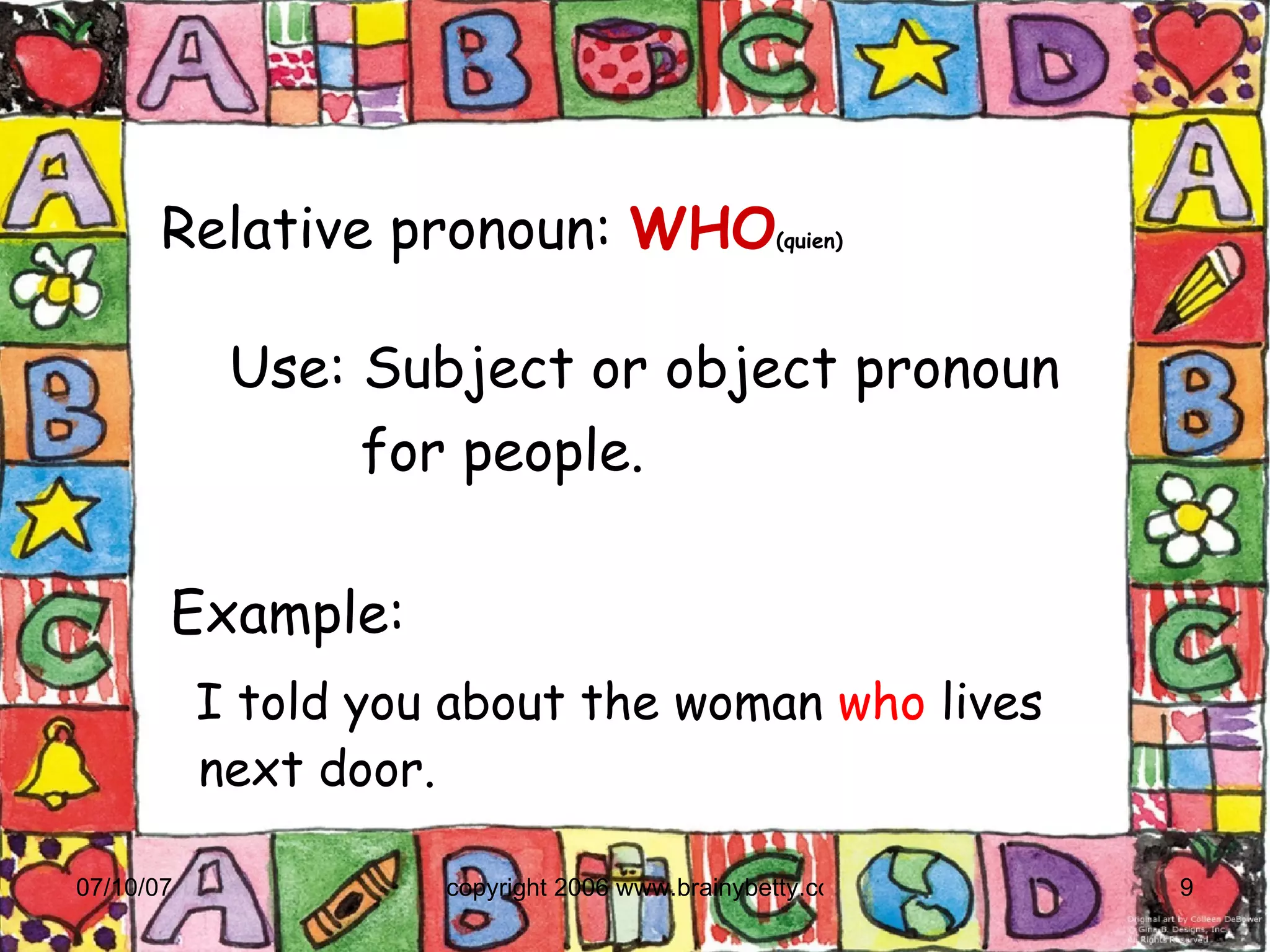
Relative pronoun:   WHO (quien)‏ Example:  I told you about the woman  who  lives next door. Use: Subject or object pronoun  for people.
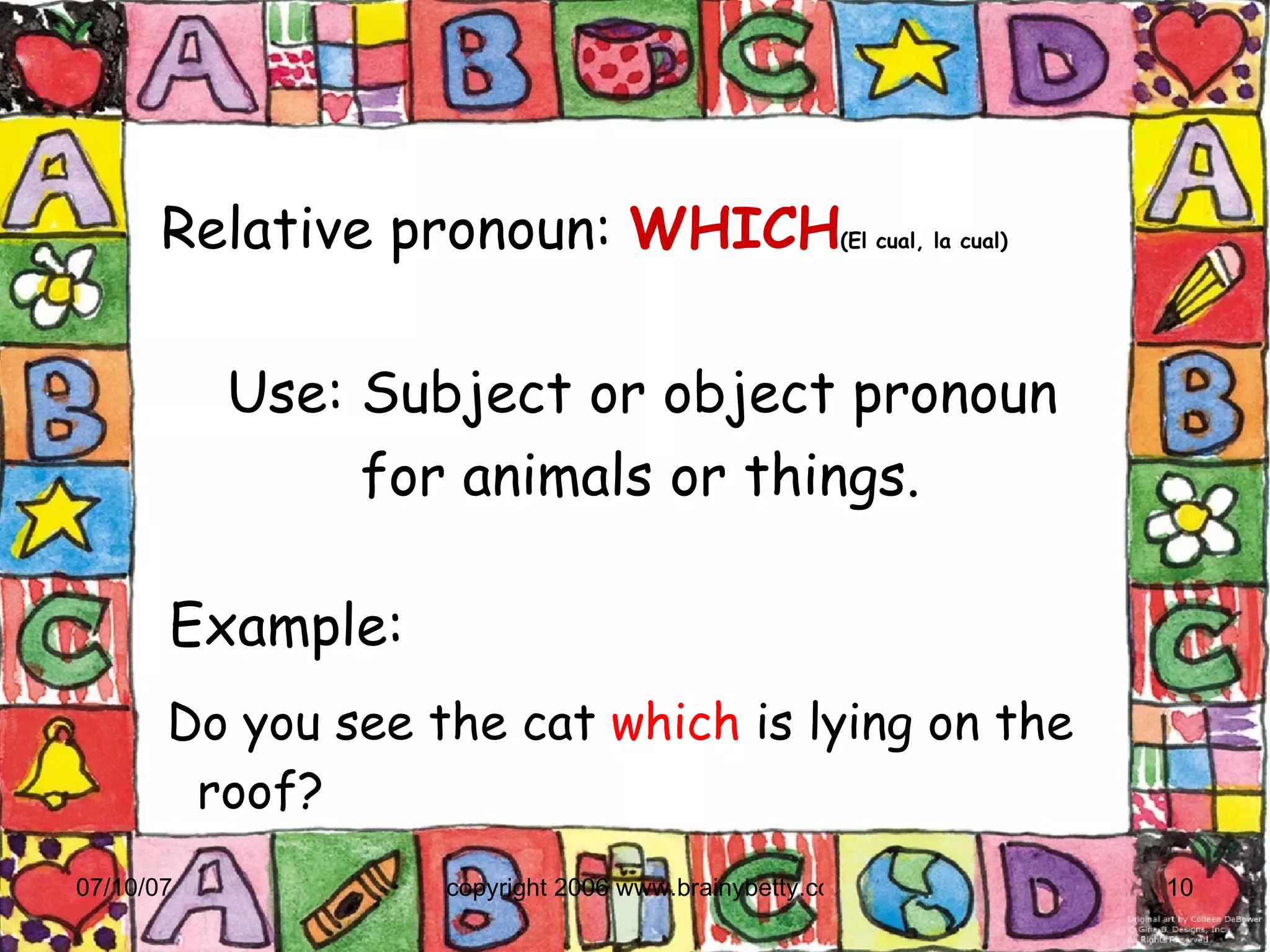
Relative pronoun:   WHICH (El cual, la cual)‏ Example:    Do you see the cat  which  is lying on the roof? Use: Subject or object pronoun  for animals or things.
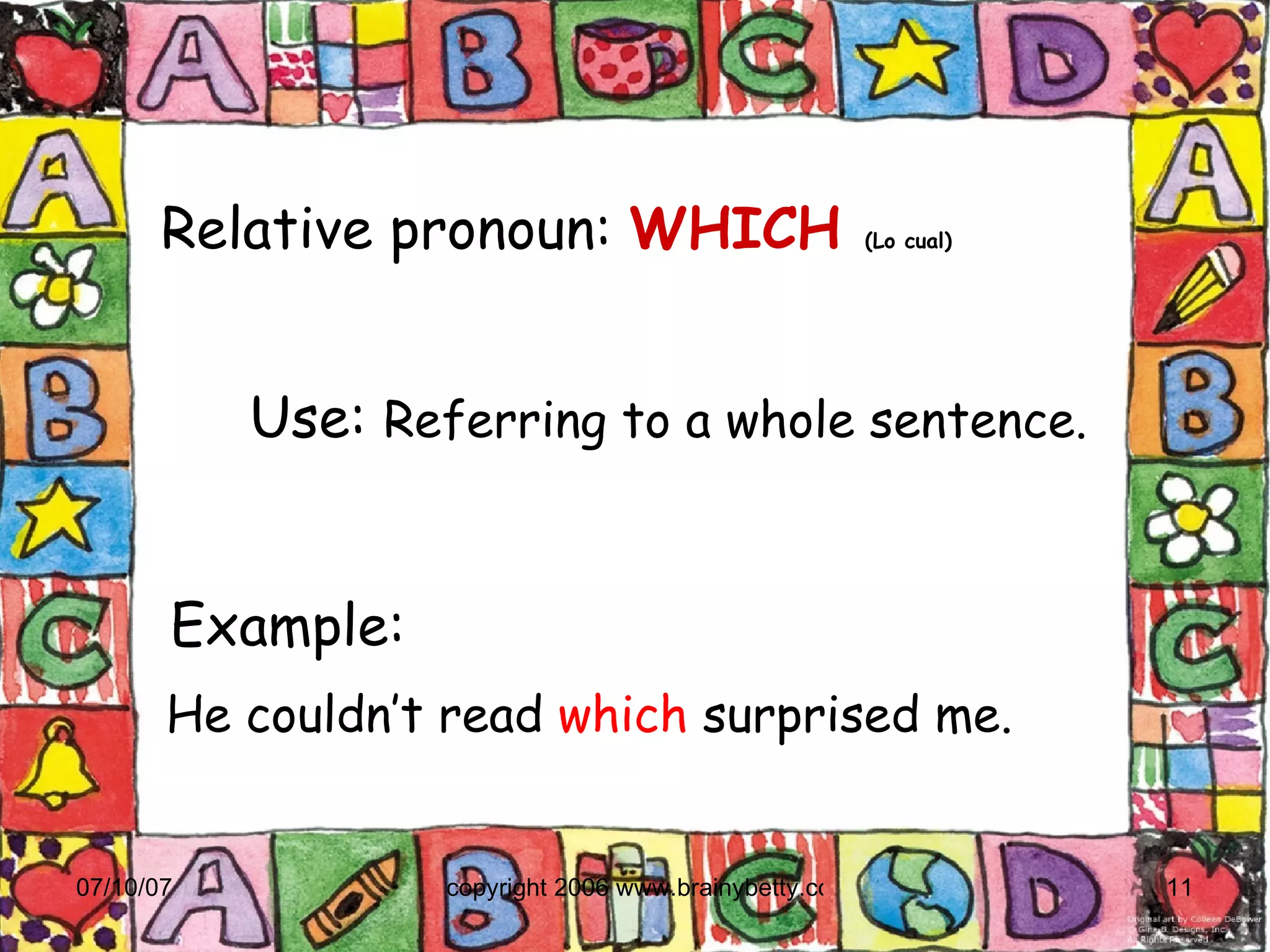
Relative pronoun:   WHICH   (Lo cual)‏ Example:  He couldn’t read  which  surprised me. Use:  Referring to a whole sentence.
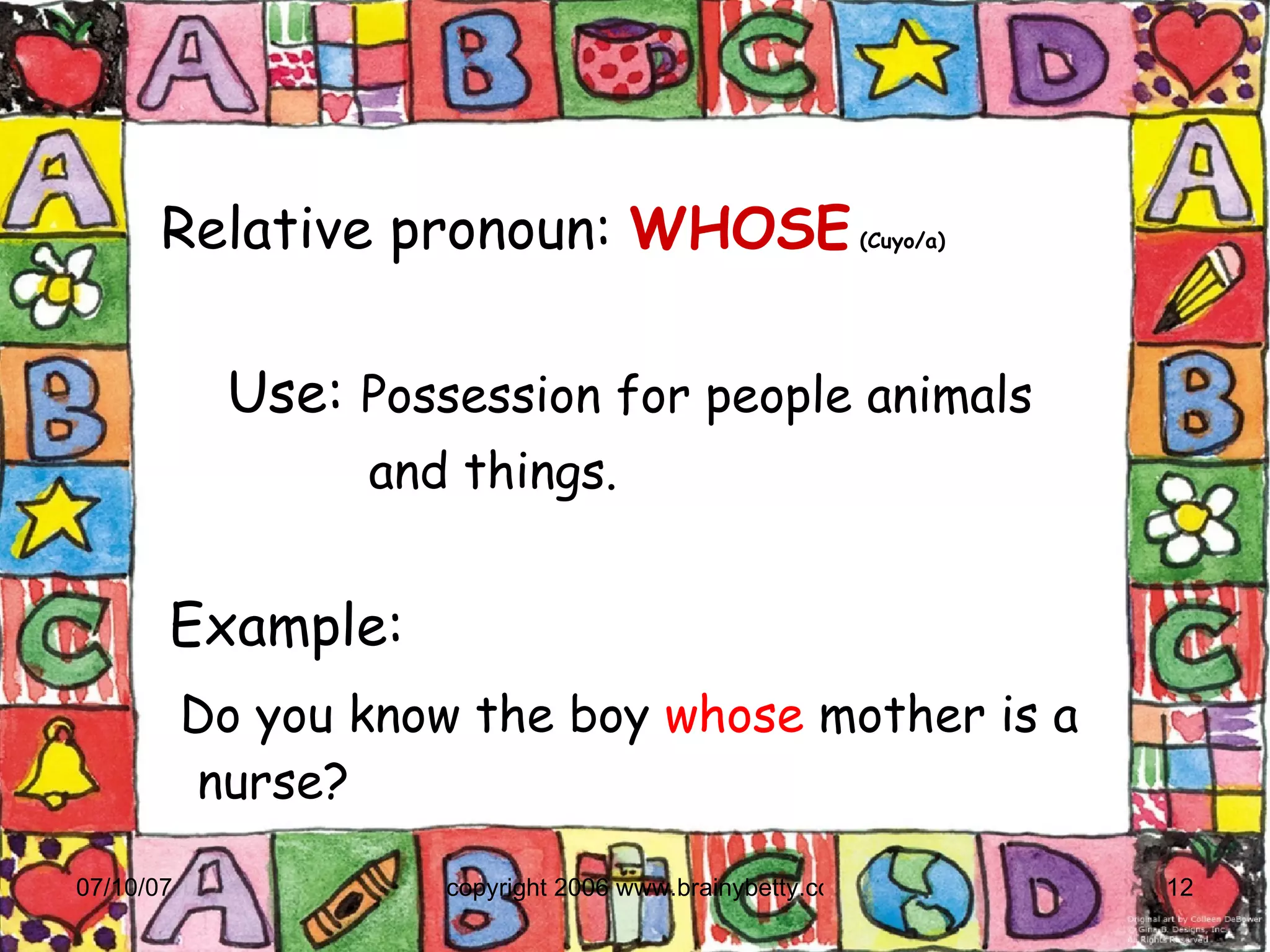
Relative pronoun:   WHOSE  (Cuyo/a)‏ Example:  Do you know the boy  whose  mother is a nurse? Use:  Possession for people animals  and things.
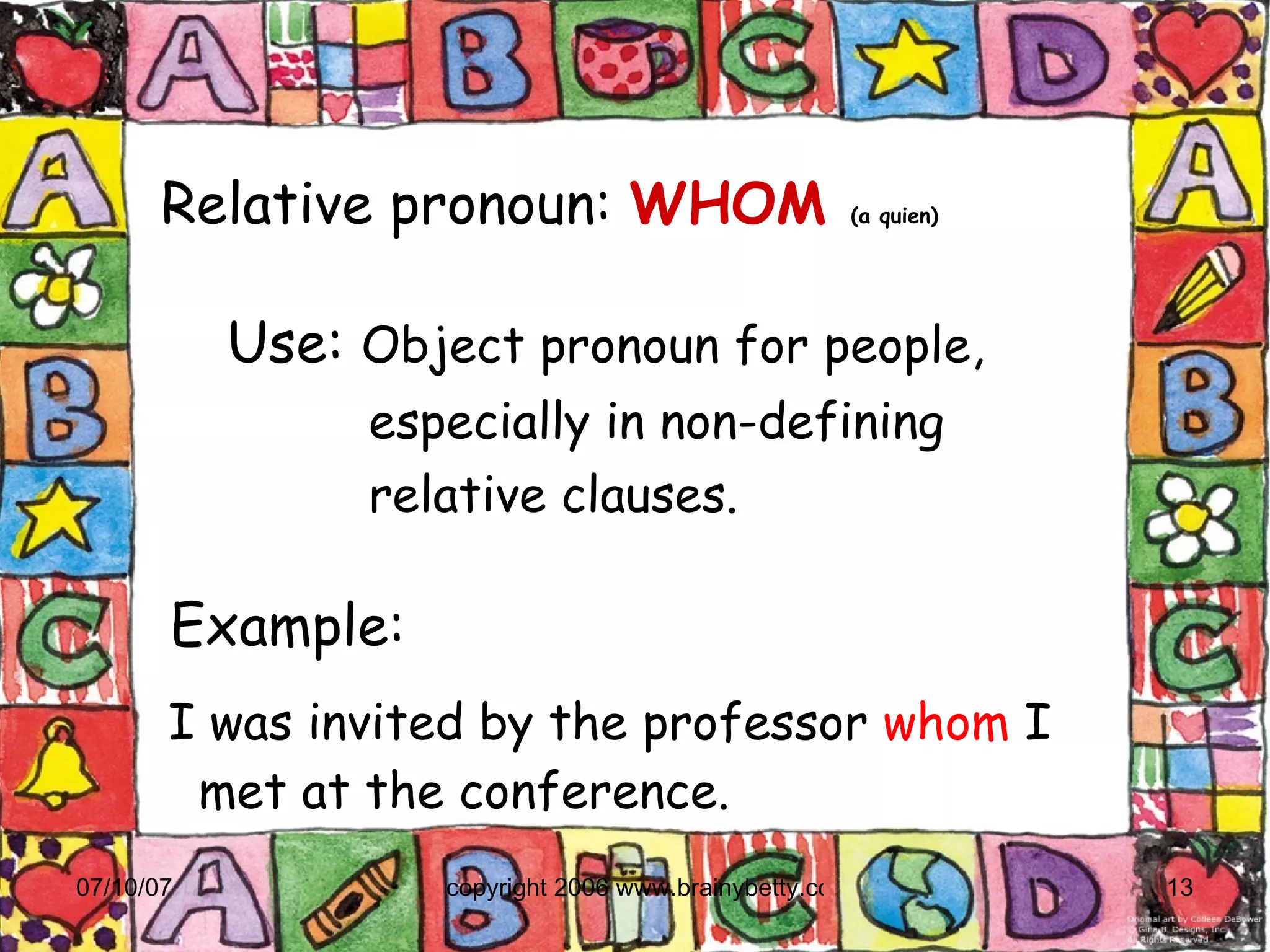
Relative pronoun:   WHOM  (a quien)‏ Example:  I was invited by the professor  whom  I met at the conference. Use:  Object pronoun for people,  especially in non-defining  relative clauses.
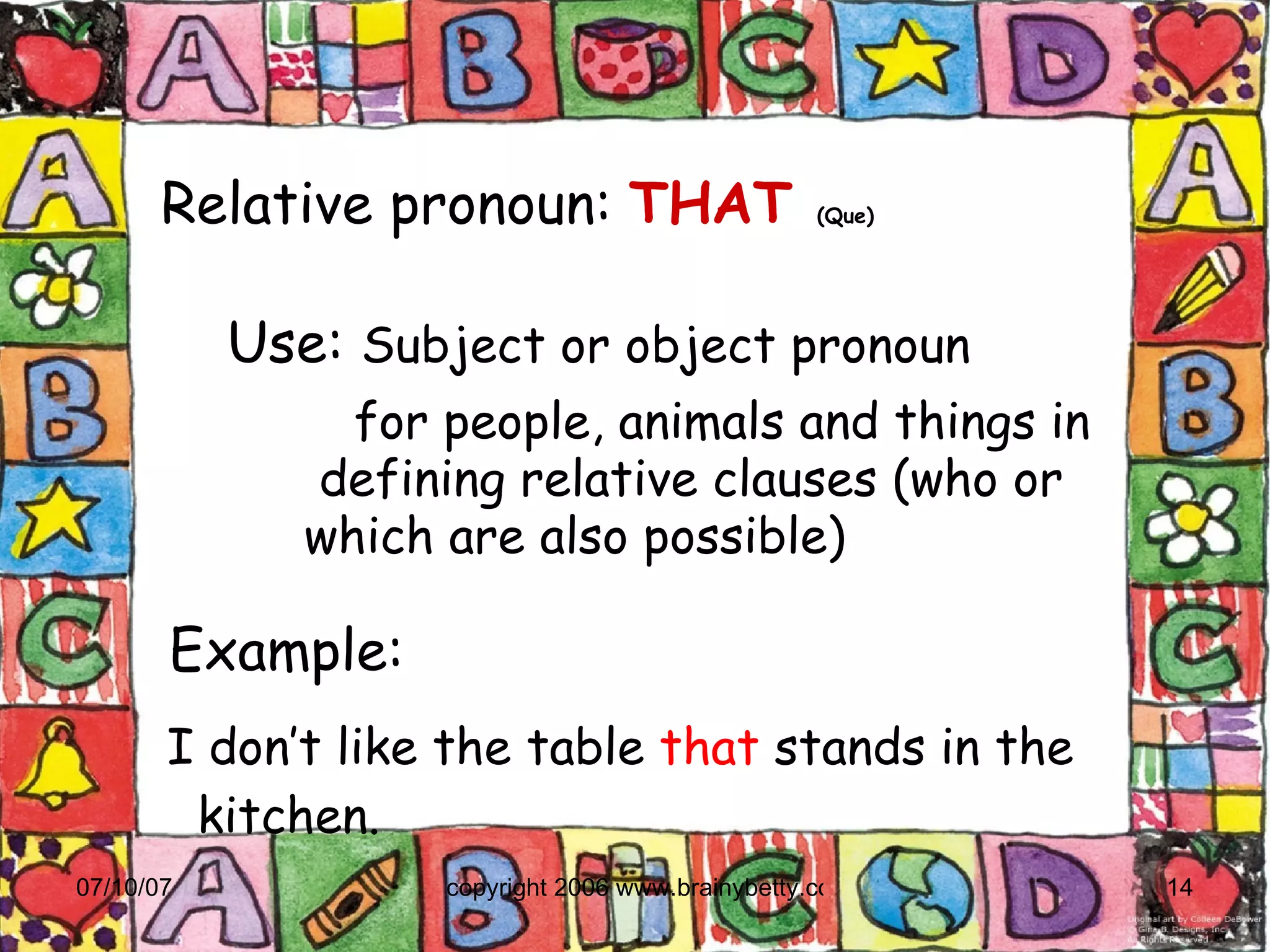
Relative pronoun:   THAT  (Que)‏ Example:  I don’t like the table  that  stands in the kitchen. Use:  Subject or object pronoun  for people, animals and things in  defining relative clauses (who or  which are also possible)‏
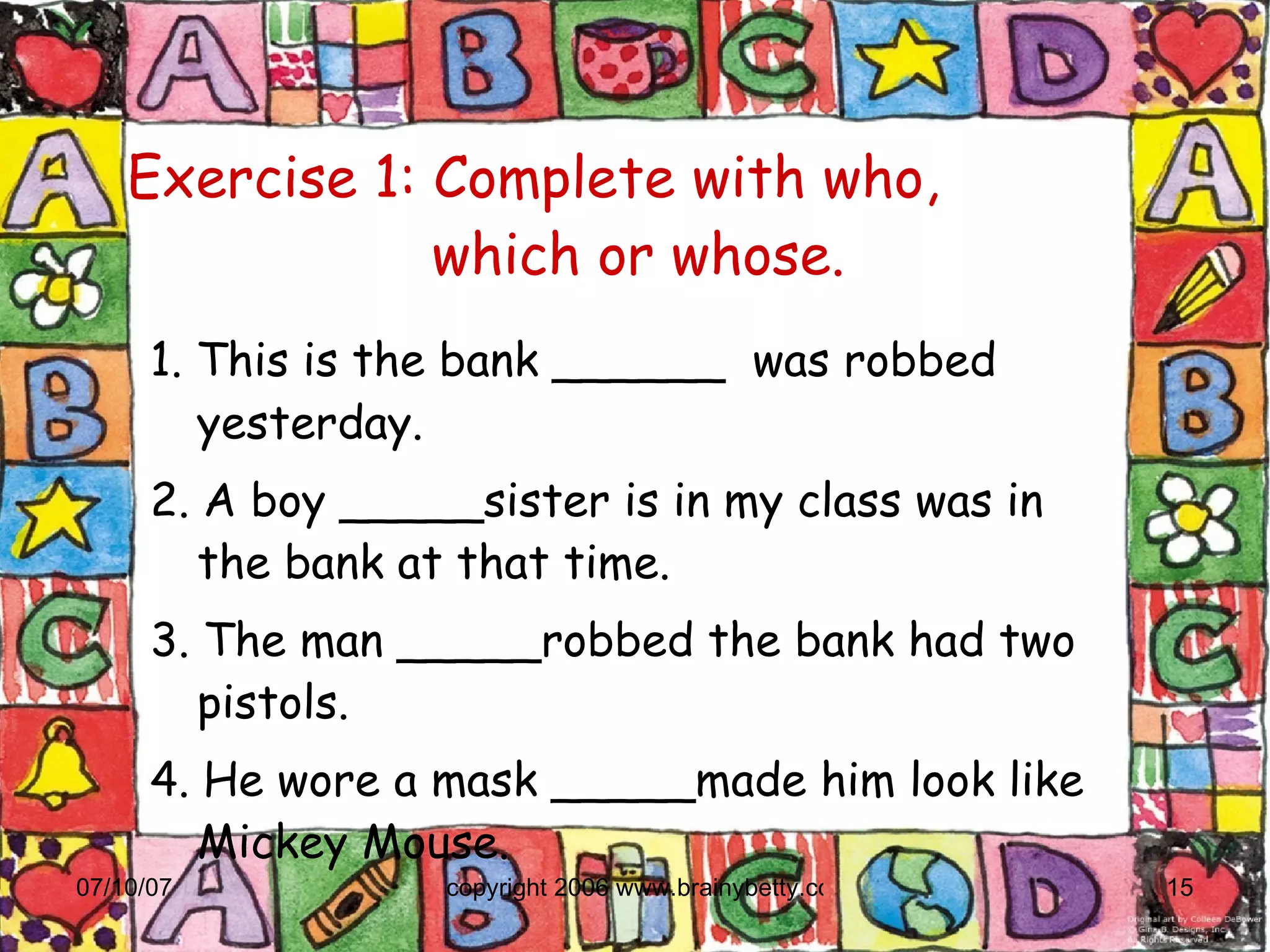
Exercise 1: Complete with who,    which or whose. 1. This is the bank ______  was robbed yesterday. 2. A boy _____sister is in my class was in the bank at that time. 3. The man _____robbed the bank had two pistols. 4. He wore a mask _____made him look like Mickey Mouse.
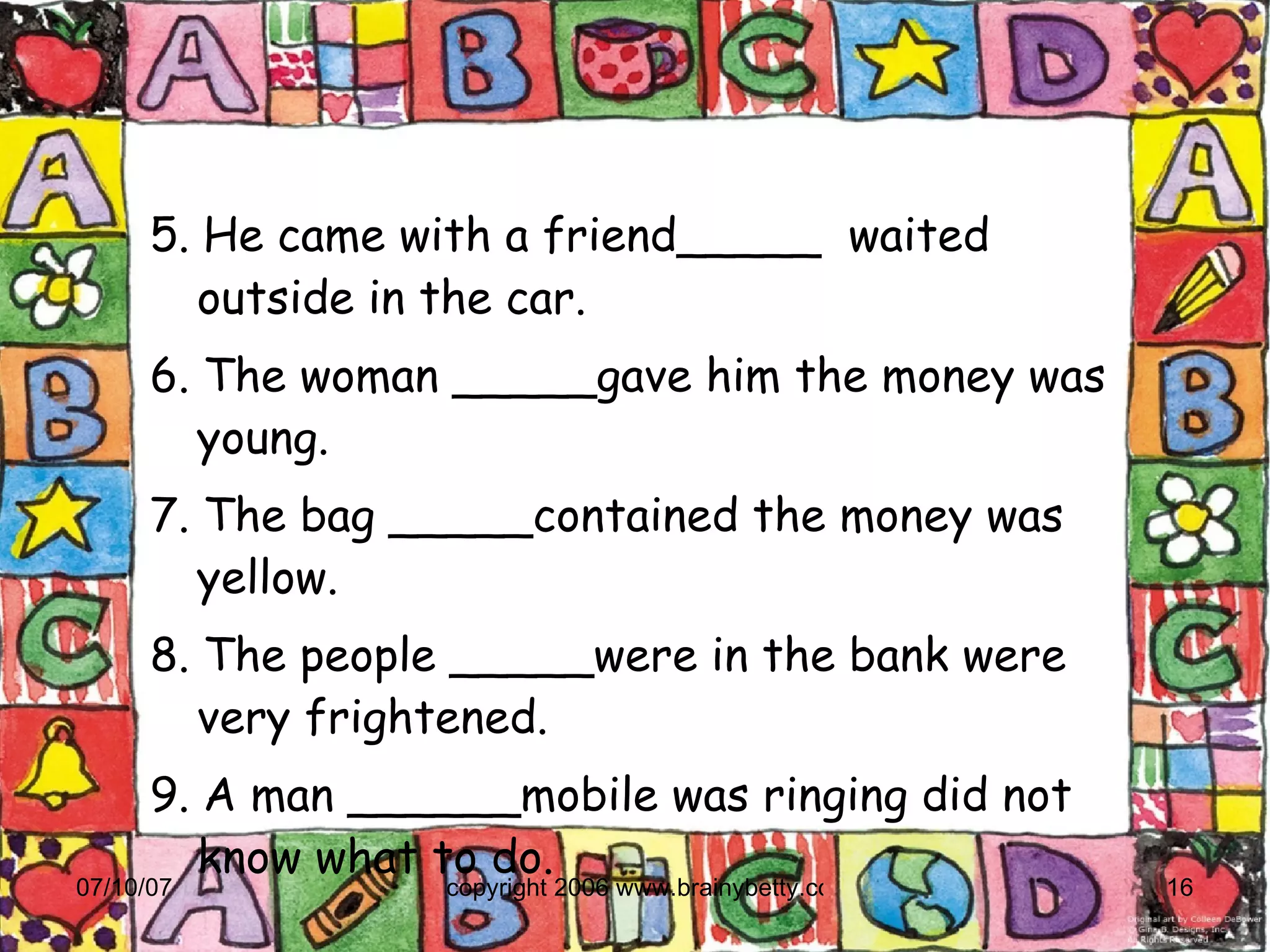
5. He came with a friend_____  waited outside in the car. 6. The woman _____gave him the money was young. 7. The bag _____contained the money was yellow. 8. The people _____were in the bank were very frightened. 9. A man ______mobile was ringing did not know what to do.
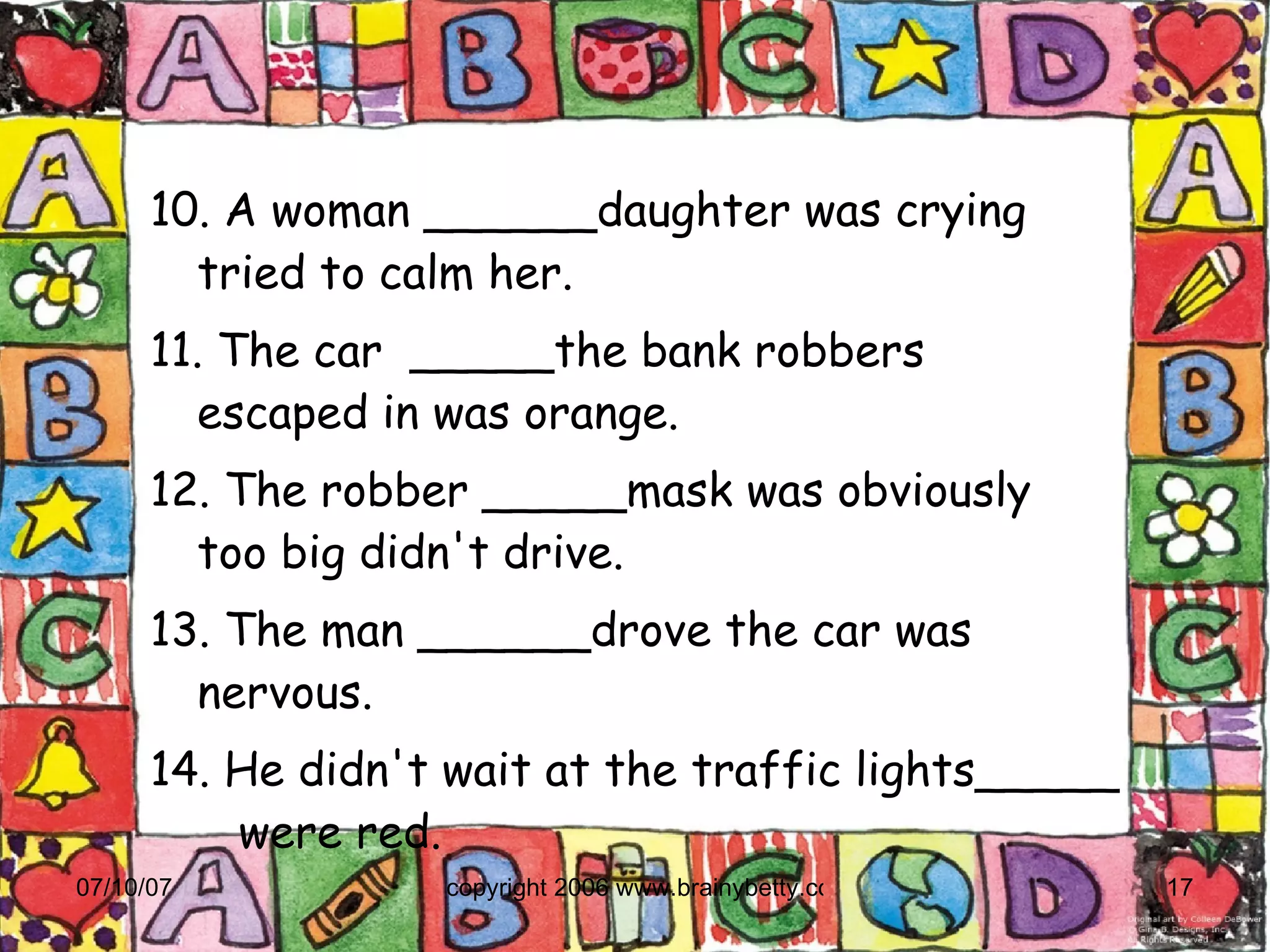
10. A woman ______daughter was crying  tried to calm her.  11. The car  _____the bank robbers  escaped in was orange. 12. The robber _____mask was obviously  too big didn't drive. 13. The man ______drove the car was  nervous. 14. He didn't wait at the traffic lights_____  were red.
Material created by Danitza Lazcano Flores Teacher of English Master in Education Educational Counselor

Relative Clauses

  • 1.
  • 2.
    We use relativeclauses to give additional information about something without starting another sentence. By combining sentences with a relative clause, your text becomes more fluent and you can avoid repeating certain words.
  • 3.
    1. Howto Form Relative Clauses? Imagine, a girl is talking to Tom. You want to know who she is and ask a friend whether he knows her. You could say:
  • 4.
    “ A girlis talking to Tom. Do you know the girl?” That sounds rather complicated, doesn't it? It would be easier with a relative clause: you put both pieces of information into one sentence. Start with the most important thing – you want to know who the girl is.
  • 5.
    “ Do youknow the girl …” As your friend cannot know which girl you are talking about, you need to put in the additional information – the girl is talking to Tom.
  • 6.
    Use „the girl“only in the first part of the sentence, in the second part replace it with the relative pronoun (for people, use the relative pronoun „who“). So the final sentence is: “ Do you know the girl who is talking to Tom?”
  • 7.
    In other words...It is necessary to use relative pronouns to join two sentences and at the end we'll have a relative clause.
  • 8.
    2. RELATIVEPRONOUNS The relative pronouns are those words that help us to join two sentences by replacing another one. Let's see them...
  • 9.
    Relative pronoun: WHO (quien)‏ Example: I told you about the woman who lives next door. Use: Subject or object pronoun for people.
  • 10.
    Relative pronoun: WHICH (El cual, la cual)‏ Example: Do you see the cat which is lying on the roof? Use: Subject or object pronoun for animals or things.
  • 11.
    Relative pronoun: WHICH (Lo cual)‏ Example: He couldn’t read which surprised me. Use: Referring to a whole sentence.
  • 12.
    Relative pronoun: WHOSE (Cuyo/a)‏ Example: Do you know the boy whose mother is a nurse? Use: Possession for people animals and things.
  • 13.
    Relative pronoun: WHOM (a quien)‏ Example: I was invited by the professor whom I met at the conference. Use: Object pronoun for people, especially in non-defining relative clauses.
  • 14.
    Relative pronoun: THAT (Que)‏ Example: I don’t like the table that stands in the kitchen. Use: Subject or object pronoun for people, animals and things in defining relative clauses (who or which are also possible)‏
  • 15.
    Exercise 1: Completewith who, which or whose. 1. This is the bank ______ was robbed yesterday. 2. A boy _____sister is in my class was in the bank at that time. 3. The man _____robbed the bank had two pistols. 4. He wore a mask _____made him look like Mickey Mouse.
  • 16.
    5. He camewith a friend_____ waited outside in the car. 6. The woman _____gave him the money was young. 7. The bag _____contained the money was yellow. 8. The people _____were in the bank were very frightened. 9. A man ______mobile was ringing did not know what to do.
  • 17.
    10. A woman______daughter was crying tried to calm her. 11. The car _____the bank robbers escaped in was orange. 12. The robber _____mask was obviously too big didn't drive. 13. The man ______drove the car was nervous. 14. He didn't wait at the traffic lights_____ were red.
  • 18.
    Material created byDanitza Lazcano Flores Teacher of English Master in Education Educational Counselor