
ADJECTIVE CLAUSE
INTRODUCTION
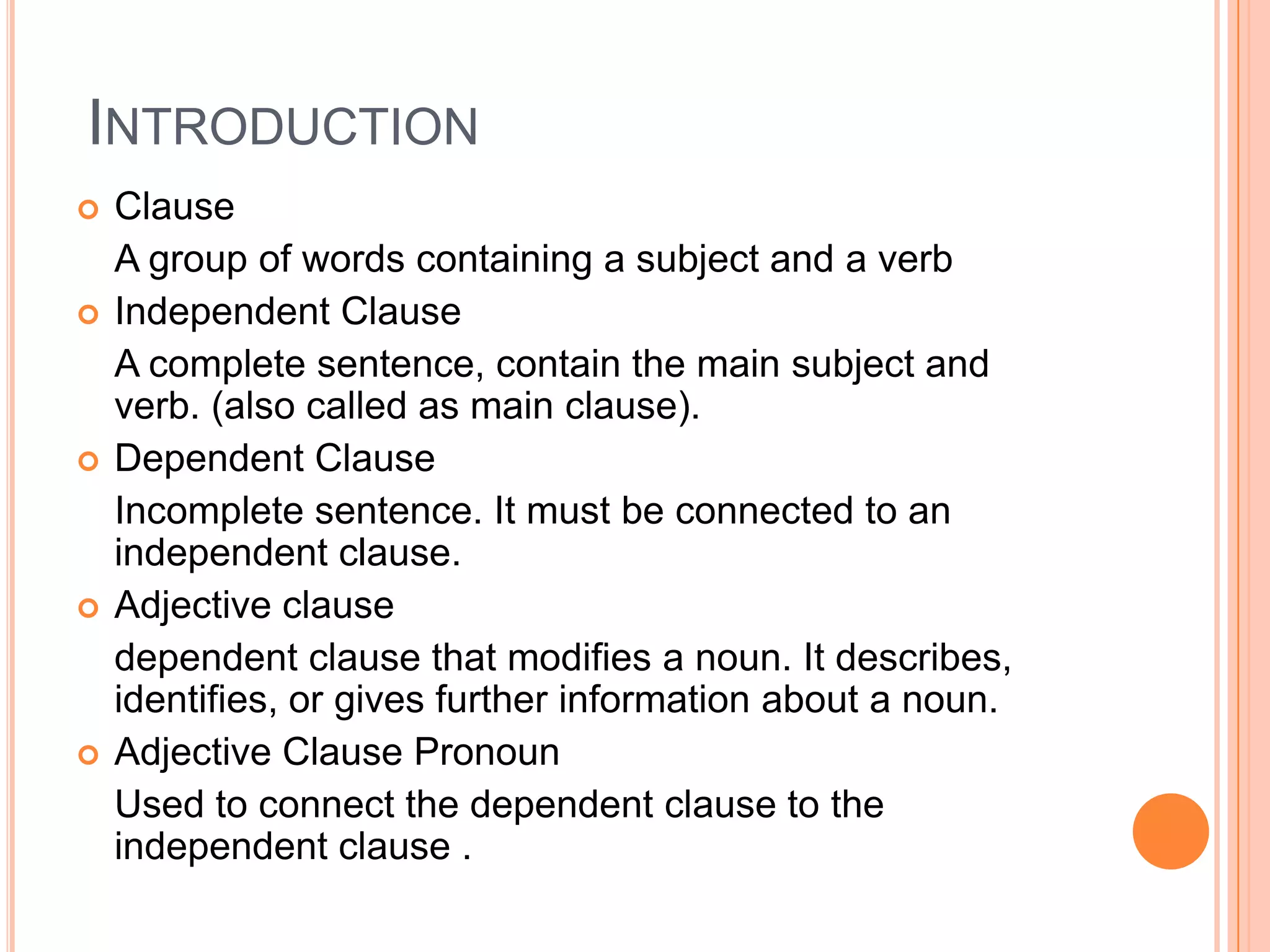
   Clause
    A group of words containing a subject and a verb
   Independent Clause
    A complete sentence, contain the main subject and
    verb. (also called as main clause).
   Dependent Clause
    Incomplete sentence. It must be connected to an
    independent clause.
   Adjective clause
    dependent clause that modifies a noun. It describes,
    identifies, or gives further information about a noun.
   Adjective Clause Pronoun
    Used to connect the dependent clause to the
    independent clause .
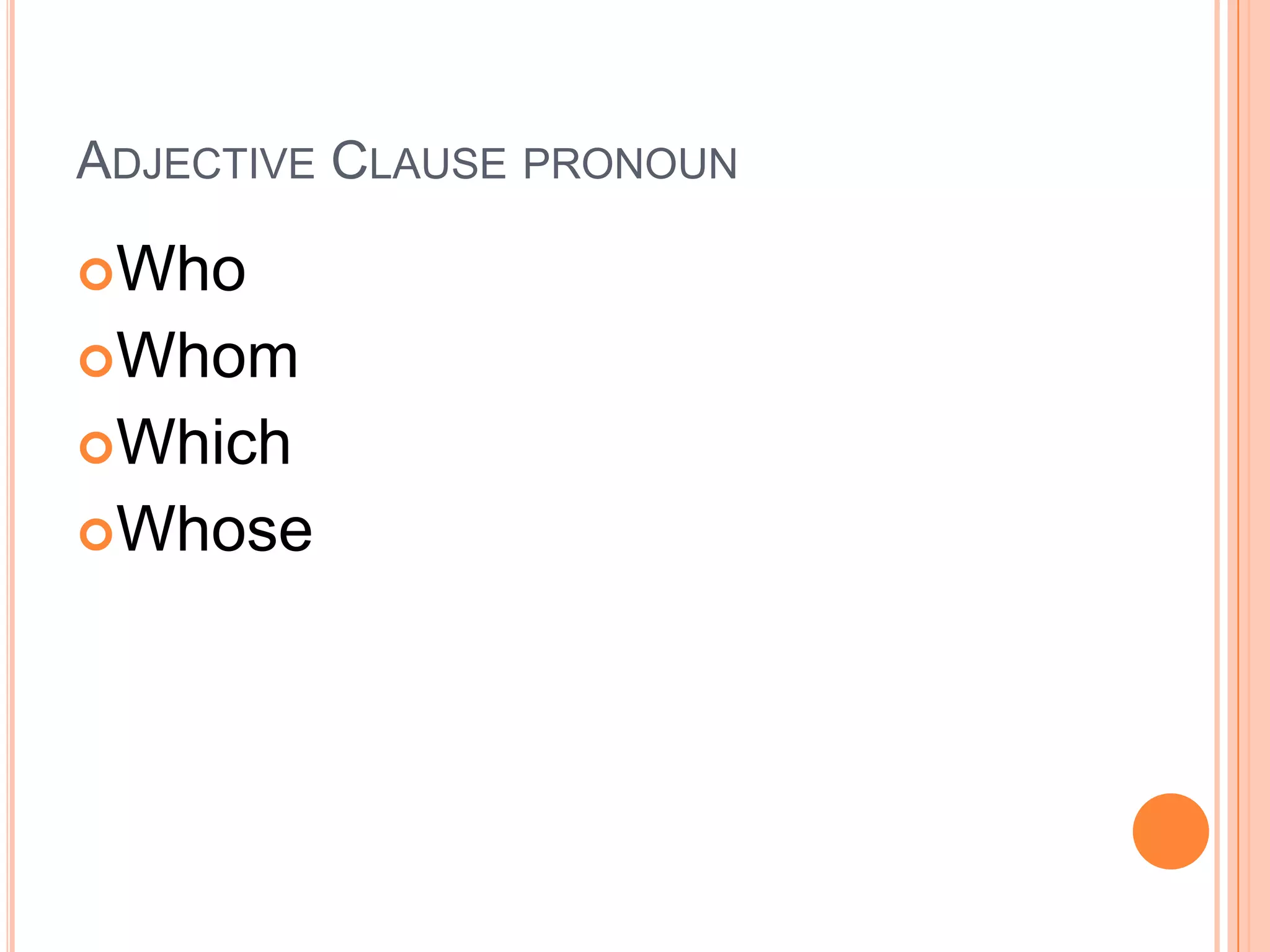
ADJECTIVE CLAUSE PRONOUN

Who
Whom
Which
Whose
WHO
 Used as the subject
 Talk about people

 Example:

  I thanked the woman.
  She helped me.
   I thank the woman who helped me
  The adjective clause modifies the noun woman.
WHOM
 Used as the object
 Example:

 The man was Mr. Jones

  I saw him.
   The man whom I saw was Mr. Jones
WHICH
 The same function as ‘who’ and ‘whom’ but for
  things.
 Example :

  The boss gave me task.
  The task was so difficult.
   The boss gave me task which was so difficult.

    The movie wasn’t very good.
    We saw it last night.
     The movie which we saw last night wasn’t very
    good.
WHOSE

 Used to show possession
 Carries the same meaning as other possessive
  pronouns : his, her, their, its
 Connected to a noun

 Examples :

  I know the man.
  His bicycle was stolen.
   I know the man whose bicycle was stolen.
WHERE
 Talk about places
 Example:

  The hotel wasn’t clean.
  We stayed there.
   The hotel where we stayed wasn’t clean.
GIVE IT A TRY!
 The   book is mine. It is on the table
 I saw the man. He closed the door

  The student is from Australia. He sits next to
  me.
 I liked the woman. I met her at the party last
  night.

I   know a man. His last name is Smith.
LET’S RACE
 The people were very nice. We visited them
  yesterday.
 The taxi driver was friendly. He took me to the
  airport.
 The man reported to the safety officer. His unit was
  bogged.
 The town is small. I grew up there.
 I read about a man. He keeps chickens in his
  apartment.
 We are studying sentence. It contains an adjective
  clause.
 I live in a camp. Its residents come from many
  regions.
LET’S RACE
   You are sitting on a chair         is comfortable.

   I like the composition            you wrote.

   The young women              we met at the
    meeting

   I returned the money         I borrowed from my
    roommate.

   I ran into an old friend     I hadn’t seen for
    years.
   I wrote a report about an operator              was
    nearly hit by a dump truck.

   The meeting           takes place in Manggis Meeting
    room lasts for 2 hours.

   The trainer            I talked to is from Balikpapan.

   The operator            unit was broken down reported to
    the mechanic.

   I work in a workshop              is located in Pit 2.

Adjective clause

  • 1.
  • 2.
    INTRODUCTION  Clause A group of words containing a subject and a verb  Independent Clause A complete sentence, contain the main subject and verb. (also called as main clause).  Dependent Clause Incomplete sentence. It must be connected to an independent clause.  Adjective clause dependent clause that modifies a noun. It describes, identifies, or gives further information about a noun.  Adjective Clause Pronoun Used to connect the dependent clause to the independent clause .
  • 3.
  • 4.
    WHO  Used asthe subject  Talk about people  Example: I thanked the woman. She helped me.  I thank the woman who helped me The adjective clause modifies the noun woman.
  • 5.
    WHOM  Used asthe object  Example:  The man was Mr. Jones I saw him.  The man whom I saw was Mr. Jones
  • 6.
    WHICH  The samefunction as ‘who’ and ‘whom’ but for things.  Example : The boss gave me task. The task was so difficult.  The boss gave me task which was so difficult. The movie wasn’t very good. We saw it last night.  The movie which we saw last night wasn’t very good.
  • 7.
    WHOSE  Used toshow possession  Carries the same meaning as other possessive pronouns : his, her, their, its  Connected to a noun  Examples : I know the man. His bicycle was stolen.  I know the man whose bicycle was stolen.
  • 8.
    WHERE  Talk aboutplaces  Example: The hotel wasn’t clean. We stayed there.  The hotel where we stayed wasn’t clean.
  • 9.
    GIVE IT ATRY!  The book is mine. It is on the table  I saw the man. He closed the door The student is from Australia. He sits next to me.  I liked the woman. I met her at the party last night. I know a man. His last name is Smith.
  • 10.
    LET’S RACE  Thepeople were very nice. We visited them yesterday.  The taxi driver was friendly. He took me to the airport.  The man reported to the safety officer. His unit was bogged.  The town is small. I grew up there.  I read about a man. He keeps chickens in his apartment.  We are studying sentence. It contains an adjective clause.  I live in a camp. Its residents come from many regions.
  • 11.
    LET’S RACE  You are sitting on a chair is comfortable.  I like the composition you wrote.  The young women we met at the meeting  I returned the money I borrowed from my roommate.  I ran into an old friend I hadn’t seen for years.
  • 12.
    I wrote a report about an operator was nearly hit by a dump truck.  The meeting takes place in Manggis Meeting room lasts for 2 hours.  The trainer I talked to is from Balikpapan.  The operator unit was broken down reported to the mechanic.  I work in a workshop is located in Pit 2.