Understanding   ADHD
What is Attention  Deficit Hyperactivity Disorder? The term ADHD refers to Attention Deficit Hyperactivity Disorder, a condition that makes it difficult for children to pay attention and/or control their behavior.
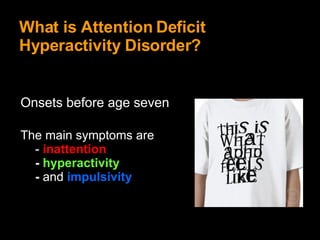
What is Attention Deficit Hyperactivity Disorder? Onsets before age seven The main symptoms are   -   inattention -  hyperactivity   -   and   impulsivity .
What is Attention Deficit Hyperactivity Disorder? The condition often becomes apparent when children are in  preschool  or when they are in their early school years. An estimated  3-5%  of children have ADHD.
What does “ inattention ” look like? A child who has difficulty keeping their mind on a task, or who gets bored of a task easily. A child who jumps from one task to another without completing the first task. A child who is easily distracted or doesn’t follow instructions carefully. A child who forgets and loses things that they need to complete a task. ADHD: What does it look like?
What does “ hyperactivity ” look like? A child who can’t seem to sit still and who is constantly moving, roaming, touching things, squirming or fidgeting. ADHD: What does it look like? What does “ impulsivity ” look like? A child who speaks or acts without thinking about the consequences of that act. A child who blurts out inappropriate comments, has difficulty waiting their turn, and displays their emotions without restraint.
A child who is  inattentive ,  hyperactive   or   impulsive   does  NOT  necessarily have ADHD  Many normal children have some of these symptoms (especially young children!).  AND, the symptoms could be caused by  another disorder entirely . ADHD: Getting a diagnosis
It is  VERY  important that children are examined and diagnosed by a qualified professional who will use strict diagnostic guidelines to determine whether the behaviors are inappropriate for the child’s age, and whether the symptoms indicate ADHD or not.  Talking to your family physician might be a good start. ADHD: Getting a diagnosis
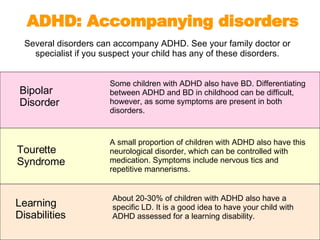
Several disorders can accompany ADHD. See your family doctor or specialist if you suspect your child has any of these disorders. ADHD: Accompanying disorders Learning  Disabilities About 20-30% of children with ADHD also have a specific LD. It is a good idea to have your child with ADHD assessed for a learning disability. Tourette  Syndrome A small proportion of children with ADHD also have this neurological disorder, which can be controlled with medication. Symptoms include nervous tics and repetitive mannerisms. Bipolar  Disorder Some children with ADHD also have BD. Differentiating between ADHD and BD in childhood can be difficult, however, as some symptoms are present in both disorders.
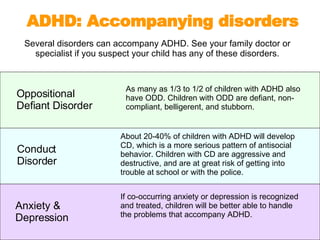
Several disorders can accompany ADHD. See your family doctor or specialist if you suspect your child has any of these disorders. ADHD: Accompanying disorders Oppositional  Defiant Disorder As many as 1/3 to 1/2 of children with ADHD also have ODD. Children with ODD are defiant, non-compliant, belligerent, and stubborn.  Conduct  Disorder About 20-40% of children with ADHD will develop CD, which is a more serious pattern of antisocial behavior. Children with CD are aggressive and destructive, and are at great risk of getting into trouble at school or with the police.  Anxiety &  Depression If co-occurring anxiety or depression is recognized and treated, children will be better able to handle the problems that accompany ADHD.
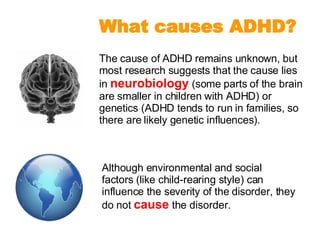
The cause of ADHD remains unknown, but most research suggests that the cause lies in  neurobiology  (some parts of the brain are smaller in children with ADHD) or genetics (ADHD tends to run in families, so there are likely genetic influences).  Although environmental and social factors (like child-rearing style) can influence the severity of the disorder, they do not  cause  the disorder.  What causes ADHD?
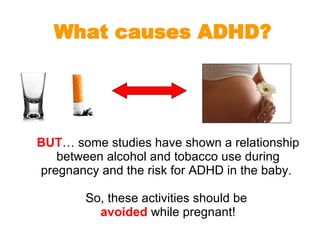
BUT … some studies have shown a relationship between alcohol and tobacco use during pregnancy and the risk for ADHD in the baby.  So, these activities should be  avoided  while pregnant! What causes ADHD?
Stimulants   (like methylphenidate or “Ritalin”) seem to be the most effective class of medication, and are usually considered quite safe.  They do not make children feel “high” and there is no evidence that stimulants (when used for the treatment of ADHD) cause drug abuse or dependence. Medications have been used to treat ADHD for decades.  Treatment  for ADHD
In many people, stimulants reduce hyperactivity and impulsivity, and improve the ability to focus, work and learn. About 10% of children are not helped by stimulants, even after trying several medications at several doses. Recently, at least one  non-stimulant medication  has shown great potential for reducing the symptoms of ADHD (atomoxetine or “Strattera”).  Treatment  for ADHD
Choosing a Treatment  for ADHD What does the research show?  Medication seems to be essential for children with ADHD.  The most intensive ADHD treatment study to date found that long-term management with medication or a combination treatment of medication and behavioral treatment are superior to behavioral treatments alone.
Which treatment will be most effective for my child?   Because no two children are alike, this question must be answered by each family in consultation with their health care professional.
Although medication works well for many children, it can cause undesirable side effects in others, making it an unacceptable treatment.  Each child’s needs and personal history must be carefully considered.  BUT… no one treatment is the answer for every child!
If you need more help.. Medication can help a child control the behavior problems that have led to trouble with parents and siblings, but it can take a long time to undo the frustration, blame and anger that may have gone on for so long.  ADHD: What else can we do?
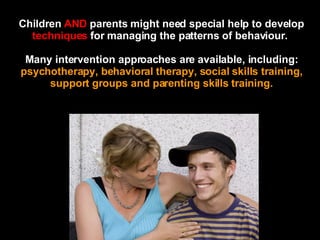
Children  AND  parents might need special help to develop  techniques  for managing the patterns of behaviour.  Many intervention approaches are available, including:  psychotherapy, behavioral therapy, social skills training, support groups and parenting skills training.
Try these simple tips…! Schedule  - have the same routine every day, and post the schedule in the kitchen. Organize needed everyday items  - have a place for everything, and keep everything in its place. Use homework/notebook organizers  - stress the importance of writing down assignments and bringing home needed books. ADHD: What else can we do?
In Adolescent Mental Health For more information visit WWW.TEENMENTALHEALTH.ORG  Sun Life Financial Chair
Want to know more about Attention Deficit Hyperactivity Disorder? The information provided in this presentation is based on information provided by the National Institute of Mental Health.  For more information about ADHD, visit their website at  www.nimh.nih.gov  or talk to your family physician.

Understanding ADHD

  • 1.
  • 2.
    What is Attention Deficit Hyperactivity Disorder? The term ADHD refers to Attention Deficit Hyperactivity Disorder, a condition that makes it difficult for children to pay attention and/or control their behavior.
  • 3.
    What is AttentionDeficit Hyperactivity Disorder? Onsets before age seven The main symptoms are - inattention - hyperactivity - and impulsivity .
  • 4.
    What is AttentionDeficit Hyperactivity Disorder? The condition often becomes apparent when children are in preschool or when they are in their early school years. An estimated 3-5% of children have ADHD.
  • 5.
    What does “inattention ” look like? A child who has difficulty keeping their mind on a task, or who gets bored of a task easily. A child who jumps from one task to another without completing the first task. A child who is easily distracted or doesn’t follow instructions carefully. A child who forgets and loses things that they need to complete a task. ADHD: What does it look like?
  • 6.
    What does “hyperactivity ” look like? A child who can’t seem to sit still and who is constantly moving, roaming, touching things, squirming or fidgeting. ADHD: What does it look like? What does “ impulsivity ” look like? A child who speaks or acts without thinking about the consequences of that act. A child who blurts out inappropriate comments, has difficulty waiting their turn, and displays their emotions without restraint.
  • 7.
    A child whois inattentive , hyperactive or impulsive does NOT necessarily have ADHD Many normal children have some of these symptoms (especially young children!). AND, the symptoms could be caused by another disorder entirely . ADHD: Getting a diagnosis
  • 8.
    It is VERY important that children are examined and diagnosed by a qualified professional who will use strict diagnostic guidelines to determine whether the behaviors are inappropriate for the child’s age, and whether the symptoms indicate ADHD or not. Talking to your family physician might be a good start. ADHD: Getting a diagnosis
  • 9.
    Several disorders canaccompany ADHD. See your family doctor or specialist if you suspect your child has any of these disorders. ADHD: Accompanying disorders Learning Disabilities About 20-30% of children with ADHD also have a specific LD. It is a good idea to have your child with ADHD assessed for a learning disability. Tourette Syndrome A small proportion of children with ADHD also have this neurological disorder, which can be controlled with medication. Symptoms include nervous tics and repetitive mannerisms. Bipolar Disorder Some children with ADHD also have BD. Differentiating between ADHD and BD in childhood can be difficult, however, as some symptoms are present in both disorders.
  • 10.
    Several disorders canaccompany ADHD. See your family doctor or specialist if you suspect your child has any of these disorders. ADHD: Accompanying disorders Oppositional Defiant Disorder As many as 1/3 to 1/2 of children with ADHD also have ODD. Children with ODD are defiant, non-compliant, belligerent, and stubborn. Conduct Disorder About 20-40% of children with ADHD will develop CD, which is a more serious pattern of antisocial behavior. Children with CD are aggressive and destructive, and are at great risk of getting into trouble at school or with the police. Anxiety & Depression If co-occurring anxiety or depression is recognized and treated, children will be better able to handle the problems that accompany ADHD.
  • 11.
    The cause ofADHD remains unknown, but most research suggests that the cause lies in neurobiology (some parts of the brain are smaller in children with ADHD) or genetics (ADHD tends to run in families, so there are likely genetic influences). Although environmental and social factors (like child-rearing style) can influence the severity of the disorder, they do not cause the disorder. What causes ADHD?
  • 12.
    BUT … somestudies have shown a relationship between alcohol and tobacco use during pregnancy and the risk for ADHD in the baby. So, these activities should be avoided while pregnant! What causes ADHD?
  • 13.
    Stimulants (like methylphenidate or “Ritalin”) seem to be the most effective class of medication, and are usually considered quite safe. They do not make children feel “high” and there is no evidence that stimulants (when used for the treatment of ADHD) cause drug abuse or dependence. Medications have been used to treat ADHD for decades. Treatment for ADHD
  • 14.
    In many people,stimulants reduce hyperactivity and impulsivity, and improve the ability to focus, work and learn. About 10% of children are not helped by stimulants, even after trying several medications at several doses. Recently, at least one non-stimulant medication has shown great potential for reducing the symptoms of ADHD (atomoxetine or “Strattera”). Treatment for ADHD
  • 15.
    Choosing a Treatment for ADHD What does the research show? Medication seems to be essential for children with ADHD. The most intensive ADHD treatment study to date found that long-term management with medication or a combination treatment of medication and behavioral treatment are superior to behavioral treatments alone.
  • 16.
    Which treatment willbe most effective for my child? Because no two children are alike, this question must be answered by each family in consultation with their health care professional.
  • 17.
    Although medication workswell for many children, it can cause undesirable side effects in others, making it an unacceptable treatment. Each child’s needs and personal history must be carefully considered. BUT… no one treatment is the answer for every child!
  • 18.
    If you needmore help.. Medication can help a child control the behavior problems that have led to trouble with parents and siblings, but it can take a long time to undo the frustration, blame and anger that may have gone on for so long. ADHD: What else can we do?
  • 19.
    Children AND parents might need special help to develop techniques for managing the patterns of behaviour. Many intervention approaches are available, including: psychotherapy, behavioral therapy, social skills training, support groups and parenting skills training.
  • 20.
    Try these simpletips…! Schedule - have the same routine every day, and post the schedule in the kitchen. Organize needed everyday items - have a place for everything, and keep everything in its place. Use homework/notebook organizers - stress the importance of writing down assignments and bringing home needed books. ADHD: What else can we do?
  • 21.
    In Adolescent MentalHealth For more information visit WWW.TEENMENTALHEALTH.ORG Sun Life Financial Chair
  • 22.
    Want to knowmore about Attention Deficit Hyperactivity Disorder? The information provided in this presentation is based on information provided by the National Institute of Mental Health. For more information about ADHD, visit their website at www.nimh.nih.gov or talk to your family physician.

Editor's Notes

  • #2 What is Attention Deficit Hyperactivity Disorder? Attention Deficit Hyperactivity Disorder is the most commonly diagnosed behavioural disorder of childhood. In any six-month period, ADHD affects an estimated 4 -6 % of young people between the ages of 9 and 17. Boys are two to three times more likely then girls to develop ADHD. Although ADHD is usually associated with children, the disorder can persist into adulthood. Children and adults with ADHD are easily distracted by sights and sounds and other features of their environment, cannot concentrate for long periods of time, are restless and impulsive, or have a tendency to daydream and be slow to complete tasks Symptoms The three predominant symptoms of ADHD are 1) inability to regulate activity level (hyperactivity); 2) inability to attend to tasks (inattention); and 3) impulsivity, or inability to inhibit behaviour. Common symptoms include varying degrees of the following: Poor concentration and brief attention span Increased activity - always on the go Impulsive - doesn't stop to think Social and relationship problems Fearless and takes undue risks Poor coordination Sleep problems Normal or high intelligence but under perform at school For useful information about ADHD refer to the following website: http://www.psychiatry24x7.com/homes/adhd.jhtml