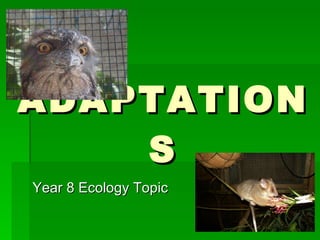
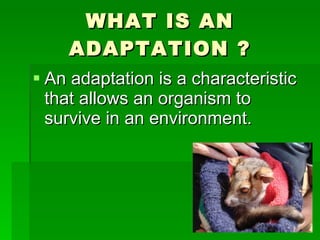
ADAPTATIONS Year 8 Ecology Topic
WHAT IS AN ADAPTATION ? An adaptation is a characteristic that allows an organism to survive in an environment.
Types of adaptations Structural adaptations   refer to the shape and size of the organism and how the various parts of its body are put together; for example, a flattened body, colour, and the shape and size of its legs. Physiological adaptations   refer to the working of an organism’s body; for example how an organisms digestive system works or how an organ works. Behavioural adaptations   are to do with how the organism behaves; for example, burrowing or being nocturnal.
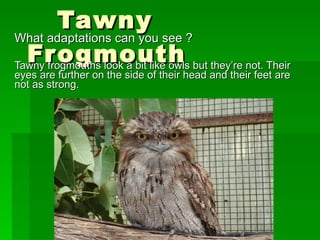
Tawny Frogmouth What adaptations can you see ? Tawny frogmouths look a bit like owls but they’re not. Their eyes are further on the side of their head and their feet are not as strong.
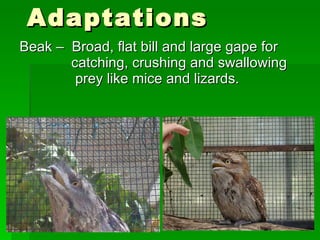
Beak –  Broad, flat bill and large gape for    catching, crushing and swallowing    prey like mice and lizards. Adaptations
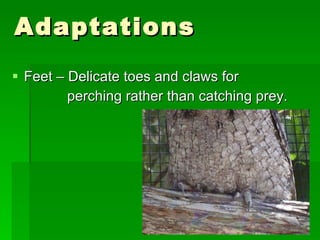
Adaptations Feet – Delicate toes and claws for  perching rather than catching prey.
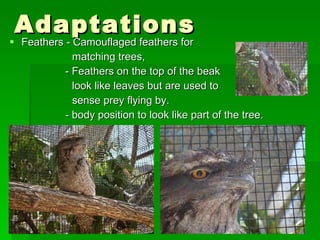
Adaptations Feathers - Camouflaged feathers for  matching trees,    - Feathers on the top of the beak  look like leaves but are used to  sense prey flying by.   - body position to look like part of the tree.
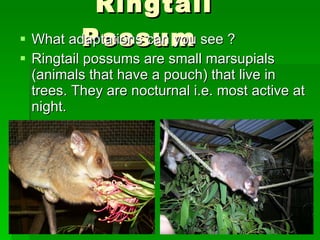
Ringtail Possum What adaptations can you see ? Ringtail possums are small marsupials (animals that have a pouch) that live in  trees. They are nocturnal i.e. most active at night.
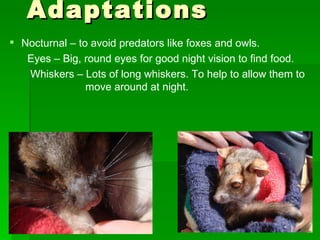
Adaptations Nocturnal – to avoid predators like foxes and owls. Eyes – Big, round eyes for good night vision to find food. Whiskers – Lots of long whiskers. To help to allow them to    move around at night.
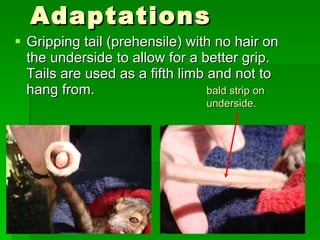
Gripping tail (prehensile) with no hair on the underside to allow for a better grip. Tails are used as a fifth limb and not to hang from. bald strip on  underside. Adaptations
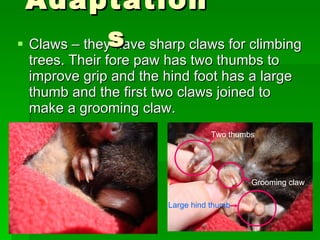
Claws – they have sharp claws for climbing trees. Their fore paw has two thumbs to improve grip and the hind foot has a large thumb and the first two claws joined to make a grooming claw. Adaptations Two thumbs Grooming claw Large   hind thumb
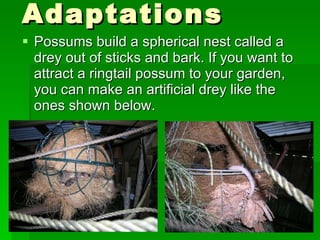
Possums build a spherical nest called a drey out of sticks and bark. If you want to attract a ringtail possum to your garden, you can make an artificial drey like the ones shown below. Adaptations
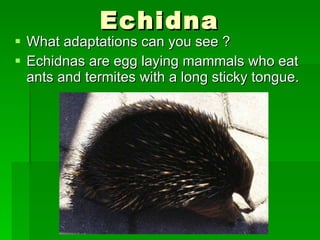
Echidna What adaptations can you see ? Echidnas are egg laying mammals who eat ants and termites with a long sticky tongue.
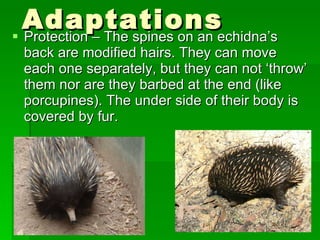
Protection – The spines on an echidna’s back are modified hairs. They can move each one separately, but they can not ‘throw’ them nor are they barbed at the end (like porcupines). The under side of their body is covered by fur. Adaptations
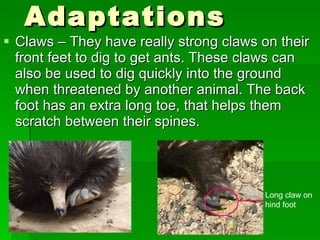
Adaptations Claws – They have really strong claws on their front feet to dig to get ants. These claws can also be used to dig quickly into the ground when threatened by another animal. The back foot has an extra long toe, that helps them scratch between their spines. Long claw on hind foot
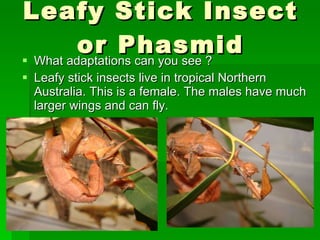
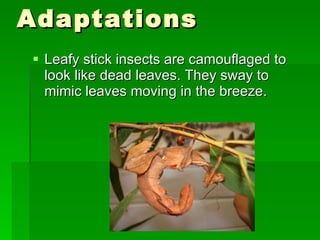
Leafy Stick Insect or Phasmid What adaptations can you see ? Leafy stick insects live in tropical Northern Australia. This is a female. The males have much larger wings and can fly.
Adaptations Leafy stick insects are camouflaged to look like dead leaves. They sway to mimic leaves moving in the breeze.
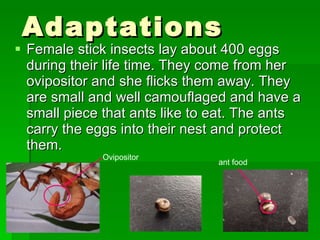
Adaptations Female stick insects lay about 400 eggs during their life time. They come from her ovipositor and she flicks them away. They are small and well camouflaged and have a small piece that ants like to eat. The ants carry the eggs into their nest and protect them.  Ovipositor ant food
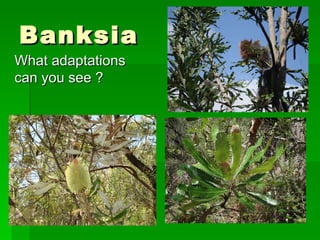
Banksia What adaptations  can you see ?
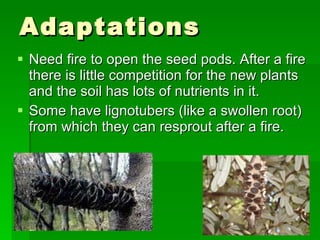
Adaptations Need fire to open the seed pods. After a fire there is little competition for the new plants and the soil has lots of nutrients in it. Some have lignotubers (like a swollen root) from which they can resprout after a fire.
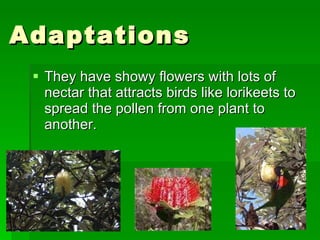
Adaptations They have showy flowers with lots of nectar that attracts birds like lorikeets to spread the pollen from one plant to another.
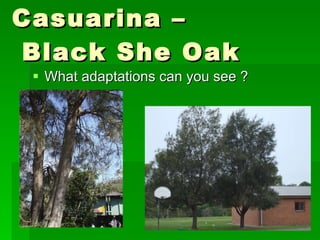
Casuarina –  Black She Oak What adaptations can you see ?
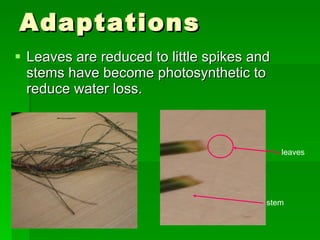
Adaptations Leaves are reduced to little spikes and stems have become photosynthetic to reduce water loss. leaves stem
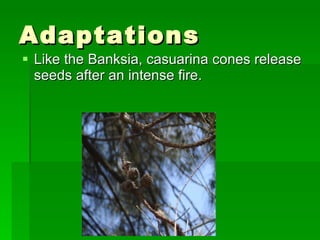
Adaptations Like the Banksia, casuarina cones release seeds after an intense fire.
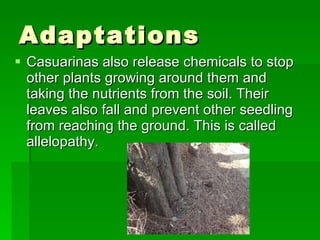
Adaptations Casuarinas also release chemicals to stop other plants growing around them and taking the nutrients from the soil. Their leaves also fall and prevent other seedling from reaching the ground. This is called allelopathy.

Adaptations Year 8

  • 1.
    ADAPTATIONS Year 8Ecology Topic
  • 2.
    WHAT IS ANADAPTATION ? An adaptation is a characteristic that allows an organism to survive in an environment.
  • 3.
    Types of adaptationsStructural adaptations refer to the shape and size of the organism and how the various parts of its body are put together; for example, a flattened body, colour, and the shape and size of its legs. Physiological adaptations refer to the working of an organism’s body; for example how an organisms digestive system works or how an organ works. Behavioural adaptations are to do with how the organism behaves; for example, burrowing or being nocturnal.
  • 4.
    Tawny Frogmouth Whatadaptations can you see ? Tawny frogmouths look a bit like owls but they’re not. Their eyes are further on the side of their head and their feet are not as strong.
  • 5.
    Beak – Broad, flat bill and large gape for catching, crushing and swallowing prey like mice and lizards. Adaptations
  • 6.
    Adaptations Feet –Delicate toes and claws for perching rather than catching prey.
  • 7.
    Adaptations Feathers -Camouflaged feathers for matching trees, - Feathers on the top of the beak look like leaves but are used to sense prey flying by. - body position to look like part of the tree.
  • 8.
    Ringtail Possum Whatadaptations can you see ? Ringtail possums are small marsupials (animals that have a pouch) that live in trees. They are nocturnal i.e. most active at night.
  • 9.
    Adaptations Nocturnal –to avoid predators like foxes and owls. Eyes – Big, round eyes for good night vision to find food. Whiskers – Lots of long whiskers. To help to allow them to move around at night.
  • 10.
    Gripping tail (prehensile)with no hair on the underside to allow for a better grip. Tails are used as a fifth limb and not to hang from. bald strip on underside. Adaptations
  • 11.
    Claws – theyhave sharp claws for climbing trees. Their fore paw has two thumbs to improve grip and the hind foot has a large thumb and the first two claws joined to make a grooming claw. Adaptations Two thumbs Grooming claw Large hind thumb
  • 12.
    Possums build aspherical nest called a drey out of sticks and bark. If you want to attract a ringtail possum to your garden, you can make an artificial drey like the ones shown below. Adaptations
  • 13.
    Echidna What adaptationscan you see ? Echidnas are egg laying mammals who eat ants and termites with a long sticky tongue.
  • 14.
    Protection – Thespines on an echidna’s back are modified hairs. They can move each one separately, but they can not ‘throw’ them nor are they barbed at the end (like porcupines). The under side of their body is covered by fur. Adaptations
  • 15.
    Adaptations Claws –They have really strong claws on their front feet to dig to get ants. These claws can also be used to dig quickly into the ground when threatened by another animal. The back foot has an extra long toe, that helps them scratch between their spines. Long claw on hind foot
  • 16.
    Leafy Stick Insector Phasmid What adaptations can you see ? Leafy stick insects live in tropical Northern Australia. This is a female. The males have much larger wings and can fly.
  • 17.
    Adaptations Leafy stickinsects are camouflaged to look like dead leaves. They sway to mimic leaves moving in the breeze.
  • 18.
    Adaptations Female stickinsects lay about 400 eggs during their life time. They come from her ovipositor and she flicks them away. They are small and well camouflaged and have a small piece that ants like to eat. The ants carry the eggs into their nest and protect them. Ovipositor ant food
  • 19.
  • 20.
    Adaptations Need fireto open the seed pods. After a fire there is little competition for the new plants and the soil has lots of nutrients in it. Some have lignotubers (like a swollen root) from which they can resprout after a fire.
  • 21.
    Adaptations They haveshowy flowers with lots of nectar that attracts birds like lorikeets to spread the pollen from one plant to another.
  • 22.
    Casuarina – Black She Oak What adaptations can you see ?
  • 23.
    Adaptations Leaves arereduced to little spikes and stems have become photosynthetic to reduce water loss. leaves stem
  • 24.
    Adaptations Like theBanksia, casuarina cones release seeds after an intense fire.
  • 25.
    Adaptations Casuarinas alsorelease chemicals to stop other plants growing around them and taking the nutrients from the soil. Their leaves also fall and prevent other seedling from reaching the ground. This is called allelopathy.