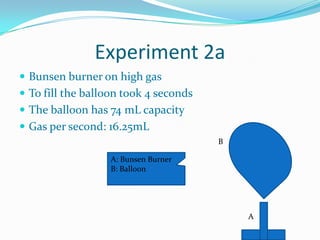
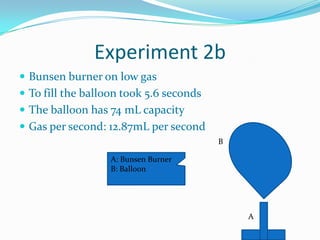
Energy Measuring Company By Team Bunsen Burner
Meet the teamTeam Bunsen BurnerA## J##: Head of DepartmentT##### L##: Leading ExecutiveS#### S#####: Senior analyst A##### N#: Junior Executive
Objective brief    It is our mission to observe and test gas efficiency inside Bunsen Burners. We must find out what type of flame is the most efficient and energy saving.  We have 3 periods to analyse and publish our findings,  which could provide you and your families information about gas and energy. By using our research, you could save money per year and help us prevent energy wastage around the globe.
Experiment AimsWe aim to prove the difference between a high heat bunsen burner and a low heat, and compare the energy usage and the temperature increase speed.    By using our information, this data could then be used for gas stoves, barbeques and petrol for cars.     As an elite small group, we will provide lab-tested results quickly and efficiently for free, giving the world vital info regarding energy usage.
HypothesisWe expect the high heat gas flame to heat, fill andevaporate faster than the low flame because, as you mayhave noticed, the lower flame would heat slower, fillspaces slower and take more time to get liquids andgases to the aimed temperature- costing more gas andtherefore more expense.
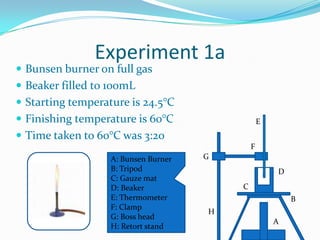
Experiment 1aBunsen burner on full gas
Beaker filled to 100mL
Starting temperature is 24.5°C
Finishing temperature is 60°C
Time taken to 60°C was 3:20 EFG°°A: Bunsen BurnerB: TripodC: Gauze matD: BeakerE: ThermometerF: ClampG: Boss headH: Retort standD°°CBHA
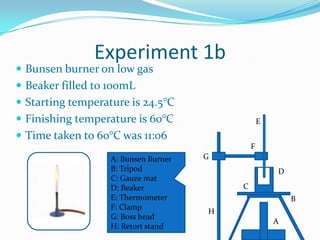
Experiment 1bBunsen burner on low gas
Beaker filled to 100mL

Energy Measuring Company

  • 1.
    Energy Measuring CompanyBy Team Bunsen Burner
  • 2.
    Meet the teamTeamBunsen BurnerA## J##: Head of DepartmentT##### L##: Leading ExecutiveS#### S#####: Senior analyst A##### N#: Junior Executive
  • 3.
    Objective brief It is our mission to observe and test gas efficiency inside Bunsen Burners. We must find out what type of flame is the most efficient and energy saving. We have 3 periods to analyse and publish our findings, which could provide you and your families information about gas and energy. By using our research, you could save money per year and help us prevent energy wastage around the globe.
  • 4.
    Experiment AimsWe aimto prove the difference between a high heat bunsen burner and a low heat, and compare the energy usage and the temperature increase speed. By using our information, this data could then be used for gas stoves, barbeques and petrol for cars. As an elite small group, we will provide lab-tested results quickly and efficiently for free, giving the world vital info regarding energy usage.
  • 5.
    HypothesisWe expect thehigh heat gas flame to heat, fill andevaporate faster than the low flame because, as you mayhave noticed, the lower flame would heat slower, fillspaces slower and take more time to get liquids andgases to the aimed temperature- costing more gas andtherefore more expense.
  • 6.
  • 7.
  • 8.
  • 9.
  • 10.
    Time taken to60°C was 3:20 EFG°°A: Bunsen BurnerB: TripodC: Gauze matD: BeakerE: ThermometerF: ClampG: Boss headH: Retort standD°°CBHA
  • 11.
  • 12.