Animal Adaptations ROEL R. MARAYA Teacher
Types of Adaptation Anything that helps an organism survive in its environment is an  adaptation.   It also refers to the ability of living things to adjust to different conditions within their environments.   Structural adaptation   Protective coloration Mimicry   Behaviour adaptations Migration Hibernation
Structural adaptations A  structural adaptation  involves some part of an animal's body. Teeth  Body coverings     Movement
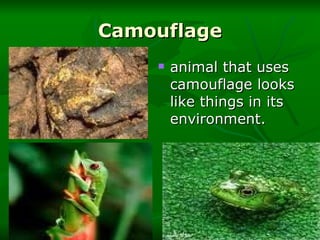
Protective Coloration Coloration  and  protective resemblance  allow an animal to blend into its environment.   Another word for this might be camouflage.  Their camouflage makes it hard for enemies to single out individuals.  
Mimicry Mimicry  allows one animal to look, sound, or act like another animal to fool predators into thinking it is poisonous or dangerous.  
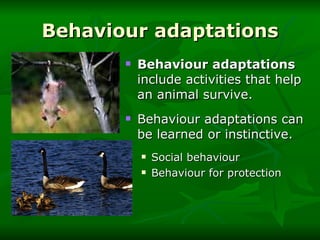
Behaviour adaptations Behaviour adaptations  include activities that help an animal survive.   Behaviour adaptations can be learned or instinctive.  Social behaviour     Behaviour for protection  
Migration Animals migrate for different reasons.   better climate  better food  safe place to live  safe place to raise young  go back to the place they were born.  This is when behavioural adaptation that involves an animal or group of animals moving from one region to another and then back again. 
Hibernation This is deep sleep in which animal’s body temp droops, body activities are slowed to conserve energy. E.g. Bats, woodchucks & bears.
Camouflage animal that uses camouflage looks like things in its environment.
Find me game!
Thank you!

Animal adaptations i

  • 1.
    Animal Adaptations ROELR. MARAYA Teacher
  • 2.
    Types of AdaptationAnything that helps an organism survive in its environment is an adaptation.  It also refers to the ability of living things to adjust to different conditions within their environments.  Structural adaptation Protective coloration Mimicry   Behaviour adaptations Migration Hibernation
  • 3.
    Structural adaptations A structural adaptation involves some part of an animal's body. Teeth Body coverings    Movement
  • 4.
    Protective Coloration Coloration and protective resemblance allow an animal to blend into its environment.  Another word for this might be camouflage.  Their camouflage makes it hard for enemies to single out individuals.  
  • 5.
    Mimicry Mimicry allows one animal to look, sound, or act like another animal to fool predators into thinking it is poisonous or dangerous.  
  • 6.
    Behaviour adaptations Behaviouradaptations include activities that help an animal survive.  Behaviour adaptations can be learned or instinctive. Social behaviour   Behaviour for protection  
  • 7.
    Migration Animals migratefor different reasons.  better climate better food safe place to live safe place to raise young go back to the place they were born. This is when behavioural adaptation that involves an animal or group of animals moving from one region to another and then back again. 
  • 8.
    Hibernation This isdeep sleep in which animal’s body temp droops, body activities are slowed to conserve energy. E.g. Bats, woodchucks & bears.
  • 9.
    Camouflage animal thatuses camouflage looks like things in its environment.
  • 10.
  • 11.

Editor's Notes

  • #4 A structural adaptation involves some part of an animal's body, such as the size or shape of the teeth, the animal's body covering, or the way the animal moves.   Teeth - since different animals eat different things, they don't all have the same kind of teeth Body coverings - Hair, scales, spines, and feathers grow from the skin.  All of these parts help animals survive in their environments.   Movement - animals find food by moving from place to place
  • #6 Coral snake (left) very poinsonous & Milk snake (right)
  • #7 Behavior adaptations include activities that help an animal survive.  Behavior adaptations can be learned or instinctive. (a behavior an animal is born with). Social behavior - some animals live by themselves, while other live in groups.  Behavior for protection -  An animal's behavior sometimes helps to protect the animal.  For instance the opossum plays dead.  A rabbit freezes when it thinks it has been seen. 
  • #8 Migration -is the behavioral adaptation that involves an animal or group of animals moving from one region to another and then back again.  Animals migrate for different reasons.  The reasons are as follows. better climate better food safe place to live safe place to raise young go back to the place they were born.
  • #9 Hibernation - is a deep sleep in which an animal's body temperature drops to about the temperature of the environment.  Body activities, such as heartbeat and breathing are slowed causing the animal to need very little food.  Animals that hibernate are  bats  woodchucks snakes  bears. During the hibernation the animals live off of the fat that is stored in their body.