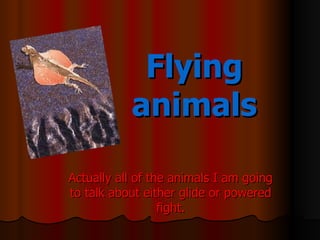
Flying
           animals

Actually all of the animals I am going
to talk about either glide or powered
                  fight.
All about flying animals!?
A number of animals have evolved aerial locomotion,
either by powered flight or by gliding. Flying and gliding
animals have evolved separately many times, without
any single ancestor. Flight has evolved at least four
times, in the insects, pterosaurs, birds, and bats.
Gliding has evolved on many more occasions. Usually
the development is to aid canopy animals in getting
from tree to tree, although there are other possibilities.
Gliding, in particular, has evolved
among rainforest animals, especially in the rainforests
in Asia (most especially Borneo)
Invertebrates:
                      Arthropods
   Gliding ants (gliding). The flightless workers of these
    insects have secondarily gained some capacity to move
    through the air. Gliding has evolved independently in a
    number of arboreal ant species from the groups
    Cephalotini, Pseudomyrmecinae, and Formicinae(mostly
    Camponotus). All arboreal dolichoderines and non-
    cephalotine myrmicines except Daceton armigerum do
    not glide. Living in the rainforest canopy like many other
    gliders, gliding ants use their gliding to return to the
    trunk of the tree they live on should they fall or be
    knocked off a branch.
Continuation
   Gliding was first discovered for Cephalotes
    atreus in the Peruvian rainforest. Cephalotes
    atreus can make 180 degree turns, and locate
    the trunk using visual cues, succeeding in
    landing 80% of the time.[8] Unique among
    gliding animals, Cephalotini and
    Pseudomyrmecinae ants glide abdomen first, the
    Forminicae however glide in the more
    conventional head first manner.[9] The following
    page has some good videos of gliding ants. [1]
Oh! Then how about spiders!!!
   Spiders (parachuting). The young of some
    species of spiders travel through the air by
    using silk draglines to catch the wind, as
    may some smaller species of adult spider,
    such themoney spider family. This
    behavior is commonly known as
    "ballooning". Ballooning spiders make up
    part of the aeroplankton.
And last one of all Molluscs
   Flying squid (gliding). Several oceanic squids, such as
    the Pacific flying squid, will leap out of the water to
    escape predators, an adaptation similar to that of
    flying fish.[10] Smaller squids will fly in shoals, and have
    been observed to cover distances as long as 50 meters.
    Small fins towards the back of the mantle do not
    produce much lift, but do help stabilize the motion of
    flight. They exit the water by expelling water out of their
    funnel, indeed some squid have been observed to
    continue jetting water while airborne possibly providing
    thrust even after leaving the water. This may make
    flying squid the only animals with jet-propelled aerial
    locomotion.
    Where the trees are tall and widely spaced
Now lets go to Vertebrates:
                    Fish

    There are over 50 species of flying fish belonging to the
    family Exocoetidae The largest flying fish can reach
    lengths of 45 cm, but most species measure less than
    30 cm in length. They can be divided into two-winged
    varieties and four-winged varieties. Before the fish
    leaves the water it increases its speed to around 30
    body lengths per second and as it breaks the surface
    and is freed from the drag of the water it can be
    traveling at around 60 km/h.The glides are usually up to
    30–50 metres in length, but some have been observed
    soaring for hundreds of metres using the updraft on the
    leading edges of waves. The fish can also make a series
    of glides, each time dipping the tail into the water to
    produce forward thrust. The longest recorded series of
    glides, with the fish only periodically dipping its tail in
    the water, was for 45 seconds .
More Fish!!!

  Halfbeaks (gliding). A group related to the Exocoetidae, one or two
  hemirhamphid species possess enlarged pectoral fins and show true
  gliding flight rather than simple leaps.
 Freshwater butterfly fish (possibly gliding). It can move through the
  air several times the length of its body. While it does this, the fish
  flaps its large pectoral fins, giving it its common name.
 However, it is debated whether the freshwater butterfly fish can
  truly glide, Saidel et al. (2004) argue that it cannot.
 Freshwater hatchet fish (possibly flying). There are 9 species of
  freshwater hatchet fish split among 3 genera. Freshwater
  hatchetfish have an extremely large sternal region that is fitted with
  a large amount of muscle that allows it to flap its pectoral fins. They
  can move in a straight line over a few meters to escape predators
Now on to Amphibians

   Rhacophoridae flying frogs. Gliding has evolved
    independently in two families of tree frogs, the
    Old World Rhacophoridae and the New World Hylidae.
    Within each lineage there are a range of gliding abilities
    from non-gliding, to parachuting, to full gliding.. For
    example, the Malayan flying frog glides using the
    membranes between the toes of its limbs, and small
    membranes located at the heel, the base of the leg, and
    the forearm. Some of the frogs are quite accomplished
    gliders, for example, the Chinese gliding frog
    Polypedates dennysi can maneuver in the air, making
    two kinds of turn, either rolling into the turn or yawing
     into the turn (a crabbed turn). Hylidae flying frogs.The
    other frog family that contains gliders.
Now lets head
of on
REPTILES
Draco lizard
There are 28 species of lizard of the genus Draco,
 found in Sri Lanka, India, and Southeast Asia.
 They live in trees, feeding on tree ants, but nest
 on the forest floor. They can glide for up to 60
 m and over this distance they lose only 10 m in
 height. Unusually, their patagium is supported
 on elongated ribs rather than the more common
 situation among gliding vertebrates of having
 the patagium attached to the limbs. When
 extended, the ribs form a semicircle on either
 side the lizard's body and can be folded to the
 body like a folding fan.
Gliding Lacertids and Ptychozoon
              (gliding geckos)
   Gliding Lacertids (gliding). There are two species
    of gliding lacertid, of the genus Holaspis. Found
    in Africa. They have fringed toes and tail sides
    and can flatten their bodies for
    gliding/parachuting.
    There are six species of gliding gecko, of the
    genus Ptychozoon, from Southeast Asia. These
    lizards have small flaps of skin along their limbs,
    torso, tail, and head that catch the air and
    enable them to glide.
Chrysopelea snake
    Five species of snake from Southeast Asia,
    Melanesia, and India. The paradise tree snake of
    southern Thailand, Malaysia, Borneo, Philippines,
    and Sulawesi is the most capable glider of those
    snakes studied. It glides by stretching out its
    body sideways and opening its ribs so the belly
    is concave, and by making lateral slithering
    movements. It can remarkably glide up to 100 m
    and make 90 degree turns. Follow this link for
    videos of gliding snakes.
Now who is
ready for
Mammals???
Flying phalangers or wrist-winged
                 gliders.
   Flying phalangers or wrist-winged gliders gliding
    possbliy found in Australia, and New Guinea.
    The gliding membranes are hardly noticeable
    until they jump. On jumping, the animal extends
    all four legs and stretches the loose but
    muscularly controlled folds of skin. The
    subfamily contains seven species. Of the six
    species in the genus Petaurus, the Sugar glider
    and the Biak Glider are the most common
    species.
Petauroides volans

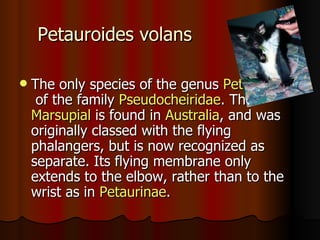
   The only species of the genus Petauroidae
     of the family Pseudocheiridae. This
    Marsupial is found in Australia, and was
    originally classed with the flying
    phalangers, but is now recognized as
    separate. Its flying membrane only
    extends to the elbow, rather than to the
    wrist as in Petaurinae.
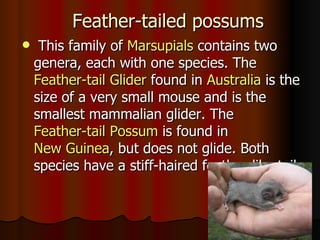
Feather-tailed possums
    This family of Marsupials contains two
    genera, each with one species. The
    Feather-tail Glider found in Australia is the
    size of a very small mouse and is the
    smallest mammalian glider. The
    Feather-tail Possum is found in
    New Guinea, but does not glide. Both
    species have a stiff-haired feather-like tail.
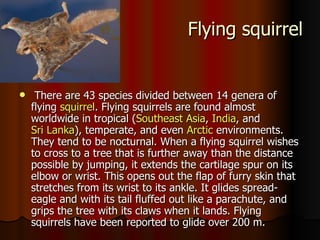
Flying squirrel


    There are 43 species divided between 14 genera of
    flying squirrel. Flying squirrels are found almost
    worldwide in tropical (Southeast Asia, India, and
    Sri Lanka), temperate, and even Arctic environments.
    They tend to be nocturnal. When a flying squirrel wishes
    to cross to a tree that is further away than the distance
    possible by jumping, it extends the cartilage spur on its
    elbow or wrist. This opens out the flap of furry skin that
    stretches from its wrist to its ankle. It glides spread-
    eagle and with its tail fluffed out like a parachute, and
    grips the tree with its claws when it lands. Flying
    squirrels have been reported to glide over 200 m.
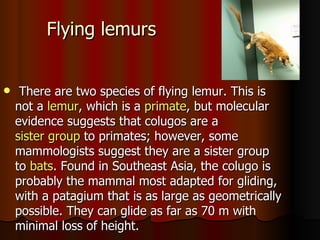
Flying lemurs


    There are two species of flying lemur. This is
    not a lemur, which is a primate, but molecular
    evidence suggests that colugos are a
    sister group to primates; however, some
    mammologists suggest they are a sister group
    to bats. Found in Southeast Asia, the colugo is
    probably the mammal most adapted for gliding,
    with a patagium that is as large as geometrically
    possible. They can glide as far as 70 m with
    minimal loss of height.
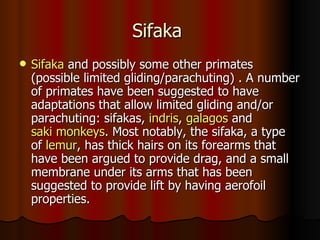
Sifaka
   Sifaka and possibly some other primates
    (possible limited gliding/parachuting) . A number
    of primates have been suggested to have
    adaptations that allow limited gliding and/or
    parachuting: sifakas, indris, galagos and
    saki monkeys. Most notably, the sifaka, a type
    of lemur, has thick hairs on its forearms that
    have been argued to provide drag, and a small
    membrane under its arms that has been
    suggested to provide lift by having aerofoil
    properties.
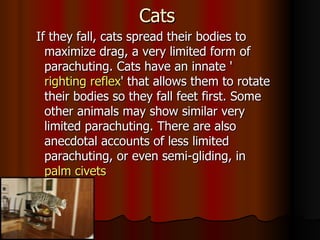
Cats
If they fall, cats spread their bodies to
  maximize drag, a very limited form of
  parachuting. Cats have an innate '
  righting reflex' that allows them to rotate
  their bodies so they fall feet first. Some
  other animals may show similar very
  limited parachuting. There are also
  anecdotal accounts of less limited
  parachuting, or even semi-gliding, in
  palm civets
Thank you for listening
 for my presentation, I
 hope you liked it.
Created by:Habiba
 bishery Younes 5gn

flying animals

  • 1.
    Flying animals Actually all of the animals I am going to talk about either glide or powered fight.
  • 2.
    All about flyinganimals!? A number of animals have evolved aerial locomotion, either by powered flight or by gliding. Flying and gliding animals have evolved separately many times, without any single ancestor. Flight has evolved at least four times, in the insects, pterosaurs, birds, and bats. Gliding has evolved on many more occasions. Usually the development is to aid canopy animals in getting from tree to tree, although there are other possibilities. Gliding, in particular, has evolved among rainforest animals, especially in the rainforests in Asia (most especially Borneo)
  • 3.
    Invertebrates: Arthropods  Gliding ants (gliding). The flightless workers of these insects have secondarily gained some capacity to move through the air. Gliding has evolved independently in a number of arboreal ant species from the groups Cephalotini, Pseudomyrmecinae, and Formicinae(mostly Camponotus). All arboreal dolichoderines and non- cephalotine myrmicines except Daceton armigerum do not glide. Living in the rainforest canopy like many other gliders, gliding ants use their gliding to return to the trunk of the tree they live on should they fall or be knocked off a branch.
  • 4.
    Continuation  Gliding was first discovered for Cephalotes atreus in the Peruvian rainforest. Cephalotes atreus can make 180 degree turns, and locate the trunk using visual cues, succeeding in landing 80% of the time.[8] Unique among gliding animals, Cephalotini and Pseudomyrmecinae ants glide abdomen first, the Forminicae however glide in the more conventional head first manner.[9] The following page has some good videos of gliding ants. [1]
  • 5.
    Oh! Then howabout spiders!!!  Spiders (parachuting). The young of some species of spiders travel through the air by using silk draglines to catch the wind, as may some smaller species of adult spider, such themoney spider family. This behavior is commonly known as "ballooning". Ballooning spiders make up part of the aeroplankton.
  • 6.
    And last oneof all Molluscs  Flying squid (gliding). Several oceanic squids, such as the Pacific flying squid, will leap out of the water to escape predators, an adaptation similar to that of flying fish.[10] Smaller squids will fly in shoals, and have been observed to cover distances as long as 50 meters. Small fins towards the back of the mantle do not produce much lift, but do help stabilize the motion of flight. They exit the water by expelling water out of their funnel, indeed some squid have been observed to continue jetting water while airborne possibly providing thrust even after leaving the water. This may make flying squid the only animals with jet-propelled aerial locomotion.  Where the trees are tall and widely spaced
  • 7.
    Now lets goto Vertebrates: Fish  There are over 50 species of flying fish belonging to the family Exocoetidae The largest flying fish can reach lengths of 45 cm, but most species measure less than 30 cm in length. They can be divided into two-winged varieties and four-winged varieties. Before the fish leaves the water it increases its speed to around 30 body lengths per second and as it breaks the surface and is freed from the drag of the water it can be traveling at around 60 km/h.The glides are usually up to 30–50 metres in length, but some have been observed soaring for hundreds of metres using the updraft on the leading edges of waves. The fish can also make a series of glides, each time dipping the tail into the water to produce forward thrust. The longest recorded series of glides, with the fish only periodically dipping its tail in the water, was for 45 seconds .
  • 8.
    More Fish!!!  Halfbeaks (gliding). A group related to the Exocoetidae, one or two hemirhamphid species possess enlarged pectoral fins and show true gliding flight rather than simple leaps.  Freshwater butterfly fish (possibly gliding). It can move through the air several times the length of its body. While it does this, the fish flaps its large pectoral fins, giving it its common name.  However, it is debated whether the freshwater butterfly fish can truly glide, Saidel et al. (2004) argue that it cannot.  Freshwater hatchet fish (possibly flying). There are 9 species of freshwater hatchet fish split among 3 genera. Freshwater hatchetfish have an extremely large sternal region that is fitted with a large amount of muscle that allows it to flap its pectoral fins. They can move in a straight line over a few meters to escape predators
  • 9.
    Now on toAmphibians  Rhacophoridae flying frogs. Gliding has evolved independently in two families of tree frogs, the Old World Rhacophoridae and the New World Hylidae. Within each lineage there are a range of gliding abilities from non-gliding, to parachuting, to full gliding.. For example, the Malayan flying frog glides using the membranes between the toes of its limbs, and small membranes located at the heel, the base of the leg, and the forearm. Some of the frogs are quite accomplished gliders, for example, the Chinese gliding frog Polypedates dennysi can maneuver in the air, making two kinds of turn, either rolling into the turn or yawing into the turn (a crabbed turn). Hylidae flying frogs.The other frog family that contains gliders.
  • 10.
    Now lets head ofon REPTILES
  • 11.
    Draco lizard There are28 species of lizard of the genus Draco, found in Sri Lanka, India, and Southeast Asia. They live in trees, feeding on tree ants, but nest on the forest floor. They can glide for up to 60 m and over this distance they lose only 10 m in height. Unusually, their patagium is supported on elongated ribs rather than the more common situation among gliding vertebrates of having the patagium attached to the limbs. When extended, the ribs form a semicircle on either side the lizard's body and can be folded to the body like a folding fan.
  • 12.
    Gliding Lacertids andPtychozoon (gliding geckos)  Gliding Lacertids (gliding). There are two species of gliding lacertid, of the genus Holaspis. Found in Africa. They have fringed toes and tail sides and can flatten their bodies for gliding/parachuting.  There are six species of gliding gecko, of the genus Ptychozoon, from Southeast Asia. These lizards have small flaps of skin along their limbs, torso, tail, and head that catch the air and enable them to glide.
  • 13.
    Chrysopelea snake  Five species of snake from Southeast Asia, Melanesia, and India. The paradise tree snake of southern Thailand, Malaysia, Borneo, Philippines, and Sulawesi is the most capable glider of those snakes studied. It glides by stretching out its body sideways and opening its ribs so the belly is concave, and by making lateral slithering movements. It can remarkably glide up to 100 m and make 90 degree turns. Follow this link for videos of gliding snakes.
  • 14.
    Now who is readyfor Mammals???
  • 15.
    Flying phalangers orwrist-winged gliders.  Flying phalangers or wrist-winged gliders gliding possbliy found in Australia, and New Guinea. The gliding membranes are hardly noticeable until they jump. On jumping, the animal extends all four legs and stretches the loose but muscularly controlled folds of skin. The subfamily contains seven species. Of the six species in the genus Petaurus, the Sugar glider and the Biak Glider are the most common species.
  • 16.
    Petauroides volans  The only species of the genus Petauroidae of the family Pseudocheiridae. This Marsupial is found in Australia, and was originally classed with the flying phalangers, but is now recognized as separate. Its flying membrane only extends to the elbow, rather than to the wrist as in Petaurinae.
  • 17.
    Feather-tailed possums  This family of Marsupials contains two genera, each with one species. The Feather-tail Glider found in Australia is the size of a very small mouse and is the smallest mammalian glider. The Feather-tail Possum is found in New Guinea, but does not glide. Both species have a stiff-haired feather-like tail.
  • 18.
    Flying squirrel  There are 43 species divided between 14 genera of flying squirrel. Flying squirrels are found almost worldwide in tropical (Southeast Asia, India, and Sri Lanka), temperate, and even Arctic environments. They tend to be nocturnal. When a flying squirrel wishes to cross to a tree that is further away than the distance possible by jumping, it extends the cartilage spur on its elbow or wrist. This opens out the flap of furry skin that stretches from its wrist to its ankle. It glides spread- eagle and with its tail fluffed out like a parachute, and grips the tree with its claws when it lands. Flying squirrels have been reported to glide over 200 m.
  • 19.
    Flying lemurs  There are two species of flying lemur. This is not a lemur, which is a primate, but molecular evidence suggests that colugos are a sister group to primates; however, some mammologists suggest they are a sister group to bats. Found in Southeast Asia, the colugo is probably the mammal most adapted for gliding, with a patagium that is as large as geometrically possible. They can glide as far as 70 m with minimal loss of height.
  • 20.
    Sifaka  Sifaka and possibly some other primates (possible limited gliding/parachuting) . A number of primates have been suggested to have adaptations that allow limited gliding and/or parachuting: sifakas, indris, galagos and saki monkeys. Most notably, the sifaka, a type of lemur, has thick hairs on its forearms that have been argued to provide drag, and a small membrane under its arms that has been suggested to provide lift by having aerofoil properties.
  • 21.
    Cats If they fall,cats spread their bodies to maximize drag, a very limited form of parachuting. Cats have an innate ' righting reflex' that allows them to rotate their bodies so they fall feet first. Some other animals may show similar very limited parachuting. There are also anecdotal accounts of less limited parachuting, or even semi-gliding, in palm civets
  • 22.
    Thank you forlistening for my presentation, I hope you liked it. Created by:Habiba bishery Younes 5gn