Downloaded 19 times


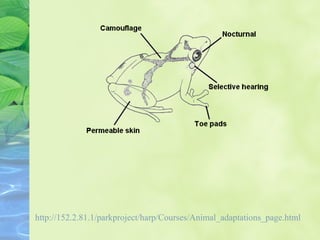


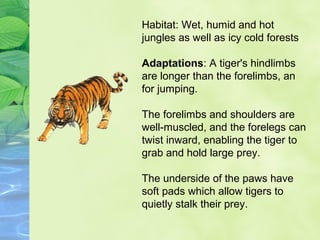


This document discusses adaptations that allow organisms to survive in their environments. It defines adaptations as characteristics that improve an organism's chance of survival. Adaptations can be structural, like body size or shape; behavioral, such as being nocturnal; or physiological, like hibernation. Examples are given of structural adaptations like sharp teeth in carnivores or thick fur in arctic foxes that protect against cold. Behavioral adaptations include animals moving in groups for protection. Physiological adaptations include ways organisms regulate internal functions. Specific habitat adaptations are described for kangaroos, orcas, tigers, orangutans, cacti, and aquatic plants.


![Lion adaptation 2011[1]-1](https://cdn.slidesharecdn.com/ss_thumbnails/lionadaptation20111-1-110305224616-phpapp01-thumbnail.jpg?width=640&height=640&fit=bounds)


