0
Pediatric Standard Treatment
Guidelines
:
Pediatric Standard Treatment
Guidelines
TABLE OF CONTENTS
1. RESPIRATORY DISEASES………………………………………………………………………………………………….4
1.1.Croup
1.2.Acute Bronchitis
1.3.Bronchiolitis
1.4.Upper Respiratory Tract Infection (URTI)
1.5.Pertussis (Whooping cough)
1.6.Pneumonia
1.7.Diphtheria
1.8.Epiglotitis
2. ENT – EYE, NOSE, THROAT……………………………………………………….…………………………………12
2.1.Acute Otitis Media
2.2.Chronic Supurative Otitis Media
2.3.Acute Otitis Externa
2.4.Mastoiditis
2.5.Tonsillitis
2.6.Peritonsillar abscess
3. OPTHTALMOLOGICAL DISEASES……………………………………………………………………………………14
3.1.Conjuntivitis
3.2.Periorbital and Orbital Cellulitis
3.3.Neonatal Conjunctivitis
3.4.Trachoma
3.5.Vitamin A Deficiency
4. VIRAL DISEASES……………………………………………………………………………………………………………19
4.1.Measles
4.2.Viral Hepatitis A, B, C, D, E
5. BACTERIAL DISEASES………………………………………………………………………….…………………………21
5.1.Meningitis
5.2.Septicemia
5.3.Tetanus
5.4.Relapsing fever (Borreliosis)
5.5.Eruptive Rickettsiosis
5.6.Typhoid Fever
6. GASTROINTESTINAL DISORDERS…………………………………………………………………………………..27
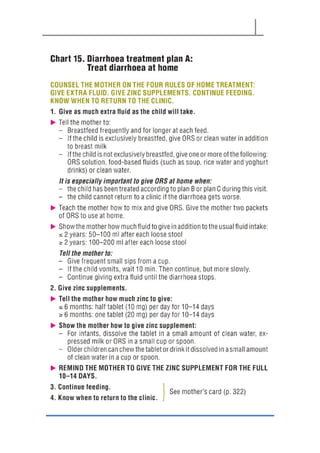
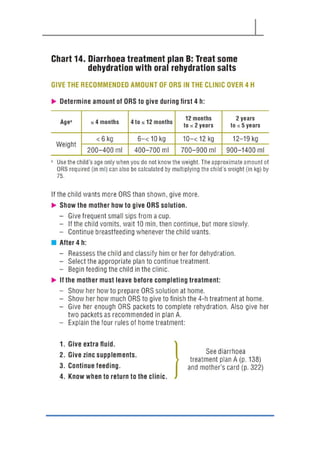
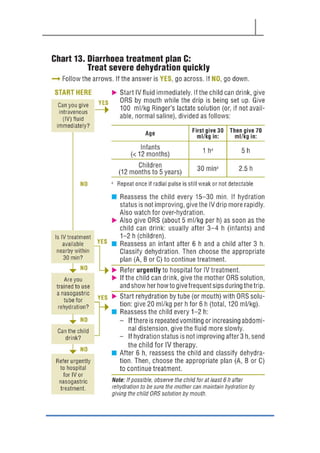
6.1.Dehydration: Plan A-B-C
6.2.Acute Diarrhoea
6.3.Dysentery
6.4.Cholera
7. PROTOZOAN INFECTIONS………………………………………………………………………….……………….32
7.1.Malaria
8. INTESTINAL PROTOZAN INFECTIONS………………………………………………….…………………………37
8.1.Parasitic Diarrhoea
8.1.1.Giardiasis
8.1.2.Amoebiasis
8.2.Schistosomiasis
9. HELMINTHIASIS……………………………………………………………………………………….……………………3
9
9.1.Taeniasis
9.2.Hymenolepiasis
9.3.Hydated Cyst
9.4.Ascariasis
9.5.Trichuriasis
9.6.Ancylostomiasis
9.7.Strongyloidiasis
9.8.Enterobiasis
9.9.Filariasis
10. RENAL DISORDERS……………………………………………………………………………………………………….43
10.1. Acute Cistitis
10.2. Pyelonephritis/Urinary Tract Infection
10.3. Post infectious glomerulonephritis
10.4. Nephrotic Syndrome
11. BONE AND JOINT …………………………………………………………………………………..…………………….48
11.1. Osteomyelitis / Septic Arthritis
12. DERMATOLOGY……………………………………………………………………………….…………………………..50
12.1. Impetigo
12.2. Scabies
12.3. Foruncles and carbuncles
12.4. Erysipelas and cellulitis
12.5. Cutaneous anthrax
12.6. Eczema
12.7. Seborrheic dermatitis
12.8. Urticaria
12.9. Pellagra
12.10. Animal bites
12.11. Lices (Pediculosis)
12.12. Fungal infections
12.12.1. Candidiasis
12.12.2. Tinea
13. CENTRAL NERVOUS SYSTEM…………………………………………………………………………………………59
13.1. Seizures
13.2. Epilepsy
14. OTHERS………………………………………………………………………………………………………………………..66
14.1. Dental Infection
14.2. Abscess
15. ANNEX……………………………………………………………………………….…………………………………………67
15.1. Hypoglycemia…………………………………………………………………………………..…….…….67
15.2. Glasgow Coma Scale………………………………………………………………………..……………68
15.3. Balantyre Coma Scale……………………………………………………………………..…………….69
15.4. Anaphilaxia………………………………………………………………….………………………………..70
15.5. Drugs in Pharmacy……………………………………………………….………..………..……………71
15.6. Nurses Material……………………………………………………………………………………..……..74
15.7. Drugs in Dressing and Emergency Room……………………..………………………………..76
15.8. Laboratory Material…………………………………………………….………………………………..78
15.9. Paracetamol Table…………………………………………………………………………..….………..80
15.10. Cotrimoxazol table……………………………………………………………..…………………………81
15.11. Normal Daily maintenance IV fluids…………………………….….…………….………………82
15.12. Adverse drug reaction (ADR) reporting form………………………………..……….……..83
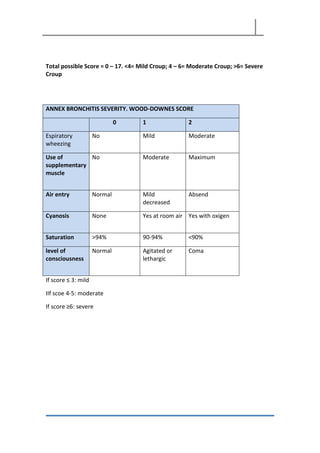
15.13. Croup classification……………………………………………………………………..….…………….86
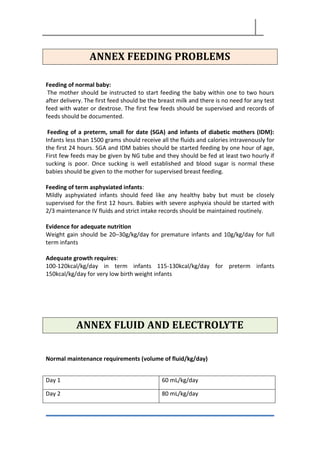
15.14. Feeding problems………………………………………………………………………..…..…………..87
15.15. Fluid and electrolyte ……………………….……………………………………………...……………88
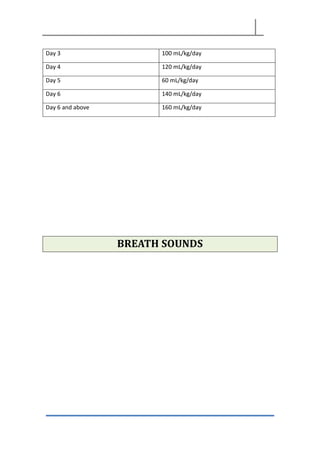
15.16. Breath sounds………………………………………………………………………….……..…………….89
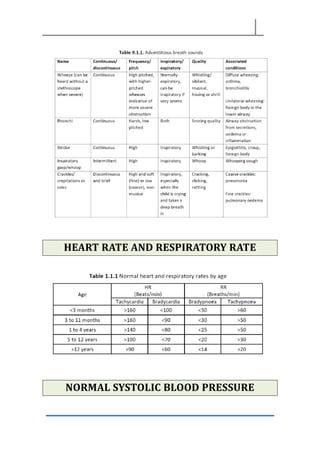
15.17. Heart Rate and Respiratory Rate……………………………………………………………………89
15.18. Normal Systolic Blood Pressure………………………………………………………..…………..90
15.19. Triage priority categories………………………………………………………….…………………..90
15.20. Emergency signs (ABCDE)…………………………………………………… …………….………...91
15.21. Primary assessment………………………………………………….…………………………..………92
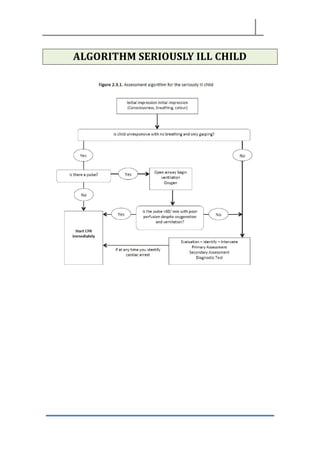
15.22. Algorithm for the seriously ill child………………………………………………………………..94
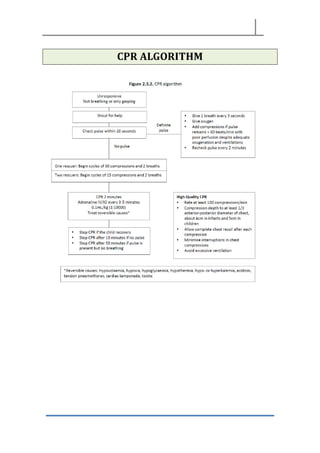
15.23. CPR Algorithm………………………………………………………………………………………….……95
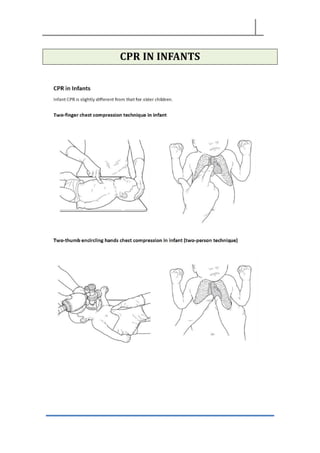
15.24. CPR in infants………………………………………………………………………………..……………...96
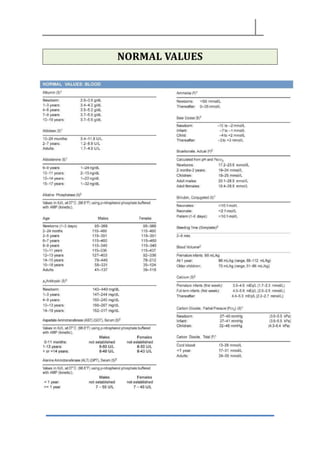
15.25. Normal Values……………………………………………………………………….………………………97
15.26. Medical Glossary……………………………………………………………………………………..….103
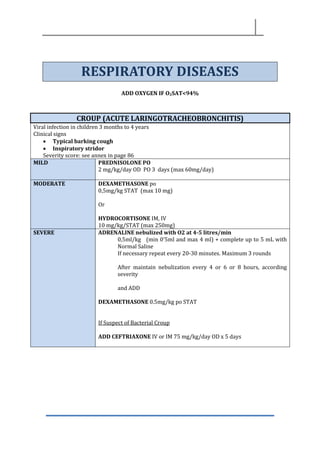
RESPIRATORY DISEASES
ADD OXYGEN IF O2SAT<94%
CROUP (ACUTE LARINGOTRACHEOBRONCHITIS)
Viral infection in children 3 months to 4 years
Clinical signs
• Typical barking cough
• Inspiratory stridor
Severity score: see annex in page 86
MILD PREDNISOLONE PO
2 mg/kg/day OD PO 3 days (max 60mg/day)
MODERATE DEXAMETHASONE po
0,5mg/kg STAT (max 10 mg)
Or
HYDROCORTISONE IM, IV
10 mg/kg/STAT (max 250mg)
SEVERE ADRENALINE nebulized with O2 at 4-5 litres/min
0,5ml/kg (min 0’5ml and max 4 ml) + complete up to 5 mL with
Normal Saline
If necessary repeat every 20-30 minutes. Maximum 3 rounds
After maintain nebulization every 4 or 6 or 8 hours, according
severity
and ADD
DEXAMETHASONE 0.5mg/kg po STAT
If Suspect of Bacterial Croup
ADD CEFTRIAXONE IV or IM 75 mg/kg/day OD x 5 days
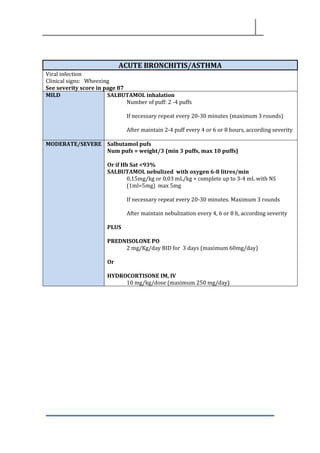
ACUTE BRONCHITIS/ASTHMA
Viral infection
Clinical signs: Wheezing
See severity score in page 87
MILD SALBUTAMOL inhalation
Number of puff: 2 -4 puffs
If necessary repeat every 20-30 minutes (maximum 3 rounds)
After maintain 2-4 puff every 4 or 6 or 8 hours, according severity
MODERATE/SEVERE Salbutamol pufs
Num pufs = weight/3 (min 3 puffs, max 10 puffs)
Or if Hb Sat <93%
SALBUTAMOL nebulized with oxygen 6-8 litres/min
0,15mg/kg or 0,03 mL/kg + complete up to 3-4 mL with NS
(1ml=5mg) max 5mg
If necessary repeat every 20-30 minutes. Maximum 3 rounds
After maintain nebulization every 4, 6 or 8 h, according severity
PLUS
PREDNISOLONE PO
2 mg/Kg/day BID for 3 days (maximum 60mg/day)
Or
HYDROCORTISONE IM, IV
10 mg/kg/dose (maximum 250 mg/day)
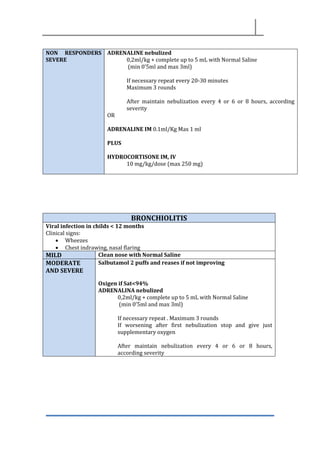
NON RESPONDERS
SEVERE
ADRENALINE nebulized
0,2ml/kg + complete up to 5 mL with Normal Saline
(min 0’5ml and max 3ml)
If necessary repeat every 20-30 minutes
Maximum 3 rounds
After maintain nebulization every 4 or 6 or 8 hours, according
severity
OR
ADRENALINE IM 0.1ml/Kg Max 1 ml
PLUS
HYDROCORTISONE IM, IV
10 mg/kg/dose (max 250 mg)
BRONCHIOLITIS
Viral infection in childs < 12 months
Clinical signs:
• Wheezes
• Chest indrawing, nasal flaring
MILD Clean nose with Normal Saline
MODERATE
AND SEVERE
Salbutamol 2 puffs and reases if not improving
Oxigen if Sat<94%
ADRENALINA nebulized
0,2ml/kg + complete up to 5 mL with Normal Saline
(min 0’5ml and max 3ml)
If necessary repeat . Maximum 3 rounds
If worsening after first nebulization stop and give just
supplementary oxygen
After maintain nebulization every 4 or 6 or 8 hours,
according severity
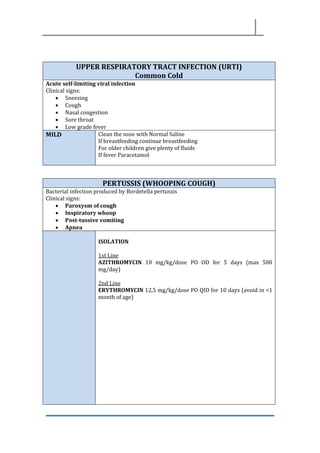
UPPER RESPIRATORY TRACT INFECTION (URTI)
Common Cold
Acute self-limiting viral infection
Clinical signs:
• Sneezing
• Cough
• Nasal congestion
• Sore throat
• Low grade fever
MILD Clean the nose with Normal Saline
If breastfeeding continue breastfeeding
For older children give plenty of fluids
If fever Paracetamol
PERTUSSIS (WHOOPING COUGH)
Bacterial infection produced by Bordetella pertussis
Clinical signs:
• Paroxysm of cough
• Inspiratory whoop
• Post-tussive vomiting
• Apnea
ISOLATION
1st Line
AZITHROMYCIN 10 mg/kg/dose PO OD for 5 days (max 500
mg/day)
2nd Line
ERYTHROMYCIN 12,5 mg/kg/dose PO QID for 10 days (avoid in <1
month of age)
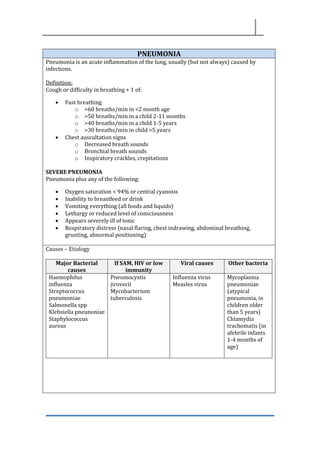
PNEUMONIA
Pneumonia is an acute inflammation of the lung, usually (but not always) caused by
infections.
Definition:
Cough or difficulty in breathing + 1 of:
• Fast breathing
o >60 breaths/min in <2 month age
o >50 breaths/min in a child 2-11 months
o >40 breaths/min in a child 1-5 years
o >30 breaths/min in child >5 years
• Chest auscultation signs
o Decreased breath sounds
o Bronchial breath sounds
o Inspiratory crackles, crepitations
SEVERE PNEUMONIA
Pneumonia plus any of the following:
• Oxygen saturation < 94% or central cyanosis
• Inability to breastfeed or drink
• Vomiting everything (all foods and liquids)
• Lethargy or reduced level of consciousness
• Appears severely ill of toxic
• Respiratory distress (nasal flaring, chest indrawing, abdominal breathing,
grunting, abnormal positioning)
Causes – Etiology
Major Bacterial
causes
If SAM, HIV or low
immunity
Viral causes Other bacteria
Haemophilus
influenza
Streptococcus
pneumoniae
Salmonella spp
Klebsiella pneunoniae
Staphylococcus
aureus
Pneumocystis
jirovecii
Mycobacterium
tuberculosis
Influenza virus
Measles virus
Mycoplasma
pneumoniae
(atypical
pneumonia, in
children older
than 5 years)
Chlamydia
trachomatis (in
afebrile infants
1-4 months of
age)
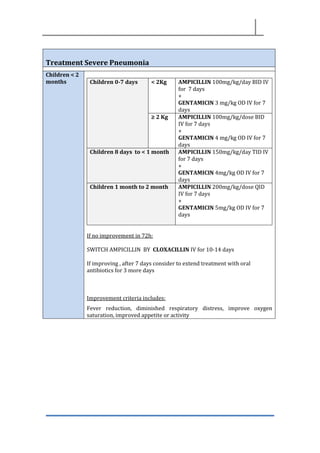
Treatment Severe Pneumonia
Children < 2
months Children 0-7 days < 2Kg AMPICILLIN 100mg/kg/day BID IV
for 7 days
+
GENTAMICIN 3 mg/kg OD IV for 7
days
≥ 2 Kg AMPICILLIN 100mg/kg/dose BID
IV for 7 days
+
GENTAMICIN 4 mg/kg OD IV for 7
days
Children 8 days to < 1 month AMPICILLIN 150mg/kg/day TID IV
for 7 days
+
GENTAMICIN 4mg/kg OD IV for 7
days
Children 1 month to 2 month AMPICILLIN 200mg/kg/dose QID
IV for 7 days
+
GENTAMICIN 5mg/kg OD IV for 7
days
If no improvement in 72h:
SWITCH AMPICILLIN BY CLOXACILLIN IV for 10-14 days
If improving , after 7 days consider to extend treatment with oral
antibiotics for 3 more days
Improvement criteria includes:
Fever reduction, diminished respiratory distress, improve oxygen
saturation, improved appetite or activity
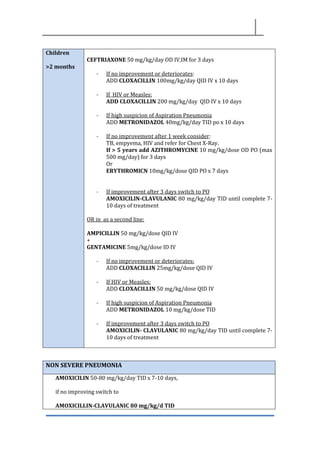
Children
>2 months
CEFTRIAXONE 50 mg/kg/day OD IV,IM for 3 days
- If no improvement or deteriorates:
ADD CLOXACILLIN 100mg/kg/day QID IV x 10 days
- If HIV or Measles:
ADD CLOXACILLIN 200 mg/kg/day QID IV x 10 days
- If high suspicion of Aspiration Pneumonia
ADD METRONIDAZOL 40mg/kg/day TID po x 10 days
- If no improvement after 1 week consider:
TB, empyema, HIV and refer for Chest X-Ray.
If > 5 years add AZITHROMYCINE 10 mg/kg/dose OD PO (max
500 mg/day) for 3 days
Or
ERYTHROMICN 10mg/kg/dose QID PO x 7 days
- If improvement after 3 days switch to PO
AMOXICILIN-CLAVULANIC 80 mg/kg/day TID until complete 7-
10 days of treatment
OR in as a second line:
AMPICILLIN 50 mg/kg/dose QID IV
+
GENTAMICINE 5mg/kg/dose ID IV
- If no improvement or deteriorates:
ADD CLOXACILLIN 25mg/kg/dose QID IV
- If HIV or Measles:
ADD CLOXACILLIN 50 mg/kg/dose QID IV
- If high suspicion of Aspiration Pneumonia
ADD METRONIDAZOL 10 mg/kg/dose TID
- If improvement after 3 days switch to PO
AMOXICILIN- CLAVULANIC 80 mg/kg/day TID until complete 7-
10 days of treatment
NON SEVERE PNEUMONIA
AMOXICILIN 50-80 mg/kg/day TID x 7-10 days,
if no improving switch to
AMOXICILLIN-CLAVULANIC 80 mg/kg/d TID
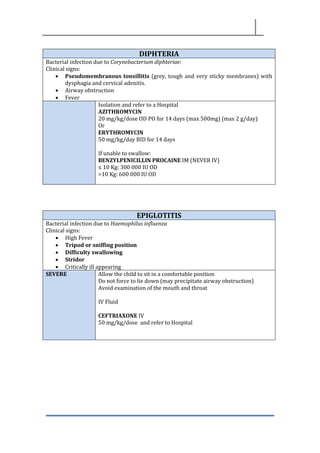
DIPHTERIA
Bacterial infection due to Corynebacterium diphteriae:
Clinical signs:
• Pseudomembranous tonsillitis (grey, tough and very sticky membranes) with
dysphagia and cervical adenitis.
• Airway obstruction
• Fever
Isolation and refer to a Hospital
AZITHROMYCIN
20 mg/kg/dose OD PO for 14 days (max 500mg) (max 2 g/day)
Or
ERYTHROMYCIN
50 mg/kg/day BID for 14 days
If unable to swallow:
BENZYLPENICILLIN PROCAINE IM (NEVER IV)
≤ 10 Kg: 300 000 IU OD
>10 Kg: 600 000 IU OD
EPIGLOTITIS
Bacterial infection due to Haemophilus influenza
Clinical signs:
• High Fever
• Tripod or sniffing position
• Difficulty swallowing
• Stridor
• Critically ill appearing
SEVERE Allow the child to sit in a comfortable position
Do not force to lie down (may precipitate airway obstruction)
Avoid examination of the mouth and throat
IV Fluid
CEFTRIAXONE IV
50 mg/kg/dose and refer to Hospital
ENT
EAR, NOSE AND THROAT PROBLEMS
ACUTE OTITIS MEDIA (AOM)
Acute inflammation of the middle ear due to viral or bacterial infection.
Clinical signs:
• Ear pain, otorrhea, bulging and erythema of tympanic membrane
• Otoscopy: bright red tympanic membrane
• Fever, rhinorrhea, cough…
• Complications:
o Chronic Supurative Otitis Media
o Meningitis
o Mastoiditis
o Brain Abscess
Treatment AMOXICILLIN PO
80-100mg/kg/day TID for 7-10 days
- If no improvement in 48 hours
Switch to AMOXICILLIN-CLAVULANIC PO
50 mg/kg/day TID for 7 days
Ear irrigation is contraindicated
Ear drops are not indicated
CHRONIC SUPPURATIVE OTITIS MEDIA (CSOM)
Is the result of an initial episode of AOM and is characterized by a persistent (>14 days)
discharge from the middle ear through a tympanic perforation.
Suspect TB: If child does not respond to Ciprofloxacin ear drop for more than 30 days
Treatment Dry the ear by wicking
GENTAMICIN EAR DROPS OR CIPROFLOXACIN ear drops
2-3 drops in the affected ear BID for 2-4 weeks
If not improving add
DEXAMETHASONE ear drops
2-3 drops in the affected ear BID for 2-4 weeks
No oral antibiotics
ACUTE OTITIS EXTERNA
Acute inflammation of the external ear canal due to bacterial or fungal infection
Treatment Dry the discharge and keep it clean
Gentamicin ear drops 2-3 drops
5-7 days.
MASTOIDITIS
Complication of AOM in which purulent material accumulates within the mastoid cavities.
Clinical signs
• Tenderness, erythema, swelling, fluctuance, mass and protrusion of the auricle.
• Fever
• Ear pain
Treatment To consider referral to a hospital
CEFTRIAXONE IV
75 mg/kg/dose OD for 7-10 days
- If no improvement in 48 h
ADD CLOXACILLIN IV
200 mg/kg/day QID
Switch to PO when there is improvement:
AMOXICILLIN-CLAVULANIC PO
80 mg/kg/day TID for 2-3 weeks
TONSILLITIS
Viral or bacterial infection due to Streptococcus group A
Acute inflammation of the tonsil and pharynges
Complication
• Acute Rheumatic Fever: due to due to Streptococcus group A
• Peritonsillar abscess
Bacterial signs
• Tender cervical node
• Headache
• Petechial on the palate
Viral signs
• Conjunctivitis
Treatment AMOXICILLIN PO
50 mg/kg/day BID for 10 days
PERITONSILLAR ABSCESS
Complication of tonsillitis
Fever
Intense pain
Hoarse voice
Trismus
Unilateral deviation of the uvula
Treatment Amoxi-clavulanate 60mg/kg/day TID and consider to
refer to Adama for drainage
OPHTALMOLOGICAL DISEASES
CONJUCTIVITIS
Acute inflammation of the conjunctiva due to bacterial or viral infection, allergy, or
irritation.
Clinical signs
• Redness of the eye
• Irritation
• Visual acuity is not affected
Bacterial conjunctivitis signs
• Purulent secretion
• Eyelids stuck together
• Unilateral infection
Viral conjunctivitis signs
• Watery (serous) secretion
• No itching
Allergic conjunctivitis
• Excessive secretion
• Eyelid oedema
• Intensive itching
In endemic areas turn off both upper eyelids to check for signs of trachoma.
Suspect keratitis: intense pain plus photophobia
Always check for foreign bodies.
Treatment Bacterial conjunctivitis
Clean eyes 4 to 6 times/day with cold boiled water
TETRACYCLINE EYE OINTMENT
BID 7 days in both eyes
Viral Conjunctivitis
Clean eyes 4 to 6 times/day with cold boiled water
Allergic conjunctivitis
Clean eyes 4 to 6 times/day with cold boiled water
Dexamethasone eye drops 1-2 drop BID x 3 days
or if rhinitis or sneezing→ CHLORPHENIRAMINE PO
1-2 years: 1mg BID
2-6 years. 1mg QID
6-12 years: 2mg QID
>12 years: 4mg QID
PERIORBITAL AND ORBITAL CELLULITIS
Periorbital cellulitis: is a bacterial infection of the eyelids.
Clinical signs:
• Acute eyelid erythema and oedema. The oedema has a violaceous hue if
secondary to H.influenzae.
Orbital cellulitis: serious infection involving the contents of the orbit that may lead to loss
of vision or a brain abscess.
Clinical signs:
• Pain with eye movements
• Ophthalmoplegia (paralysis of eye movements): often with diplopia (double
vision)
• Protrusion of the eye
• High fever, systemic signs
• Acute eyelid erythema and oedema. The oedema has a violaceous hue if
secondary to H.influenzae.
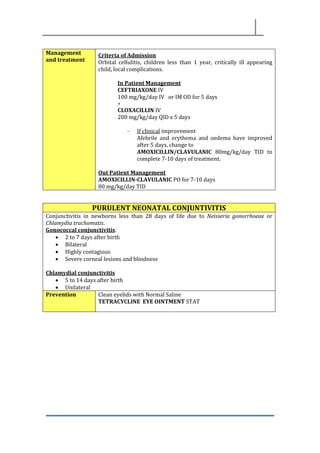
Management
and treatment
Criteria of Admission
Orbital cellulitis, children less than 1 year, critically ill appearing
child, local complications.
In Patient Management
CEFTRIAXONE IV
100 mg/kg/day IV or IM OD for 5 days
+
CLOXACILLIN IV
200 mg/kg/day QID x 5 days
- If clinical improvement
Afebrile and erythema and oedema have improved
after 5 days, change to
AMOXICILLIN/CLAVULANIC 80mg/kg/day TID to
complete 7-10 days of treatment.
Out Patient Management
AMOXICILLIN-CLAVULANIC PO for 7-10 days
80 mg/kg/day TID
PURULENT NEONATAL CONJUNTIVITIS
Conjunctivitis in newborns less than 28 days of life due to Neisseria gonorrhoeae or
Chlamydia trachomatis.
Gonococcal conjunctivitis:
• 2 to 7 days after birth
• Bilateral
• Highly contagious
• Severe corneal lesions and blindness
Chlamydial conjunctivitis
• 5 to 14 days after birth
• Unilateral
Prevention Clean eyelids with Normal Saline
TETRACYCLINE EYE OINTMENT STAT
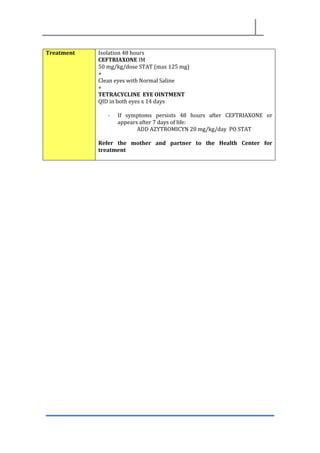
Treatment Isolation 48 hours
CEFTRIAXONE IM
50 mg/kg/dose STAT (max 125 mg)
+
Clean eyes with Normal Saline
+
TETRACYCLINE EYE OINTMENT
QID in both eyes x 14 days
- If symptoms persists 48 hours after CEFTRIAXONE or
appears after 7 days of life:
ADD AZYTROMICYN 20 mg/kg/day PO STAT
Refer the mother and partner to the Health Center for
treatment
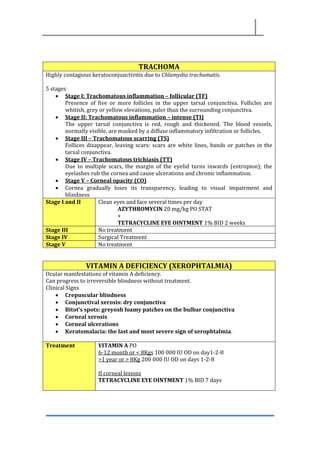
TRACHOMA
Highly contagious keratoconjunctivitis due to Chlamydia trachomatis.
5 stages
• Stage I: Trachomatous inflammation – follicular (TF)
Presence of five or more follicles in the upper tarsal conjunctiva. Follicles are
whitish, grey or yellow elevations, paler than the surrounding conjunctiva.
• Stage II: Trachomatous inflammation – intense (TI)
The upper tarsal conjunctiva is red, rough and thickened. The blood vessels,
normally visible, are masked by a diffuse inflammatory infiltration or follicles.
• Stage III – Trachomatous scarring (TS)
Follices disappear, leaving scars: scars are white lines, bands or patches in the
tarsal conjunctiva.
• Stage IV – Trachomatous trichiasis (TT)
Due to multiple scars, the margin of the eyelid turns inwards (entropion); the
eyelashes rub the cornea and cause ulcerations and chronic inflammation.
• Stage V – Corneal opacity (CO)
• Cornea gradually loses its transparency, leading to visual impairment and
blindness
Stage I and II Clean eyes and face several times per day
AZYTHROMYCIN 20 mg/kg PO STAT
+
TETRACYCLINE EYE OINTMENT 1% BID 2 weeks
Stage III No treatment
Stage IV Surgical Treatment
Stage V No treatment
VITAMIN A DEFICIENCY (XEROPHTALMIA)
Ocular manifestations of vitamin A deficiency.
Can progress to irreversible blindness without treatment.
Clinical Signs
• Crepuscular blindness
• Conjunctival xerosis: dry conjunctiva
• Bitot’s spots: greyosh foamy patches on the bulbar conjunctiva
• Corneal xerosis
• Corneal ulcerations
• Keratomalacia: the last and most severe sign of xerophtalmia.
Treatment VITAMIN A PO
6-12 month or < 8Kgs 100 000 IU OD on day1-2-8
>1 year or > 8Kg 200 000 IU OD on days 1-2-8
If corneal lesions
TETRACYCLINE EYE OINTMENT 1% BID 7 days
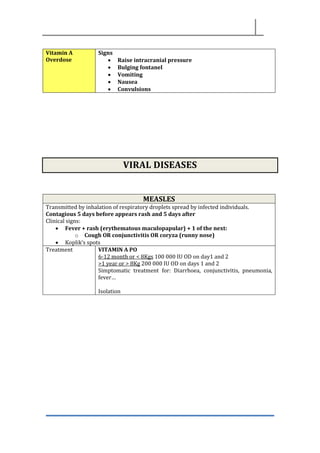
Vitamin A
Overdose
Signs
• Raise intracranial pressure
• Bulging fontanel
• Vomiting
• Nausea
• Convulsions
VIRAL DISEASES
MEASLES
Transmitted by inhalation of respiratory droplets spread by infected individuals.
Contagious 5 days before appears rash and 5 days after
Clinical signs:
• Fever + rash (erythematous maculopapular) + 1 of the next:
o Cough OR conjunctivitis OR coryza (runny nose)
• Koplik’s spots
Treatment VITAMIN A PO
6-12 month or < 8Kgs 100 000 IU OD on day1 and 2
>1 year or > 8Kg 200 000 IU OD on days 1 and 2
Simptomatic treatment for: Diarrhoea, conjunctivitis, pneumonia,
fever…
Isolation
BACTERIAL DISEASES
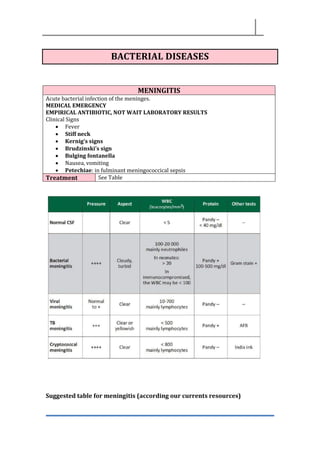
MENINGITIS
Acute bacterial infection of the meninges.
MEDICAL EMERGENCY
EMPIRICAL ANTIBIOTIC, NOT WAIT LABORATORY RESULTS
Clinical Signs
• Fever
• Stiff neck
• Kernig’s signs
• Brudzinski’s sign
• Bulging fontanella
• Nausea, vomiting
• Petechiae: in fulminant meningococcical sepsis
Treatment See Table
Suggested table for meningitis (according our currents resources)
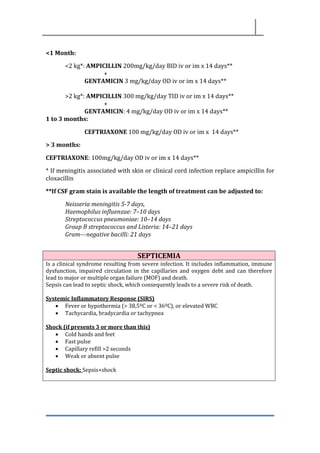
<1 Month:
<2 kg*: AMPICILLIN 200mg/kg/day BID iv or im x 14 days**
+
GENTAMICIN 3 mg/kg/day OD iv or im x 14 days**
>2 kg*: AMPICILLIN 300 mg/kg/day TID iv or im x 14 days**
+
GENTAMICIN: 4 mg/kg/day OD iv or im x 14 days**
1 to 3 months:
CEFTRIAXONE 100 mg/kg/day OD iv or im x 14 days**
> 3 months:
CEFTRIAXONE: 100mg/kg/day OD iv or im x 14 days**
* If meningitis associated with skin or clinical cord infection replace ampicillin for
cloxacillin
**If CSF gram stain is available the length of treatment can be adjusted to:
Neisseria meningitis 5-7 days,
Haemophilus influenzae: 7–10 days
Streptococcus pneumoniae: 10–14 days
Group B streptococcus and Listeria: 14–21 days
Gram--‐negative bacilli: 21 days
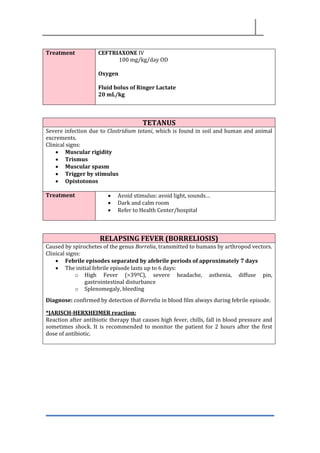
SEPTICEMIA
Is a clinical syndrome resulting from severe infection. It includes inflammation, immune
dysfunction, impaired circulation in the capillaries and oxygen debt and can therefore
lead to major or multiple organ failure (MOF) and death.
Sepsis can lead to septic shock, which consequently leads to a severe risk of death.
Systemic Inflammatory Response (SIRS)
• Fever or hypothermia (> 38,5ºC or < 36ºC), or elevated WBC
• Tachycardia, bradycardia or tachypnea
Shock (if presents 3 or more than this)
• Cold hands and feet
• Fast pulse
• Capillary refill >2 seconds
• Weak or absent pulse
Septic shock: Sepsis+shock
Treatment CEFTRIAXONE IV
100 mg/kg/day OD
Oxygen
Fluid bolus of Ringer Lactate
20 mL/kg
TETANUS
Severe infection due to Clostridium tetani, which is found in soil and human and animal
excrements.
Clinical signs:
• Muscular rigidity
• Trismus
• Muscular spasm
• Trigger by stimulus
• Opistotonos
Treatment • Avoid stimulus: avoid light, sounds…
• Dark and calm room
• Refer to Health Center/hospital
RELAPSING FEVER (BORRELIOSIS)
Caused by spirochetes of the genus Borrelia, transmitted to humans by arthropod vectors.
Clinical signs:
• Febrile episodes separated by afebrile periods of approximately 7 days
• The initial febrile episode lasts up to 6 days:
o High Fever (>39ºC), severe headache, asthenia, diffuse pin,
gastrointestinal disturbance
o Splenomegaly, bleeding
Diagnose: confirmed by detection of Borrelia in blood film always during febrile episode.
*JARISCH-HERXHEIMER reaction:
Reaction after antibiotic therapy that causes high fever, chills, fall in blood pressure and
sometimes shock. It is recommended to monitor the patient for 2 hours after the first
dose of antibiotic.
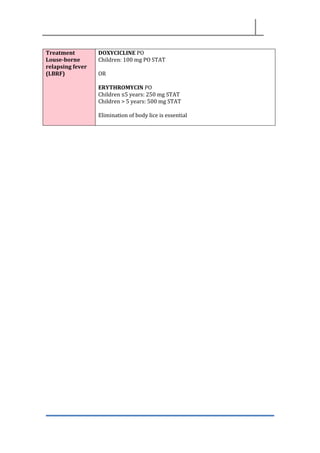
Treatment
Louse-borne
relapsing fever
(LBRF)
DOXYCICLINE PO
Children: 100 mg PO STAT
OR
ERYTHROMYCIN PO
Children ≤5 years: 250 mg STAT
Children > 5 years: 500 mg STAT
Elimination of body lice is essential
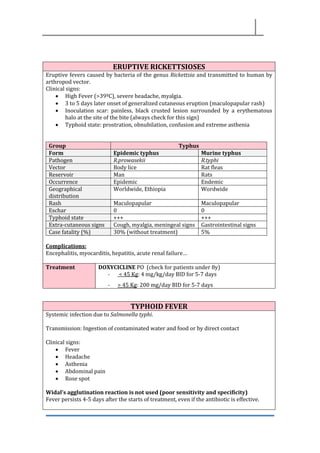
ERUPTIVE RICKETTSIOSES
Eruptive fevers caused by bacteria of the genus Rickettsia and transmitted to human by
arthropod vector.
Clinical signs:
• High Fever (>39ºC), severe headache, myalgia.
• 3 to 5 days later onset of generalized cutaneous eruption (maculopapular rash)
• Inoculation scar: painless, black crusted lesion surrounded by a erythematous
halo at the site of the bite (always check for this sign)
• Typhoid state: prostration, obnubilation, confusion and extreme asthenia
Group Typhus
Form Epidemic typhus Murine typhus
Pathogen R.prowasekii R.typhi
Vector Body lice Rat fleas
Reservoir Man Rats
Occurrence Epidemic Endemic
Geographical
distribution
Worldwide, Ethiopia Wordwide
Rash Maculopapular Maculopapular
Eschar 0 0
Typhoid state +++ +++
Extra-cutaneous signs Cough, myalgia, meningeal signs Gastrointestinal signs
Case fatality (%) 30% (without treatment) 5%
Complications:
Encephalitis, myocarditis, hepatitis, acute renal failure…
Treatment DOXYCICLINE PO (check for patients under 8y)
- < 45 Kg: 4 mg/kg/day BID for 5-7 days
- > 45 Kg: 200 mg/day BID for 5-7 days
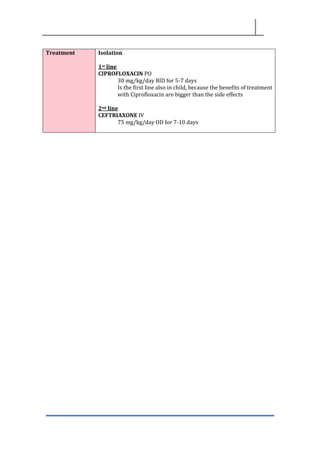
TYPHOID FEVER
Systemic infection due to Salmonella typhi.
Transmission: Ingestion of contaminated water and food or by direct contact
Clinical signs:
• Fever
• Headache
• Asthenia
• Abdominal pain
• Rose spot
Widal’s agglutination reaction is not used (poor sensitivity and specificity)
Fever persists 4-5 days after the starts of treatment, even if the antibiotic is effective.
Treatment Isolation
1st line
CIPROFLOXACIN PO
30 mg/kg/day BID for 5-7 days
Is the first line also in child, because the benefits of treatment
with Ciprofloxacin are bigger than the side effects
2nd line
CEFTRIAXONE IV
75 mg/kg/day OD for 7-10 days
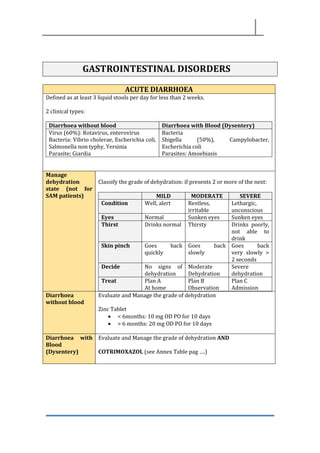
GASTROINTESTINAL DISORDERS
ACUTE DIARRHOEA
Defined as at least 3 liquid stools per day for less than 2 weeks.
2 clinical types:
Diarrhoea without blood Diarrhoea with Blood (Dysentery)
Virus (60%): Rotavirus, enterovirus
Bacteria: Vibrio cholerae, Escherichia coli,
Salmonella non typhy, Yersinia
Parasite; Giardia
Bacteria
Shigella (50%), Campylobacter,
Escherichia coli
Parasites: Amoebiasis
Manage
dehydration
state (not for
SAM patients)
Classify the grade of dehydration: if presents 2 or more of the next:
MILD MODERATE SEVERE
Condition Well, alert Restless,
irritable
Lethargic,
unconscious
Eyes Normal Sunken eyes Sunken eyes
Thirst Drinks normal Thirsty Drinks poorly,
not able to
drink
Skin pinch Goes back
quickly
Goes back
slowly
Goes back
very slowly >
2 seconds
Decide No signs of
dehydration
Moderate
Dehydration
Severe
dehydration
Treat Plan A
At home
Plan B
Observation
Plan C
Admission
Diarrhoea
without blood
Evaluate and Manage the grade of dehydration
Zinc Tablet
• < 6months: 10 mg OD PO for 10 days
• > 6 months: 20 mg OD PO for 10 days
Diarrhoea with
Blood
(Dysentery)
Evaluate and Manage the grade of dehydration AND
COTRIMOXAZOL (see Annex Table pag ….)
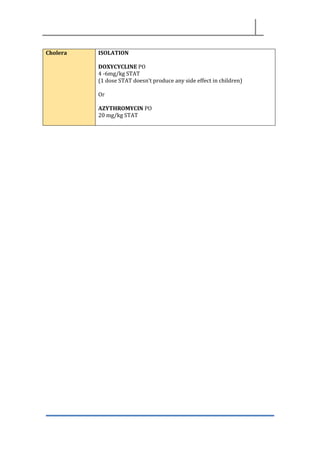
Cholera ISOLATION
DOXYCYCLINE PO
4 -6mg/kg STAT
(1 dose STAT doesn’t produce any side effect in children)
Or
AZYTHROMYCIN PO
20 mg/kg STAT
PROTOZOAN INFECTIONS
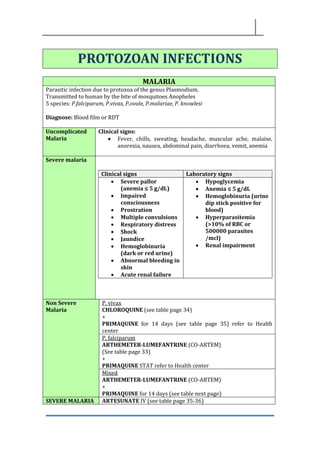
MALARIA
Parasitic infection due to protozoa of the genus Plasmodium.
Transmitted to human by the bite of mosquitoes Anopheles
5 species: P.falciparum, P.vivax, P.ovale, P.malariae, P. knowlesi
Diagnose: Blood film or RDT
Uncomplicated
Malaria
Clinical signs:
• Fever, chills, sweating, headache, muscular ache, malaise,
anorexia, nausea, abdominal pain, diarrhoea, vomit, anemia
Severe malaria
Clinical signs Laboratory signs
• Severe pallor
(anemia ≤ 5 g/dL)
• Impaired
consciousness
• Prostration
• Multiple convulsions
• Respiratory distress
• Shock
• Jaundice
• Hemoglobinuria
(dark or red urine)
• Abnormal bleeding in
skin
• Acute renal failure
• Hypoglycemia
• Anemia ≤ 5 g/dL
• Hemoglobinuria (urine
dip stick positive for
blood)
• Hyperparasitemia
(>10% of RBC or
500000 parasites
/mcl)
• Renal impairment
Non Severe
Malaria
P. vivax
CHLOROQUINE (see table page 34)
+
PRIMAQUINE for 14 days (see table page 35) refer to Health
center
P. falciparum
ARTHEMETER-LUMEFANTRINE (CO-ARTEM)
(See table page 33)
+
PRIMAQUINE STAT refer to Health center
Mixed
ARTHEMETER-LUMEFANTRINE (CO-ARTEM)
+
PRIMAQUINE for 14 days (see table next page)
SEVERE MALARIA ARTESUNATE IV (see table page 35-36)
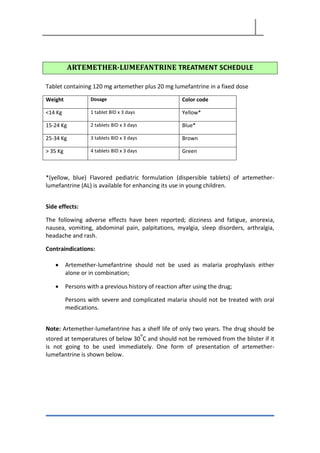
ARTEMETHER-LUMEFANTRINE TREATMENT SCHEDULE
Tablet containing 120 mg artemether plus 20 mg lumefantrine in a fixed dose
Weight Dosage Color code
<14 Kg 1 tablet BID x 3 days Yellow*
15-24 Kg 2 tablets BID x 3 days Blue*
25-34 Kg 3 tablets BID x 3 days Brown
> 35 Kg 4 tablets BID x 3 days Green
*(yellow, blue) Flavored pediatric formulation (dispersible tablets) of artemether-
lumefantrine (AL) is available for enhancing its use in young children.
Side effects:
The following adverse effects have been reported; dizziness and fatigue, anorexia,
nausea, vomiting, abdominal pain, palpitations, myalgia, sleep disorders, arthralgia,
headache and rash.
Contraindications:
• Artemether-lumefantrine should not be used as malaria prophylaxis either
alone or in combination;
• Persons with a previous history of reaction after using the drug;
Persons with severe and complicated malaria should not be treated with oral
medications.
Note: Artemether-lumefantrine has a shelf life of only two years. The drug should be
stored at temperatures of below 30
o
C and should not be removed from the blister if it
is not going to be used immediately. One form of presentation of artemether-
lumefantrine is shown below.
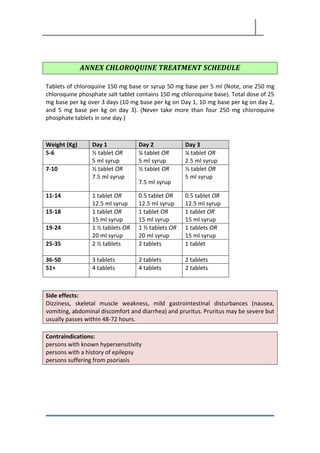
ANNEX CHLOROQUINE TREATMENT SCHEDULE
Tablets of chloroquine 150 mg base or syrup 50 mg base per 5 ml (Note, one 250 mg
chloroquine phosphate salt tablet contains 150 mg chloroquine base). Total dose of 25
mg base per kg over 3 days (10 mg base per kg on Day 1, 10 mg base per kg on day 2,
and 5 mg base per kg on day 3). (Never take more than four 250 mg chloroquine
phosphate tablets in one day.)
Weight (Kg) Day 1 Day 2 Day 3
5-6 ½ tablet OR
5 ml syrup
¼ tablet OR
5 ml syrup
¼ tablet OR
2.5 ml syrup
7-10 ½ tablet OR
7.5 ml syrup
½ tablet OR
7.5 ml syrup
½ tablet OR
5 ml syrup
11-14 1 tablet OR
12.5 ml syrup
0.5 tablet OR
12.5 ml syrup
0.5 tablet OR
12.5 ml syrup
15-18 1 tablet OR
15 ml syrup
1 tablet OR
15 ml syrup
1 tablet OR
15 ml syrup
19-24 1 ½ tablets OR
20 ml syrup
1 ½ tablets OR
20 ml syrup
1 tablets OR
15 ml syrup
25-35 2 ½ tablets 2 tablets 1 tablet
36-50 3 tablets 2 tablets 2 tablets
51+ 4 tablets 4 tablets 2 tablets
Side effects:
Dizziness, skeletal muscle weakness, mild gastrointestinal disturbances (nausea,
vomiting, abdominal discomfort and diarrhea) and pruritus. Pruritus may be severe but
usually passes within 48-72 hours.
Contraindications:
persons with known hypersensitivity
persons with a history of epilepsy
persons suffering from psoriasis
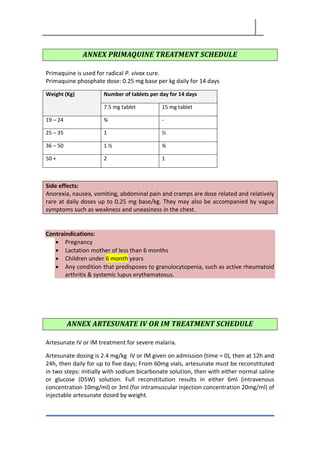
ANNEX PRIMAQUINE TREATMENT SCHEDULE
Primaquine is used for radical P. vivax cure.
Primaquine phosphate dose: 0.25 mg base per kg daily for 14 days
Weight (Kg) Number of tablets per day for 14 days
7.5 mg tablet 15 mg tablet
19 – 24 ¾ -
25 – 35 1 ½
36 – 50 1 ½ ¾
50 + 2 1
Side effects:
Anorexia, nausea, vomiting, abdominal pain and cramps are dose related and relatively
rare at daily doses up to 0.25 mg base/kg. They may also be accompanied by vague
symptoms such as weakness and uneasiness in the chest.
Contraindications:
• Pregnancy
• Lactation mother of less than 6 months
• Children under 6 month years
• Any condition that predisposes to granulocytopenia, such as active rheumatoid
arthritis & systemic lupus erythematosus.
ANNEX ARTESUNATE IV OR IM TREATMENT SCHEDULE
Artesunate IV or IM treatment for severe malaria.
Artesunate dosing is 2.4 mg/kg IV or IM given on admission (time = 0), then at 12h and
24h, then daily for up to five days; From 60mg vials, artesunate must be reconstituted
in two steps: initially with sodium bicarbonate solution, then with either normal saline
or glucose (D5W) solution. Full reconstitution results in either 6ml (intravenous
concentration 10mg/ml) or 3ml (for intramuscular injection concentration 20mg/ml) of
injectable artesunate dosed by weight.
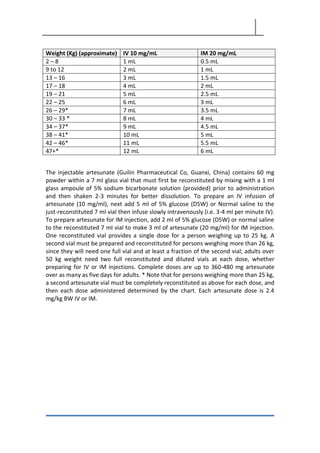
Weight (Kg) (approximate) IV 10 mg/mL IM 20 mg/mL
2 – 8 1 mL 0.5 mL
9 to 12 2 mL 1 mL
13 – 16 3 mL 1.5 mL
17 – 18 4 mL 2 mL
19 – 21 5 mL 2.5 mL
22 – 25 6 mL 3 mL
26 – 29* 7 mL 3.5 mL
30 – 33 * 8 mL 4 mL
34 – 37* 9 mL 4.5 mL
38 – 41* 10 mL 5 mL
42 – 46* 11 mL 5.5 mL
47+* 12 mL 6 mL
The injectable artesunate (Guilin Pharmaceutical Co, Guanxi, China) contains 60 mg
powder within a 7 ml glass vial that must first be reconstituted by mixing with a 1 ml
glass ampoule of 5% sodium bicarbonate solution (provided) prior to administration
and then shaken 2-3 minutes for better dissolution. To prepare an IV infusion of
artesunate (10 mg/ml), next add 5 ml of 5% glucose (D5W) or Normal saline to the
just-reconstituted 7 ml vial then infuse slowly intravenously (i.e. 3-4 ml per minute IV).
To prepare artesunate for IM injection, add 2 ml of 5% glucose (D5W) or normal saline
to the reconstituted 7 ml vial to make 3 ml of artesunate (20 mg/ml) for IM injection.
One reconstituted vial provides a single dose for a person weighing up to 25 kg. A
second vial must be prepared and reconstituted for persons weighing more than 26 kg,
since they will need one full vial and at least a fraction of the second vial; adults over
50 kg weight need two full reconstituted and diluted vials at each dose, whether
preparing for IV or IM injections. Complete doses are up to 360-480 mg artesunate
over as many as five days for adults. * Note that for persons weighing more than 25 kg,
a second artesunate vial must be completely reconstituted as above for each dose, and
then each dose administered determined by the chart. Each artesunate dose is 2.4
mg/kg BW IV or IM.
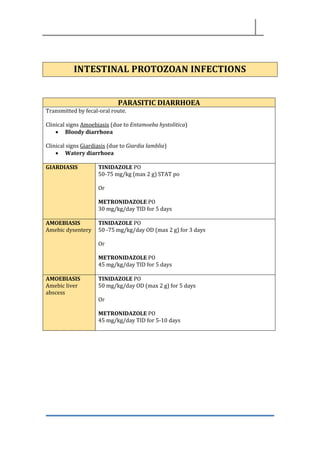
INTESTINAL PROTOZOAN INFECTIONS
PARASITIC DIARRHOEA
Transmitted by fecal-oral route.
Clinical signs Amoebiasis (due to Entamoeba hystolitica)
• Bloody diarrhoea
Clinical signs Giardiasis (due to Giardia lamblia)
• Watery diarrhoea
GIARDIASIS TINIDAZOLE PO
50-75 mg/kg (max 2 g) STAT po
Or
METRONIDAZOLE PO
30 mg/kg/day TID for 5 days
AMOEBIASIS
Amebic dysentery
TINIDAZOLE PO
50 -75 mg/kg/day OD (max 2 g) for 3 days
Or
METRONIDAZOLE PO
45 mg/kg/day TID for 5 days
AMOEBIASIS
Amebic liver
abscess
TINIDAZOLE PO
50 mg/kg/day OD (max 2 g) for 5 days
Or
METRONIDAZOLE PO
45 mg/kg/day TID for 5-10 days
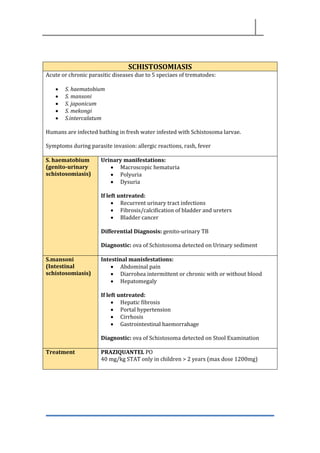
SCHISTOSOMIASIS
Acute or chronic parasitic diseases due to 5 speciaes of trematodes:
• S. haematobium
• S. mansoni
• S. japonicum
• S. mekongi
• S.intercalatum
Humans are infected bathing in fresh water infested with Schistosoma larvae.
Symptoms during parasite invasion: allergic reactions, rash, fever
S. haematobium
(genito-urinary
schistosomiasis)
Urinary manifestations:
• Macroscopic hematuria
• Polyuria
• Dysuria
If left untreated:
• Recurrent urinary tract infections
• Fibrosis/calcification of bladder and ureters
• Bladder cancer
Differential Diagnosis: genito-urinary TB
Diagnostic: ova of Schistosoma detected on Urinary sediment
S.mansoni
(Intestinal
schistosomiasis)
Intestinal manisfestations:
• Abdominal pain
• Diarrohea intermittent or chronic with or without blood
• Hepatomegaly
If left untreated:
• Hepatic fibrosis
• Portal hypertension
• Cirrhosis
• Gastrointestinal haemorrahage
Diagnostic: ova of Schistosoma detected on Stool Examination
Treatment PRAZIQUANTEL PO
40 mg/kg STAT only in children > 2 years (max dose 1200mg)
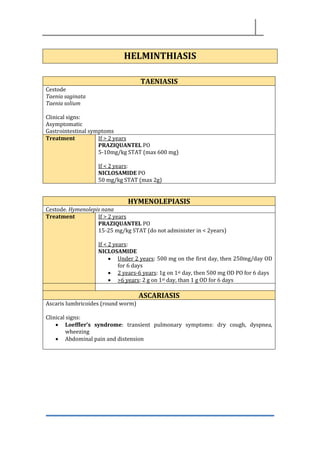
HELMINTHIASIS
TAENIASIS
Cestode
Taenia saginata
Taenia solium
Clinical signs:
Asymptomatic
Gastrointestinal symptoms
Treatment If > 2 years
PRAZIQUANTEL PO
5-10mg/kg STAT (max 600 mg)
If < 2 years:
NICLOSAMIDE PO
50 mg/kg STAT (max 2g)
HYMENOLEPIASIS
Cestode. Hymenolepis nana
Treatment If > 2 years
PRAZIQUANTEL PO
15-25 mg/kg STAT (do not administer in < 2years)
If < 2 years:
NICLOSAMIDE
• Under 2 years: 500 mg on the first day, then 250mg/day OD
for 6 days
• 2 years-6 years: 1g on 1st day, then 500 mg OD PO for 6 days
• >6 years: 2 g on 1st day, than 1 g OD for 6 days
ASCARIASIS
Ascaris lumbricoides (round worm)
Clinical signs:
• Loeffler’s syndrome: transient pulmonary symptoms: dry cough, dyspnea,
wheezing
• Abdominal pain and distension
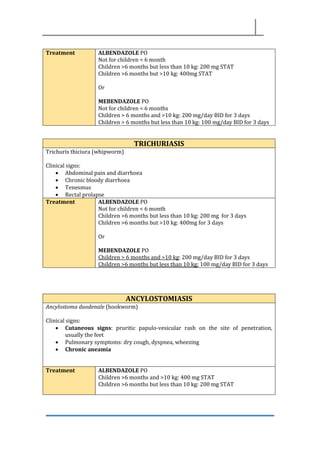
Treatment ALBENDAZOLE PO
Not for children < 6 month
Children >6 months but less than 10 kg: 200 mg STAT
Children >6 months but >10 kg: 400mg STAT
Or
MEBENDAZOLE PO
Not for children < 6 months
Children > 6 months and >10 kg: 200 mg/day BID for 3 days
Children > 6 months but less than 10 kg: 100 mg/day BID for 3 days
TRICHURIASIS
Trichuris thiciura (whipworm)
Clinical signs:
• Abdominal pain and diarrhoea
• Chronic bloody diarrhoea
• Tenesmus
• Rectal prolapse
Treatment ALBENDAZOLE PO
Not for children < 6 month
Children >6 months but less than 10 kg: 200 mg for 3 days
Children >6 months but >10 kg: 400mg for 3 days
Or
MEBENDAZOLE PO
Children > 6 months and >10 kg: 200 mg/day BID for 3 days
Children >6 months but less than 10 kg: 100 mg/day BID for 3 days
ANCYLOSTOMIASIS
Ancylostoma duodenale (hookworm)
Clinical signs:
• Cutaneous signs: pruritic papulo-vesicular rash on the site of penetration,
usually the feet
• Pulmonary symptoms: dry cough, dyspnea, wheezing
• Chronic aneamia
Treatment ALBENDAZOLE PO
Children >6 months and >10 kg: 400 mg STAT
Children >6 months but less than 10 kg: 200 mg STAT
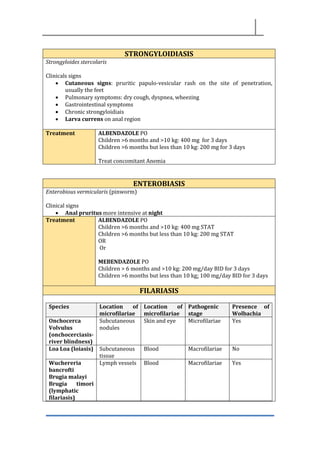
STRONGYLOIDIASIS
Strongyloides stercolaris
Clinicals signs
• Cutaneous signs: pruritic papulo-vesicular rash on the site of penetration,
usually the feet
• Pulmonary symptoms: dry cough, dyspnea, wheezing
• Gastrointestinal symptoms
• Chronic strongyloidiais
• Larva currens on anal region
Treatment ALBENDAZOLE PO
Children >6 months and >10 kg: 400 mg for 3 days
Children >6 months but less than 10 kg: 200 mg for 3 days
Treat concomitant Anemia
ENTEROBIASIS
Enterobious vermicularis (pinworm)
Clinical signs
• Anal pruritus more intensive at night
Treatment ALBENDAZOLE PO
Children >6 months and >10 kg: 400 mg STAT
Children >6 months but less than 10 kg: 200 mg STAT
OR
Or
MEBENDAZOLE PO
Children > 6 months and >10 kg: 200 mg/day BID for 3 days
Children >6 months but less than 10 kg: 100 mg/day BID for 3 days
FILARIASIS
Species Location of
microfilariae
Location of
microfilariae
Pathogenic
stage
Presence of
Wolbachia
Onchocerca
Volvulus
(onchocerciasis-
river blindness)
Subcutaneous
nodules
Skin and eye Microfilariae Yes
Loa Loa (loiasis) Subcutaneous
tissue
Blood Macrofilariae No
Wuchereria
bancrofti
Brugia malayi
Brugia timori
(lymphatic
filariasis)
Lymph vessels Blood Macrofilariae Yes
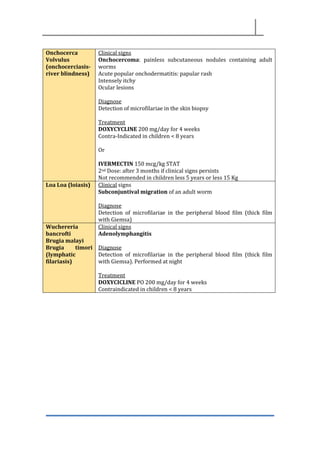
Onchocerca
Volvulus
(onchocerciasis-
river blindness)
Clinical signs
Onchocercoma: painless subcutaneous nodules containing adult
worms
Acute popular onchodermatitis: papular rash
Intensely itchy
Ocular lesions
Diagnose
Detection of microfilariae in the skin biopsy
Treatment
DOXYCYCLINE 200 mg/day for 4 weeks
Contra-Indicated in children < 8 years
Or
IVERMECTIN 150 mcg/kg STAT
2nd Dose: after 3 months if clinical signs persists
Not recommended in children less 5 years or less 15 Kg
Loa Loa (loiasis) Clinical signs
Subconjuntival migration of an adult worm
Diagnose
Detection of microfilariae in the peripheral blood film (thick film
with Giemsa)
Wuchereria
bancrofti
Brugia malayi
Brugia timori
(lymphatic
filariasis)
Clinical signs
Adenolymphangitis
Diagnose
Detection of microfilariae in the peripheral blood film (thick film
with Giemsa). Performed at night
Treatment
DOXYCICLINE PO 200 mg/day for 4 weeks
Contraindicated in children < 8 years
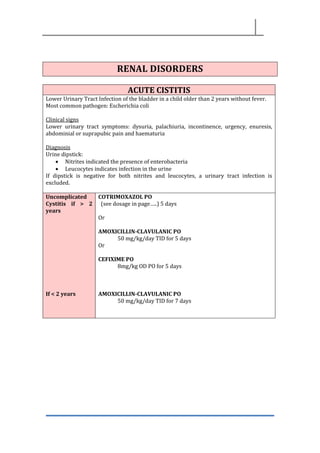
RENAL DISORDERS
ACUTE CISTITIS
Lower Urinary Tract Infection of the bladder in a child older than 2 years without fever.
Most common pathogen: Escherichia coli
Clinical signs
Lower urinary tract symptoms: dysuria, palachiuria, incontinence, urgency, enuresis,
abdominial or suprapubic pain and haematuria
Diagnosis
Urine dipstick:
• Nitrites indicated the presence of enterobacteria
• Leucocytes indicates infection in the urine
If dipstick is negative for both nitrites and leucocytes, a urinary tract infection is
excluded.
Uncomplicated
Cystitis if > 2
years
If < 2 years
COTRIMOXAZOL PO
(see dosage in page…..) 5 days
Or
AMOXICILLIN-CLAVULANIC PO
50 mg/kg/day TID for 5 days
Or
CEFIXIME PO
8mg/kg OD PO for 5 days
AMOXICILLIN-CLAVULANIC PO
50 mg/kg/day TID for 7 days
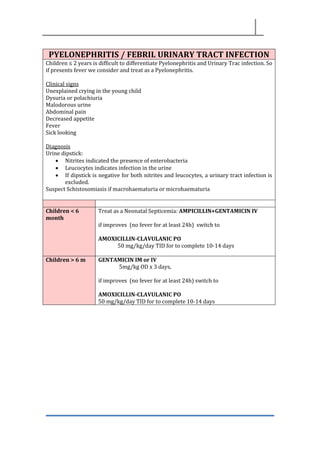
PYELONEPHRITIS / FEBRIL URINARY TRACT INFECTION
Children ≤ 2 years is difficult to differentiate Pyelonephritis and Urinary Trac infection. So
if presents fever we consider and treat as a Pyelonephritis.
Clinical signs
Unexplained crying in the young child
Dysuria or polachiuria
Malodorous urine
Abdominal pain
Decreased appetite
Fever
Sick looking
Diagnosis
Urine dipstick:
• Nitrites indicated the presence of enterobacteria
• Leucocytes indicates infection in the urine
• If dipstick is negative for both nitrites and leucocytes, a urinary tract infection is
excluded.
Suspect Schistosomiasis if macrohaematuria or microhaematuria
Children < 6
month
Treat as a Neonatal Septicemia: AMPICILLIN+GENTAMICIN IV
if improves (no fever for at least 24h) switch to
AMOXICILLIN-CLAVULANIC PO
50 mg/kg/day TID for to complete 10-14 days
Children > 6 m GENTAMICIN IM or IV
5mg/kg OD x 3 days,
if improves (no fever for at least 24h) switch to
AMOXICILLIN-CLAVULANIC PO
50 mg/kg/day TID for to complete 10-14 days
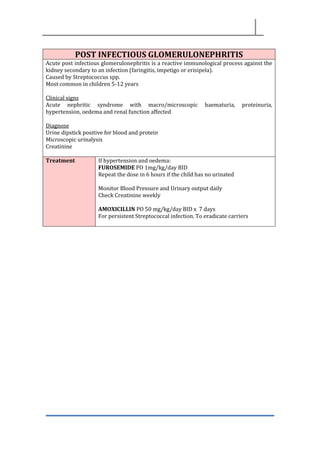
POST INFECTIOUS GLOMERULONEPHRITIS
Acute post infectious glomerulonephritis is a reactive immunological process against the
kidney secondary to an infection (faringitis, impetigo or erisipela).
Caused by Streptococcus spp.
Most common in children 5-12 years
Clinical signs
Acute nephritic syndrome with macro/microscopic haematuria, proteinuria,
hypertension, oedema and renal function affected
Diagnose
Urine dipstick positive for blood and protein
Microscopic urinalysis
Creatinine
Treatment If hypertension and oedema:
FUROSEMIDE PO 1mg/kg/day BID
Repeat the dose in 6 hours if the child has no urinated
Monitor Blood Pressure and Urinary output daily
Check Creatinine weekly
AMOXICILLIN PO 50 mg/kg/day BID x 7 days
For persistent Streptococcal infection. To eradicate carriers
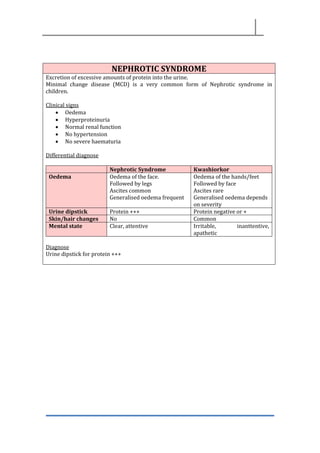
NEPHROTIC SYNDROME
Excretion of excessive amounts of protein into the urine.
Minimal change disease (MCD) is a very common form of Nephrotic syndrome in
children.
Clinical signs
• Oedema
• Hyperproteinuria
• Normal renal function
• No hypertension
• No severe haematuria
Differential diagnose
Nephrotic Syndrome Kwashiorkor
Oedema Oedema of the face.
Followed by legs
Ascites common
Generalised oedema frequent
Oedema of the hands/feet
Followed by face
Ascites rare
Generalised oedema depends
on severity
Urine dipstick Protein +++ Protein negative or +
Skin/hair changes No Common
Mental state Clear, attentive Irritable, inanttentive,
apathetic
Diagnose
Urine dipstick for protein +++
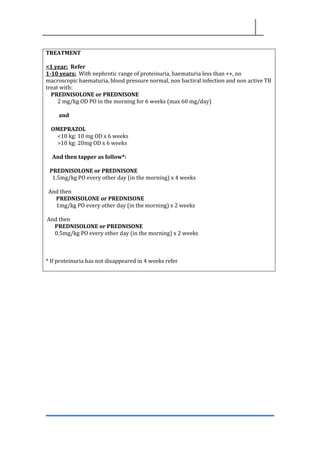
TREATMENT
<1 year: Refer
1-10 years: With nephrotic range of proteinuria, haematuria less than ++, no
macroscopic haematuria, blood pressure normal, non bactiral infection and non active TB
treat with:
PREDNISOLONE or PREDNISONE
2 mg/kg OD PO in the morning for 6 weeks (max 60 mg/day)
and
OMEPRAZOL
<10 kg: 10 mg OD x 6 weeks
>10 kg: 20mg OD x 6 weeks
And then tapper as follow*:
PREDNISOLONE or PREDNISONE
1.5mg/kg PO every other day (in the morning) x 4 weeks
And then
PREDNISOLONE or PREDNISONE
1mg/kg PO every other day (in the morning) x 2 weeks
And then
PREDNISOLONE or PREDNISONE
0.5mg/kg PO every other day (in the morning) x 2 weeks
* If proteinuria has not disappeared in 4 weeks refer
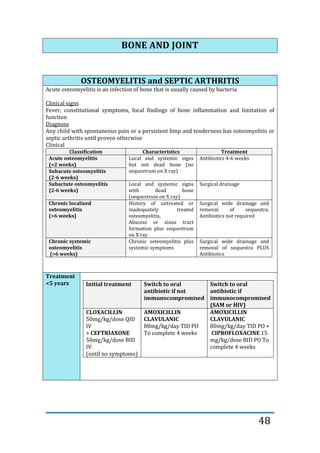
48
BONE AND JOINT
OSTEOMYELITIS and SEPTIC ARTHRITIS
Acute osteomyelitis is an infection of bone that is usually caused by bacteria
Clinical signs
Fever, constitutional symptoms, focal findings of bone inflammation and limitation of
function
Diagnose
Any child with spontaneous pain or a persistent limp and tenderness has osteomyelitis or
septic arthritis until proven otherwise
Clinical
Classification Characteristics Treatment
Acute osteomyelitis
(<2 weeks)
Local and systemic signs
but not dead bone (no
sequestrum on X ray)
Antibiotics 4-6 weeks
Subacute osteomyelitis
(2-6 weeks)
Subactute osteomyelitis
(2-6 weeks)
Local and systemic signs
with dead bone
(sequestrum on X ray)
Surgical drainage
Chronic localized
osteomyelitis
(>6 weeks)
History of untreated or
inadequately treated
osteomyelitis,
Abscess or sinus tract
formation plus sequestrum
on X ray
Surgical wide drainage and
removal of sequestra.
Antibiotics not required
Chronic systemic
osteomyelitis
(>6 weeks)
Chronic osteomyelitis plus
systemic symptoms
Surgical wide drainage and
removal of sequestra PLUS
Antibiotics
Treatment
<5 years Initial treatment Switch to oral
antibiotic if not
immunocompromised
Switch to oral
antibiotic if
immunocompromised
(SAM or HIV)
CLOXACILLIN
50mg/kg/dose QID
IV
+ CEFTRIAXONE
50mg/kg/dose BID
IV
(until no symptoms)
AMOXICILLIN
CLAVULANIC
80mg/kg/day TID PO
To complete 4 weeks
AMOXICILLIN
CLAVULANIC
80mg/kg/day TID PO +
CIPROFLOXACINE 15
mg/kg/dose BID PO To
complete 4 weeks
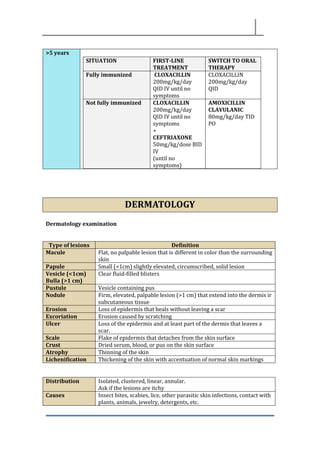
>5 years
SITUATION FIRST-LINE
TREATMENT
SWITCH TO ORAL
THERAPY
Fully immunized CLOXACILLIN
200mg/kg/day
QID IV until no
symptoms
CLOXACILLIN
200mg/kg/day
QID
Not fully immunized CLOXACILLIN
200mg/kg/day
QID IV until no
symptoms
+
CEFTRIAXONE
50mg/kg/dose BID
IV
(until no
symptoms)
AMOXICILLIN
CLAVULANIC
80mg/kg/day TID
PO
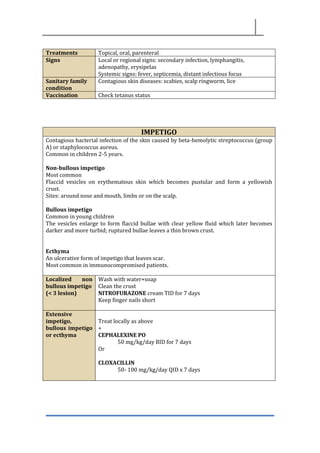
DERMATOLOGY
Dermatology examination
Type of lesions Definition
Macule Flat, no palpable lesion that is different in color than the surrounding
skin
Papule Small (<1cm) slightly elevated, circumscribed, solid lesion
Vesicle (<1cm)
Bulla (>1 cm)
Clear fluid-filled blisters
Pustule Vesicle containing pus
Nodule Firm, elevated, palpable lesion (>1 cm) that extend into the dermis ir
subcutaneous tissue
Erosion Loss of epidermis that heals without leaving a scar
Excoriation Erosion caused by scratching
Ulcer Loss of the epidermis and at least part of the dermis that leaves a
scar.
Scale Flake of epidermis that detaches from the skin surface
Crust Dried serum, blood, or pus on the skin surface
Atrophy Thinning of the skin
Lichenification Thickening of the skin with accentuation of normal skin markings
Distribution Isolated, clustered, linear, annular.
Ask if the lesions are itchy
Causes Insect bites, scabies, lice, other parasitic skin infections, contact with
plants, animals, jewelry, detergents, etc.
Treatments Topical, oral, parenteral
Signs Local or regional signs: secondary infection, lymphangitis,
adenopathy, erysipelas
Systemic signs: fever, septicemia, distant infectious focus
Sanitary family
condition
Contagious skin diseases: scabies, scalp ringworm, lice
Vaccination Check tetanus status
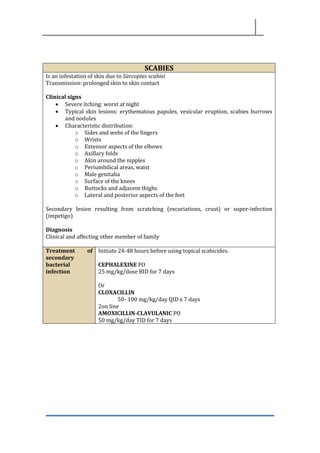
IMPETIGO
Contagious bacterial infection of the skin caused by beta-hemolytic streptococcus (group
A) or staphylococcus aureus.
Common in children 2-5 years.
Non-bullous impetigo
Most common
Flaccid vesicles on erythematous skin which becomes pustular and form a yellowish
crust.
Sites: around nose and mouth, limbs or on the scalp.
Bullous impetigo
Common in young children
The vesicles enlarge to form flaccid bullae with clear yellow fluid which later becomes
darker and more turbid; ruptured bullae leaves a thin brown crust.
Ecthyma
An ulcerative form of impetigo that leaves scar.
Most common in immunocompromised patients.
Localized non
bullous impetigo
(< 3 lesion)
Wash with water+soap
Clean the crust
NITROFURAZONE cream TID for 7 days
Keep finger nails short
Extensive
impetigo,
bullous impetigo
or ecthyma
Treat locally as above
+
CEPHALEXINE PO
50 mg/kg/day BID for 7 days
Or
CLOXACILLIN
50- 100 mg/kg/day QID x 7 days
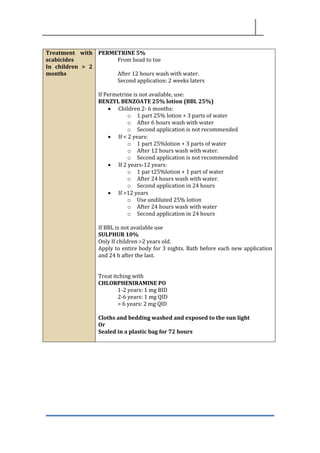
SCABIES
Is an infestation of skin due to Sarcoptes scabiei
Transmission: prolonged skin to skin contact
Clinical signs
• Severe itching: worst at night
• Typical skin lesions: erythematous papules, vesicular eruption, scabies burrows
and nodules
• Characteristic distribution:
o Sides and webs of the fingers
o Wrists
o Extensor aspects of the elbows
o Axillary folds
o Akin around the nipples
o Periumbilical areas, waist
o Male genitalia
o Surface of the knees
o Buttocks and adjacent thighs
o Lateral and posterior aspects of the feet
Secondary lesion resulting from scratching (excoriations, crust) or super-infection
(impetigo)
Diagnosis
Clinical and affecting other member of family
Treatment of
secondary
bacterial
infection
Initiate 24-48 hours before using topical scabicides.
CEPHALEXINE PO
25 mg/kg/dose BID for 7 days
Or
CLOXACILLIN
50- 100 mg/kg/day QID x 7 days
2on line
AMOXICILLIN-CLAVULANIC PO
50 mg/kg/day TID for 7 days
Treatment with
scabicides
In children > 2
months
PERMETRINE 5%
From head to toe
After 12 hours wash with water.
Second application: 2 weeks laters
If Permetrine is not available, use:
BENZYL BENZOATE 25% lotion (BBL 25%)
• Children 2- 6 months:
o 1 part 25% lotion + 3 parts of water
o After 6 hours wash with water
o Second application is not recommended
• If < 2 years:
o 1 part 25%lotion + 3 parts of water
o After 12 hours wash with water.
o Second application is not recommended
• If 2 years-12 years:
o 1 par t25%lotion + 1 part of water
o After 24 hours wash with water.
o Second application in 24 hours
• If >12 years
o Use undiluted 25% lotion
o After 24 hours wash with water
o Second application in 24 hours
If BBL is not available use
SULPHUR 10%
Only If children >2 years old.
Apply to entire body for 3 nights. Bath before each new application
and 24 h after the last.
Treat itching with
CHLORPHENIRAMINE PO
1-2 years: 1 mg BID
2-6 years: 1 mg QID
> 6 years: 2 mg QID
Cloths and bedding washed and exposed to the sun light
Or
Sealed in a plastic bag for 72 hours
FORUNCLES AND CARBUNCLES
Necrotizing perifollicular infection, usually due to Staphylococcus aureus.
Clinical signs
Foruncle
Red warm, painful nodule with a central pustule, usually a hair follicle. No fever. Leaves a
depressed scar.
Carbuncle
A cluster of interconnected furuncles, sometimes with fever and peripheral
lymphadenopathy. Leaves a depressed scar.
Single furuncle Water+soap
Warm compresses to encourage to drain
Furuncle on face,
multiple furuncles,
carbuncles,
immunocompromised
patients
Water+soap
CEPHALEXIN PO for 7 days
- < 7 days of life: 50 mg/kg/day BID
- Neonates 7-28 days: 75 mg/kg/day TID
- 1month-12 years: 25-50 mg/kg/day BID
- 12 years: 2 g/day BID
Or
CLOXACILLIN
50- 100 mg/kg/day QID x 7 days
AMOXICILLIN-CLAVULANIC PO
50 mg/kg/day BID for 7 days
ERYSIPELAS AND CELLULITIS
Acute skin infections, most often due to Group A beta-haemolytic streptococcus, and at
times S.aureus.
Clinical signs
- skin erythema, oedema with well demarcated margins, warmth, pain, usually on the
lower limbs and at times the face.
- Often with fever, lymphadenopathy and lymphangitis
- look for a portal of entry
- Rare systemic complications (acute glomerulonephritis, septicaemia)
OUTPATIENT CEPHALEXIN PO
1 month-12 years: 25-50 mg/kg/day BID
>12 years: 2g/day BID
Or
AMOXICILLIN-CLAVULANIC PO
50 mg/kg/day BID for 7 days
In-PATIENT All children < 3 months old, failure of outpatient treatment or risk of
non-compliance.
CLOXACILLIN IV
1 month-12 years: 50-100 mg/kg/day QID
>12 years: 4g/day QID
If not improvement in 48 hours, add metronidazol po
ECZEMA
Acute eczema Erythematous plaque, pruritic, vesicular with poorly demarcated
and crumbly borders
Treatment
Clean with water+soap
If intensive pruritus treat with chlorpheniramine
Chronic eczema Erythematous plaque, scaly, dry, poorly demarcated and pruritic
Treatment
Clean with water + soap
HIDROCORTISONE 1% cream BID for max 7 days (face, neck,
axillar)
OR
BETAMETHASONE cream BID for max 7 days (arms, legs)
If intensive pruritus treat with chlorpheniramine
SEBORRHEIC DERMATITIS
Seborrheix dermatitis is an inflammatory chronic dermatosis that can be localized on rich
areas rich with sebaceous glands
Clinical signs
Erythematous plaques covered by greasy yellow sacles that can be localized on the scalp,
face, sternum, spine, perineum and skin folds
Treatment Water+ soap
HYDROCORTISONE 1% BID maximum 7 days
Don’t apply if bacterial infection (impetigo). Treat first the bacterial
infection.
URTICARIA
Papules: transient, erythematous, oedematous, pruritic, resembling nettle signs
Look for a cause: food or drug allergy, insect bites…
Treatment CHLORPHENIRAMINE PO
1-2 years: 1mg BID
2-6 years. 1mg QID
6-12 years: 2mg QID
>12 years: 4mg QID
PELLAGRA
Pellagra is a dermatitis resulting from niacin or tryptophan deficiency
Clinical signs
3 “D” Dermatitis + Diarrhoea +Dementia
Dark red plaques well demarcated, symmetric, located on exposed areas of the body
Treatment NICOTINAMIDE (VITAMIN PP) PO
Children and adults: 300mg-500mg/day BID
Give diet rich in proteins
ANIMAL BITES
Treatment AMOXICILLINE-CLAVULANIC 50mg/kg/day TID 7 days
Refer to Health Center for tetanus and antirabies vaccine
Don’t close the wound by suture
LICES (PEDICULOSIS)
Is a benign contagious parasitic infection
Transmission: person to person through direct or indirect contact.
Body lices are potential vectors of relapsing fever, typhus and trench fever.
Clinical signs
Head lices
Itching and scratch marks (nape of neck and around the ears) which may become
secondarily infected (impetigo)
Body lices
Itching and scratch marks on the back, belt line and armpits
The lices are on the clothes, not on the body
Head lices PERMETRINE 1% lotion apply to dry hair and wash after 10 minuts
Or
MALATHION 0,5% lotion
6m – 2 years. Wash after 8 hours
>2 years: Wash after 12 hours
Repeat the application after 10 days
Cloths and bedding washed and exposed to the sun light
Or
Sealed in a plastic bag for 2 weeks
Body lices Cloths and bedding washed and exposed to the sun light
Or
Sealed in a plastic bag for 2 weeks
FUNGAL INFECTIONS
CANDIDIASIS
Oral candidiasis: white patches on the tongue, inside the cheeks
MICONAZOL ORAL GEL or NYSTATIN PO 100.000 UI/QID
Diaper dermatitis: erythema of the perianal area with peripheral desquamation and
sometimes pustules.
Treatment: avoid humidity, expose buttocks to air. Protect the skin with zinc oxide
ointment if diarrhoea is present.
DERMATOPHYTOSES
Tinea capitis Scalp ringworm.
Inflammation, suppuration, crusting, peripheral lymphadenopathy
Treatment
- Shave or cut hair short on and around the lesions
- if suppurative lesions treat as impetigo before applying local
treatment
WHITFIELD’S OINTMENT BID 2 weeks
Or
KETOCONAZOLE cream BID 2 weeks
+
GRISEOFULVIN PO for 6 weeks
< 12 years: 10-15 mg/kg/day OD or BID (maximum 500mg/day)
> 12 years: 500mg OD or BID
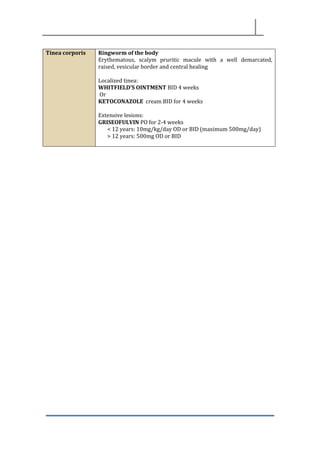
Tinea corporis Ringworm of the body
Erythematous, scalym pruritic macule with a well demarcated,
raised, vesicular border and central healing
Localized tinea:
WHITFIELD’S OINTMENT BID 4 weeks
Or
KETOCONAZOLE cream BID for 4 weeks
Extensive lesions:
GRISEOFULVIN PO for 2-4 weeks
< 12 years: 10mg/kg/day OD or BID (maximum 500mg/day)
> 12 years: 500mg OD or BID
CENTRAL NERVOUS SYSTEM
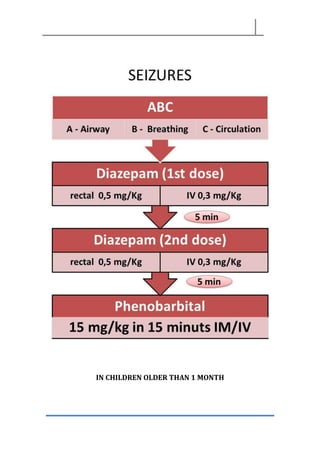
IN CHILDREN OLDER THAN 1 MONTH
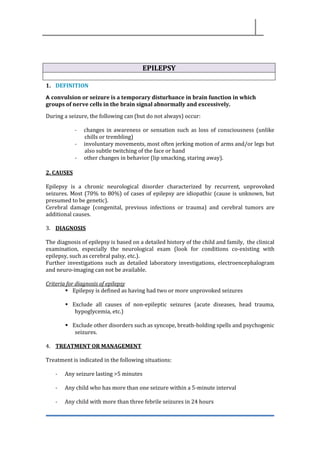
EPILEPSY
1. DEFINITION
A convulsion or seizure is a temporary disturbance in brain function in which
groups of nerve cells in the brain signal abnormally and excessively.
During a seizure, the following can (but do not always) occur:
- changes in awareness or sensation such as loss of consciousness (unlike
chills or trembling)
- involuntary movements, most often jerking motion of arms and/or legs but
also subtle twitching of the face or hand
- other changes in behavior (lip smacking, staring away).
2. CAUSES
Epilepsy is a chronic neurological disorder characterized by recurrent, unprovoked
seizures. Most (70% to 80%) of cases of epilepsy are idiopathic (cause is unknown, but
presumed to be genetic).
Cerebral damage (congenital, previous infections or trauma) and cerebral tumors are
additional causes.
3. DIAGNOSIS
The diagnosis of epilepsy is based on a detailed history of the child and family, the clinical
examination, especially the neurological exam (look for conditions co-existing with
epilepsy, such as cerebral palsy, etc.).
Further investigations such as detailed laboratory investigations, electroencephalogram
and neuro-imaging can not be available.
Criteria for diagnosis of epilepsy
▪ Epilepsy is defined as having had two or more unprovoked seizures
▪ Exclude all causes of non-epileptic seizures (acute diseases, head trauma,
hypoglycemia, etc.)
▪ Exclude other disorders such as syncope, breath-holding spells and psychogenic
seizures.
4. TREATMENT OR MANAGEMENT
Treatment is indicated in the following situations:
- Any seizure lasting >5 minutes
- Any child who has more than one seizure within a 5-minute interval
- Any child with more than three febrile seizures in 24 hours
Before start consider:
- As epilepsy treatment is a long-term treatment
- It needs to be established that the family is willing to give the treatment and come
for consultation on a regular basis.
- The most common seizures in childhood are of the generalized tonic-clonic type.
The main four antiepileptic drugs (AEDs)—phenobarbital, phenytoin,
carbamazepine and valproate—are almost equally effective for these seizures
- In cases of non-convulsive “absence seizures,” use valproate as first-line treatment.
5. GUIDING PRINCIPLES TO START ANTIEPILEPTIC TREATMENT:
- Carefully establish diagnosis.
- Start treatment with one drug.
- Phenobarbitone is the most cost-effective drug and should be consider as first-line
Check for co-existing clinical conditions (heart, renal, hepatic failure, etc.) and
contraindications for the drugs or interactions with other medications the patient
might be taking.
A starting dose of phenobarbital (3 mg/kg once a day) is given for 3–4 weeks.
For the majority of patients, the starting dose is not enough to reach complete seizure
control.
Gradually increase dosage with increments at regular intervals (add 1 mg/kg every
3–4 weeks and give BID) until complete seizure control (minimum maintenance
dose), until side effects appear or until the maximum dosage has been reached.
Maximum dose of phenobarbital: 8 mg/kg/day BID (Max 600 mg/day)
Severe “intoxication” side effects appearing at the beginning of the treatment can
indicate too rapid an increase in dosing.
A starting dose of carbamazepine (5mg/kg BID) is given for 3–4 weeks. For the
majority of patients, the starting dose is not enough to reach complete seizure control.
Gradually increase dosage with increments at regular intervals (add 5 mg/kg every
Phenobarbitone is the most cost-effective drug and
should be considered as first-line treatment.
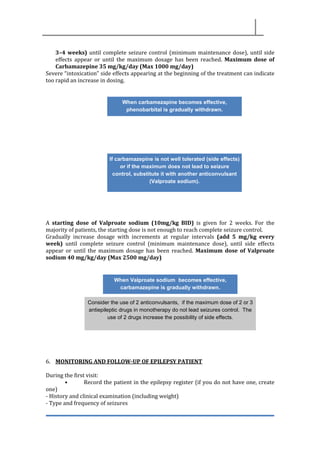
If phenobarbital is not well tolerated (side effects)
or if the maximum tolerated dose does not lead to
seizure control, substitute it with another
anticonvulsant (carbamazepine).
3–4 weeks) until complete seizure control (minimum maintenance dose), until side
effects appear or until the maximum dosage has been reached. Maximum dose of
Carbamazepine 35 mg/kg/day (Max 1000 mg/day)
Severe “intoxication” side effects appearing at the beginning of the treatment can indicate
too rapid an increase in dosing.
A starting dose of Valproate sodium (10mg/kg BID) is given for 2 weeks. For the
majority of patients, the starting dose is not enough to reach complete seizure control.
Gradually increase dosage with increments at regular intervals (add 5 mg/kg every
week) until complete seizure control (minimum maintenance dose), until side effects
appear or until the maximum dosage has been reached. Maximum dose of Valproate
sodium 40 mg/kg/day (Max 2500 mg/day)
6. MONITORING AND FOLLOW-UP OF EPILEPSY PATIENT
During the first visit:
• Record the patient in the epilepsy register (if you do not have one, create
one)
- History and clinical examination (including weight)
- Type and frequency of seizures
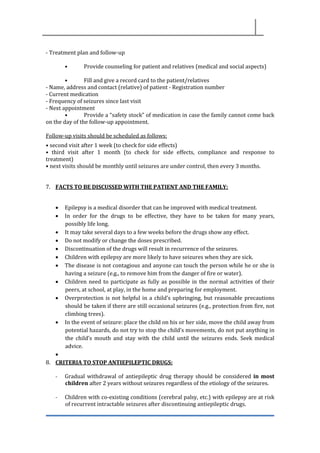
When carbamezapine becomes effective,
phenobarbital is gradually withdrawn.
If carbamazepine is not well tolerated (side effects)
or if the maximum does not lead to seizure
control, substitute it with another anticonvulsant
(Valproate sodium).
When Valproate sodium becomes effective,
carbamazepine is gradually withdrawn.
Consider the use of 2 anticonvulsants, if the maximum dose of 2 or 3
antiepileptic drugs in monotherapy do not lead seizures control. The
use of 2 drugs increase the possibility of side effects.
- Treatment plan and follow-up
• Provide counseling for patient and relatives (medical and social aspects)
• Fill and give a record card to the patient/relatives
- Name, address and contact (relative) of patient - Registration number
- Current medication
- Frequency of seizures since last visit
- Next appointment
• Provide a “safety stock” of medication in case the family cannot come back
on the day of the follow-up appointment.
Follow-up visits should be scheduled as follows:
• second visit after 1 week (to check for side effects)
• third visit after 1 month (to check for side effects, compliance and response to
treatment)
• next visits should be monthly until seizures are under control, then every 3 months.
7. FACTS TO BE DISCUSSED WITH THE PATIENT AND THE FAMILY:
• Epilepsy is a medical disorder that can be improved with medical treatment.
• In order for the drugs to be effective, they have to be taken for many years,
possibly life long.
• It may take several days to a few weeks before the drugs show any effect.
• Do not modify or change the doses prescribed.
• Discontinuation of the drugs will result in recurrence of the seizures.
• Children with epilepsy are more likely to have seizures when they are sick.
• The disease is not contagious and anyone can touch the person while he or she is
having a seizure (e.g., to remove him from the danger of fire or water).
• Children need to participate as fully as possible in the normal activities of their
peers, at school, at play, in the home and preparing for employment.
• Overprotection is not helpful in a child’s upbringing, but reasonable precautions
should be taken if there are still occasional seizures (e.g., protection from fire, not
climbing trees).
• In the event of seizure: place the child on his or her side, move the child away from
potential hazards, do not try to stop the child’s movements, do not put anything in
the child’s mouth and stay with the child until the seizures ends. Seek medical
advice.
•
8. CRITERIA TO STOP ANTIEPILEPTIC DRUGS:
- Gradual withdrawal of antiepileptic drug therapy should be considered in most
children after 2 years without seizures regardless of the etiology of the seizures.
- Children with co-existing conditions (cerebral palsy, etc.) with epilepsy are at risk
of recurrent intractable seizures after discontinuing antiepileptic drugs.
- If no pediatrician is available in the field, contact the Pediatric Advisor prior to
discontinuation of treatment.
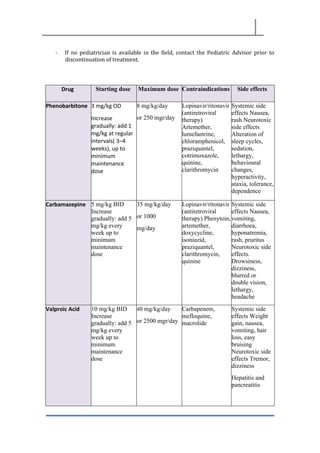
Drug Starting dose Maximum dose Contraindications Side effects
Phenobarbitone 3 mg/kg OD
Increase
gradually: add 1
mg/kg at regular
intervals( 3–4
weeks), up to
minimum
maintenance
dose
8 mg/kg/day
or 250 mgr/day
Lopinavir/ritonavir
(antiretroviral
therapy)
Artemether,
lumefantrine,
chloramphenicol,
praziquantel,
cotrimoxazole,
quinine,
clarithromycin
Systemic side
effects Nausea,
rash Neurotoxic
side effects
Alteration of
sleep cycles,
sedation,
lethargy,
behavioural
changes,
hyperactivity,
ataxia, tolerance,
dependence
Carbamazepine 5 mg/kg BID
Increase
gradually: add 5
mg/kg every
week up to
minimum
maintenance
dose
35 mg/kg/day
or 1000
mg/day
Lopinavir/ritonavir
(antiretroviral
therapy) Phenytoin,
artemether,
doxycycline,
isoniazid,
praziquantel,
clarithromycin,
quinine
Systemic side
effects Nausea,
vomiting,
diarrhoea,
hyponatremia,
rash, pruritus
Neurotoxic side
effects.
Drowsiness,
dizziness,
blurred or
double vision,
lethargy,
headache
Valproic Acid 10 mg/kg BID
Increase
gradually: add 5
mg/kg every
week up to
minimum
maintenance
dose
40 mg/kg/day
or 2500 mgr/day
Carbapenem,
mefloquine,
macrolide
Systemic side
effects Weight
gain, nausea,
vomiting, hair
loss, easy
bruising
Neurotoxic side
effects Tremor,
dizziness
Hepatitis and
pancreatitis
OTHERS
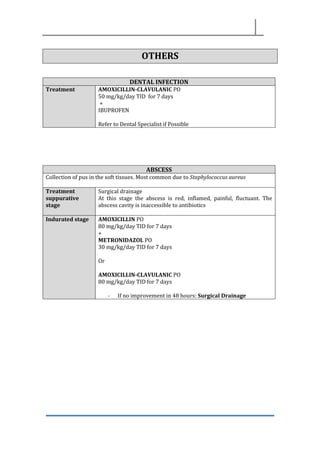
DENTAL INFECTION
Treatment AMOXICILLIN-CLAVULANIC PO
50 mg/kg/day TID for 7 days
+
IBUPROFEN
Refer to Dental Specialist if Possible
ABSCESS
Collection of pus in the soft tissues. Most common due to Staphylococcus aureus
Treatment
suppurative
stage
Surgical drainage
At this stage the abscess is red, inflamed, painful, fluctuant. The
abscess cavity is inaccessible to antibiotics
Indurated stage AMOXICILLIN PO
80 mg/kg/day TID for 7 days
+
METRONIDAZOL PO
30 mg/kg/day TID for 7 days
Or
AMOXICILLIN-CLAVULANIC PO
80 mg/kg/day TID for 7 days
- If no improvement in 48 hours: Surgical Drainage
ANNEX
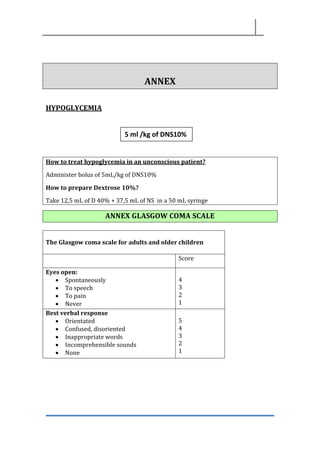
HYPOGLYCEMIA
How to treat hypoglycemia in an unconscious patient?
Administer bolus of 5mL/kg of DNS10%
How to prepare Dextrose 10%?
Take 12,5 mL of D 40% + 37,5 mL of NS in a 50 mL syringe
ANNEX GLASGOW COMA SCALE
The Glasgow coma scale for adults and older children
Score
Eyes open:
• Spontaneously
• To speech
• To pain
• Never
4
3
2
1
Best verbal response
• Orientated
• Confused, disoriented
• Inappropriate words
• Incomprehensible sounds
• None
5
4
3
2
1
5 ml /kg of DNS10%
IV
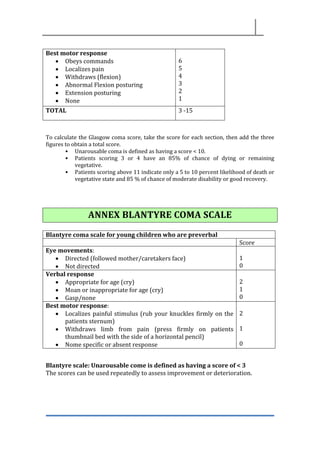
Best motor response
• Obeys commands
• Localizes pain
• Withdraws (flexion)
• Abnormal Flexion posturing
• Extension posturing
• None
6
5
4
3
2
1
TOTAL 3 -15
To calculate the Glasgow coma score, take the score for each section, then add the three
figures to obtain a total score.
• Unarousable coma is defined as having a score < 10.
• Patients scoring 3 or 4 have an 85% of chance of dying or remaining
vegetative.
• Patients scoring above 11 indicate only a 5 to 10 percent likelihood of death or
vegetative state and 85 % of chance of moderate disability or good recovery.
ANNEX BLANTYRE COMA SCALE
Blantyre coma scale for young children who are preverbal
Score
Eye movements:
• Directed (followed mother/caretakers face)
• Not directed
1
0
Verbal response
• Appropriate for age (cry)
• Moan or inappropriate for age (cry)
• Gasp/none
2
1
0
Best motor response:
• Localizes painful stimulus (rub your knuckles firmly on the
patients sternum)
• Withdraws limb from pain (press firmly on patients
thumbnail bed with the side of a horizontal pencil)
• Nome specific or absent response
2
1
0
Blantyre scale: Unarousable come is defined as having a score of < 3
The scores can be used repeatedly to assess improvement or deterioration.
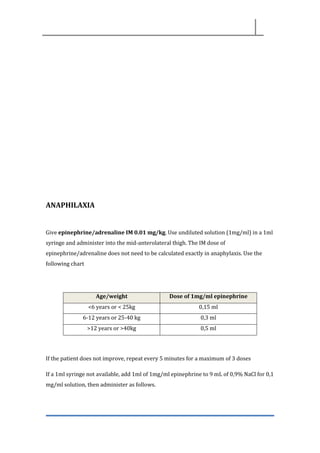
ANAPHILAXIA
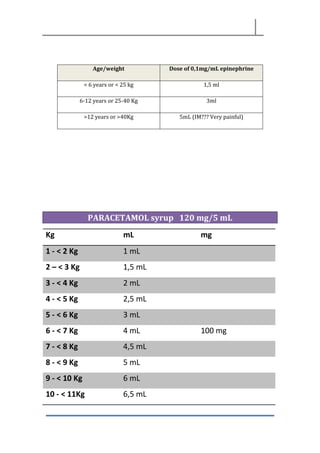
Give epinephrine/adrenaline IM 0.01 mg/kg. Use undiluted solution (1mg/ml) in a 1ml
syringe and administer into the mid-anterolateral thigh. The IM dose of
epinephrine/adrenaline does not need to be calculated exactly in anaphylaxis. Use the
following chart
If the patient does not improve, repeat every 5 minutes for a maximum of 3 doses
If a 1ml syringe not available, add 1ml of 1mg/ml epinephrine to 9 mL of 0,9% NaCl for 0,1
mg/ml solution, then administer as follows.
Age/weight Dose of 1mg/ml epinephrine
<6 years or < 25kg 0,15 ml
6-12 years or 25-40 kg 0,3 ml
>12 years or >40kg 0,5 ml
Age/weight Dose of 0,1mg/mL epinephrine
< 6 years or < 25 kg 1,5 ml
6-12 years or 25-40 Kg 3ml
>12 years or >40Kg 5mL (IM??? Very painful)
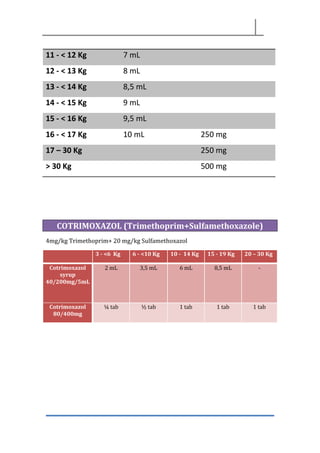
PARACETAMOL syrup 120 mg/5 mL
Kg mL mg
1 - < 2 Kg 1 mL
2 – < 3 Kg 1,5 mL
3 - < 4 Kg 2 mL
4 - < 5 Kg 2,5 mL
5 - < 6 Kg 3 mL
6 - < 7 Kg 4 mL 100 mg
7 - < 8 Kg 4,5 mL
8 - < 9 Kg 5 mL
9 - < 10 Kg 6 mL
10 - < 11Kg 6,5 mL
11 - < 12 Kg 7 mL
12 - < 13 Kg 8 mL
13 - < 14 Kg 8,5 mL
14 - < 15 Kg 9 mL
15 - < 16 Kg 9,5 mL
16 - < 17 Kg 10 mL 250 mg
17 – 30 Kg 250 mg
> 30 Kg 500 mg
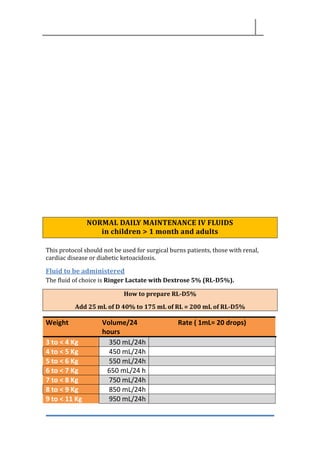
COTRIMOXAZOL (Trimethoprim+Sulfamethoxazole)
4mg/kg Trimethoprim+ 20 mg/kg Sulfamethoxazol
3 - <6 Kg 6 - <10 Kg 10 - 14 Kg 15 - 19 Kg 20 – 30 Kg
Cotrimoxazol
syrup
40/200mg/5mL
2 mL 3,5 mL 6 mL 8,5 mL -
Cotrimoxazol
80/400mg
¼ tab ½ tab 1 tab 1 tab 1 tab
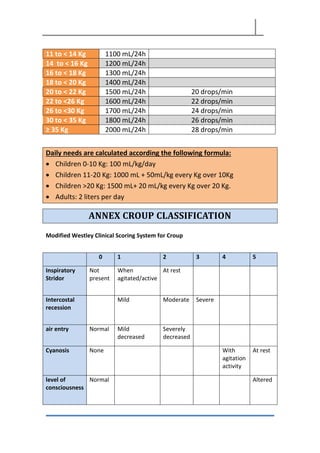
NORMAL DAILY MAINTENANCE IV FLUIDS
in children > 1 month and adults
This protocol should not be used for surgical burns patients, those with renal,
cardiac disease or diabetic ketoacidosis.
Fluid to be administered
The fluid of choice is Ringer Lactate with Dextrose 5% (RL-D5%).
How to prepare RL-D5%
Add 25 mL of D 40% to 175 mL of RL = 200 mL of RL-D5%
Weight Volume/24
hours
Rate ( 1mL= 20 drops)
3 to < 4 Kg 350 mL/24h
4 to < 5 Kg 450 mL/24h
5 to < 6 Kg 550 mL/24h
6 to < 7 Kg 650 mL/24 h
7 to < 8 Kg 750 mL/24h
8 to < 9 Kg 850 mL/24h
9 to < 11 Kg 950 mL/24h
11 to < 14 Kg 1100 mL/24h
14 to < 16 Kg 1200 mL/24h
16 to < 18 Kg 1300 mL/24h
18 to < 20 Kg 1400 mL/24h
20 to < 22 Kg 1500 mL/24h 20 drops/min
22 to <26 Kg 1600 mL/24h 22 drops/min
26 to <30 Kg 1700 mL/24h 24 drops/min
30 to < 35 Kg 1800 mL/24h 26 drops/min
≥ 35 Kg 2000 mL/24h 28 drops/min
Daily needs are calculated according the following formula:
• Children 0-10 Kg: 100 mL/kg/day
• Children 11-20 Kg: 1000 mL + 50mL/kg every Kg over 10Kg
• Children >20 Kg: 1500 mL+ 20 mL/kg every Kg over 20 Kg.
• Adults: 2 liters per day
ANNEX CROUP CLASSIFICATION
Modified Westley Clinical Scoring System for Croup
0 1 2 3 4 5
Inspiratory
Stridor
Not
present
When
agitated/active
At rest
Intercostal
recession
Mild Moderate Severe
air entry Normal Mild
decreased
Severely
decreased
Cyanosis None With
agitation
activity
At rest
level of
consciousness
Normal Altered
Total possible Score = 0 – 17. <4= Mild Croup; 4 – 6= Moderate Croup; >6= Severe
Croup
ANNEX BRONCHITIS SEVERITY. WOOD-DOWNES SCORE
0 1 2
Espiratory
wheezing
No Mild Moderate
Use of
supplementary
muscle
No Moderate Maximum
Air entry Normal Mild
decreased
Absend
Cyanosis None Yes at room air Yes with oxigen
Saturation >94% 90-94% <90%
level of
consciousness
Normal Agitated or
lethargic
Coma
If score ≤ 3: mild
IIf scoe 4-5: moderate
If score ≥6: severe
ANNEX FEEDING PROBLEMS
Feeding of normal baby:
The mother should be instructed to start feeding the baby within one to two hours
after delivery. The first feed should be the breast milk and there is no need for any test
feed with water or dextrose. The first few feeds should be supervised and records of
feeds should be documented.
Feeding of a preterm, small for date (SGA) and infants of diabetic mothers (IDM):
Infants less than 1500 grams should receive all the fluids and calories intravenously for
the first 24 hours. SGA and IDM babies should be started feeding by one hour of age,
First few feeds may be given by NG tube and they should be fed at least two hourly if
sucking is poor. Once sucking is well established and blood sugar is normal these
babies should be given to the mother for supervised breast feeding.
Feeding of term asphyxiated infants:
Mildly asphyxiated infants should feed like any healthy baby but must be closely
supervised for the first 12 hours. Babies with severe asphyxia should be started with
2/3 maintenance IV fluids and strict intake records should be maintained routinely.
Evidence for adequate nutrition
Weight gain should be 20–30g/kg/day for premature infants and 10g/kg/day for full
term infants
Adequate growth requires:
100-120kcal/kg/day in term infants 115-130kcal/kg/day for preterm infants
150kcal/kg/day for very low birth weight infants
ANNEX FLUID AND ELECTROLYTE
Normal maintenance requirements (volume of fluid/kg/day)
Day 1 60 mL/kg/day
Day 2 80 mL/kg/day
Day 3 100 mL/kg/day
Day 4 120 mL/kg/day
Day 5 60 mL/kg/day
Day 6 140 mL/kg/day
Day 6 and above 160 mL/kg/day
BREATH SOUNDS
HEART RATE AND RESPIRATORY RATE
NORMAL SYSTOLIC BLOOD PRESSURE
TRIAGE PRIORITY CATEGORIES
EMERGENCY SIGNS (ABCDE)
PRIMARY ASSESSMENT
ALGORITHM SERIOUSLY ILL CHILD
CPR ALGORITHM
CPR IN INFANTS
NORMAL VALUES
MEDICAL GLOSSARY
Terminology Definition
Anemia A reduction in the number of circulating red blood cells or in
the quantity of hemoglobin.
Anopheles A genus of mosquito; some species can transmit human
malaria.
Anorexia Lack of appetite and a lack of desire or interest in food.
Anthropophilic Mosquitoes that prefer to take blood meals on humans.
Antibody A specialized serum protein (immunoglobulin or gamma
globulin) produced by B lymphocytes in the blood in response
to an exposure to foreign proteins (antigens). The antibodies
specifically bind to the antigens that induced the immune
response. Antibodies help defend the body against infectious
agents, including bacteria, viruses, or parasites.
Antigen Any substance that stimulates the immune system to produce
antibodies. Antigens are often foreign substances: invading
bacteria, viruses, or parasites.
Autochthonous Malaria transmitted by mosquitoes that can be indigenous (in
a geographic area where malaria occurs regularly) or
introduced (in a geographic area where malaria does not
occur regularly).
Cerebral malaria A complication of Plasmodium falciparum malaria with
cerebral manifestations, usually including coma (Glasgow
coma scale < 11, Blantyre coma scale < 3). Malaria with coma
persisting for > 30 min after a seizure is considered to be
cerebral malaria.
Chemoprophylaxis Taking antimalarial drugs to prevent the disease.
Cinchonism Side effects from quinine or quinidine, including tinnitus,
headache, nausea, diarrhea, altered auditory acuity, and
blurred vision. The term comes from cinchona bark, the
natural source of quinine.
Clinical cure Elimination of malaria symptoms, sometimes without
eliminating all parasites. See radical cure and suppressive
cure/treatment.
Coma A decreased state of consciousness from which a person
cannot be awakened.
Congenital malaria Malaria in a newborn or infant, transmitted from the mother
at birth.
Control Reduction of disease incidence, prevalence, morbidity or
mortality to a locally acceptable level as a result of deliberate
efforts.
Cryptic A case of malaria where epidemiologic investigations fail to
identify how the patient acquired the disease; this term
applies mainly to cases found in non-endemic countries.
Drug resistance The result of microbes changing in ways that reduce or
eliminate the effectiveness of drugs, chemicals, or other
agents to cure or prevent infections.
Dyspnea Shallow, labored breathing.
Efficacy The power or capacity to produce a desired effect.
Elimination The interruption of local mosquito-borne malaria transmission
in a defined geographical area, creating a zero incidence of
locally contracted cases. Imported cases will continue to occur
and continued intervention measures are required.
Elimination of disease Reduction to zero of the incidence of a specified disease in a
defined geographical area as a result of deliberate efforts.
Elimination of infection Reduction to zero of the incidence of infection caused by a
specified agent in a defined geographical area as a result of
deliberate efforts.
Endemic Where disease occurs consistently.
Endophagic A mosquito that feeds indoors.
Endophilic A mosquito that tends to inhabit/rest indoors. Endophilism
facilitates the blocking of malaria transmission through the
application of residual insecticides to walls.
Epidemic The occurrence of more cases of disease than expected in a
given area or among a specific group of people over a
particular period of time.
Epidemiology The study of the distribution and determinants of health-
related states or events in specified populations; the
application of this study to control health problems.
Eradication Permanentt reduction to zero of the worldwide incidence of
infection caused by a specific agent as a result of deliberate
efforts;
Erythrocytic stage A stage in the life cycle of the malaria parasite found in the
red blood cells. Erythrocytic stage parasites cause the
symptoms of malaria.
Exoerythrocytic stage A stage in the life cycle of the malaria parasite found in liver
cells (hepatocytes). Exoerythrocytic stage parasites do not
cause symptoms.
Exophagic A mosquito that feeds outdoors.
Exophilic An exophilic mosquito tends to inhabit/rest outdoors.
Residual insecticides in buildings are less effective at
controlling exophilic mosquitoes.
Extinction The specific infectious agent no longer exists in nature or in
the laboratory.
G6PD deficiency An inherited abnormality that causes the loss of a red blood
cell enzyme. People who are G6PD deficient should not take
the antimalarial drug primaquine.
Gametocyte The sexual stage of malaria parasites. Male gametocytes
(microgametocytes) and female gametocytes
(macrogametocytes) are inside red blood cells in the
circulation. If a female Anopheles mosquito ingests them, they
undergo sexual reproduction, which starts the extrinsic
(sporogonic) cycle of the parasite in the mosquito.
Gametocytes of Plasmodium falciparum are typically banana
or crescent-shaped (from the Latin falcis = sickle).
Hypnozoite Dormant form of malaria parasites found in liver cells.
Hypnozoites occur only with Plasmodium vivax and P. ovale.
After sporozoites (inoculated by the mosquito) invade liver
cells, some sporozoites develop into dormant forms (the
hypnozoites), which do not cause any symptoms. Hypnozoites
can become activated months or years after the initial
infection, producing a relapse.
Hypoglycemia Low blood glucose; can occur with malaria. In addition,
treatment with quinine and quinidine stimulate insulin
secretion, reducing blood glucose.
Immune system The cells, tissues, and organs that help the body resist
infection and disease by producing antibodies and/or cells
that inhibit the multiplication of the infectious agent.
Immunity Protection generated by the body's immune system, in
response to previous malaria attacks, resulting in the ability to
control or lessen a malaria attack.
Immunization The process or procedure by which a subject (person, animal,
or plant) is rendered immune or resistant to a specific disease.
This term is often used interchangeably with vaccination or
inoculation, although inoculation does not always result in
immunity.
Imported malaria Malaria acquired outside a specific geographic area.
Incubation period The interval of time between infection by a microorganism
and the onset of the illness or the first symptoms of the
illness. With malaria, the incubation is between the mosquito
bite and the first symptoms. Incubation periods range from 7
to 40 days, depending on the species.
Indigenous malaria Mosquito-borne transmission of malaria in a geographic area
where malaria occurs regularly.
Induced malaria Malaria acquired through artificial means (for example, blood
transfusion, shared needles or syringes, or malariotherapy).
Infection The invasion of an organism by a pathogen, such as bacteria,
viruses, or parasites. Some, but not all, infections lead to
disease.
Introduced malaria Mosquito-borne transmission of malaria from an imported
case in a geographic area where malaria does not regularly
occur.
Merozoite A daughter-cell formed by asexual development in the life
cycle of malaria parasites. Liver-stage and blood-stage malaria
parasites develop into schizonts, which contain many
merozoites. When the schizonts are mature, they (and their
host cells!) rupture, the merozoites are released and infect
red blood cells.
Oocyst A stage in the life cyle of malaria parasites, oocysts are
rounded cysts located in the outer wall of the stomach of
mosquitoes. Sporozoites develop inside the oocysts. When
mature, the oocysts rupture and release the sporozoites,
which then migrate into the mosquito's salivary glands, ready
for injection into the human host.
Outbreak AnIs an epidemic limited to a localized increase in disease
incidence, e.g. in a village, town or closed institution.
Pandemic AnIs an epidemic occurring over a very wide area, crossing
international boundaries and usually affecting a large number
of people.
Parasite Any organism that lives in or on another organism without
benefiting the host organism; commonly refers to pathogens,
most commonly to protozoans and helminths.
Parasitemia The presence of parasites in the blood. The term can also be
used to express the quantity of parasites in the blood (for
example, a parasitemia of 2 percent).
Paroxysm A sudden attack or increase in intensity of a symptom, usually
occurring at intervals.
Pathogen Bacteria, viruses, parasites, or fungi that can cause disease.
Plasmodium The genus of the parasite that causes malaria. The genus
includes four species that infect humans: Plasmodium
falciparum, Plasmodium vivax, Plasmodium ovale, and
Plasmodium malariae.
Presumptive treatment Treatment of clinically suspected cases without, or prior to,
results from confirmatory laboratory tests.
Prophylaxis See chemoprophylaxis.
Radical cure (also radical
treatment)
Complete elimination of malaria parasites from the body; the
term applies specifically to elimination of dormant liver stage
parasites (hypnozoites) found in Plasmodium vivax and P.
ovale.
Recrudescence A repeated attack of malaria (short-term relapse or delayed),
due to the survival of malaria parasites in red blood cells.
Radical treatment: see radical cure.
Relapse Recurrence of disease after it has been apparently cured. In
malaria, true relapses are caused by reactivation of dormant
liver stage parasites
Residual insecticide
spraying
SS praying insecticides that have residual efficacy (that
continue to affect mosquitoes for several months) against
houses where people spend nighttime hours. Residual
insecticide spraying is done to kill mosquitoes when they
come to rest on the walls, usually after a blood meal.
Resistance The ability of an organism to develop strains that are
impervious to specific threats to their existence. The malaria
parasite has developed strains that are resistant to drugs,
such as chloroquine. The Anopheles mosquito has developed
strains that are resistant to DDT and other insecticides.
Rigor Severe shaking chill.
Schizogony Asexual reproductive stage of malaria parasites. In red blood
cells, schizogony entails development of a single trophozoite
into numerous merozoites; a similar process happens in
infected liver cells.
Schizont A developmental form of the malaria parasite that contains
many merozoites. Schizonts are seen in the liver-stage and
blood-stage parasites.
Sector A 1 km square grid in a kebele map (in the context of this
guideline).
Serology The branch of science dealing with the measurement and
characterization of antibodies and other immunological
substances in body fluids, particularly serum.
Sporozoite rate The proportion of female anopheline mosquitoes of a
particular species that have sporozoites in their salivary glands
(as seen by dissection) or that are positive in immunologic
tests to detect sporozoite antigens.
Sporozoite A stage in the life cycle of the malaria parasite. Sporozoites,
produced in the mosquito, migrate to the mosquito's salivary
glands. They can be inoculated into a human host when the
mosquito takes a blood meal on the human. In the human,
the sporozoites enter liver cells where they develop into the
next stage of the malaria parasite life cycle (the liver stage or
exo-erythrocytic stage).
Suppressive treatment Treatment intended to prevent clinical symptoms and
parasitemia by destroying the parasites in red blood cells. It
does not prevent infection because the parasite stages
inoculated by the mosquito (sporozoites) will survive and
invade the liver and develop liver-stage parasites. The
parasites are destroyed when they leave the liver cells to
invade the blood. Because the blood-stage parasites cause the
disease, eliminating these stages will prevent symptoms.
Tachycardia Increased heart rate.
Tachypnea Increased rate of breathing.
Tinnitus Ringing sound in the ears, a common side effect of quinine
treatment.
Trophozoite A developmental form during the blood stage of malaria
parasites. After merozoites have invaded the red blood cell,
they develop into trophozoites (sometimes, early trophozoites
are called rings or ring stage parasites); trophozoites develop
into schizonts.
Upsurge Sometimes used as euphemism for an outbreak or epidemic.
Vaccine A preparation that stimulates an immune response that can
prevent an infection or create resistance to an infection.
Vector competence The ability of a vector (for example, Anopheles mosquitoes) to
transmit a disease (for example, malaria).
Vector An organism (for example, Anopheles mosquitoes) that
transmits an infectious agent (for example, malaria parasites)
from one host to the other (for example, humans).
Virus A microorganism made up of a piece of genetic material —
RNA or DNA — surrounded by a protein coat. To replicate, a
virus must infect a cell and direct its cellular machinery to
produce new viruses.
Zoophilic Mosquitoes that prefer to take blood meals on animals.
COMMENTS ON AMOXI-CLAV PRESCRIPCION
Amoxi / Clav 312,5 (250/62,5)mg/ 5ml. Amox/clav 4:1 100ml
Amoxi / Clav 375 (250/125)mg. Amox/clav 2:1 1 tablet
Amoxi / Clav 625 (500/125)mg. Amox/clav 4:1 1 tablet
Dosage of amoxicillin 40-100 mg/kg/dia
Dosage of clavulanate: maximum 12.5 mg/kg/dia or 375 mg/day
Exemple 10 kg patient
If dosage amoxi 40mg/kg/dia → Amoxi/clav susp 4 ml (200mg amox+ 50 mg clavu) BID
(dosage of clavulanate 10mg/kg/day)
If dosage of amoxi 80 mg/kg/day→ 800 mg/day aprox 250mg amox TID
If suspension it will be 62,5 x 3 mg clavu= 187 mg/day (18.7 mg/kg/d)
If tabs 250/125→ 125 x 3 = 375 mg/day (37.5mg/kg/day)
If tabs 500/125→ 1 tab BID = 1000mg of amoxi (100 mg/kg/dia+ 250 mg clavula
(25mg/kg/dia)

HC-Pediatric-Guidelines for treatment.pdf

  • 1.
  • 2.
  • 3.
    TABLE OF CONTENTS 1.RESPIRATORY DISEASES………………………………………………………………………………………………….4 1.1.Croup 1.2.Acute Bronchitis 1.3.Bronchiolitis 1.4.Upper Respiratory Tract Infection (URTI) 1.5.Pertussis (Whooping cough) 1.6.Pneumonia 1.7.Diphtheria 1.8.Epiglotitis 2. ENT – EYE, NOSE, THROAT……………………………………………………….…………………………………12 2.1.Acute Otitis Media 2.2.Chronic Supurative Otitis Media 2.3.Acute Otitis Externa 2.4.Mastoiditis 2.5.Tonsillitis 2.6.Peritonsillar abscess 3. OPTHTALMOLOGICAL DISEASES……………………………………………………………………………………14 3.1.Conjuntivitis 3.2.Periorbital and Orbital Cellulitis 3.3.Neonatal Conjunctivitis 3.4.Trachoma 3.5.Vitamin A Deficiency 4. VIRAL DISEASES……………………………………………………………………………………………………………19 4.1.Measles 4.2.Viral Hepatitis A, B, C, D, E 5. BACTERIAL DISEASES………………………………………………………………………….…………………………21 5.1.Meningitis 5.2.Septicemia 5.3.Tetanus 5.4.Relapsing fever (Borreliosis) 5.5.Eruptive Rickettsiosis 5.6.Typhoid Fever 6. GASTROINTESTINAL DISORDERS…………………………………………………………………………………..27 6.1.Dehydration: Plan A-B-C 6.2.Acute Diarrhoea 6.3.Dysentery 6.4.Cholera
  • 4.
    7. PROTOZOAN INFECTIONS………………………………………………………………………….……………….32 7.1.Malaria 8.INTESTINAL PROTOZAN INFECTIONS………………………………………………….…………………………37 8.1.Parasitic Diarrhoea 8.1.1.Giardiasis 8.1.2.Amoebiasis 8.2.Schistosomiasis 9. HELMINTHIASIS……………………………………………………………………………………….……………………3 9 9.1.Taeniasis 9.2.Hymenolepiasis 9.3.Hydated Cyst 9.4.Ascariasis 9.5.Trichuriasis 9.6.Ancylostomiasis 9.7.Strongyloidiasis 9.8.Enterobiasis 9.9.Filariasis 10. RENAL DISORDERS……………………………………………………………………………………………………….43 10.1. Acute Cistitis 10.2. Pyelonephritis/Urinary Tract Infection 10.3. Post infectious glomerulonephritis 10.4. Nephrotic Syndrome 11. BONE AND JOINT …………………………………………………………………………………..…………………….48 11.1. Osteomyelitis / Septic Arthritis 12. DERMATOLOGY……………………………………………………………………………….…………………………..50 12.1. Impetigo 12.2. Scabies 12.3. Foruncles and carbuncles 12.4. Erysipelas and cellulitis 12.5. Cutaneous anthrax 12.6. Eczema 12.7. Seborrheic dermatitis 12.8. Urticaria 12.9. Pellagra 12.10. Animal bites 12.11. Lices (Pediculosis) 12.12. Fungal infections 12.12.1. Candidiasis 12.12.2. Tinea 13. CENTRAL NERVOUS SYSTEM…………………………………………………………………………………………59 13.1. Seizures 13.2. Epilepsy
  • 5.
    14. OTHERS………………………………………………………………………………………………………………………..66 14.1. DentalInfection 14.2. Abscess 15. ANNEX……………………………………………………………………………….…………………………………………67 15.1. Hypoglycemia…………………………………………………………………………………..…….…….67 15.2. Glasgow Coma Scale………………………………………………………………………..……………68 15.3. Balantyre Coma Scale……………………………………………………………………..…………….69 15.4. Anaphilaxia………………………………………………………………….………………………………..70 15.5. Drugs in Pharmacy……………………………………………………….………..………..……………71 15.6. Nurses Material……………………………………………………………………………………..……..74 15.7. Drugs in Dressing and Emergency Room……………………..………………………………..76 15.8. Laboratory Material…………………………………………………….………………………………..78 15.9. Paracetamol Table…………………………………………………………………………..….………..80 15.10. Cotrimoxazol table……………………………………………………………..…………………………81 15.11. Normal Daily maintenance IV fluids…………………………….….…………….………………82 15.12. Adverse drug reaction (ADR) reporting form………………………………..……….……..83 15.13. Croup classification……………………………………………………………………..….…………….86 15.14. Feeding problems………………………………………………………………………..…..…………..87 15.15. Fluid and electrolyte ……………………….……………………………………………...……………88 15.16. Breath sounds………………………………………………………………………….……..…………….89 15.17. Heart Rate and Respiratory Rate……………………………………………………………………89 15.18. Normal Systolic Blood Pressure………………………………………………………..…………..90 15.19. Triage priority categories………………………………………………………….…………………..90 15.20. Emergency signs (ABCDE)…………………………………………………… …………….………...91 15.21. Primary assessment………………………………………………….…………………………..………92 15.22. Algorithm for the seriously ill child………………………………………………………………..94 15.23. CPR Algorithm………………………………………………………………………………………….……95 15.24. CPR in infants………………………………………………………………………………..……………...96 15.25. Normal Values……………………………………………………………………….………………………97 15.26. Medical Glossary……………………………………………………………………………………..….103
  • 6.
    RESPIRATORY DISEASES ADD OXYGENIF O2SAT<94% CROUP (ACUTE LARINGOTRACHEOBRONCHITIS) Viral infection in children 3 months to 4 years Clinical signs • Typical barking cough • Inspiratory stridor Severity score: see annex in page 86 MILD PREDNISOLONE PO 2 mg/kg/day OD PO 3 days (max 60mg/day) MODERATE DEXAMETHASONE po 0,5mg/kg STAT (max 10 mg) Or HYDROCORTISONE IM, IV 10 mg/kg/STAT (max 250mg) SEVERE ADRENALINE nebulized with O2 at 4-5 litres/min 0,5ml/kg (min 0’5ml and max 4 ml) + complete up to 5 mL with Normal Saline If necessary repeat every 20-30 minutes. Maximum 3 rounds After maintain nebulization every 4 or 6 or 8 hours, according severity and ADD DEXAMETHASONE 0.5mg/kg po STAT If Suspect of Bacterial Croup ADD CEFTRIAXONE IV or IM 75 mg/kg/day OD x 5 days
  • 7.
    ACUTE BRONCHITIS/ASTHMA Viral infection Clinicalsigns: Wheezing See severity score in page 87 MILD SALBUTAMOL inhalation Number of puff: 2 -4 puffs If necessary repeat every 20-30 minutes (maximum 3 rounds) After maintain 2-4 puff every 4 or 6 or 8 hours, according severity MODERATE/SEVERE Salbutamol pufs Num pufs = weight/3 (min 3 puffs, max 10 puffs) Or if Hb Sat <93% SALBUTAMOL nebulized with oxygen 6-8 litres/min 0,15mg/kg or 0,03 mL/kg + complete up to 3-4 mL with NS (1ml=5mg) max 5mg If necessary repeat every 20-30 minutes. Maximum 3 rounds After maintain nebulization every 4, 6 or 8 h, according severity PLUS PREDNISOLONE PO 2 mg/Kg/day BID for 3 days (maximum 60mg/day) Or HYDROCORTISONE IM, IV 10 mg/kg/dose (maximum 250 mg/day)
  • 8.
    NON RESPONDERS SEVERE ADRENALINE nebulized 0,2ml/kg+ complete up to 5 mL with Normal Saline (min 0’5ml and max 3ml) If necessary repeat every 20-30 minutes Maximum 3 rounds After maintain nebulization every 4 or 6 or 8 hours, according severity OR ADRENALINE IM 0.1ml/Kg Max 1 ml PLUS HYDROCORTISONE IM, IV 10 mg/kg/dose (max 250 mg) BRONCHIOLITIS Viral infection in childs < 12 months Clinical signs: • Wheezes • Chest indrawing, nasal flaring MILD Clean nose with Normal Saline MODERATE AND SEVERE Salbutamol 2 puffs and reases if not improving Oxigen if Sat<94% ADRENALINA nebulized 0,2ml/kg + complete up to 5 mL with Normal Saline (min 0’5ml and max 3ml) If necessary repeat . Maximum 3 rounds If worsening after first nebulization stop and give just supplementary oxygen After maintain nebulization every 4 or 6 or 8 hours, according severity
  • 9.
    UPPER RESPIRATORY TRACTINFECTION (URTI) Common Cold Acute self-limiting viral infection Clinical signs: • Sneezing • Cough • Nasal congestion • Sore throat • Low grade fever MILD Clean the nose with Normal Saline If breastfeeding continue breastfeeding For older children give plenty of fluids If fever Paracetamol PERTUSSIS (WHOOPING COUGH) Bacterial infection produced by Bordetella pertussis Clinical signs: • Paroxysm of cough • Inspiratory whoop • Post-tussive vomiting • Apnea ISOLATION 1st Line AZITHROMYCIN 10 mg/kg/dose PO OD for 5 days (max 500 mg/day) 2nd Line ERYTHROMYCIN 12,5 mg/kg/dose PO QID for 10 days (avoid in <1 month of age)
  • 10.
    PNEUMONIA Pneumonia is anacute inflammation of the lung, usually (but not always) caused by infections. Definition: Cough or difficulty in breathing + 1 of: • Fast breathing o >60 breaths/min in <2 month age o >50 breaths/min in a child 2-11 months o >40 breaths/min in a child 1-5 years o >30 breaths/min in child >5 years • Chest auscultation signs o Decreased breath sounds o Bronchial breath sounds o Inspiratory crackles, crepitations SEVERE PNEUMONIA Pneumonia plus any of the following: • Oxygen saturation < 94% or central cyanosis • Inability to breastfeed or drink • Vomiting everything (all foods and liquids) • Lethargy or reduced level of consciousness • Appears severely ill of toxic • Respiratory distress (nasal flaring, chest indrawing, abdominal breathing, grunting, abnormal positioning) Causes – Etiology Major Bacterial causes If SAM, HIV or low immunity Viral causes Other bacteria Haemophilus influenza Streptococcus pneumoniae Salmonella spp Klebsiella pneunoniae Staphylococcus aureus Pneumocystis jirovecii Mycobacterium tuberculosis Influenza virus Measles virus Mycoplasma pneumoniae (atypical pneumonia, in children older than 5 years) Chlamydia trachomatis (in afebrile infants 1-4 months of age)
  • 11.
    Treatment Severe Pneumonia Children< 2 months Children 0-7 days < 2Kg AMPICILLIN 100mg/kg/day BID IV for 7 days + GENTAMICIN 3 mg/kg OD IV for 7 days ≥ 2 Kg AMPICILLIN 100mg/kg/dose BID IV for 7 days + GENTAMICIN 4 mg/kg OD IV for 7 days Children 8 days to < 1 month AMPICILLIN 150mg/kg/day TID IV for 7 days + GENTAMICIN 4mg/kg OD IV for 7 days Children 1 month to 2 month AMPICILLIN 200mg/kg/dose QID IV for 7 days + GENTAMICIN 5mg/kg OD IV for 7 days If no improvement in 72h: SWITCH AMPICILLIN BY CLOXACILLIN IV for 10-14 days If improving , after 7 days consider to extend treatment with oral antibiotics for 3 more days Improvement criteria includes: Fever reduction, diminished respiratory distress, improve oxygen saturation, improved appetite or activity
  • 12.
    Children >2 months CEFTRIAXONE 50mg/kg/day OD IV,IM for 3 days - If no improvement or deteriorates: ADD CLOXACILLIN 100mg/kg/day QID IV x 10 days - If HIV or Measles: ADD CLOXACILLIN 200 mg/kg/day QID IV x 10 days - If high suspicion of Aspiration Pneumonia ADD METRONIDAZOL 40mg/kg/day TID po x 10 days - If no improvement after 1 week consider: TB, empyema, HIV and refer for Chest X-Ray. If > 5 years add AZITHROMYCINE 10 mg/kg/dose OD PO (max 500 mg/day) for 3 days Or ERYTHROMICN 10mg/kg/dose QID PO x 7 days - If improvement after 3 days switch to PO AMOXICILIN-CLAVULANIC 80 mg/kg/day TID until complete 7- 10 days of treatment OR in as a second line: AMPICILLIN 50 mg/kg/dose QID IV + GENTAMICINE 5mg/kg/dose ID IV - If no improvement or deteriorates: ADD CLOXACILLIN 25mg/kg/dose QID IV - If HIV or Measles: ADD CLOXACILLIN 50 mg/kg/dose QID IV - If high suspicion of Aspiration Pneumonia ADD METRONIDAZOL 10 mg/kg/dose TID - If improvement after 3 days switch to PO AMOXICILIN- CLAVULANIC 80 mg/kg/day TID until complete 7- 10 days of treatment NON SEVERE PNEUMONIA AMOXICILIN 50-80 mg/kg/day TID x 7-10 days, if no improving switch to AMOXICILLIN-CLAVULANIC 80 mg/kg/d TID
  • 13.
    DIPHTERIA Bacterial infection dueto Corynebacterium diphteriae: Clinical signs: • Pseudomembranous tonsillitis (grey, tough and very sticky membranes) with dysphagia and cervical adenitis. • Airway obstruction • Fever Isolation and refer to a Hospital AZITHROMYCIN 20 mg/kg/dose OD PO for 14 days (max 500mg) (max 2 g/day) Or ERYTHROMYCIN 50 mg/kg/day BID for 14 days If unable to swallow: BENZYLPENICILLIN PROCAINE IM (NEVER IV) ≤ 10 Kg: 300 000 IU OD >10 Kg: 600 000 IU OD EPIGLOTITIS Bacterial infection due to Haemophilus influenza Clinical signs: • High Fever • Tripod or sniffing position • Difficulty swallowing • Stridor • Critically ill appearing SEVERE Allow the child to sit in a comfortable position Do not force to lie down (may precipitate airway obstruction) Avoid examination of the mouth and throat IV Fluid CEFTRIAXONE IV 50 mg/kg/dose and refer to Hospital
  • 14.
    ENT EAR, NOSE ANDTHROAT PROBLEMS ACUTE OTITIS MEDIA (AOM) Acute inflammation of the middle ear due to viral or bacterial infection. Clinical signs: • Ear pain, otorrhea, bulging and erythema of tympanic membrane • Otoscopy: bright red tympanic membrane • Fever, rhinorrhea, cough… • Complications: o Chronic Supurative Otitis Media o Meningitis o Mastoiditis o Brain Abscess Treatment AMOXICILLIN PO 80-100mg/kg/day TID for 7-10 days - If no improvement in 48 hours Switch to AMOXICILLIN-CLAVULANIC PO 50 mg/kg/day TID for 7 days Ear irrigation is contraindicated Ear drops are not indicated CHRONIC SUPPURATIVE OTITIS MEDIA (CSOM) Is the result of an initial episode of AOM and is characterized by a persistent (>14 days) discharge from the middle ear through a tympanic perforation. Suspect TB: If child does not respond to Ciprofloxacin ear drop for more than 30 days Treatment Dry the ear by wicking GENTAMICIN EAR DROPS OR CIPROFLOXACIN ear drops 2-3 drops in the affected ear BID for 2-4 weeks If not improving add DEXAMETHASONE ear drops 2-3 drops in the affected ear BID for 2-4 weeks No oral antibiotics
  • 15.
    ACUTE OTITIS EXTERNA Acuteinflammation of the external ear canal due to bacterial or fungal infection Treatment Dry the discharge and keep it clean Gentamicin ear drops 2-3 drops 5-7 days. MASTOIDITIS Complication of AOM in which purulent material accumulates within the mastoid cavities. Clinical signs • Tenderness, erythema, swelling, fluctuance, mass and protrusion of the auricle. • Fever • Ear pain Treatment To consider referral to a hospital CEFTRIAXONE IV 75 mg/kg/dose OD for 7-10 days - If no improvement in 48 h ADD CLOXACILLIN IV 200 mg/kg/day QID Switch to PO when there is improvement: AMOXICILLIN-CLAVULANIC PO 80 mg/kg/day TID for 2-3 weeks TONSILLITIS Viral or bacterial infection due to Streptococcus group A Acute inflammation of the tonsil and pharynges Complication • Acute Rheumatic Fever: due to due to Streptococcus group A • Peritonsillar abscess Bacterial signs • Tender cervical node • Headache • Petechial on the palate Viral signs • Conjunctivitis Treatment AMOXICILLIN PO 50 mg/kg/day BID for 10 days
  • 16.
    PERITONSILLAR ABSCESS Complication oftonsillitis Fever Intense pain Hoarse voice Trismus Unilateral deviation of the uvula Treatment Amoxi-clavulanate 60mg/kg/day TID and consider to refer to Adama for drainage OPHTALMOLOGICAL DISEASES CONJUCTIVITIS Acute inflammation of the conjunctiva due to bacterial or viral infection, allergy, or irritation. Clinical signs • Redness of the eye • Irritation • Visual acuity is not affected Bacterial conjunctivitis signs • Purulent secretion • Eyelids stuck together • Unilateral infection Viral conjunctivitis signs • Watery (serous) secretion • No itching Allergic conjunctivitis • Excessive secretion • Eyelid oedema • Intensive itching In endemic areas turn off both upper eyelids to check for signs of trachoma. Suspect keratitis: intense pain plus photophobia Always check for foreign bodies.
  • 17.
    Treatment Bacterial conjunctivitis Cleaneyes 4 to 6 times/day with cold boiled water TETRACYCLINE EYE OINTMENT BID 7 days in both eyes Viral Conjunctivitis Clean eyes 4 to 6 times/day with cold boiled water Allergic conjunctivitis Clean eyes 4 to 6 times/day with cold boiled water Dexamethasone eye drops 1-2 drop BID x 3 days or if rhinitis or sneezing→ CHLORPHENIRAMINE PO 1-2 years: 1mg BID 2-6 years. 1mg QID 6-12 years: 2mg QID >12 years: 4mg QID PERIORBITAL AND ORBITAL CELLULITIS Periorbital cellulitis: is a bacterial infection of the eyelids. Clinical signs: • Acute eyelid erythema and oedema. The oedema has a violaceous hue if secondary to H.influenzae. Orbital cellulitis: serious infection involving the contents of the orbit that may lead to loss of vision or a brain abscess. Clinical signs: • Pain with eye movements • Ophthalmoplegia (paralysis of eye movements): often with diplopia (double vision) • Protrusion of the eye • High fever, systemic signs • Acute eyelid erythema and oedema. The oedema has a violaceous hue if secondary to H.influenzae.
  • 18.
    Management and treatment Criteria ofAdmission Orbital cellulitis, children less than 1 year, critically ill appearing child, local complications. In Patient Management CEFTRIAXONE IV 100 mg/kg/day IV or IM OD for 5 days + CLOXACILLIN IV 200 mg/kg/day QID x 5 days - If clinical improvement Afebrile and erythema and oedema have improved after 5 days, change to AMOXICILLIN/CLAVULANIC 80mg/kg/day TID to complete 7-10 days of treatment. Out Patient Management AMOXICILLIN-CLAVULANIC PO for 7-10 days 80 mg/kg/day TID PURULENT NEONATAL CONJUNTIVITIS Conjunctivitis in newborns less than 28 days of life due to Neisseria gonorrhoeae or Chlamydia trachomatis. Gonococcal conjunctivitis: • 2 to 7 days after birth • Bilateral • Highly contagious • Severe corneal lesions and blindness Chlamydial conjunctivitis • 5 to 14 days after birth • Unilateral Prevention Clean eyelids with Normal Saline TETRACYCLINE EYE OINTMENT STAT
  • 19.
    Treatment Isolation 48hours CEFTRIAXONE IM 50 mg/kg/dose STAT (max 125 mg) + Clean eyes with Normal Saline + TETRACYCLINE EYE OINTMENT QID in both eyes x 14 days - If symptoms persists 48 hours after CEFTRIAXONE or appears after 7 days of life: ADD AZYTROMICYN 20 mg/kg/day PO STAT Refer the mother and partner to the Health Center for treatment
  • 20.
    TRACHOMA Highly contagious keratoconjunctivitisdue to Chlamydia trachomatis. 5 stages • Stage I: Trachomatous inflammation – follicular (TF) Presence of five or more follicles in the upper tarsal conjunctiva. Follicles are whitish, grey or yellow elevations, paler than the surrounding conjunctiva. • Stage II: Trachomatous inflammation – intense (TI) The upper tarsal conjunctiva is red, rough and thickened. The blood vessels, normally visible, are masked by a diffuse inflammatory infiltration or follicles. • Stage III – Trachomatous scarring (TS) Follices disappear, leaving scars: scars are white lines, bands or patches in the tarsal conjunctiva. • Stage IV – Trachomatous trichiasis (TT) Due to multiple scars, the margin of the eyelid turns inwards (entropion); the eyelashes rub the cornea and cause ulcerations and chronic inflammation. • Stage V – Corneal opacity (CO) • Cornea gradually loses its transparency, leading to visual impairment and blindness Stage I and II Clean eyes and face several times per day AZYTHROMYCIN 20 mg/kg PO STAT + TETRACYCLINE EYE OINTMENT 1% BID 2 weeks Stage III No treatment Stage IV Surgical Treatment Stage V No treatment VITAMIN A DEFICIENCY (XEROPHTALMIA) Ocular manifestations of vitamin A deficiency. Can progress to irreversible blindness without treatment. Clinical Signs • Crepuscular blindness • Conjunctival xerosis: dry conjunctiva • Bitot’s spots: greyosh foamy patches on the bulbar conjunctiva • Corneal xerosis • Corneal ulcerations • Keratomalacia: the last and most severe sign of xerophtalmia. Treatment VITAMIN A PO 6-12 month or < 8Kgs 100 000 IU OD on day1-2-8 >1 year or > 8Kg 200 000 IU OD on days 1-2-8 If corneal lesions TETRACYCLINE EYE OINTMENT 1% BID 7 days
  • 21.
    Vitamin A Overdose Signs • Raiseintracranial pressure • Bulging fontanel • Vomiting • Nausea • Convulsions VIRAL DISEASES MEASLES Transmitted by inhalation of respiratory droplets spread by infected individuals. Contagious 5 days before appears rash and 5 days after Clinical signs: • Fever + rash (erythematous maculopapular) + 1 of the next: o Cough OR conjunctivitis OR coryza (runny nose) • Koplik’s spots Treatment VITAMIN A PO 6-12 month or < 8Kgs 100 000 IU OD on day1 and 2 >1 year or > 8Kg 200 000 IU OD on days 1 and 2 Simptomatic treatment for: Diarrhoea, conjunctivitis, pneumonia, fever… Isolation
  • 22.
    BACTERIAL DISEASES MENINGITIS Acute bacterialinfection of the meninges. MEDICAL EMERGENCY EMPIRICAL ANTIBIOTIC, NOT WAIT LABORATORY RESULTS Clinical Signs • Fever • Stiff neck • Kernig’s signs • Brudzinski’s sign • Bulging fontanella • Nausea, vomiting • Petechiae: in fulminant meningococcical sepsis Treatment See Table Suggested table for meningitis (according our currents resources)
  • 23.
    <1 Month: <2 kg*:AMPICILLIN 200mg/kg/day BID iv or im x 14 days** + GENTAMICIN 3 mg/kg/day OD iv or im x 14 days** >2 kg*: AMPICILLIN 300 mg/kg/day TID iv or im x 14 days** + GENTAMICIN: 4 mg/kg/day OD iv or im x 14 days** 1 to 3 months: CEFTRIAXONE 100 mg/kg/day OD iv or im x 14 days** > 3 months: CEFTRIAXONE: 100mg/kg/day OD iv or im x 14 days** * If meningitis associated with skin or clinical cord infection replace ampicillin for cloxacillin **If CSF gram stain is available the length of treatment can be adjusted to: Neisseria meningitis 5-7 days, Haemophilus influenzae: 7–10 days Streptococcus pneumoniae: 10–14 days Group B streptococcus and Listeria: 14–21 days Gram--‐negative bacilli: 21 days SEPTICEMIA Is a clinical syndrome resulting from severe infection. It includes inflammation, immune dysfunction, impaired circulation in the capillaries and oxygen debt and can therefore lead to major or multiple organ failure (MOF) and death. Sepsis can lead to septic shock, which consequently leads to a severe risk of death. Systemic Inflammatory Response (SIRS) • Fever or hypothermia (> 38,5ºC or < 36ºC), or elevated WBC • Tachycardia, bradycardia or tachypnea Shock (if presents 3 or more than this) • Cold hands and feet • Fast pulse • Capillary refill >2 seconds • Weak or absent pulse Septic shock: Sepsis+shock
  • 24.
    Treatment CEFTRIAXONE IV 100mg/kg/day OD Oxygen Fluid bolus of Ringer Lactate 20 mL/kg TETANUS Severe infection due to Clostridium tetani, which is found in soil and human and animal excrements. Clinical signs: • Muscular rigidity • Trismus • Muscular spasm • Trigger by stimulus • Opistotonos Treatment • Avoid stimulus: avoid light, sounds… • Dark and calm room • Refer to Health Center/hospital RELAPSING FEVER (BORRELIOSIS) Caused by spirochetes of the genus Borrelia, transmitted to humans by arthropod vectors. Clinical signs: • Febrile episodes separated by afebrile periods of approximately 7 days • The initial febrile episode lasts up to 6 days: o High Fever (>39ºC), severe headache, asthenia, diffuse pin, gastrointestinal disturbance o Splenomegaly, bleeding Diagnose: confirmed by detection of Borrelia in blood film always during febrile episode. *JARISCH-HERXHEIMER reaction: Reaction after antibiotic therapy that causes high fever, chills, fall in blood pressure and sometimes shock. It is recommended to monitor the patient for 2 hours after the first dose of antibiotic.
  • 25.
    Treatment Louse-borne relapsing fever (LBRF) DOXYCICLINE PO Children:100 mg PO STAT OR ERYTHROMYCIN PO Children ≤5 years: 250 mg STAT Children > 5 years: 500 mg STAT Elimination of body lice is essential
  • 26.
    ERUPTIVE RICKETTSIOSES Eruptive feverscaused by bacteria of the genus Rickettsia and transmitted to human by arthropod vector. Clinical signs: • High Fever (>39ºC), severe headache, myalgia. • 3 to 5 days later onset of generalized cutaneous eruption (maculopapular rash) • Inoculation scar: painless, black crusted lesion surrounded by a erythematous halo at the site of the bite (always check for this sign) • Typhoid state: prostration, obnubilation, confusion and extreme asthenia Group Typhus Form Epidemic typhus Murine typhus Pathogen R.prowasekii R.typhi Vector Body lice Rat fleas Reservoir Man Rats Occurrence Epidemic Endemic Geographical distribution Worldwide, Ethiopia Wordwide Rash Maculopapular Maculopapular Eschar 0 0 Typhoid state +++ +++ Extra-cutaneous signs Cough, myalgia, meningeal signs Gastrointestinal signs Case fatality (%) 30% (without treatment) 5% Complications: Encephalitis, myocarditis, hepatitis, acute renal failure… Treatment DOXYCICLINE PO (check for patients under 8y) - < 45 Kg: 4 mg/kg/day BID for 5-7 days - > 45 Kg: 200 mg/day BID for 5-7 days TYPHOID FEVER Systemic infection due to Salmonella typhi. Transmission: Ingestion of contaminated water and food or by direct contact Clinical signs: • Fever • Headache • Asthenia • Abdominal pain • Rose spot Widal’s agglutination reaction is not used (poor sensitivity and specificity) Fever persists 4-5 days after the starts of treatment, even if the antibiotic is effective.
  • 27.
    Treatment Isolation 1st line CIPROFLOXACINPO 30 mg/kg/day BID for 5-7 days Is the first line also in child, because the benefits of treatment with Ciprofloxacin are bigger than the side effects 2nd line CEFTRIAXONE IV 75 mg/kg/day OD for 7-10 days
  • 28.
    GASTROINTESTINAL DISORDERS ACUTE DIARRHOEA Definedas at least 3 liquid stools per day for less than 2 weeks. 2 clinical types: Diarrhoea without blood Diarrhoea with Blood (Dysentery) Virus (60%): Rotavirus, enterovirus Bacteria: Vibrio cholerae, Escherichia coli, Salmonella non typhy, Yersinia Parasite; Giardia Bacteria Shigella (50%), Campylobacter, Escherichia coli Parasites: Amoebiasis Manage dehydration state (not for SAM patients) Classify the grade of dehydration: if presents 2 or more of the next: MILD MODERATE SEVERE Condition Well, alert Restless, irritable Lethargic, unconscious Eyes Normal Sunken eyes Sunken eyes Thirst Drinks normal Thirsty Drinks poorly, not able to drink Skin pinch Goes back quickly Goes back slowly Goes back very slowly > 2 seconds Decide No signs of dehydration Moderate Dehydration Severe dehydration Treat Plan A At home Plan B Observation Plan C Admission Diarrhoea without blood Evaluate and Manage the grade of dehydration Zinc Tablet • < 6months: 10 mg OD PO for 10 days • > 6 months: 20 mg OD PO for 10 days Diarrhoea with Blood (Dysentery) Evaluate and Manage the grade of dehydration AND COTRIMOXAZOL (see Annex Table pag ….)
  • 29.
    Cholera ISOLATION DOXYCYCLINE PO 4-6mg/kg STAT (1 dose STAT doesn’t produce any side effect in children) Or AZYTHROMYCIN PO 20 mg/kg STAT
  • 33.
    PROTOZOAN INFECTIONS MALARIA Parasitic infectiondue to protozoa of the genus Plasmodium. Transmitted to human by the bite of mosquitoes Anopheles 5 species: P.falciparum, P.vivax, P.ovale, P.malariae, P. knowlesi Diagnose: Blood film or RDT Uncomplicated Malaria Clinical signs: • Fever, chills, sweating, headache, muscular ache, malaise, anorexia, nausea, abdominal pain, diarrhoea, vomit, anemia Severe malaria Clinical signs Laboratory signs • Severe pallor (anemia ≤ 5 g/dL) • Impaired consciousness • Prostration • Multiple convulsions • Respiratory distress • Shock • Jaundice • Hemoglobinuria (dark or red urine) • Abnormal bleeding in skin • Acute renal failure • Hypoglycemia • Anemia ≤ 5 g/dL • Hemoglobinuria (urine dip stick positive for blood) • Hyperparasitemia (>10% of RBC or 500000 parasites /mcl) • Renal impairment Non Severe Malaria P. vivax CHLOROQUINE (see table page 34) + PRIMAQUINE for 14 days (see table page 35) refer to Health center P. falciparum ARTHEMETER-LUMEFANTRINE (CO-ARTEM) (See table page 33) + PRIMAQUINE STAT refer to Health center Mixed ARTHEMETER-LUMEFANTRINE (CO-ARTEM) + PRIMAQUINE for 14 days (see table next page) SEVERE MALARIA ARTESUNATE IV (see table page 35-36)
  • 34.
    ARTEMETHER-LUMEFANTRINE TREATMENT SCHEDULE Tabletcontaining 120 mg artemether plus 20 mg lumefantrine in a fixed dose Weight Dosage Color code <14 Kg 1 tablet BID x 3 days Yellow* 15-24 Kg 2 tablets BID x 3 days Blue* 25-34 Kg 3 tablets BID x 3 days Brown > 35 Kg 4 tablets BID x 3 days Green *(yellow, blue) Flavored pediatric formulation (dispersible tablets) of artemether- lumefantrine (AL) is available for enhancing its use in young children. Side effects: The following adverse effects have been reported; dizziness and fatigue, anorexia, nausea, vomiting, abdominal pain, palpitations, myalgia, sleep disorders, arthralgia, headache and rash. Contraindications: • Artemether-lumefantrine should not be used as malaria prophylaxis either alone or in combination; • Persons with a previous history of reaction after using the drug; Persons with severe and complicated malaria should not be treated with oral medications. Note: Artemether-lumefantrine has a shelf life of only two years. The drug should be stored at temperatures of below 30 o C and should not be removed from the blister if it is not going to be used immediately. One form of presentation of artemether- lumefantrine is shown below.
  • 35.
    ANNEX CHLOROQUINE TREATMENTSCHEDULE Tablets of chloroquine 150 mg base or syrup 50 mg base per 5 ml (Note, one 250 mg chloroquine phosphate salt tablet contains 150 mg chloroquine base). Total dose of 25 mg base per kg over 3 days (10 mg base per kg on Day 1, 10 mg base per kg on day 2, and 5 mg base per kg on day 3). (Never take more than four 250 mg chloroquine phosphate tablets in one day.) Weight (Kg) Day 1 Day 2 Day 3 5-6 ½ tablet OR 5 ml syrup ¼ tablet OR 5 ml syrup ¼ tablet OR 2.5 ml syrup 7-10 ½ tablet OR 7.5 ml syrup ½ tablet OR 7.5 ml syrup ½ tablet OR 5 ml syrup 11-14 1 tablet OR 12.5 ml syrup 0.5 tablet OR 12.5 ml syrup 0.5 tablet OR 12.5 ml syrup 15-18 1 tablet OR 15 ml syrup 1 tablet OR 15 ml syrup 1 tablet OR 15 ml syrup 19-24 1 ½ tablets OR 20 ml syrup 1 ½ tablets OR 20 ml syrup 1 tablets OR 15 ml syrup 25-35 2 ½ tablets 2 tablets 1 tablet 36-50 3 tablets 2 tablets 2 tablets 51+ 4 tablets 4 tablets 2 tablets Side effects: Dizziness, skeletal muscle weakness, mild gastrointestinal disturbances (nausea, vomiting, abdominal discomfort and diarrhea) and pruritus. Pruritus may be severe but usually passes within 48-72 hours. Contraindications: persons with known hypersensitivity persons with a history of epilepsy persons suffering from psoriasis
  • 36.
    ANNEX PRIMAQUINE TREATMENTSCHEDULE Primaquine is used for radical P. vivax cure. Primaquine phosphate dose: 0.25 mg base per kg daily for 14 days Weight (Kg) Number of tablets per day for 14 days 7.5 mg tablet 15 mg tablet 19 – 24 ¾ - 25 – 35 1 ½ 36 – 50 1 ½ ¾ 50 + 2 1 Side effects: Anorexia, nausea, vomiting, abdominal pain and cramps are dose related and relatively rare at daily doses up to 0.25 mg base/kg. They may also be accompanied by vague symptoms such as weakness and uneasiness in the chest. Contraindications: • Pregnancy • Lactation mother of less than 6 months • Children under 6 month years • Any condition that predisposes to granulocytopenia, such as active rheumatoid arthritis & systemic lupus erythematosus. ANNEX ARTESUNATE IV OR IM TREATMENT SCHEDULE Artesunate IV or IM treatment for severe malaria. Artesunate dosing is 2.4 mg/kg IV or IM given on admission (time = 0), then at 12h and 24h, then daily for up to five days; From 60mg vials, artesunate must be reconstituted in two steps: initially with sodium bicarbonate solution, then with either normal saline or glucose (D5W) solution. Full reconstitution results in either 6ml (intravenous concentration 10mg/ml) or 3ml (for intramuscular injection concentration 20mg/ml) of injectable artesunate dosed by weight.
  • 37.
    Weight (Kg) (approximate)IV 10 mg/mL IM 20 mg/mL 2 – 8 1 mL 0.5 mL 9 to 12 2 mL 1 mL 13 – 16 3 mL 1.5 mL 17 – 18 4 mL 2 mL 19 – 21 5 mL 2.5 mL 22 – 25 6 mL 3 mL 26 – 29* 7 mL 3.5 mL 30 – 33 * 8 mL 4 mL 34 – 37* 9 mL 4.5 mL 38 – 41* 10 mL 5 mL 42 – 46* 11 mL 5.5 mL 47+* 12 mL 6 mL The injectable artesunate (Guilin Pharmaceutical Co, Guanxi, China) contains 60 mg powder within a 7 ml glass vial that must first be reconstituted by mixing with a 1 ml glass ampoule of 5% sodium bicarbonate solution (provided) prior to administration and then shaken 2-3 minutes for better dissolution. To prepare an IV infusion of artesunate (10 mg/ml), next add 5 ml of 5% glucose (D5W) or Normal saline to the just-reconstituted 7 ml vial then infuse slowly intravenously (i.e. 3-4 ml per minute IV). To prepare artesunate for IM injection, add 2 ml of 5% glucose (D5W) or normal saline to the reconstituted 7 ml vial to make 3 ml of artesunate (20 mg/ml) for IM injection. One reconstituted vial provides a single dose for a person weighing up to 25 kg. A second vial must be prepared and reconstituted for persons weighing more than 26 kg, since they will need one full vial and at least a fraction of the second vial; adults over 50 kg weight need two full reconstituted and diluted vials at each dose, whether preparing for IV or IM injections. Complete doses are up to 360-480 mg artesunate over as many as five days for adults. * Note that for persons weighing more than 25 kg, a second artesunate vial must be completely reconstituted as above for each dose, and then each dose administered determined by the chart. Each artesunate dose is 2.4 mg/kg BW IV or IM.
  • 38.
    INTESTINAL PROTOZOAN INFECTIONS PARASITICDIARRHOEA Transmitted by fecal-oral route. Clinical signs Amoebiasis (due to Entamoeba hystolitica) • Bloody diarrhoea Clinical signs Giardiasis (due to Giardia lamblia) • Watery diarrhoea GIARDIASIS TINIDAZOLE PO 50-75 mg/kg (max 2 g) STAT po Or METRONIDAZOLE PO 30 mg/kg/day TID for 5 days AMOEBIASIS Amebic dysentery TINIDAZOLE PO 50 -75 mg/kg/day OD (max 2 g) for 3 days Or METRONIDAZOLE PO 45 mg/kg/day TID for 5 days AMOEBIASIS Amebic liver abscess TINIDAZOLE PO 50 mg/kg/day OD (max 2 g) for 5 days Or METRONIDAZOLE PO 45 mg/kg/day TID for 5-10 days
  • 39.
    SCHISTOSOMIASIS Acute or chronicparasitic diseases due to 5 speciaes of trematodes: • S. haematobium • S. mansoni • S. japonicum • S. mekongi • S.intercalatum Humans are infected bathing in fresh water infested with Schistosoma larvae. Symptoms during parasite invasion: allergic reactions, rash, fever S. haematobium (genito-urinary schistosomiasis) Urinary manifestations: • Macroscopic hematuria • Polyuria • Dysuria If left untreated: • Recurrent urinary tract infections • Fibrosis/calcification of bladder and ureters • Bladder cancer Differential Diagnosis: genito-urinary TB Diagnostic: ova of Schistosoma detected on Urinary sediment S.mansoni (Intestinal schistosomiasis) Intestinal manisfestations: • Abdominal pain • Diarrohea intermittent or chronic with or without blood • Hepatomegaly If left untreated: • Hepatic fibrosis • Portal hypertension • Cirrhosis • Gastrointestinal haemorrahage Diagnostic: ova of Schistosoma detected on Stool Examination Treatment PRAZIQUANTEL PO 40 mg/kg STAT only in children > 2 years (max dose 1200mg)
  • 40.
    HELMINTHIASIS TAENIASIS Cestode Taenia saginata Taenia solium Clinicalsigns: Asymptomatic Gastrointestinal symptoms Treatment If > 2 years PRAZIQUANTEL PO 5-10mg/kg STAT (max 600 mg) If < 2 years: NICLOSAMIDE PO 50 mg/kg STAT (max 2g) HYMENOLEPIASIS Cestode. Hymenolepis nana Treatment If > 2 years PRAZIQUANTEL PO 15-25 mg/kg STAT (do not administer in < 2years) If < 2 years: NICLOSAMIDE • Under 2 years: 500 mg on the first day, then 250mg/day OD for 6 days • 2 years-6 years: 1g on 1st day, then 500 mg OD PO for 6 days • >6 years: 2 g on 1st day, than 1 g OD for 6 days ASCARIASIS Ascaris lumbricoides (round worm) Clinical signs: • Loeffler’s syndrome: transient pulmonary symptoms: dry cough, dyspnea, wheezing • Abdominal pain and distension
  • 41.
    Treatment ALBENDAZOLE PO Notfor children < 6 month Children >6 months but less than 10 kg: 200 mg STAT Children >6 months but >10 kg: 400mg STAT Or MEBENDAZOLE PO Not for children < 6 months Children > 6 months and >10 kg: 200 mg/day BID for 3 days Children > 6 months but less than 10 kg: 100 mg/day BID for 3 days TRICHURIASIS Trichuris thiciura (whipworm) Clinical signs: • Abdominal pain and diarrhoea • Chronic bloody diarrhoea • Tenesmus • Rectal prolapse Treatment ALBENDAZOLE PO Not for children < 6 month Children >6 months but less than 10 kg: 200 mg for 3 days Children >6 months but >10 kg: 400mg for 3 days Or MEBENDAZOLE PO Children > 6 months and >10 kg: 200 mg/day BID for 3 days Children >6 months but less than 10 kg: 100 mg/day BID for 3 days ANCYLOSTOMIASIS Ancylostoma duodenale (hookworm) Clinical signs: • Cutaneous signs: pruritic papulo-vesicular rash on the site of penetration, usually the feet • Pulmonary symptoms: dry cough, dyspnea, wheezing • Chronic aneamia Treatment ALBENDAZOLE PO Children >6 months and >10 kg: 400 mg STAT Children >6 months but less than 10 kg: 200 mg STAT
  • 42.
    STRONGYLOIDIASIS Strongyloides stercolaris Clinicals signs •Cutaneous signs: pruritic papulo-vesicular rash on the site of penetration, usually the feet • Pulmonary symptoms: dry cough, dyspnea, wheezing • Gastrointestinal symptoms • Chronic strongyloidiais • Larva currens on anal region Treatment ALBENDAZOLE PO Children >6 months and >10 kg: 400 mg for 3 days Children >6 months but less than 10 kg: 200 mg for 3 days Treat concomitant Anemia ENTEROBIASIS Enterobious vermicularis (pinworm) Clinical signs • Anal pruritus more intensive at night Treatment ALBENDAZOLE PO Children >6 months and >10 kg: 400 mg STAT Children >6 months but less than 10 kg: 200 mg STAT OR Or MEBENDAZOLE PO Children > 6 months and >10 kg: 200 mg/day BID for 3 days Children >6 months but less than 10 kg: 100 mg/day BID for 3 days FILARIASIS Species Location of microfilariae Location of microfilariae Pathogenic stage Presence of Wolbachia Onchocerca Volvulus (onchocerciasis- river blindness) Subcutaneous nodules Skin and eye Microfilariae Yes Loa Loa (loiasis) Subcutaneous tissue Blood Macrofilariae No Wuchereria bancrofti Brugia malayi Brugia timori (lymphatic filariasis) Lymph vessels Blood Macrofilariae Yes
  • 43.
    Onchocerca Volvulus (onchocerciasis- river blindness) Clinical signs Onchocercoma:painless subcutaneous nodules containing adult worms Acute popular onchodermatitis: papular rash Intensely itchy Ocular lesions Diagnose Detection of microfilariae in the skin biopsy Treatment DOXYCYCLINE 200 mg/day for 4 weeks Contra-Indicated in children < 8 years Or IVERMECTIN 150 mcg/kg STAT 2nd Dose: after 3 months if clinical signs persists Not recommended in children less 5 years or less 15 Kg Loa Loa (loiasis) Clinical signs Subconjuntival migration of an adult worm Diagnose Detection of microfilariae in the peripheral blood film (thick film with Giemsa) Wuchereria bancrofti Brugia malayi Brugia timori (lymphatic filariasis) Clinical signs Adenolymphangitis Diagnose Detection of microfilariae in the peripheral blood film (thick film with Giemsa). Performed at night Treatment DOXYCICLINE PO 200 mg/day for 4 weeks Contraindicated in children < 8 years
  • 44.
    RENAL DISORDERS ACUTE CISTITIS LowerUrinary Tract Infection of the bladder in a child older than 2 years without fever. Most common pathogen: Escherichia coli Clinical signs Lower urinary tract symptoms: dysuria, palachiuria, incontinence, urgency, enuresis, abdominial or suprapubic pain and haematuria Diagnosis Urine dipstick: • Nitrites indicated the presence of enterobacteria • Leucocytes indicates infection in the urine If dipstick is negative for both nitrites and leucocytes, a urinary tract infection is excluded. Uncomplicated Cystitis if > 2 years If < 2 years COTRIMOXAZOL PO (see dosage in page…..) 5 days Or AMOXICILLIN-CLAVULANIC PO 50 mg/kg/day TID for 5 days Or CEFIXIME PO 8mg/kg OD PO for 5 days AMOXICILLIN-CLAVULANIC PO 50 mg/kg/day TID for 7 days
  • 45.
    PYELONEPHRITIS / FEBRILURINARY TRACT INFECTION Children ≤ 2 years is difficult to differentiate Pyelonephritis and Urinary Trac infection. So if presents fever we consider and treat as a Pyelonephritis. Clinical signs Unexplained crying in the young child Dysuria or polachiuria Malodorous urine Abdominal pain Decreased appetite Fever Sick looking Diagnosis Urine dipstick: • Nitrites indicated the presence of enterobacteria • Leucocytes indicates infection in the urine • If dipstick is negative for both nitrites and leucocytes, a urinary tract infection is excluded. Suspect Schistosomiasis if macrohaematuria or microhaematuria Children < 6 month Treat as a Neonatal Septicemia: AMPICILLIN+GENTAMICIN IV if improves (no fever for at least 24h) switch to AMOXICILLIN-CLAVULANIC PO 50 mg/kg/day TID for to complete 10-14 days Children > 6 m GENTAMICIN IM or IV 5mg/kg OD x 3 days, if improves (no fever for at least 24h) switch to AMOXICILLIN-CLAVULANIC PO 50 mg/kg/day TID for to complete 10-14 days
  • 46.
    POST INFECTIOUS GLOMERULONEPHRITIS Acutepost infectious glomerulonephritis is a reactive immunological process against the kidney secondary to an infection (faringitis, impetigo or erisipela). Caused by Streptococcus spp. Most common in children 5-12 years Clinical signs Acute nephritic syndrome with macro/microscopic haematuria, proteinuria, hypertension, oedema and renal function affected Diagnose Urine dipstick positive for blood and protein Microscopic urinalysis Creatinine Treatment If hypertension and oedema: FUROSEMIDE PO 1mg/kg/day BID Repeat the dose in 6 hours if the child has no urinated Monitor Blood Pressure and Urinary output daily Check Creatinine weekly AMOXICILLIN PO 50 mg/kg/day BID x 7 days For persistent Streptococcal infection. To eradicate carriers
  • 47.
    NEPHROTIC SYNDROME Excretion ofexcessive amounts of protein into the urine. Minimal change disease (MCD) is a very common form of Nephrotic syndrome in children. Clinical signs • Oedema • Hyperproteinuria • Normal renal function • No hypertension • No severe haematuria Differential diagnose Nephrotic Syndrome Kwashiorkor Oedema Oedema of the face. Followed by legs Ascites common Generalised oedema frequent Oedema of the hands/feet Followed by face Ascites rare Generalised oedema depends on severity Urine dipstick Protein +++ Protein negative or + Skin/hair changes No Common Mental state Clear, attentive Irritable, inanttentive, apathetic Diagnose Urine dipstick for protein +++
  • 48.
    TREATMENT <1 year: Refer 1-10years: With nephrotic range of proteinuria, haematuria less than ++, no macroscopic haematuria, blood pressure normal, non bactiral infection and non active TB treat with: PREDNISOLONE or PREDNISONE 2 mg/kg OD PO in the morning for 6 weeks (max 60 mg/day) and OMEPRAZOL <10 kg: 10 mg OD x 6 weeks >10 kg: 20mg OD x 6 weeks And then tapper as follow*: PREDNISOLONE or PREDNISONE 1.5mg/kg PO every other day (in the morning) x 4 weeks And then PREDNISOLONE or PREDNISONE 1mg/kg PO every other day (in the morning) x 2 weeks And then PREDNISOLONE or PREDNISONE 0.5mg/kg PO every other day (in the morning) x 2 weeks * If proteinuria has not disappeared in 4 weeks refer
  • 49.
    48 BONE AND JOINT OSTEOMYELITISand SEPTIC ARTHRITIS Acute osteomyelitis is an infection of bone that is usually caused by bacteria Clinical signs Fever, constitutional symptoms, focal findings of bone inflammation and limitation of function Diagnose Any child with spontaneous pain or a persistent limp and tenderness has osteomyelitis or septic arthritis until proven otherwise Clinical Classification Characteristics Treatment Acute osteomyelitis (<2 weeks) Local and systemic signs but not dead bone (no sequestrum on X ray) Antibiotics 4-6 weeks Subacute osteomyelitis (2-6 weeks) Subactute osteomyelitis (2-6 weeks) Local and systemic signs with dead bone (sequestrum on X ray) Surgical drainage Chronic localized osteomyelitis (>6 weeks) History of untreated or inadequately treated osteomyelitis, Abscess or sinus tract formation plus sequestrum on X ray Surgical wide drainage and removal of sequestra. Antibiotics not required Chronic systemic osteomyelitis (>6 weeks) Chronic osteomyelitis plus systemic symptoms Surgical wide drainage and removal of sequestra PLUS Antibiotics Treatment <5 years Initial treatment Switch to oral antibiotic if not immunocompromised Switch to oral antibiotic if immunocompromised (SAM or HIV) CLOXACILLIN 50mg/kg/dose QID IV + CEFTRIAXONE 50mg/kg/dose BID IV (until no symptoms) AMOXICILLIN CLAVULANIC 80mg/kg/day TID PO To complete 4 weeks AMOXICILLIN CLAVULANIC 80mg/kg/day TID PO + CIPROFLOXACINE 15 mg/kg/dose BID PO To complete 4 weeks
  • 50.
    >5 years SITUATION FIRST-LINE TREATMENT SWITCHTO ORAL THERAPY Fully immunized CLOXACILLIN 200mg/kg/day QID IV until no symptoms CLOXACILLIN 200mg/kg/day QID Not fully immunized CLOXACILLIN 200mg/kg/day QID IV until no symptoms + CEFTRIAXONE 50mg/kg/dose BID IV (until no symptoms) AMOXICILLIN CLAVULANIC 80mg/kg/day TID PO DERMATOLOGY Dermatology examination Type of lesions Definition Macule Flat, no palpable lesion that is different in color than the surrounding skin Papule Small (<1cm) slightly elevated, circumscribed, solid lesion Vesicle (<1cm) Bulla (>1 cm) Clear fluid-filled blisters Pustule Vesicle containing pus Nodule Firm, elevated, palpable lesion (>1 cm) that extend into the dermis ir subcutaneous tissue Erosion Loss of epidermis that heals without leaving a scar Excoriation Erosion caused by scratching Ulcer Loss of the epidermis and at least part of the dermis that leaves a scar. Scale Flake of epidermis that detaches from the skin surface Crust Dried serum, blood, or pus on the skin surface Atrophy Thinning of the skin Lichenification Thickening of the skin with accentuation of normal skin markings Distribution Isolated, clustered, linear, annular. Ask if the lesions are itchy Causes Insect bites, scabies, lice, other parasitic skin infections, contact with plants, animals, jewelry, detergents, etc.
  • 51.
    Treatments Topical, oral,parenteral Signs Local or regional signs: secondary infection, lymphangitis, adenopathy, erysipelas Systemic signs: fever, septicemia, distant infectious focus Sanitary family condition Contagious skin diseases: scabies, scalp ringworm, lice Vaccination Check tetanus status IMPETIGO Contagious bacterial infection of the skin caused by beta-hemolytic streptococcus (group A) or staphylococcus aureus. Common in children 2-5 years. Non-bullous impetigo Most common Flaccid vesicles on erythematous skin which becomes pustular and form a yellowish crust. Sites: around nose and mouth, limbs or on the scalp. Bullous impetigo Common in young children The vesicles enlarge to form flaccid bullae with clear yellow fluid which later becomes darker and more turbid; ruptured bullae leaves a thin brown crust. Ecthyma An ulcerative form of impetigo that leaves scar. Most common in immunocompromised patients. Localized non bullous impetigo (< 3 lesion) Wash with water+soap Clean the crust NITROFURAZONE cream TID for 7 days Keep finger nails short Extensive impetigo, bullous impetigo or ecthyma Treat locally as above + CEPHALEXINE PO 50 mg/kg/day BID for 7 days Or CLOXACILLIN 50- 100 mg/kg/day QID x 7 days
  • 52.
    SCABIES Is an infestationof skin due to Sarcoptes scabiei Transmission: prolonged skin to skin contact Clinical signs • Severe itching: worst at night • Typical skin lesions: erythematous papules, vesicular eruption, scabies burrows and nodules • Characteristic distribution: o Sides and webs of the fingers o Wrists o Extensor aspects of the elbows o Axillary folds o Akin around the nipples o Periumbilical areas, waist o Male genitalia o Surface of the knees o Buttocks and adjacent thighs o Lateral and posterior aspects of the feet Secondary lesion resulting from scratching (excoriations, crust) or super-infection (impetigo) Diagnosis Clinical and affecting other member of family Treatment of secondary bacterial infection Initiate 24-48 hours before using topical scabicides. CEPHALEXINE PO 25 mg/kg/dose BID for 7 days Or CLOXACILLIN 50- 100 mg/kg/day QID x 7 days 2on line AMOXICILLIN-CLAVULANIC PO 50 mg/kg/day TID for 7 days
  • 53.
    Treatment with scabicides In children> 2 months PERMETRINE 5% From head to toe After 12 hours wash with water. Second application: 2 weeks laters If Permetrine is not available, use: BENZYL BENZOATE 25% lotion (BBL 25%) • Children 2- 6 months: o 1 part 25% lotion + 3 parts of water o After 6 hours wash with water o Second application is not recommended • If < 2 years: o 1 part 25%lotion + 3 parts of water o After 12 hours wash with water. o Second application is not recommended • If 2 years-12 years: o 1 par t25%lotion + 1 part of water o After 24 hours wash with water. o Second application in 24 hours • If >12 years o Use undiluted 25% lotion o After 24 hours wash with water o Second application in 24 hours If BBL is not available use SULPHUR 10% Only If children >2 years old. Apply to entire body for 3 nights. Bath before each new application and 24 h after the last. Treat itching with CHLORPHENIRAMINE PO 1-2 years: 1 mg BID 2-6 years: 1 mg QID > 6 years: 2 mg QID Cloths and bedding washed and exposed to the sun light Or Sealed in a plastic bag for 72 hours
  • 54.
    FORUNCLES AND CARBUNCLES Necrotizingperifollicular infection, usually due to Staphylococcus aureus. Clinical signs Foruncle Red warm, painful nodule with a central pustule, usually a hair follicle. No fever. Leaves a depressed scar. Carbuncle A cluster of interconnected furuncles, sometimes with fever and peripheral lymphadenopathy. Leaves a depressed scar. Single furuncle Water+soap Warm compresses to encourage to drain Furuncle on face, multiple furuncles, carbuncles, immunocompromised patients Water+soap CEPHALEXIN PO for 7 days - < 7 days of life: 50 mg/kg/day BID - Neonates 7-28 days: 75 mg/kg/day TID - 1month-12 years: 25-50 mg/kg/day BID - 12 years: 2 g/day BID Or CLOXACILLIN 50- 100 mg/kg/day QID x 7 days AMOXICILLIN-CLAVULANIC PO 50 mg/kg/day BID for 7 days ERYSIPELAS AND CELLULITIS Acute skin infections, most often due to Group A beta-haemolytic streptococcus, and at times S.aureus. Clinical signs - skin erythema, oedema with well demarcated margins, warmth, pain, usually on the lower limbs and at times the face. - Often with fever, lymphadenopathy and lymphangitis - look for a portal of entry - Rare systemic complications (acute glomerulonephritis, septicaemia) OUTPATIENT CEPHALEXIN PO 1 month-12 years: 25-50 mg/kg/day BID >12 years: 2g/day BID Or AMOXICILLIN-CLAVULANIC PO 50 mg/kg/day BID for 7 days
  • 55.
    In-PATIENT All children< 3 months old, failure of outpatient treatment or risk of non-compliance. CLOXACILLIN IV 1 month-12 years: 50-100 mg/kg/day QID >12 years: 4g/day QID If not improvement in 48 hours, add metronidazol po ECZEMA Acute eczema Erythematous plaque, pruritic, vesicular with poorly demarcated and crumbly borders Treatment Clean with water+soap If intensive pruritus treat with chlorpheniramine Chronic eczema Erythematous plaque, scaly, dry, poorly demarcated and pruritic Treatment Clean with water + soap HIDROCORTISONE 1% cream BID for max 7 days (face, neck, axillar) OR BETAMETHASONE cream BID for max 7 days (arms, legs) If intensive pruritus treat with chlorpheniramine SEBORRHEIC DERMATITIS Seborrheix dermatitis is an inflammatory chronic dermatosis that can be localized on rich areas rich with sebaceous glands Clinical signs Erythematous plaques covered by greasy yellow sacles that can be localized on the scalp, face, sternum, spine, perineum and skin folds Treatment Water+ soap HYDROCORTISONE 1% BID maximum 7 days Don’t apply if bacterial infection (impetigo). Treat first the bacterial infection. URTICARIA Papules: transient, erythematous, oedematous, pruritic, resembling nettle signs Look for a cause: food or drug allergy, insect bites…
  • 56.
    Treatment CHLORPHENIRAMINE PO 1-2years: 1mg BID 2-6 years. 1mg QID 6-12 years: 2mg QID >12 years: 4mg QID PELLAGRA Pellagra is a dermatitis resulting from niacin or tryptophan deficiency Clinical signs 3 “D” Dermatitis + Diarrhoea +Dementia Dark red plaques well demarcated, symmetric, located on exposed areas of the body Treatment NICOTINAMIDE (VITAMIN PP) PO Children and adults: 300mg-500mg/day BID Give diet rich in proteins ANIMAL BITES Treatment AMOXICILLINE-CLAVULANIC 50mg/kg/day TID 7 days Refer to Health Center for tetanus and antirabies vaccine Don’t close the wound by suture LICES (PEDICULOSIS) Is a benign contagious parasitic infection Transmission: person to person through direct or indirect contact. Body lices are potential vectors of relapsing fever, typhus and trench fever. Clinical signs Head lices Itching and scratch marks (nape of neck and around the ears) which may become secondarily infected (impetigo) Body lices Itching and scratch marks on the back, belt line and armpits The lices are on the clothes, not on the body
  • 57.
    Head lices PERMETRINE1% lotion apply to dry hair and wash after 10 minuts Or MALATHION 0,5% lotion 6m – 2 years. Wash after 8 hours >2 years: Wash after 12 hours Repeat the application after 10 days Cloths and bedding washed and exposed to the sun light Or Sealed in a plastic bag for 2 weeks Body lices Cloths and bedding washed and exposed to the sun light Or Sealed in a plastic bag for 2 weeks FUNGAL INFECTIONS CANDIDIASIS Oral candidiasis: white patches on the tongue, inside the cheeks MICONAZOL ORAL GEL or NYSTATIN PO 100.000 UI/QID Diaper dermatitis: erythema of the perianal area with peripheral desquamation and sometimes pustules. Treatment: avoid humidity, expose buttocks to air. Protect the skin with zinc oxide ointment if diarrhoea is present. DERMATOPHYTOSES Tinea capitis Scalp ringworm. Inflammation, suppuration, crusting, peripheral lymphadenopathy Treatment - Shave or cut hair short on and around the lesions - if suppurative lesions treat as impetigo before applying local treatment WHITFIELD’S OINTMENT BID 2 weeks Or KETOCONAZOLE cream BID 2 weeks + GRISEOFULVIN PO for 6 weeks < 12 years: 10-15 mg/kg/day OD or BID (maximum 500mg/day) > 12 years: 500mg OD or BID
  • 58.
    Tinea corporis Ringwormof the body Erythematous, scalym pruritic macule with a well demarcated, raised, vesicular border and central healing Localized tinea: WHITFIELD’S OINTMENT BID 4 weeks Or KETOCONAZOLE cream BID for 4 weeks Extensive lesions: GRISEOFULVIN PO for 2-4 weeks < 12 years: 10mg/kg/day OD or BID (maximum 500mg/day) > 12 years: 500mg OD or BID
  • 59.
  • 60.
    IN CHILDREN OLDERTHAN 1 MONTH
  • 61.
    EPILEPSY 1. DEFINITION A convulsionor seizure is a temporary disturbance in brain function in which groups of nerve cells in the brain signal abnormally and excessively. During a seizure, the following can (but do not always) occur: - changes in awareness or sensation such as loss of consciousness (unlike chills or trembling) - involuntary movements, most often jerking motion of arms and/or legs but also subtle twitching of the face or hand - other changes in behavior (lip smacking, staring away). 2. CAUSES Epilepsy is a chronic neurological disorder characterized by recurrent, unprovoked seizures. Most (70% to 80%) of cases of epilepsy are idiopathic (cause is unknown, but presumed to be genetic). Cerebral damage (congenital, previous infections or trauma) and cerebral tumors are additional causes. 3. DIAGNOSIS The diagnosis of epilepsy is based on a detailed history of the child and family, the clinical examination, especially the neurological exam (look for conditions co-existing with epilepsy, such as cerebral palsy, etc.). Further investigations such as detailed laboratory investigations, electroencephalogram and neuro-imaging can not be available. Criteria for diagnosis of epilepsy ▪ Epilepsy is defined as having had two or more unprovoked seizures ▪ Exclude all causes of non-epileptic seizures (acute diseases, head trauma, hypoglycemia, etc.) ▪ Exclude other disorders such as syncope, breath-holding spells and psychogenic seizures. 4. TREATMENT OR MANAGEMENT Treatment is indicated in the following situations: - Any seizure lasting >5 minutes - Any child who has more than one seizure within a 5-minute interval - Any child with more than three febrile seizures in 24 hours
  • 62.
    Before start consider: -As epilepsy treatment is a long-term treatment - It needs to be established that the family is willing to give the treatment and come for consultation on a regular basis. - The most common seizures in childhood are of the generalized tonic-clonic type. The main four antiepileptic drugs (AEDs)—phenobarbital, phenytoin, carbamazepine and valproate—are almost equally effective for these seizures - In cases of non-convulsive “absence seizures,” use valproate as first-line treatment. 5. GUIDING PRINCIPLES TO START ANTIEPILEPTIC TREATMENT: - Carefully establish diagnosis. - Start treatment with one drug. - Phenobarbitone is the most cost-effective drug and should be consider as first-line Check for co-existing clinical conditions (heart, renal, hepatic failure, etc.) and contraindications for the drugs or interactions with other medications the patient might be taking. A starting dose of phenobarbital (3 mg/kg once a day) is given for 3–4 weeks. For the majority of patients, the starting dose is not enough to reach complete seizure control. Gradually increase dosage with increments at regular intervals (add 1 mg/kg every 3–4 weeks and give BID) until complete seizure control (minimum maintenance dose), until side effects appear or until the maximum dosage has been reached. Maximum dose of phenobarbital: 8 mg/kg/day BID (Max 600 mg/day) Severe “intoxication” side effects appearing at the beginning of the treatment can indicate too rapid an increase in dosing. A starting dose of carbamazepine (5mg/kg BID) is given for 3–4 weeks. For the majority of patients, the starting dose is not enough to reach complete seizure control. Gradually increase dosage with increments at regular intervals (add 5 mg/kg every Phenobarbitone is the most cost-effective drug and should be considered as first-line treatment. If phenobarbital is not well tolerated (side effects) or if the maximum tolerated dose does not lead to seizure control, substitute it with another anticonvulsant (carbamazepine).
  • 63.
    3–4 weeks) untilcomplete seizure control (minimum maintenance dose), until side effects appear or until the maximum dosage has been reached. Maximum dose of Carbamazepine 35 mg/kg/day (Max 1000 mg/day) Severe “intoxication” side effects appearing at the beginning of the treatment can indicate too rapid an increase in dosing. A starting dose of Valproate sodium (10mg/kg BID) is given for 2 weeks. For the majority of patients, the starting dose is not enough to reach complete seizure control. Gradually increase dosage with increments at regular intervals (add 5 mg/kg every week) until complete seizure control (minimum maintenance dose), until side effects appear or until the maximum dosage has been reached. Maximum dose of Valproate sodium 40 mg/kg/day (Max 2500 mg/day) 6. MONITORING AND FOLLOW-UP OF EPILEPSY PATIENT During the first visit: • Record the patient in the epilepsy register (if you do not have one, create one) - History and clinical examination (including weight) - Type and frequency of seizures When carbamezapine becomes effective, phenobarbital is gradually withdrawn. If carbamazepine is not well tolerated (side effects) or if the maximum does not lead to seizure control, substitute it with another anticonvulsant (Valproate sodium). When Valproate sodium becomes effective, carbamazepine is gradually withdrawn. Consider the use of 2 anticonvulsants, if the maximum dose of 2 or 3 antiepileptic drugs in monotherapy do not lead seizures control. The use of 2 drugs increase the possibility of side effects.
  • 64.
    - Treatment planand follow-up • Provide counseling for patient and relatives (medical and social aspects) • Fill and give a record card to the patient/relatives - Name, address and contact (relative) of patient - Registration number - Current medication - Frequency of seizures since last visit - Next appointment • Provide a “safety stock” of medication in case the family cannot come back on the day of the follow-up appointment. Follow-up visits should be scheduled as follows: • second visit after 1 week (to check for side effects) • third visit after 1 month (to check for side effects, compliance and response to treatment) • next visits should be monthly until seizures are under control, then every 3 months. 7. FACTS TO BE DISCUSSED WITH THE PATIENT AND THE FAMILY: • Epilepsy is a medical disorder that can be improved with medical treatment. • In order for the drugs to be effective, they have to be taken for many years, possibly life long. • It may take several days to a few weeks before the drugs show any effect. • Do not modify or change the doses prescribed. • Discontinuation of the drugs will result in recurrence of the seizures. • Children with epilepsy are more likely to have seizures when they are sick. • The disease is not contagious and anyone can touch the person while he or she is having a seizure (e.g., to remove him from the danger of fire or water). • Children need to participate as fully as possible in the normal activities of their peers, at school, at play, in the home and preparing for employment. • Overprotection is not helpful in a child’s upbringing, but reasonable precautions should be taken if there are still occasional seizures (e.g., protection from fire, not climbing trees). • In the event of seizure: place the child on his or her side, move the child away from potential hazards, do not try to stop the child’s movements, do not put anything in the child’s mouth and stay with the child until the seizures ends. Seek medical advice. • 8. CRITERIA TO STOP ANTIEPILEPTIC DRUGS: - Gradual withdrawal of antiepileptic drug therapy should be considered in most children after 2 years without seizures regardless of the etiology of the seizures. - Children with co-existing conditions (cerebral palsy, etc.) with epilepsy are at risk of recurrent intractable seizures after discontinuing antiepileptic drugs.
  • 65.
    - If nopediatrician is available in the field, contact the Pediatric Advisor prior to discontinuation of treatment. Drug Starting dose Maximum dose Contraindications Side effects Phenobarbitone 3 mg/kg OD Increase gradually: add 1 mg/kg at regular intervals( 3–4 weeks), up to minimum maintenance dose 8 mg/kg/day or 250 mgr/day Lopinavir/ritonavir (antiretroviral therapy) Artemether, lumefantrine, chloramphenicol, praziquantel, cotrimoxazole, quinine, clarithromycin Systemic side effects Nausea, rash Neurotoxic side effects Alteration of sleep cycles, sedation, lethargy, behavioural changes, hyperactivity, ataxia, tolerance, dependence Carbamazepine 5 mg/kg BID Increase gradually: add 5 mg/kg every week up to minimum maintenance dose 35 mg/kg/day or 1000 mg/day Lopinavir/ritonavir (antiretroviral therapy) Phenytoin, artemether, doxycycline, isoniazid, praziquantel, clarithromycin, quinine Systemic side effects Nausea, vomiting, diarrhoea, hyponatremia, rash, pruritus Neurotoxic side effects. Drowsiness, dizziness, blurred or double vision, lethargy, headache Valproic Acid 10 mg/kg BID Increase gradually: add 5 mg/kg every week up to minimum maintenance dose 40 mg/kg/day or 2500 mgr/day Carbapenem, mefloquine, macrolide Systemic side effects Weight gain, nausea, vomiting, hair loss, easy bruising Neurotoxic side effects Tremor, dizziness Hepatitis and pancreatitis
  • 66.
    OTHERS DENTAL INFECTION Treatment AMOXICILLIN-CLAVULANICPO 50 mg/kg/day TID for 7 days + IBUPROFEN Refer to Dental Specialist if Possible ABSCESS Collection of pus in the soft tissues. Most common due to Staphylococcus aureus Treatment suppurative stage Surgical drainage At this stage the abscess is red, inflamed, painful, fluctuant. The abscess cavity is inaccessible to antibiotics Indurated stage AMOXICILLIN PO 80 mg/kg/day TID for 7 days + METRONIDAZOL PO 30 mg/kg/day TID for 7 days Or AMOXICILLIN-CLAVULANIC PO 80 mg/kg/day TID for 7 days - If no improvement in 48 hours: Surgical Drainage
  • 67.
    ANNEX HYPOGLYCEMIA How to treathypoglycemia in an unconscious patient? Administer bolus of 5mL/kg of DNS10% How to prepare Dextrose 10%? Take 12,5 mL of D 40% + 37,5 mL of NS in a 50 mL syringe ANNEX GLASGOW COMA SCALE The Glasgow coma scale for adults and older children Score Eyes open: • Spontaneously • To speech • To pain • Never 4 3 2 1 Best verbal response • Orientated • Confused, disoriented • Inappropriate words • Incomprehensible sounds • None 5 4 3 2 1 5 ml /kg of DNS10% IV
  • 68.
    Best motor response •Obeys commands • Localizes pain • Withdraws (flexion) • Abnormal Flexion posturing • Extension posturing • None 6 5 4 3 2 1 TOTAL 3 -15 To calculate the Glasgow coma score, take the score for each section, then add the three figures to obtain a total score. • Unarousable coma is defined as having a score < 10. • Patients scoring 3 or 4 have an 85% of chance of dying or remaining vegetative. • Patients scoring above 11 indicate only a 5 to 10 percent likelihood of death or vegetative state and 85 % of chance of moderate disability or good recovery. ANNEX BLANTYRE COMA SCALE Blantyre coma scale for young children who are preverbal Score Eye movements: • Directed (followed mother/caretakers face) • Not directed 1 0 Verbal response • Appropriate for age (cry) • Moan or inappropriate for age (cry) • Gasp/none 2 1 0 Best motor response: • Localizes painful stimulus (rub your knuckles firmly on the patients sternum) • Withdraws limb from pain (press firmly on patients thumbnail bed with the side of a horizontal pencil) • Nome specific or absent response 2 1 0 Blantyre scale: Unarousable come is defined as having a score of < 3 The scores can be used repeatedly to assess improvement or deterioration.
  • 69.
    ANAPHILAXIA Give epinephrine/adrenaline IM0.01 mg/kg. Use undiluted solution (1mg/ml) in a 1ml syringe and administer into the mid-anterolateral thigh. The IM dose of epinephrine/adrenaline does not need to be calculated exactly in anaphylaxis. Use the following chart If the patient does not improve, repeat every 5 minutes for a maximum of 3 doses If a 1ml syringe not available, add 1ml of 1mg/ml epinephrine to 9 mL of 0,9% NaCl for 0,1 mg/ml solution, then administer as follows. Age/weight Dose of 1mg/ml epinephrine <6 years or < 25kg 0,15 ml 6-12 years or 25-40 kg 0,3 ml >12 years or >40kg 0,5 ml
  • 70.
    Age/weight Dose of0,1mg/mL epinephrine < 6 years or < 25 kg 1,5 ml 6-12 years or 25-40 Kg 3ml >12 years or >40Kg 5mL (IM??? Very painful) PARACETAMOL syrup 120 mg/5 mL Kg mL mg 1 - < 2 Kg 1 mL 2 – < 3 Kg 1,5 mL 3 - < 4 Kg 2 mL 4 - < 5 Kg 2,5 mL 5 - < 6 Kg 3 mL 6 - < 7 Kg 4 mL 100 mg 7 - < 8 Kg 4,5 mL 8 - < 9 Kg 5 mL 9 - < 10 Kg 6 mL 10 - < 11Kg 6,5 mL
  • 71.
    11 - <12 Kg 7 mL 12 - < 13 Kg 8 mL 13 - < 14 Kg 8,5 mL 14 - < 15 Kg 9 mL 15 - < 16 Kg 9,5 mL 16 - < 17 Kg 10 mL 250 mg 17 – 30 Kg 250 mg > 30 Kg 500 mg COTRIMOXAZOL (Trimethoprim+Sulfamethoxazole) 4mg/kg Trimethoprim+ 20 mg/kg Sulfamethoxazol 3 - <6 Kg 6 - <10 Kg 10 - 14 Kg 15 - 19 Kg 20 – 30 Kg Cotrimoxazol syrup 40/200mg/5mL 2 mL 3,5 mL 6 mL 8,5 mL - Cotrimoxazol 80/400mg ¼ tab ½ tab 1 tab 1 tab 1 tab
  • 72.
    NORMAL DAILY MAINTENANCEIV FLUIDS in children > 1 month and adults This protocol should not be used for surgical burns patients, those with renal, cardiac disease or diabetic ketoacidosis. Fluid to be administered The fluid of choice is Ringer Lactate with Dextrose 5% (RL-D5%). How to prepare RL-D5% Add 25 mL of D 40% to 175 mL of RL = 200 mL of RL-D5% Weight Volume/24 hours Rate ( 1mL= 20 drops) 3 to < 4 Kg 350 mL/24h 4 to < 5 Kg 450 mL/24h 5 to < 6 Kg 550 mL/24h 6 to < 7 Kg 650 mL/24 h 7 to < 8 Kg 750 mL/24h 8 to < 9 Kg 850 mL/24h 9 to < 11 Kg 950 mL/24h
  • 73.
    11 to <14 Kg 1100 mL/24h 14 to < 16 Kg 1200 mL/24h 16 to < 18 Kg 1300 mL/24h 18 to < 20 Kg 1400 mL/24h 20 to < 22 Kg 1500 mL/24h 20 drops/min 22 to <26 Kg 1600 mL/24h 22 drops/min 26 to <30 Kg 1700 mL/24h 24 drops/min 30 to < 35 Kg 1800 mL/24h 26 drops/min ≥ 35 Kg 2000 mL/24h 28 drops/min Daily needs are calculated according the following formula: • Children 0-10 Kg: 100 mL/kg/day • Children 11-20 Kg: 1000 mL + 50mL/kg every Kg over 10Kg • Children >20 Kg: 1500 mL+ 20 mL/kg every Kg over 20 Kg. • Adults: 2 liters per day ANNEX CROUP CLASSIFICATION Modified Westley Clinical Scoring System for Croup 0 1 2 3 4 5 Inspiratory Stridor Not present When agitated/active At rest Intercostal recession Mild Moderate Severe air entry Normal Mild decreased Severely decreased Cyanosis None With agitation activity At rest level of consciousness Normal Altered
  • 74.
    Total possible Score= 0 – 17. <4= Mild Croup; 4 – 6= Moderate Croup; >6= Severe Croup ANNEX BRONCHITIS SEVERITY. WOOD-DOWNES SCORE 0 1 2 Espiratory wheezing No Mild Moderate Use of supplementary muscle No Moderate Maximum Air entry Normal Mild decreased Absend Cyanosis None Yes at room air Yes with oxigen Saturation >94% 90-94% <90% level of consciousness Normal Agitated or lethargic Coma If score ≤ 3: mild IIf scoe 4-5: moderate If score ≥6: severe
  • 75.
    ANNEX FEEDING PROBLEMS Feedingof normal baby: The mother should be instructed to start feeding the baby within one to two hours after delivery. The first feed should be the breast milk and there is no need for any test feed with water or dextrose. The first few feeds should be supervised and records of feeds should be documented. Feeding of a preterm, small for date (SGA) and infants of diabetic mothers (IDM): Infants less than 1500 grams should receive all the fluids and calories intravenously for the first 24 hours. SGA and IDM babies should be started feeding by one hour of age, First few feeds may be given by NG tube and they should be fed at least two hourly if sucking is poor. Once sucking is well established and blood sugar is normal these babies should be given to the mother for supervised breast feeding. Feeding of term asphyxiated infants: Mildly asphyxiated infants should feed like any healthy baby but must be closely supervised for the first 12 hours. Babies with severe asphyxia should be started with 2/3 maintenance IV fluids and strict intake records should be maintained routinely. Evidence for adequate nutrition Weight gain should be 20–30g/kg/day for premature infants and 10g/kg/day for full term infants Adequate growth requires: 100-120kcal/kg/day in term infants 115-130kcal/kg/day for preterm infants 150kcal/kg/day for very low birth weight infants ANNEX FLUID AND ELECTROLYTE Normal maintenance requirements (volume of fluid/kg/day) Day 1 60 mL/kg/day Day 2 80 mL/kg/day
  • 76.
    Day 3 100mL/kg/day Day 4 120 mL/kg/day Day 5 60 mL/kg/day Day 6 140 mL/kg/day Day 6 and above 160 mL/kg/day BREATH SOUNDS
  • 77.
    HEART RATE ANDRESPIRATORY RATE NORMAL SYSTOLIC BLOOD PRESSURE
  • 78.
  • 79.
  • 82.
  • 83.
  • 84.
  • 85.
  • 91.
    MEDICAL GLOSSARY Terminology Definition AnemiaA reduction in the number of circulating red blood cells or in the quantity of hemoglobin. Anopheles A genus of mosquito; some species can transmit human malaria. Anorexia Lack of appetite and a lack of desire or interest in food. Anthropophilic Mosquitoes that prefer to take blood meals on humans. Antibody A specialized serum protein (immunoglobulin or gamma globulin) produced by B lymphocytes in the blood in response to an exposure to foreign proteins (antigens). The antibodies specifically bind to the antigens that induced the immune response. Antibodies help defend the body against infectious agents, including bacteria, viruses, or parasites. Antigen Any substance that stimulates the immune system to produce antibodies. Antigens are often foreign substances: invading bacteria, viruses, or parasites. Autochthonous Malaria transmitted by mosquitoes that can be indigenous (in a geographic area where malaria occurs regularly) or introduced (in a geographic area where malaria does not occur regularly). Cerebral malaria A complication of Plasmodium falciparum malaria with cerebral manifestations, usually including coma (Glasgow coma scale < 11, Blantyre coma scale < 3). Malaria with coma persisting for > 30 min after a seizure is considered to be cerebral malaria. Chemoprophylaxis Taking antimalarial drugs to prevent the disease. Cinchonism Side effects from quinine or quinidine, including tinnitus, headache, nausea, diarrhea, altered auditory acuity, and blurred vision. The term comes from cinchona bark, the natural source of quinine. Clinical cure Elimination of malaria symptoms, sometimes without eliminating all parasites. See radical cure and suppressive cure/treatment. Coma A decreased state of consciousness from which a person cannot be awakened. Congenital malaria Malaria in a newborn or infant, transmitted from the mother at birth. Control Reduction of disease incidence, prevalence, morbidity or mortality to a locally acceptable level as a result of deliberate efforts. Cryptic A case of malaria where epidemiologic investigations fail to identify how the patient acquired the disease; this term applies mainly to cases found in non-endemic countries.
  • 92.
    Drug resistance Theresult of microbes changing in ways that reduce or eliminate the effectiveness of drugs, chemicals, or other agents to cure or prevent infections. Dyspnea Shallow, labored breathing. Efficacy The power or capacity to produce a desired effect. Elimination The interruption of local mosquito-borne malaria transmission in a defined geographical area, creating a zero incidence of locally contracted cases. Imported cases will continue to occur and continued intervention measures are required. Elimination of disease Reduction to zero of the incidence of a specified disease in a defined geographical area as a result of deliberate efforts. Elimination of infection Reduction to zero of the incidence of infection caused by a specified agent in a defined geographical area as a result of deliberate efforts. Endemic Where disease occurs consistently. Endophagic A mosquito that feeds indoors. Endophilic A mosquito that tends to inhabit/rest indoors. Endophilism facilitates the blocking of malaria transmission through the application of residual insecticides to walls. Epidemic The occurrence of more cases of disease than expected in a given area or among a specific group of people over a particular period of time. Epidemiology The study of the distribution and determinants of health- related states or events in specified populations; the application of this study to control health problems. Eradication Permanentt reduction to zero of the worldwide incidence of infection caused by a specific agent as a result of deliberate efforts; Erythrocytic stage A stage in the life cycle of the malaria parasite found in the red blood cells. Erythrocytic stage parasites cause the symptoms of malaria. Exoerythrocytic stage A stage in the life cycle of the malaria parasite found in liver cells (hepatocytes). Exoerythrocytic stage parasites do not cause symptoms. Exophagic A mosquito that feeds outdoors. Exophilic An exophilic mosquito tends to inhabit/rest outdoors. Residual insecticides in buildings are less effective at controlling exophilic mosquitoes. Extinction The specific infectious agent no longer exists in nature or in the laboratory. G6PD deficiency An inherited abnormality that causes the loss of a red blood cell enzyme. People who are G6PD deficient should not take the antimalarial drug primaquine.
  • 93.
    Gametocyte The sexualstage of malaria parasites. Male gametocytes (microgametocytes) and female gametocytes (macrogametocytes) are inside red blood cells in the circulation. If a female Anopheles mosquito ingests them, they undergo sexual reproduction, which starts the extrinsic (sporogonic) cycle of the parasite in the mosquito. Gametocytes of Plasmodium falciparum are typically banana or crescent-shaped (from the Latin falcis = sickle). Hypnozoite Dormant form of malaria parasites found in liver cells. Hypnozoites occur only with Plasmodium vivax and P. ovale. After sporozoites (inoculated by the mosquito) invade liver cells, some sporozoites develop into dormant forms (the hypnozoites), which do not cause any symptoms. Hypnozoites can become activated months or years after the initial infection, producing a relapse. Hypoglycemia Low blood glucose; can occur with malaria. In addition, treatment with quinine and quinidine stimulate insulin secretion, reducing blood glucose. Immune system The cells, tissues, and organs that help the body resist infection and disease by producing antibodies and/or cells that inhibit the multiplication of the infectious agent. Immunity Protection generated by the body's immune system, in response to previous malaria attacks, resulting in the ability to control or lessen a malaria attack. Immunization The process or procedure by which a subject (person, animal, or plant) is rendered immune or resistant to a specific disease. This term is often used interchangeably with vaccination or inoculation, although inoculation does not always result in immunity. Imported malaria Malaria acquired outside a specific geographic area. Incubation period The interval of time between infection by a microorganism and the onset of the illness or the first symptoms of the illness. With malaria, the incubation is between the mosquito bite and the first symptoms. Incubation periods range from 7 to 40 days, depending on the species. Indigenous malaria Mosquito-borne transmission of malaria in a geographic area where malaria occurs regularly. Induced malaria Malaria acquired through artificial means (for example, blood transfusion, shared needles or syringes, or malariotherapy). Infection The invasion of an organism by a pathogen, such as bacteria, viruses, or parasites. Some, but not all, infections lead to disease. Introduced malaria Mosquito-borne transmission of malaria from an imported case in a geographic area where malaria does not regularly occur.
  • 94.
    Merozoite A daughter-cellformed by asexual development in the life cycle of malaria parasites. Liver-stage and blood-stage malaria parasites develop into schizonts, which contain many merozoites. When the schizonts are mature, they (and their host cells!) rupture, the merozoites are released and infect red blood cells. Oocyst A stage in the life cyle of malaria parasites, oocysts are rounded cysts located in the outer wall of the stomach of mosquitoes. Sporozoites develop inside the oocysts. When mature, the oocysts rupture and release the sporozoites, which then migrate into the mosquito's salivary glands, ready for injection into the human host. Outbreak AnIs an epidemic limited to a localized increase in disease incidence, e.g. in a village, town or closed institution. Pandemic AnIs an epidemic occurring over a very wide area, crossing international boundaries and usually affecting a large number of people. Parasite Any organism that lives in or on another organism without benefiting the host organism; commonly refers to pathogens, most commonly to protozoans and helminths. Parasitemia The presence of parasites in the blood. The term can also be used to express the quantity of parasites in the blood (for example, a parasitemia of 2 percent). Paroxysm A sudden attack or increase in intensity of a symptom, usually occurring at intervals. Pathogen Bacteria, viruses, parasites, or fungi that can cause disease. Plasmodium The genus of the parasite that causes malaria. The genus includes four species that infect humans: Plasmodium falciparum, Plasmodium vivax, Plasmodium ovale, and Plasmodium malariae. Presumptive treatment Treatment of clinically suspected cases without, or prior to, results from confirmatory laboratory tests. Prophylaxis See chemoprophylaxis. Radical cure (also radical treatment) Complete elimination of malaria parasites from the body; the term applies specifically to elimination of dormant liver stage parasites (hypnozoites) found in Plasmodium vivax and P. ovale. Recrudescence A repeated attack of malaria (short-term relapse or delayed), due to the survival of malaria parasites in red blood cells. Radical treatment: see radical cure. Relapse Recurrence of disease after it has been apparently cured. In malaria, true relapses are caused by reactivation of dormant liver stage parasites
  • 95.
    Residual insecticide spraying SS prayinginsecticides that have residual efficacy (that continue to affect mosquitoes for several months) against houses where people spend nighttime hours. Residual insecticide spraying is done to kill mosquitoes when they come to rest on the walls, usually after a blood meal. Resistance The ability of an organism to develop strains that are impervious to specific threats to their existence. The malaria parasite has developed strains that are resistant to drugs, such as chloroquine. The Anopheles mosquito has developed strains that are resistant to DDT and other insecticides. Rigor Severe shaking chill. Schizogony Asexual reproductive stage of malaria parasites. In red blood cells, schizogony entails development of a single trophozoite into numerous merozoites; a similar process happens in infected liver cells. Schizont A developmental form of the malaria parasite that contains many merozoites. Schizonts are seen in the liver-stage and blood-stage parasites. Sector A 1 km square grid in a kebele map (in the context of this guideline). Serology The branch of science dealing with the measurement and characterization of antibodies and other immunological substances in body fluids, particularly serum. Sporozoite rate The proportion of female anopheline mosquitoes of a particular species that have sporozoites in their salivary glands (as seen by dissection) or that are positive in immunologic tests to detect sporozoite antigens. Sporozoite A stage in the life cycle of the malaria parasite. Sporozoites, produced in the mosquito, migrate to the mosquito's salivary glands. They can be inoculated into a human host when the mosquito takes a blood meal on the human. In the human, the sporozoites enter liver cells where they develop into the next stage of the malaria parasite life cycle (the liver stage or exo-erythrocytic stage). Suppressive treatment Treatment intended to prevent clinical symptoms and parasitemia by destroying the parasites in red blood cells. It does not prevent infection because the parasite stages inoculated by the mosquito (sporozoites) will survive and invade the liver and develop liver-stage parasites. The parasites are destroyed when they leave the liver cells to invade the blood. Because the blood-stage parasites cause the disease, eliminating these stages will prevent symptoms. Tachycardia Increased heart rate. Tachypnea Increased rate of breathing. Tinnitus Ringing sound in the ears, a common side effect of quinine treatment.
  • 96.
    Trophozoite A developmentalform during the blood stage of malaria parasites. After merozoites have invaded the red blood cell, they develop into trophozoites (sometimes, early trophozoites are called rings or ring stage parasites); trophozoites develop into schizonts. Upsurge Sometimes used as euphemism for an outbreak or epidemic. Vaccine A preparation that stimulates an immune response that can prevent an infection or create resistance to an infection. Vector competence The ability of a vector (for example, Anopheles mosquitoes) to transmit a disease (for example, malaria). Vector An organism (for example, Anopheles mosquitoes) that transmits an infectious agent (for example, malaria parasites) from one host to the other (for example, humans). Virus A microorganism made up of a piece of genetic material — RNA or DNA — surrounded by a protein coat. To replicate, a virus must infect a cell and direct its cellular machinery to produce new viruses. Zoophilic Mosquitoes that prefer to take blood meals on animals. COMMENTS ON AMOXI-CLAV PRESCRIPCION Amoxi / Clav 312,5 (250/62,5)mg/ 5ml. Amox/clav 4:1 100ml Amoxi / Clav 375 (250/125)mg. Amox/clav 2:1 1 tablet Amoxi / Clav 625 (500/125)mg. Amox/clav 4:1 1 tablet Dosage of amoxicillin 40-100 mg/kg/dia Dosage of clavulanate: maximum 12.5 mg/kg/dia or 375 mg/day Exemple 10 kg patient If dosage amoxi 40mg/kg/dia → Amoxi/clav susp 4 ml (200mg amox+ 50 mg clavu) BID (dosage of clavulanate 10mg/kg/day) If dosage of amoxi 80 mg/kg/day→ 800 mg/day aprox 250mg amox TID If suspension it will be 62,5 x 3 mg clavu= 187 mg/day (18.7 mg/kg/d) If tabs 250/125→ 125 x 3 = 375 mg/day (37.5mg/kg/day) If tabs 500/125→ 1 tab BID = 1000mg of amoxi (100 mg/kg/dia+ 250 mg clavula
  • 97.