ACUTE RESPIRATORY INFECTION
CONTROL PROGRAMME
 Acute respiratory infection (ARI) may cause inflammation of
respiratory tract anywhere from nose to alveoli .
 ARI is often classified into ARI of upper (AURI )or lower (ALRI)
respiratory tract
 AURI -common cold , pharyngitis and otitis media
 ALRI-epiglottitis , laryngitis , laryngotracheitis , bronchitis ,
broncholitis and pneumonia
 ARI in young infants , small children and elderly increases
morbidity and mortality
 Acute lower respiratory tract infection (LRTI) is the chief
cause of mortality in children below 5 years of age.
 Most common etiological agent is bacteria
 Common bacteria causing LRTI in preschool children
(H.influenzae, S. pneumonia, staphylococci)
 The WHO has recommended criteria for diagnosis of
pneumonia applicable for countries where the infant
mortality rate is >40/1000 live births.
CLINICAL ASSESSMENT
HISTORY TAKING
• Age of child
• Cough: duration , nature , diurnal variation , postural variation
, productive or not
• Associated with rapid breathing or not during sleeping or
feeding
• Difficulty in breathing
• Fever : duration
• If associated with drowsiness : duration , regain of
consciousness
• Associated convulsions
• Cyanosis
• Past history of diseases such as measles
• History of any previous episodes and treatment
PHYSICAL EXAMINATION
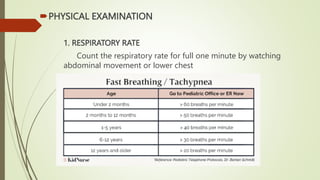
1. RESPIRATORY RATE
Count the respiratory rate for full one minute by watching
abdominal movement or lower chest
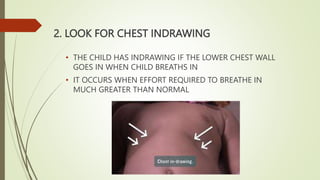
2. LOOK FOR CHEST INDRAWING
• THE CHILD HAS INDRAWING IF THE LOWER CHEST WALL
GOES IN WHEN CHILD BREATHS IN
• IT OCCURS WHEN EFFORT REQUIRED TO BREATHE IN
MUCH GREATER THAN NORMAL
3.LISTEN FOR STRIDOR :
• Makes a harsh noise when breathing
• It occurs when there is narrowing of the
larynx , trachea or epiglottis which interferes
with air entering the lungs
4.LOOK FOR WHEEZING
• High pitched whistling sound while breathing.
5.SEE IF CHILD IS DROWSY
6.CHECK BODY TEMPERATURE FOR FEVER OR LOW
BODY TEMPERATURE
7. CHECK FOR SEVERE MALNUTRITION
• High risk factor increases fatality rate
Severely malnourished children with
pneumonia may have impaired or absent
response to hypoxia and cough reflex
8. CYANOSIS
• Sign of hypoxia
CLASSIFICATION OF ILLNESS
• Child aged 2 Months upto 5 years
 Very severe disease.
Severe pneumonia.
 Pneumonia( not severe .)
No pneumonia:- cough or cold.
1.NO PNEUMONIA:COUGH OR COLD
SIGNS:-
No chest indrawing
No fast breathing
TREATMENT
If coughing more than 30 days,refer for assessment.
Assess and treat ear problems or sore throat,if present.
Assess and treat other problems.
Advice mother to give home care.
Treat fever, if present.
Treat wheezing, if present.
2.PNEUMONIA (NOT SEVERE )
SIGNS:-
Cough
No chest indrawing
Fast breathing
TREATMENT
Advice mother to give home care.
Antibiotic Cotrimoxazole is the drug of choice.
Treat fever, if present.
Treat wheezing, if present.
Advice mother to return with child in 2 days for
reassessment , or earlier if the child is getting worse .
Reassess in 2 days a child who is taking an antibiotic for
pneumonia.
3. SEVERE PNEUMONIA
 SIGNS:-
 Chest indrawing .
 Fast breathing.
 Nasal flaring:- nose widens as the child breaths in
 Grunting:- short sounds made with the voice  difficulty in
breathing.
 Cyanosis.
TREATMENT
Refer URGENTLY to hospital.
Give first dose of an antibiotic . DOC is IM benzyl
penicillin ( after test dose), ampicillin or
chloramphenicol.
Treat fever, if present.
Treat wheezing, if present ( if referral is not feasible,
treat with an antibiotic and follow closely.)
4.VERY SEVERE PNEMONIA
SIGNS:-
Not able to drink.
Convulsions.
 Abnormally sleepy and different to wake.
Stridor in calm child.
Severe malnutrition
TREATMENT
 Refer urgently to hospital.
 Give first dose of an antibiotics. Chloramphenicol IM is the
drug of choice . Treat for 48 hours - if condition improves
switch over to oral chloramphenicol Chloramphenicol – 10
days. If condition worsens switch to IM Cloxacilin and
gentamycin.
 Treat fever if present.
 Treat wheezing if present.
 If cerebral malaria is possible, give an antimalarial.
B.Young infant.
1) VERY SEVERE DISEASE.
• SIGNS:-
• Stopped feeding well.
• Convulsions
• Abnormally sleepy or difficulty to wake.
• Stridor in calm child , wheezing
• fever or low body temperature.
TREATMENT
Refer URGENTLY to hospital.
Keep young infant warm.
Give first dose of an antibiotic
2.Severe pneumonia
SIGNS:-
Severe chest indrawing or fast breathing.( 60 per minute
or more)
TREATMENT:-
Refer URGENTLY to hospital.
Keep young infant warm.
Give first dose of an antibiotic.( If referral is not feasible,
treat with an antibiotic and follow closely.)
3.NO PNEUMONIA
SIGNS:-
No severe chest indrawing and no fast breathing ( less
than 60 per minute).
TREATMENT:- Advise mother to give the following home
care.
Keep young infant warm.
Breast feed frequently.
Clear nose if it interferes with feeding.
Return quickly if:-
• Breathing is difficult.
• Breathing becomes fast.
• Feeding becomes a problem
• The young infant becomes sicker.
Prevention of ARI
 BREASTFEEDING :
• Excellent nutritional value
• Antibodies protect from infection
 AVOID IRRITANTS
• Smoke from cooking fires
• cow dung as fuel
 ADEQUATE NUTRIENTS
 IMMUNISATION
• MEASLES VACCINE
pneumonia is a serious complication of measles
Live attenuated vaccine
Freeze dried product
0.5 ml dose subcutaneously also IM is effective
Schedule 9th month
• HIB VACCINE
H.influenzae one the most important cause of death
due to pneumonia
Included in immunisation schedule
Combined preparation with DPT and poliomyelitis
3 or 4 doses are given depending on type of vaccine
Schedule: 6,10, 14 weeks , booster dose 12-18 months
Vaccine not offered to children more than 24 months
• PNEUMOCOCCAL VACCINE
PPV23 : polysaccharide non conjugate vaccine
Children under 2 years and immunocompromised do
not respond well to this vaccine
Dose -0.5 ml
IM in the deltoid
Select group – sickle cell disease , chronic heart
disease , DM , organ transplantation etc

Share ari-1......................,......pptx

  • 1.
  • 2.
     Acute respiratoryinfection (ARI) may cause inflammation of respiratory tract anywhere from nose to alveoli .  ARI is often classified into ARI of upper (AURI )or lower (ALRI) respiratory tract  AURI -common cold , pharyngitis and otitis media  ALRI-epiglottitis , laryngitis , laryngotracheitis , bronchitis , broncholitis and pneumonia  ARI in young infants , small children and elderly increases morbidity and mortality
  • 3.
     Acute lowerrespiratory tract infection (LRTI) is the chief cause of mortality in children below 5 years of age.  Most common etiological agent is bacteria  Common bacteria causing LRTI in preschool children (H.influenzae, S. pneumonia, staphylococci)  The WHO has recommended criteria for diagnosis of pneumonia applicable for countries where the infant mortality rate is >40/1000 live births.
  • 4.
    CLINICAL ASSESSMENT HISTORY TAKING •Age of child • Cough: duration , nature , diurnal variation , postural variation , productive or not • Associated with rapid breathing or not during sleeping or feeding • Difficulty in breathing • Fever : duration • If associated with drowsiness : duration , regain of consciousness • Associated convulsions • Cyanosis • Past history of diseases such as measles • History of any previous episodes and treatment
  • 5.
    PHYSICAL EXAMINATION 1. RESPIRATORYRATE Count the respiratory rate for full one minute by watching abdominal movement or lower chest
  • 6.
    2. LOOK FORCHEST INDRAWING • THE CHILD HAS INDRAWING IF THE LOWER CHEST WALL GOES IN WHEN CHILD BREATHS IN • IT OCCURS WHEN EFFORT REQUIRED TO BREATHE IN MUCH GREATER THAN NORMAL
  • 7.
    3.LISTEN FOR STRIDOR: • Makes a harsh noise when breathing • It occurs when there is narrowing of the larynx , trachea or epiglottis which interferes with air entering the lungs 4.LOOK FOR WHEEZING • High pitched whistling sound while breathing.
  • 8.
    5.SEE IF CHILDIS DROWSY 6.CHECK BODY TEMPERATURE FOR FEVER OR LOW BODY TEMPERATURE 7. CHECK FOR SEVERE MALNUTRITION • High risk factor increases fatality rate Severely malnourished children with pneumonia may have impaired or absent response to hypoxia and cough reflex 8. CYANOSIS • Sign of hypoxia
  • 9.
    CLASSIFICATION OF ILLNESS •Child aged 2 Months upto 5 years  Very severe disease. Severe pneumonia.  Pneumonia( not severe .) No pneumonia:- cough or cold.
  • 10.
    1.NO PNEUMONIA:COUGH ORCOLD SIGNS:- No chest indrawing No fast breathing
  • 11.
    TREATMENT If coughing morethan 30 days,refer for assessment. Assess and treat ear problems or sore throat,if present. Assess and treat other problems. Advice mother to give home care. Treat fever, if present. Treat wheezing, if present.
  • 12.
    2.PNEUMONIA (NOT SEVERE) SIGNS:- Cough No chest indrawing Fast breathing
  • 13.
    TREATMENT Advice mother togive home care. Antibiotic Cotrimoxazole is the drug of choice. Treat fever, if present. Treat wheezing, if present. Advice mother to return with child in 2 days for reassessment , or earlier if the child is getting worse . Reassess in 2 days a child who is taking an antibiotic for pneumonia.
  • 14.
    3. SEVERE PNEUMONIA SIGNS:-  Chest indrawing .  Fast breathing.  Nasal flaring:- nose widens as the child breaths in  Grunting:- short sounds made with the voice  difficulty in breathing.  Cyanosis.
  • 15.
    TREATMENT Refer URGENTLY tohospital. Give first dose of an antibiotic . DOC is IM benzyl penicillin ( after test dose), ampicillin or chloramphenicol. Treat fever, if present. Treat wheezing, if present ( if referral is not feasible, treat with an antibiotic and follow closely.)
  • 16.
    4.VERY SEVERE PNEMONIA SIGNS:- Notable to drink. Convulsions.  Abnormally sleepy and different to wake. Stridor in calm child. Severe malnutrition
  • 17.
    TREATMENT  Refer urgentlyto hospital.  Give first dose of an antibiotics. Chloramphenicol IM is the drug of choice . Treat for 48 hours - if condition improves switch over to oral chloramphenicol Chloramphenicol – 10 days. If condition worsens switch to IM Cloxacilin and gentamycin.  Treat fever if present.  Treat wheezing if present.  If cerebral malaria is possible, give an antimalarial.
  • 18.
    B.Young infant. 1) VERYSEVERE DISEASE. • SIGNS:- • Stopped feeding well. • Convulsions • Abnormally sleepy or difficulty to wake. • Stridor in calm child , wheezing • fever or low body temperature.
  • 19.
    TREATMENT Refer URGENTLY tohospital. Keep young infant warm. Give first dose of an antibiotic
  • 20.
    2.Severe pneumonia SIGNS:- Severe chestindrawing or fast breathing.( 60 per minute or more) TREATMENT:- Refer URGENTLY to hospital. Keep young infant warm. Give first dose of an antibiotic.( If referral is not feasible, treat with an antibiotic and follow closely.)
  • 21.
    3.NO PNEUMONIA SIGNS:- No severechest indrawing and no fast breathing ( less than 60 per minute). TREATMENT:- Advise mother to give the following home care. Keep young infant warm. Breast feed frequently. Clear nose if it interferes with feeding.
  • 22.
    Return quickly if:- •Breathing is difficult. • Breathing becomes fast. • Feeding becomes a problem • The young infant becomes sicker.
  • 23.
    Prevention of ARI BREASTFEEDING : • Excellent nutritional value • Antibodies protect from infection  AVOID IRRITANTS • Smoke from cooking fires • cow dung as fuel  ADEQUATE NUTRIENTS
  • 24.
     IMMUNISATION • MEASLESVACCINE pneumonia is a serious complication of measles Live attenuated vaccine Freeze dried product 0.5 ml dose subcutaneously also IM is effective Schedule 9th month
  • 25.
    • HIB VACCINE H.influenzaeone the most important cause of death due to pneumonia Included in immunisation schedule Combined preparation with DPT and poliomyelitis 3 or 4 doses are given depending on type of vaccine Schedule: 6,10, 14 weeks , booster dose 12-18 months Vaccine not offered to children more than 24 months
  • 26.
    • PNEUMOCOCCAL VACCINE PPV23: polysaccharide non conjugate vaccine Children under 2 years and immunocompromised do not respond well to this vaccine Dose -0.5 ml IM in the deltoid Select group – sickle cell disease , chronic heart disease , DM , organ transplantation etc