Pneumonia


     Dr Swati Das
Consultant Pulmonologist
Is It Pnemonia?


Clinical        Radiological
     Pneumonia is an acute infection of lung
    parenchyma


     Can be subdivided into different types
    according to epidemiological criteria
Epidemiological classification of
         Pneumonia
   CAP: Community Acquired Pneumonia
   HCAP: Health Care Associated Pneumonia
   HAP or NP: Hospital Acquired Pneumonia
   VAP: Ventilator Associated Pneumonia
Incidence of CAP


   Unknown in the most of countries

   5-11/1000 adults in US & UK*


                      *Eur Respir Mon, 2009, 43, 111–132
Pneumonia: a difficult diagnosis ?
Mr. SM

   69 years
   Does not smoke (anymore since two years)
   No co-morbids

   Cough since five days
   Coughs up some green phlegm
   Looks unwell
Mr. SM

   Pulse 92 reg
   BP 130/90mm Hg
   RR 20/min
   Temp 38.5 C
   Percussion: normal
   Auscultation: some scattered rhonchi
Mr. SM

   Diagnosis?

   Acute bronchitis
   Pneumonia
   Exacerbation COPD
Aetiology         Signs &      Diagnosis
Bacterial         symptoms     Bronchitis
Viral             Cough        COPD
Tumor             Fever        Heart failure
Cardiac           Crackles     Pneumonia
                  Rales        Lung cancer


            Nothing specific
Searching for the correct diagnosis
Questions on diagnosis

   How to detect pneumonia?
   Diagnostic value of signs and symptoms ???
   Additional value of tests?
Most important tests
Diagnostic models
• Hopstaken et al
       •Dry cough, diarrhoea, temp > 38 C
       •If all three present: 76% CAP, if none present: 6%
• Diehr et al
       •Absence of rhinorrhoea and sore throat, presence of night sweats,
       myalgia, sputum all day, resp rate > 25, fever
       • Score 1: 9% CAP, score 4, 27%, score 6 100%
• Khalil et al
       •Cough, chest pain, shortness of breath, temp>38, heart rate>100,
                                   Not Of help
       Resp rate>20, pulse oximetry<95%
       •Pos pred value 30%, neg pred value 99%
• Gonzales Ortiz et al
•      pathologic auscultation, neutrophilia, pleural pain, dyspnoea
•      pos pred value 23%, neg pred value 88%
• Melbye et al
•      Absence of coryza and sore throat, presence of dyspnoea, chest pain, crackles
       •Pos pred value 17%, neg pred value 79%
Additional tests
   Radiological investigations
   Tests to detect bacterial pathogens
      Gram stain, sputum c/s, blood c/s

      Urine test for Streptococcus pneumoniae
       sen>70%,specificity>95%,
      Legionella antigen

   Tests to detect viral pathogens
      Test for influenza

   Biomarkers
      CRP

      Procalcitonine/adrenomodulin
Site of care ?
AD, 50 ys


   Hello doctor, … I’ve got fever and dry cough since two
    days


   BP 120/70 HR 88r RR 18’ TEMP 39.0°C


   Breath sound diminished on right base


                HOSPITAL ADMISSION?
Hospital admission?

1. No, mild clinical syndrome

2. Yes, high fever

3. What about history?


              Otherwise healthy man
Hospital admission?
1. No, mild clinical syndrome in otherwise healthy man


               Pneumonia = 4  medium risk = 10%
DFE, 34

• Fever (38.5°C) 2days
• Dry cough 3days
• Physical examination:
                                            Chest x-ray
• non-ill; BP 130/80 HR 96r RR 20’
• rales right lung base
          You - his physician –
                decide …
… to hospitalise him


       WHY?
History is lacking:
     the patient underwent splenectomy 2 years before


                   He is immunocompromised
             at risk for development of severe fulminant sepsis
             (especially by S. pneumoniae and H. influenzae)
FP, 81 ys


• Fever   (37.7°C) started one day before
• non-productive cough
• Non-ill; BP 120/85 HR 90 RR 20’
• Co-morbids-DM, CHF;

                 What would you do?
FP, 81 ys


1. admit to hospital


2. treat him as outpatient


    admit to hospital: patient at risk for adverse outcome
Pneumonia + age + CHF + DM = 9  complications risk = 31%
DA, 63 ys


•Fever (37.9°C) started two days before
• non-productive cough


 You - his physician - decide that your patient
     is a candidate for hospital admission


                Why?
DA, 63 ys, otherwise healthy


• Fever (37.9°C) started two days before
• non-productive cough


                 The speech is interrupted by frequent breaths


         Hello doctor            I’ve got fever            and dry cough            since two days

breath                  breath                    breath                   breath                    breath
CRB-65 predicts death from community-acquired pneumonia


•Analysis performed on 1343 patients (208 out-patients and 1135 hospitalized)
with all data sets completed for the calculation of CURB, CRB and CRB-65


•Validated in 1967 patients (482 out-patients and 1485 hospitalized)


                                                 Bauer TT et al. J Intern Med. 2006; 260:93-101
CURB–65 score
Score one point for presence of each Clinical feature (0 –
    5)
       1. Confusion
       2. Urea > 7 mmol/l
       3. Respiratory rate  30/min
       4. Blood pressure (SBP <90 or DBP  60mmHg)
       5. Age  65yrs


  (Albumin < 30 g/dl had an      OR 4.7 [2.5-8.7]    <0.001)


                  Lim et al Thorax 2003;58:377-382
CURB 65

   0-1=Outpatient
   2=Hospital
   >=3 HDU/ICU
RESULTS: Overall 30-day mortality was 4.3% (0.6% in out-patients and 5.5% in hospitalized patients,
p<0.0001). Overall, the CURB, CRB and CRB-65 scores provided comparable predictions for death from CAP


CONCLUSIONS: Both the CURB and CRB-65 scores can be used in the hospital and
out-patients setting to assess pneumonia severity and the risk of death

Given that the CRB-65 is easier to handle, we favor the use of CRB-65 where blood
urea nitrogen is unavailable
                                                                     Bauer TT et al. J Intern Med. 2006; 260:93-101
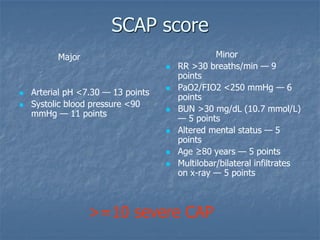
SCAP score
          Major                                   Minor
                                       RR >30 breaths/min — 9
                                        points
                                       PaO2/FIO2 <250 mmHg — 6
   Arterial pH <7.30 — 13 points
                                        points
   Systolic blood pressure <90
                                       BUN >30 mg/dL (10.7 mmol/L)
    mmHg — 11 points
                                        — 5 points
                                       Altered mental status — 5
                                        points
                                       Age ≥80 years — 5 points
                                       Multilobar/bilateral infiltrates
                                        on x-ray — 5 points


                  >=10 severe CAP
EMPIRIC TREATMENT?
                    YES !!!
              Based on knowledge….
               …..You need to know
   Epidemiology in YOUR area
   Rate of antibiotic resistance in YOUR area
     Please do not forget Microbiology work
                        up……
             EVEN IF IT COSTS….
Factors in empirical antibiotic choice for CAP

      GEOGRAPHY

      Spectrum of causative pathogen
      Acquired antibiotic resistance
      THE PATIENT
      Illness severity
      Other characteristics (eg age, vomiting)
      THE ANTIBIOTIC
      Randomised controlled trial
      Drug side effects
      Cost
GEOGRAPHICAL VARIATION IN
      (32 prospective studies; n = 8211)
CAP                                      %
                0        10        20         30          40

S pneumoniae


 H influenzae


   Legionella


Staph aureus


      GNEB


                    UK    Europe   AUS + NZ   N America
GEOGRAPHICAL VARIATION IN
      (32 prospective studies; n = 8211)
CAP                                      %
                 0        5        10         15          20

M pneumoniae


C pneumoniae


    C psittaci


    C burnetii


      Viruses


                     UK   Europe   AUS + NZ   N America
ANTIBIOTIC THERAPY


S pneumoniae
H influenzae    B-lactam
                            Macrolide
Mycoplasma                  Tetracycline
Chlamydia                                  Fluoroquinolone
Legionella

Gram-negative
 bacteria       Cephalosporin
ATS/IDSA


INPATIENT – NON-ICU


Fluoroquinolone (strong recommendation; level I evidence)
-lactam + macrolide
              (strong recommendation; level I evidence)


    Mandell et al Clin Infect Dis 2007;44(Suppl 2):S27-S72
ATS/IDSA GUIDELINES

    INPATIENT – ICU
-lactam +
Either Azithromycin (level II evidence)
or Fluoroquinolone (strong recommendation; level I evidence)

    For Pseudomonas
 Anti-pseudomonal -lactam +
 Either cipro or levo (level II evidence)
 or above -lactam + gentamicin + azithromycin
 or above -lactam + antipneumococcal fluoroquinolone
         (weak recommendation; level III evidence)

        Mandell et al Clin Infect Dis 2007;44(Suppl 2):S27-S72
34 yrs, Chinese; ER visit for fever and blood-tinged sputum
Risk factors for TB


    Yes/No


IF YES NO QUINOLONES
Antibiotic within 6 hours
and oxygen therapy
Conclusion

   Clinical assessment
   Know your local epidemiology
   Be aware of national and international
    outbreaks
   Never forget Mycobacterium tuberculosis
Pneumonia management

Pneumonia management

  • 1.
    Pneumonia Dr Swati Das Consultant Pulmonologist
  • 2.
  • 3.
    Pneumonia is an acute infection of lung parenchyma  Can be subdivided into different types according to epidemiological criteria
  • 4.
    Epidemiological classification of Pneumonia  CAP: Community Acquired Pneumonia  HCAP: Health Care Associated Pneumonia  HAP or NP: Hospital Acquired Pneumonia  VAP: Ventilator Associated Pneumonia
  • 5.
    Incidence of CAP  Unknown in the most of countries  5-11/1000 adults in US & UK* *Eur Respir Mon, 2009, 43, 111–132
  • 6.
  • 7.
    Mr. SM  69 years  Does not smoke (anymore since two years)  No co-morbids  Cough since five days  Coughs up some green phlegm  Looks unwell
  • 8.
    Mr. SM  Pulse 92 reg  BP 130/90mm Hg  RR 20/min  Temp 38.5 C  Percussion: normal  Auscultation: some scattered rhonchi
  • 9.
    Mr. SM  Diagnosis?  Acute bronchitis  Pneumonia  Exacerbation COPD
  • 10.
    Aetiology Signs & Diagnosis Bacterial symptoms Bronchitis Viral Cough COPD Tumor Fever Heart failure Cardiac Crackles Pneumonia Rales Lung cancer Nothing specific
  • 11.
    Searching for thecorrect diagnosis
  • 12.
    Questions on diagnosis  How to detect pneumonia?  Diagnostic value of signs and symptoms ???  Additional value of tests?
  • 13.
  • 14.
    Diagnostic models • Hopstakenet al •Dry cough, diarrhoea, temp > 38 C •If all three present: 76% CAP, if none present: 6% • Diehr et al •Absence of rhinorrhoea and sore throat, presence of night sweats, myalgia, sputum all day, resp rate > 25, fever • Score 1: 9% CAP, score 4, 27%, score 6 100% • Khalil et al •Cough, chest pain, shortness of breath, temp>38, heart rate>100, Not Of help Resp rate>20, pulse oximetry<95% •Pos pred value 30%, neg pred value 99% • Gonzales Ortiz et al • pathologic auscultation, neutrophilia, pleural pain, dyspnoea • pos pred value 23%, neg pred value 88% • Melbye et al • Absence of coryza and sore throat, presence of dyspnoea, chest pain, crackles •Pos pred value 17%, neg pred value 79%
  • 15.
    Additional tests  Radiological investigations  Tests to detect bacterial pathogens  Gram stain, sputum c/s, blood c/s  Urine test for Streptococcus pneumoniae sen>70%,specificity>95%,  Legionella antigen  Tests to detect viral pathogens  Test for influenza  Biomarkers  CRP  Procalcitonine/adrenomodulin
  • 16.
  • 17.
    AD, 50 ys  Hello doctor, … I’ve got fever and dry cough since two days  BP 120/70 HR 88r RR 18’ TEMP 39.0°C  Breath sound diminished on right base HOSPITAL ADMISSION?
  • 18.
    Hospital admission? 1. No,mild clinical syndrome 2. Yes, high fever 3. What about history? Otherwise healthy man
  • 19.
    Hospital admission? 1. No,mild clinical syndrome in otherwise healthy man Pneumonia = 4  medium risk = 10%
  • 20.
    DFE, 34 • Fever(38.5°C) 2days • Dry cough 3days • Physical examination: Chest x-ray • non-ill; BP 130/80 HR 96r RR 20’ • rales right lung base You - his physician – decide …
  • 21.
  • 22.
    History is lacking: the patient underwent splenectomy 2 years before He is immunocompromised at risk for development of severe fulminant sepsis (especially by S. pneumoniae and H. influenzae)
  • 23.
    FP, 81 ys •Fever (37.7°C) started one day before • non-productive cough • Non-ill; BP 120/85 HR 90 RR 20’ • Co-morbids-DM, CHF; What would you do?
  • 24.
    FP, 81 ys 1.admit to hospital 2. treat him as outpatient admit to hospital: patient at risk for adverse outcome
  • 26.
    Pneumonia + age+ CHF + DM = 9  complications risk = 31%
  • 27.
    DA, 63 ys •Fever(37.9°C) started two days before • non-productive cough You - his physician - decide that your patient is a candidate for hospital admission Why?
  • 28.
    DA, 63 ys,otherwise healthy • Fever (37.9°C) started two days before • non-productive cough The speech is interrupted by frequent breaths Hello doctor I’ve got fever and dry cough since two days breath breath breath breath breath
  • 29.
    CRB-65 predicts deathfrom community-acquired pneumonia •Analysis performed on 1343 patients (208 out-patients and 1135 hospitalized) with all data sets completed for the calculation of CURB, CRB and CRB-65 •Validated in 1967 patients (482 out-patients and 1485 hospitalized) Bauer TT et al. J Intern Med. 2006; 260:93-101
  • 30.
    CURB–65 score Score onepoint for presence of each Clinical feature (0 – 5) 1. Confusion 2. Urea > 7 mmol/l 3. Respiratory rate  30/min 4. Blood pressure (SBP <90 or DBP  60mmHg) 5. Age  65yrs (Albumin < 30 g/dl had an OR 4.7 [2.5-8.7] <0.001) Lim et al Thorax 2003;58:377-382
  • 31.
    CURB 65  0-1=Outpatient  2=Hospital  >=3 HDU/ICU
  • 32.
    RESULTS: Overall 30-daymortality was 4.3% (0.6% in out-patients and 5.5% in hospitalized patients, p<0.0001). Overall, the CURB, CRB and CRB-65 scores provided comparable predictions for death from CAP CONCLUSIONS: Both the CURB and CRB-65 scores can be used in the hospital and out-patients setting to assess pneumonia severity and the risk of death Given that the CRB-65 is easier to handle, we favor the use of CRB-65 where blood urea nitrogen is unavailable Bauer TT et al. J Intern Med. 2006; 260:93-101
  • 33.
    SCAP score Major Minor  RR >30 breaths/min — 9 points  PaO2/FIO2 <250 mmHg — 6  Arterial pH <7.30 — 13 points points  Systolic blood pressure <90  BUN >30 mg/dL (10.7 mmol/L) mmHg — 11 points — 5 points  Altered mental status — 5 points  Age ≥80 years — 5 points  Multilobar/bilateral infiltrates on x-ray — 5 points >=10 severe CAP
  • 34.
    EMPIRIC TREATMENT? YES !!! Based on knowledge…. …..You need to know  Epidemiology in YOUR area  Rate of antibiotic resistance in YOUR area Please do not forget Microbiology work up…… EVEN IF IT COSTS….
  • 35.
    Factors in empiricalantibiotic choice for CAP GEOGRAPHY Spectrum of causative pathogen Acquired antibiotic resistance THE PATIENT Illness severity Other characteristics (eg age, vomiting) THE ANTIBIOTIC Randomised controlled trial Drug side effects Cost
  • 36.
    GEOGRAPHICAL VARIATION IN (32 prospective studies; n = 8211) CAP % 0 10 20 30 40 S pneumoniae H influenzae Legionella Staph aureus GNEB UK Europe AUS + NZ N America
  • 37.
    GEOGRAPHICAL VARIATION IN (32 prospective studies; n = 8211) CAP % 0 5 10 15 20 M pneumoniae C pneumoniae C psittaci C burnetii Viruses UK Europe AUS + NZ N America
  • 38.
    ANTIBIOTIC THERAPY S pneumoniae Hinfluenzae B-lactam Macrolide Mycoplasma Tetracycline Chlamydia Fluoroquinolone Legionella Gram-negative bacteria Cephalosporin
  • 39.
    ATS/IDSA INPATIENT – NON-ICU Fluoroquinolone(strong recommendation; level I evidence) -lactam + macrolide (strong recommendation; level I evidence) Mandell et al Clin Infect Dis 2007;44(Suppl 2):S27-S72
  • 40.
    ATS/IDSA GUIDELINES INPATIENT – ICU -lactam + Either Azithromycin (level II evidence) or Fluoroquinolone (strong recommendation; level I evidence) For Pseudomonas Anti-pseudomonal -lactam + Either cipro or levo (level II evidence) or above -lactam + gentamicin + azithromycin or above -lactam + antipneumococcal fluoroquinolone (weak recommendation; level III evidence) Mandell et al Clin Infect Dis 2007;44(Suppl 2):S27-S72
  • 41.
    34 yrs, Chinese;ER visit for fever and blood-tinged sputum
  • 42.
    Risk factors forTB Yes/No IF YES NO QUINOLONES
  • 45.
    Antibiotic within 6hours and oxygen therapy
  • 46.
    Conclusion  Clinical assessment  Know your local epidemiology  Be aware of national and international outbreaks  Never forget Mycobacterium tuberculosis