Acute pancreatitis
Dr Lalit K Shah
Resident 1st year
General Surgery
Anatomy
• Pancreas is derived from Greek word ‘pan’ (all) and
‘kreas’ (flesh)
• Pancreas is situated in the retroperitoneum
• The average pancreas weighs beween 75 g to 125 g and
measures 10 cm to 20 cm
• Anatomically divided into five sections, the head;
uncinate; neck; body and tail
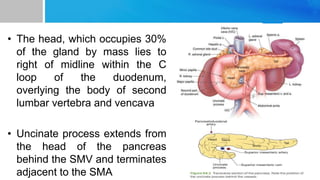
• The head, which occupies 30%
of the gland by mass lies to
right of midline within the C
loop of the duodenum,
overlying the body of second
lumbar vertebra and vencava
• Uncinate process extends from
the head of the pancreas
behind the SMV and terminates
adjacent to the SMA
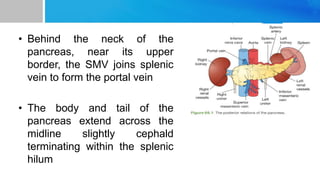
• Behind the neck of the
pancreas, near its upper
border, the SMV joins splenic
vein to form the portal vein
• The body and tail of the
pancreas extend across the
midline slightly cephald
terminating within the splenic
hilum
Arterial Supply
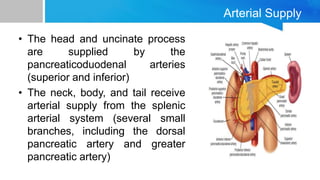
• The head and uncinate process
are supplied by the
pancreaticoduodenal arteries
(superior and inferior)
• The neck, body, and tail receive
arterial supply from the splenic
arterial system (several small
branches, including the dorsal
pancreatic artery and greater
pancreatic artery)
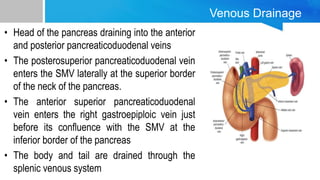
Venous Drainage
• Head of the pancreas draining into the anterior
and posterior pancreaticoduodenal veins
• The posterosuperior pancreaticoduodenal vein
enters the SMV laterally at the superior border
of the neck of the pancreas.
• The anterior superior pancreaticoduodenal
vein enters the right gastroepiploic vein just
before its confluence with the SMV at the
inferior border of the pancreas
• The body and tail are drained through the
splenic venous system
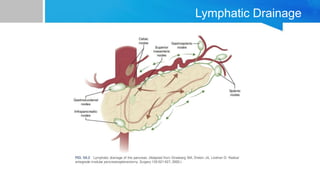
Lymphatic Drainage
Definition
• Pancreatitis is inflammation of the pancreatic parenchyma
• Acute pancreatitis is defined as an acute condition
presenting with abdominal pain, a threefold or greater rise
in the serum levels of the pancreatic enzymes amylase or
lipase, and/or characteristic findings of pancreatic
inflammation on contrast-enhanced CT
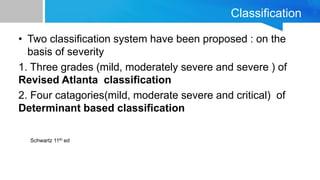
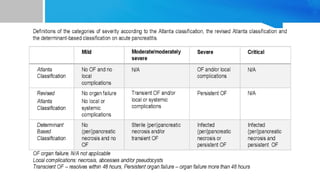
Classification
• Two classification system have been proposed : on the
basis of severity
1. Three grades (mild, moderately severe and severe ) of
Revised Atlanta classification
2. Four catagories(mild, moderate severe and critical) of
Determinant based classification
Schwartz 11th ed
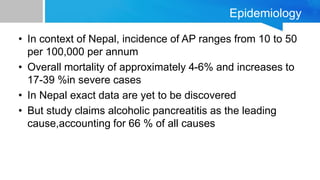
Epidemiology
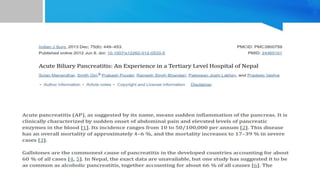
• In context of Nepal, incidence of AP ranges from 10 to 50
per 100,000 per annum
• Overall mortality of approximately 4-6% and increases to
17-39 %in severe cases
• In Nepal exact data are yet to be discovered
• But study claims alcoholic pancreatitis as the leading
cause,accounting for 66 % of all causes
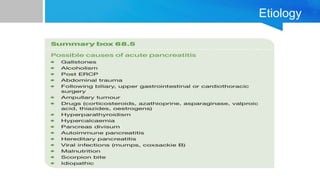
Etiology
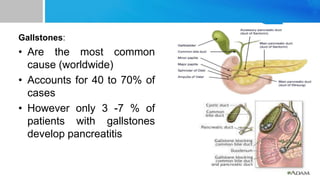
Gallstones:
• Are the most common
cause (worldwide)
• Accounts for 40 to 70% of
cases
• However only 3 -7 % of
patients with gallstones
develop pancreatitis
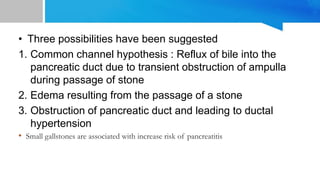
• Three possibilities have been suggested
1. Common channel hypothesis : Reflux of bile into the
pancreatic duct due to transient obstruction of ampulla
during passage of stone
2. Edema resulting from the passage of a stone
3. Obstruction of pancreatic duct and leading to ductal
hypertension
• Small gallstones are associated with increase risk of pancreatitis
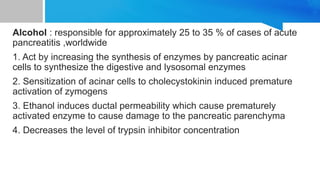
Alcohol : responsible for approximately 25 to 35 % of cases of acute
pancreatitis ,worldwide
1. Act by increasing the synthesis of enzymes by pancreatic acinar
cells to synthesize the digestive and lysosomal enzymes
2. Sensitization of acinar cells to cholecystokinin induced premature
activation of zymogens
3. Ethanol induces ductal permeability which cause prematurely
activated enzyme to cause damage to the pancreatic parenchyma
4. Decreases the level of trypsin inhibitor concentration
Hyper lipidemia :
• Lipase liberates toxic fatty acid into pancreatic micro
circulation
• Leads to impairment of pancreatic microcirculation and
ischemia
• Hereditary pancreatitis : Autosomal dominant disease
related to mutation of trypsinogenic gene
• Drugs : Thaizides diuretics, frusemide, Estrogen
replacement therapy,steroid therapy , propofol
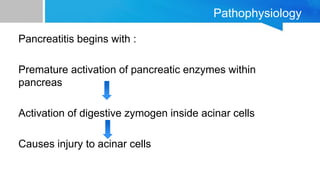
Pathophysiology
Pancreatitis begins with :
Premature activation of pancreatic enzymes within
pancreas
Activation of digestive zymogen inside acinar cells
Causes injury to acinar cells
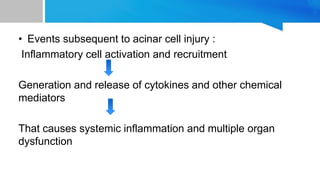
• Events subsequent to acinar cell injury :
Inflammatory cell activation and recruitment
Generation and release of cytokines and other chemical
mediators
That causes systemic inflammation and multiple organ
dysfunction
Diagnosis
• Modalities of diagnosis
1.Detailed history
2.Thorough examination
3.Appropriate investigations
Detailed History
Clinical Presentation
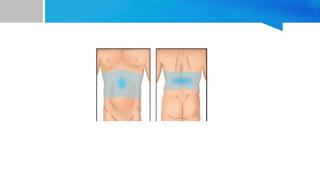
• Pain is the cardinal symptom
• Characteristically develops quickly, reaching maximum
intensity within minutes
• Pain is severe , constant and refractory to the usual dose
of analgesics
• Usually experienced in the epigastrium, but may be
localized to the upper quadrant or diffused throughout
abdomen
• Radiates to back in 50% of the patient
• In some ,relieved by leaning forward
• Nausea ,repeated vomiting and retching are marked
• Retching may persists even if stomach is kept empty by
nasogastric aspiration
Thorough Examination
• Can be fair looking or at the extreme, gravely ill look with
profound shock toxicity and confusion
• Tachypnea and tachycardia is usual, hypotension can be
present
• Body temperature is often normal, but rises as
inflammation develops
• Mild icteric due to biliary obstruction in gall stone
pancreatitis
• Bleeding into fascial plane can produce bluish
discoloration Flanks (Grey turner’s sign) or umbilicus
(cullen’s sign)
• Usually muscle guarding in upper abdomen
• Pleural effusion present in 10-20% of patients
• Another rare sign is tetany due to hypocalcemia
Appropriate Investigations
• Investigations of acute pancreatitis must be based on :
1. Is a diagnosis of acute pancreatitis correct ?
2. How severe is the attack ?
3. What is the etiology ?
Laboratory
Serum amylase or lipase (> 3 times upper limit of normal)
• Serum amylase concentrates rises immediately with onset
of disease
• Peaks within several hours and remains elevated for 3-5
days
• No correlation between extent of serum amylase elevation
and severity
• Serum lipase if available, is more sensitive and specific
then amylase
Imaging
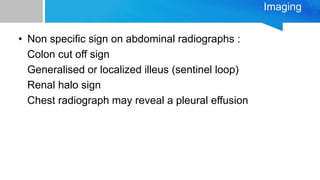
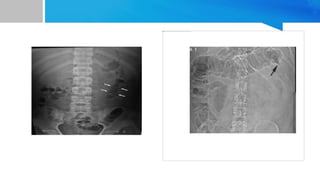
• Non specific sign on abdominal radiographs :
Colon cut off sign
Generalised or localized illeus (sentinel loop)
Renal halo sign
Chest radiograph may reveal a pleural effusion
• USG doesnot establish the diagnosis of acute pancreatitis
• Should be performed :
To detect gallstone,as a potential cause
To rule out acute cholecystitis
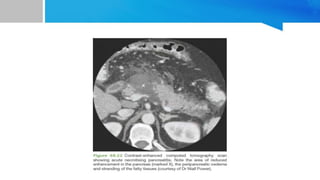
• CECT is indicated in following :
1. If there is diagnostic uncertainty.
2. In patients with severe acute pancreatitis, to distinguish
interstitial from necrotising pancreatitis
3. Severity of pancreatitis detected on CT be staged a/c to
balthazar score
4. In patients with organ failure, signs of sepsis and clinical
deterioration
5.When localized collection is suspected, fluid collection,
psuedocyst
• MRI and MRCP ,are used increasingly to diagnose and
assess severity
• MRI appears to be comparable to CT :
As effective as CT in demonstrating presence and extent of
pancreatic necrosis and fluid collection
Regarding the severity of the disease
Probably superior for indicating the suitability of collections
for non surgical drainage
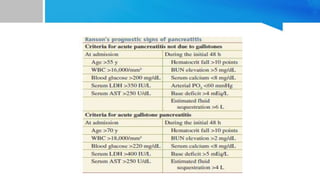
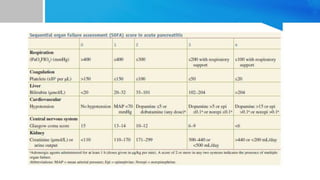
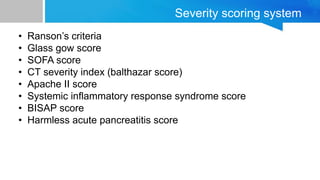
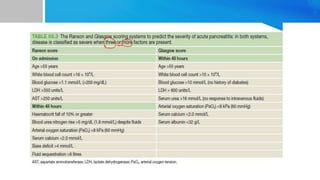
Severity scoring system
• Ranson’s criteria
• Glass gow score
• SOFA score
• CT severity index (balthazar score)
• Apache II score
• Systemic inflammatory response syndrome score
• BISAP score
• Harmless acute pancreatitis score
Harmless Acute Pancreatitis Score
• Assess for the following features :
. No sign of peritonitis
Normal serum creatinine
Normal Hematocrit
If all three features are present ,it is 98% accurate at
identifying patients with a non severe disease
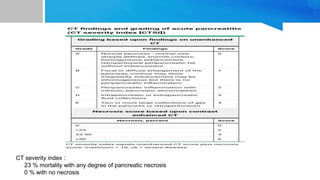
CT severity index :
23 % mortality with any degree of pancreatic necrosis
0 % with no necrosis
Treatment
• After initial assessment if a patient is considered to have mild
acute pancreatitis
A conservative approach is indicated with IV fluids and
frequent observation
Brief period of fasting for patient who is nauseated, prolonged
Nil by mouth has got little physiological justification
Antibiotics are not indicated
Apart from analgesic and anti emetics ,No drugs and
intervention are warranted
Early Management of Severe acute Pancreatitis
• Admission to HDU/ICU
• Analgesia
• Aggressive fluid rehydration
• Supplemental oxygen
• Invasive monitoring of vital signs, central venous
pressure, urine output, blood gases
• Frequent monitoring of haematological and biochemical
parameters (including liver and renal function, clotting, serum calcium,
blood glucose)
• Nasogastric drainage (only initially)
• Antibiotics if cholangitis suspected; prophylactic antibiotics can be
considered
• CT scan essential if organ failure, clinical deterioration or signs of
sepsis develop
• ERCP within 72 hours for severe gallstone pancreatitis or signs of
cholangitis
• Supportive therapy for organ failure if it develops (inotropes,
ventilatory support, haemofiltration,)
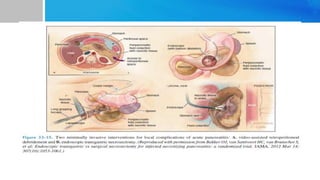
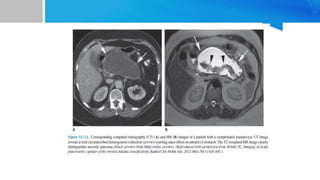
Local complications
• Acute (< 4 weeks, No defined walls)
 Acute pancreatic fluid collection
 Acute necrotic collection
• Chronic ( > 4 weeks, Defined walls)
 Pancreatic pseudocyst
 Walled of necrosis
Systemic complications
1.Cardiovascular
Shock, Arrhythmias
2. Pulmonary
ARDS ,Pulmonary Effusion
3.Renal failure
4.Haematological
5. Metabolic
Hypocalcaemia
Hyperglycaemia
Hyperlipidaemia
6. Gastrointestinal
Ileus ,GI hemmorrhage
7. Neurological
Visual disturbances
Confusion, irritability
Encephalopathy
8. Miscellaneous
Subcutaneous fat necrosis, Arthralgia

Acute pancreatitis

  • 1.
    Acute pancreatitis Dr LalitK Shah Resident 1st year General Surgery
  • 2.
    Anatomy • Pancreas isderived from Greek word ‘pan’ (all) and ‘kreas’ (flesh) • Pancreas is situated in the retroperitoneum • The average pancreas weighs beween 75 g to 125 g and measures 10 cm to 20 cm • Anatomically divided into five sections, the head; uncinate; neck; body and tail
  • 3.
    • The head,which occupies 30% of the gland by mass lies to right of midline within the C loop of the duodenum, overlying the body of second lumbar vertebra and vencava • Uncinate process extends from the head of the pancreas behind the SMV and terminates adjacent to the SMA
  • 4.
    • Behind theneck of the pancreas, near its upper border, the SMV joins splenic vein to form the portal vein • The body and tail of the pancreas extend across the midline slightly cephald terminating within the splenic hilum
  • 5.
    Arterial Supply • Thehead and uncinate process are supplied by the pancreaticoduodenal arteries (superior and inferior) • The neck, body, and tail receive arterial supply from the splenic arterial system (several small branches, including the dorsal pancreatic artery and greater pancreatic artery)
  • 6.
    Venous Drainage • Headof the pancreas draining into the anterior and posterior pancreaticoduodenal veins • The posterosuperior pancreaticoduodenal vein enters the SMV laterally at the superior border of the neck of the pancreas. • The anterior superior pancreaticoduodenal vein enters the right gastroepiploic vein just before its confluence with the SMV at the inferior border of the pancreas • The body and tail are drained through the splenic venous system
  • 7.
  • 9.
    Definition • Pancreatitis isinflammation of the pancreatic parenchyma • Acute pancreatitis is defined as an acute condition presenting with abdominal pain, a threefold or greater rise in the serum levels of the pancreatic enzymes amylase or lipase, and/or characteristic findings of pancreatic inflammation on contrast-enhanced CT
  • 10.
    Classification • Two classificationsystem have been proposed : on the basis of severity 1. Three grades (mild, moderately severe and severe ) of Revised Atlanta classification 2. Four catagories(mild, moderate severe and critical) of Determinant based classification Schwartz 11th ed
  • 12.
    Epidemiology • In contextof Nepal, incidence of AP ranges from 10 to 50 per 100,000 per annum • Overall mortality of approximately 4-6% and increases to 17-39 %in severe cases • In Nepal exact data are yet to be discovered • But study claims alcoholic pancreatitis as the leading cause,accounting for 66 % of all causes
  • 14.
  • 15.
    Gallstones: • Are themost common cause (worldwide) • Accounts for 40 to 70% of cases • However only 3 -7 % of patients with gallstones develop pancreatitis
  • 16.
    • Three possibilitieshave been suggested 1. Common channel hypothesis : Reflux of bile into the pancreatic duct due to transient obstruction of ampulla during passage of stone 2. Edema resulting from the passage of a stone 3. Obstruction of pancreatic duct and leading to ductal hypertension • Small gallstones are associated with increase risk of pancreatitis
  • 17.
    Alcohol : responsiblefor approximately 25 to 35 % of cases of acute pancreatitis ,worldwide 1. Act by increasing the synthesis of enzymes by pancreatic acinar cells to synthesize the digestive and lysosomal enzymes 2. Sensitization of acinar cells to cholecystokinin induced premature activation of zymogens 3. Ethanol induces ductal permeability which cause prematurely activated enzyme to cause damage to the pancreatic parenchyma 4. Decreases the level of trypsin inhibitor concentration
  • 18.
    Hyper lipidemia : •Lipase liberates toxic fatty acid into pancreatic micro circulation • Leads to impairment of pancreatic microcirculation and ischemia
  • 19.
    • Hereditary pancreatitis: Autosomal dominant disease related to mutation of trypsinogenic gene • Drugs : Thaizides diuretics, frusemide, Estrogen replacement therapy,steroid therapy , propofol
  • 20.
    Pathophysiology Pancreatitis begins with: Premature activation of pancreatic enzymes within pancreas Activation of digestive zymogen inside acinar cells Causes injury to acinar cells
  • 21.
    • Events subsequentto acinar cell injury : Inflammatory cell activation and recruitment Generation and release of cytokines and other chemical mediators That causes systemic inflammation and multiple organ dysfunction
  • 22.
    Diagnosis • Modalities ofdiagnosis 1.Detailed history 2.Thorough examination 3.Appropriate investigations
  • 23.
    Detailed History Clinical Presentation •Pain is the cardinal symptom • Characteristically develops quickly, reaching maximum intensity within minutes • Pain is severe , constant and refractory to the usual dose of analgesics • Usually experienced in the epigastrium, but may be localized to the upper quadrant or diffused throughout abdomen
  • 24.
    • Radiates toback in 50% of the patient • In some ,relieved by leaning forward • Nausea ,repeated vomiting and retching are marked • Retching may persists even if stomach is kept empty by nasogastric aspiration
  • 26.
    Thorough Examination • Canbe fair looking or at the extreme, gravely ill look with profound shock toxicity and confusion • Tachypnea and tachycardia is usual, hypotension can be present • Body temperature is often normal, but rises as inflammation develops • Mild icteric due to biliary obstruction in gall stone pancreatitis
  • 27.
    • Bleeding intofascial plane can produce bluish discoloration Flanks (Grey turner’s sign) or umbilicus (cullen’s sign) • Usually muscle guarding in upper abdomen • Pleural effusion present in 10-20% of patients • Another rare sign is tetany due to hypocalcemia
  • 28.
    Appropriate Investigations • Investigationsof acute pancreatitis must be based on : 1. Is a diagnosis of acute pancreatitis correct ? 2. How severe is the attack ? 3. What is the etiology ?
  • 29.
    Laboratory Serum amylase orlipase (> 3 times upper limit of normal) • Serum amylase concentrates rises immediately with onset of disease • Peaks within several hours and remains elevated for 3-5 days • No correlation between extent of serum amylase elevation and severity • Serum lipase if available, is more sensitive and specific then amylase
  • 30.
    Imaging • Non specificsign on abdominal radiographs : Colon cut off sign Generalised or localized illeus (sentinel loop) Renal halo sign Chest radiograph may reveal a pleural effusion
  • 32.
    • USG doesnotestablish the diagnosis of acute pancreatitis • Should be performed : To detect gallstone,as a potential cause To rule out acute cholecystitis
  • 33.
    • CECT isindicated in following : 1. If there is diagnostic uncertainty. 2. In patients with severe acute pancreatitis, to distinguish interstitial from necrotising pancreatitis 3. Severity of pancreatitis detected on CT be staged a/c to balthazar score 4. In patients with organ failure, signs of sepsis and clinical deterioration 5.When localized collection is suspected, fluid collection, psuedocyst
  • 35.
    • MRI andMRCP ,are used increasingly to diagnose and assess severity • MRI appears to be comparable to CT : As effective as CT in demonstrating presence and extent of pancreatic necrosis and fluid collection Regarding the severity of the disease Probably superior for indicating the suitability of collections for non surgical drainage
  • 37.
    Severity scoring system •Ranson’s criteria • Glass gow score • SOFA score • CT severity index (balthazar score) • Apache II score • Systemic inflammatory response syndrome score • BISAP score • Harmless acute pancreatitis score
  • 41.
    Harmless Acute PancreatitisScore • Assess for the following features : . No sign of peritonitis Normal serum creatinine Normal Hematocrit If all three features are present ,it is 98% accurate at identifying patients with a non severe disease
  • 42.
    CT severity index: 23 % mortality with any degree of pancreatic necrosis 0 % with no necrosis
  • 43.
    Treatment • After initialassessment if a patient is considered to have mild acute pancreatitis A conservative approach is indicated with IV fluids and frequent observation Brief period of fasting for patient who is nauseated, prolonged Nil by mouth has got little physiological justification Antibiotics are not indicated Apart from analgesic and anti emetics ,No drugs and intervention are warranted
  • 44.
    Early Management ofSevere acute Pancreatitis • Admission to HDU/ICU • Analgesia • Aggressive fluid rehydration • Supplemental oxygen • Invasive monitoring of vital signs, central venous pressure, urine output, blood gases • Frequent monitoring of haematological and biochemical parameters (including liver and renal function, clotting, serum calcium, blood glucose)
  • 45.
    • Nasogastric drainage(only initially) • Antibiotics if cholangitis suspected; prophylactic antibiotics can be considered • CT scan essential if organ failure, clinical deterioration or signs of sepsis develop • ERCP within 72 hours for severe gallstone pancreatitis or signs of cholangitis • Supportive therapy for organ failure if it develops (inotropes, ventilatory support, haemofiltration,)
  • 46.
    Local complications • Acute(< 4 weeks, No defined walls)  Acute pancreatic fluid collection  Acute necrotic collection • Chronic ( > 4 weeks, Defined walls)  Pancreatic pseudocyst  Walled of necrosis
  • 48.
    Systemic complications 1.Cardiovascular Shock, Arrhythmias 2.Pulmonary ARDS ,Pulmonary Effusion 3.Renal failure 4.Haematological
  • 49.
    5. Metabolic Hypocalcaemia Hyperglycaemia Hyperlipidaemia 6. Gastrointestinal Ileus,GI hemmorrhage 7. Neurological Visual disturbances Confusion, irritability Encephalopathy 8. Miscellaneous Subcutaneous fat necrosis, Arthralgia

Editor's Notes

  • #6 Pancreas is supplied by a complex arterial network arising from the celiac trunk and SMA.. superior pancraticoduodenal arise form gtroduodenal and divides into anterior and posterior and runs inferiorly in wihin the pancreaticoduodenal groove