ACUTE LIMB ISCHEMIA
Dr. Walid Gamal, MD
Assistant Professor and Head of Vascular Surgery
Department, Qena Faculty Of Medicine
South Valley University
Surgical anatomy
1
-
large arteries: e.g. aorta, they contain
considerable elastic tissue
2
-
medium sized arteries:e.g femoral artery,these posses
less elastic tissue and more
muscle fibers
3
-
small sized arteries:e.g digital arteries,the wall is
primarily of smooth muscle fibers
4
-
Terminal arteries:these are vessels 50-100 microns in
diameter ,their wall is composed of endothelial
lining ,internal elastic lamina and 2 layers of smooth
muscle fibers
.
5- Arterioles: have a diameter of 20-50 microns,they
are similar to terminal arteries but
have only one layer of smooth muscle fibers
•
Ischemia means diminished blood supply(may be
acute or chronic)
The effect of ischemia depends on
:
1
-
type of artery: some arteries have efficient collateral
circulation e.g, subclavian artery while brachial and
popliteal arteries have poor collaterals
2- The rate of occlusion of the artery:Acute
ischemia is much more serious than chronic
ischemia as there is no sufficient time to
collaterals to develop
3- The state of collateral vessels: Healthy
collateral vessel can compensate to some
extent the effect of ischemia
4-The general condition of the patient: The
presence of myocardial insufficiency or sever
anemia will exacerbate the effect of ischemia
Acute ischemia :
Definition;
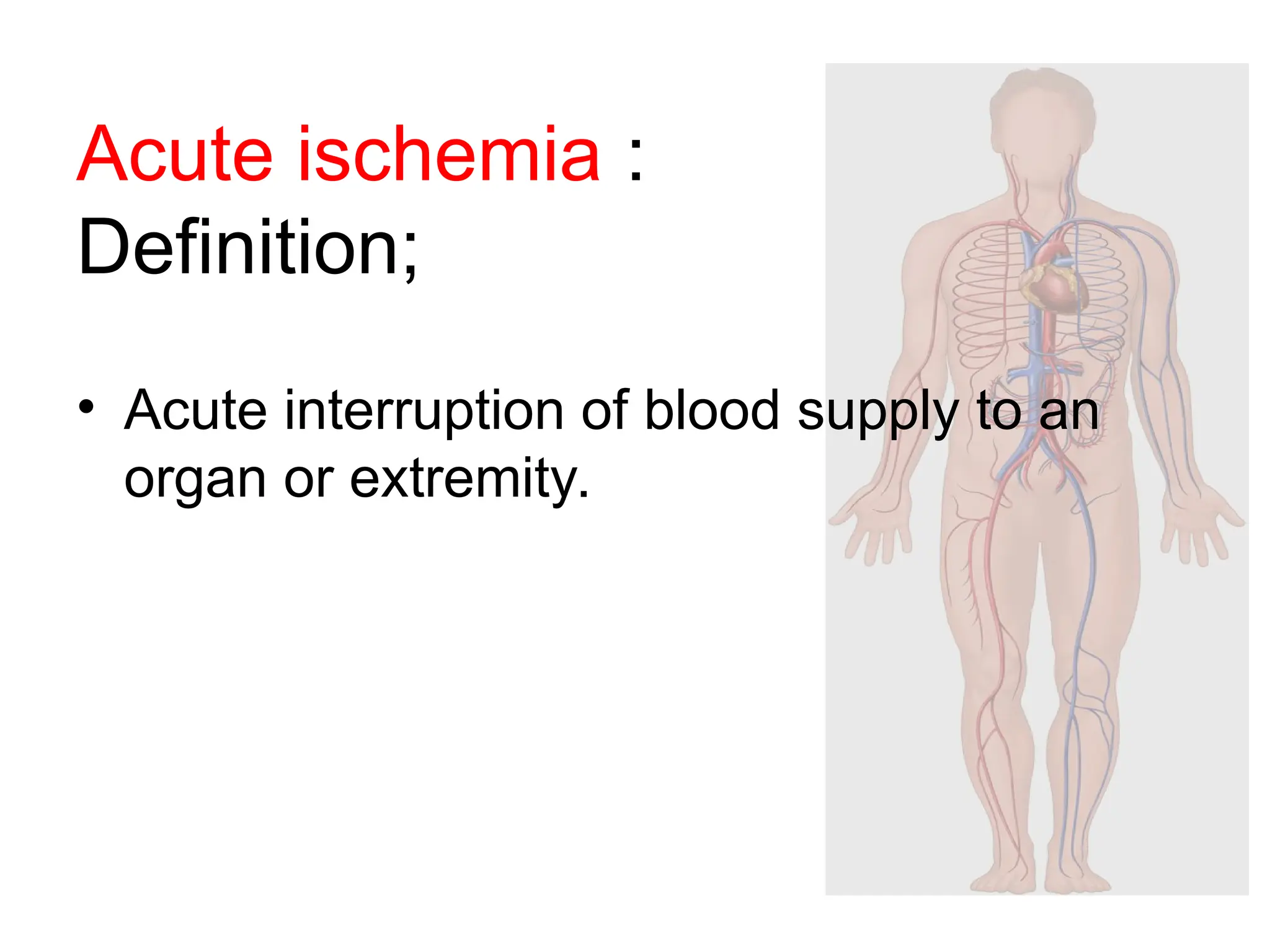
• Acute interruption of blood supply to an
organ or extremity.
Aetiology
1) Arterial embolism
2) Thrombosis: native arteries, baypass grafts
3) Traumatic
4) Acute aortic dissection.
5) Rare causes: low flow states: e.g.
cardiogenic shock / sepsis, drugs (cocaine,
vasopressors), vasculitis.
Embolism
• The most common.
• Secondary to:
– Cardiac causes (80-90%): most common,
arrhythmias, myocardial infarction (mural
thromus), vegetations (SABE) , prosthetic
valves, cardiac tumors, etc..
– Noncaridac causes: atheroembolism,
aneurysms, paradoxical emoblizaton,
iatrogenic.
– Cryptogenic emboli: 5-10%.
Embolism (cont.)
Site of impaction:
bifurcations, major branching sites
• Lower limb
– Femoral bifurcation
– Popliteal
– Distal aorta
• Cerebrovascular
• Visceral
• Upper limb
Thrombosis
• Secondary to ASO: distal SFA, aorta, popliteal
• In absence of stenotic lesion:
– Intra-arterial injections
– hypercoagulable states: e.g. malignancy,
antiphospholipid syndrome, etc..
• Thrombosis of bypass grafts (kinking,
stenosis, anastomotic lesions, ..).
Because the management is different
Embolism versus Thrombosis
Embolism
Thrombosis
Sources
Frequently detected
Not specified
Onset
Sudden
Acute
Site
Normal vessels, soft
On top of a stenosis, calcified
Previous complaint
Rare
Symptoms of chronic ischemia
Findings
Normal pulses
Evidence of peripheral arterial
disease
Multiplicity
Multiple sites
Single site
Angiography
No or minimal ASO,
sharp cut off
(Fontaine sign),
multiple cclusions,
no collaterals
Diffuse atherosclerosis, tapered and
irregular cut off, developed
collaterals
Pathophysiology
• Depends on:
– Degree of obstruction (complete or partial)
– Site of occlusion
– Presence of collaterals
– Affected tissues.
• Sluggish circulation distal to the occlusion 
secondary thrombosis  occlusion of collaterals.
• Different tissues can tolerate ischemia at different
rates (brain and heart versus skin, subcutaneous,
and muscles).
• Nerves: First to be affected (irreversible
damage after 6 hours)
• Muscles: more tolerant (up to 6-10 hours).
• Skin: last to show necrosis.
Pathophysiology (Cont.)
• Cellular ischaemia (Revascularization)
– Alteration of cell wall permeability  Na+
and
water influx  intra and extra cellular edema 
compartment syndrome
– Release of K +
 hyperkalaemia cardiac arrest.
– Release of myoglobin after muscle infarction 
precipitate in renal tubules  myoglobinuria and
acute renal failure.
Pathophysiology (Cont.)
• Accumulation of acidic products of anaerobic
metablolism  metabolic acidosis.
• During reperfusion, oxygen free radicals
accumulate  cellular insult and necrosis
(Mannitol and free radical scavengers).
Classifications
• Partial
• Total
• Late
• Viable
• Threatened
– Marginally (reversible with
prompt treatment)
– Immediately (reversible with
immediate treatment)
• Irreversible
Diagnosis
• History: source of embolism (e.g. cardiac
patients), risk factors for atherosclerosis.
• Clinical picture: 6 Ps
– Pain (sudden / acute onset, severe, steady, starts
most distal).
– Pallor or cyanosis
– Parasthesia (numbness  anaesthesia due to nerve
isch.)
– Pulselessness (sudden loss of previously palpable
pulse = embolic).
– Poikelothermia (cooling of the limb)
– Paralysis (fine movement first due to motor nerve
isch. then because of nerve and muscle).
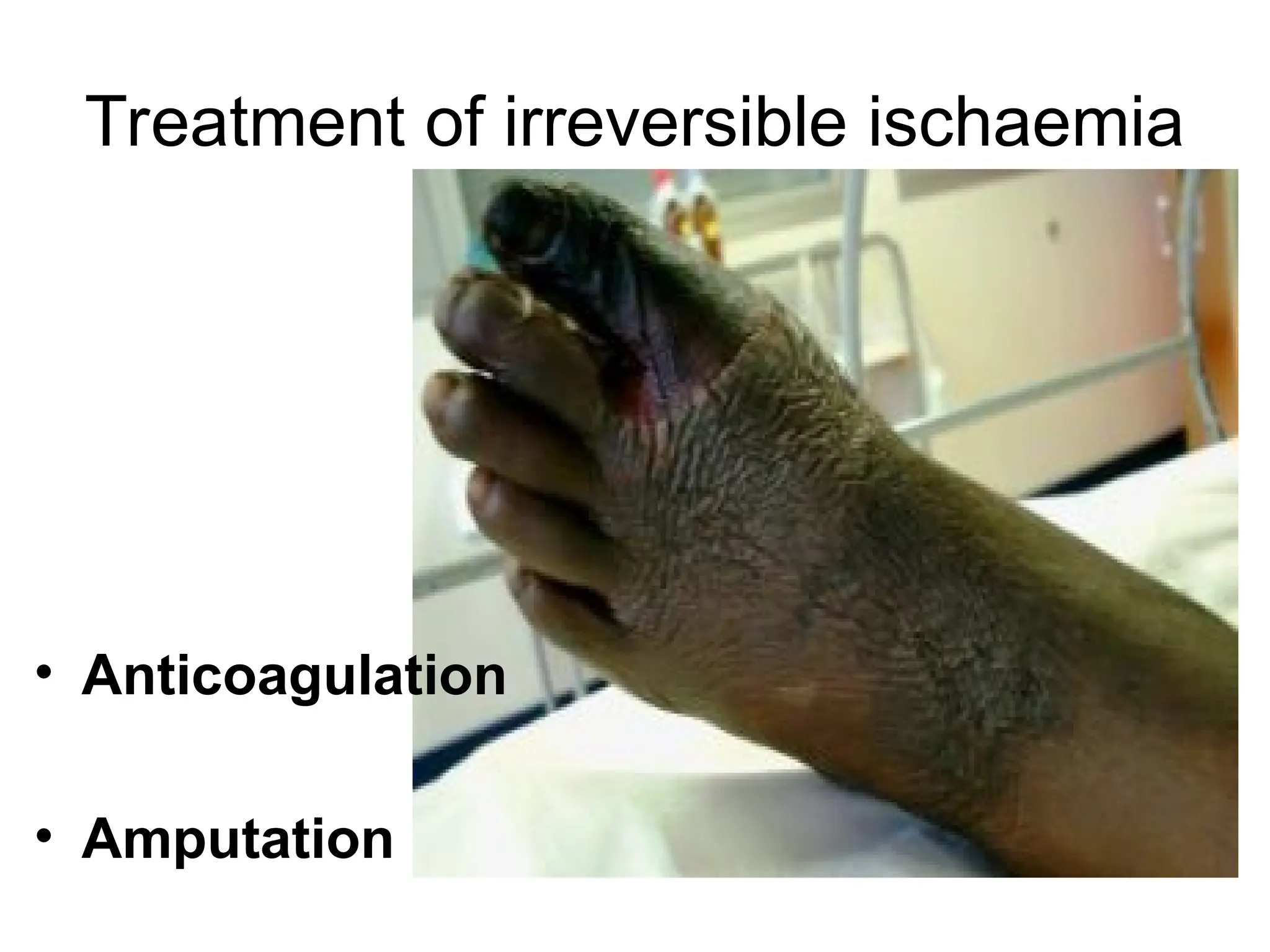
Acute late (irreversible) ischaemia
• Swollen limb
• Tender muscles
• Loss of muscle turgor (doughy).
• Fixed cyanotic color changes, marbling,
necrosis, desquamation.
• Rigor mortis.
Investigations
• Doppler US (to detect blood flow)
– ABI.
– Segmental pressure.
• Imaging:
– Duplex US
– Contrast angiography
• When?
• Why? Site / cause of occlusion (aneurysm,
thrombosis, entrapment, collaterals, dissection,
therapeutic)
Investigations (Cont.)
• To detect the cause:
– Chest X-ray: heart, calcification, aneurysm
– ECG: CAD, arrhythmias
– Echo: trans-thoracic (TTE), trans-esophageal
(TEE), intra-cardiac masses.
– CTA, MRA.
Treatment
Any fool can cut off a leg – it
takes a surgeon to save it.
George G. Ross
1834-1892
Treatment of reversible ischaemia
• Immediate anticoagulation:
• Unfractionated heparin or LMWH
– Dose (bolus / maintenance)
– Route
– Methods
– Complications
– Monitoring
– Antidote
• Oral anticoagulation
– Contraindications
– Monitoring
– Complications
– Antidote
Treatment of reversible ischaemia (cont.)
• Open surgical treatment:
– Embolectomy / thrombectomy
– Bypass
Indications?
Contraindications?
Treatment of reversible ischaemia (cont.)
Thrombolysis
• Indications:
1. Viable or marginally threatened limb
2. Recent acute thrombosis (not suitable for
embolism or old thrombi)
• Types: systemic / catheter-directed.
• Agents: streptokinase, urokinase, tissue
plasminogen activator (TPA).
• Contraindications (absolute / relative).
• What is next local / systemic?
Treatment of irreversible ischaemia
• Anticoagulation
• Amputation
If I refuse to allow my leg to be
amputated, its mortification may
prove that I was wrong, but if I let
the leg go, no body can ever prove
that the surgeon was wrong.
Operation is therefore the safe side
for the surgeon.
George Bernard Shaw,
1856-1950
Differential diagnosis
• DVT (swollen limb with difficult pulse
palpation)
• Neurologic disorders: e.g. paraplegia
• Low cardiac output.
• Frost bite and other vasospastic diseases.
• Chronic limb ischaemia.
Summary
• Definition
• Etiology
• Pathophysiology
• Classification
• Diagnosis
• Investigations
• Treatment
• Differential diagnosis
THANK YOU
THANK YOU

Acute Limb Ischemia - embolectomy, endovascular treatment, hybrid therapy, thrombolysis

  • 1.
    ACUTE LIMB ISCHEMIA Dr.Walid Gamal, MD Assistant Professor and Head of Vascular Surgery Department, Qena Faculty Of Medicine South Valley University
  • 2.
    Surgical anatomy 1 - large arteries:e.g. aorta, they contain considerable elastic tissue 2 - medium sized arteries:e.g femoral artery,these posses less elastic tissue and more muscle fibers 3 - small sized arteries:e.g digital arteries,the wall is primarily of smooth muscle fibers 4 - Terminal arteries:these are vessels 50-100 microns in diameter ,their wall is composed of endothelial lining ,internal elastic lamina and 2 layers of smooth muscle fibers .
  • 3.
    5- Arterioles: havea diameter of 20-50 microns,they are similar to terminal arteries but have only one layer of smooth muscle fibers • Ischemia means diminished blood supply(may be acute or chronic) The effect of ischemia depends on : 1 - type of artery: some arteries have efficient collateral circulation e.g, subclavian artery while brachial and popliteal arteries have poor collaterals
  • 4.
    2- The rateof occlusion of the artery:Acute ischemia is much more serious than chronic ischemia as there is no sufficient time to collaterals to develop 3- The state of collateral vessels: Healthy collateral vessel can compensate to some extent the effect of ischemia 4-The general condition of the patient: The presence of myocardial insufficiency or sever anemia will exacerbate the effect of ischemia
  • 5.
    Acute ischemia : Definition; •Acute interruption of blood supply to an organ or extremity.
  • 6.
    Aetiology 1) Arterial embolism 2)Thrombosis: native arteries, baypass grafts 3) Traumatic 4) Acute aortic dissection. 5) Rare causes: low flow states: e.g. cardiogenic shock / sepsis, drugs (cocaine, vasopressors), vasculitis.
  • 7.
    Embolism • The mostcommon. • Secondary to: – Cardiac causes (80-90%): most common, arrhythmias, myocardial infarction (mural thromus), vegetations (SABE) , prosthetic valves, cardiac tumors, etc.. – Noncaridac causes: atheroembolism, aneurysms, paradoxical emoblizaton, iatrogenic. – Cryptogenic emboli: 5-10%.
  • 8.
    Embolism (cont.) Site ofimpaction: bifurcations, major branching sites • Lower limb – Femoral bifurcation – Popliteal – Distal aorta • Cerebrovascular • Visceral • Upper limb
  • 9.
    Thrombosis • Secondary toASO: distal SFA, aorta, popliteal • In absence of stenotic lesion: – Intra-arterial injections – hypercoagulable states: e.g. malignancy, antiphospholipid syndrome, etc.. • Thrombosis of bypass grafts (kinking, stenosis, anastomotic lesions, ..).
  • 10.
    Because the managementis different Because the management is different Embolism versus Thrombosis Embolism Thrombosis Sources Frequently detected Not specified Onset Sudden Acute Site Normal vessels, soft On top of a stenosis, calcified Previous complaint Rare Symptoms of chronic ischemia Findings Normal pulses Evidence of peripheral arterial disease Multiplicity Multiple sites Single site Angiography No or minimal ASO, sharp cut off (Fontaine sign), multiple cclusions, no collaterals Diffuse atherosclerosis, tapered and irregular cut off, developed collaterals
  • 11.
    Pathophysiology • Depends on: –Degree of obstruction (complete or partial) – Site of occlusion – Presence of collaterals – Affected tissues. • Sluggish circulation distal to the occlusion  secondary thrombosis  occlusion of collaterals. • Different tissues can tolerate ischemia at different rates (brain and heart versus skin, subcutaneous, and muscles).
  • 12.
    • Nerves: Firstto be affected (irreversible damage after 6 hours) • Muscles: more tolerant (up to 6-10 hours). • Skin: last to show necrosis. Pathophysiology (Cont.)
  • 13.
    • Cellular ischaemia(Revascularization) – Alteration of cell wall permeability  Na+ and water influx  intra and extra cellular edema  compartment syndrome – Release of K +  hyperkalaemia cardiac arrest. – Release of myoglobin after muscle infarction  precipitate in renal tubules  myoglobinuria and acute renal failure. Pathophysiology (Cont.)
  • 14.
    Pathophysiology (Cont.) • Accumulationof acidic products of anaerobic metablolism  metabolic acidosis. • During reperfusion, oxygen free radicals accumulate  cellular insult and necrosis (Mannitol and free radical scavengers).
  • 15.
    Classifications • Partial • Total •Late • Viable • Threatened – Marginally (reversible with prompt treatment) – Immediately (reversible with immediate treatment) • Irreversible
  • 16.
    Diagnosis • History: sourceof embolism (e.g. cardiac patients), risk factors for atherosclerosis. • Clinical picture: 6 Ps – Pain (sudden / acute onset, severe, steady, starts most distal). – Pallor or cyanosis – Parasthesia (numbness  anaesthesia due to nerve isch.) – Pulselessness (sudden loss of previously palpable pulse = embolic). – Poikelothermia (cooling of the limb) – Paralysis (fine movement first due to motor nerve isch. then because of nerve and muscle).
  • 18.
    Acute late (irreversible)ischaemia • Swollen limb • Tender muscles • Loss of muscle turgor (doughy). • Fixed cyanotic color changes, marbling, necrosis, desquamation. • Rigor mortis.
  • 24.
    Investigations • Doppler US(to detect blood flow) – ABI. – Segmental pressure. • Imaging: – Duplex US – Contrast angiography • When? • Why? Site / cause of occlusion (aneurysm, thrombosis, entrapment, collaterals, dissection, therapeutic)
  • 27.
    Investigations (Cont.) • Todetect the cause: – Chest X-ray: heart, calcification, aneurysm – ECG: CAD, arrhythmias – Echo: trans-thoracic (TTE), trans-esophageal (TEE), intra-cardiac masses. – CTA, MRA.
  • 28.
    Treatment Any fool cancut off a leg – it takes a surgeon to save it. George G. Ross 1834-1892
  • 29.
  • 30.
    Treatment of reversibleischaemia • Immediate anticoagulation: • Unfractionated heparin or LMWH – Dose (bolus / maintenance) – Route – Methods – Complications – Monitoring – Antidote • Oral anticoagulation – Contraindications – Monitoring – Complications – Antidote
  • 31.
    Treatment of reversibleischaemia (cont.) • Open surgical treatment: – Embolectomy / thrombectomy – Bypass Indications? Contraindications?
  • 36.
    Treatment of reversibleischaemia (cont.) Thrombolysis • Indications: 1. Viable or marginally threatened limb 2. Recent acute thrombosis (not suitable for embolism or old thrombi) • Types: systemic / catheter-directed. • Agents: streptokinase, urokinase, tissue plasminogen activator (TPA). • Contraindications (absolute / relative). • What is next local / systemic?
  • 38.
    Treatment of irreversibleischaemia • Anticoagulation • Amputation
  • 39.
    If I refuseto allow my leg to be amputated, its mortification may prove that I was wrong, but if I let the leg go, no body can ever prove that the surgeon was wrong. Operation is therefore the safe side for the surgeon. George Bernard Shaw, 1856-1950
  • 40.
    Differential diagnosis • DVT(swollen limb with difficult pulse palpation) • Neurologic disorders: e.g. paraplegia • Low cardiac output. • Frost bite and other vasospastic diseases. • Chronic limb ischaemia.
  • 41.
    Summary • Definition • Etiology •Pathophysiology • Classification • Diagnosis • Investigations • Treatment • Differential diagnosis
  • 42.