Acute Encephalitis Syndrome
Yogiraj Ray
MD (Tropical Medicine)
Assistant professor
Calcutta School of Tropical Medicine
Case 1
• 15 years old boy from Dhapa, near Kolkata
• Fever for 7days- initially low grade, then high grade
from next day with chills
• Headache
• 5 episodes of GTCS in 3 days.

• Unconscious for 3 days
• No rash/bleeding/ cough/ pain abdomen/ loose
motion/ dysuria/ history of travel.
On Examination
• GCS: 5
• Pupil : pin point (B/L)
• Doll’s eye : Present
• B/L basal crepts
• Pulse: not palpable
• Respiration: shallow, 38/min
• Blood Pressure : Not recordable
Your opinion & management
Case Definition of Suspected case
• Acute onset of fever, not more than 5-7 days duration.
• Change in mental status with/ without
 New onset of seizures (excluding febrile seizures)
 (Other early clinical findings – may include irritability,
somnolence or abnormal behaviour greater than that seen
with usual febrile illness)
Important
• In an epidemic situation fever with altered sensorium persisting for more than two hours with a focal
seizure or paralysis of any part of body, is encephalitis.
• Presence of rash on body excludes Japanese Encephalitis.
• AES with symmetrical signs and fever is likely to be cerebral Malaria.
Case Classification
Probable Cases
• Suspected case in close geographic and temporal
relationship to a laboratory-confirmed case of AES/JE in an
outbreak
Acute Encephalitis Syndrome due to other agent
• A suspected case in which diagnostic testing is performed
and an etiological agent other than AES/JE is identified
Acute Encephalitis Syndrome due to unknown agent
• A suspected case in which no diagnostic testing is
performed / no etiological agent is identified / test results
are indeterminate
Laboratory-Confirmed case
A suspected case with any one of the following markers:
• Presence of lgM antibody in serum and/ or CSF to a
specific virus including JE/Entero Virus or others
• Four fold difference in lgG antibody titre in paired sera
• Virus isolation from brain tissue
• Antigen detection by immunofluroscence
• Nucleic acid detection by PCR
In the sentinel surveillance network, AES/JE will be diagnosed by lgM Capture ELISA, and virus
isolation will be done in National Reference Laboratory
encephalitis
Vector borne
• Japanese B
• West Nile
• Chandipura
• Tick borne
• Chikungunya
• Dengue
Important others
• HSV
• Rabies
• Nipah
• VZV
• Mumps
• Measels
• Enteoviruses
• Poliomyelitis
• HIV
JE Epidemiology
Mosquito
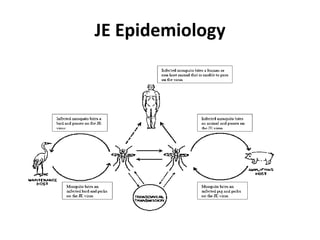
• In India, JE virus has been isolated from 17 mosquito species
in wild caught specimens from different parts of the country.
• Maximum isolations have been recorded from Culex vishnui
group consisting of Cx.tritaeniorhynchus, Cx.vishnui and
Cx.pseudovishnui.
• Female mosquitoes get infected after feeding on a vertebrate
host harbouring JE virus and after 9-12 days of extrinsic
incubation period, they can transmit the virus to other hosts.
• The ratio of overt disease to inapparent infection
varies from 1:250 to 1:1000.
• Thus the cases of JE represent tip of the iceberg
compared to the large number of inapparent
infections.
• Usually the number of overt disease cases reported
from each village is 1 or 2.
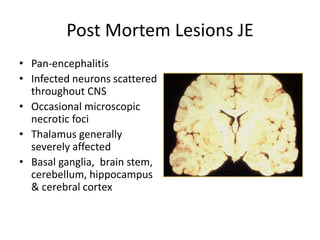
Post Mortem Lesions JE
• Pan-encephalitis
• Infected neurons scattered
throughout CNS
• Occasional microscopic
necrotic foci
• Thalamus generally
severely affected
• Basal ganglia, brain stem,
cerebellum, hippocampus
& cerebral cortex
SYMPTOMS
• Incubation period: 5-15 days
• Fever, headache, nausea, vomiting, myalgia
• Altered mental status follows
• Seizures in 66% esp. children. headache & meningismus more
common in adults
• Tremor & involuntary movements common.
• Mutism reported.
• Fever subsides by 2nd week
• Extrapyramidal symptoms develop later
SIGNS
• Varied neurologic signs
• Generalised weakness, hypertonia, hyperreflexia
• Papilloedema in <10%
• Cranial nerve findings –33% (disconjugate gaze,cr. nv. palsy)
• Extrapyramidal signs frequent(mask like facies,tremor, rigidity.
choreoathetoid movement)
• May be loss of bowel & bladder control
Mortality & morbidity
• An estimated 25% of the affected children die
• Among those who survive, about 30-40% suffers
from physical & mental impairment
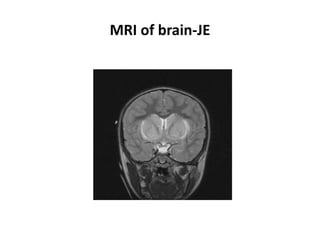
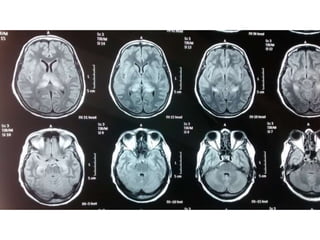
MRI of brain-JE
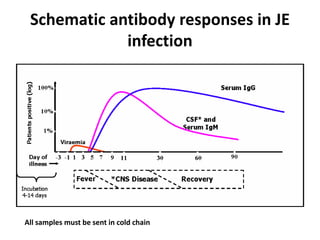
Schematic antibody responses in JE
infection
All samples must be sent in cold chain
Specimen collection and
transportation
• Blood (serum) and Cerebrospinal fluid (CSF) are the
specimens to be collected for JE diagnosis.
• Blood samples should be collected from suspected JE cases
within 4 days after the onset of illness for isolation of virus
and at least 5 days after the onset of illness for detection of
IgM antibodies.
• A second, convalescent samples should be collected at least
10-14 days after the first sample for serology.
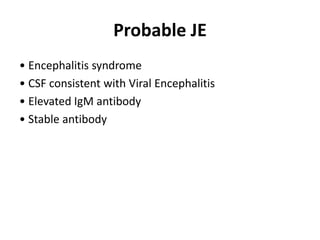
Probable JE
• Encephalitis syndrome
• CSF consistent with Viral Encephalitis
• Elevated IgM antibody
• Stable antibody
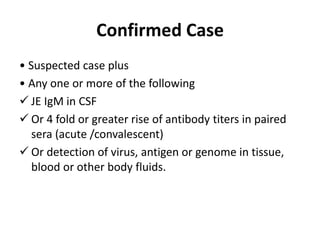
Confirmed Case
• Suspected case plus
• Any one or more of the following
 JE IgM in CSF
 Or 4 fold or greater rise of antibody titers in paired
sera (acute /convalescent)
 Or detection of virus, antigen or genome in tissue,
blood or other body fluids.
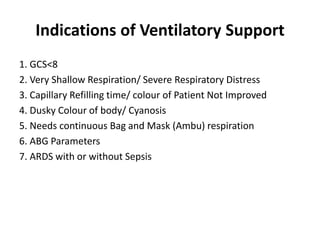
Indications of Ventilatory Support
1. GCS<8
2. Very Shallow Respiration/ Severe Respiratory Distress
3. Capillary Refilling time/ colour of Patient Not Improved
4. Dusky Colour of body/ Cyanosis
5. Needs continuous Bag and Mask (Ambu) respiration
6. ABG Parameters
7. ARDS with or without Sepsis
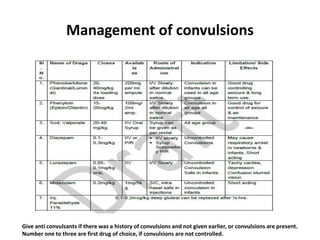
Management of convulsions
Give anti convulsants if there was a history of convulsions and not given earlier, or convulsions are present.
Number one to three are first drug of choice, if convulsions are not controlled.
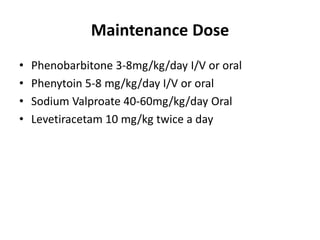
Maintenance Dose
• Phenobarbitone 3-8mg/kg/day I/V or oral
• Phenytoin 5-8 mg/kg/day I/V or oral
• Sodium Valproate 40-60mg/kg/day Oral
• Levetiracetam 10 mg/kg twice a day
Management of case 1
• ABC
• Anticonvulsunt
• Confirmed JE by CSF anti JE IgM antibody
• Sepsis manage
• Tracheostomy
• Feeding jejunostomy
• Pysiotherapy
• Discharged with recovery (aphasia still there)
Case 2
• 65 year male from Bankura H/O fever with
vesicular eruption for 5 days
• Seizure 2 episode
• Bizarre behavior with involuntary movement
• ???? Diagnosis
Treatment
• No need for ventilator
• Isolation
• Aciclovir
• Cured and discharged after 10 days
Case 3
• Fever 3 days
• Diffuse macular rash with island of clear skin 1
days
• Sudden unconciousness 6 hours
Diagnosis??????
• Diagnosed as dengue
• CSF pleocytosis only
• Looked for many causes
• Iv antibiotic as per meningitis
• Aciclovir
• Died after 3 days
Case 4
• Fever for 15 days
• Altered sensorium 3 days
• Bizarre movement 10 days back which
recovered after 3 days
• Admitted with GCS 10
• No need for CCU care
• CSF s/o viral encephalitis
• HSV PCR positive
• IV Aciclovir for 21 days
• Physitherapy
• After 21 days: aphasia, ophthalmoplegia,
chorieform movement
• Complete recovery after 40 days
Case 5
• 25 yr old male b/l parotid enlargement with
fever 7 days
• Testicular pain for 3 days
• GCTS with status
• Admitted at CCU
• Iv lorazepum
• Phenytoin loading & maintenance
• Add on Levetiracetam
• GCTS controlled but unconscious
• O2 by T-piece
Recovery
• Supportive care
• Physiotherapy
• RIBAVIRIN
AES
• JE
• HSV
• VZV
• Mumps
• WNV
• HIV related
• Unclassified (???????) : keep them as AES
Thank you

Acute encephalitis syndrome

  • 1.
    Acute Encephalitis Syndrome YogirajRay MD (Tropical Medicine) Assistant professor Calcutta School of Tropical Medicine
  • 2.
    Case 1 • 15years old boy from Dhapa, near Kolkata • Fever for 7days- initially low grade, then high grade from next day with chills • Headache • 5 episodes of GTCS in 3 days. • Unconscious for 3 days • No rash/bleeding/ cough/ pain abdomen/ loose motion/ dysuria/ history of travel.
  • 3.
    On Examination • GCS:5 • Pupil : pin point (B/L) • Doll’s eye : Present • B/L basal crepts • Pulse: not palpable • Respiration: shallow, 38/min • Blood Pressure : Not recordable
  • 4.
    Your opinion &management
  • 5.
    Case Definition ofSuspected case • Acute onset of fever, not more than 5-7 days duration. • Change in mental status with/ without  New onset of seizures (excluding febrile seizures)  (Other early clinical findings – may include irritability, somnolence or abnormal behaviour greater than that seen with usual febrile illness) Important • In an epidemic situation fever with altered sensorium persisting for more than two hours with a focal seizure or paralysis of any part of body, is encephalitis. • Presence of rash on body excludes Japanese Encephalitis. • AES with symmetrical signs and fever is likely to be cerebral Malaria.
  • 6.
    Case Classification Probable Cases •Suspected case in close geographic and temporal relationship to a laboratory-confirmed case of AES/JE in an outbreak Acute Encephalitis Syndrome due to other agent • A suspected case in which diagnostic testing is performed and an etiological agent other than AES/JE is identified Acute Encephalitis Syndrome due to unknown agent • A suspected case in which no diagnostic testing is performed / no etiological agent is identified / test results are indeterminate
  • 7.
    Laboratory-Confirmed case A suspectedcase with any one of the following markers: • Presence of lgM antibody in serum and/ or CSF to a specific virus including JE/Entero Virus or others • Four fold difference in lgG antibody titre in paired sera • Virus isolation from brain tissue • Antigen detection by immunofluroscence • Nucleic acid detection by PCR In the sentinel surveillance network, AES/JE will be diagnosed by lgM Capture ELISA, and virus isolation will be done in National Reference Laboratory
  • 8.
    encephalitis Vector borne • JapaneseB • West Nile • Chandipura • Tick borne • Chikungunya • Dengue Important others • HSV • Rabies • Nipah • VZV • Mumps • Measels • Enteoviruses • Poliomyelitis • HIV
  • 9.
  • 10.
    Mosquito • In India,JE virus has been isolated from 17 mosquito species in wild caught specimens from different parts of the country. • Maximum isolations have been recorded from Culex vishnui group consisting of Cx.tritaeniorhynchus, Cx.vishnui and Cx.pseudovishnui. • Female mosquitoes get infected after feeding on a vertebrate host harbouring JE virus and after 9-12 days of extrinsic incubation period, they can transmit the virus to other hosts.
  • 11.
    • The ratioof overt disease to inapparent infection varies from 1:250 to 1:1000. • Thus the cases of JE represent tip of the iceberg compared to the large number of inapparent infections. • Usually the number of overt disease cases reported from each village is 1 or 2.
  • 12.
    Post Mortem LesionsJE • Pan-encephalitis • Infected neurons scattered throughout CNS • Occasional microscopic necrotic foci • Thalamus generally severely affected • Basal ganglia, brain stem, cerebellum, hippocampus & cerebral cortex
  • 13.
    SYMPTOMS • Incubation period:5-15 days • Fever, headache, nausea, vomiting, myalgia • Altered mental status follows • Seizures in 66% esp. children. headache & meningismus more common in adults • Tremor & involuntary movements common. • Mutism reported. • Fever subsides by 2nd week • Extrapyramidal symptoms develop later
  • 14.
    SIGNS • Varied neurologicsigns • Generalised weakness, hypertonia, hyperreflexia • Papilloedema in <10% • Cranial nerve findings –33% (disconjugate gaze,cr. nv. palsy) • Extrapyramidal signs frequent(mask like facies,tremor, rigidity. choreoathetoid movement) • May be loss of bowel & bladder control
  • 15.
    Mortality & morbidity •An estimated 25% of the affected children die • Among those who survive, about 30-40% suffers from physical & mental impairment
  • 16.
  • 18.
    Schematic antibody responsesin JE infection All samples must be sent in cold chain
  • 19.
    Specimen collection and transportation •Blood (serum) and Cerebrospinal fluid (CSF) are the specimens to be collected for JE diagnosis. • Blood samples should be collected from suspected JE cases within 4 days after the onset of illness for isolation of virus and at least 5 days after the onset of illness for detection of IgM antibodies. • A second, convalescent samples should be collected at least 10-14 days after the first sample for serology.
  • 20.
    Probable JE • Encephalitissyndrome • CSF consistent with Viral Encephalitis • Elevated IgM antibody • Stable antibody
  • 21.
    Confirmed Case • Suspectedcase plus • Any one or more of the following  JE IgM in CSF  Or 4 fold or greater rise of antibody titers in paired sera (acute /convalescent)  Or detection of virus, antigen or genome in tissue, blood or other body fluids.
  • 24.
    Indications of VentilatorySupport 1. GCS<8 2. Very Shallow Respiration/ Severe Respiratory Distress 3. Capillary Refilling time/ colour of Patient Not Improved 4. Dusky Colour of body/ Cyanosis 5. Needs continuous Bag and Mask (Ambu) respiration 6. ABG Parameters 7. ARDS with or without Sepsis
  • 25.
    Management of convulsions Giveanti convulsants if there was a history of convulsions and not given earlier, or convulsions are present. Number one to three are first drug of choice, if convulsions are not controlled.
  • 26.
    Maintenance Dose • Phenobarbitone3-8mg/kg/day I/V or oral • Phenytoin 5-8 mg/kg/day I/V or oral • Sodium Valproate 40-60mg/kg/day Oral • Levetiracetam 10 mg/kg twice a day
  • 27.
    Management of case1 • ABC • Anticonvulsunt • Confirmed JE by CSF anti JE IgM antibody • Sepsis manage • Tracheostomy • Feeding jejunostomy • Pysiotherapy • Discharged with recovery (aphasia still there)
  • 28.
    Case 2 • 65year male from Bankura H/O fever with vesicular eruption for 5 days • Seizure 2 episode • Bizarre behavior with involuntary movement • ???? Diagnosis
  • 29.
    Treatment • No needfor ventilator • Isolation • Aciclovir • Cured and discharged after 10 days
  • 30.
    Case 3 • Fever3 days • Diffuse macular rash with island of clear skin 1 days • Sudden unconciousness 6 hours Diagnosis??????
  • 31.
    • Diagnosed asdengue • CSF pleocytosis only • Looked for many causes • Iv antibiotic as per meningitis • Aciclovir • Died after 3 days
  • 32.
    Case 4 • Feverfor 15 days • Altered sensorium 3 days • Bizarre movement 10 days back which recovered after 3 days • Admitted with GCS 10 • No need for CCU care
  • 33.
    • CSF s/oviral encephalitis • HSV PCR positive • IV Aciclovir for 21 days • Physitherapy • After 21 days: aphasia, ophthalmoplegia, chorieform movement • Complete recovery after 40 days
  • 34.
    Case 5 • 25yr old male b/l parotid enlargement with fever 7 days • Testicular pain for 3 days • GCTS with status • Admitted at CCU
  • 35.
    • Iv lorazepum •Phenytoin loading & maintenance • Add on Levetiracetam • GCTS controlled but unconscious • O2 by T-piece
  • 36.
    Recovery • Supportive care •Physiotherapy • RIBAVIRIN
  • 37.
    AES • JE • HSV •VZV • Mumps • WNV • HIV related • Unclassified (???????) : keep them as AES
  • 38.