Coronary artery Disease Dr. Iyer B. K.
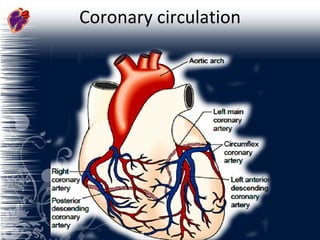
Coronary circulation
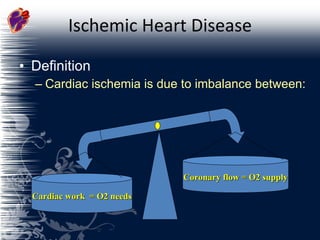
Ischemic Heart Disease Definition Cardiac ischemia is due to imbalance between: Coronary flow = O2 supply Cardiac work  = O2 needs
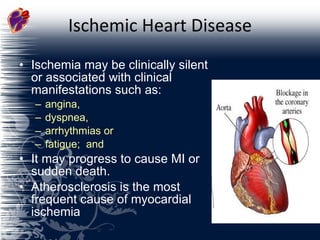
Ischemic Heart Disease Ischemia may be clinically silent or associated with clinical manifestations such as: angina, dyspnea, arrhythmias or fatigue;  and  It may progress to cause MI or sudden death. Atherosclerosis is the most frequent cause of myocardial ischemia
Ischemic Heart Disease Risk factors: Fixed: Age, Male sex, Positive family history. Potentially changeable: Hyperlipidaemia, Cigarette smoking, Hypertension, Diabetes mellitus, Lack of exercise, Blood coagulation factors (high fibrinogen, factor VII), C-reactive protein, Homocysteinaemia, Obesity, excess alcohol intake.
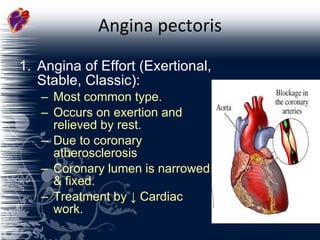
Angina pectoris Angina of Effort (Exertional, Stable, Classic): Most common type. Occurs on exertion and relieved by rest. Due to coronary atherosclerosis Coronary lumen is narrowed & fixed. Treatment by  ↓  Cardiac work.
Angina pectoris Prinzmetal (Variant, Vaso-spastic) Angina: Occurs at rest, usually accompanied by arrhythmia. Due to reversible coronary vasospasm  (Supersensitive coronary)  Treatment by Coronary V.D.
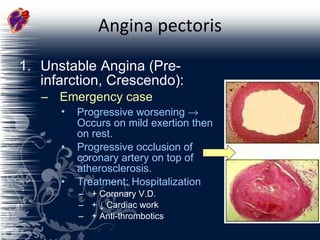
Angina pectoris Unstable Angina (Pre-infarction, Crescendo): Emergency case Progressive worsening    Occurs on mild exertion then on rest. Progressive occlusion of coronary artery on top of atherosclerosis. Treatment: Hospitalization + Coronary V.D.  +  ↓  Cardiac work + Anti-thrombotics
Clinical features Symptoms and signs that may represent myocardial ischemia include the following: Chest pain or epigastric pain, non-traumatic in origin, characterized by:  Central/substernal compression or crushing chest pain Pressure, tightness, heaviness, cramping, burning, aching sensation  Unexplained indigestion, belching, epigastric pain  Radiating pain in neck, jaw, shoulders, back, or arm(s)  Associated dyspnea  Associated nausea and/or vomiting  Associated diaphoresis
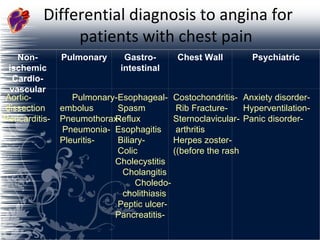
Differential diagnosis to angina for patients with chest pain  -Anxiety disorder  -Hyperventilation  -Panic disorder  -Costochondritis -Rib Fracture  -Sternoclavicular arthritis  -Herpes zoster (before the rash) -Esophageal  Spasm      Reflux    Esophagitis -Biliary  Colic     Cholecystitis     Cholangitis  Choledo-  cholithiasis  -Peptic ulcer  -Pancreatitis -Pulmonary  embolus -Pneumothorax -Pneumonia  -Pleuritis -Aortic  dissection  -Pericarditis Non-ischemic Cardio-vascular Pulmonary Gastro-intestinal Chest Wall Psychiatric ·
Examination and Diagnosis There are usually no abnormal findings in angina, although occasionally a fourth heart sound may be heard. Signs to suggest anaemia, thyrotoxicosis or hyperlipidaemia should be sought. Exclude aortic stenosis as a possible cause for the angina.  The blood pressure should be taken to identify coexistent hypertension.
Laboratory Investigations Evaluation of: CBC,  Enzyme markers such as Troponin I & T, CK-MB, myoglobin. Hyperlipidemia,  diabetes mellitus,  homocycteine levels,  CRP, fibrinogen.
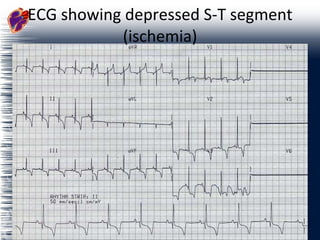
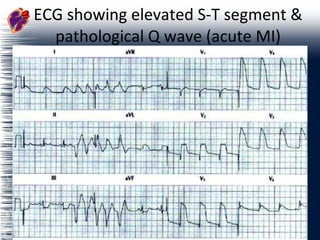
ECG The resting ECG has limited value in stable angina. It may show ST-segment or T-wave abnormalities suggestive of ischemia or Q-waves of prior MI. It may be extremely valuable in unstable angina as it shows ST-T changes consistent with ischemia.
ECG showing depressed S-T segment (ischemia)
ECG showing elevated S-T segment & pathological Q wave (acute MI)
Provocative Testing Exercise ECG Perfusion Scintigraphy with exercise or dipyridamole injection Stress Echocardiography Continuous ECG monitoring Coronary angiography
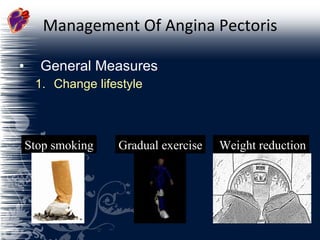
Management Of Angina Pectoris General Measures Change lifestyle Stop smoking Gradual exercise Weight reduction
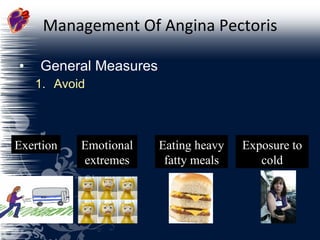
Management Of Angina Pectoris General Measures Avoid Exertion Emotional extremes Eating heavy fatty meals Exposure to cold
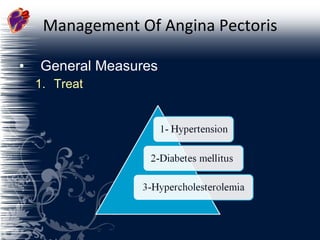
Management Of Angina Pectoris General Measures Treat
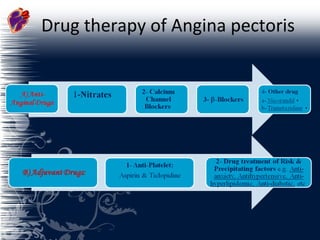
Drug therapy of Angina pectoris
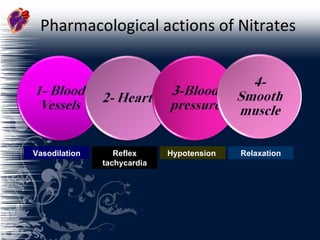
Pharmacological actions of Nitrates Vasodilation Reflex tachycardia Hypotension  Relaxation
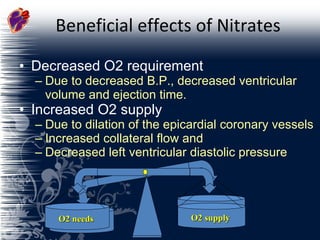
Beneficial effects of Nitrates Decreased O2 requirement  Due to decreased B.P., decreased ventricular volume and ejection time. Increased O2 supply  Due to dilation of the epicardial coronary vessels  Increased collateral flow and Decreased left ventricular diastolic pressure O2 supply O2 needs O2 supply O2 needs
Precautions with Nitrates 8-10 Hours nitrate-free period or alternate every 2 weeks to avoid tolerance with long acting nitrate. Never Stop nitrate therapy suddenly    Rebound ischemia & infarction. Not combined with Sildenafil (Viagra)    Severe Hypotension    May be Fatal
Nicorandil Oral V.D. lead to  ↓  Preload & Afterload: Nitrate-like    Release NO = Arterio-venodilator. Opens ATP-dependent K+-Channel. V.D. of Normal Large Epicardial coronaries. Useful in Angina & Heart failure. No tolerance. Headache.
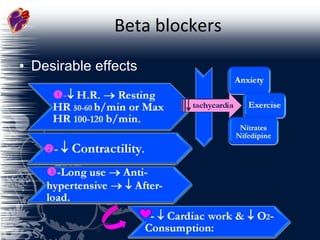
Beta blockers Desirable effects
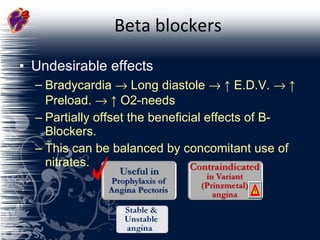
Beta blockers Undesirable effects Bradycardia    Long diastole     ↑  E.D.V.     ↑  Preload.     ↑  O2-needs Partially offset the beneficial effects of B-Blockers.  This can be balanced by concomitant use of nitrates.
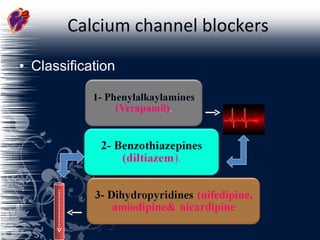
Calcium channel blockers Classification
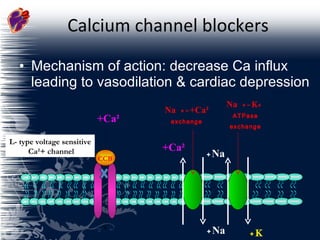
Calcium channel blockers Mechanism of action: decrease Ca influx leading to vasodilation & cardiac depression  L- type voltage sensitive Ca²+ channel  Ca²+ Na + Na + Ca²+ K + Na +-  K + ATPase exchange Na +-  Ca²+ exchange CCB
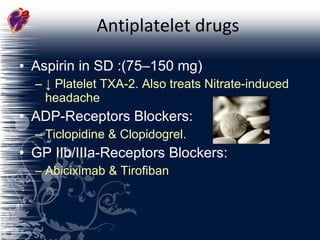
Antiplatelet drugs Aspirin in SD :(75–150 mg)  ↓   Platelet TXA-2. Also treats Nitrate-induced headache ADP-Receptors Blockers: Ticlopidine & Clopidogrel. GP IIb/IIIa-Receptors Blockers:  Abiciximab & Tirofiban
Drug therapy of Angina Acute Attacks (Acute Pain) & Immediate Prophylaxis: Rapidly acting Nitrates Nitroglycerine: S.L. 0.5 mg  or Buccal Spray 0.4 mg Isosorbide Dinitrate :S.L. 5 mg  or Buccal Spray 1.25 mg
Drug therapy of Angina Long term Prophylaxis: Long acting Nitrates oral SR, trans-dermal patch or ointment and / or Calcium Channel Blocker and / or Beta-Blocker and / or Nicorandil Anti-Platelet Drugs: Aspirin: 75 – 150 mg / day orally:
Acute coronary syndrome Acute coronary syndromes (ACS) include:  ST-elevation myocardial infarction (STEMI)  Non-ST-elevation myocardial infarction (NSTEMI)  Unstable angina  Myocardial infarction occurs when cardiac myocytes die due to myocardial ischaemia, and can be diagnosed on the basis of  Appropriate clinical history, 12-lead ECG and  Elevated biochemical markers - troponin I and T, creatinine-kinase-MB (CK-MB). 
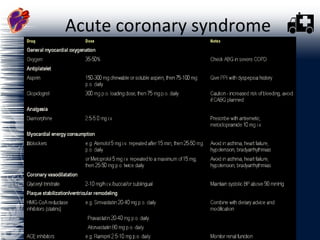
Acute coronary syndrome Pharmacological therapy:  Oxygen: 35-50% Antiplatelet:  Aspirin, Clodipogrel Analgesia:  Diamorphine Myocardial energy consumption:  β blocker Coronary vasodilatation:  Glycerial trinitrate Plaque stabilization / ventricular remodelling:  Statins,  ACE inhibitors 
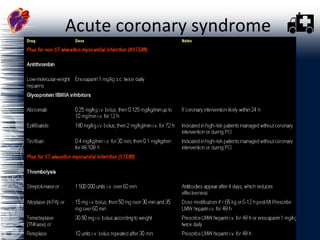
Acute coronary syndrome Pharmacological therapy: + for non-ST-elevation myocardial infarction (NSTEMI)  Antithrombin:  Low molecular weight Heparin Glycoproteins IIB/IIIA inhibitors: Abciximab, Tirofiban,  
Acute coronary syndrome Pharmacological therapy: + for ST-elevation myocardial infarction (STEMI) Thrombolytic therapy:  streptokinase, alteplase 
Acute coronary syndrome Non- Pharmacological therapy: Coronary intervention: Coronary revascularization is recommended in high-risk patients with ACS.  Percutaneous transluminal coronary angioplasty (PTCA: Coronary stenting may stabilize the disrupted coronary plaque and reduces angiographic restenosis rates compared to PTCA alone.  Surgical Management Coronary Artery Bypass Grafting (CABG)  
Acute coronary syndrome 
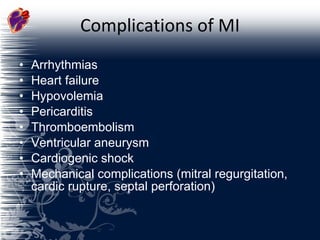
Complications of MI Arrhythmias Heart failure Hypovolemia Pericarditis Thromboembolism Ventricular aneurysm Cardiogenic shock Mechanical complications (mitral regurgitation, cardic rupture, septal perforation)
Case studies Implications of the learning
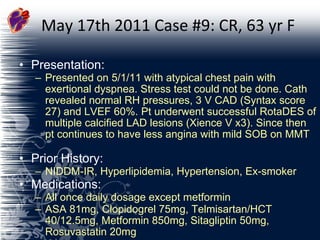
May 17th 2011 Case #9: CR, 63 yr F Presentation:  Presented on 5/1/11 with atypical chest pain with exertional dyspnea. Stress test could not be done. Cath revealed normal RH pressures, 3 V CAD (Syntax score 27) and LVEF 60%. Pt underwent successful RotaDES of multiple calcified LAD lesions (Xience V x3). Since then pt continues to have less angina with mild SOB on MMT  Prior History:  NIDDM-IR, Hyperlipidemia, Hypertension, Ex-smoker Medications:  All once daily dosage except metformin ASA 81mg, Clopidogrel 75mg, Telmisartan/HCT 40/12.5mg, Metformin 850mg, Sitagliptin 50mg, Rosuvastatin 20mg
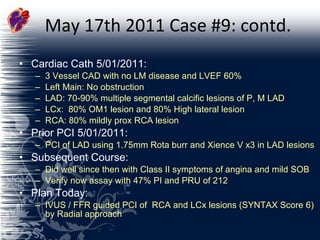
May 17th 2011 Case #9: contd. Cardiac Cath 5/01/2011:  3 Vessel CAD with no LM disease and LVEF 60% Left Main: No obstruction LAD: 70-90% multiple segmental calcific lesions of P, M LAD LCx:  80% OM1 lesion and 80% High lateral lesion RCA: 80% mildly prox RCA lesion Prior PCI 5/01/2011:  PCI of LAD using 1.75mm Rota burr and Xience V x3 in LAD lesions  Subsequent Course: Did well since then with Class II symptoms of angina and mild SOB Verify now assay with 47% PI and PRU of 212 Plan Today:  IVUS / FFR guided PCI of  RCA and LCx lesions (SYNTAX Score 6) by Radial approach
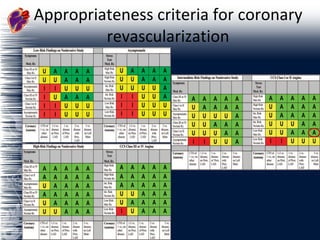
Appropriateness criteria for coronary revascularization
Issues Involving The Case Appropriate Use Criteria (AUC) for PCI   Status (utility) of IVUS or FFR guided PCI
What are the important clinical Questions in Stable CAD? Does the patient have angina? Does the patient have ischemia? Does the patient have anatomic lesion concordant  with the ischemia (location)? Is the lesion severe? Does the patient have anatomic lesions suitable for revascularization; PCI vs. CABG? What is the optimal PCI strategy and endpoints?
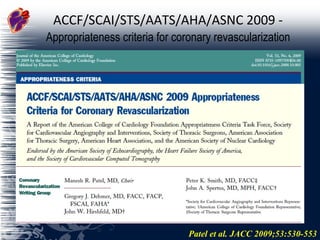
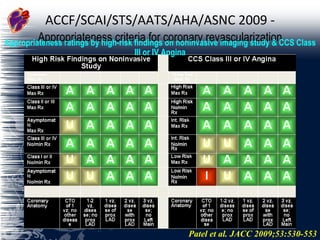
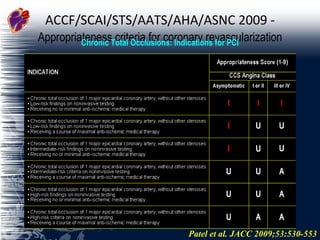
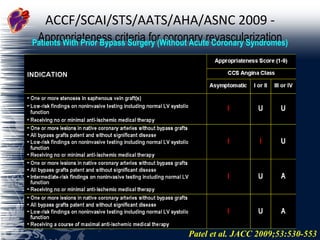
ACCF/SCAI/STS/AATS/AHA/ASNC 2009 -   Appropriateness criteria for coronary revascularization Patel et al. JACC 2009;53:530-553
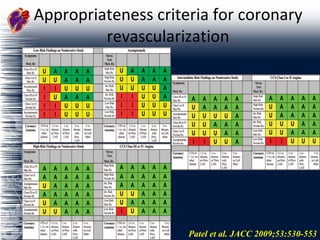
Appropriateness of Coronary Revascularization  Writing committee came up with 180 clinical scenarios to mimic common clinical situations Separate technical panel (consisting of Cardiologists, Interventionalists and CTS) scored each indication on a scale of 1 to 9: Appropriate: Score 7 to 9  Coronary Revascularization is generally acceptable  and is likely to improve overall health outcomes or survival Uncertain: Score 4 to 6  Coronary Revascularization may be acceptable and may be reasonable but with uncertain benefit on health outcome  Inappropriate: Score 1 to 3  Coronary Revascularization is not generally acceptable and is unlikely to improve overall health outcome or survival
Appropriateness of Coronary Revascularization  Important Issues: Symptoms:  asymptomatic, Class I-II vs. Class III-IV Non-invasive risk assessment:  low, intermediate or high risk Maximal medical therapy:  at least 2 Drugs-Nitrates, Ca+ blockers, B blocker or Ranolazine Coronary Anatomy Findings
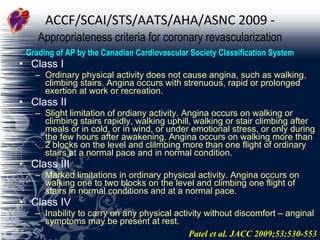
ACCF/SCAI/STS/AATS/AHA/ASNC 2009 -   Appropriateness criteria for coronary revascularization Class I Ordinary physical activity does not cause angina, such as walking, climbing stairs. Angina occurs with strenuous, rapid or prolonged exertion at work or recreation. Class II Slight limitation of ordiany activity. Angina occurs on walking or climbing stairs rapidly, walking uphill, walking or stair climbing after meals or in cold, or in wind, or under emotional stress, or only during the few hours after awakening. Angina occurs on walking more than 2 blocks on the level and clilmbing more than one flight of ordinary stairs at a normal pace and in normal condition. Class III Marked limitations in ordinary physical activity. Angina occurs on walking one to two blocks on the level and climbing one flight of stairs in normal conditions and at a normal pace.  Class IV Inability to carry on any physical activity without discomfort – anginal symptoms may be present at rest.  Patel et al. JACC 2009;53:530-553 Grading of AP by the Canadian Cardiovascular Society Classification System
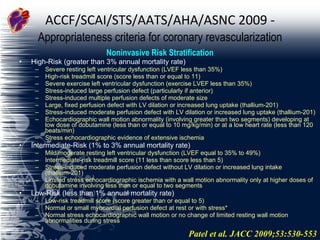
ACCF/SCAI/STS/AATS/AHA/ASNC 2009 -   Appropriateness criteria for coronary revascularization High-Risk (greater than 3% annual mortality rate) Severe resting left ventricular dysfunction (LVEF less than 35%) High-risk treadmill score (score less than or equal to 11) Severe exercise left ventricular dysfunction (exercise LVEF less than 35%) Stress-induced large perfusion defect (particularly if anterior) Stress-induced multiple perfusion defects of moderate size Large, fixed perfusion defect with LV dilation or increased lung uptake (thallium-201) Stress-induced moderate perfusion defect with LV dilation or increased lung uptake (thallium-201) Echocardiographic wall motion abnormality (involving greater than two segments) developing at low dose of dobutamine (less than or equal to 10 mg/kg/min) or at a low heart rate (less than 120 beats/min) Stress echocardiographic evidence of extensive ischemia Intermediate-Risk (1% to 3% annual mortality rate) Mild/moderate resting left ventricular dysfunction (LVEF equal to 35% to 49%) Intermediate-risk treadmill score (11 less than score less than 5) Stress-induced moderate perfusion defect without LV dilation or increased lung intake (thallium-201) Limited stress echocardiographic ischemia with a wall motion abnormality only at higher doses of dobutamine involving less than or equal to two segments Low-Risk (less than 1% annual mortality rate) Low-risk treadmill score (score greater than or equal to 5) Normal or small myocardial perfusion defect at rest or with stress* Normal stress echocardiographic wall motion or no change of limited resting wall motion abnormalities during stress Patel et al. JACC 2009;53:530-553 Noninvasive Risk Stratification
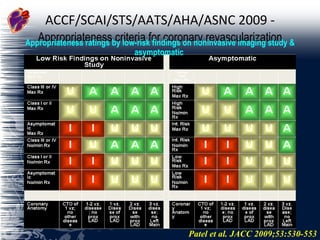
ACCF/SCAI/STS/AATS/AHA/ASNC 2009 -   Appropriateness criteria for coronary revascularization Patel et al. JACC 2009;53:530-553 Appropriateness ratings by low-risk findings on noninvasive imaging study & asymptomatic
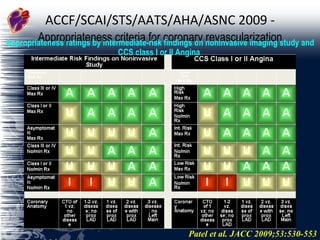
ACCF/SCAI/STS/AATS/AHA/ASNC 2009 -   Appropriateness criteria for coronary revascularization Patel et al. JACC 2009;53:530-553 Appropriateness ratings by intermediate-risk findings on noninvasive imaging study and CCS class I or II Angina
ACCF/SCAI/STS/AATS/AHA/ASNC 2009 -   Appropriateness criteria for coronary revascularization Patel et al. JACC 2009;53:530-553 Appropriateness ratings by high-risk findings on noninvasive imaging study & CCS Class III or IV Angina
ACCF/SCAI/STS/AATS/AHA/ASNC 2009 -   Appropriateness criteria for coronary revascularization Patel et al. JACC 2009;53:530-553 Chronic Total Occlusions: Indications for PCI
ACCF/SCAI/STS/AATS/AHA/ASNC 2009 -   Appropriateness criteria for coronary revascularization Patel et al. JACC 2009;53:530-553 Patients With Prior Bypass Surgery (Without Acute Coronary Syndromes)
Appropriateness criteria for coronary revascularization Patel et al. JACC 2009;53:530-553
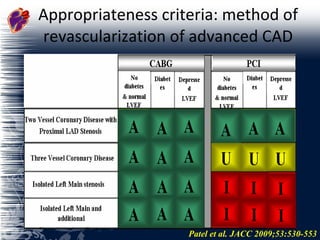
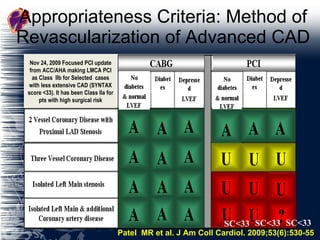
Appropriateness criteria: method of revascularization of advanced CAD Patel et al. JACC 2009;53:530-553
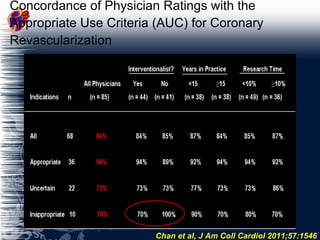
Concordance of Physician Ratings with the Appropriate Use Criteria (AUC) for Coronary Revascularization Chan et al, J Am Coll Cardiol 2011;57:1546
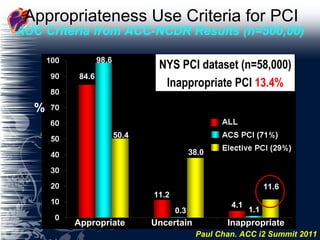
Appropriateness Use Criteria for PCI 84.6 11.6 1.1 11.2 0.3 38.0 4.1 98.6 50.4 Appropriate Uncertain Inappropriate % AUC Criteria from ACC-NCDR Results (n=500,00) Paul Chan.  ACC i2 Summit 2011 NYS PCI dataset (n=58,000) Inappropriate PCI  13.4%
Appropriateness Use Criteria [AUC] for PCI 84.6 11.6 1.1 11.2 0.3 38.0 4.1 98.6 50.4 Appropriate Uncertain Inappropriate % AUC Criteria from ACC-NCDR Results (n=500,00) Paul Chan.  ACC i2 Summit 2011 NYS PCI dataset (n=58,000) Inappropriate PCI  13.4%
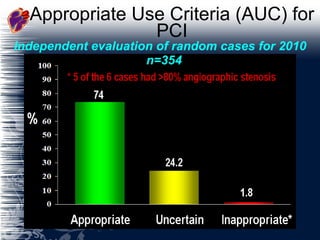
Appropriate Use Criteria (AUC) for PCI Independent evaluation of random cases for 2010 n=354
Appropriateness Criteria: Method of Revascularization of Advanced CAD Patel  MR et al. J Am Coll Cardiol. 2009;53(6):530-55 SC<33 SC<33 SC<33 Nov 24, 2009 Focused PCI update from ACC/AHA making LMCA PCI as Class  IIb for Selected  cases with less extensive CAD (SYNTAX score <33). It has been Class IIa for pts with high surgical risk
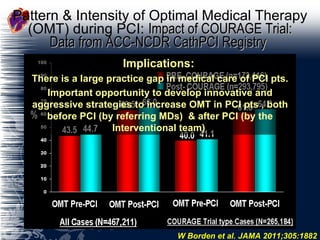
Pattern & Intensity of Optimal Medical Therapy (OMT) during PCI:   Impact of COURAGE Trial: Data from ACC-NCDR CathPCI Registry   W Borden et al. JAMA 2011;305:1882 Implications:   There is a large practice gap in medical care of PCI pts. Important opportunity to develop innovative and aggressive strategies to increase OMT in PCI pts , both before PCI (by referring MDs)  & after PCI (by the Interventional team)
Issues Involving The Case Appropriate Use Criteria (AUC) for PCI  Status (utility) of IVUS or FFR guided PCI
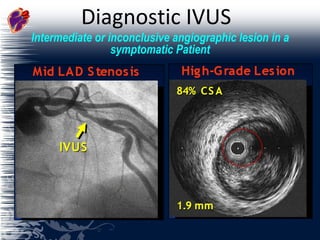
Diagnostic IVUS  Intermediate or inconclusive angiographic lesion in a symptomatic Patient
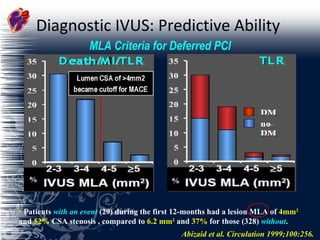
Diagnostic IVUS: Predictive Ability  Abizaid et al. Circulation 1999;100:256.   MLA Criteria for Deferred PCI •  Patients  with an event  (29) during the first 12-months had a lesion MLA of  4mm 2   and  52%  CSA stenosis , compared to  6.2 mm 2   and  37%  for those (328)  without .
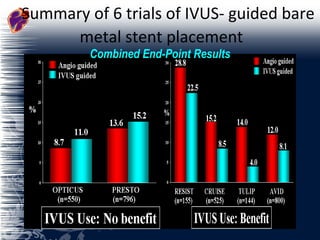
Summary of 6 trials of IVUS- guided bare metal stent placement   Combined End-Point Results
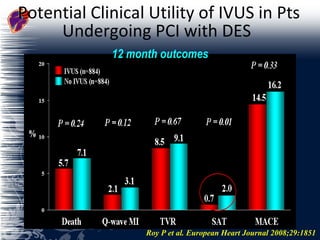
Potential Clinical Utility of IVUS in Pts Undergoing PCI with DES  Roy P et al . European Heart Journal 2008;29:1851 12 month outcomes
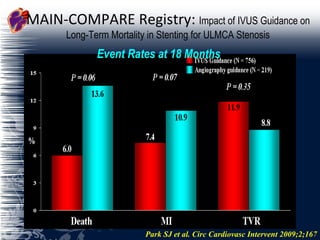
MAIN-COMPARE Registry:  Impact of IVUS Guidance on Long-Term Mortality in Stenting for ULMCA Stenosis Park SJ et al. Circ Cardiovasc Intervent 2009;2;167 Event Rates at 18 Months
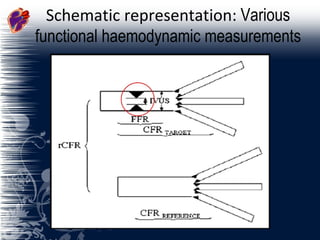
Schematic representation:  Various functional haemodynamic measurements
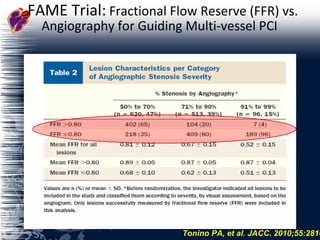
FAME Trial:   Fractional Flow Reserve (FFR) vs. Angiography for Guiding Multi-vessel PCI   Tonino PA, et al. JACC. 2010;55:2816
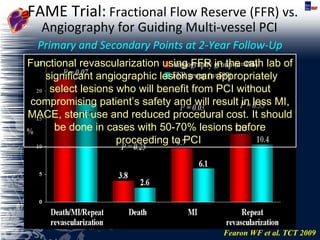
FAME Trial:   Fractional Flow Reserve (FFR) vs. Angiography for Guiding Multi-vessel PCI   Primary and Secondary Points at 2-Year Follow-Up Fearon WF et al. TCT 2009 Functional revascularization using FFR in the cath lab of  significant angiographic lesions can appropriately select lesions who will benefit from PCI without compromising patient’s safety and will result in less MI, MACE, stent use and reduced procedural cost. It should be done in cases with 50-70% lesions before proceeding to PCI
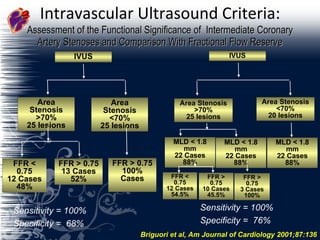
Intravascular Ultrasound Criteria:  Assessment of the Functional Significance of  Intermediate Coronary Artery Stenoses and Comparison With Fractional Flow Reserve IVUS IVUS Area Stenosis >70% 25 lesions Area Stenosis <70% 25 lesions FFR < 0.75 12 Cases 48% FFR > 0.75 13 Cases 52% FFR > 0.75 100% Cases Area Stenosis >70% 25 lesions Area Stenosis <70% 20 lesions MLD < 1.8 mm 22 Cases 88% MLD < 1.8 mm 22 Cases 88% MLD < 1.8 mm 22 Cases 88% FFR < 0.75 12 Cases 54.5% FFR > 0.75 10 Cases 45.5% FFR > 0.75 3 Cases 100% Sensitivity = 100% Specificity =  68% Sensitivity = 100% Specificity =  76% Briguori  et al, Am Journal of Cardiology 2001;87:136
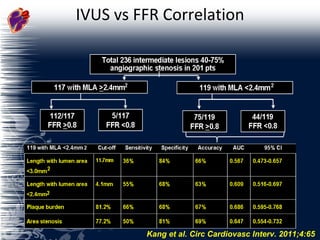
IVUS vs FFR Correlation Kang et al. Circ Cardiovasc Interv. 2011;4:65
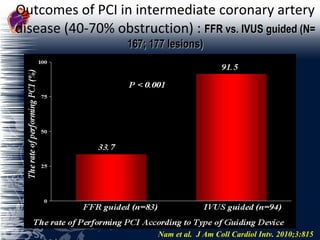
Outcomes of PCI in intermediate coronary artery disease (40-70% obstruction) :  FFR vs. IVUS guided (N= 167; 177 lesions) The rate of Performing PCI According to Type of Guiding Device Nam et al.  J Am Coll Cardiol Intv. 2010;3:815
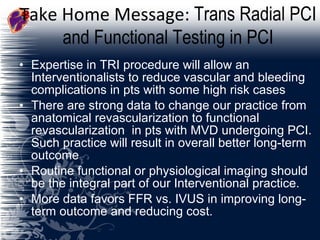
Take Home Message:  Trans Radial PCI and Functional Testing in PCI Expertise in TRI procedure will allow an Interventionalists to reduce vascular and bleeding complications in pts with some high risk cases There are strong data to change our practice from anatomical revascularization to functional revascularization  in pts with MVD undergoing PCI. Such practice will result in overall better long-term outcome Routine functional or physiological imaging should be the integral part of our Interventional practice.  More data favors FFR vs. IVUS in improving long-term outcome and reducing cost.
 
Thank you

Acute Coronary Disease

  • 1.
  • 2.
  • 3.
    Ischemic Heart DiseaseDefinition Cardiac ischemia is due to imbalance between: Coronary flow = O2 supply Cardiac work = O2 needs
  • 4.
    Ischemic Heart DiseaseIschemia may be clinically silent or associated with clinical manifestations such as: angina, dyspnea, arrhythmias or fatigue; and It may progress to cause MI or sudden death. Atherosclerosis is the most frequent cause of myocardial ischemia
  • 5.
    Ischemic Heart DiseaseRisk factors: Fixed: Age, Male sex, Positive family history. Potentially changeable: Hyperlipidaemia, Cigarette smoking, Hypertension, Diabetes mellitus, Lack of exercise, Blood coagulation factors (high fibrinogen, factor VII), C-reactive protein, Homocysteinaemia, Obesity, excess alcohol intake.
  • 6.
    Angina pectoris Anginaof Effort (Exertional, Stable, Classic): Most common type. Occurs on exertion and relieved by rest. Due to coronary atherosclerosis Coronary lumen is narrowed & fixed. Treatment by ↓ Cardiac work.
  • 7.
    Angina pectoris Prinzmetal(Variant, Vaso-spastic) Angina: Occurs at rest, usually accompanied by arrhythmia. Due to reversible coronary vasospasm (Supersensitive coronary) Treatment by Coronary V.D.
  • 8.
    Angina pectoris UnstableAngina (Pre-infarction, Crescendo): Emergency case Progressive worsening  Occurs on mild exertion then on rest. Progressive occlusion of coronary artery on top of atherosclerosis. Treatment: Hospitalization + Coronary V.D. + ↓ Cardiac work + Anti-thrombotics
  • 9.
    Clinical features Symptomsand signs that may represent myocardial ischemia include the following: Chest pain or epigastric pain, non-traumatic in origin, characterized by: Central/substernal compression or crushing chest pain Pressure, tightness, heaviness, cramping, burning, aching sensation Unexplained indigestion, belching, epigastric pain Radiating pain in neck, jaw, shoulders, back, or arm(s) Associated dyspnea Associated nausea and/or vomiting Associated diaphoresis
  • 10.
    Differential diagnosis toangina for patients with chest pain -Anxiety disorder -Hyperventilation -Panic disorder -Costochondritis -Rib Fracture -Sternoclavicular arthritis -Herpes zoster (before the rash) -Esophageal Spasm    Reflux   Esophagitis -Biliary Colic   Cholecystitis   Cholangitis Choledo- cholithiasis -Peptic ulcer -Pancreatitis -Pulmonary embolus -Pneumothorax -Pneumonia -Pleuritis -Aortic dissection -Pericarditis Non-ischemic Cardio-vascular Pulmonary Gastro-intestinal Chest Wall Psychiatric ·
  • 11.
    Examination and DiagnosisThere are usually no abnormal findings in angina, although occasionally a fourth heart sound may be heard. Signs to suggest anaemia, thyrotoxicosis or hyperlipidaemia should be sought. Exclude aortic stenosis as a possible cause for the angina. The blood pressure should be taken to identify coexistent hypertension.
  • 12.
    Laboratory Investigations Evaluationof: CBC, Enzyme markers such as Troponin I & T, CK-MB, myoglobin. Hyperlipidemia, diabetes mellitus, homocycteine levels, CRP, fibrinogen.
  • 13.
    ECG The restingECG has limited value in stable angina. It may show ST-segment or T-wave abnormalities suggestive of ischemia or Q-waves of prior MI. It may be extremely valuable in unstable angina as it shows ST-T changes consistent with ischemia.
  • 14.
    ECG showing depressedS-T segment (ischemia)
  • 15.
    ECG showing elevatedS-T segment & pathological Q wave (acute MI)
  • 16.
    Provocative Testing ExerciseECG Perfusion Scintigraphy with exercise or dipyridamole injection Stress Echocardiography Continuous ECG monitoring Coronary angiography
  • 17.
    Management Of AnginaPectoris General Measures Change lifestyle Stop smoking Gradual exercise Weight reduction
  • 18.
    Management Of AnginaPectoris General Measures Avoid Exertion Emotional extremes Eating heavy fatty meals Exposure to cold
  • 19.
    Management Of AnginaPectoris General Measures Treat
  • 20.
    Drug therapy ofAngina pectoris
  • 21.
    Pharmacological actions ofNitrates Vasodilation Reflex tachycardia Hypotension Relaxation
  • 22.
    Beneficial effects ofNitrates Decreased O2 requirement Due to decreased B.P., decreased ventricular volume and ejection time. Increased O2 supply Due to dilation of the epicardial coronary vessels Increased collateral flow and Decreased left ventricular diastolic pressure O2 supply O2 needs O2 supply O2 needs
  • 23.
    Precautions with Nitrates8-10 Hours nitrate-free period or alternate every 2 weeks to avoid tolerance with long acting nitrate. Never Stop nitrate therapy suddenly  Rebound ischemia & infarction. Not combined with Sildenafil (Viagra)  Severe Hypotension  May be Fatal
  • 24.
    Nicorandil Oral V.D.lead to ↓ Preload & Afterload: Nitrate-like  Release NO = Arterio-venodilator. Opens ATP-dependent K+-Channel. V.D. of Normal Large Epicardial coronaries. Useful in Angina & Heart failure. No tolerance. Headache.
  • 25.
  • 26.
    Beta blockers Undesirableeffects Bradycardia  Long diastole  ↑ E.D.V.  ↑ Preload.  ↑ O2-needs Partially offset the beneficial effects of B-Blockers. This can be balanced by concomitant use of nitrates.
  • 27.
  • 28.
    Calcium channel blockersMechanism of action: decrease Ca influx leading to vasodilation & cardiac depression L- type voltage sensitive Ca²+ channel Ca²+ Na + Na + Ca²+ K + Na +- K + ATPase exchange Na +- Ca²+ exchange CCB
  • 29.
    Antiplatelet drugs Aspirinin SD :(75–150 mg) ↓ Platelet TXA-2. Also treats Nitrate-induced headache ADP-Receptors Blockers: Ticlopidine & Clopidogrel. GP IIb/IIIa-Receptors Blockers: Abiciximab & Tirofiban
  • 30.
    Drug therapy ofAngina Acute Attacks (Acute Pain) & Immediate Prophylaxis: Rapidly acting Nitrates Nitroglycerine: S.L. 0.5 mg or Buccal Spray 0.4 mg Isosorbide Dinitrate :S.L. 5 mg or Buccal Spray 1.25 mg
  • 31.
    Drug therapy ofAngina Long term Prophylaxis: Long acting Nitrates oral SR, trans-dermal patch or ointment and / or Calcium Channel Blocker and / or Beta-Blocker and / or Nicorandil Anti-Platelet Drugs: Aspirin: 75 – 150 mg / day orally:
  • 32.
    Acute coronary syndromeAcute coronary syndromes (ACS) include: ST-elevation myocardial infarction (STEMI) Non-ST-elevation myocardial infarction (NSTEMI) Unstable angina Myocardial infarction occurs when cardiac myocytes die due to myocardial ischaemia, and can be diagnosed on the basis of Appropriate clinical history, 12-lead ECG and Elevated biochemical markers - troponin I and T, creatinine-kinase-MB (CK-MB). 
  • 33.
    Acute coronary syndromePharmacological therapy: Oxygen: 35-50% Antiplatelet: Aspirin, Clodipogrel Analgesia: Diamorphine Myocardial energy consumption: β blocker Coronary vasodilatation: Glycerial trinitrate Plaque stabilization / ventricular remodelling: Statins, ACE inhibitors 
  • 34.
    Acute coronary syndromePharmacological therapy: + for non-ST-elevation myocardial infarction (NSTEMI) Antithrombin: Low molecular weight Heparin Glycoproteins IIB/IIIA inhibitors: Abciximab, Tirofiban, 
  • 35.
    Acute coronary syndromePharmacological therapy: + for ST-elevation myocardial infarction (STEMI) Thrombolytic therapy: streptokinase, alteplase 
  • 36.
    Acute coronary syndromeNon- Pharmacological therapy: Coronary intervention: Coronary revascularization is recommended in high-risk patients with ACS. Percutaneous transluminal coronary angioplasty (PTCA: Coronary stenting may stabilize the disrupted coronary plaque and reduces angiographic restenosis rates compared to PTCA alone. Surgical Management Coronary Artery Bypass Grafting (CABG) 
  • 37.
  • 38.
  • 39.
    Complications of MIArrhythmias Heart failure Hypovolemia Pericarditis Thromboembolism Ventricular aneurysm Cardiogenic shock Mechanical complications (mitral regurgitation, cardic rupture, septal perforation)
  • 40.
  • 41.
    May 17th 2011Case #9: CR, 63 yr F Presentation: Presented on 5/1/11 with atypical chest pain with exertional dyspnea. Stress test could not be done. Cath revealed normal RH pressures, 3 V CAD (Syntax score 27) and LVEF 60%. Pt underwent successful RotaDES of multiple calcified LAD lesions (Xience V x3). Since then pt continues to have less angina with mild SOB on MMT Prior History: NIDDM-IR, Hyperlipidemia, Hypertension, Ex-smoker Medications: All once daily dosage except metformin ASA 81mg, Clopidogrel 75mg, Telmisartan/HCT 40/12.5mg, Metformin 850mg, Sitagliptin 50mg, Rosuvastatin 20mg
  • 42.
    May 17th 2011Case #9: contd. Cardiac Cath 5/01/2011: 3 Vessel CAD with no LM disease and LVEF 60% Left Main: No obstruction LAD: 70-90% multiple segmental calcific lesions of P, M LAD LCx: 80% OM1 lesion and 80% High lateral lesion RCA: 80% mildly prox RCA lesion Prior PCI 5/01/2011: PCI of LAD using 1.75mm Rota burr and Xience V x3 in LAD lesions Subsequent Course: Did well since then with Class II symptoms of angina and mild SOB Verify now assay with 47% PI and PRU of 212 Plan Today: IVUS / FFR guided PCI of RCA and LCx lesions (SYNTAX Score 6) by Radial approach
  • 43.
    Appropriateness criteria forcoronary revascularization
  • 44.
    Issues Involving TheCase Appropriate Use Criteria (AUC) for PCI Status (utility) of IVUS or FFR guided PCI
  • 45.
    What are theimportant clinical Questions in Stable CAD? Does the patient have angina? Does the patient have ischemia? Does the patient have anatomic lesion concordant with the ischemia (location)? Is the lesion severe? Does the patient have anatomic lesions suitable for revascularization; PCI vs. CABG? What is the optimal PCI strategy and endpoints?
  • 46.
    ACCF/SCAI/STS/AATS/AHA/ASNC 2009 - Appropriateness criteria for coronary revascularization Patel et al. JACC 2009;53:530-553
  • 47.
    Appropriateness of CoronaryRevascularization Writing committee came up with 180 clinical scenarios to mimic common clinical situations Separate technical panel (consisting of Cardiologists, Interventionalists and CTS) scored each indication on a scale of 1 to 9: Appropriate: Score 7 to 9 Coronary Revascularization is generally acceptable and is likely to improve overall health outcomes or survival Uncertain: Score 4 to 6 Coronary Revascularization may be acceptable and may be reasonable but with uncertain benefit on health outcome Inappropriate: Score 1 to 3 Coronary Revascularization is not generally acceptable and is unlikely to improve overall health outcome or survival
  • 48.
    Appropriateness of CoronaryRevascularization Important Issues: Symptoms: asymptomatic, Class I-II vs. Class III-IV Non-invasive risk assessment: low, intermediate or high risk Maximal medical therapy: at least 2 Drugs-Nitrates, Ca+ blockers, B blocker or Ranolazine Coronary Anatomy Findings
  • 49.
    ACCF/SCAI/STS/AATS/AHA/ASNC 2009 - Appropriateness criteria for coronary revascularization Class I Ordinary physical activity does not cause angina, such as walking, climbing stairs. Angina occurs with strenuous, rapid or prolonged exertion at work or recreation. Class II Slight limitation of ordiany activity. Angina occurs on walking or climbing stairs rapidly, walking uphill, walking or stair climbing after meals or in cold, or in wind, or under emotional stress, or only during the few hours after awakening. Angina occurs on walking more than 2 blocks on the level and clilmbing more than one flight of ordinary stairs at a normal pace and in normal condition. Class III Marked limitations in ordinary physical activity. Angina occurs on walking one to two blocks on the level and climbing one flight of stairs in normal conditions and at a normal pace. Class IV Inability to carry on any physical activity without discomfort – anginal symptoms may be present at rest. Patel et al. JACC 2009;53:530-553 Grading of AP by the Canadian Cardiovascular Society Classification System
  • 50.
    ACCF/SCAI/STS/AATS/AHA/ASNC 2009 - Appropriateness criteria for coronary revascularization High-Risk (greater than 3% annual mortality rate) Severe resting left ventricular dysfunction (LVEF less than 35%) High-risk treadmill score (score less than or equal to 11) Severe exercise left ventricular dysfunction (exercise LVEF less than 35%) Stress-induced large perfusion defect (particularly if anterior) Stress-induced multiple perfusion defects of moderate size Large, fixed perfusion defect with LV dilation or increased lung uptake (thallium-201) Stress-induced moderate perfusion defect with LV dilation or increased lung uptake (thallium-201) Echocardiographic wall motion abnormality (involving greater than two segments) developing at low dose of dobutamine (less than or equal to 10 mg/kg/min) or at a low heart rate (less than 120 beats/min) Stress echocardiographic evidence of extensive ischemia Intermediate-Risk (1% to 3% annual mortality rate) Mild/moderate resting left ventricular dysfunction (LVEF equal to 35% to 49%) Intermediate-risk treadmill score (11 less than score less than 5) Stress-induced moderate perfusion defect without LV dilation or increased lung intake (thallium-201) Limited stress echocardiographic ischemia with a wall motion abnormality only at higher doses of dobutamine involving less than or equal to two segments Low-Risk (less than 1% annual mortality rate) Low-risk treadmill score (score greater than or equal to 5) Normal or small myocardial perfusion defect at rest or with stress* Normal stress echocardiographic wall motion or no change of limited resting wall motion abnormalities during stress Patel et al. JACC 2009;53:530-553 Noninvasive Risk Stratification
  • 51.
    ACCF/SCAI/STS/AATS/AHA/ASNC 2009 - Appropriateness criteria for coronary revascularization Patel et al. JACC 2009;53:530-553 Appropriateness ratings by low-risk findings on noninvasive imaging study & asymptomatic
  • 52.
    ACCF/SCAI/STS/AATS/AHA/ASNC 2009 - Appropriateness criteria for coronary revascularization Patel et al. JACC 2009;53:530-553 Appropriateness ratings by intermediate-risk findings on noninvasive imaging study and CCS class I or II Angina
  • 53.
    ACCF/SCAI/STS/AATS/AHA/ASNC 2009 - Appropriateness criteria for coronary revascularization Patel et al. JACC 2009;53:530-553 Appropriateness ratings by high-risk findings on noninvasive imaging study & CCS Class III or IV Angina
  • 54.
    ACCF/SCAI/STS/AATS/AHA/ASNC 2009 - Appropriateness criteria for coronary revascularization Patel et al. JACC 2009;53:530-553 Chronic Total Occlusions: Indications for PCI
  • 55.
    ACCF/SCAI/STS/AATS/AHA/ASNC 2009 - Appropriateness criteria for coronary revascularization Patel et al. JACC 2009;53:530-553 Patients With Prior Bypass Surgery (Without Acute Coronary Syndromes)
  • 56.
    Appropriateness criteria forcoronary revascularization Patel et al. JACC 2009;53:530-553
  • 57.
    Appropriateness criteria: methodof revascularization of advanced CAD Patel et al. JACC 2009;53:530-553
  • 58.
    Concordance of PhysicianRatings with the Appropriate Use Criteria (AUC) for Coronary Revascularization Chan et al, J Am Coll Cardiol 2011;57:1546
  • 59.
    Appropriateness Use Criteriafor PCI 84.6 11.6 1.1 11.2 0.3 38.0 4.1 98.6 50.4 Appropriate Uncertain Inappropriate % AUC Criteria from ACC-NCDR Results (n=500,00) Paul Chan. ACC i2 Summit 2011 NYS PCI dataset (n=58,000) Inappropriate PCI 13.4%
  • 60.
    Appropriateness Use Criteria[AUC] for PCI 84.6 11.6 1.1 11.2 0.3 38.0 4.1 98.6 50.4 Appropriate Uncertain Inappropriate % AUC Criteria from ACC-NCDR Results (n=500,00) Paul Chan. ACC i2 Summit 2011 NYS PCI dataset (n=58,000) Inappropriate PCI 13.4%
  • 61.
    Appropriate Use Criteria(AUC) for PCI Independent evaluation of random cases for 2010 n=354
  • 62.
    Appropriateness Criteria: Methodof Revascularization of Advanced CAD Patel MR et al. J Am Coll Cardiol. 2009;53(6):530-55 SC<33 SC<33 SC<33 Nov 24, 2009 Focused PCI update from ACC/AHA making LMCA PCI as Class IIb for Selected cases with less extensive CAD (SYNTAX score <33). It has been Class IIa for pts with high surgical risk
  • 63.
    Pattern & Intensityof Optimal Medical Therapy (OMT) during PCI: Impact of COURAGE Trial: Data from ACC-NCDR CathPCI Registry W Borden et al. JAMA 2011;305:1882 Implications: There is a large practice gap in medical care of PCI pts. Important opportunity to develop innovative and aggressive strategies to increase OMT in PCI pts , both before PCI (by referring MDs) & after PCI (by the Interventional team)
  • 64.
    Issues Involving TheCase Appropriate Use Criteria (AUC) for PCI Status (utility) of IVUS or FFR guided PCI
  • 65.
    Diagnostic IVUS Intermediate or inconclusive angiographic lesion in a symptomatic Patient
  • 66.
    Diagnostic IVUS: PredictiveAbility Abizaid et al. Circulation 1999;100:256. MLA Criteria for Deferred PCI • Patients with an event (29) during the first 12-months had a lesion MLA of 4mm 2 and 52% CSA stenosis , compared to 6.2 mm 2 and 37% for those (328) without .
  • 67.
    Summary of 6trials of IVUS- guided bare metal stent placement Combined End-Point Results
  • 68.
    Potential Clinical Utilityof IVUS in Pts Undergoing PCI with DES Roy P et al . European Heart Journal 2008;29:1851 12 month outcomes
  • 69.
    MAIN-COMPARE Registry: Impact of IVUS Guidance on Long-Term Mortality in Stenting for ULMCA Stenosis Park SJ et al. Circ Cardiovasc Intervent 2009;2;167 Event Rates at 18 Months
  • 70.
    Schematic representation: Various functional haemodynamic measurements
  • 71.
    FAME Trial: Fractional Flow Reserve (FFR) vs. Angiography for Guiding Multi-vessel PCI Tonino PA, et al. JACC. 2010;55:2816
  • 72.
    FAME Trial: Fractional Flow Reserve (FFR) vs. Angiography for Guiding Multi-vessel PCI Primary and Secondary Points at 2-Year Follow-Up Fearon WF et al. TCT 2009 Functional revascularization using FFR in the cath lab of significant angiographic lesions can appropriately select lesions who will benefit from PCI without compromising patient’s safety and will result in less MI, MACE, stent use and reduced procedural cost. It should be done in cases with 50-70% lesions before proceeding to PCI
  • 73.
    Intravascular Ultrasound Criteria: Assessment of the Functional Significance of Intermediate Coronary Artery Stenoses and Comparison With Fractional Flow Reserve IVUS IVUS Area Stenosis >70% 25 lesions Area Stenosis <70% 25 lesions FFR < 0.75 12 Cases 48% FFR > 0.75 13 Cases 52% FFR > 0.75 100% Cases Area Stenosis >70% 25 lesions Area Stenosis <70% 20 lesions MLD < 1.8 mm 22 Cases 88% MLD < 1.8 mm 22 Cases 88% MLD < 1.8 mm 22 Cases 88% FFR < 0.75 12 Cases 54.5% FFR > 0.75 10 Cases 45.5% FFR > 0.75 3 Cases 100% Sensitivity = 100% Specificity = 68% Sensitivity = 100% Specificity = 76% Briguori et al, Am Journal of Cardiology 2001;87:136
  • 74.
    IVUS vs FFRCorrelation Kang et al. Circ Cardiovasc Interv. 2011;4:65
  • 75.
    Outcomes of PCIin intermediate coronary artery disease (40-70% obstruction) : FFR vs. IVUS guided (N= 167; 177 lesions) The rate of Performing PCI According to Type of Guiding Device Nam et al. J Am Coll Cardiol Intv. 2010;3:815
  • 76.
    Take Home Message: Trans Radial PCI and Functional Testing in PCI Expertise in TRI procedure will allow an Interventionalists to reduce vascular and bleeding complications in pts with some high risk cases There are strong data to change our practice from anatomical revascularization to functional revascularization in pts with MVD undergoing PCI. Such practice will result in overall better long-term outcome Routine functional or physiological imaging should be the integral part of our Interventional practice. More data favors FFR vs. IVUS in improving long-term outcome and reducing cost.
  • 77.
  • 78.