Dr C.S. Singh
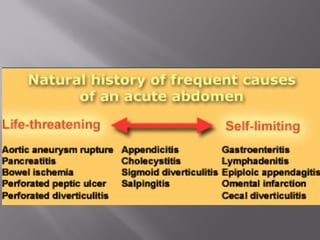
• Severe abdominal pain, requiring the clinician to
make an urgent therapeutic decision.
• Differential diagnosis of an acute abdomen includes
a wide spectrum of disorders, ranging from life-
threatening diseases to benign self-limiting
conditions
• Management may vary from emergency surgery to
reassurance of the patient and misdiagnosis may
easily result in delayed necessary treatment or
unnecessary surgery.
• Sonography and CT are the aids
 Findings may be normal in patients who need
emergency surgery (such as appendicitis) and
may be abnormal in patients without a surgical
disease (like salpingitis).
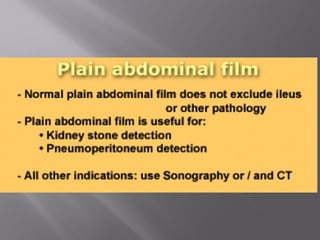
 A plain abdominal film has a limited value in
the evaluation of abdominal pain.
 A normal film does not exclude an ileus or
other pathology and may falsely reassure the
clinician.
 TYPES
 Pneumoperitoneum-/free air/intraperitoneal air
 Retroperintoneal air
 Air in the bowel wall (pneumatosis intestinalis)
 Air in the biliary system (pneumobilia)
 The patient should be positioned sitting upright
for 10-20 minutes prior to acquiring the erect
chest X-ray image.
 This allows any free intra-abdominal gas to rise
up, forming a crescent beneath the diaphragm.
It is said that as little as 1ml of gas can be
detected in this way.
 Rupture of a hollow viscus
 Perforated peptic ulcer
 Trauma
 Perforated diverticulitis (usually seals off)
 Perforated carcinoma
 Post-op --5-7 days normal, should get less with
successive studies
 NOT ruptured appendix (seals off)
 Crescent sign
 Chilaiditis sign
 Riglers
 Football sign
 Falciform ligament sign
 Triangle sign
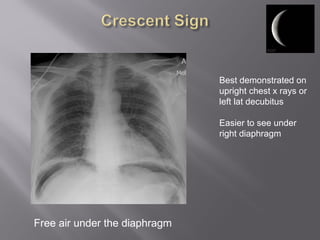
Free air under the diaphragm
Best demonstrated on
upright chest x rays or
left lat decubitus
Easier to see under
right diaphragm
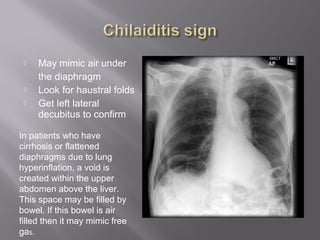
 May mimic air under
the diaphragm
 Look for haustral folds
 Get left lateral
decubitus to confirm
In patients who have
cirrhosis or flattened
diaphragms due to lung
hyperinflation, a void is
created within the upper
abdomen above the liver.
This space may be filled by
bowel. If this bowel is air
filled then it may mimic free
gas.
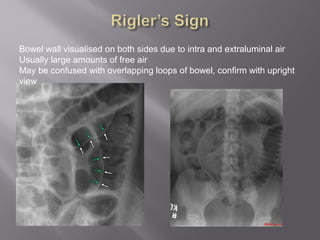
Bowel wall visualised on both sides due to intra and extraluminal air
Usually large amounts of free air
May be confused with overlapping loops of bowel, confirm with upright
view
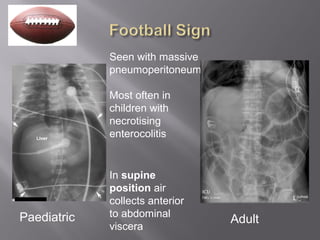
Seen with massive
pneumoperitoneum
Most often in
children with
necrotising
enterocolitis
Paediatric Adult
In supine
position air
collects anterior
to abdominal
viscera
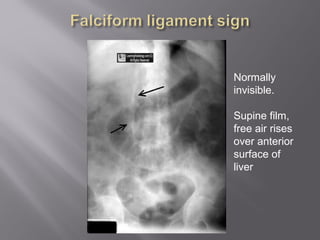
Normally
invisible.
Supine film,
free air rises
over anterior
surface of
liver
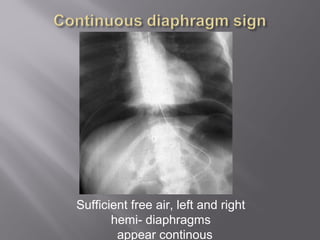
Sufficient free air, left and right
hemi- diaphragms
appear continous
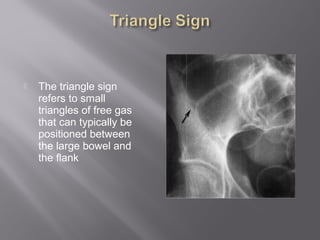
 The triangle sign
refers to small
triangles of free gas
that can typically be
positioned between
the large bowel and
the flank
 Recognised by:
 Streaky, linear appearance outlining retroperitoneal
structures
 Mottled, blotchy appearance
 Relatively fixed position
 May outline:
 Psoas muscles
 Kidneys, ureters, bladder
 Aorta or IVC
 Subphrenic spaces
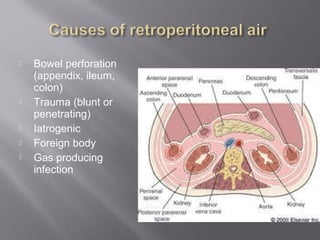
 Bowel perforation
(appendix, ileum,
colon)
 Trauma (blunt or
penetrating)
 Iatrogenic
 Foreign body
 Gas producing
infection
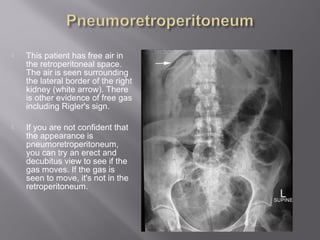
 This patient has free air in
the retroperitoneal space.
The air is seen surrounding
the lateral border of the right
kidney (white arrow). There
is other evidence of free gas
including Rigler's sign.
 If you are not confident that
the appearance is
pneumoretroperitoneum,
you can try an erect and
decubitus view to see if the
gas moves. If the gas is
seen to move, it's not in the
retroperitoneum.
 Primary
 Pneumatosis cystoides intestinalis (rare)
 usually affects left colon
 Produces cyst-like collections of air in the submucosa or serosa
 Secondary
 Diseases with bowel wall necrosis
 Obstructing lesions of the bowel that raise intraluminal pressure
 Complications
 Rupture into peritoneal cavity
 Dissection of air into portal venous system
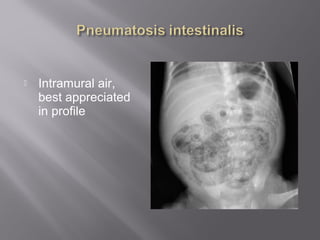
 Intramural air,
best appreciated
in profile
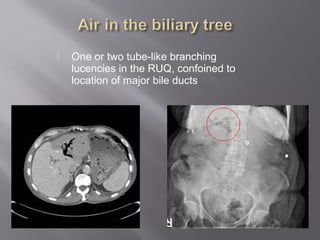
 One or two tube-like branching
lucencies in the RUQ, confoined to
location of major bile ducts
 “Normal” if Sphincter of Oddi incompetence
 Previous surgery including sphincterotomy or
transplantation of CBD
 Pathology (uncommon)
 Gallstone ileus: gallstone erodes through wall of GB
into the duodenum producing a fistula between the
bowel and the biliary system.
 Stone impacts in small bowel = mechanical SBO.
“ileus” misnomer
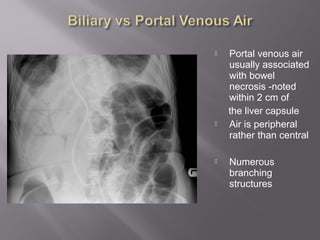
 Portal venous air
usually associated
with bowel
necrosis -noted
within 2 cm of
the liver capsule
 Air is peripheral
rather than central
 Numerous
branching
structures
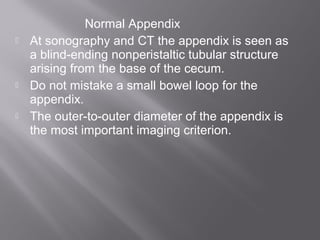
Normal Appendix
 At sonography and CT the appendix is seen as
a blind-ending nonperistaltic tubular structure
arising from the base of the cecum.
 Do not mistake a small bowel loop for the
appendix.
 The outer-to-outer diameter of the appendix is
the most important imaging criterion.
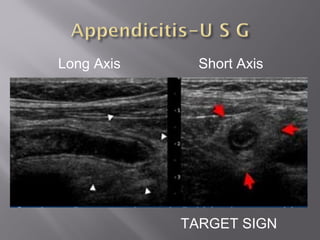
Long Axis Short Axis
TARGET SIGN
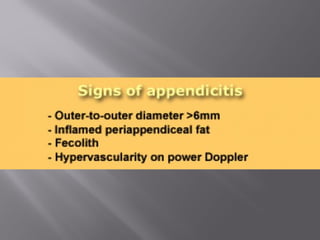
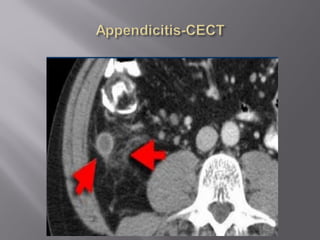
 Diameter larger than 6 mm
 Usually surrounded by inflamed fat
 Presence of a fecolith
 Hypervascularity on power Doppler
 Mesenteric lymphadenitis is a mimicker of appendicitis.
 It is the second most common cause of right lower
quadrant pain after appendicitis.
 It is defined as a benign self-limiting inflammation of
right-sided mesenteric lymph nodes without an
identifiable underlying inflammatory process - often in
children than in adults..
 Diagnosis can only be made confidently when a
normal appendix is found, because adenopathy also
frequently occurs with appendicitis.
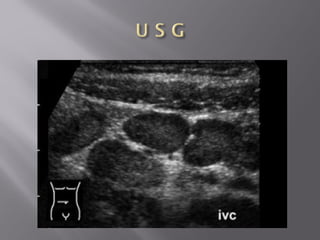
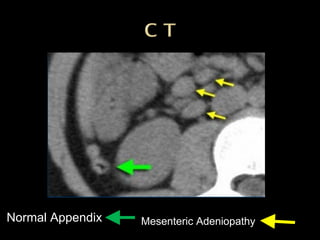
 Key finding: Lymphadenopathy with a normal appendix
and normal mesenteric fat
Normal Appendix Mesenteric Adeniopathy
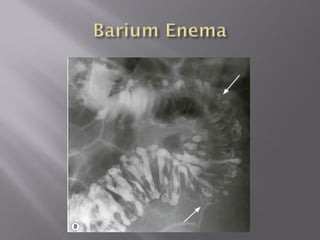
 It is a very common condition in older patients.
 Diverticula- A characteristic muscle abnormality
in the sigmoid colon with typical ‘out pouching’
from the colonic wall
 Diverticulosis - presence of diverticula,
Diverticulitis – refers to inflammatory changes
within one or more diverticula
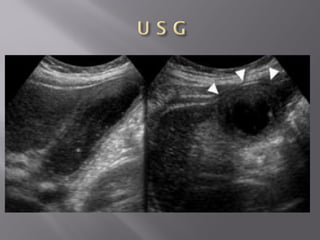
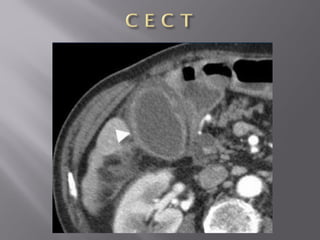
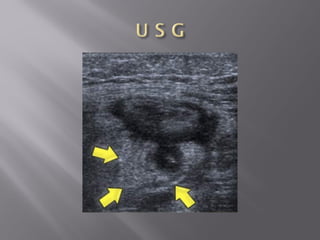
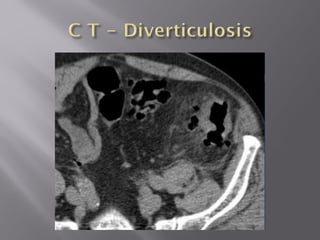
U S G and CT show diverticulosis with segmental
colonic wall thickening and inflammatory changes
in the fat surrounding a diverticulum
Complications of Diverticulitis such as abscess
formation or perforation, can best be excluded with
CT.
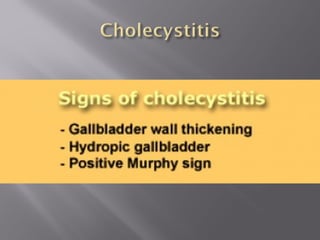
 Cholecystitis
 Occurs when a calculus obstructs the cystic duct.
The trapped bile causes inflammation of the
gallbladder wall.
 U S G is the preferred imaging method for the
evaluation of cholecystitis, also allowing
assessment of the compressibility of the
gallbladder.
 The diagnosis of a hydropic gallbladder is solely
made on the non-compressability of the
gallbladder.
 Causes
 Adhesions 80%
 Hernia 15%
 Tumors, intussusception, midgut volvulus, etc.
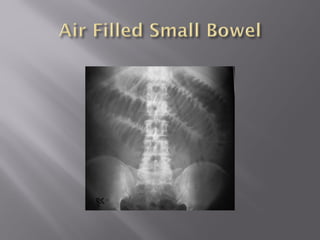
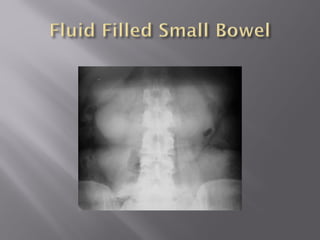
   Loops proximal to the point of obstruction will
become dilated and fluid-filled - Usually greater
than 2.5-3 cm in size
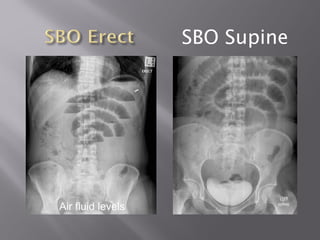
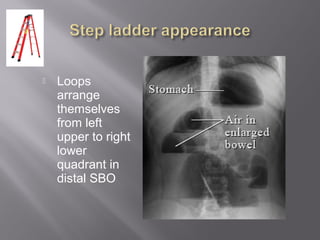
 Step-ladder pattern of bowel loops on supine view
 Step-ladder air-fluid levels on erect/decubitus
views
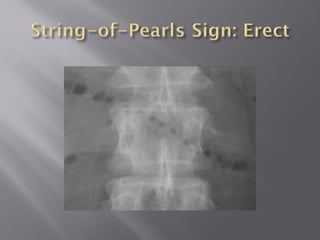
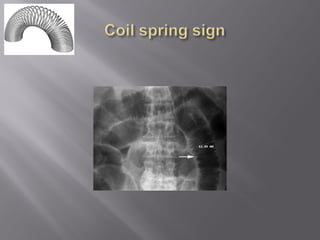
 Stretch sign on supine view
 String-of-pearls sign on erect/decubitus views
 Fluid-filled bowel may be more significant than air-
filled bowel
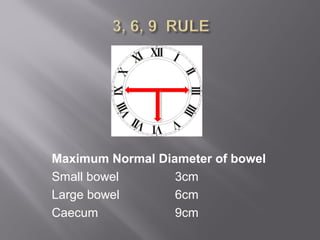
Maximum Normal Diameter of bowel
Small bowel 3cm
Large bowel 6cm
Caecum 9cm
SBO Supine
Air fluid levels
 Loops
arrange
themselves
from left
upper to right
lower
quadrant in
distal SBO
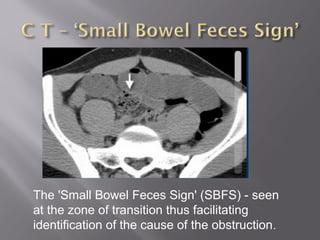
The 'Small Bowel Feces Sign' (SBFS) - seen
at the zone of transition thus facilitating
identification of the cause of the obstruction.
Causes
 Carcinoma of the colon - 80%
 Volvulus - 5%
 Diverticulitis - 5%
 Fecal impaction - 5%
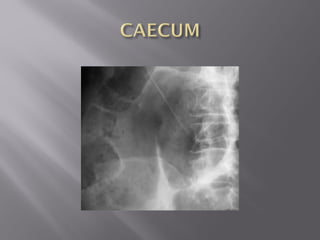
 The cecum is the most distensible part of the
colon
 A cecum of 9 cm diameter is cause for concern
 A cecum of 11 cm is impending perforation
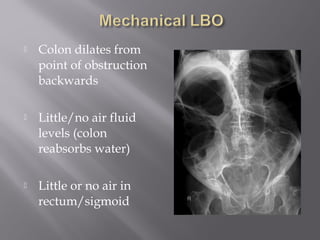
 Colon dilates from
point of obstruction
backwards
 Little/no air fluid
levels (colon
reabsorbs water)
 Little or no air in
rectum/sigmoid
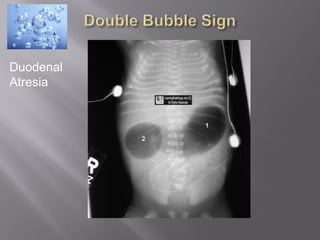
 Seen in infants
 Represents dilatation of the proximal
duodenum and stomach.
 It is seen in both radiographs and ultrasound,
and can be identified antenatally
 Seen in duodenal atresia.
Duodenal
Atresia
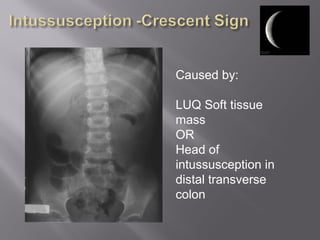
Caused by:
LUQ Soft tissue
mass
OR
Head of
intussusception in
distal transverse
colon
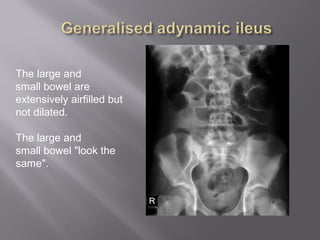
The large and
small bowel are
extensively airfilled but
not dilated.
The large and
small bowel "look the
same".
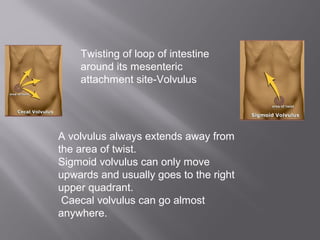
A volvulus always extends away from
the area of twist.
Sigmoid volvulus can only move
upwards and usually goes to the right
upper quadrant.
Caecal volvulus can go almost
anywhere.
Twisting of loop of intestine
around its mesenteric
attachment site-Volvulus
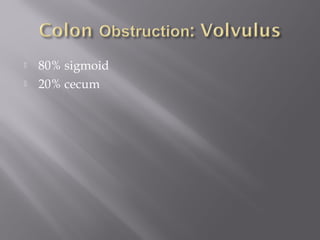
 80% sigmoid
 20% cecum
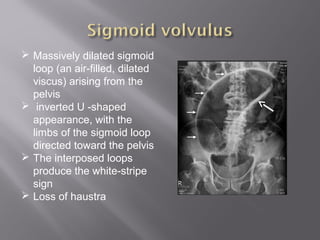
 Massively dilated sigmoid
loop (an air-filled, dilated
viscus) arising from the
pelvis
 inverted U -shaped
appearance, with the
limbs of the sigmoid loop
directed toward the pelvis
 The interposed loops
produce the white-stripe
sign
 Loss of haustra
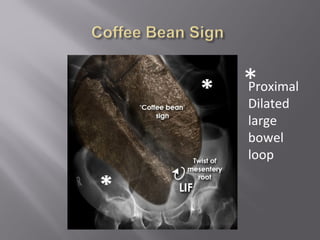
Proximal
Dilated
large
bowel
loop
*
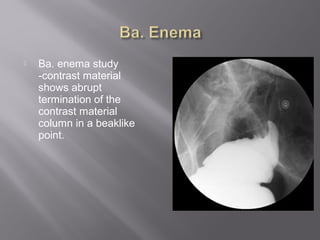
 Ba. enema study
-contrast material
shows abrupt
termination of the
contrast material
column in a beaklike
point.
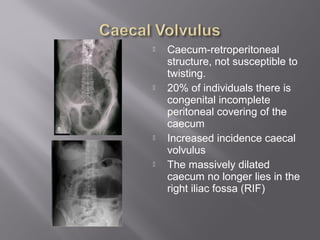
 Caecum-retroperitoneal
structure, not susceptible to
twisting.
 20% of individuals there is
congenital incomplete
peritoneal covering of the
caecum
 Increased incidence caecal
volvulus
 The massively dilated
caecum no longer lies in the
right iliac fossa (RIF)
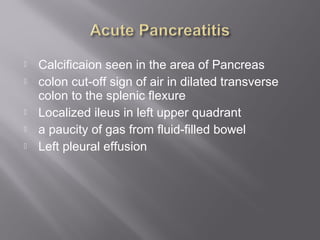
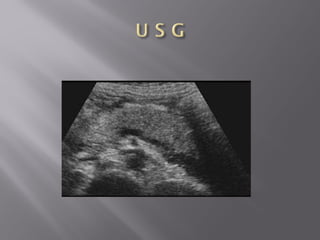
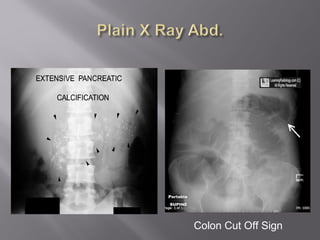
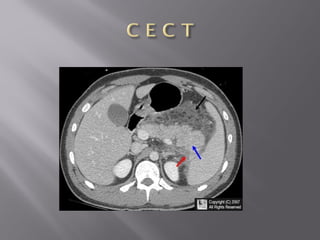
 Calcificaion seen in the area of Pancreas
 colon cut-off sign of air in dilated transverse
colon to the splenic flexure
 Localized ileus in left upper quadrant
 a paucity of gas from fluid-filled bowel
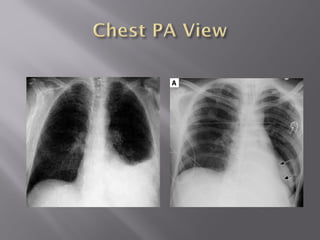
 Left pleural effusion
Colon Cut Off Sign
Radioation Hazards-Introduction
DR C.S.SINGH
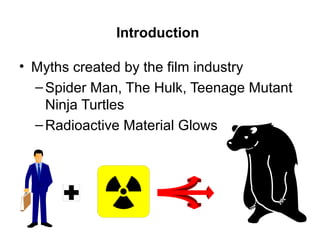
Introduction
• Myths created by the film industry
–Spider Man, The Hulk, Teenage Mutant
Ninja Turtles
–Radioactive Material Glows
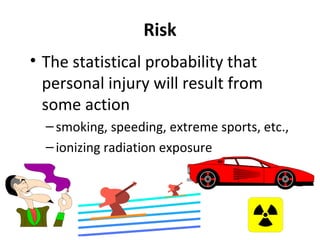
Risk
• The statistical probability that
personal injury will result from
some action
–smoking, speeding, extreme sports, etc.,
–ionizing radiation exposure
Ionizing Radiation Exposure Effects
• Somatic Effect (Prompt or Delayed)
– Stochastic Effect (Cancer) - probability of effect
occurring increases as doses increases. No Threshold
– Non-Stochastic Effect (Cataracts) - severity of the
effect varies with dosage. Threshold dose
• Teratogenic Effects (Offspring while in-utero)
– mental retardation
– malformations
Ionizing Radiation Exposure Effects
(Con’t)
• Genetic Effects (Future Generations)
–Anemia
–Epilepsy
–Diabetes
–Asthma
Physical Factors of Effects
• Acute dose vs. Chronic Dose
Physical Factors of Effects
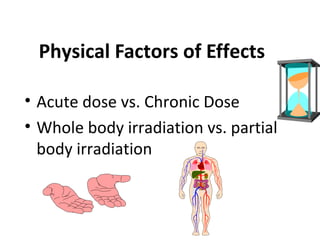
• Acute dose vs. Chronic Dose
• Whole body irradiation vs. partial
body irradiation
• Radiation causes ionizations in the molecules of living
cells
• At low doses, for ex. from background radiation, the cells
repair the damage rapidly.
• At higher doses (up to 100 rem), the cells might not be
able to repair the damage - the cells may either be
changed permanently / die.
• Most cells that die - body can just replace them.
• Cells changed permanently - produce abnormal cells
when they divide - thus these cells may lead to cancer.
Characters
• The onset and type of symptoms depends on the radiation
exposure.
• smaller doses - gastrointestinal effects - nausea and vomiting
and symptoms related to falling blood counts such as infection
and bleeding.
• Relatively larger doses - neurological effects and rapid death.
• Similar symptoms may appear months to years after
exposure as chronic radiation syndrome when the dose rate is
too low to cause the acute form.
• Radiation exposure - increase the probability of developing
different types of cancers.
Problems with Models
• Cancers are indistinguishable
• Ionizing radiation is not only cause
of cancer
• Long latency period of cancer
• Cannot perform human experiment
• Studies may suggest radiation as the
cause of cancer but cannot identify
Cancer Facts
• Causes - Many
Risk increases after age 40
• Risk factors
–Personal Habits, Environmental
factors, Occupational hazards
What is cancer? - uncontrolled
growth and spread of abnormal
cells
Cancer Facts (Con’t)
–40% Male/Female
• Death of cancer victims
–50% of personnel who develop
cancer will die
• Overall death rate from cancer
–20%
Cancers frequently linked to
radiation
Breast cancer
Thyroid cancer
Leukemia
Is Radiation Safe?
• Safer than normal risk associated with
many activities encountered daily
Something Extra
• Irradiating Food
• Radon
Summary
• There may be a slight increase in
the risk of developing cancer

ACUTE ABDOMEN

  • 1.
  • 3.
    • Severe abdominalpain, requiring the clinician to make an urgent therapeutic decision. • Differential diagnosis of an acute abdomen includes a wide spectrum of disorders, ranging from life- threatening diseases to benign self-limiting conditions • Management may vary from emergency surgery to reassurance of the patient and misdiagnosis may easily result in delayed necessary treatment or unnecessary surgery. • Sonography and CT are the aids
  • 4.
     Findings maybe normal in patients who need emergency surgery (such as appendicitis) and may be abnormal in patients without a surgical disease (like salpingitis).  A plain abdominal film has a limited value in the evaluation of abdominal pain.  A normal film does not exclude an ileus or other pathology and may falsely reassure the clinician.
  • 7.
     TYPES  Pneumoperitoneum-/freeair/intraperitoneal air  Retroperintoneal air  Air in the bowel wall (pneumatosis intestinalis)  Air in the biliary system (pneumobilia)
  • 8.
     The patientshould be positioned sitting upright for 10-20 minutes prior to acquiring the erect chest X-ray image.  This allows any free intra-abdominal gas to rise up, forming a crescent beneath the diaphragm. It is said that as little as 1ml of gas can be detected in this way.
  • 9.
     Rupture ofa hollow viscus  Perforated peptic ulcer  Trauma  Perforated diverticulitis (usually seals off)  Perforated carcinoma  Post-op --5-7 days normal, should get less with successive studies  NOT ruptured appendix (seals off)
  • 10.
     Crescent sign Chilaiditis sign  Riglers  Football sign  Falciform ligament sign  Triangle sign
  • 11.
    Free air underthe diaphragm Best demonstrated on upright chest x rays or left lat decubitus Easier to see under right diaphragm
  • 12.
     May mimicair under the diaphragm  Look for haustral folds  Get left lateral decubitus to confirm In patients who have cirrhosis or flattened diaphragms due to lung hyperinflation, a void is created within the upper abdomen above the liver. This space may be filled by bowel. If this bowel is air filled then it may mimic free gas.
  • 13.
    Bowel wall visualisedon both sides due to intra and extraluminal air Usually large amounts of free air May be confused with overlapping loops of bowel, confirm with upright view
  • 14.
    Seen with massive pneumoperitoneum Mostoften in children with necrotising enterocolitis Paediatric Adult In supine position air collects anterior to abdominal viscera
  • 15.
    Normally invisible. Supine film, free airrises over anterior surface of liver
  • 16.
    Sufficient free air,left and right hemi- diaphragms appear continous
  • 17.
     The trianglesign refers to small triangles of free gas that can typically be positioned between the large bowel and the flank
  • 18.
     Recognised by: Streaky, linear appearance outlining retroperitoneal structures  Mottled, blotchy appearance  Relatively fixed position  May outline:  Psoas muscles  Kidneys, ureters, bladder  Aorta or IVC  Subphrenic spaces
  • 19.
     Bowel perforation (appendix,ileum, colon)  Trauma (blunt or penetrating)  Iatrogenic  Foreign body  Gas producing infection
  • 20.
     This patienthas free air in the retroperitoneal space. The air is seen surrounding the lateral border of the right kidney (white arrow). There is other evidence of free gas including Rigler's sign.  If you are not confident that the appearance is pneumoretroperitoneum, you can try an erect and decubitus view to see if the gas moves. If the gas is seen to move, it's not in the retroperitoneum.
  • 21.
     Primary  Pneumatosiscystoides intestinalis (rare)  usually affects left colon  Produces cyst-like collections of air in the submucosa or serosa  Secondary  Diseases with bowel wall necrosis  Obstructing lesions of the bowel that raise intraluminal pressure  Complications  Rupture into peritoneal cavity  Dissection of air into portal venous system
  • 22.
     Intramural air, bestappreciated in profile
  • 23.
     One ortwo tube-like branching lucencies in the RUQ, confoined to location of major bile ducts
  • 24.
     “Normal” ifSphincter of Oddi incompetence  Previous surgery including sphincterotomy or transplantation of CBD  Pathology (uncommon)  Gallstone ileus: gallstone erodes through wall of GB into the duodenum producing a fistula between the bowel and the biliary system.  Stone impacts in small bowel = mechanical SBO. “ileus” misnomer
  • 25.
     Portal venousair usually associated with bowel necrosis -noted within 2 cm of the liver capsule  Air is peripheral rather than central  Numerous branching structures
  • 27.
    Normal Appendix  Atsonography and CT the appendix is seen as a blind-ending nonperistaltic tubular structure arising from the base of the cecum.  Do not mistake a small bowel loop for the appendix.  The outer-to-outer diameter of the appendix is the most important imaging criterion.
  • 28.
    Long Axis ShortAxis TARGET SIGN
  • 30.
     Diameter largerthan 6 mm  Usually surrounded by inflamed fat  Presence of a fecolith  Hypervascularity on power Doppler
  • 31.
     Mesenteric lymphadenitisis a mimicker of appendicitis.  It is the second most common cause of right lower quadrant pain after appendicitis.  It is defined as a benign self-limiting inflammation of right-sided mesenteric lymph nodes without an identifiable underlying inflammatory process - often in children than in adults..  Diagnosis can only be made confidently when a normal appendix is found, because adenopathy also frequently occurs with appendicitis.  Key finding: Lymphadenopathy with a normal appendix and normal mesenteric fat
  • 33.
  • 34.
     It isa very common condition in older patients.  Diverticula- A characteristic muscle abnormality in the sigmoid colon with typical ‘out pouching’ from the colonic wall  Diverticulosis - presence of diverticula, Diverticulitis – refers to inflammatory changes within one or more diverticula
  • 35.
    U S Gand CT show diverticulosis with segmental colonic wall thickening and inflammatory changes in the fat surrounding a diverticulum Complications of Diverticulitis such as abscess formation or perforation, can best be excluded with CT.
  • 39.
     Cholecystitis  Occurswhen a calculus obstructs the cystic duct. The trapped bile causes inflammation of the gallbladder wall.  U S G is the preferred imaging method for the evaluation of cholecystitis, also allowing assessment of the compressibility of the gallbladder.  The diagnosis of a hydropic gallbladder is solely made on the non-compressability of the gallbladder.
  • 43.
     Causes  Adhesions80%  Hernia 15%  Tumors, intussusception, midgut volvulus, etc.
  • 44.
       Loops proximalto the point of obstruction will become dilated and fluid-filled - Usually greater than 2.5-3 cm in size  Step-ladder pattern of bowel loops on supine view  Step-ladder air-fluid levels on erect/decubitus views  Stretch sign on supine view  String-of-pearls sign on erect/decubitus views  Fluid-filled bowel may be more significant than air- filled bowel
  • 45.
    Maximum Normal Diameterof bowel Small bowel 3cm Large bowel 6cm Caecum 9cm
  • 49.
  • 50.
     Loops arrange themselves from left upperto right lower quadrant in distal SBO
  • 52.
    The 'Small BowelFeces Sign' (SBFS) - seen at the zone of transition thus facilitating identification of the cause of the obstruction.
  • 53.
    Causes  Carcinoma ofthe colon - 80%  Volvulus - 5%  Diverticulitis - 5%  Fecal impaction - 5%
  • 54.
     The cecumis the most distensible part of the colon  A cecum of 9 cm diameter is cause for concern  A cecum of 11 cm is impending perforation
  • 55.
     Colon dilatesfrom point of obstruction backwards  Little/no air fluid levels (colon reabsorbs water)  Little or no air in rectum/sigmoid
  • 57.
     Seen ininfants  Represents dilatation of the proximal duodenum and stomach.  It is seen in both radiographs and ultrasound, and can be identified antenatally  Seen in duodenal atresia.
  • 58.
  • 59.
    Caused by: LUQ Softtissue mass OR Head of intussusception in distal transverse colon
  • 60.
    The large and smallbowel are extensively airfilled but not dilated. The large and small bowel "look the same".
  • 61.
    A volvulus alwaysextends away from the area of twist. Sigmoid volvulus can only move upwards and usually goes to the right upper quadrant. Caecal volvulus can go almost anywhere. Twisting of loop of intestine around its mesenteric attachment site-Volvulus
  • 62.
  • 63.
     Massively dilatedsigmoid loop (an air-filled, dilated viscus) arising from the pelvis  inverted U -shaped appearance, with the limbs of the sigmoid loop directed toward the pelvis  The interposed loops produce the white-stripe sign  Loss of haustra
  • 64.
  • 65.
     Ba. enemastudy -contrast material shows abrupt termination of the contrast material column in a beaklike point.
  • 66.
     Caecum-retroperitoneal structure, notsusceptible to twisting.  20% of individuals there is congenital incomplete peritoneal covering of the caecum  Increased incidence caecal volvulus  The massively dilated caecum no longer lies in the right iliac fossa (RIF)
  • 67.
     Calcificaion seenin the area of Pancreas  colon cut-off sign of air in dilated transverse colon to the splenic flexure  Localized ileus in left upper quadrant  a paucity of gas from fluid-filled bowel  Left pleural effusion
  • 69.
  • 73.
  • 74.
    Introduction • Myths createdby the film industry –Spider Man, The Hulk, Teenage Mutant Ninja Turtles –Radioactive Material Glows
  • 75.
    Risk • The statisticalprobability that personal injury will result from some action –smoking, speeding, extreme sports, etc., –ionizing radiation exposure
  • 76.
    Ionizing Radiation ExposureEffects • Somatic Effect (Prompt or Delayed) – Stochastic Effect (Cancer) - probability of effect occurring increases as doses increases. No Threshold – Non-Stochastic Effect (Cataracts) - severity of the effect varies with dosage. Threshold dose • Teratogenic Effects (Offspring while in-utero) – mental retardation – malformations
  • 77.
    Ionizing Radiation ExposureEffects (Con’t) • Genetic Effects (Future Generations) –Anemia –Epilepsy –Diabetes –Asthma
  • 78.
    Physical Factors ofEffects • Acute dose vs. Chronic Dose
  • 79.
    Physical Factors ofEffects • Acute dose vs. Chronic Dose • Whole body irradiation vs. partial body irradiation
  • 80.
    • Radiation causesionizations in the molecules of living cells • At low doses, for ex. from background radiation, the cells repair the damage rapidly. • At higher doses (up to 100 rem), the cells might not be able to repair the damage - the cells may either be changed permanently / die. • Most cells that die - body can just replace them. • Cells changed permanently - produce abnormal cells when they divide - thus these cells may lead to cancer.
  • 81.
    Characters • The onsetand type of symptoms depends on the radiation exposure. • smaller doses - gastrointestinal effects - nausea and vomiting and symptoms related to falling blood counts such as infection and bleeding. • Relatively larger doses - neurological effects and rapid death. • Similar symptoms may appear months to years after exposure as chronic radiation syndrome when the dose rate is too low to cause the acute form. • Radiation exposure - increase the probability of developing different types of cancers.
  • 82.
    Problems with Models •Cancers are indistinguishable • Ionizing radiation is not only cause of cancer • Long latency period of cancer • Cannot perform human experiment • Studies may suggest radiation as the cause of cancer but cannot identify
  • 83.
    Cancer Facts • Causes- Many Risk increases after age 40 • Risk factors –Personal Habits, Environmental factors, Occupational hazards What is cancer? - uncontrolled growth and spread of abnormal cells
  • 84.
    Cancer Facts (Con’t) –40%Male/Female • Death of cancer victims –50% of personnel who develop cancer will die • Overall death rate from cancer –20%
  • 85.
    Cancers frequently linkedto radiation Breast cancer Thyroid cancer Leukemia
  • 86.
    Is Radiation Safe? •Safer than normal risk associated with many activities encountered daily
  • 87.
  • 88.
    Summary • There maybe a slight increase in the risk of developing cancer