ENGLISH TEACHING METHODOLOGY
PROFESSOR: MST. NESTOR BONILLA
STUDENT: ANTONIO RODRIGUEZ CASTRO
 It is considerad the ability to control and
inspire a class.
 It es crucial the communication with te
student.
 Teachers requiere emphatize with people
 The emphaty allow them to almost feel
whether if the level of language is
appropriate for the audience.
 It is a crucial for Teacher’s job.
 Establish a set of standards concerning
class procedures and routines and stick to
them
 Teacher should be very clear in
establishing some general basis of
discipline.
 Teacher should manage routines that best
suit their teaching style and situation.
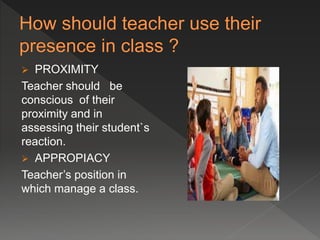
 PROXIMITY
Teacher should be
conscious of their
proximity and in
assessing their student`s
reaction.
 APPROPIACY
Teacher’s position in
which manage a class.
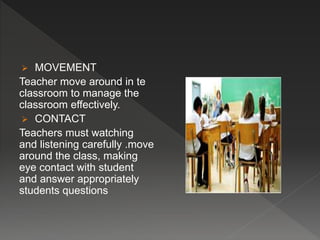
 MOVEMENT
Teacher move around in te
classroom to manage the
classroom effectively.
 CONTACT
Teachers must watching
and listening carefully .move
around the class, making
eye contact with student
and answer appropriately
students questions
 Sitting in orderly rows.
 Sitting in a large circle around the classroom
 Sitting in small groups working in different
parts of the room
 Sitting in a horseshoe shape around the
teacher
 Sitting on separate tables.
 Whole class
Teacher may work with the whole class in an
arragement class focusing on him or her a task
in hand.
 Group work and pairwork
-It is a cooperative form in which students
disscuss a topic or solving problem.
- Students participate more equally
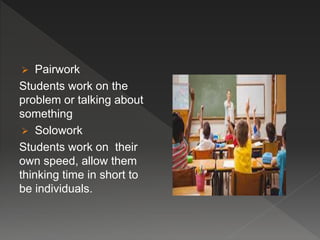
 Pairwork
Students work on the
problem or talking about
something
 Solowork
Students work on their
own speed, allow them
thinking time in short to
be individuals.
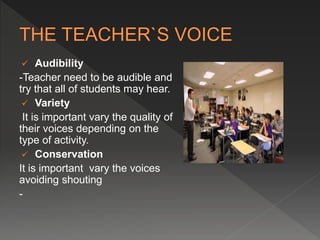
 Audibility
-Teacher need to be audible and
try that all of students may hear.
 Variety
It is important vary the quality of
their voices depending on the
type of activity.
 Conservation
It is important vary the voices
avoiding shouting
-
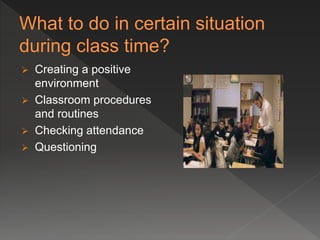
 Creating a positive
environment
 Classroom procedures
and routines
 Checking attendance
 Questioning
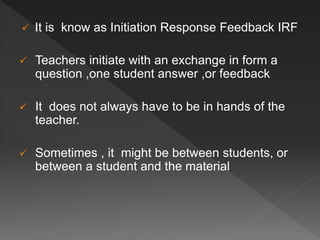
 It is know as Initiation Response Feedback IRF
 Teachers initiate with an exchange in form a
question ,one student answer ,or feedback
 It does not always have to be in hands of the
teacher.
 Sometimes , it might be between students, or
between a student and the material
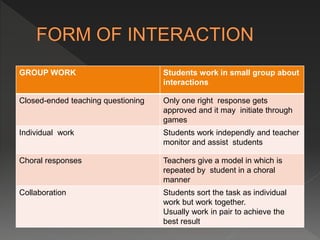
GROUP WORK Students work in small group about
interactions
Closed-ended teaching questioning Only one right response gets
approved and it may initiate through
games
Individual work Students work independly and teacher
monitor and assist students
Choral responses Teachers give a model in which is
repeated by student in a choral
manner
Collaboration Students sort the task as individual
work but work together.
Usually work in pair to achieve the
best result
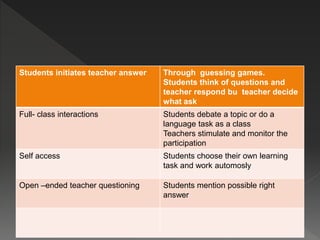
Students initiates teacher answer Through guessing games.
Students think of questions and
teacher respond bu teacher decide
what ask
Full- class interactions Students debate a topic or do a
language task as a class
Teachers stimulate and monitor the
participation
Self access Students choose their own learning
task and work automosly
Open –ended teacher questioning Students mention possible right
answer
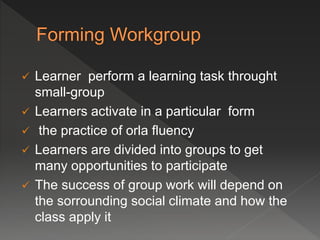
 Learner perform a learning task throught
small-group
 Learners activate in a particular form
 the practice of orla fluency
 Learners are divided into groups to get
many opportunities to participate
 The success of group work will depend on
the sorrounding social climate and how the
class apply it
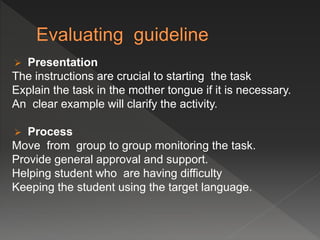
 Presentation
The instructions are crucial to starting the task
Explain the task in the mother tongue if it is necessary.
An clear example will clarify the activity.
 Process
Move from group to group monitoring the task.
Provide general approval and support.
Helping student who are having difficulty
Keeping the student using the target language.
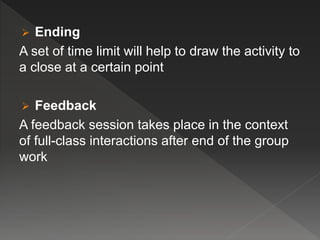
 Ending
A set of time limit will help to draw the activity to
a close at a certain point
 Feedback
A feedback session takes place in the context
of full-class interactions after end of the group
work
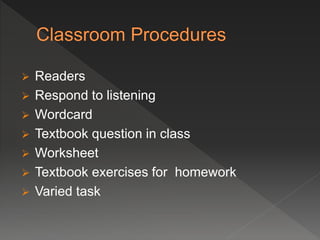
 Readers
 Respond to listening
 Wordcard
 Textbook question in class
 Worksheet
 Textbook exercises for homework
 Varied task

Activity # 2

  • 1.
    ENGLISH TEACHING METHODOLOGY PROFESSOR:MST. NESTOR BONILLA STUDENT: ANTONIO RODRIGUEZ CASTRO
  • 2.
     It isconsiderad the ability to control and inspire a class.  It es crucial the communication with te student.  Teachers requiere emphatize with people  The emphaty allow them to almost feel whether if the level of language is appropriate for the audience.
  • 3.
     It isa crucial for Teacher’s job.  Establish a set of standards concerning class procedures and routines and stick to them  Teacher should be very clear in establishing some general basis of discipline.  Teacher should manage routines that best suit their teaching style and situation.
  • 4.
     PROXIMITY Teacher shouldbe conscious of their proximity and in assessing their student`s reaction.  APPROPIACY Teacher’s position in which manage a class.
  • 5.
     MOVEMENT Teacher movearound in te classroom to manage the classroom effectively.  CONTACT Teachers must watching and listening carefully .move around the class, making eye contact with student and answer appropriately students questions
  • 6.
     Sitting inorderly rows.  Sitting in a large circle around the classroom  Sitting in small groups working in different parts of the room  Sitting in a horseshoe shape around the teacher  Sitting on separate tables.
  • 7.
     Whole class Teachermay work with the whole class in an arragement class focusing on him or her a task in hand.  Group work and pairwork -It is a cooperative form in which students disscuss a topic or solving problem. - Students participate more equally
  • 8.
     Pairwork Students workon the problem or talking about something  Solowork Students work on their own speed, allow them thinking time in short to be individuals.
  • 9.
     Audibility -Teacher needto be audible and try that all of students may hear.  Variety It is important vary the quality of their voices depending on the type of activity.  Conservation It is important vary the voices avoiding shouting -
  • 10.
     Creating apositive environment  Classroom procedures and routines  Checking attendance  Questioning
  • 12.
     It isknow as Initiation Response Feedback IRF  Teachers initiate with an exchange in form a question ,one student answer ,or feedback  It does not always have to be in hands of the teacher.  Sometimes , it might be between students, or between a student and the material
  • 13.
    GROUP WORK Studentswork in small group about interactions Closed-ended teaching questioning Only one right response gets approved and it may initiate through games Individual work Students work independly and teacher monitor and assist students Choral responses Teachers give a model in which is repeated by student in a choral manner Collaboration Students sort the task as individual work but work together. Usually work in pair to achieve the best result
  • 14.
    Students initiates teacheranswer Through guessing games. Students think of questions and teacher respond bu teacher decide what ask Full- class interactions Students debate a topic or do a language task as a class Teachers stimulate and monitor the participation Self access Students choose their own learning task and work automosly Open –ended teacher questioning Students mention possible right answer
  • 15.
     Learner performa learning task throught small-group  Learners activate in a particular form  the practice of orla fluency  Learners are divided into groups to get many opportunities to participate  The success of group work will depend on the sorrounding social climate and how the class apply it
  • 16.
     Presentation The instructionsare crucial to starting the task Explain the task in the mother tongue if it is necessary. An clear example will clarify the activity.  Process Move from group to group monitoring the task. Provide general approval and support. Helping student who are having difficulty Keeping the student using the target language.
  • 17.
     Ending A setof time limit will help to draw the activity to a close at a certain point  Feedback A feedback session takes place in the context of full-class interactions after end of the group work
  • 18.
     Readers  Respondto listening  Wordcard  Textbook question in class  Worksheet  Textbook exercises for homework  Varied task