




CLASSROOM
MANAGEMENT
And its importance
VARIABLES
• How the classroom space is organised.
• Wheter the students are woprking by their own or in group.
• Classroom time
• How we appear to the students
• How do we use our voice.
• The way we talk to the students.
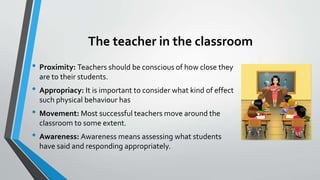
The teacher in the classroom
• Proximity: Teachers should be conscious of how close they
are to their students.
• Appropriacy: It is important to consider what kind of effect
such physical behaviour has
• Movement: Most successful teachers move around the
classroom to some extent.
• Awareness: Awareness means assessing what students
have said and responding appropriately.
USINGTHEVOICE
• Audibility: Everyone in the class can listen to the teacher.
• Variety: vary the quality of their voices
• Conservation: Good teachers breathe correctly so that they don’t strain
their larynxes.
MOTIVATING STUDENTS
• Role-play, with one student taking the role of a foreigner
• Native-speaking visitors answer questions on specific topics
• Pen friends, by mail or E-mail
• Group presentations of topics students have researched
• Interclass debates
• Speech competitions
• Concerts with plays and singing
MANAGING CONSTRAINTS
• Explain that groups are a chance to speak without the teacher noticing mistakes.
• When students complain about having to listen to all the other students’ bad English when
they get into groups, point out that communication involves listening to everyone and
making sense whether people speak slowly or fast, formally or informally.
• Make the activities age-appropriate.Avoid the word games with older learners.
• Make the purpose of each activity clear beforehand.
• Call for student feedback on group activities.What went well?What could be changed?
• Start with self-selected groupings, so that students are working with people they know or
like.
• Show connections between group activities and the rest of the program to overcome the
belief that group work is an extra.
MANAGINGTHETEACHER’S ROLE
• The teacher’s role includes relationships with colleagues.
• When a whole department operates by the same approach, there are fewer
misunderstandings.
QUANTITY OFTEACHERTALK
• The point in the lesson when the teacher must speak
• What prompts the teacher talk.
• The value of the talk as potentially input for acquisition.
QUESTIONING
• Questioning is a universally used activation technique in teaching, mainly
within the Initiation-Response-Feedback pattern. teacher questions are not
always realized by interrogatives. For example, the question:
• 'What can you see in this picture?'
• may be expressed by the statement,
• We'll describe what is going on in this picture.'
• or by the command:
• 'Tell me what you can see in this picture.'
GROUP WORK
• It is a form of learner activation that is of particular value in the practice of
oral fluency: learners in a class that is divided into five groups get five times
as many opportunities to talk as in full-class organization
Individualization
• The concept of individualization' in education is sometimesi dentified with
the provision of a self-accescse ntre,o r evena full self-acceslse arning
programme. Materials of various kinds are made available, and the learners
choose which to work on: the organization of these choices may be in the
hands of either teacher or learner, and learners may be working on their
own or in groups or pairs.
Different student groupings:
advantages
• Whole class
• we can have the students focus on us and the task in hand.This is useful for presenting
information and for controlled practice.
• Groupwork and pairwork
• They both foster cooperative activity in that the students involved work together to
complete a task.
• Solowork:
• It often provides welcome relief from the group-centred nature of much language teaching.
• Class-to-class
• when we are able to join two classes so that they can interact with each other
Different student groupings:
disadvantages
• Whole class
• students get fewer individual opportunities either to speak or to reflect
• Groupwork and pairwork
• students may not like the people they are grouped or paired with.
• Solowork:
• For the time that solowork takes place, students can relax their public faces and go back to
considering their own individual needs and progress..
• Class-to-class
• They can be time-consuming to organise, but, at their best, can often give students a huge sense
of satisfaction.
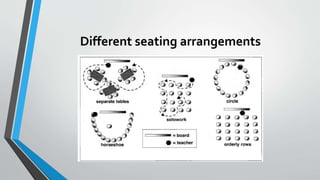
Different seating arrangements
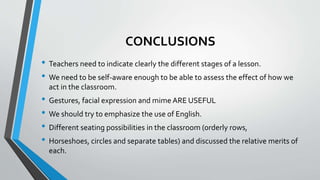
CONCLUSIONS
• Teachers need to indicate clearly the different stages of a lesson.
• We need to be self-aware enough to be able to assess the effect of how we
act in the classroom.
• Gestures, facial expression and mime ARE USEFUL
• We should try to emphasize the use of English.
• Different seating possibilities in the classroom (orderly rows,
• Horseshoes, circles and separate tables) and discussed the relative merits of
each.

Classroom management

  • 1.
  • 2.
    VARIABLES • How theclassroom space is organised. • Wheter the students are woprking by their own or in group. • Classroom time • How we appear to the students • How do we use our voice. • The way we talk to the students.
  • 3.
    The teacher inthe classroom • Proximity: Teachers should be conscious of how close they are to their students. • Appropriacy: It is important to consider what kind of effect such physical behaviour has • Movement: Most successful teachers move around the classroom to some extent. • Awareness: Awareness means assessing what students have said and responding appropriately.
  • 4.
    USINGTHEVOICE • Audibility: Everyonein the class can listen to the teacher. • Variety: vary the quality of their voices • Conservation: Good teachers breathe correctly so that they don’t strain their larynxes.
  • 5.
    MOTIVATING STUDENTS • Role-play,with one student taking the role of a foreigner • Native-speaking visitors answer questions on specific topics • Pen friends, by mail or E-mail • Group presentations of topics students have researched • Interclass debates • Speech competitions • Concerts with plays and singing
  • 6.
    MANAGING CONSTRAINTS • Explainthat groups are a chance to speak without the teacher noticing mistakes. • When students complain about having to listen to all the other students’ bad English when they get into groups, point out that communication involves listening to everyone and making sense whether people speak slowly or fast, formally or informally. • Make the activities age-appropriate.Avoid the word games with older learners. • Make the purpose of each activity clear beforehand. • Call for student feedback on group activities.What went well?What could be changed? • Start with self-selected groupings, so that students are working with people they know or like. • Show connections between group activities and the rest of the program to overcome the belief that group work is an extra.
  • 7.
    MANAGINGTHETEACHER’S ROLE • Theteacher’s role includes relationships with colleagues. • When a whole department operates by the same approach, there are fewer misunderstandings.
  • 8.
    QUANTITY OFTEACHERTALK • Thepoint in the lesson when the teacher must speak • What prompts the teacher talk. • The value of the talk as potentially input for acquisition.
  • 9.
    QUESTIONING • Questioning isa universally used activation technique in teaching, mainly within the Initiation-Response-Feedback pattern. teacher questions are not always realized by interrogatives. For example, the question: • 'What can you see in this picture?' • may be expressed by the statement, • We'll describe what is going on in this picture.' • or by the command: • 'Tell me what you can see in this picture.'
  • 10.
    GROUP WORK • Itis a form of learner activation that is of particular value in the practice of oral fluency: learners in a class that is divided into five groups get five times as many opportunities to talk as in full-class organization
  • 11.
    Individualization • The conceptof individualization' in education is sometimesi dentified with the provision of a self-accescse ntre,o r evena full self-acceslse arning programme. Materials of various kinds are made available, and the learners choose which to work on: the organization of these choices may be in the hands of either teacher or learner, and learners may be working on their own or in groups or pairs.
  • 12.
    Different student groupings: advantages •Whole class • we can have the students focus on us and the task in hand.This is useful for presenting information and for controlled practice. • Groupwork and pairwork • They both foster cooperative activity in that the students involved work together to complete a task. • Solowork: • It often provides welcome relief from the group-centred nature of much language teaching. • Class-to-class • when we are able to join two classes so that they can interact with each other
  • 13.
    Different student groupings: disadvantages •Whole class • students get fewer individual opportunities either to speak or to reflect • Groupwork and pairwork • students may not like the people they are grouped or paired with. • Solowork: • For the time that solowork takes place, students can relax their public faces and go back to considering their own individual needs and progress.. • Class-to-class • They can be time-consuming to organise, but, at their best, can often give students a huge sense of satisfaction.
  • 14.
  • 15.
    CONCLUSIONS • Teachers needto indicate clearly the different stages of a lesson. • We need to be self-aware enough to be able to assess the effect of how we act in the classroom. • Gestures, facial expression and mime ARE USEFUL • We should try to emphasize the use of English. • Different seating possibilities in the classroom (orderly rows, • Horseshoes, circles and separate tables) and discussed the relative merits of each.