CLASSROOM
MANAGEMENT
      Departamento de Lenguas Extranjeras,
Facultad de Ciencias Humanas ,UNLPam.
 Práctica Educativa II, Prof. Estela N. Braun (2012)
MAIN ASPECTS
 ROLES OF THE TEACHER.


 STUDENT GROUPINGS.


 DISRUPTIVE BEHAVIOUR.
Teacher’s ROLES
 The most effective techniques
 can be made useless if the
 teacher does not organize them
 properly”.
The teacher as CONTROLLER
   Some stages of the lesson require this role,
    e.g. presentation.
   Instruct           Cue Nominate CYCLE
   + All attention is focused at the front of the class.
   + All students work at the same beat.
   Teachers do most of the talking.
   It is vital that control be relaxed if the students
    are to be allowed a chance to learn.
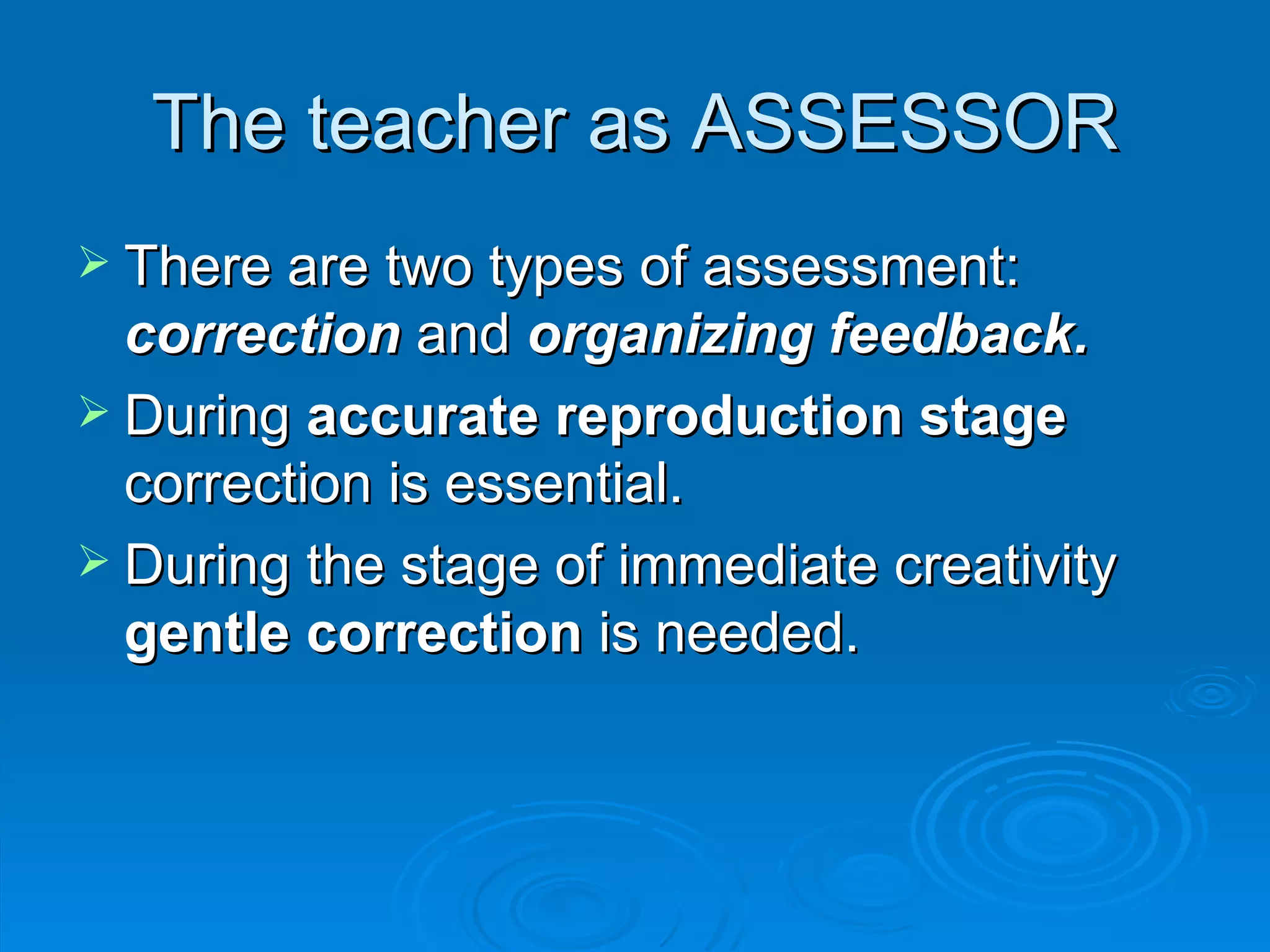
The teacher as ASSESSOR
 There are two types of assessment:
  correction and organizing feedback.
 During accurate reproduction stage
  correction is essential.
 During the stage of immediate creativity
  gentle correction is needed.
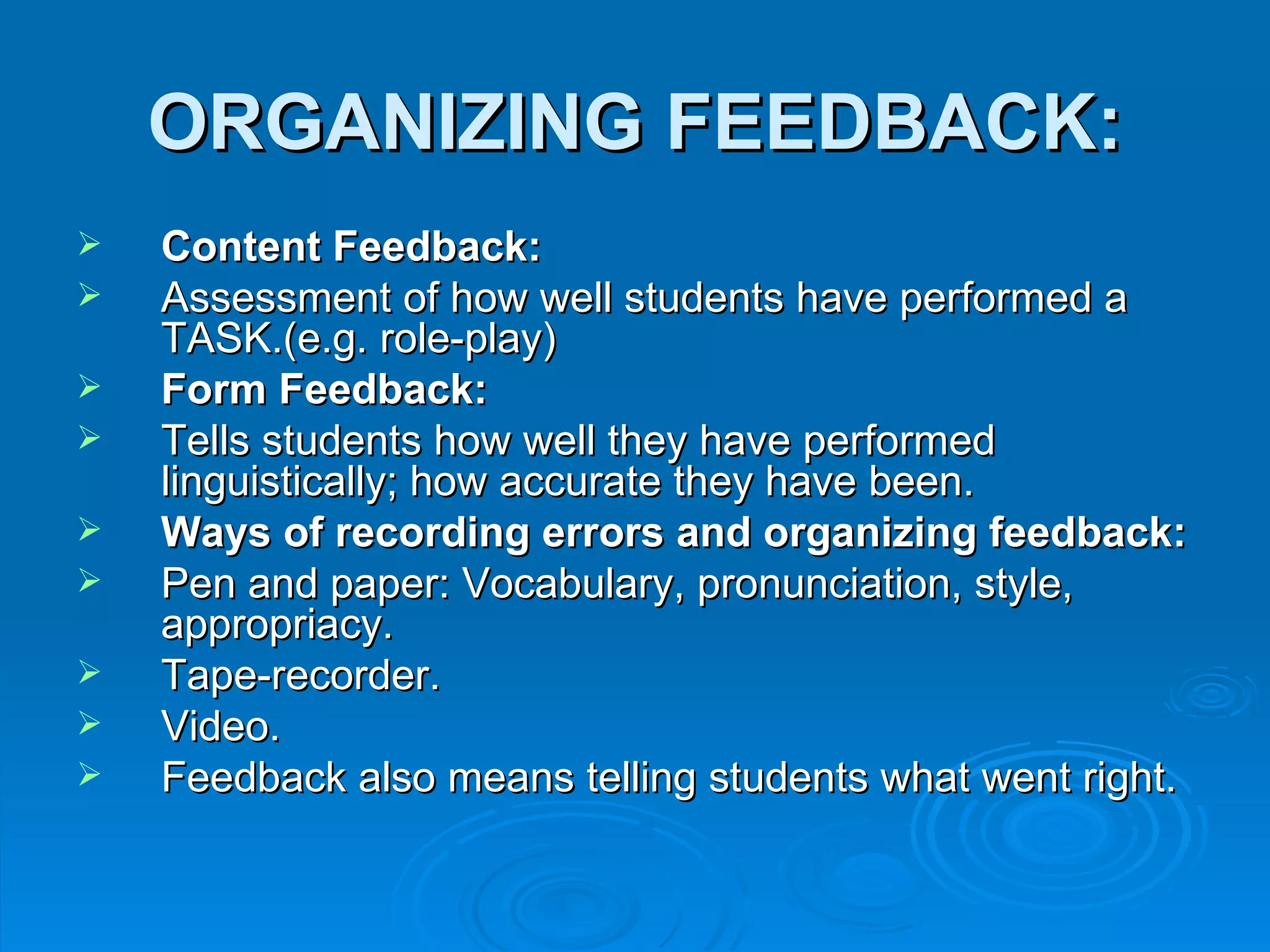
ORGANIZING FEEDBACK:
   Content Feedback:
   Assessment of how well students have performed a
    TASK.(e.g. role-play)
   Form Feedback:
   Tells students how well they have performed
    linguistically; how accurate they have been.
   Ways of recording errors and organizing feedback:
   Pen and paper: Vocabulary, pronunciation, style,
    appropriacy.
   Tape-recorder.
   Video.
   Feedback also means telling students what went right.
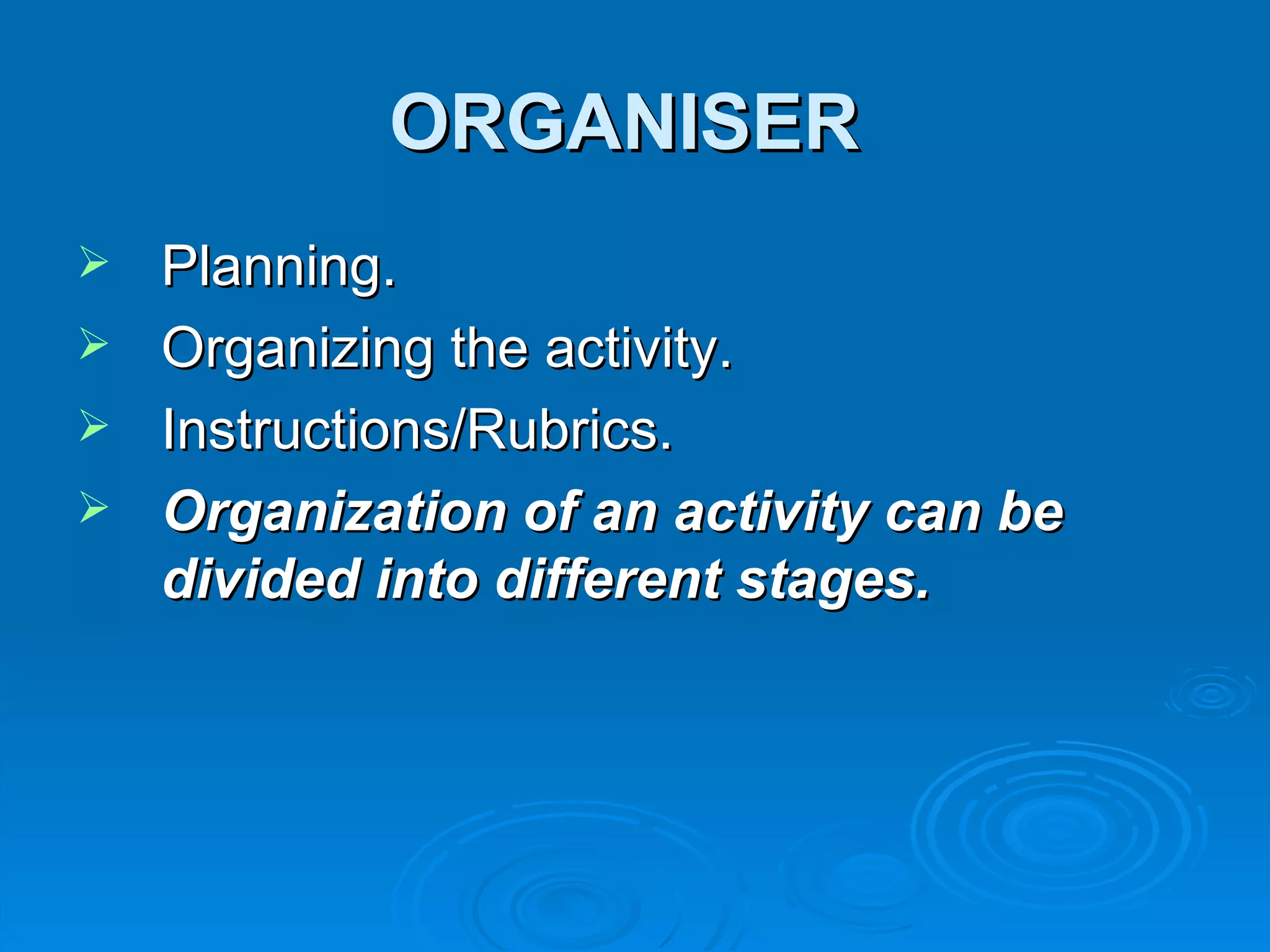
ORGANISER
 Planning.
 Organizing the activity.
 Instructions/Rubrics.
 Organization of an activity can be
  divided into different stages.
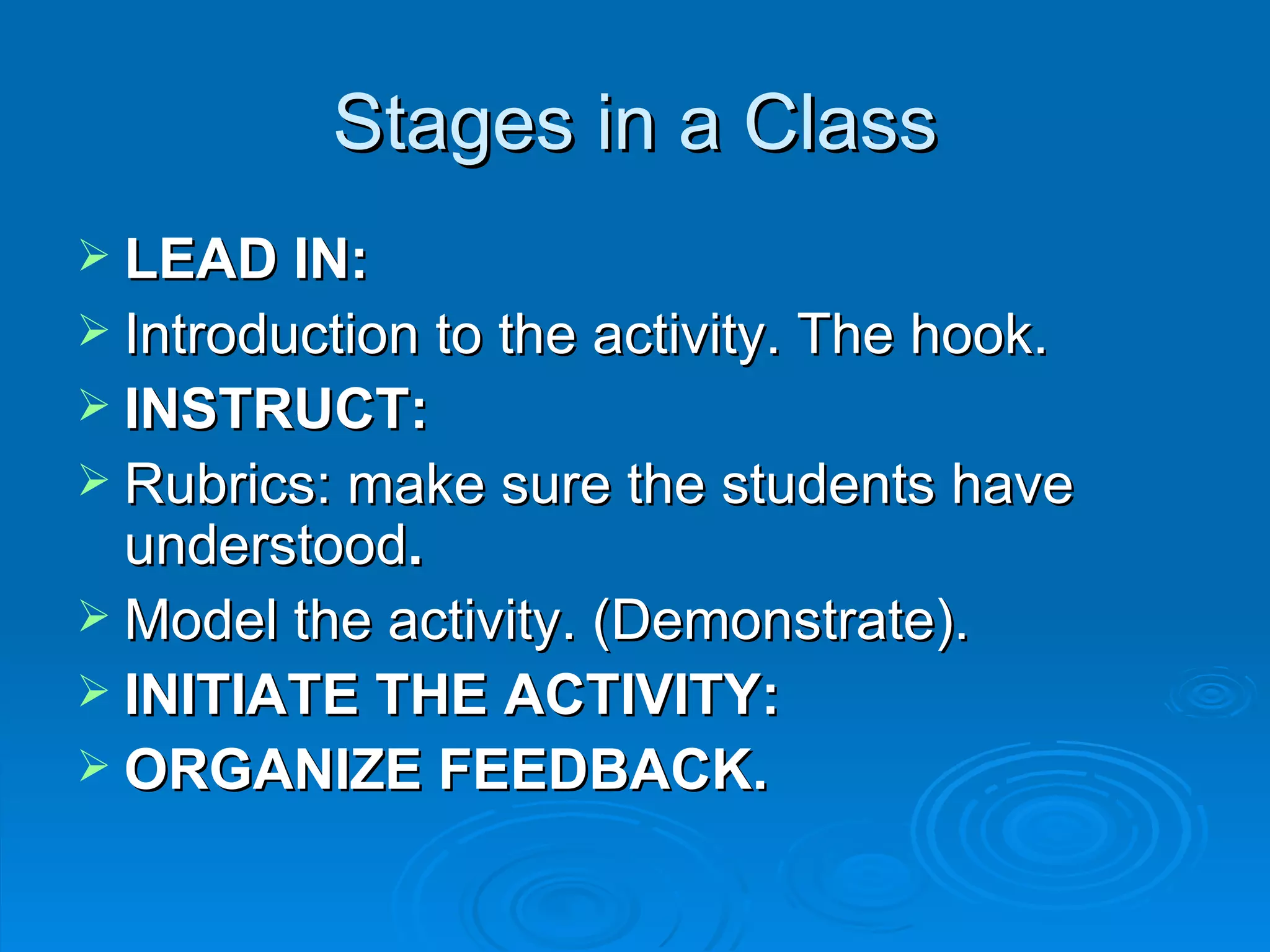
Stages in a Class
 LEAD IN:
 Introduction to the activity. The hook.
 INSTRUCT:
 Rubrics: make sure the students have
  understood.
 Model the activity. (Demonstrate).
 INITIATE THE ACTIVITY:
 ORGANIZE FEEDBACK.
Other teacher roles:

 PROMPTER/ PARTICIPANT/
 RESOURCE/ TUTOR/
 COUNSELLOR/ MONITOR/
 RESEARCHER.
STUDENT GROUPINGS:
         LOCKSTEP:
       FOR
       Everybody concentrates.
       Very dynamic (choral repetition, etc).
       Comforting for students.
       AGAINST:
       Little chance for students to talk.
       Sometimes wrong speed: either too fast or
        too slow.
PAIR-WORK/GROUP WORK:
 FOR:
 It fosters cooperation.
 Communication of ideas.
 Very dynamic.
 Enormous potential for MI and different
  learning styles.
 Flexible groups: form, re-form them.
DRAWBACKS:
 Analytic learners prefer individual work.
 Selection of group members/ roles.
 Group size.
 INDIVIDUAL WORK.

Classroom management

  • 1.
    CLASSROOM MANAGEMENT Departamento de Lenguas Extranjeras, Facultad de Ciencias Humanas ,UNLPam. Práctica Educativa II, Prof. Estela N. Braun (2012)
  • 2.
    MAIN ASPECTS  ROLESOF THE TEACHER.  STUDENT GROUPINGS.  DISRUPTIVE BEHAVIOUR.
  • 3.
    Teacher’s ROLES  Themost effective techniques can be made useless if the teacher does not organize them properly”.
  • 4.
    The teacher asCONTROLLER  Some stages of the lesson require this role, e.g. presentation.  Instruct Cue Nominate CYCLE  + All attention is focused at the front of the class.  + All students work at the same beat.  Teachers do most of the talking.  It is vital that control be relaxed if the students are to be allowed a chance to learn.
  • 5.
    The teacher asASSESSOR  There are two types of assessment: correction and organizing feedback.  During accurate reproduction stage correction is essential.  During the stage of immediate creativity gentle correction is needed.
  • 6.
    ORGANIZING FEEDBACK:  Content Feedback:  Assessment of how well students have performed a TASK.(e.g. role-play)  Form Feedback:  Tells students how well they have performed linguistically; how accurate they have been.  Ways of recording errors and organizing feedback:  Pen and paper: Vocabulary, pronunciation, style, appropriacy.  Tape-recorder.  Video.  Feedback also means telling students what went right.
  • 7.
    ORGANISER  Planning.  Organizingthe activity.  Instructions/Rubrics.  Organization of an activity can be divided into different stages.
  • 8.
    Stages in aClass  LEAD IN:  Introduction to the activity. The hook.  INSTRUCT:  Rubrics: make sure the students have understood.  Model the activity. (Demonstrate).  INITIATE THE ACTIVITY:  ORGANIZE FEEDBACK.
  • 9.
    Other teacher roles: PROMPTER/ PARTICIPANT/ RESOURCE/ TUTOR/ COUNSELLOR/ MONITOR/ RESEARCHER.
  • 10.
    STUDENT GROUPINGS:  LOCKSTEP:  FOR  Everybody concentrates.  Very dynamic (choral repetition, etc).  Comforting for students.  AGAINST:  Little chance for students to talk.  Sometimes wrong speed: either too fast or too slow.
  • 11.
    PAIR-WORK/GROUP WORK:  FOR: It fosters cooperation.  Communication of ideas.  Very dynamic.  Enormous potential for MI and different learning styles.  Flexible groups: form, re-form them.
  • 12.
    DRAWBACKS:  Analytic learnersprefer individual work.  Selection of group members/ roles.  Group size.  INDIVIDUAL WORK.