Barriers to Effective Listening
                         Jethro Dato
                       Ruby Joy Juan
                        Alpha Garcia
                     Franchesca Asis
                              2BES2
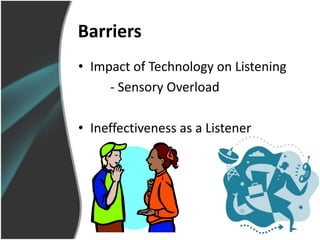
Barriers
• Impact of Technology on Listening
     - Sensory Overload

• Ineffectiveness as a Listener
Distractions
Physical and Mental

• Physical
      - Hearing Impairment, Noisy Environment
  or Loud Music
• Mental
      - Thinking about something else or Being
  Emotional
Biases and Prejudice
• Biases and Prejudice against an individual will
  invariably distort listening.

• This bias will distort incoming messages that
  contradict this assuption.
Lack of Approriate Focus

• There are many influences that can lead you
  astray.
• Anticipating how to respond prevents you
  from hearing the message in full.
Premature Judgement

• Assuming that you already know what the
  speaker is going to say
• Draw conclusions or judgements on
  incomplete evidences.
Considering the Topic or
Speaker Uninteresting
• The effort we put into listening
  depends on our interest and the
  subject’s importance.
• A competent listener keeps an open
  mind.
Criticizing the Speaker
        Instead of the Message

• Speakers and listeners have responsibilities in
  the communication process.

• The listener must stay involved in the
  message.
Concentrating on Details,
Not Main Ideas
• Specific facts are needed in some
  situations, but we focus too much
  on details.
• This results to receiving disjointed
  details.
Concentrating on Details,
Not Main Ideas (cont)
• All stages of the listening process
  could be affected.
• Focus on the main ideas.
Avoiding Difficult
           Listening Situations

• The vast amount and complexity of the
  information confront us.
• We deal with situations by giving up and
  ignorance.
Avoiding Difficult
         Listening Situations (cont)

•   Concentration and energy are needed.
•   Ask questions.
•   Making the effort to listen is your responsibility.
•   Successful listening improves confidence and
    ability.
Tolerating or Failing to
Adjust to Distractions
• Distractions constantly disrupt
  concentration.
• Unable to eliminate distractions
• Failure to focus on the speaker’s
  message
Tolerating or Failing to Adjust to
          Distractions (cont)

• Listener must overcome distractions through
  mental effort.
• Consciously focus on selecting the appropriate
  messages.
• Filter out extraneous noise and other distractions.
Faking Attention
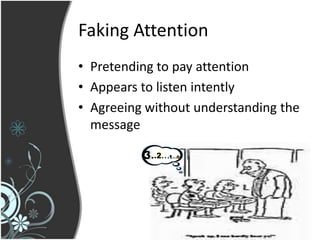
• Pretending to pay attention
• Appears to listen intently
• Agreeing without understanding the
  message
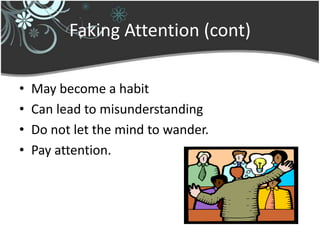
Faking Attention (cont)

•   May become a habit
•   Can lead to misunderstanding
•   Do not let the mind to wander.
•   Pay attention.
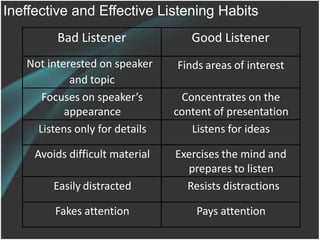
Ineffective and Effective Listening Habits
         Bad Listener               Good Listener
   Not interested on speaker     Finds areas of interest
            and topic
      Focuses on speaker’s        Concentrates on the
           appearance            content of presentation
     Listens only for details       Listens for ideas

     Avoids difficult material   Exercises the mind and
                                   prepares to listen
         Easily distracted         Resists distractions

         Fakes attention             Pays attention
What to Do About
Listening Barriers
1. Physical Barriers
For the Listener:
• Focus on the Speaker;
  You can look at the
  room and the audience
  later.
For the Speaker:
• Try-- whenever
  possible--to remove
  potential distractions.
2. Mental Distractions
For the Listener:
• Recognize that you can
  think about you date
  later; get back to
  listening.
For the Speaker:
• Make what you say
  compelling and so
  relevant to the
  listener.
3. Close-mindedness
For the Listener:
• Assume that what
 the speaker is saying
 will be useful in
 some ways.
For the Speaker:
• Anticipate close-
  mindedness and ask for
  openness.
4. Biases and
  Prejudices
For the Listener:
• Be willing to subject your
  biases and prejudice to
  contradictory information.
For the Speaker:
• When you feel that your
  listener(s) may be biased,
  ask for a suspension of bias.
5. Rehearsing
  Responses
For the Listeners:
• Make a mental note of
  something and get back to
  listening.
For the Speakers:
• When you feel that the
  audience is preparing to
  argue with you, tell them
  you’ll return to this point
  later.
6. Dismissing the
     Speaker
For the Listeners:
• Assume that everyone has
  something of value to say
  to you
For the Speakers:
• Stress the importance of
  what you will say.
7. Focusing on
 Irrelevancies
For the Listeners:
• When encountering an
  example, recall the point,
  the main idea, that it refers
  to.
For the Speakers:
• Repeat the main points and
  connect them to your
  examples and illustrations.
8. Excessive self-focus
For the Listeners:
• Think about how this topic
  relates to others or some
  larger picture.
For the Speakers:
• Include all the listeners;
  make what you say relevant
  to everyone.
9. Faulty Assumptions
For the Listeners:
• Let the speaker guide your
  listening.
For the Speakers:
• Make it clear that what
  you’re saying will be
  unexpected.
10. Drawing too-early
conclusions/judgements
For the Listeners:
• Avoid making judgements
  before you gather all the
  information; listen before
  judging.
For the Speakers:
• Consider giving part of the
  evidence before stating any
  idea to which you
  anticipate serious objection
  from listeners.
Reference:
Seiler, W., & Beall, M. (2011). Communication: making
         connections (8th ed.). Boston: Pearson.

Listening barriers