


BRANCH : COMPUTER ENGINEERING
Types of Listening and Barriers to
effective Listening.
SUBJECT : COMMUNICATION AND SKILLS
CONTENT
1. Types of Listening.
2. Barriers to effective
Listening.
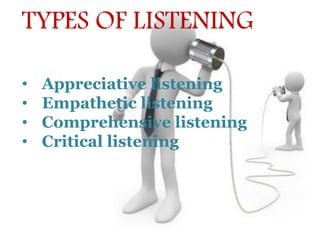
TYPES OF LISTENING
• Appreciative listening
• Empathetic listening
• Comprehensive listening
• Critical listening
Appreciative listening
This is listening for deriving aesthetic pleasure,
as we do when we listen to a comedian,
musician, or entertainer.
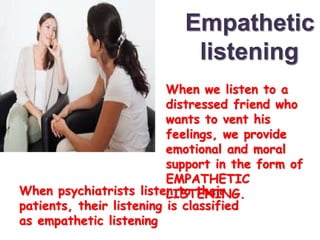
Empathetic
listening
When we listen to a
distressed friend who
wants to vent his
feelings, we provide
emotional and moral
support in the form of
EMPATHETIC
LISTENING.When psychiatrists listen to their
patients, their listening is classified
as empathetic listening
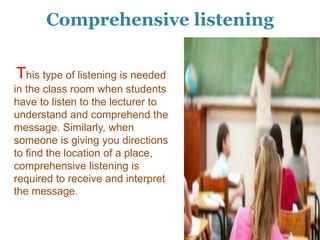
Comprehensive listening
This type of listening is needed
in the class room when students
have to listen to the lecturer to
understand and comprehend the
message. Similarly, when
someone is giving you directions
to find the location of a place,
comprehensive listening is
required to receive and interpret
the message.
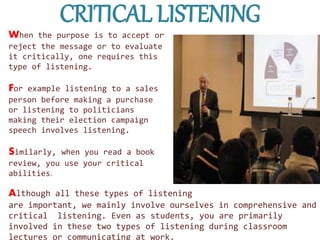
CRITICAL LISTENING
When the purpose is to accept or
reject the message or to evaluate
it critically, one requires this
type of listening.
For example listening to a sales
person before making a purchase
or listening to politicians
making their election campaign
speech involves listening.
Similarly, when you read a book
review, you use your critical
abilities.
Although all these types of listening
are important, we mainly involve ourselves in comprehensive and
critical listening. Even as students, you are primarily
involved in these two types of listening during classroom
lectures or communicating at work.
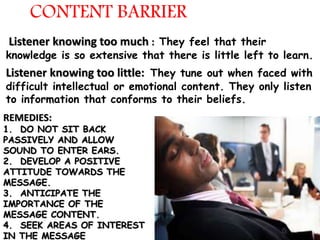
CONTENT BARRIER
Listener knowing too much : They feel that their
knowledge is so extensive that there is little left to learn.
Listener knowing too little: They tune out when faced with
difficult intellectual or emotional content. They only listen
to information that conforms to their beliefs.
REMEDIES:
1. DO NOT SIT BACK
PASSIVELY AND ALLOW
SOUND TO ENTER EARS.
2. DEVELOP A POSITIVE
ATTITUDE TOWARDS THE
MESSAGE.
3. ANTICIPATE THE
IMPORTANCE OF THE
MESSAGE CONTENT.
4. SEEK AREAS OF INTEREST
IN THE MESSAGE
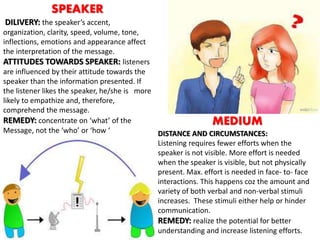
SPEAKER
DILIVERY: the speaker’s accent,
organization, clarity, speed, volume, tone,
inflections, emotions and appearance affect
the interpretation of the message.
ATTITUDES TOWARDS SPEAKER: listeners
are influenced by their attitude towards the
speaker than the information presented. If
the listener likes the speaker, he/she is more
likely to empathize and, therefore,
comprehend the message.
REMEDY: concentrate on ‘what’ of the
Message, not the ‘who’ or ‘how ‘
MEDIUM
DISTANCE AND CIRCUMSTANCES:
Listening requires fewer efforts when the
speaker is not visible. More effort is needed
when the speaker is visible, but not physically
present. Max. effort is needed in face- to- face
interactions. This happens coz the amount and
variety of both verbal and non-verbal stimuli
increases. These stimuli either help or hinder
communication.
REMEDY: realize the potential for better
understanding and increase listening efforts.
DISTRACTIONS
EXRTANEOUS STIMULI: Sounds, lights, odors, mannerisms, voice inflections and moving obj.
can easily distract listeners. Psychological studies indicate that a listener’s attention span is
sometimes not more than 2 or 3 sec. These stimuli can be categorized as environmental or
physical, but most often psychological.
REMEDIES:
• Identify and eradicate distractions.
• If distraction cannot be eliminated, increase concentration.
• Free urself from preconceptions, prejudices and neg. emotions
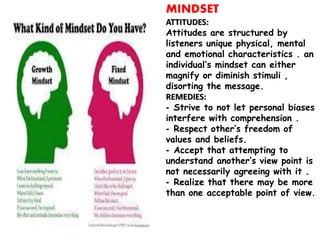
MINDSET
ATTITUDES:
Attitudes are structured by
listeners unique physical, mental
and emotional characteristics . an
individual’s mindset can either
magnify or diminish stimuli ,
disorting the message.
REMEDIES:
- Strive to not let personal biases
interfere with comprehension .
- Respect other’s freedom of
values and beliefs.
- Accept that attempting to
understand another’s view point is
not necessarily agreeing with it .
- Realize that there may be more
than one acceptable point of view.
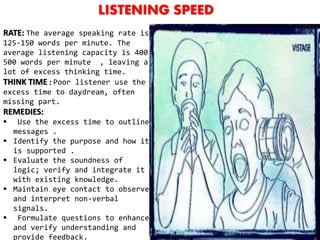
RATE: The average speaking rate is
125-150 words per minute. The
average listening capacity is 400-
500 words per minute , leaving a
lot of excess thinking time.
THINK TIME : Poor listener use the
excess time to daydream, often
missing part.
REMEDIES:
 Use the excess time to outline
messages .
 Identify the purpose and how it
is supported .
 Evaluate the soundness of
logic; verify and integrate it
with existing knowledge.
 Maintain eye contact to observe
and interpret non-verbal
signals.
 Formulate questions to enhance
and verify understanding and
provide feedback.
LISTENING SPEED
.
LANGUAGE
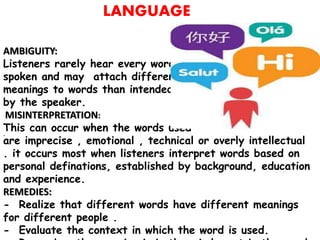
AMBIGUITY:
Listeners rarely hear every word
spoken and may attach different
meanings to words than intended
by the speaker.
MISINTERPRETATION:
This can occur when the words used
are imprecise , emotional , technical or overly intellectual
. it occurs most when listeners interpret words based on
personal definations, established by background, education
and experience.
REMEDIES:
- Realize that different words have different meanings
for different people .
- Evaluate the context in which the word is used.
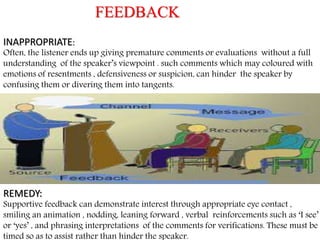
INAPPROPRIATE:
Often, the listener ends up giving premature comments or evaluations without a full
understanding of the speaker’s viewpoint . such comments which may coloured with
emotions of resentments , defensiveness or suspicion, can hinder the speaker by
confusing them or divering them into tangents.
REMEDY:
Supportive feedback can demonstrate interest through appropriate eye contact ,
smiling an animation , nodding, leaning forward , verbal reinforcements such as ‘I see’
or ‘yes’ , and phrasing interpretations of the comments for verifications. These must be
timed so as to assist rather than hinder the speaker.
FEEDBACK
Listening is though , and more so if someone is from another
culture or subculture . the problem crops up because of the
different choice of words , accents, pronunciation , and many
other intangible reasons. One must be extra careful while
listening to a person from another region or culture . In fact,
listening can be improved by talking to more people of
different nations and trying to understand them.
REFERENCE
TECHNICAL COMMUNICATION
PRINCPLES AND PRACTICE
OXFORD UNIVERSITY PRESS (SECOND
EDITION )
BY- Meenakshi Raman and Sangeeta Sharma.
Communication & Skills

Communication & Skills

  • 1.
    BRANCH : COMPUTERENGINEERING Types of Listening and Barriers to effective Listening. SUBJECT : COMMUNICATION AND SKILLS
  • 2.
    CONTENT 1. Types ofListening. 2. Barriers to effective Listening.
  • 3.
    TYPES OF LISTENING •Appreciative listening • Empathetic listening • Comprehensive listening • Critical listening
  • 4.
    Appreciative listening This islistening for deriving aesthetic pleasure, as we do when we listen to a comedian, musician, or entertainer.
  • 5.
    Empathetic listening When we listento a distressed friend who wants to vent his feelings, we provide emotional and moral support in the form of EMPATHETIC LISTENING.When psychiatrists listen to their patients, their listening is classified as empathetic listening
  • 6.
    Comprehensive listening This typeof listening is needed in the class room when students have to listen to the lecturer to understand and comprehend the message. Similarly, when someone is giving you directions to find the location of a place, comprehensive listening is required to receive and interpret the message.
  • 7.
    CRITICAL LISTENING When thepurpose is to accept or reject the message or to evaluate it critically, one requires this type of listening. For example listening to a sales person before making a purchase or listening to politicians making their election campaign speech involves listening. Similarly, when you read a book review, you use your critical abilities. Although all these types of listening are important, we mainly involve ourselves in comprehensive and critical listening. Even as students, you are primarily involved in these two types of listening during classroom lectures or communicating at work.
  • 9.
    CONTENT BARRIER Listener knowingtoo much : They feel that their knowledge is so extensive that there is little left to learn. Listener knowing too little: They tune out when faced with difficult intellectual or emotional content. They only listen to information that conforms to their beliefs. REMEDIES: 1. DO NOT SIT BACK PASSIVELY AND ALLOW SOUND TO ENTER EARS. 2. DEVELOP A POSITIVE ATTITUDE TOWARDS THE MESSAGE. 3. ANTICIPATE THE IMPORTANCE OF THE MESSAGE CONTENT. 4. SEEK AREAS OF INTEREST IN THE MESSAGE
  • 10.
    SPEAKER DILIVERY: the speaker’saccent, organization, clarity, speed, volume, tone, inflections, emotions and appearance affect the interpretation of the message. ATTITUDES TOWARDS SPEAKER: listeners are influenced by their attitude towards the speaker than the information presented. If the listener likes the speaker, he/she is more likely to empathize and, therefore, comprehend the message. REMEDY: concentrate on ‘what’ of the Message, not the ‘who’ or ‘how ‘ MEDIUM DISTANCE AND CIRCUMSTANCES: Listening requires fewer efforts when the speaker is not visible. More effort is needed when the speaker is visible, but not physically present. Max. effort is needed in face- to- face interactions. This happens coz the amount and variety of both verbal and non-verbal stimuli increases. These stimuli either help or hinder communication. REMEDY: realize the potential for better understanding and increase listening efforts.
  • 11.
    DISTRACTIONS EXRTANEOUS STIMULI: Sounds,lights, odors, mannerisms, voice inflections and moving obj. can easily distract listeners. Psychological studies indicate that a listener’s attention span is sometimes not more than 2 or 3 sec. These stimuli can be categorized as environmental or physical, but most often psychological. REMEDIES: • Identify and eradicate distractions. • If distraction cannot be eliminated, increase concentration. • Free urself from preconceptions, prejudices and neg. emotions
  • 12.
    MINDSET ATTITUDES: Attitudes are structuredby listeners unique physical, mental and emotional characteristics . an individual’s mindset can either magnify or diminish stimuli , disorting the message. REMEDIES: - Strive to not let personal biases interfere with comprehension . - Respect other’s freedom of values and beliefs. - Accept that attempting to understand another’s view point is not necessarily agreeing with it . - Realize that there may be more than one acceptable point of view.
  • 13.
    RATE: The averagespeaking rate is 125-150 words per minute. The average listening capacity is 400- 500 words per minute , leaving a lot of excess thinking time. THINK TIME : Poor listener use the excess time to daydream, often missing part. REMEDIES:  Use the excess time to outline messages .  Identify the purpose and how it is supported .  Evaluate the soundness of logic; verify and integrate it with existing knowledge.  Maintain eye contact to observe and interpret non-verbal signals.  Formulate questions to enhance and verify understanding and provide feedback. LISTENING SPEED
  • 14.
    . LANGUAGE AMBIGUITY: Listeners rarely hearevery word spoken and may attach different meanings to words than intended by the speaker. MISINTERPRETATION: This can occur when the words used are imprecise , emotional , technical or overly intellectual . it occurs most when listeners interpret words based on personal definations, established by background, education and experience. REMEDIES: - Realize that different words have different meanings for different people . - Evaluate the context in which the word is used.
  • 15.
    INAPPROPRIATE: Often, the listenerends up giving premature comments or evaluations without a full understanding of the speaker’s viewpoint . such comments which may coloured with emotions of resentments , defensiveness or suspicion, can hinder the speaker by confusing them or divering them into tangents. REMEDY: Supportive feedback can demonstrate interest through appropriate eye contact , smiling an animation , nodding, leaning forward , verbal reinforcements such as ‘I see’ or ‘yes’ , and phrasing interpretations of the comments for verifications. These must be timed so as to assist rather than hinder the speaker. FEEDBACK
  • 16.
    Listening is though, and more so if someone is from another culture or subculture . the problem crops up because of the different choice of words , accents, pronunciation , and many other intangible reasons. One must be extra careful while listening to a person from another region or culture . In fact, listening can be improved by talking to more people of different nations and trying to understand them.
  • 17.
    REFERENCE TECHNICAL COMMUNICATION PRINCPLES ANDPRACTICE OXFORD UNIVERSITY PRESS (SECOND EDITION ) BY- Meenakshi Raman and Sangeeta Sharma.