Active and Passive voice
        Kettyl Amoakon
What is the difference between
  active and passive voice?
        How and When to use them?
The term voice here, refers to the structure of a
sentence.

There are two “voices” in English grammar; active voice
and passive voice.
According to the Chicago Manual of Styles; “voice shows
whether the subject (of the sentence) acts… or is acted on … -
That is whether the subject performs or receive the action of
the verb”
Active Voice
In an active voice sentence, the subject ( the one who does
the action in the sentence) is clearly stated as the subject.
The thing that the subject does something to ( the direct
object) comes after the verb.

                    Subject--Verb--object
Let’s look at some examples
               Kathy wrote an essay.
              Carly made an apple pie.

   The subject of the sentence performs the action.
Passive Voice
In a passive voice sentence, the thing that the subject does
something to, is placed as the subject of the sentence.
The subject (the one who does the action) is placed after the
subject, usually in a prepositional phrase. In fact, sometimes
the subject is hidden or not even mentioned.
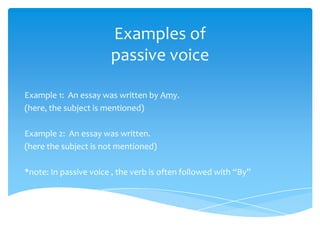
Examples of
                       passive voice

Example 1: An essay was written by Amy.
(here, the subject is mentioned)

Example 2: An essay was written.
(here the subject is not mentioned)

*note: In passive voice , the verb is often followed with “By”
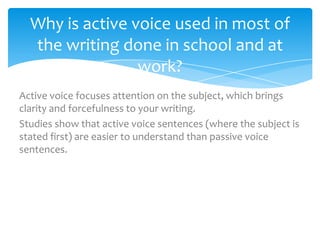
Why is active voice used in most of
  the writing done in school and at
                 work?
Active voice focuses attention on the subject, which brings
clarity and forcefulness to your writing.
Studies show that active voice sentences (where the subject is
stated first) are easier to understand than passive voice
sentences.
Let’s look up more examples:
Active voice: Students consider topics for the next essay.
Passive voice: Topics for the next essay are being
considered by the students.
*The active voice is less wordy
This is not to say that passive voice
   can’t or should not be used.
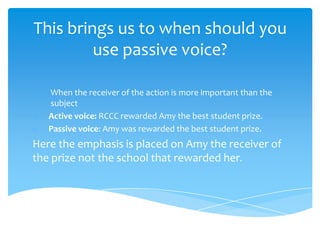
This brings us to when should you
         use passive voice?

1.   When the receiver of the action is more important than the
     subject
o    Active voice: RCCC rewarded Amy the best student prize.
o    Passive voice: Amy was rewarded the best student prize.
Here the emphasis is placed on Amy the receiver of
the prize not the school that rewarded her.
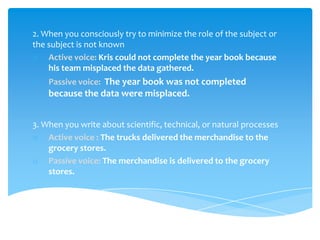
2. When you consciously try to minimize the role of the subject or
the subject is not known
o Active voice: Kris could not complete the year book because
    his team misplaced the data gathered.
o   Passive voice: The year book was not completed
    because the data were misplaced.


3. When you write about scientific, technical, or natural processes
o Active voice : The trucks delivered the merchandise to the
    grocery stores.
o Passive voice: The merchandise is delivered to the grocery
    stores.
To recap what we’ve talked about:
   o   A sentence in which the subject performs the action
                         is in active voice.
  o    A sentence in which the subject receives the force of
             the action of the verb is in passive voice.
As you can see it is important to understand sentence
  structures to better determine what voice to use…
but remember to use active voice in most of your writing
     as it makes reading easier and more interesting.
Thank you

Active and Passive Voice

  • 1.
    Active and Passivevoice Kettyl Amoakon
  • 2.
    What is thedifference between active and passive voice? How and When to use them?
  • 3.
    The term voicehere, refers to the structure of a sentence. There are two “voices” in English grammar; active voice and passive voice.
  • 4.
    According to theChicago Manual of Styles; “voice shows whether the subject (of the sentence) acts… or is acted on … - That is whether the subject performs or receive the action of the verb”
  • 5.
    Active Voice In anactive voice sentence, the subject ( the one who does the action in the sentence) is clearly stated as the subject. The thing that the subject does something to ( the direct object) comes after the verb. Subject--Verb--object
  • 6.
    Let’s look atsome examples Kathy wrote an essay. Carly made an apple pie. The subject of the sentence performs the action.
  • 7.
    Passive Voice In apassive voice sentence, the thing that the subject does something to, is placed as the subject of the sentence. The subject (the one who does the action) is placed after the subject, usually in a prepositional phrase. In fact, sometimes the subject is hidden or not even mentioned.
  • 8.
    Examples of passive voice Example 1: An essay was written by Amy. (here, the subject is mentioned) Example 2: An essay was written. (here the subject is not mentioned) *note: In passive voice , the verb is often followed with “By”
  • 9.
    Why is activevoice used in most of the writing done in school and at work? Active voice focuses attention on the subject, which brings clarity and forcefulness to your writing. Studies show that active voice sentences (where the subject is stated first) are easier to understand than passive voice sentences.
  • 10.
    Let’s look upmore examples: Active voice: Students consider topics for the next essay. Passive voice: Topics for the next essay are being considered by the students. *The active voice is less wordy
  • 11.
    This is notto say that passive voice can’t or should not be used.
  • 12.
    This brings usto when should you use passive voice? 1. When the receiver of the action is more important than the subject o Active voice: RCCC rewarded Amy the best student prize. o Passive voice: Amy was rewarded the best student prize. Here the emphasis is placed on Amy the receiver of the prize not the school that rewarded her.
  • 13.
    2. When youconsciously try to minimize the role of the subject or the subject is not known o Active voice: Kris could not complete the year book because his team misplaced the data gathered. o Passive voice: The year book was not completed because the data were misplaced. 3. When you write about scientific, technical, or natural processes o Active voice : The trucks delivered the merchandise to the grocery stores. o Passive voice: The merchandise is delivered to the grocery stores.
  • 14.
    To recap whatwe’ve talked about: o A sentence in which the subject performs the action is in active voice. o A sentence in which the subject receives the force of the action of the verb is in passive voice.
  • 15.
    As you cansee it is important to understand sentence structures to better determine what voice to use… but remember to use active voice in most of your writing as it makes reading easier and more interesting.
  • 16.