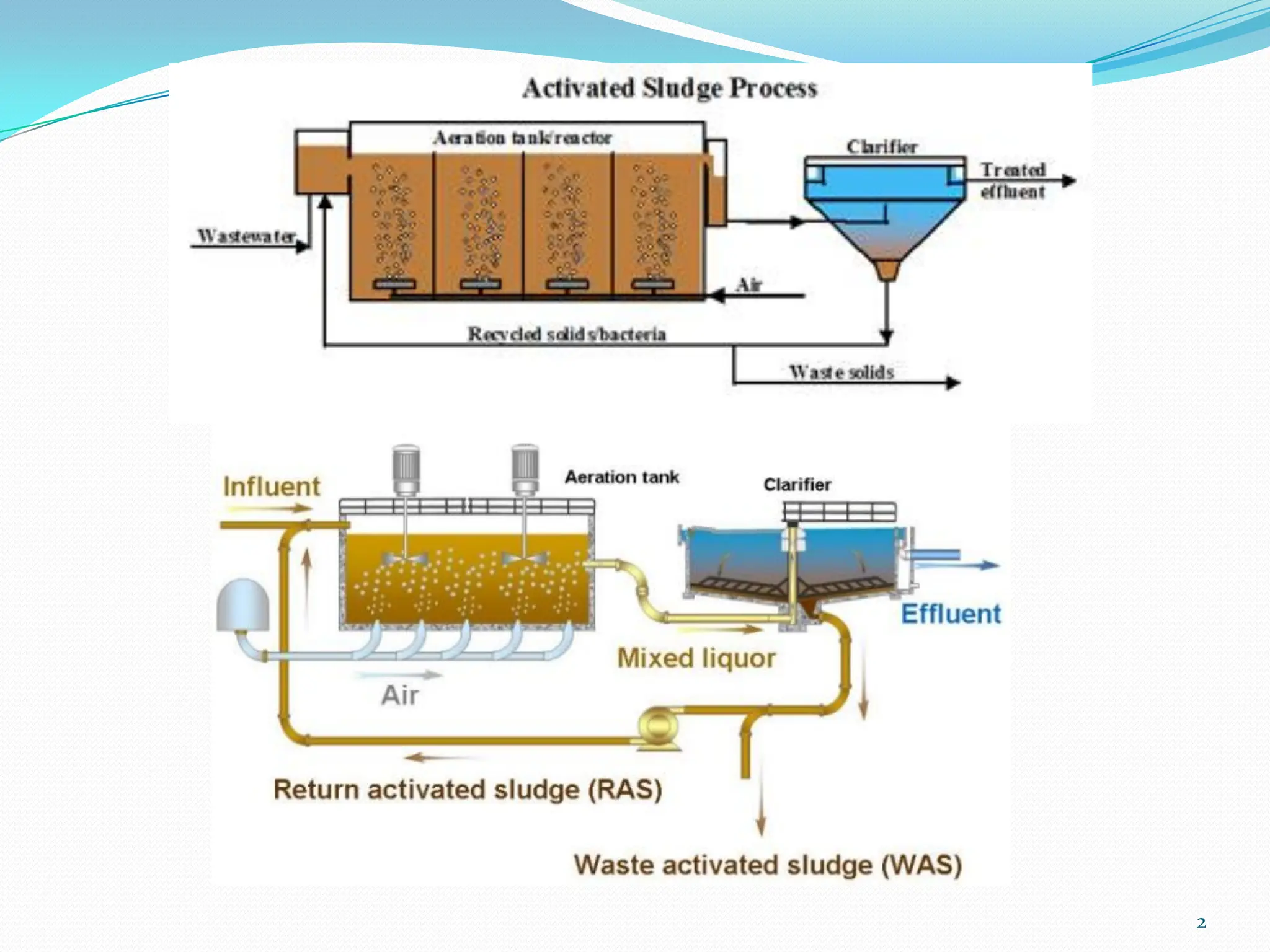
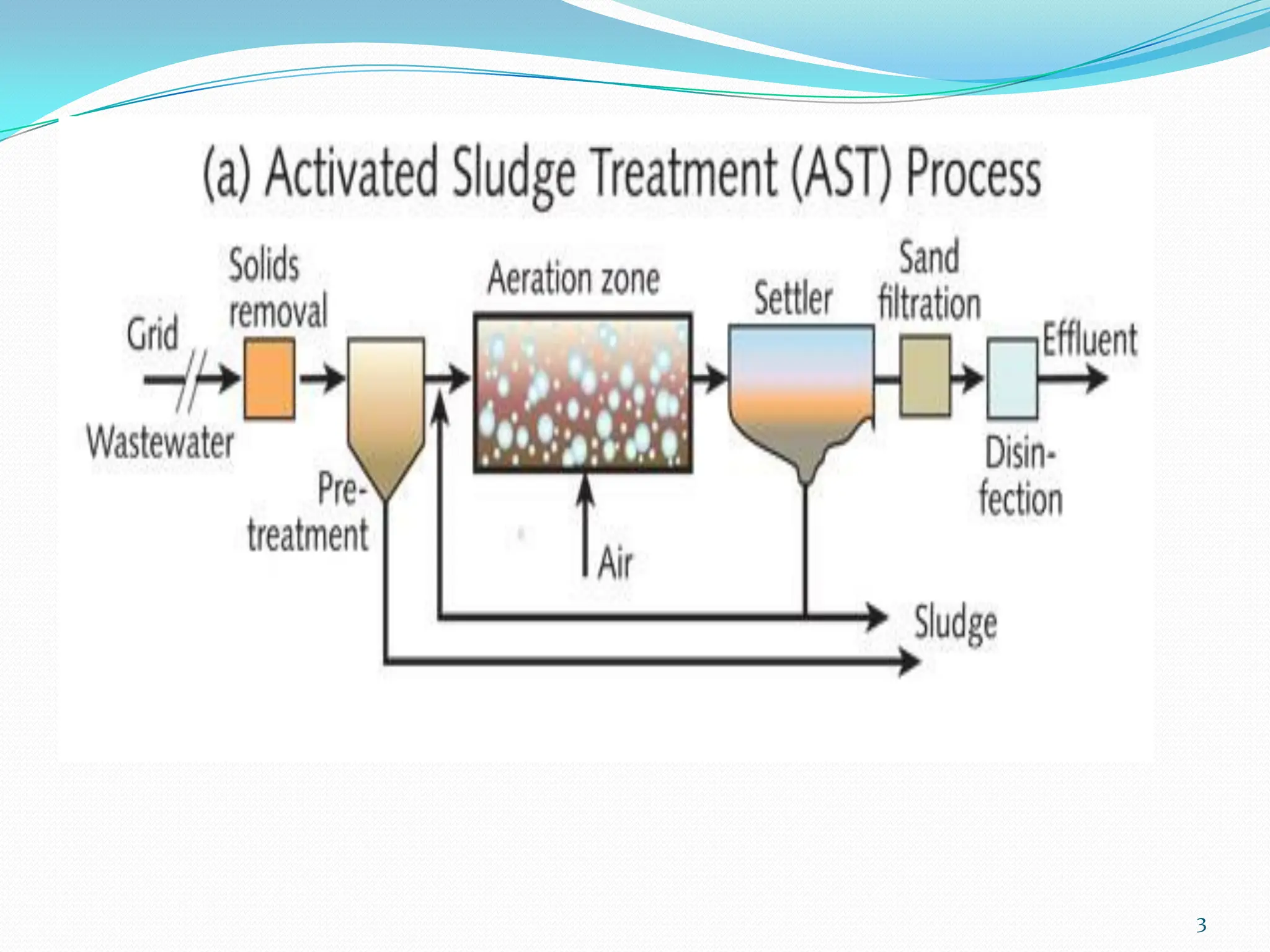
Activated Sludge Process
Most extensively used aerobic suspended growth biological
treatment process
Sewage from sedimentation tank enters into aeration tank. 20-
30% of active sludge is mixed (returned). This activated sludge
contains large concentration of highly active aerobic
microorganisms. The mixture is aerated and mixed in the tank
for about 4-8 hrs residence time
Microorganism oxidise organic matter in the presence of
oxygen in the aeration tank and sewage is allowed to settle in
the secondary sedimentation tank.
This settled sludge has undergone aeration and has active
microorganisms. So some portion of this active sludge is
recirculated into the aeration tank where the mixed liquor
containing the suspended solids is under continuous agitation.
The excess sludge is disposed off from the sedimentation tank
1
Advantages
Efficiency ishigh (80-95% of BOD removal and the
bacteria removal is 90-95%)
Land area required is less than that for trickling filter
Designed unit can be made compact
Initial cost of construction is lower than trickling filter (TF)
Process is free from foul and insect nuisance
Sludge has a high fertilizing value and the effluent can be
used for irrigation
4
5.
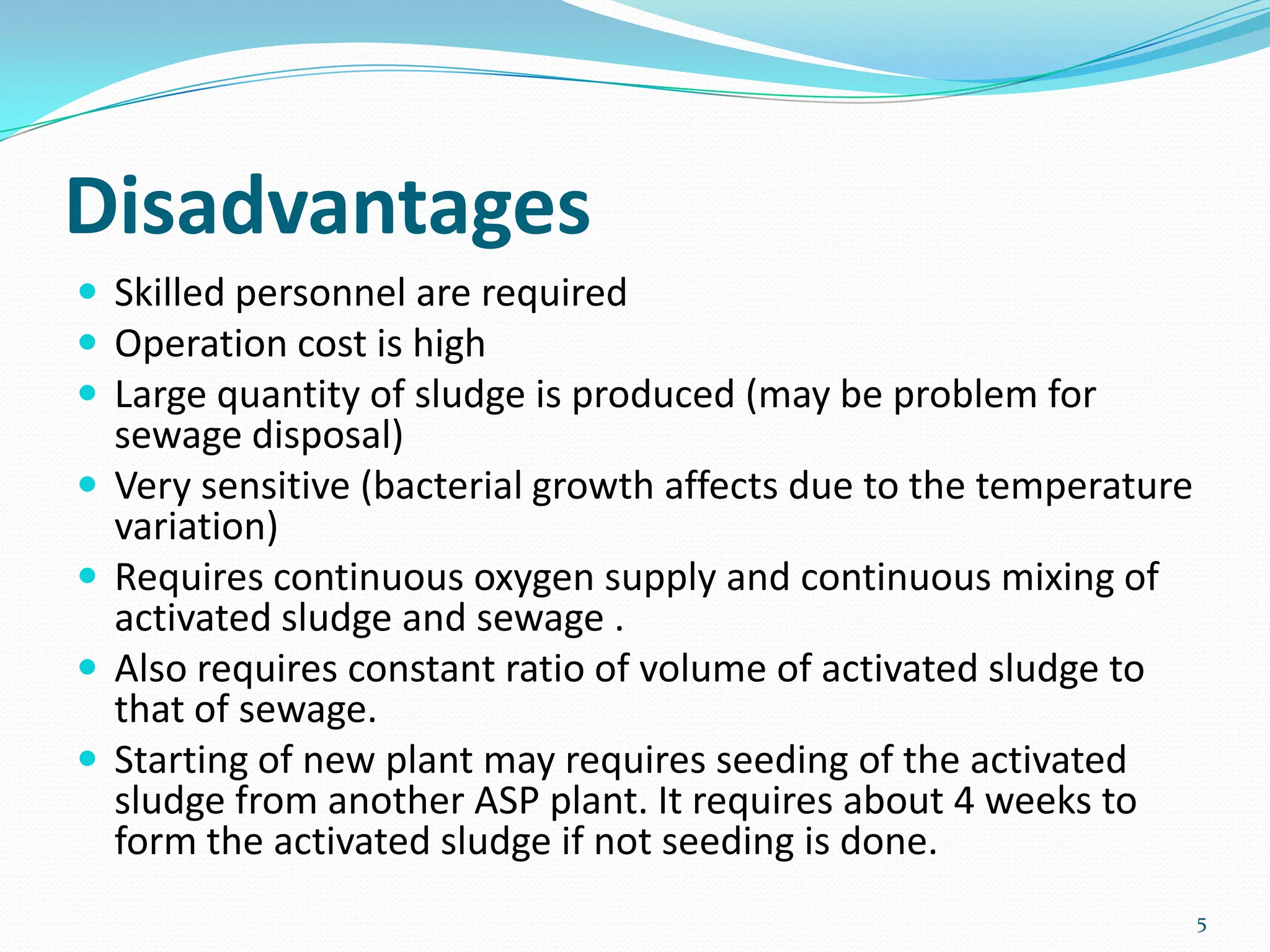
Disadvantages
Skilled personnelare required
Operation cost is high
Large quantity of sludge is produced (may be problem for
sewage disposal)
Very sensitive (bacterial growth affects due to the temperature
variation)
Requires continuous oxygen supply and continuous mixing of
activated sludge and sewage .
Also requires constant ratio of volume of activated sludge to
that of sewage.
Starting of new plant may requires seeding of the activated
sludge from another ASP plant. It requires about 4 weeks to
form the activated sludge if not seeding is done.
5
6.
Volume of returncedactivated sludge
Desired BOD removal
(ppm)
% of returned activated
sludge
o150
o250
o300
o400
o500
o600
25
30
35
40
48
53
6
7.
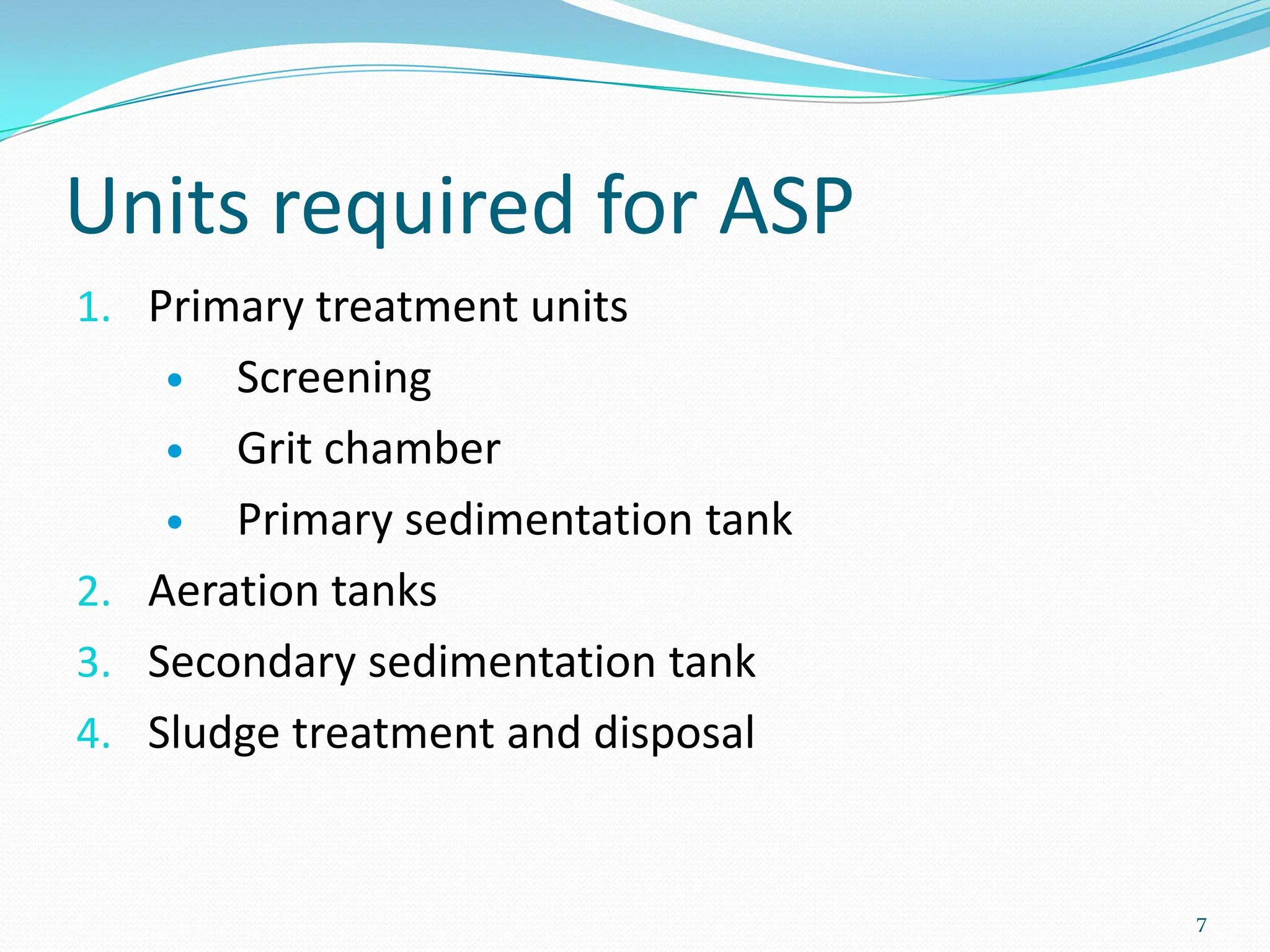
Units required forASP
1. Primary treatment units
Screening
Grit chamber
Primary sedimentation tank
2. Aeration tanks
3. Secondary sedimentation tank
4. Sludge treatment and disposal
7
8.
Aeration tanks ofASP
Aeration is the most important operation in the activated
sludge process so as to provide oxygen and mixing.
The aeration facilities are designed to meet the oxygen
demand.
A minimum DO of about 1-2 mg/l is necessary for the
proper biological treatment.
The aeration tanks are 3-4.5 m deep.
The detention tank is kept between 4-8 hours for
municipal sewage.
8
9.
Methods of aeration
1.Diffused aeration
2. Mechanical aeration
3. Combined diffused and mechanical aeration
9
10.
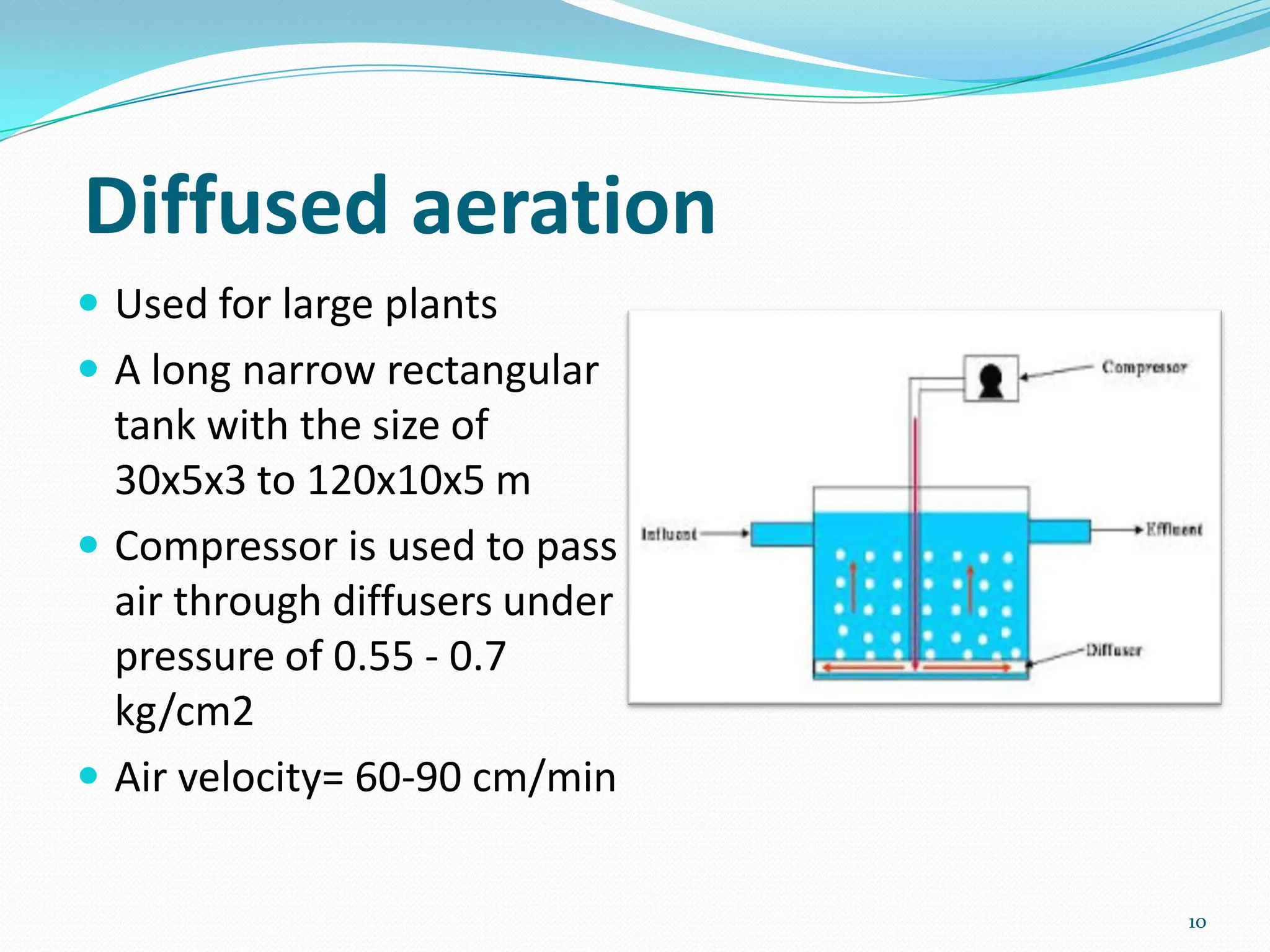
Diffused aeration
Usedfor large plants
A long narrow rectangular
tank with the size of
30x5x3 to 120x10x5 m
Compressor is used to pass
air through diffusers under
pressure of 0.55 - 0.7
kg/cm2
Air velocity= 60-90 cm/min
10
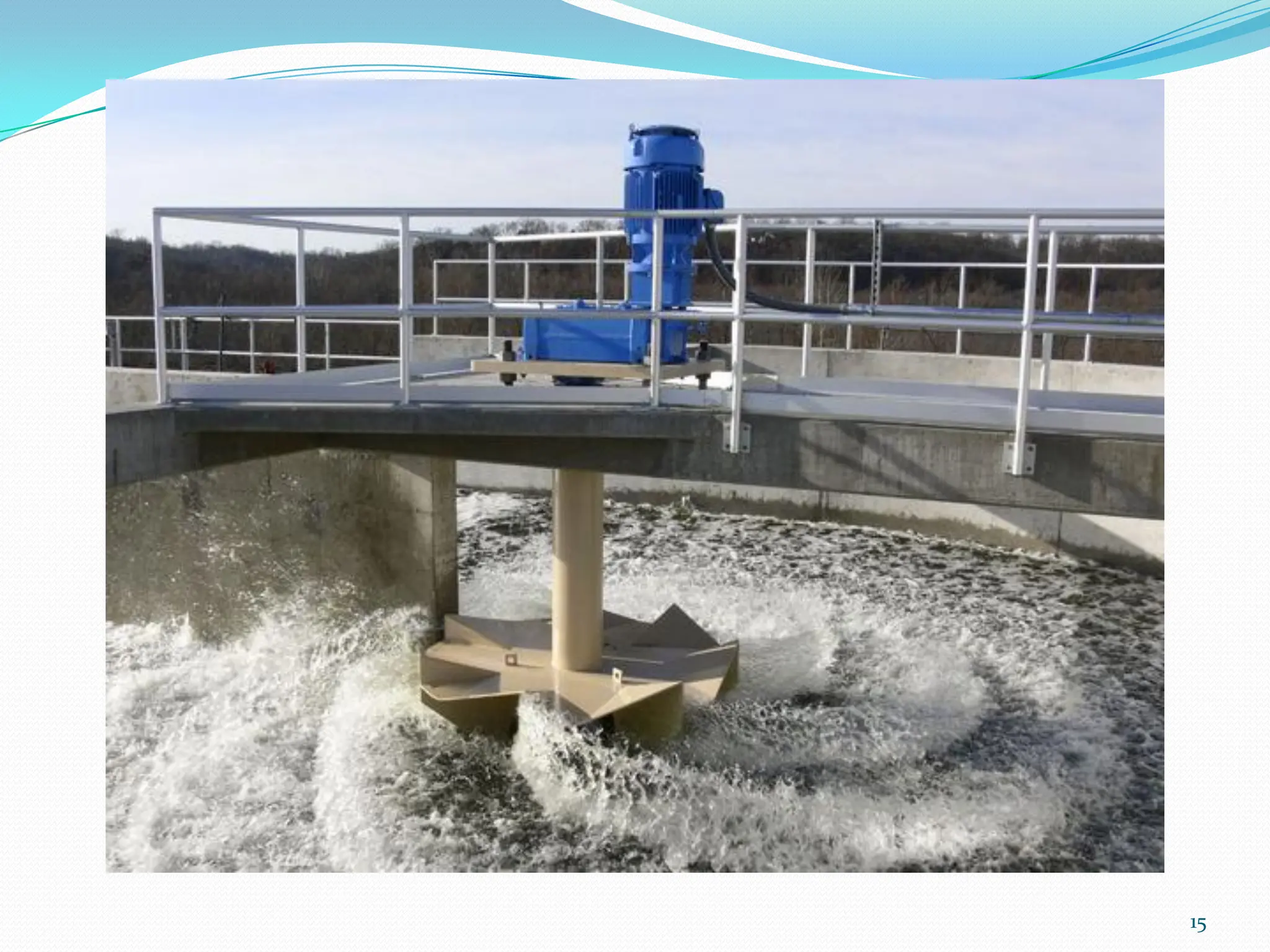
Mechanical aeration
Compressor isnot used but aeration is done in the
principle that the sewage is stirred and take them to top
surface every time from where mix liquor takes
atmospheric air.
Generally consists of large diameter impeller plates
revolving on vertical shaft at the surface of the liquid with
or without draft tubes
Hydraulic jump is created by the impellers at the surface
causing air entrainment in the sewage
The speed of rotation of impellers 70-110 rpm
13
Capacity of aerationtank
Depends upon the following three factors
Aeration period
Volume of returned sludge
Volume of flow of sewage
V = (Q + Qs) T/24
Where, V = capacity of aeration tank, m3
Q = volume of flow of sewage, m3/day
Qs = volume of returned sludge, m3/day
T = aeration period, hours
17
18.
Oxidation Pond
Biologicalor secondary treatment process
Simple, low cost holding tanks 1-2 m deep that take oxygen
from atmosphere
Theory
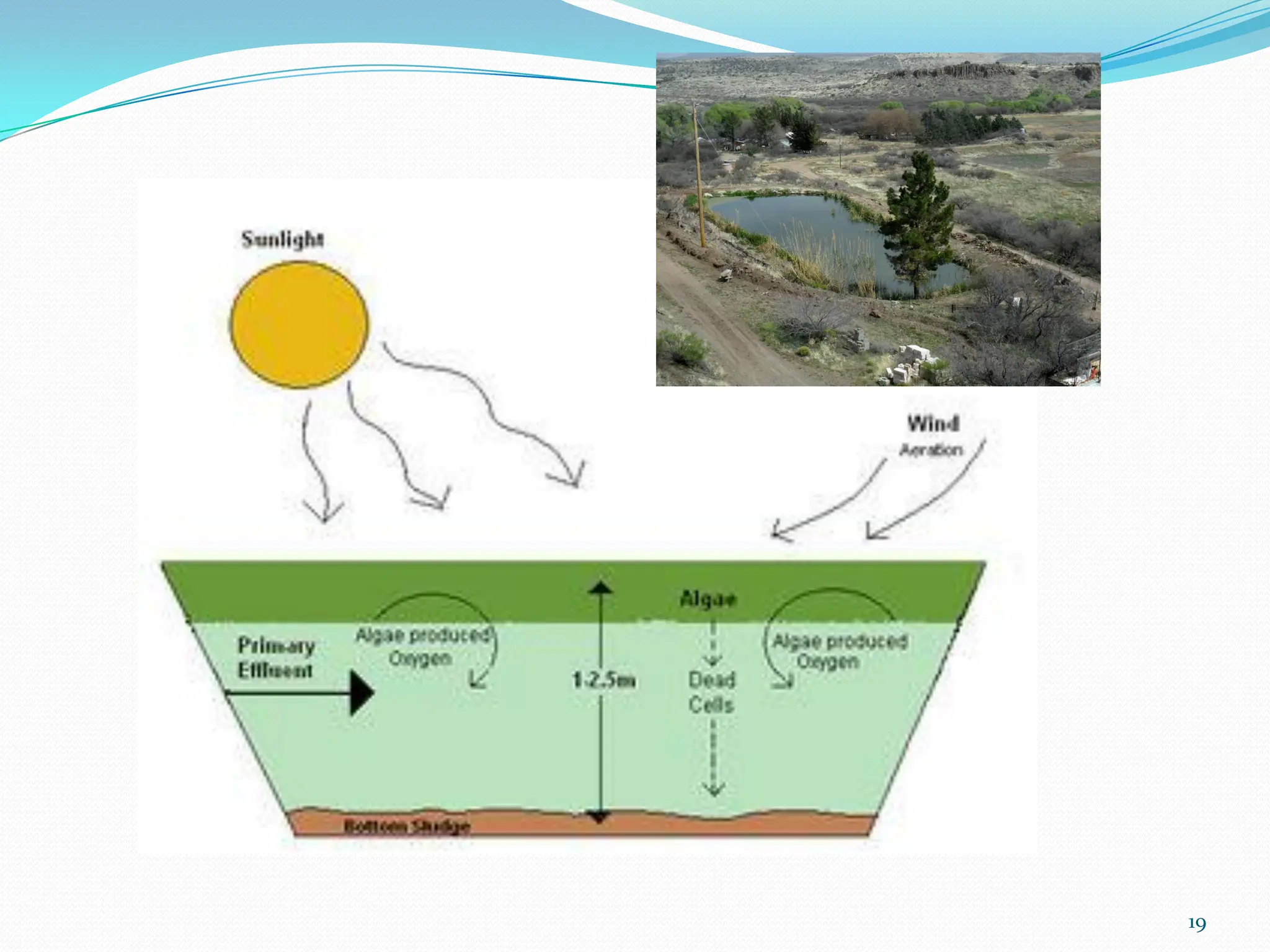
When sewage is retained in the shallow depth tank open to
atmosphere, the aerobic bacteria present in the sewage
convert the sewage into stable substances by aerobic action in
the presence of free oxygen and sunlight. Also the algae grown
in the pond exerts oxygen in the process of photosynthesis in
the presence of air and sunlight. The produced carbon dioxide
is taken by the algae whereas the oxygen produced by algae is
useful for aerobic bacteria. The combined action of aerobic
bacteria and algae together for their mutual benefit is called
bacterial algal symbiosis. The solids are settle at the bottom
and the accumulated sludge is cleaned after one third of
filling.
18
Location and construction
Located at least 300 m far from the locality
No obstacles (tree, building) around 50-60 m
distances so that sunlight can reach to the pond.
Water sources should be at least 15 m far away.
Pond surrounded by earthen dykes of 1-1.5 m wide on
top and side slopes of 1:1.5 -1:3 (can be turfed for good
appearance)
Sewage discharged at the centre of the pond form inlet
chamber through inlet pipe from bell mouth end
21
22.
Commissining of oxidationpond
1) Culture method:
2) Natural method:
1) Culture method: (Artificial Method)
Sewage is filled to a depth of 15 cm for the growth of
algae (seeds are introduced)
Portion of sewage decreased is refilled
Pond should turn completely green (at least a week)
Application of sewage to the operation level
Algae grow takes place from 2-3 days
22
23.
2) Natural method:
Algae are made to grow naturally
Initially sewage is kept to operation level and inlet and
outlet are closed
The reduced sewage is refilled daily
The growth of algae takes place in 2 weeks
23
24.
Operation and maintenance
Does not require equipment and skilled personnel but
the fallen leaves, papers and other floating materials
should be removed
No chemicals are sprayed to prevent form mosquitoes
and flies nuisance
Fish farming can be done so that the larva of mosquito
and flies are fed by fish
Settled sludge should be removed from time to time
Efficiency of pond is high (BOD removal more than
90%, SS >90% and coliform bacteria >99%)
24
25.
Merits and demeritsof Oxi. Pond
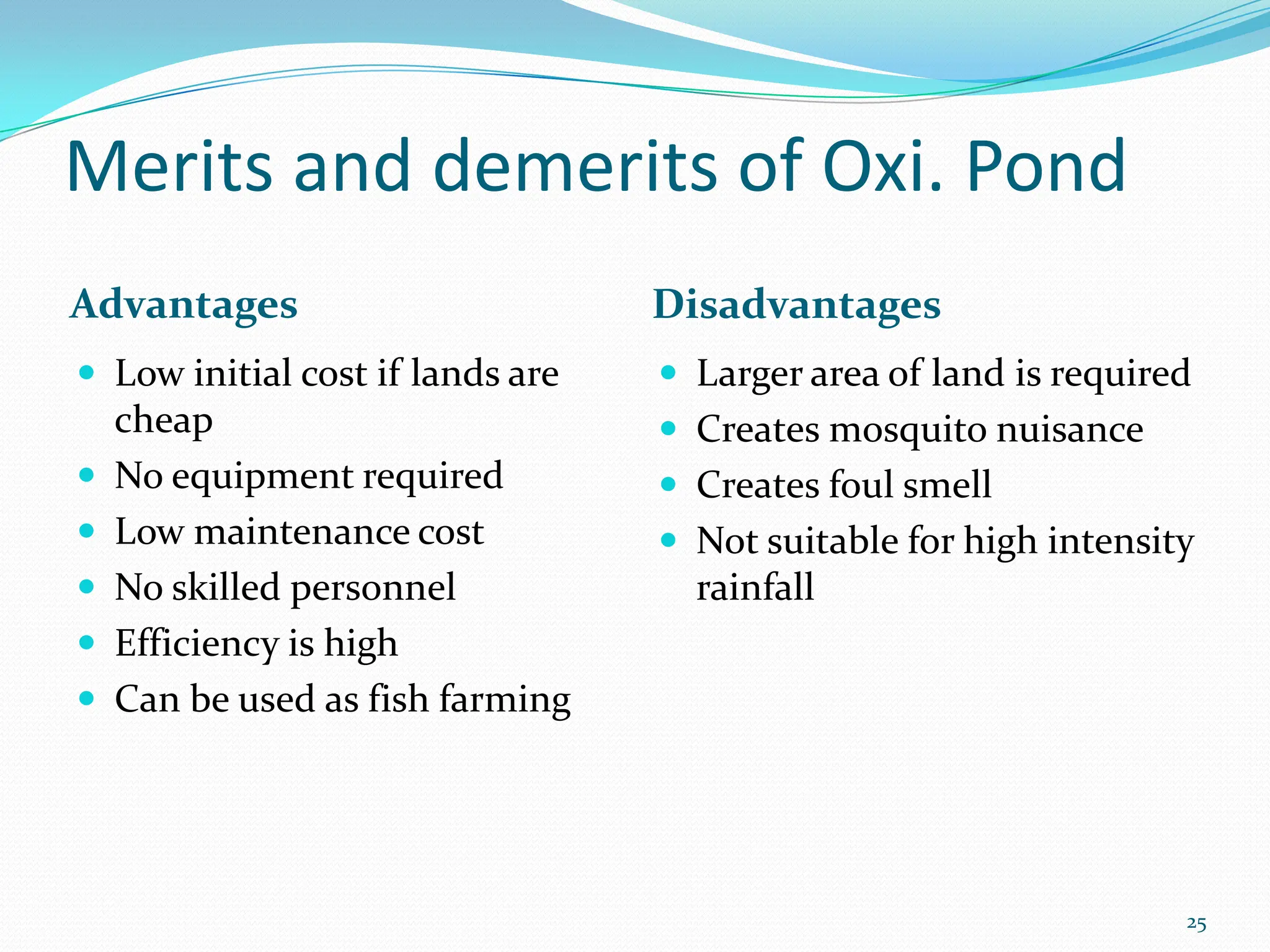
Advantages Disadvantages
Low initial cost if lands are
cheap
No equipment required
Low maintenance cost
No skilled personnel
Efficiency is high
Can be used as fish farming
Larger area of land is required
Creates mosquito nuisance
Creates foul smell
Not suitable for high intensity
rainfall
25
26.
Design Criteria
Detentiontime 10-45 days (colder place require longer detention time)
Lt = La (10 -kt)
t = 1/k log10 (La/Lt) where La = influent or inlet BOD
Lt = effluent or outlet BOD
Surface area As = 0.2-0.4 ha/1000 persons
Volume of pond V = Q x t
Organic loading (U) = W/As = 150-330 kg/ha/d where As = plan area
W = BOD applied = Q x La
Rectangular in shape
Effective depth d = 80-150 cm (no sludge depth)
Freeboard 20-50 cm
Length width ratio = 2-3
Side slope = 1:1.5 - 1:3
Oxidation pond is used where at least 200 days are sunny in a year
26
27.
Design of ActivatedSludge Process (ASP)
1) Index of mass of active microorganism:
Mix liquor suspended solids (MLSS) is generally taken
as an index of mass of microorganisms
In the present context, mixed liquor volatile
suspended solids (MLVSS) is taken as an index of the
mass of active microorganism.
The mixture of recycled sludge and sewage in the
aeration tank is referred to as mixed liquor
27
28.
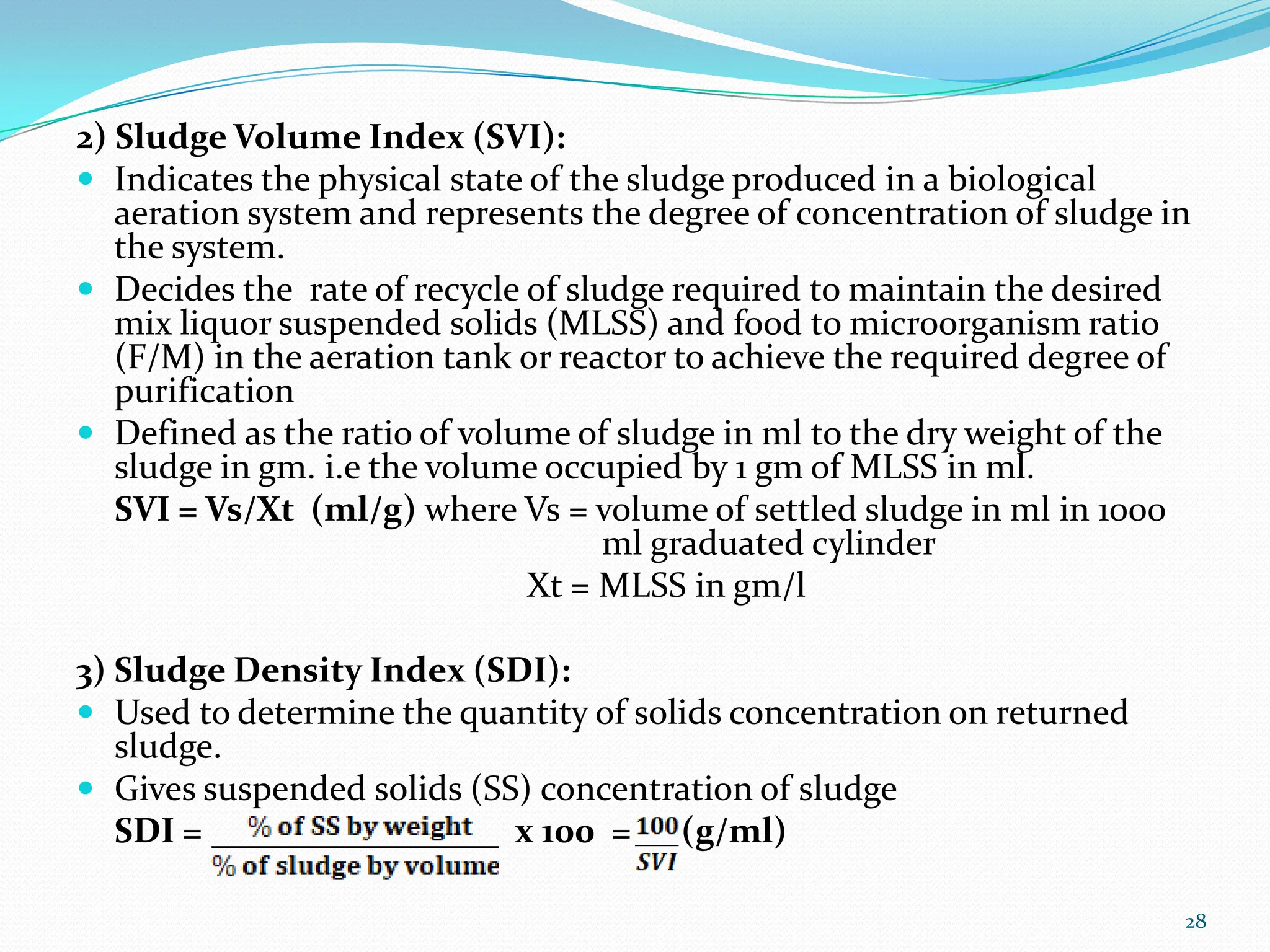
2) Sludge VolumeIndex (SVI):
Indicates the physical state of the sludge produced in a biological
aeration system and represents the degree of concentration of sludge in
the system.
Decides the rate of recycle of sludge required to maintain the desired
mix liquor suspended solids (MLSS) and food to microorganism ratio
(F/M) in the aeration tank or reactor to achieve the required degree of
purification
Defined as the ratio of volume of sludge in ml to the dry weight of the
sludge in gm. i.e the volume occupied by 1 gm of MLSS in ml.
SVI = Vs/Xt (ml/g) where Vs = volume of settled sludge in ml in 1000
ml graduated cylinder
Xt = MLSS in gm/l
3) Sludge Density Index (SDI):
Used to determine the quantity of solids concentration on returned
sludge.
Gives suspended solids (SS) concentration of sludge
SDI = x 100 = (g/ml)
28
29.
4) Sludeg ageor sludge retention time (SRT)
Also called as mean cell residence time (MCRT) or solid
retention time
Defined as the time spend by mix liquor volatile suspended
solids (MLVSS) or activated sludge in aeration tank.
Mathematically, θc =
Where V = volume of aerator tank or reactor
Xt = concentration of MLSS
Xr = concentration of MLVSS in returned
sludge
Q = influent sewage flow rate
Qw = wasted sludge flow rate
Xe = concentration of MLVSS in effluent
29
30.
5) Recycle ratioor return sludge ratio
r = Qr/Q where Qr = returned sludge flow rate
where Xt = mg/l and SVI = ml/g
6) Aeration period: depends upon
Strength of sewage and MLSS concentration
Desired degree of purification in terms of BOD removal
Proportion of returned activated sludge
Empirical Formula
A) American Public Health Association Formula
T (hrs) = Where T = aeration period and
La = influent BOD in mg/l
B) M/S Ames Crosta Mills and Co. Ltd (England)
T (hrs) =(La/10)3/4
C) Hydraulic Retention Time(HRT) [4-8 hrs]
HRT = T = V/Q in hrs
30
31.
7) Volumetric BODloading
Defined as BOD applied per unit volume of an
aeration tank
Also known as organic loading
VBL = QxLa/V, kg/m3/day
8) Food microorganism ratio (F/M) [0.2-0.6 per day]
F = total influent BOD = Qx La and
M = MLSS in aeration tank = Vx Xt
F/M ratio is the main factor controlling BOD removal
Lower the F/M value, higher will be the BOD removal
or vice versa
31
32.
9) Tank configuration:
Rectangular in shape Effective depth = 2.5 - 4.5 m
FB = 0.5 m Width/depth = 1.2-2.2
Velocity of flow ≤ 1.5 m/min
10) Air requirement
a) For diffuser type aerator
Air required = 40-125 m3 of air/kg of BOD applied
Standard diffuser = 0.3mx0.3mx25mm with 0.3 mm pores
Velocity of air flow = 60-90 cm/min
b) For other types of aerator
If F/M ≤ 0.3, air required = 75-115 m3 of air/kg of BOD removed
If F/M ≥ 0.3, air required = 30-55 m3 of air/kg of BOD removed
32













![5) Recycle ratio or return sludge ratio
r = Qr/Q where Qr = returned sludge flow rate
where Xt = mg/l and SVI = ml/g
6) Aeration period: depends upon
Strength of sewage and MLSS concentration
Desired degree of purification in terms of BOD removal
Proportion of returned activated sludge
Empirical Formula
A) American Public Health Association Formula
T (hrs) = Where T = aeration period and
La = influent BOD in mg/l
B) M/S Ames Crosta Mills and Co. Ltd (England)
T (hrs) =(La/10)3/4
C) Hydraulic Retention Time(HRT) [4-8 hrs]
HRT = T = V/Q in hrs
30](https://image.slidesharecdn.com/activatedsludgeprocess-250411233820-d9a32066/75/activated-sludge-process-sanitary-engineering-30-2048.jpg)
![7) Volumetric BOD loading
Defined as BOD applied per unit volume of an
aeration tank
Also known as organic loading
VBL = QxLa/V, kg/m3/day
8) Food microorganism ratio (F/M) [0.2-0.6 per day]
F = total influent BOD = Qx La and
M = MLSS in aeration tank = Vx Xt
F/M ratio is the main factor controlling BOD removal
Lower the F/M value, higher will be the BOD removal
or vice versa
31](https://image.slidesharecdn.com/activatedsludgeprocess-250411233820-d9a32066/75/activated-sludge-process-sanitary-engineering-31-2048.jpg)


