OECD and Education

Deborah Roseveare
Head, Education and Training Policy Division
Directorate for Education

28th April, 2011
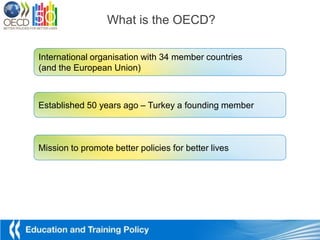
What is the OECD?

International organisation with 34 member countries
(and the European Union)


Established 50 years ago – Turkey a founding member


Mission to promote better policies for better lives
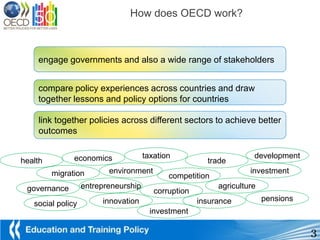
How does OECD work?


    engage governments and also a wide range of stakeholders


    compare policy experiences across countries and draw
    together lessons and policy options for countries

    link together policies across different sectors to achieve better
    outcomes


               economics              taxation                       development
health                                                  trade
         migration        environment                               investment
                                             competition
 governance        entrepreneurship                        agriculture
                                         corruption
                        innovation                    insurance          pensions
   social policy
                                        investment

                                                                                    3
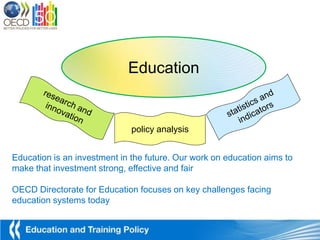
Education


                              policy analysis


Education is an investment in the future. Our work on education aims to
make that investment strong, effective and fair

OECD Directorate for Education focuses on key challenges facing
education systems today
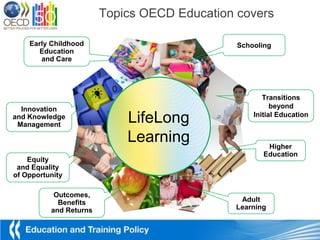
Topics OECD Education covers

    Early Childhood                           Schooling
       Education
       and Care


                                                     Transitions
  Innovation                                            beyond
and Knowledge
 Management
                            LifeLong              Initial Education


                            Learning                  Higher
                                                     Education
    Equity
 and Equality
of Opportunity

           Outcomes,
            Benefits                          Adult
          and Returns                        Learning
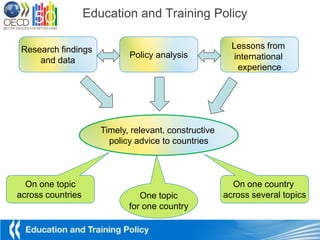
Education and Training Policy

 Research findings                                       Lessons from
                             Policy analysis             international
     and data
                                                          experience


                      Timely, relevant, constructive
                        policy advice to countries


  On one topic                                           On one country
across countries                One topic              across several topics
                             for one country
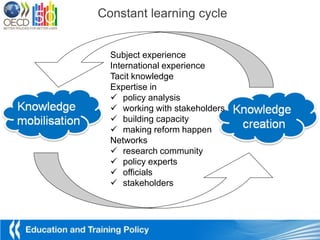
Constant learning cycle


  Subject experience
  International experience
  Tacit knowledge
  Expertise in
   policy analysis
   working with stakeholders
   building capacity
   making reform happen
  Networks
   research community
   policy experts
   officials
   stakeholders
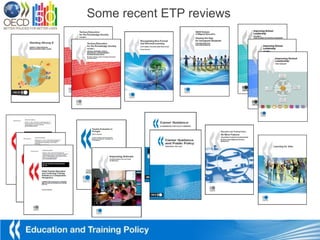
Some recent ETP reviews
Current ETP reviews

      Encouraging quality in ECEC

 Overcoming school failure: policies that work

    Assessment and Evaluation Frameworks for Improving
    School Outcomes

Improving outcomes in lower secondary school in Norway

           Transitions for Students with Disabilities beyond Secondary
           School

Investing in youth in emerging economies

     Skills beyond School
Common policy challenges
                   Skills beyond School

How can institutional frameworks, funding and governance arrangements
be designed to encourage:
   – optimal balance between post-secondary VET and academic
      programmes?
   – providers to respond to labour market needs?
   – innovation and efficient provision of programmes?

How to manage costs of post-secondary VET
  (private and public)?

How to strengthen quality assurance
  – to drive improvement?
  – to increase accountability?


                                                                        10
Common policy challenges
                    Skills beyond School
How well do programmes correspond to labour market needs?
– Do they broadly match job openings?
– Do they lead to better labour market outcomes?
– Do they provide technical, generic, soft skills that
       • employers currently want
       • are transferable though working life
       • underpin lifelong learning

How to make providers more responsive to labour market needs?

How to strengthen “job-readiness” skills?

How to most effectively engage employers, trade unions and other
  stakeholders in postsecondary VET?

How to collect, interpret and use data on labour market outcomes effectively?


                                                                          11
Common policy challenges
                    Skills beyond School
Which tools are best for sideways and upwards mobility through post-
  secondary education?
  – Qualifications frameworks
  – Credit transfer arrangements
  – Recognition of prior learning

How to raise completion rates?
– Tighter and/or tougher student entry requirements?
– Stricter quality control of programmes offered?
– Better orientation and guidance?
– More effective student support?
– Better student preparation?
– Rebalancing funding across providers and students?
– Improve flexibility and mobility through system?


                                                                       12
Thank you!


       www.oecd.org/edu
   www.oecd.org/edu/pointers
 www.oecd.org/edu/earlychildhood
www.oecd.org/edu/evaluationpolicy
    www.oecd.org/edu/equity
 www.oecd.org/edu/learningforjobs
  www.oecd.org/education/vet

Roseveare oecd and education

  • 1.
    OECD and Education DeborahRoseveare Head, Education and Training Policy Division Directorate for Education 28th April, 2011
  • 2.
    What is theOECD? International organisation with 34 member countries (and the European Union) Established 50 years ago – Turkey a founding member Mission to promote better policies for better lives
  • 3.
    How does OECDwork? engage governments and also a wide range of stakeholders compare policy experiences across countries and draw together lessons and policy options for countries link together policies across different sectors to achieve better outcomes economics taxation development health trade migration environment investment competition governance entrepreneurship agriculture corruption innovation insurance pensions social policy investment 3
  • 4.
    Education policy analysis Education is an investment in the future. Our work on education aims to make that investment strong, effective and fair OECD Directorate for Education focuses on key challenges facing education systems today
  • 5.
    Topics OECD Educationcovers Early Childhood Schooling Education and Care Transitions Innovation beyond and Knowledge Management LifeLong Initial Education Learning Higher Education Equity and Equality of Opportunity Outcomes, Benefits Adult and Returns Learning
  • 6.
    Education and TrainingPolicy Research findings Lessons from Policy analysis international and data experience Timely, relevant, constructive policy advice to countries On one topic On one country across countries One topic across several topics for one country
  • 7.
    Constant learning cycle Subject experience International experience Tacit knowledge Expertise in  policy analysis  working with stakeholders  building capacity  making reform happen Networks  research community  policy experts  officials  stakeholders
  • 8.
  • 9.
    Current ETP reviews Encouraging quality in ECEC Overcoming school failure: policies that work Assessment and Evaluation Frameworks for Improving School Outcomes Improving outcomes in lower secondary school in Norway Transitions for Students with Disabilities beyond Secondary School Investing in youth in emerging economies Skills beyond School
  • 10.
    Common policy challenges Skills beyond School How can institutional frameworks, funding and governance arrangements be designed to encourage: – optimal balance between post-secondary VET and academic programmes? – providers to respond to labour market needs? – innovation and efficient provision of programmes? How to manage costs of post-secondary VET (private and public)? How to strengthen quality assurance – to drive improvement? – to increase accountability? 10
  • 11.
    Common policy challenges Skills beyond School How well do programmes correspond to labour market needs? – Do they broadly match job openings? – Do they lead to better labour market outcomes? – Do they provide technical, generic, soft skills that • employers currently want • are transferable though working life • underpin lifelong learning How to make providers more responsive to labour market needs? How to strengthen “job-readiness” skills? How to most effectively engage employers, trade unions and other stakeholders in postsecondary VET? How to collect, interpret and use data on labour market outcomes effectively? 11
  • 12.
    Common policy challenges Skills beyond School Which tools are best for sideways and upwards mobility through post- secondary education? – Qualifications frameworks – Credit transfer arrangements – Recognition of prior learning How to raise completion rates? – Tighter and/or tougher student entry requirements? – Stricter quality control of programmes offered? – Better orientation and guidance? – More effective student support? – Better student preparation? – Rebalancing funding across providers and students? – Improve flexibility and mobility through system? 12
  • 13.
    Thank you! www.oecd.org/edu www.oecd.org/edu/pointers www.oecd.org/edu/earlychildhood www.oecd.org/edu/evaluationpolicy www.oecd.org/edu/equity www.oecd.org/edu/learningforjobs www.oecd.org/education/vet