
Dr. J D Singh
Asst. Professor
G V (PG) College of Education (CTE)
Sangaria-335063, Rajasthan.
Email: drjdsingh@gmail.com
Outline of presentation
Introduction

Current Scenario in India
Major Problems, Issues and Challenges
Suggestions for improving higher

Education
Conclusion
Introduction
Quality life of the people of any country largely rest
on the quality of education and research.
There are three broad categories of the higher
education institutions in India, centrally funded
institutions, state funded institutions and private
institutions.
India's higher education system is the world's third
largest in terms of students, next to China and
the United States.
At present, we are looking towards goal oriented
teaching and research.
Current Scenario of Higher Education
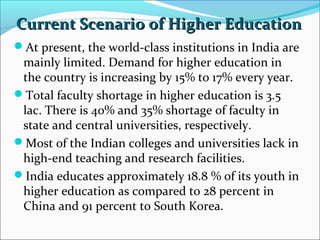
At present, the world-class institutions in India are

mainly limited. Demand for higher education in
the country is increasing by 15% to 17% every year.
Total faculty shortage in higher education is 3.5
lac. There is 40% and 35% shortage of faculty in
state and central universities, respectively.
Most of the Indian colleges and universities lack in
high-end teaching and research facilities.
India educates approximately 18.8 % of its youth in
higher education as compared to 28 percent in
China and 91 percent to South Korea.
Current Scenario of Higher Education
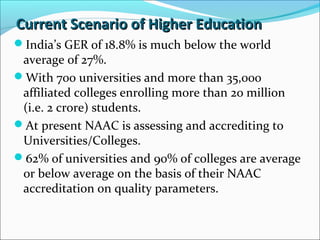
India’s GER of 18.8% is much below the world

average of 27%.
With 700 universities and more than 35,000
affiliated colleges enrolling more than 20 million
(i.e. 2 crore) students.
At present NAAC is assessing and accrediting to
Universities/Colleges.
62% of universities and 90% of colleges are average
or below average on the basis of their NAAC
accreditation on quality parameters.
Current Scenario of Higher Education
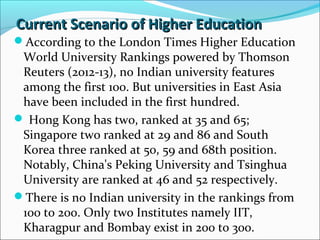
According to the London Times Higher Education

World University Rankings powered by Thomson
Reuters (2012-13), no Indian university features
among the first 100. But universities in East Asia
have been included in the first hundred.
 Hong Kong has two, ranked at 35 and 65;
Singapore two ranked at 29 and 86 and South
Korea three ranked at 50, 59 and 68th position.
Notably, China's Peking University and Tsinghua
University are ranked at 46 and 52 respectively.
There is no Indian university in the rankings from
100 to 200. Only two Institutes namely IIT,
Kharagpur and Bombay exist in 200 to 300.
Current Scenario of Higher Education
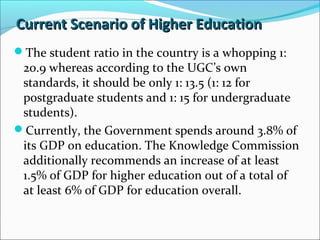
The student ratio in the country is a whopping 1:

20.9 whereas according to the UGC’s own
standards, it should be only 1: 13.5 (1: 12 for
postgraduate students and 1: 15 for undergraduate
students).
Currently, the Government spends around 3.8% of
its GDP on education. The Knowledge Commission
additionally recommends an increase of at least
1.5% of GDP for higher education out of a total of
at least 6% of GDP for education overall.
Current Scenario of Higher Education
0.81% of GDP expends on research & development

in the field of Science & Technology as compared
to 2.79% in the USA, Israel (5.11 %), Japan (3.45 %),
1.23% in China and almost 3% in South Korea.
32.5% contribution of published research papers is
of USA researchers in the world while only 2.5%
contribution is Indian scholars that always been
under criticism for not being innovative, original
and of high quality.
Universities for Research & Innovation Bill 2012,
which envisages setting up of universities of
excellence is pending in the parliament.
Problems, Issues and Challenges
Quality education according to global standards
Inadequate financial resources, incentives and

motivation
Work load of faculty and Overcrowded
classrooms
 Shortage of qualified and dedicated faculty
Lack of up-to-date library, books and Internet
search skills and materials on higher education
Less strengthen workshops and partnership
between universities and schools to prepare
teachers.
Problems, Issues and Challenges
The NKC recommends creation of 1,500 colleges

and universities over the next several years to
roughly double that percentage
Japan has 4,000 universities for its 127 million
people,
The US has 5,850 universities for its 331 million,
India has only 700 universities level Institutions
for its 1.2 billion people.
The Commission estimates that 160,000 Indians
are studying abroad, spending an estimated $4
billion a year.
Problems, Issues and Challenges
Lack of enthusiasm for technology among

academics
Lack of work culture
Lack of Outstanding quality of research and
teaching
Low extension of Research towards local
application of global knowledge pool
200 universities and 3000 colleges/ institutions
have been accredited by NAAC so far. It is a big
challenge to accredit other universities and
colleges.
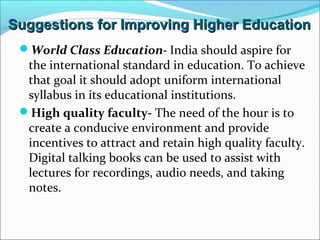
Suggestions for Improving Higher Education
World Class Education- India should aspire for

the international standard in education. To achieve
that goal it should adopt uniform international
syllabus in its educational institutions.
High quality faculty- The need of the hour is to
create a conducive environment and provide
incentives to attract and retain high quality faculty.
Digital talking books can be used to assist with
lectures for recordings, audio needs, and taking
notes.
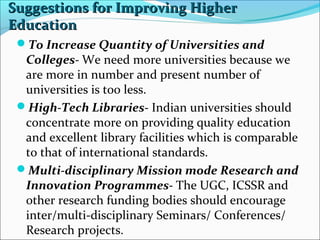
Suggestions for Improving Higher
Education
To Increase Quantity of Universities and

Colleges- We need more universities because we
are more in number and present number of
universities is too less.
High-Tech Libraries- Indian universities should
concentrate more on providing quality education
and excellent library facilities which is comparable
to that of international standards.
Multi-disciplinary Mission mode Research and
Innovation Programmes- The UGC, ICSSR and
other research funding bodies should encourage
inter/multi-disciplinary Seminars/ Conferences/
Research projects.
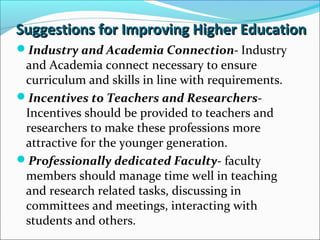
Suggestions for Improving Higher Education
Industry and Academia Connection- Industry

and Academia connect necessary to ensure
curriculum and skills in line with requirements.
Incentives to Teachers and ResearchersIncentives should be provided to teachers and
researchers to make these professions more
attractive for the younger generation.
Professionally dedicated Faculty- faculty
members should manage time well in teaching
and research related tasks, discussing in
committees and meetings, interacting with
students and others.
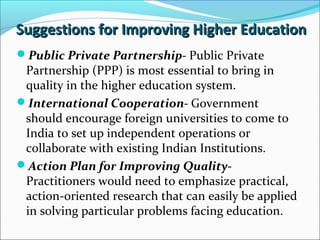
Suggestions for Improving Higher Education
Public Private Partnership- Public Private

Partnership (PPP) is most essential to bring in
quality in the higher education system.
International Cooperation- Government
should encourage foreign universities to come to
India to set up independent operations or
collaborate with existing Indian Institutions.
Action Plan for Improving QualityPractitioners would need to emphasize practical,
action-oriented research that can easily be applied
in solving particular problems facing education.
Suggestions for Improving Higher Education
Regular Monitoring And Evaluation- There

should be regular monitoring and evaluation of
teaching and research in the universities and other
institutions of higher learning.
Innovative Research Practices- Teachers should
be encouraged to attend various Conventions,
Conferences, Seminars, Workshops in their
disciplines to update their subject know how.
Suggestions for Improving Higher Education
Better Implement of newly launched

ambitious programme Rashtriya Uchchatar
Shiksha Abhiyan (RUSA) to revamp the higher
education effectively.
It is a new centrally sponsored scheme for higher
education which will spread over two plan periods
(XIIth and XIIIth) to improve access, equity and
quality in higher education at the state level. It is
proposed to improve the Gross Enrolment Ratio
from 19% at present to 30% by 2020.
Conclusion
In this New Millennium, higher education in
India is needed for growth and utilization of best
practices.
Research and Teaching learning practices
should become the target of researchers, policy
makers, program designers, implementers, and
evaluators to raise the level of its quality keeping
in view the international standards and create
positive development in the society.
Questioning /Answering session
You are most
Welcome
For raising
Questions relating to the theme
Thank You
Very much

Excellence in higher education jd singh

  • 1.
    Dr. J DSingh Asst. Professor G V (PG) College of Education (CTE) Sangaria-335063, Rajasthan. Email: drjdsingh@gmail.com
  • 2.
    Outline of presentation Introduction CurrentScenario in India Major Problems, Issues and Challenges Suggestions for improving higher Education Conclusion
  • 3.
    Introduction Quality life ofthe people of any country largely rest on the quality of education and research. There are three broad categories of the higher education institutions in India, centrally funded institutions, state funded institutions and private institutions. India's higher education system is the world's third largest in terms of students, next to China and the United States. At present, we are looking towards goal oriented teaching and research.
  • 4.
    Current Scenario ofHigher Education At present, the world-class institutions in India are mainly limited. Demand for higher education in the country is increasing by 15% to 17% every year. Total faculty shortage in higher education is 3.5 lac. There is 40% and 35% shortage of faculty in state and central universities, respectively. Most of the Indian colleges and universities lack in high-end teaching and research facilities. India educates approximately 18.8 % of its youth in higher education as compared to 28 percent in China and 91 percent to South Korea.
  • 5.
    Current Scenario ofHigher Education India’s GER of 18.8% is much below the world average of 27%. With 700 universities and more than 35,000 affiliated colleges enrolling more than 20 million (i.e. 2 crore) students. At present NAAC is assessing and accrediting to Universities/Colleges. 62% of universities and 90% of colleges are average or below average on the basis of their NAAC accreditation on quality parameters.
  • 6.
    Current Scenario ofHigher Education According to the London Times Higher Education World University Rankings powered by Thomson Reuters (2012-13), no Indian university features among the first 100. But universities in East Asia have been included in the first hundred.  Hong Kong has two, ranked at 35 and 65; Singapore two ranked at 29 and 86 and South Korea three ranked at 50, 59 and 68th position. Notably, China's Peking University and Tsinghua University are ranked at 46 and 52 respectively. There is no Indian university in the rankings from 100 to 200. Only two Institutes namely IIT, Kharagpur and Bombay exist in 200 to 300.
  • 7.
    Current Scenario ofHigher Education The student ratio in the country is a whopping 1: 20.9 whereas according to the UGC’s own standards, it should be only 1: 13.5 (1: 12 for postgraduate students and 1: 15 for undergraduate students). Currently, the Government spends around 3.8% of its GDP on education. The Knowledge Commission additionally recommends an increase of at least 1.5% of GDP for higher education out of a total of at least 6% of GDP for education overall.
  • 8.
    Current Scenario ofHigher Education 0.81% of GDP expends on research & development in the field of Science & Technology as compared to 2.79% in the USA, Israel (5.11 %), Japan (3.45 %), 1.23% in China and almost 3% in South Korea. 32.5% contribution of published research papers is of USA researchers in the world while only 2.5% contribution is Indian scholars that always been under criticism for not being innovative, original and of high quality. Universities for Research & Innovation Bill 2012, which envisages setting up of universities of excellence is pending in the parliament.
  • 9.
    Problems, Issues andChallenges Quality education according to global standards Inadequate financial resources, incentives and motivation Work load of faculty and Overcrowded classrooms  Shortage of qualified and dedicated faculty Lack of up-to-date library, books and Internet search skills and materials on higher education Less strengthen workshops and partnership between universities and schools to prepare teachers.
  • 10.
    Problems, Issues andChallenges The NKC recommends creation of 1,500 colleges and universities over the next several years to roughly double that percentage Japan has 4,000 universities for its 127 million people, The US has 5,850 universities for its 331 million, India has only 700 universities level Institutions for its 1.2 billion people. The Commission estimates that 160,000 Indians are studying abroad, spending an estimated $4 billion a year.
  • 11.
    Problems, Issues andChallenges Lack of enthusiasm for technology among academics Lack of work culture Lack of Outstanding quality of research and teaching Low extension of Research towards local application of global knowledge pool 200 universities and 3000 colleges/ institutions have been accredited by NAAC so far. It is a big challenge to accredit other universities and colleges.
  • 12.
    Suggestions for ImprovingHigher Education World Class Education- India should aspire for the international standard in education. To achieve that goal it should adopt uniform international syllabus in its educational institutions. High quality faculty- The need of the hour is to create a conducive environment and provide incentives to attract and retain high quality faculty. Digital talking books can be used to assist with lectures for recordings, audio needs, and taking notes.
  • 13.
    Suggestions for ImprovingHigher Education To Increase Quantity of Universities and Colleges- We need more universities because we are more in number and present number of universities is too less. High-Tech Libraries- Indian universities should concentrate more on providing quality education and excellent library facilities which is comparable to that of international standards. Multi-disciplinary Mission mode Research and Innovation Programmes- The UGC, ICSSR and other research funding bodies should encourage inter/multi-disciplinary Seminars/ Conferences/ Research projects.
  • 14.
    Suggestions for ImprovingHigher Education Industry and Academia Connection- Industry and Academia connect necessary to ensure curriculum and skills in line with requirements. Incentives to Teachers and ResearchersIncentives should be provided to teachers and researchers to make these professions more attractive for the younger generation. Professionally dedicated Faculty- faculty members should manage time well in teaching and research related tasks, discussing in committees and meetings, interacting with students and others.
  • 15.
    Suggestions for ImprovingHigher Education Public Private Partnership- Public Private Partnership (PPP) is most essential to bring in quality in the higher education system. International Cooperation- Government should encourage foreign universities to come to India to set up independent operations or collaborate with existing Indian Institutions. Action Plan for Improving QualityPractitioners would need to emphasize practical, action-oriented research that can easily be applied in solving particular problems facing education.
  • 16.
    Suggestions for ImprovingHigher Education Regular Monitoring And Evaluation- There should be regular monitoring and evaluation of teaching and research in the universities and other institutions of higher learning. Innovative Research Practices- Teachers should be encouraged to attend various Conventions, Conferences, Seminars, Workshops in their disciplines to update their subject know how.
  • 17.
    Suggestions for ImprovingHigher Education Better Implement of newly launched ambitious programme Rashtriya Uchchatar Shiksha Abhiyan (RUSA) to revamp the higher education effectively. It is a new centrally sponsored scheme for higher education which will spread over two plan periods (XIIth and XIIIth) to improve access, equity and quality in higher education at the state level. It is proposed to improve the Gross Enrolment Ratio from 19% at present to 30% by 2020.
  • 18.
    Conclusion In this NewMillennium, higher education in India is needed for growth and utilization of best practices. Research and Teaching learning practices should become the target of researchers, policy makers, program designers, implementers, and evaluators to raise the level of its quality keeping in view the international standards and create positive development in the society.
  • 19.
    Questioning /Answering session Youare most Welcome For raising Questions relating to the theme
  • 20.