How to make an
Action Research?
DONITA ANN B. MALLILLIN, LPT
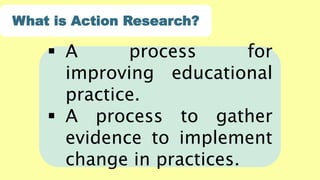
 A process for
improving educational
practice.
 A process to gather
evidence to implement
change in practices.
What is Action Research?
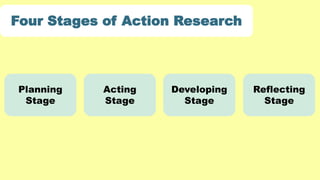
Planning
Stage
Acting
Stage
Developing
Stage
Reflecting
Stage
Four Stages of Action Research
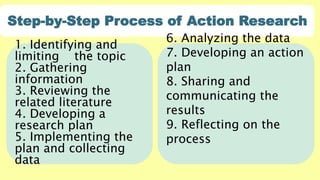
Step-by-Step Process of Action Research
1. Identifying and
limiting the topic
2. Gathering
information
3. Reviewing the
related literature
4. Developing a
research plan
5. Implementing the
plan and collecting
data
6. Analyzing the data
7. Developing an action
plan
8. Sharing and
communicating the
results
9. Reflecting on the
process
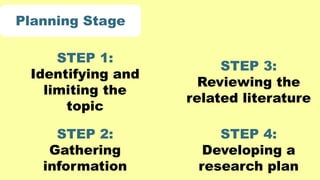
STEP 1:
Identifying and
limiting the
topic
STEP 2:
Gathering
information
STEP 3:
Reviewing the
related literature
STEP 4:
Developing a
research plan
Planning Stage
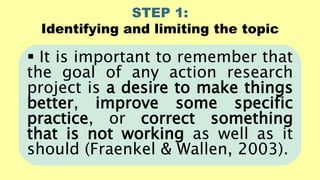
STEP 1:
Identifying and limiting the topic
 It is important to remember that
the goal of any action research
project is a desire to make things
better, improve some specific
practice, or correct something
that is not working as well as it
should (Fraenkel & Wallen, 2003).
STEP 1:
Identifying and limiting the topic
Essentially, you are
looking to identify some
topic that you would
genuinely like to examine
in depth (Johnson, 2008).
STEP 2:
Gathering information
Preliminary information
gathering, a process that Mills
(2011) refers to as
reconnaissance.
Doing reconnaissance involves
taking time to reflect on your own
beliefs and to gain a better
understanding of the nature and
context of your research problem
(Mills, 2011).
STEP 3:
Reviewing the related literature
Related information can provide guidance
for defining or limiting the problem, for
developing an appropriate research design,
or for selecting legitimate instruments or
techniques for collecting data (Parsons &
Brown, 2002).
This activity provides an opportunity for
the action research to connect existing
theory and research to actual classroom
STEP 4:
Developing a research plan
Once the research problem or
topic has been identified and
focused, it is then appropriate
to state one or more research
questions and possibly to
develop from those questions
specific hypotheses (Parsons &
Brown, 2002).
STEP 4:
Developing a research plan
A research question is the
fundamental question
inherent in the research
problem; it is the question
the action researcher seeks
to answer through
conducting the study.
STEP 5:
Implementing
the plan and
collecting data
STEP 6:
Analyzing the
data
Acting Stage
STEP 5:
Implementing the plan and collecting data
The next step in the
process of conducting
action research is the
determination of the
specific data to be
collected and how to
actually collect them.
STEP 5:
Implementing the plan and collecting data
Fraenkel and Wallen (2003) suggest three
main categories of data collection
techniques.
1. Teachers can observe participants
involved in the educational process.
2. Interviews may also be used to collect
data from students or other individuals.
3. Examination and analysis of existing
documents or records.
STEP 6:
Analyzing the data
Johnson (2008) suggests that
“as you collect your data,
analyze them by looking for
themes, categories, or patterns
that emerge. This analysis will
influence further data collection
(and analysis) by helping you to
know what to look for”
STEP 7:
Developing an
action plan
Developing Stage
STEP 7:
Developing an action plan
Once the data have been analyzed
and the results of the analysis
interpreted, the next step in the
action research process is the
development of an action plan. This
is really the ultimate goal of any
action research study—it is the
“action” part of action research.
STEP 7:
Developing an action plan
The important outcome from
the development of an action
plan is the existence of a
specific and tangible approach
to trying out some new ideas as
a means to solve the original
problem (Creswell, 2005).
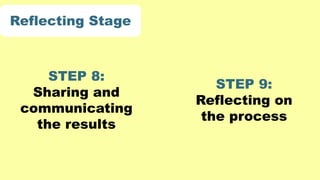
Reflecting Stage
STEP 8:
Sharing and
communicating
the results
STEP 9:
Reflecting on
the process
STEP 8:
Sharing and communicating the results
 The vast majority of
educators are constantly
looking for ways to improve
their practice—as it is the
nature of their profession.
STEP 9:
Reflecting on the process
Action research is primarily
about critical examination of
one’s own practice. In order for
someone to critically examine
her or his practice, that person
must engage in systematic
reflection of that practice.
STEP 9:
Reflecting on the process
Reflection, as it pertains to action
research, is something that must be
done at the end of a particular action
cycle. It is a crucial step in the process,
since this is where the teacher-
researcher reviews what has been done,
determines its effectiveness, and makes
decisions about possible revisions for
future implementations of the project.
Thankyou!
Thankyou!

How to make an Action Research.pptx

  • 1.
    How to makean Action Research? DONITA ANN B. MALLILLIN, LPT
  • 2.
     A processfor improving educational practice.  A process to gather evidence to implement change in practices. What is Action Research?
  • 3.
  • 4.
    Step-by-Step Process ofAction Research 1. Identifying and limiting the topic 2. Gathering information 3. Reviewing the related literature 4. Developing a research plan 5. Implementing the plan and collecting data 6. Analyzing the data 7. Developing an action plan 8. Sharing and communicating the results 9. Reflecting on the process
  • 5.
    STEP 1: Identifying and limitingthe topic STEP 2: Gathering information STEP 3: Reviewing the related literature STEP 4: Developing a research plan Planning Stage
  • 6.
    STEP 1: Identifying andlimiting the topic  It is important to remember that the goal of any action research project is a desire to make things better, improve some specific practice, or correct something that is not working as well as it should (Fraenkel & Wallen, 2003).
  • 7.
    STEP 1: Identifying andlimiting the topic Essentially, you are looking to identify some topic that you would genuinely like to examine in depth (Johnson, 2008).
  • 8.
    STEP 2: Gathering information Preliminaryinformation gathering, a process that Mills (2011) refers to as reconnaissance. Doing reconnaissance involves taking time to reflect on your own beliefs and to gain a better understanding of the nature and context of your research problem (Mills, 2011).
  • 9.
    STEP 3: Reviewing therelated literature Related information can provide guidance for defining or limiting the problem, for developing an appropriate research design, or for selecting legitimate instruments or techniques for collecting data (Parsons & Brown, 2002). This activity provides an opportunity for the action research to connect existing theory and research to actual classroom
  • 10.
    STEP 4: Developing aresearch plan Once the research problem or topic has been identified and focused, it is then appropriate to state one or more research questions and possibly to develop from those questions specific hypotheses (Parsons & Brown, 2002).
  • 11.
    STEP 4: Developing aresearch plan A research question is the fundamental question inherent in the research problem; it is the question the action researcher seeks to answer through conducting the study.
  • 12.
    STEP 5: Implementing the planand collecting data STEP 6: Analyzing the data Acting Stage
  • 13.
    STEP 5: Implementing theplan and collecting data The next step in the process of conducting action research is the determination of the specific data to be collected and how to actually collect them.
  • 14.
    STEP 5: Implementing theplan and collecting data Fraenkel and Wallen (2003) suggest three main categories of data collection techniques. 1. Teachers can observe participants involved in the educational process. 2. Interviews may also be used to collect data from students or other individuals. 3. Examination and analysis of existing documents or records.
  • 15.
    STEP 6: Analyzing thedata Johnson (2008) suggests that “as you collect your data, analyze them by looking for themes, categories, or patterns that emerge. This analysis will influence further data collection (and analysis) by helping you to know what to look for”
  • 16.
    STEP 7: Developing an actionplan Developing Stage
  • 17.
    STEP 7: Developing anaction plan Once the data have been analyzed and the results of the analysis interpreted, the next step in the action research process is the development of an action plan. This is really the ultimate goal of any action research study—it is the “action” part of action research.
  • 18.
    STEP 7: Developing anaction plan The important outcome from the development of an action plan is the existence of a specific and tangible approach to trying out some new ideas as a means to solve the original problem (Creswell, 2005).
  • 19.
    Reflecting Stage STEP 8: Sharingand communicating the results STEP 9: Reflecting on the process
  • 20.
    STEP 8: Sharing andcommunicating the results  The vast majority of educators are constantly looking for ways to improve their practice—as it is the nature of their profession.
  • 21.
    STEP 9: Reflecting onthe process Action research is primarily about critical examination of one’s own practice. In order for someone to critically examine her or his practice, that person must engage in systematic reflection of that practice.
  • 22.
    STEP 9: Reflecting onthe process Reflection, as it pertains to action research, is something that must be done at the end of a particular action cycle. It is a crucial step in the process, since this is where the teacher- researcher reviews what has been done, determines its effectiveness, and makes decisions about possible revisions for future implementations of the project.
  • 23.