Research Methodology
Action Research Designs
Madan Rijal
M.Ed. in Mathematics
Kathmandu University
School of Education
Instructor : Mr. Binod Pd. Pant
3/15/2018 1
OUTLINES
 Definition, use and its development
 Types of Action Research Designs
 Key Characteristics
 Potential ethical issues
 Steps in Conducting an Action Research Study
 Criteria for evaluating action research report
3/15/2018 2
DEFINITION
 Most applied and practical design
 Addresses a specific, practical issue and seeks to obtain solutions
 Systematic procedures done by teacher-researcher
 to gather information,
 subsequently improve teaching and students learning
 researchers address a local, practical problem
 researchers seek to empower, transform and emancipate
individual
3/15/2018 3
USES
 Solve specific educational problem
 Encourage educators to reflect on their practices
 Provide means to improve the practices
 Empower individuals through collaboration on projects
 Fosters a democratic approach in education
 Position teachers and educators as learners who seek to
narrow the gap between practice and their vision of
education
 Promote a process of testing new ideas.
3/15/2018 4
Development of Action Research
 Kurt Lewin (Social-psychologist)
 Construction of intercultural groups
 Groups processes consisted of 4 steps:
1. Planning 3. Observing
2. Acting 4. Reflecting
 Later spread from social to education sector
 Slowed during 1950s but again reemerged
in 1970s in Great Britain, USA and Australia
3/15/2018 5
Types of Action Research Design
1. Practical Action Research
• Educators seek to enhance educational practices
through study of local problem
• A small – scale research project
• Narrowly focuses on a specific problem or issue
• Undertaken by individual teachers or teams
within a school or school district
3/15/2018 6
Major ideas or Principles
Teacher-researchers
• Decision making authority
• Committed to continue professional development and
school improvement
• Reflect their practices individually or in team
• Use identifiable procedures to study problems
• Choose an area of focus, determine data collection
techniques, analyze and interpret data and develop action
plans
3/15/2018 7
Mills Dialectic Action Research Spiral
3/15/2018 8
2. Participatory Action Research (PAR)
• Also named as participatory research, critical action research
and classroom action research
• Has a social and community orientation
• Emphasis on research that contributes to emancipate or
change in our society
• Emerged as an action-oriented
• Purpose is to improve the quality of people’s organizations,
communities and family lives.
• Differs by incorporating an emancipatory aim of improving and
empowering individuals and organizations in education and
others settings.
3/15/2018 9
Major ideas or Principles
Teacher-researchers
• Study issues and address which are creating constrains
to teachers and students
• Engage in a process that promotes egalitarian and
democratic aims
• Seek to bring about a new vision for schools,
communities agencies, youth clubs and ethic groups
within schools
3/15/2018 10
Six Central Features of PAR
- Kemmis and McTaggert
• PAR is a social process
• Inquiry is participatory
• Practical and collaborative
• Emancipatory process
• Critical
• Reflexive and change orientated
3/15/2018 11
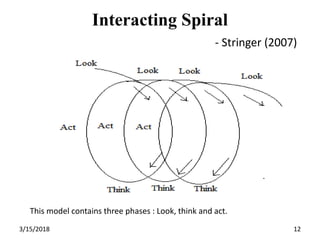
Interacting Spiral
- Stringer (2007)
3/15/2018 12
This model contains three phases : Look, think and act.
Steps in Stringer’s Action Research Model
1. Look : Building the picture
 Process
 Record and Gather information
 Extend understanding
 Organizing meetings
 Communicating
2. Think : Interpreting and Analyzing
 Process
 Frameworks
 Categorizing and coding
 Enriching analysis using frameworks
 Writing reports collaboratively
 Presentations and performance
3. Act : Resolving Problems
 Process
 Planning
 Implementing
 Reviewing
 Evaluating
3/15/2018 13
Key Characteristics of Action Research
 A practical focus
 The educator-researcher’s own practices
 Collaboration
 A dynamic process (reflection, data collection and action)
 A plan of action
 Sharing research (Unlike traditional research)
3/15/2018 14
Potential Ethical Issues in Action
Research
Collaborating with participants, a central feature
of action research, may lead to ethical issues.
 Intimate and open-ended nature
(Due to which data collection cannot be coercive)
 Dual role of teacher-researcher
3/15/2018 15
Steps in Conducting Action Research
1. Determine if it is the best design to use
2. Identify a problem to study
3. Locate Resources to help address the problem
4. Identify information you will need
5. Implement the data collection
6. Analyze the data
7. Develop a plan for action
8. Implement the plan and reflect
3/15/2018 16
Criteria for evaluating action research
report
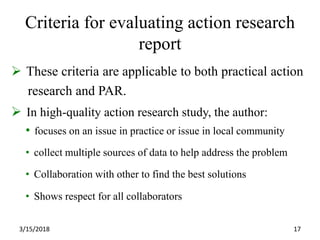
 These criteria are applicable to both practical action
research and PAR.
 In high-quality action research study, the author:
• focuses on an issue in practice or issue in local community
• collect multiple sources of data to help address the problem
• Collaboration with other to find the best solutions
• Shows respect for all collaborators
3/15/2018 17
Contd…
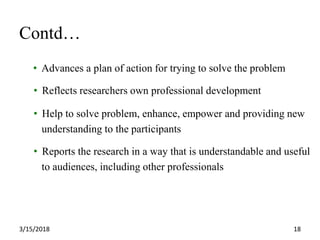
• Advances a plan of action for trying to solve the problem
• Reflects researchers own professional development
• Help to solve problem, enhance, empower and providing new
understanding to the participants
• Reports the research in a way that is understandable and useful
to audiences, including other professionals
3/15/2018 18
Thank You
3/15/2018 19

Action Research Design

  • 1.
    Research Methodology Action ResearchDesigns Madan Rijal M.Ed. in Mathematics Kathmandu University School of Education Instructor : Mr. Binod Pd. Pant 3/15/2018 1
  • 2.
    OUTLINES  Definition, useand its development  Types of Action Research Designs  Key Characteristics  Potential ethical issues  Steps in Conducting an Action Research Study  Criteria for evaluating action research report 3/15/2018 2
  • 3.
    DEFINITION  Most appliedand practical design  Addresses a specific, practical issue and seeks to obtain solutions  Systematic procedures done by teacher-researcher  to gather information,  subsequently improve teaching and students learning  researchers address a local, practical problem  researchers seek to empower, transform and emancipate individual 3/15/2018 3
  • 4.
    USES  Solve specificeducational problem  Encourage educators to reflect on their practices  Provide means to improve the practices  Empower individuals through collaboration on projects  Fosters a democratic approach in education  Position teachers and educators as learners who seek to narrow the gap between practice and their vision of education  Promote a process of testing new ideas. 3/15/2018 4
  • 5.
    Development of ActionResearch  Kurt Lewin (Social-psychologist)  Construction of intercultural groups  Groups processes consisted of 4 steps: 1. Planning 3. Observing 2. Acting 4. Reflecting  Later spread from social to education sector  Slowed during 1950s but again reemerged in 1970s in Great Britain, USA and Australia 3/15/2018 5
  • 6.
    Types of ActionResearch Design 1. Practical Action Research • Educators seek to enhance educational practices through study of local problem • A small – scale research project • Narrowly focuses on a specific problem or issue • Undertaken by individual teachers or teams within a school or school district 3/15/2018 6
  • 7.
    Major ideas orPrinciples Teacher-researchers • Decision making authority • Committed to continue professional development and school improvement • Reflect their practices individually or in team • Use identifiable procedures to study problems • Choose an area of focus, determine data collection techniques, analyze and interpret data and develop action plans 3/15/2018 7
  • 8.
    Mills Dialectic ActionResearch Spiral 3/15/2018 8
  • 9.
    2. Participatory ActionResearch (PAR) • Also named as participatory research, critical action research and classroom action research • Has a social and community orientation • Emphasis on research that contributes to emancipate or change in our society • Emerged as an action-oriented • Purpose is to improve the quality of people’s organizations, communities and family lives. • Differs by incorporating an emancipatory aim of improving and empowering individuals and organizations in education and others settings. 3/15/2018 9
  • 10.
    Major ideas orPrinciples Teacher-researchers • Study issues and address which are creating constrains to teachers and students • Engage in a process that promotes egalitarian and democratic aims • Seek to bring about a new vision for schools, communities agencies, youth clubs and ethic groups within schools 3/15/2018 10
  • 11.
    Six Central Featuresof PAR - Kemmis and McTaggert • PAR is a social process • Inquiry is participatory • Practical and collaborative • Emancipatory process • Critical • Reflexive and change orientated 3/15/2018 11
  • 12.
    Interacting Spiral - Stringer(2007) 3/15/2018 12 This model contains three phases : Look, think and act.
  • 13.
    Steps in Stringer’sAction Research Model 1. Look : Building the picture  Process  Record and Gather information  Extend understanding  Organizing meetings  Communicating 2. Think : Interpreting and Analyzing  Process  Frameworks  Categorizing and coding  Enriching analysis using frameworks  Writing reports collaboratively  Presentations and performance 3. Act : Resolving Problems  Process  Planning  Implementing  Reviewing  Evaluating 3/15/2018 13
  • 14.
    Key Characteristics ofAction Research  A practical focus  The educator-researcher’s own practices  Collaboration  A dynamic process (reflection, data collection and action)  A plan of action  Sharing research (Unlike traditional research) 3/15/2018 14
  • 15.
    Potential Ethical Issuesin Action Research Collaborating with participants, a central feature of action research, may lead to ethical issues.  Intimate and open-ended nature (Due to which data collection cannot be coercive)  Dual role of teacher-researcher 3/15/2018 15
  • 16.
    Steps in ConductingAction Research 1. Determine if it is the best design to use 2. Identify a problem to study 3. Locate Resources to help address the problem 4. Identify information you will need 5. Implement the data collection 6. Analyze the data 7. Develop a plan for action 8. Implement the plan and reflect 3/15/2018 16
  • 17.
    Criteria for evaluatingaction research report  These criteria are applicable to both practical action research and PAR.  In high-quality action research study, the author: • focuses on an issue in practice or issue in local community • collect multiple sources of data to help address the problem • Collaboration with other to find the best solutions • Shows respect for all collaborators 3/15/2018 17
  • 18.
    Contd… • Advances aplan of action for trying to solve the problem • Reflects researchers own professional development • Help to solve problem, enhance, empower and providing new understanding to the participants • Reports the research in a way that is understandable and useful to audiences, including other professionals 3/15/2018 18
  • 19.