Classroom Action Research
        Overview

 What is Action Research?
What do Teacher Researchers
           Do?
  Guidelines and Ideas for
         Research
What is Action Research?


•   Identifying problems on our own
•   Examining and assessing our own work
•   Considering ways of working differently
•   Working collaboratively
Action Research is NOT…
• JUST problem solving
• Research on other people
• The scientific method
• The usual things teachers do
Teacher Researchers…

• Develop research questions
• Collect and analyze data
• Share data with others
• Write about research
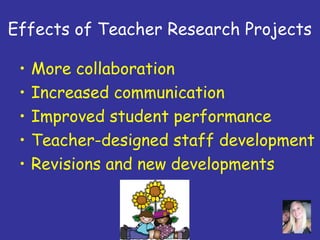
Effects of Teacher Research Projects

 •   More collaboration
 •   Increased communication
 •   Improved student performance
 •   Teacher-designed staff development
 •   Revisions and new developments
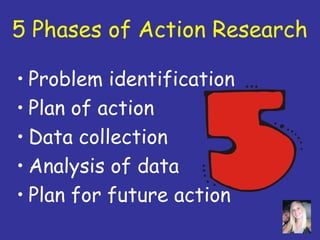
5 Phases of Action Research

• Problem identification
• Plan of action
• Data collection
• Analysis of data
• Plan for future action
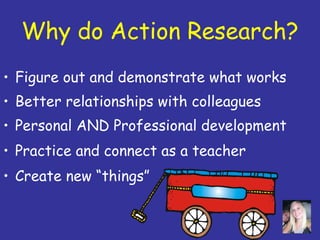
Why do Action Research?
• Figure out and demonstrate what works
• Better relationships with colleagues
• Personal AND Professional development
• Practice and connect as a teacher
• Create new “things”
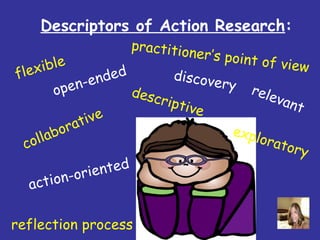
Descriptors of Action Research:
                       practitio
                                n    er’s point
     ible                                         of view
flex          n de d          discove
       op en-e       des
                                         ry   rel e
                           cript                   va n
                                i   ve                    t
                i ve
        bo   rat                          expl
 c olla                                        orat
                                                    ory

       n-ori ented
  actio

reflection process
Starting Points


    I want to improve…
I want to learn more about…
     I’m perplexed by…
 Some are unhappy about…
    I’m curious about…
Continuing Starting Points…


        I want to try…
I think to make a difference…
      I want to change…
      I’m interested in…
Developi
           ng a Q u
 Hasn’t b            estion…
              een aske
 High lev               d before
             el thinki
 N o t “Y e s          ng
               or No”
Use ever
             yday lan
Short an               guage
            d to the
                       point
ideli nes…
                 u
         ing G and able          t o do
Continu able                        g fu l
          ge               ea n i n
   Ma n a a t e an d m          know
        sion              you
   P as             what ow
      eep   it t o     to gr ions…
    K          unity quest
     O pport more
      L ea ds to
Guidelines for Data Collecting

Be clear.
How will you use it?
Design a process.
Use appropriate tools.
How much will you need?
Make it easy for you.
Use multiple resources.
Continuing Data Collecting…
Directly answers question.
Presentation is important.
Review and don’t expect too much.
Display to reveal underlying patterns.
Shouldn’t be primary job.
Facts don’t ensure being useful.
Key issue: Get USEFUL info
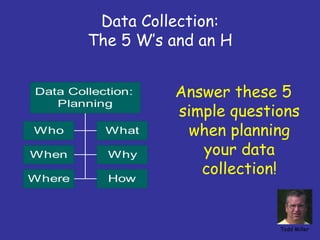
Data Collection:
        The 5 W’s and an H


Data Collection:   Answer these 5
   Planning
                   simple questions
Who        What     when planning
When       Why        your data
                      collection!
Where      How


                                Todd Miller
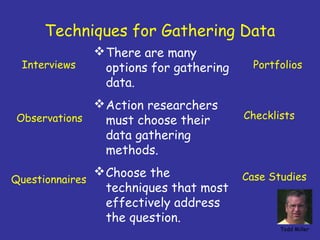
Techniques for Gathering Data
               There are many
 Interviews     options for gathering     Portfolios
                data.
              Action researchers
Observations   must choose their        Checklists
               data gathering
               methods.
                Choose the             Case Studies
Questionnaires
                 techniques that most
                 effectively address
                 the question.
                                               Todd Miller
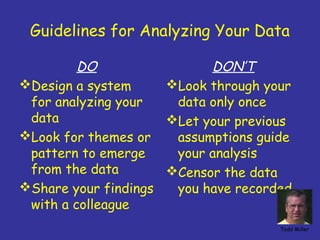
Guidelines for Analyzing Your Data

         DO                DON’T
Design a system     Look through your
 for analyzing your   data only once
 data                Let your previous
Look for themes or   assumptions guide
 pattern to emerge    your analysis
 from the data       Censor the data
Share your findings  you have recorded
 with a colleague
                                     Todd Miller
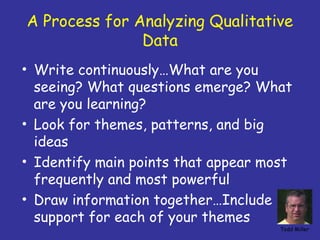
A Process for Analyzing Qualitative
               Data
• Write continuously…What are you
  seeing? What questions emerge? What
  are you learning?
• Look for themes, patterns, and big
  ideas
• Identify main points that appear most
  frequently and most powerful
• Draw information together…Include
  support for each of your themes
                                     Todd Miller
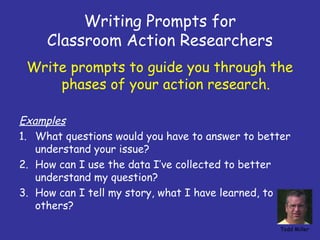
Writing Prompts for
     Classroom Action Researchers
 Write prompts to guide you through the
     phases of your action research.

Examples
1. What questions would you have to answer to better
   understand your issue?
2. How can I use the data I’ve collected to better
   understand my question?
3. How can I tell my story, what I have learned, to
   others?

                                                  Todd Miller
Roles of Participants
           • Be a good listener

           • Ask good
             questions

           • Wait to offer
             your suggestions
Ideas for Your Final Write-up
               • Background info
               • Question
               • Data collection
               • References
               • Conclusions
               • Future directions
Ideas for Your Final Write-up
               • Not all write-
                 ups will look
                 alike
               • You decide how
                 to organize your
                 write-up
Impact of CAR in Madison, WI
• Professional development activity
• Obstacles and difficulties
• Program knowledge
• Program influence
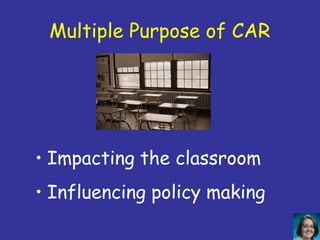
Multiple Purpose of CAR


• Impacting the classroom
• Influencing policy making
In conclusion…

      "Action research is the process through
     which teachers collaborate in evaluating
     their practice jointly; raise awareness of
     their personal theory; articulate a shared
   conception of values; try out new strategies
       to render the values expressed in their
          practice more consistent with the
      educational values they espouse; record
        their work in a form which is readily
     available to and understandable by other
    teachers; and thus develop a shared theory
       of teaching by researching practice."
                    - John Elliott


                                 Action Research is…
Process, Collaboration, Improvement, Practice, Communication

Classroom action research

  • 1.
  • 2.
    Classroom Action Research Overview What is Action Research? What do Teacher Researchers Do? Guidelines and Ideas for Research
  • 3.
    What is ActionResearch? • Identifying problems on our own • Examining and assessing our own work • Considering ways of working differently • Working collaboratively
  • 4.
    Action Research isNOT… • JUST problem solving • Research on other people • The scientific method • The usual things teachers do
  • 5.
    Teacher Researchers… • Developresearch questions • Collect and analyze data • Share data with others • Write about research
  • 6.
    Effects of TeacherResearch Projects • More collaboration • Increased communication • Improved student performance • Teacher-designed staff development • Revisions and new developments
  • 7.
    5 Phases ofAction Research • Problem identification • Plan of action • Data collection • Analysis of data • Plan for future action
  • 8.
    Why do ActionResearch? • Figure out and demonstrate what works • Better relationships with colleagues • Personal AND Professional development • Practice and connect as a teacher • Create new “things”
  • 9.
    Descriptors of ActionResearch: practitio n er’s point ible of view flex n de d discove op en-e des ry rel e cript va n i ve t i ve bo rat expl c olla orat ory n-ori ented actio reflection process
  • 10.
    Starting Points I want to improve… I want to learn more about… I’m perplexed by… Some are unhappy about… I’m curious about…
  • 11.
    Continuing Starting Points… I want to try… I think to make a difference… I want to change… I’m interested in…
  • 12.
    Developi ng a Q u Hasn’t b estion… een aske High lev d before el thinki N o t “Y e s ng or No” Use ever yday lan Short an guage d to the point
  • 13.
    ideli nes… u ing G and able t o do Continu able g fu l ge ea n i n Ma n a a t e an d m know sion you P as what ow eep it t o to gr ions… K unity quest O pport more L ea ds to
  • 14.
    Guidelines for DataCollecting Be clear. How will you use it? Design a process. Use appropriate tools. How much will you need? Make it easy for you. Use multiple resources.
  • 15.
    Continuing Data Collecting… Directlyanswers question. Presentation is important. Review and don’t expect too much. Display to reveal underlying patterns. Shouldn’t be primary job. Facts don’t ensure being useful. Key issue: Get USEFUL info
  • 16.
    Data Collection: The 5 W’s and an H Data Collection: Answer these 5 Planning simple questions Who What when planning When Why your data collection! Where How Todd Miller
  • 17.
    Techniques for GatheringData  There are many Interviews options for gathering Portfolios data.  Action researchers Observations must choose their Checklists data gathering methods.  Choose the Case Studies Questionnaires techniques that most effectively address the question. Todd Miller
  • 18.
    Guidelines for AnalyzingYour Data DO DON’T Design a system Look through your for analyzing your data only once data Let your previous Look for themes or assumptions guide pattern to emerge your analysis from the data Censor the data Share your findings you have recorded with a colleague Todd Miller
  • 19.
    A Process forAnalyzing Qualitative Data • Write continuously…What are you seeing? What questions emerge? What are you learning? • Look for themes, patterns, and big ideas • Identify main points that appear most frequently and most powerful • Draw information together…Include support for each of your themes Todd Miller
  • 20.
    Writing Prompts for Classroom Action Researchers Write prompts to guide you through the phases of your action research. Examples 1. What questions would you have to answer to better understand your issue? 2. How can I use the data I’ve collected to better understand my question? 3. How can I tell my story, what I have learned, to others? Todd Miller
  • 21.
    Roles of Participants • Be a good listener • Ask good questions • Wait to offer your suggestions
  • 22.
    Ideas for YourFinal Write-up • Background info • Question • Data collection • References • Conclusions • Future directions
  • 23.
    Ideas for YourFinal Write-up • Not all write- ups will look alike • You decide how to organize your write-up
  • 24.
    Impact of CARin Madison, WI • Professional development activity • Obstacles and difficulties • Program knowledge • Program influence
  • 25.
    Multiple Purpose ofCAR • Impacting the classroom • Influencing policy making
  • 26.
    In conclusion… "Action research is the process through which teachers collaborate in evaluating their practice jointly; raise awareness of their personal theory; articulate a shared conception of values; try out new strategies to render the values expressed in their practice more consistent with the educational values they espouse; record their work in a form which is readily available to and understandable by other teachers; and thus develop a shared theory of teaching by researching practice." - John Elliott Action Research is… Process, Collaboration, Improvement, Practice, Communication