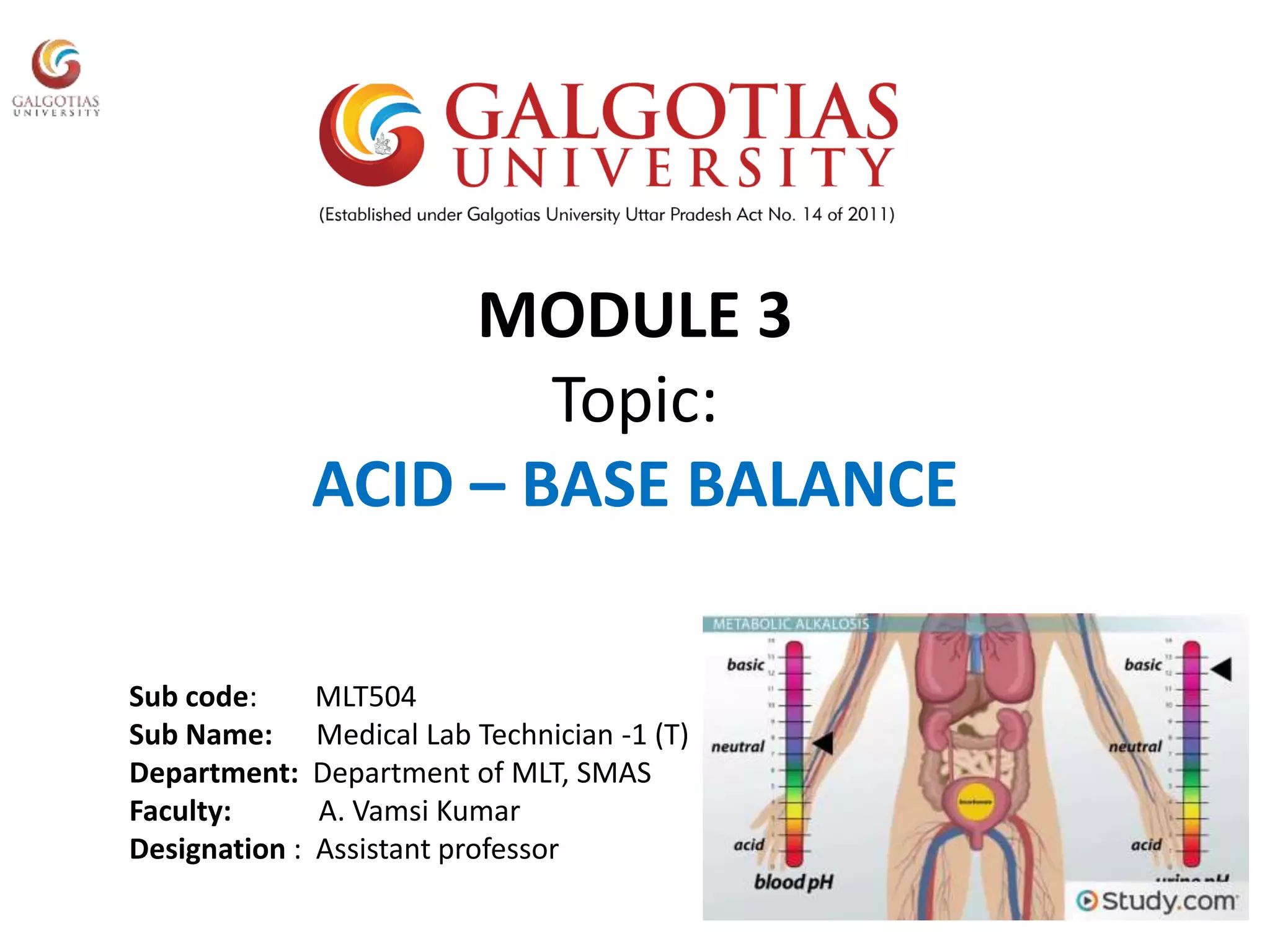
MODULE 3
Topic:
ACID – BASE BALANCE
Sub code: MLT504
Sub Name: Medical Lab Technician -1 (T)
Department: Department of MLT, SMAS
Faculty: A. Vamsi Kumar
Designation : Assistant professor
Course outcomes
• Provide technical information about test
results;
LEARNİNG OBJECTİVES
• At the end of this lecture, the student can be able to :
1. explain normal acid-base balance
2. explain buffers systems in regulation of pH
3. explain compensatory response to acid-base disorders
4. recognize metabolic acidosis
5. recognize metabolic alkalosis
6. recognize respiratory acidosis and alkalosis
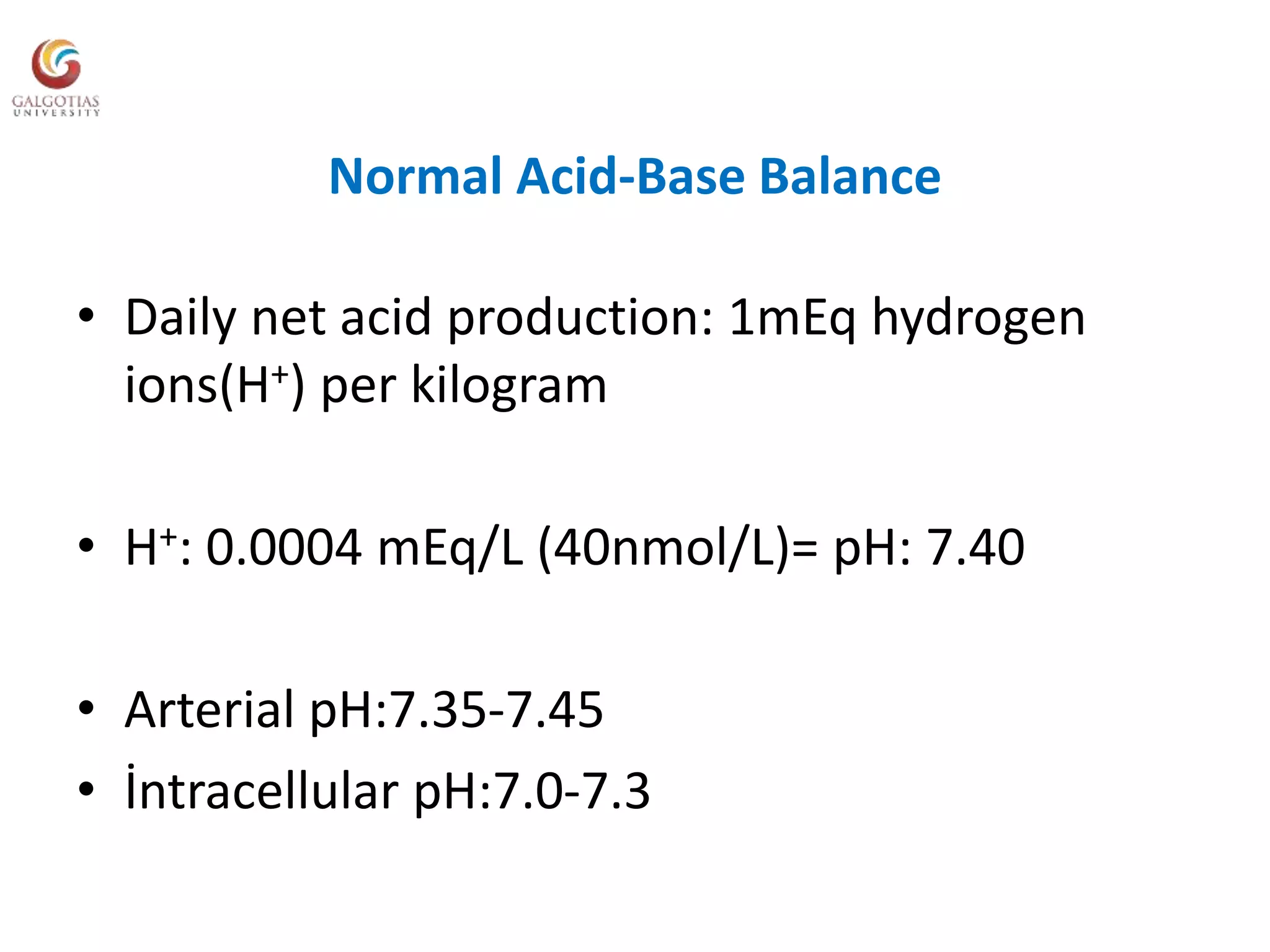
Normal Acid-Base Balance
• Daily net acid production: 1mEq hydrogen
ions(H+) per kilogram
• H+: 0.0004 mEq/L (40nmol/L)= pH: 7.40
• Arterial pH:7.35-7.45
• İntracellular pH:7.0-7.3
Buffer Systems in Regulation of pH
• Extracellular fluid:
- bicarbonate ion (HCO3
-) /carbonic acid
H++HCO3
-⇔H2CO3 H2O + CO2
- plasma proteins
- phosphate ions
- Ca2+ and HCO3
- release of bone
carbonic
anhydrase
Buffer Systems in Regulation of pH
• İntracellular fluid
- hemoglobin
- cellular proteins
- organophosphate complexes
- HCO3
- by the H+/ HCO3
- transport mechanism
Henderson-Hasselbach Equation
• pH=6.1+log
pH 7.00 7.40 7.70
[H+]
nmol/L 100 40 20
[HCO3- ] (mEq/L)
0.03XpCO2 (mm Hg)
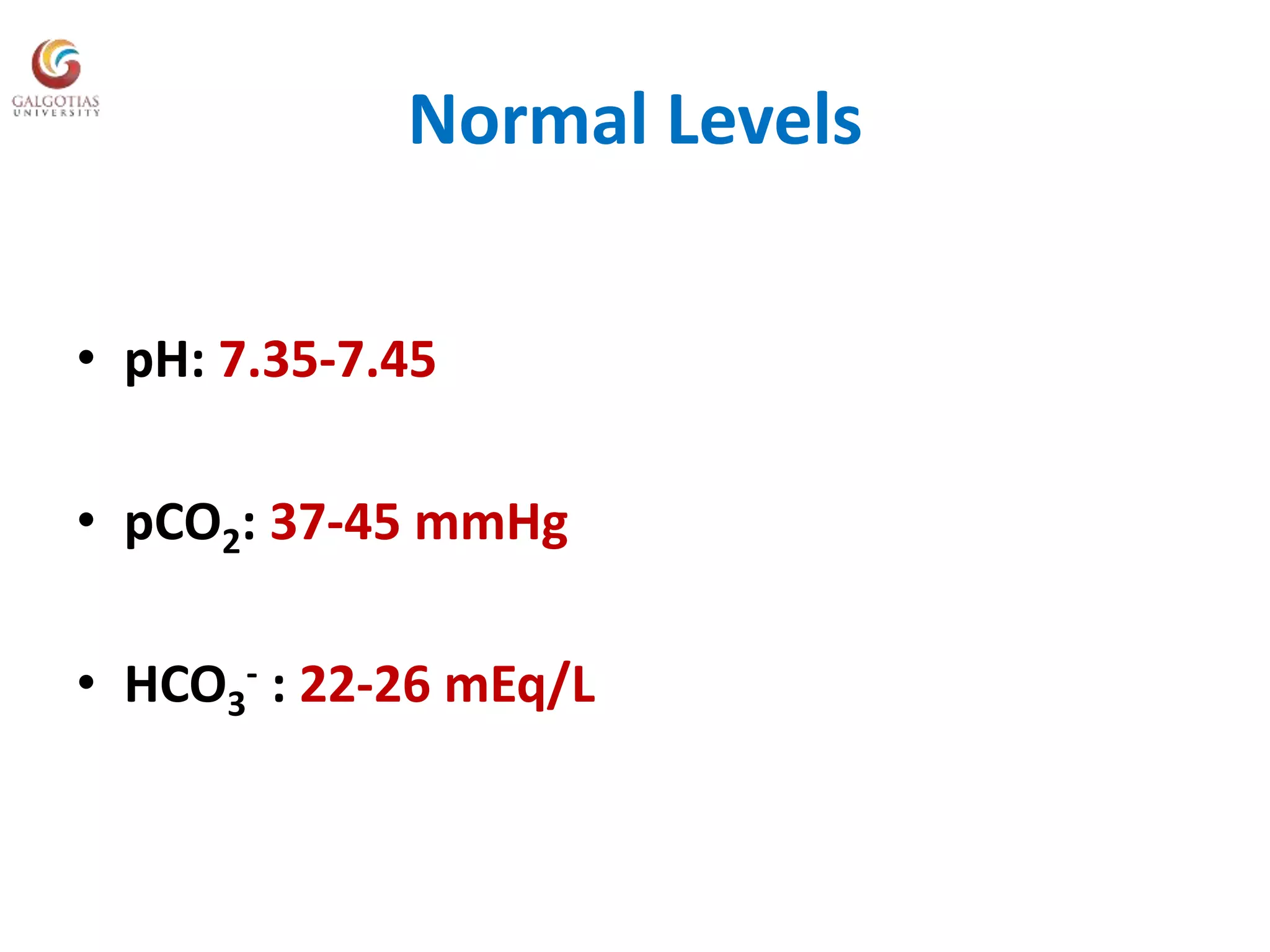
Normal Levels
• pH: 7.35-7.45
• pCO2: 37-45 mmHg
• HCO3
- : 22-26 mEq/L
pH
• Acidosis <7.35-7.45> Alkalosis
•HCO3
- ↑↓ → Metabolic
•CO2
↑↓ → Respiratory
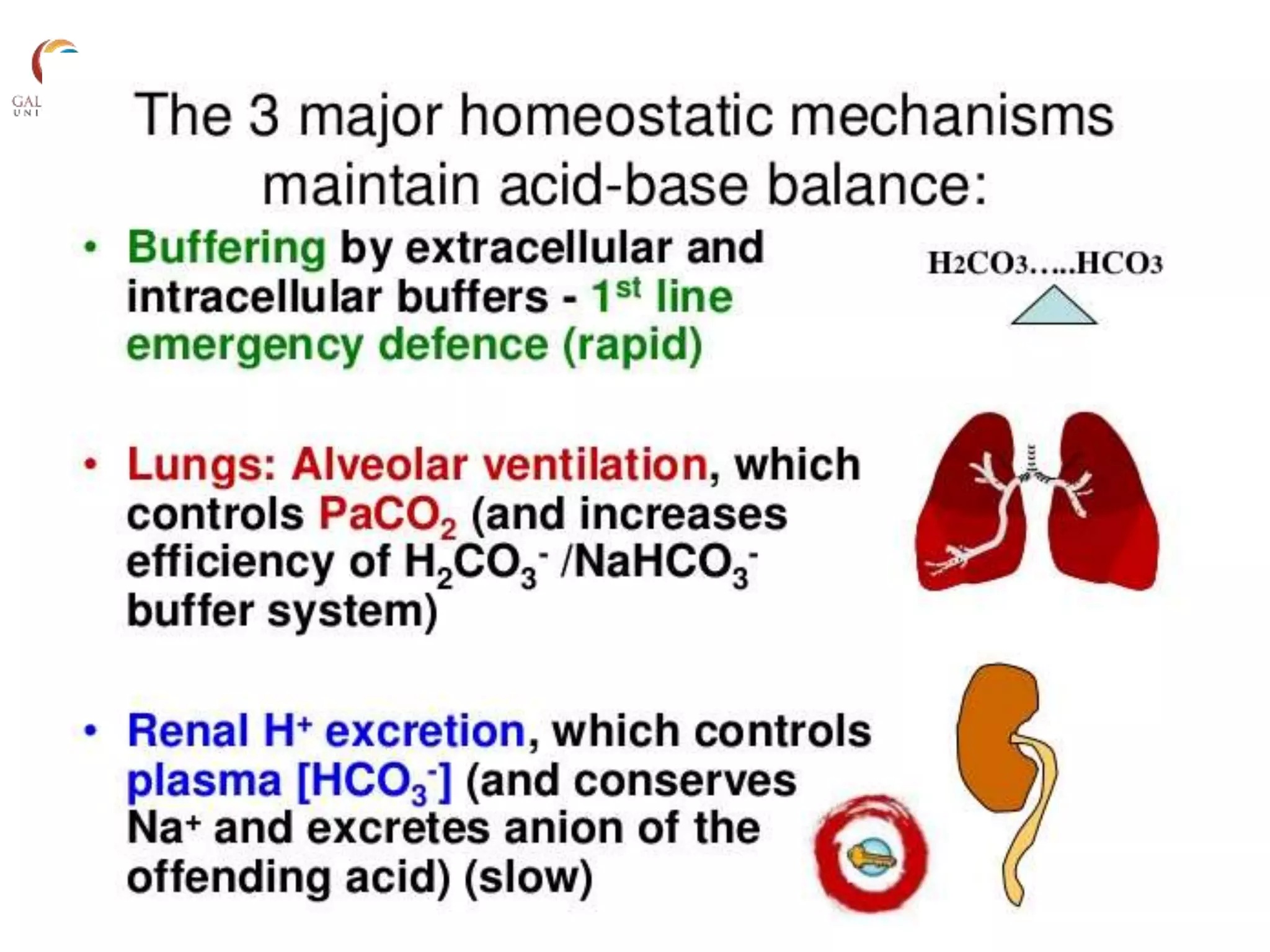
Compensatory response to acid-base
disorders
• Metabolic Acidosis/Alkalosis→
reducing / increasing CO2
• Respiratory Acidosis/Alkalosis→
renal secretion / reabsorption of HCO3
-/H+
Metabolic Acidosis
• Fall in HCO3
- concentration witt fall in pH
• Compensatory response:
fall in pH causes inreased respiration, reducing
CO2
• 1.2 mmHg fall in arterial PCO2 for every 1 meq/L reduction in the
serum HCO3 concentration
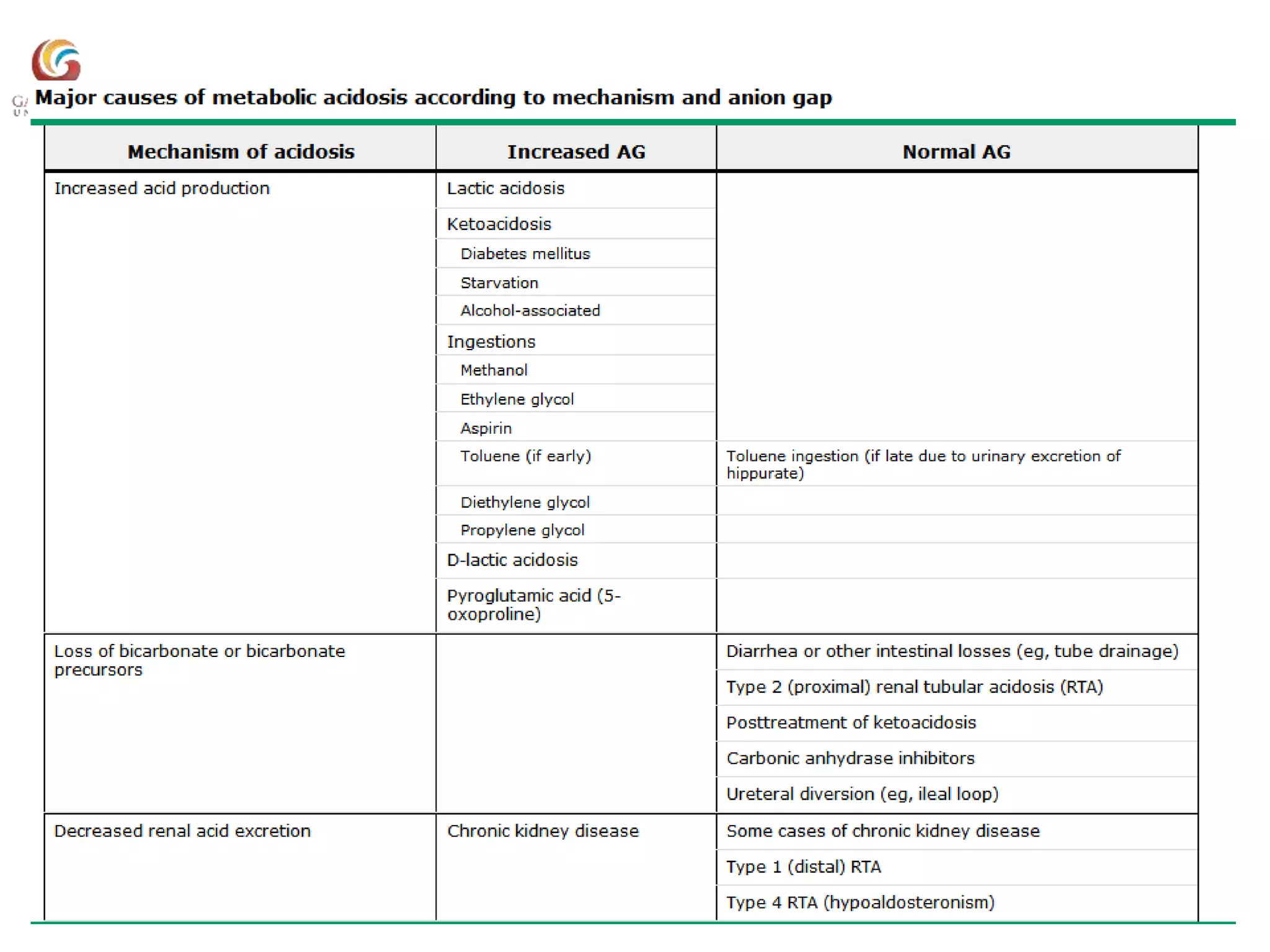
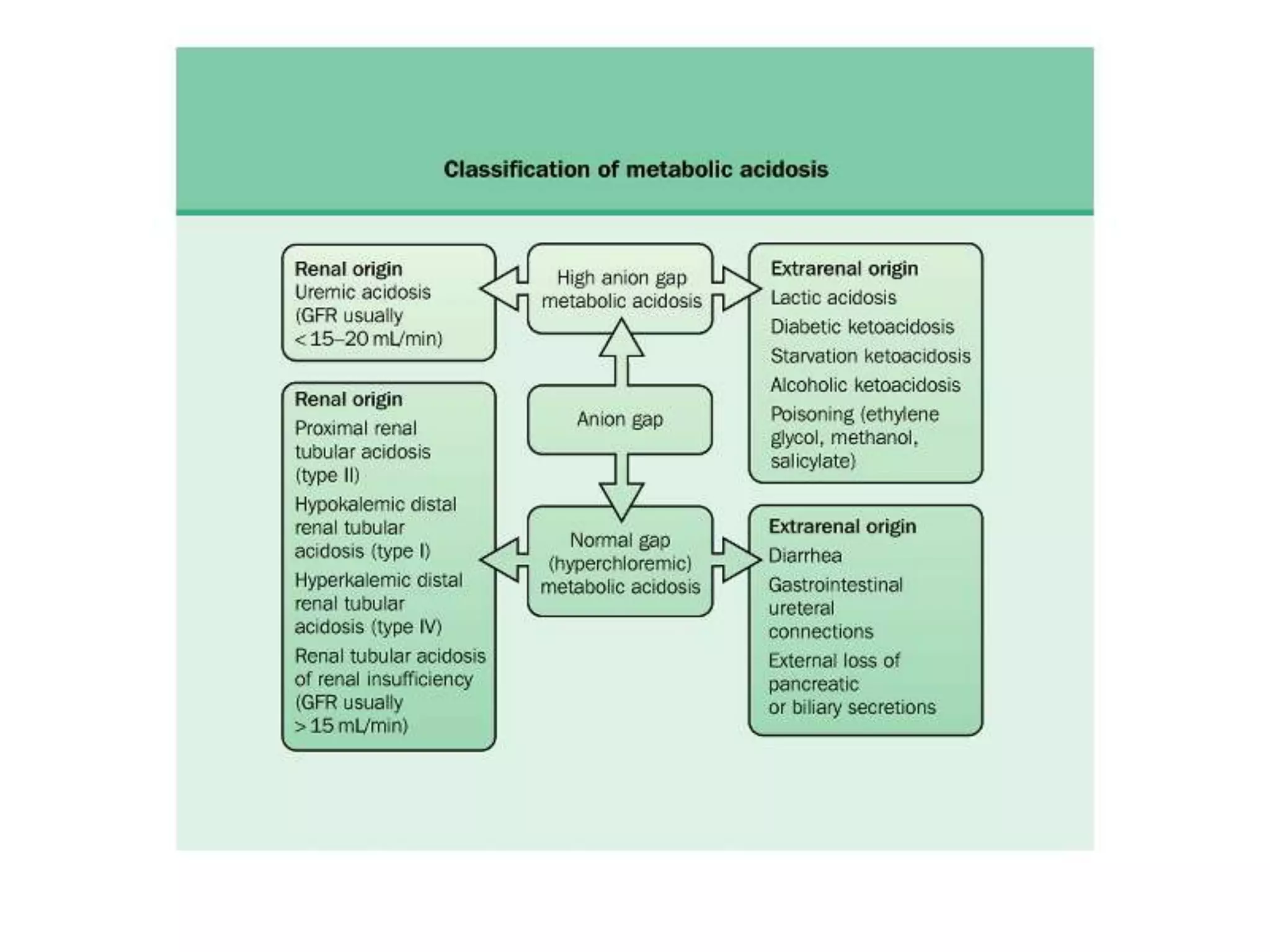
Causes of Metabolic Acidosis
• İncreases acid load (H+)
• HCO3
- loses
- extrarenal: gastrointestinal
- renal
• Decreased renal acid excretion
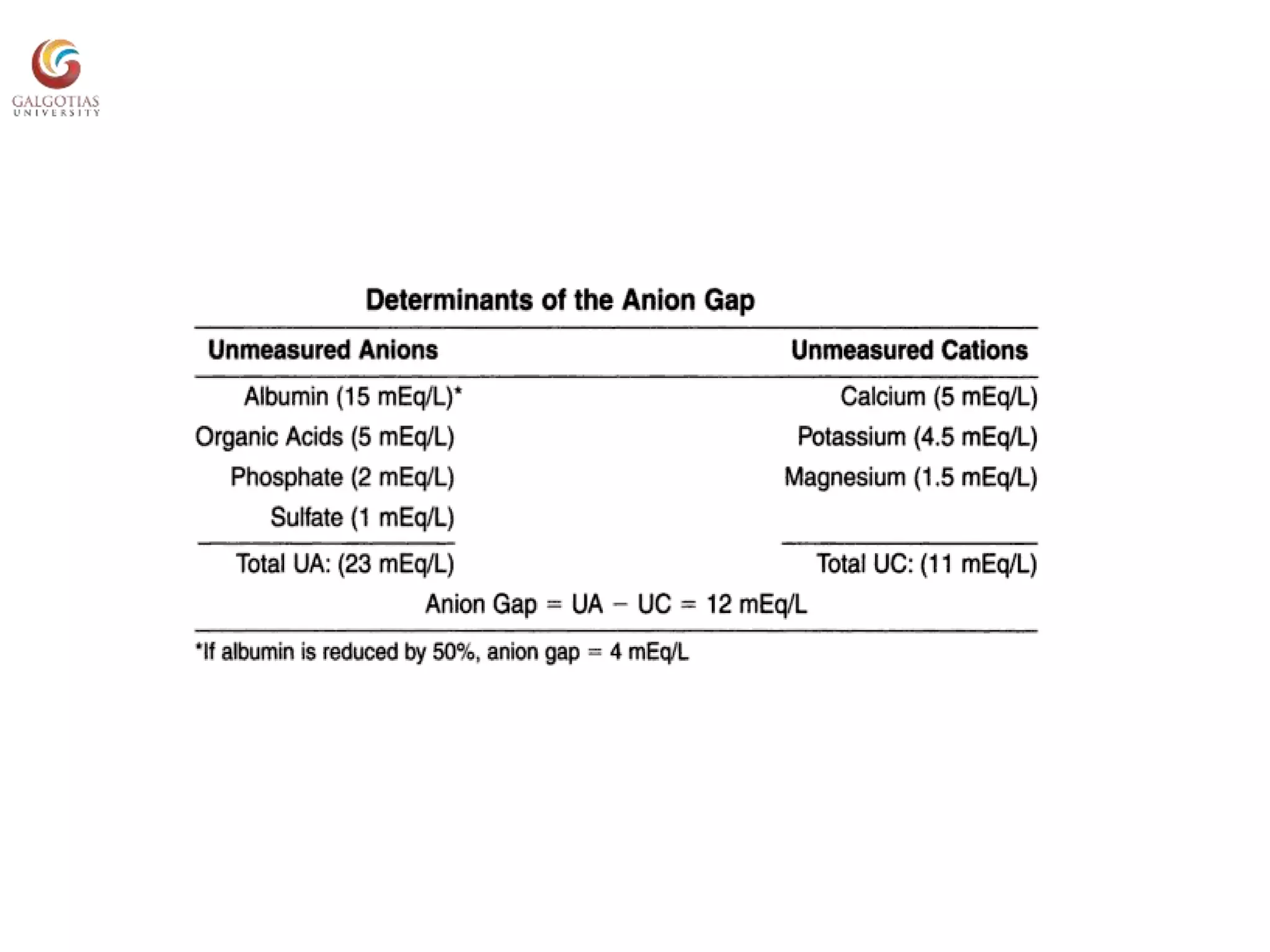
Serum Anion Gap
[Na+] - ([Cl-]+[HCO3
- ])
9 ± 3 mEq/L (mmol/L)
Serum Anion Gap
• Serum AG= Measured cations –
Measured anions
• Serum AG= Na - (Cl+HCO3)
• Serum AG= Unmeasured anions –
Unmeasured cations
HIGH SERUM ANION GAP
• increase in unmeasured anions
metabolic acidosis, hyperalbuminemia,
hyperphosphatemia, or overproduction of an
anionic paraprotein
• reduction in unmeasured cations
hypokalemia, hypocalcemia, hypomagnesemia
LOW SERUM ANION GAP
• Decrease in unmeasured anions
primarily due to hypoalbuminemia
• Increase in unmeasured cations
hyperkalemia, hypercalcemia,
hypermagnesemia, or severe litium intoxication
• Bromide ingestion
• serum protein electrophoresis should be
obtained to look for a cationic paraprotein that is
present in some patients with multiple myeloma
Urinary Anion Gap
UAG=( UNa + UK) – UCl
(-20) — (-50) mEq/L (NH4 +)
Metabolic Alkalosis
• Rise in HCO3
- concentration with rise in pH
• Compensatory response:
rise in pH causes decreased respiration,
increasing CO2
• raise the PCO2 by 0.7 mmHg for every 1 meq/L
elevation in the serum HCO3 concentration
GASTROINTESTINAL HYDROGEN LOSS
• Each meq of hydrogen lost generates one meq of
bicarbonate: the hydrogen ion is derived from water, while
the associated hydroxyl ion combines with carbon dioxide to
form bicarbonate
Development and maintenance of
metabolic alkalosis
• An elevation in the plasma bicarbonate
concentration due to hydrogen loss in the urine
or gastrointestinal tract, hydrogen movement
into the cells, the administration of bicarbonate,
or volume contraction around a relatively
constant amount of extracellular bicarbonate
(called a contraction alkalosis)
• A decrease in net renal bicarbonate excretion
(due both to enhanced reabsorption and reduced
secretion), since rapid excretion of the excess
bicarbonate would normally correct the alkalosis
Factors responsible for the rise in net
bicarbonate reabsorption
• Effective circulating volume depletion,
including reduced tissue perfusion in
edematous states such as congestive heart
failure and cirrhosis
• Chloride depletion and hypochloremia
• Hypokalemia
EFFECTIVE VOLUME DEPLETION
• Aldosterone directly enhances acidification by increasing the
activity of the H-ATPase pumps in the luminal membrane of the
intercalated cells. This pump promotes the secretion of hydrogen
ions into the tubular lumen, thereby increasing the reabsorption of
bicarbonate.
• Aldosterone-stimulated sodium reabsorption in the adjacent
principal cells makes the lumen electronegative due to the loss of
cationic sodium. This potential minimizes the passive back-diffusion
of hydrogen ions out of the lumen, allowing the urine to become
much more acid than the plasma.
• Decreased chloride delivery diminishes bicarbonate secretion in
the type B intercalated cells, which is thought to be an important
component of the normal renal response to a bicarbonate load.
CHLORIDE DEPLETION
• Vomiting
• Diuretic therapy ->hydrogen and chloride loss
• The hypochloremia can contribute to the reduction in
bicarbonate excretion by increasing distal
reabsorption and reducing distal secretion; this effect
of chloride may be more important than the
associated volume depletion
HYPOKALEMIA
• Hypokalemia directly increases bicarbonate
reabsorption
Respiratory Acidosis
• Rise in CO- concentration with fall in pH
• Compensatory response:
fall in pH causes increased renal H+ secretion,
raising HCO3
- concentration
Causes of Respiratory Acidosis
• İnhibition of respiratory drive
-opiates
-anesthetics
-sedatives
-central sleep apnea
-obesity
-central nervous system lesions
Causes of Respiratory Acidosis 2
• Disorders of respiratory muscles
1.Muscle weakness;
-myastenia gaves
-periodic paralysis
-aminoglycosides
-Guillan-Barre syndrom
-spinal cord injury
-acute lateral sclerosis
-multiple sclersis
2.Kyphoscoliosis
Causes of Respiratory Acidosis 3
• Upper airway obstruction
-obstructive sleep apnea
-laryngospasm
-aspiration
• Lung diseases
-pneumonia
-severe asthma
-pneumothorax
-acute respiratory disress syndrom
-chronic obsructive pulnmonery disease
-interstitial lung disease
Respiratory Alkalosis
• Fall in CO- concentration with rise in pH
• Compensatory response:
rise in pH causes diminished renal H+
secretion, lowering HCO3
- concentration
Causes of Respiratory Alkalosis
• Hypoxemia
1.Pulmonary disease
-pneumonia
-interstitial fibrosis
-emboli
-edema
2.Congestive heart failure
3.Anemia
Causes of Respiratory Alkalosis 2
• Stimulation of the medullary respiratory
center
-hyperventilation
-hepatic failure
-septicemia
-salycilate intoxication
-pregnancy
-neurologic disordrs
• Mechanical ventilation
Reference
• Goldman's Cecile Medicine, Goldman L, Schafer AI
• Case files Internal Medicine, Toy Patlan
• Current Medical Diagnosis and Treatment,
Maxine A. Papadakis, Stephen J. McPhee, Eds. Michael W. Rabow, Associate Ed.
• Current Diagnosis & Treatment: Nephrology &
Hypertension Edgar V. Lerma, Jeffrey S. Berns, Allen R. Nissenson
Acid base balance

Acid base balance

  • 1.
    MODULE 3 Topic: ACID –BASE BALANCE Sub code: MLT504 Sub Name: Medical Lab Technician -1 (T) Department: Department of MLT, SMAS Faculty: A. Vamsi Kumar Designation : Assistant professor
  • 2.
    Course outcomes • Providetechnical information about test results;
  • 3.
    LEARNİNG OBJECTİVES • Atthe end of this lecture, the student can be able to : 1. explain normal acid-base balance 2. explain buffers systems in regulation of pH 3. explain compensatory response to acid-base disorders 4. recognize metabolic acidosis 5. recognize metabolic alkalosis 6. recognize respiratory acidosis and alkalosis
  • 5.
    Normal Acid-Base Balance •Daily net acid production: 1mEq hydrogen ions(H+) per kilogram • H+: 0.0004 mEq/L (40nmol/L)= pH: 7.40 • Arterial pH:7.35-7.45 • İntracellular pH:7.0-7.3
  • 6.
    Buffer Systems inRegulation of pH • Extracellular fluid: - bicarbonate ion (HCO3 -) /carbonic acid H++HCO3 -⇔H2CO3 H2O + CO2 - plasma proteins - phosphate ions - Ca2+ and HCO3 - release of bone carbonic anhydrase
  • 7.
    Buffer Systems inRegulation of pH • İntracellular fluid - hemoglobin - cellular proteins - organophosphate complexes - HCO3 - by the H+/ HCO3 - transport mechanism
  • 8.
    Henderson-Hasselbach Equation • pH=6.1+log pH7.00 7.40 7.70 [H+] nmol/L 100 40 20 [HCO3- ] (mEq/L) 0.03XpCO2 (mm Hg)
  • 9.
    Normal Levels • pH:7.35-7.45 • pCO2: 37-45 mmHg • HCO3 - : 22-26 mEq/L
  • 10.
    pH • Acidosis <7.35-7.45>Alkalosis •HCO3 - ↑↓ → Metabolic •CO2 ↑↓ → Respiratory
  • 11.
    Compensatory response toacid-base disorders • Metabolic Acidosis/Alkalosis→ reducing / increasing CO2 • Respiratory Acidosis/Alkalosis→ renal secretion / reabsorption of HCO3 -/H+
  • 12.
    Metabolic Acidosis • Fallin HCO3 - concentration witt fall in pH • Compensatory response: fall in pH causes inreased respiration, reducing CO2 • 1.2 mmHg fall in arterial PCO2 for every 1 meq/L reduction in the serum HCO3 concentration
  • 13.
    Causes of MetabolicAcidosis • İncreases acid load (H+) • HCO3 - loses - extrarenal: gastrointestinal - renal • Decreased renal acid excretion
  • 16.
    Serum Anion Gap [Na+]- ([Cl-]+[HCO3 - ]) 9 ± 3 mEq/L (mmol/L)
  • 17.
    Serum Anion Gap •Serum AG= Measured cations – Measured anions • Serum AG= Na - (Cl+HCO3) • Serum AG= Unmeasured anions – Unmeasured cations
  • 19.
    HIGH SERUM ANIONGAP • increase in unmeasured anions metabolic acidosis, hyperalbuminemia, hyperphosphatemia, or overproduction of an anionic paraprotein • reduction in unmeasured cations hypokalemia, hypocalcemia, hypomagnesemia
  • 20.
    LOW SERUM ANIONGAP • Decrease in unmeasured anions primarily due to hypoalbuminemia • Increase in unmeasured cations hyperkalemia, hypercalcemia, hypermagnesemia, or severe litium intoxication • Bromide ingestion • serum protein electrophoresis should be obtained to look for a cationic paraprotein that is present in some patients with multiple myeloma
  • 22.
    Urinary Anion Gap UAG=(UNa + UK) – UCl (-20) — (-50) mEq/L (NH4 +)
  • 27.
    Metabolic Alkalosis • Risein HCO3 - concentration with rise in pH • Compensatory response: rise in pH causes decreased respiration, increasing CO2 • raise the PCO2 by 0.7 mmHg for every 1 meq/L elevation in the serum HCO3 concentration
  • 30.
    GASTROINTESTINAL HYDROGEN LOSS •Each meq of hydrogen lost generates one meq of bicarbonate: the hydrogen ion is derived from water, while the associated hydroxyl ion combines with carbon dioxide to form bicarbonate
  • 31.
    Development and maintenanceof metabolic alkalosis • An elevation in the plasma bicarbonate concentration due to hydrogen loss in the urine or gastrointestinal tract, hydrogen movement into the cells, the administration of bicarbonate, or volume contraction around a relatively constant amount of extracellular bicarbonate (called a contraction alkalosis) • A decrease in net renal bicarbonate excretion (due both to enhanced reabsorption and reduced secretion), since rapid excretion of the excess bicarbonate would normally correct the alkalosis
  • 32.
    Factors responsible forthe rise in net bicarbonate reabsorption • Effective circulating volume depletion, including reduced tissue perfusion in edematous states such as congestive heart failure and cirrhosis • Chloride depletion and hypochloremia • Hypokalemia
  • 33.
    EFFECTIVE VOLUME DEPLETION •Aldosterone directly enhances acidification by increasing the activity of the H-ATPase pumps in the luminal membrane of the intercalated cells. This pump promotes the secretion of hydrogen ions into the tubular lumen, thereby increasing the reabsorption of bicarbonate. • Aldosterone-stimulated sodium reabsorption in the adjacent principal cells makes the lumen electronegative due to the loss of cationic sodium. This potential minimizes the passive back-diffusion of hydrogen ions out of the lumen, allowing the urine to become much more acid than the plasma. • Decreased chloride delivery diminishes bicarbonate secretion in the type B intercalated cells, which is thought to be an important component of the normal renal response to a bicarbonate load.
  • 34.
    CHLORIDE DEPLETION • Vomiting •Diuretic therapy ->hydrogen and chloride loss • The hypochloremia can contribute to the reduction in bicarbonate excretion by increasing distal reabsorption and reducing distal secretion; this effect of chloride may be more important than the associated volume depletion
  • 35.
    HYPOKALEMIA • Hypokalemia directlyincreases bicarbonate reabsorption
  • 41.
    Respiratory Acidosis • Risein CO- concentration with fall in pH • Compensatory response: fall in pH causes increased renal H+ secretion, raising HCO3 - concentration
  • 43.
    Causes of RespiratoryAcidosis • İnhibition of respiratory drive -opiates -anesthetics -sedatives -central sleep apnea -obesity -central nervous system lesions
  • 44.
    Causes of RespiratoryAcidosis 2 • Disorders of respiratory muscles 1.Muscle weakness; -myastenia gaves -periodic paralysis -aminoglycosides -Guillan-Barre syndrom -spinal cord injury -acute lateral sclerosis -multiple sclersis 2.Kyphoscoliosis
  • 45.
    Causes of RespiratoryAcidosis 3 • Upper airway obstruction -obstructive sleep apnea -laryngospasm -aspiration • Lung diseases -pneumonia -severe asthma -pneumothorax -acute respiratory disress syndrom -chronic obsructive pulnmonery disease -interstitial lung disease
  • 46.
    Respiratory Alkalosis • Fallin CO- concentration with rise in pH • Compensatory response: rise in pH causes diminished renal H+ secretion, lowering HCO3 - concentration
  • 47.
    Causes of RespiratoryAlkalosis • Hypoxemia 1.Pulmonary disease -pneumonia -interstitial fibrosis -emboli -edema 2.Congestive heart failure 3.Anemia
  • 48.
    Causes of RespiratoryAlkalosis 2 • Stimulation of the medullary respiratory center -hyperventilation -hepatic failure -septicemia -salycilate intoxication -pregnancy -neurologic disordrs • Mechanical ventilation
  • 50.
    Reference • Goldman's CecileMedicine, Goldman L, Schafer AI • Case files Internal Medicine, Toy Patlan • Current Medical Diagnosis and Treatment, Maxine A. Papadakis, Stephen J. McPhee, Eds. Michael W. Rabow, Associate Ed. • Current Diagnosis & Treatment: Nephrology & Hypertension Edgar V. Lerma, Jeffrey S. Berns, Allen R. Nissenson