CONCEPT OF PH AND BUFFER
SYSTEMS IN THE BODY
LEARNING OBJECTIVES
Acid
Base
PH
Mechanism which regulate pH
Henderson–hasselbalch equation
 Acid base buffer mechanism
 Respiratory mechanism
 Renal mechanism
 Respiratory acidosis or alkalosis
 Metabolic acidosis why does it occurs
in diabetes mellitus ?
REGULATION OF pH OF BODY FLUIDS
ACID & BASE
Acid is a molecule or an ion that can function as a proton donor.
Base is the molecule or an ion that can function as a proton
acceptor.
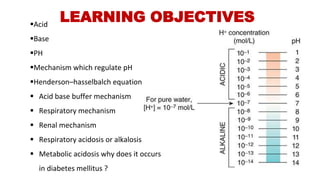
pH
pH is negative log of H+ ion concentration.
Normal pH of arterial blood is 7.4 and that of venous blood and
interstitial fl uid is 7.35. pH of intracellular fl uid is 7 (varies from 6
to 7.4).
pH=log1/H⁺ (where H⁺ is the hydrogen ion concentration or proton)
ALKALOSIS AND ACIDOSIS
An increase in pH causes alkalosis and
decrease in pH causes acidosis
WHY PH SHOULD BE
MAINTAINED NORMALLY?
(a) Slight changes in H+ ion concentration causes
marked alteration in the rates of chemical reactions
in the cells.
(b) Acidosis depresses the neurons leading to coma
whereas alkalosis excites the neurons leading to
convulsions. Alkalosis also causes tetany. Thus
changes in pH can be lethal. pH of body fluids must
be maintained.
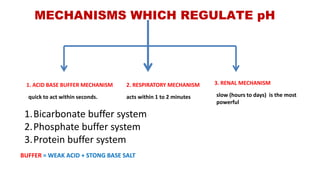
MECHANISMS WHICH REGULATE pH
1. ACID BASE BUFFER MECHANISM 2. RESPIRATORY MECHANISM 3. RENAL MECHANISM
1.Bicarbonate buffer system
2.Phosphate buffer system
3.Protein buffer system
quick to act within seconds. acts within 1 to 2 minutes slow (hours to days) is the most
powerful
BUFFER = WEAK ACID + STONG BASE SALT
HENDERSON–HASSELBALCH
EQUATION.
pH = pK + log × HCO3/ CO2
According to this increase in HCO3 on concentration
causes pH to rise and increase in dissolved CO2 causes
pH to decrease.
SOURCES OF HYDROGEN ION
GAIN IN THE BODY
H+ ions are gained in the body as follows:
 Generation of hydrogen ions from CO2.
 Production of acids during metabolism of
proteins and other organic molecules.
 Gain of H+ ions due to loss of bicarbonate
ions in stool (as in diarrhea) or in urine.
WAYS IN WHICH H+ IONS ARE
LOST FROM THE BODY
Loss of H+ ions occurs due to:
1. Loss of H+ ions in vomitus when there is
severe vomiting.
2. Loss of H+ ions in urine.
MECHANISM BY WHICH H+ IONS
ARE SECRETED BY RENAL TUBULES
(DCT)
MECHANISM BY WHICH H+ IONS
ARE SECRETED BY RENAL TUBULES
(PCT)
FACTOR ON WHICH THE RATE OF SECRETION
OF H+ IONS DEPENDS? NORMAL RATE OF
SECRETION OF H+ IONS?
1. The rate of secretion of H+ ions changes
with changes in extracellular fluid
hydrogen ion concentration and CO2
concentration.
2. Normal rate of secretion of H+ ions is
about 4400 mEq/day.
NORMAL RATE OF FILTRATION OF HCO3
– IONS?
•The normal rate of HCO3- ions filtered in the glomerular filtrate is
4,320 mEq/day.
•Thus it is almost equal to the rate of H+ ion secretion and hence it is
said that bicarbonate ions and hydrogen ions normally titrate each
other in the tubules.
• As there is a slight excess of H+ ions in tubular fluid they are
excreted in urine.
• This is essential for excretion of non-volatile end products of
metabolism.
I. ACID BASE BUFFER MECHANISM
1. BICARBONATE BUFFERING SYSTEM
2.PHASPHATE BUFFERING SYSTEM
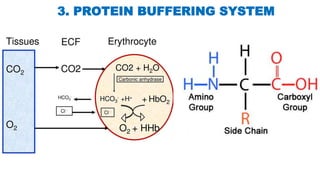
3. PROTEIN BUFFERING SYSTEM
II. RESPIRATORY MECHANISM
III. RENAL MECHANISM
1.In presence of acidosis, kidneys excrete hydrogen ions and
retain bicarbonate ions.
2.In case of metabolic acidosis, Kidneys play an important role in
preventing metabolic acidosis, by excreting excess H + ions.
3.It is gain done by 3 methods
a.Bicarbonate mechanism
b.Phosphate mechanism
c. Ammonia Mechanism
A. BICARBONATE MECHANISM
B. PHOSPHATE MECHANISM
C. AMMONIA MECHANISM
Ammonia generated within the tubular cells from glutamate
It is transported to the tubular lumen in exchange of Na+
The hudrogen that is normally excretwd combines with ammoia to form
ammonium
Thus for each molecule of ammoia formed one H+ Excreted and HCO3
retained
RESPIRATORY ACIDOSIS OR
ALKALOSIS
Acidosis or alkalosis caused due to
decreased or increased pulmonary
ventilation (resulting into decreased
and increased CO2 loss respectively)
is called respiratory acidosis or
alkalosis.
RESPIRATORY ACIDOSIS OR
ALKALOSIS
Respiratory acidosis is caused due to pathological
conditions causing reduced breathing.
e.g. obstruction in respiratory passage, pneumonia,
etc.
Respiratory alkalosis is caused due to increased
pulmonary ventilation which rarely occurs
pathologically. Physiologic type of respiratory
alkalosis is produced when person ascends to high
altitude.
METABOLIC ACIDOSIS OR
ALKALOSIS
Metabolic acidosis or alkalosis refers to all
other abnormalities of acid-base balance
besides caused by excess or insufficient
CO2 in the body.
METABOLIC ACIDOSIS
The causes are:
1. Failure of kidneys to excrete acids normally formed in the body.
2. Formation of excess quantity of metabolic acids in the body.
3. Intravenous administration of metabolic acids.
4. Addition of metabolic acids by absorption from gastrointestinal
tract.
5. Loss of base from the body fluids.
6. Metabolic acidosis occurs in diabetes mellitus, uraemia,
and diarrhoea.
METABOLIC ACIDOSIS WHY DOES IT
OCCURS IN DIABETES MELLITUS ?
DIABETIS KETO ACIDOSIS:
It is a complication of type 1 diabetes or insulin dependent diabetes
It is potentially fatal
In this type there is absolute deficiency of insulin
It is characterized by increased ketones in the body.
PATHOPHYSIOLOGY: It is precipitated by a stress or an infection
which causes excess counter regulatory hormones in blood.
METABOLIC ACIDOSIS WHY DOES IT
OCCURS IN DIABETES MELLITUS ?
CAUSES OF METABOLIC ALKALOSIS
The causes of metabolic alkalosis are:
 Administration of diuretics.
 Excessive ingestion of alkaline drugs such as sodium bicarbonate.
 Loss of chloride ions due to excessive vomiting of mainly gastric
contents.
 Excessive aldosterone secretion.
Ph & Buffer systemby dr ambareeshapptx

Ph & Buffer systemby dr ambareeshapptx

  • 1.
    CONCEPT OF PHAND BUFFER SYSTEMS IN THE BODY
  • 2.
    LEARNING OBJECTIVES Acid Base PH Mechanism whichregulate pH Henderson–hasselbalch equation  Acid base buffer mechanism  Respiratory mechanism  Renal mechanism  Respiratory acidosis or alkalosis  Metabolic acidosis why does it occurs in diabetes mellitus ?
  • 3.
    REGULATION OF pHOF BODY FLUIDS ACID & BASE Acid is a molecule or an ion that can function as a proton donor. Base is the molecule or an ion that can function as a proton acceptor. pH pH is negative log of H+ ion concentration. Normal pH of arterial blood is 7.4 and that of venous blood and interstitial fl uid is 7.35. pH of intracellular fl uid is 7 (varies from 6 to 7.4). pH=log1/H⁺ (where H⁺ is the hydrogen ion concentration or proton)
  • 4.
    ALKALOSIS AND ACIDOSIS Anincrease in pH causes alkalosis and decrease in pH causes acidosis
  • 5.
    WHY PH SHOULDBE MAINTAINED NORMALLY? (a) Slight changes in H+ ion concentration causes marked alteration in the rates of chemical reactions in the cells. (b) Acidosis depresses the neurons leading to coma whereas alkalosis excites the neurons leading to convulsions. Alkalosis also causes tetany. Thus changes in pH can be lethal. pH of body fluids must be maintained.
  • 6.
    MECHANISMS WHICH REGULATEpH 1. ACID BASE BUFFER MECHANISM 2. RESPIRATORY MECHANISM 3. RENAL MECHANISM 1.Bicarbonate buffer system 2.Phosphate buffer system 3.Protein buffer system quick to act within seconds. acts within 1 to 2 minutes slow (hours to days) is the most powerful BUFFER = WEAK ACID + STONG BASE SALT
  • 7.
    HENDERSON–HASSELBALCH EQUATION. pH = pK+ log × HCO3/ CO2 According to this increase in HCO3 on concentration causes pH to rise and increase in dissolved CO2 causes pH to decrease.
  • 8.
    SOURCES OF HYDROGENION GAIN IN THE BODY H+ ions are gained in the body as follows:  Generation of hydrogen ions from CO2.  Production of acids during metabolism of proteins and other organic molecules.  Gain of H+ ions due to loss of bicarbonate ions in stool (as in diarrhea) or in urine.
  • 9.
    WAYS IN WHICHH+ IONS ARE LOST FROM THE BODY Loss of H+ ions occurs due to: 1. Loss of H+ ions in vomitus when there is severe vomiting. 2. Loss of H+ ions in urine.
  • 10.
    MECHANISM BY WHICHH+ IONS ARE SECRETED BY RENAL TUBULES (DCT)
  • 11.
    MECHANISM BY WHICHH+ IONS ARE SECRETED BY RENAL TUBULES (PCT)
  • 12.
    FACTOR ON WHICHTHE RATE OF SECRETION OF H+ IONS DEPENDS? NORMAL RATE OF SECRETION OF H+ IONS? 1. The rate of secretion of H+ ions changes with changes in extracellular fluid hydrogen ion concentration and CO2 concentration. 2. Normal rate of secretion of H+ ions is about 4400 mEq/day.
  • 13.
    NORMAL RATE OFFILTRATION OF HCO3 – IONS? •The normal rate of HCO3- ions filtered in the glomerular filtrate is 4,320 mEq/day. •Thus it is almost equal to the rate of H+ ion secretion and hence it is said that bicarbonate ions and hydrogen ions normally titrate each other in the tubules. • As there is a slight excess of H+ ions in tubular fluid they are excreted in urine. • This is essential for excretion of non-volatile end products of metabolism.
  • 14.
    I. ACID BASEBUFFER MECHANISM 1. BICARBONATE BUFFERING SYSTEM
  • 15.
  • 16.
  • 17.
  • 18.
    III. RENAL MECHANISM 1.Inpresence of acidosis, kidneys excrete hydrogen ions and retain bicarbonate ions. 2.In case of metabolic acidosis, Kidneys play an important role in preventing metabolic acidosis, by excreting excess H + ions. 3.It is gain done by 3 methods a.Bicarbonate mechanism b.Phosphate mechanism c. Ammonia Mechanism
  • 19.
  • 20.
  • 21.
    C. AMMONIA MECHANISM Ammoniagenerated within the tubular cells from glutamate It is transported to the tubular lumen in exchange of Na+ The hudrogen that is normally excretwd combines with ammoia to form ammonium Thus for each molecule of ammoia formed one H+ Excreted and HCO3 retained
  • 22.
    RESPIRATORY ACIDOSIS OR ALKALOSIS Acidosisor alkalosis caused due to decreased or increased pulmonary ventilation (resulting into decreased and increased CO2 loss respectively) is called respiratory acidosis or alkalosis.
  • 23.
    RESPIRATORY ACIDOSIS OR ALKALOSIS Respiratoryacidosis is caused due to pathological conditions causing reduced breathing. e.g. obstruction in respiratory passage, pneumonia, etc. Respiratory alkalosis is caused due to increased pulmonary ventilation which rarely occurs pathologically. Physiologic type of respiratory alkalosis is produced when person ascends to high altitude.
  • 24.
    METABOLIC ACIDOSIS OR ALKALOSIS Metabolicacidosis or alkalosis refers to all other abnormalities of acid-base balance besides caused by excess or insufficient CO2 in the body.
  • 25.
    METABOLIC ACIDOSIS The causesare: 1. Failure of kidneys to excrete acids normally formed in the body. 2. Formation of excess quantity of metabolic acids in the body. 3. Intravenous administration of metabolic acids. 4. Addition of metabolic acids by absorption from gastrointestinal tract. 5. Loss of base from the body fluids. 6. Metabolic acidosis occurs in diabetes mellitus, uraemia, and diarrhoea.
  • 26.
    METABOLIC ACIDOSIS WHYDOES IT OCCURS IN DIABETES MELLITUS ? DIABETIS KETO ACIDOSIS: It is a complication of type 1 diabetes or insulin dependent diabetes It is potentially fatal In this type there is absolute deficiency of insulin It is characterized by increased ketones in the body. PATHOPHYSIOLOGY: It is precipitated by a stress or an infection which causes excess counter regulatory hormones in blood.
  • 27.
    METABOLIC ACIDOSIS WHYDOES IT OCCURS IN DIABETES MELLITUS ?
  • 28.
    CAUSES OF METABOLICALKALOSIS The causes of metabolic alkalosis are:  Administration of diuretics.  Excessive ingestion of alkaline drugs such as sodium bicarbonate.  Loss of chloride ions due to excessive vomiting of mainly gastric contents.  Excessive aldosterone secretion.