

Creativity and
Design
Day 1: Basics of product design
Day 1: Creativity and Design
The objective of this course is to introduce students to the
basics of product design, including issues relating to product
form and function, as well as aesthetics and experience.
Students will learn how to integrate creative ideas into
product designs that would appeal to consumers. Cutting edge
and relevant issues in product designs will be discussed.
Special emphasis will also be placed on examining product
designs in an Asian cultural context.
From: http://www.aci-institute.com/index.php/web/master_program/ProgStructure/5/104
Basics of product design
Objectives:
1. to (re)define what is design and its value for businesses
2. to identify the key elements of the design process
3. to evaluate approaches to initiate and carry design
4. to put into practice basic elements of design
5. to distinguish the basics of product design in Asia
Word Association: Creativity
What 3 words come instantly in your mind?
Creativity
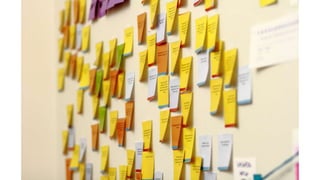
Write each word on a separate sticky note and paste it in
alphabetical order on the board.
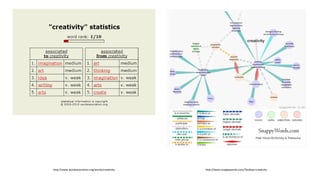
http://www.wordassociation.org/words/creativity http://www.snappywords.com/?lookup=creativity
Word Association: Design
What 3 words come instantly in your mind?
Design
Write each word on a separate sticky note and paste it in
alphabetical order on the board.
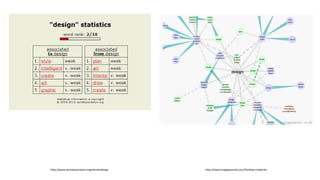
http://www.wordassociation.org/words/design http://www.snappywords.com/?lookup=creativity
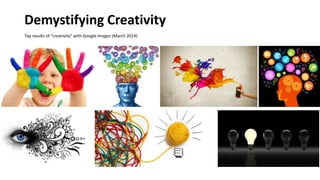
Demystifying Creativity
Top results of “creativity” with Google Images (March 2014)
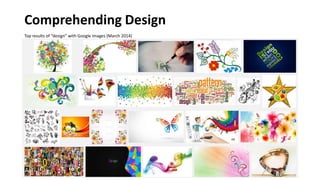
Comprehending Design
Top results of “design” with Google Images (March 2014)
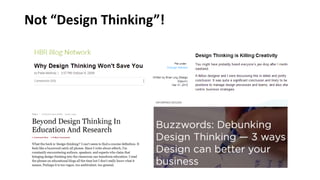
Not “Design Thinking”!
Introductions and expectations
-Break-
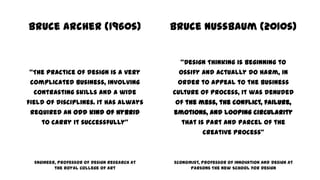
Bruce Archer (1960s)
“The practice of design is a very
complicated business, involving
contrasting skills and a wide
field of disciplines. It has always
required an odd kind of hybrid
to carry it successfully”
Engineer, Professor of Design Research at
the Royal College of Art
Bruce Nussbaum (2010s)
“Design Thinking is beginning to
ossify and actually do harm, in
order to appeal to the business
culture of process, it was denuded
of the mess, the conflict, failure,
emotions, and looping circularity
that is part and parcel of the
creative process”
Economist, Professor of Innovation and Design at
Parsons The New School for Design
What is Design?
ICSID: http://www.youtube.com/watch?v=d3hJcnWKezk
Dyson Foundation: http://www.youtube.com/watch?v=SD6d8Em8q5A
Roger Martin: https://www.youtube.com/watch?v=rLjj1MWX0bY
Where
http://rfa.itwin.com
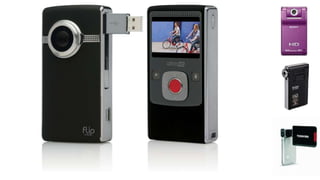
http://inspirationfeed.com/inspiration/55-creative-examples-of-usb-designs/
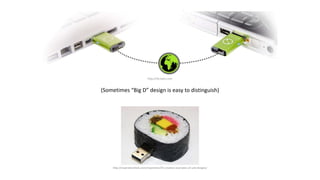
(Sometimes “Big D” design is easy to distinguish)
http://inspirationfeed.com/inspiration/55-creative-examples-of-usb-designs/
http://www.trendhunter.com/trends/vilnvixn-intelligent-accessories
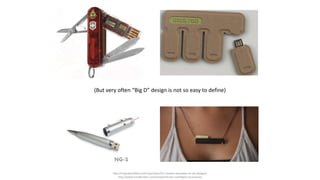
(But very often “Big D” design is not so easy to define)
http://inspirationfeed.com/inspiration/55-creative-examples-of-usb-designs/
http://www.trendhunter.com/trends/vilnvixn-intelligent-accessories
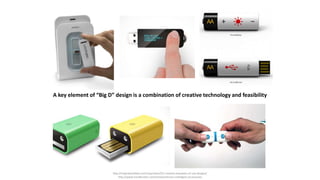
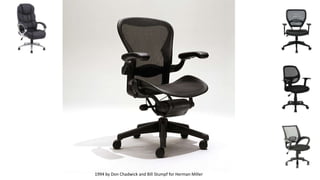
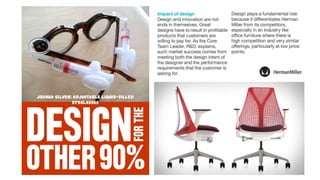
A key element of “Big D” design is a combination of creative technology and feasibility
1994 by Don Chadwick and Bill Stumpf for Herman Miller
Joshua Silver: Adjustable liquid-filled
eyeglasses
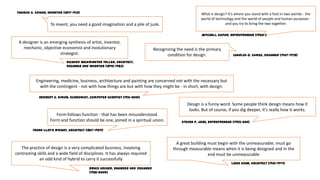
A great building must begin with the unmeasurable, must go
through measurable means when it is being designed and in the
end must be unmeasurable
Louis Kahn, architect (1901-1974)
Design is a funny word. Some people think design means how it
looks. But of course, if you dig deeper, it's really how it works.
Steven P. Jobs, entrepreneur (1955-2011)
Recognizing the need is the primary
condition for design. Charles O. Eames, designer (1907-1978)
What is design? It's where you stand with a foot in two worlds - the
world of technology and the world of people and human purposes -
and you try to bring the two together.
Mitchell Kapor, entrepreneur (1950-)
To invent, you need a good imagination and a pile of junk.
Thomas A. Edison, inventor (1847-1931)
A designer is an emerging synthesis of artist, inventor,
mechanic, objective economist and evolutionary
strategist.
Richard Buckminster Fuller, architect,
designer and inventor (1895-1983)
Engineering, medicine, business, architecture and painting are concerned not with the necessary but
with the contingent - not with how things are but with how they might be - in short, with design.
Herbert A. Simon, economist, computer scientist (1916-2001)
Form follows function - that has been misunderstood.
Form and function should be one, joined in a spiritual union.
Frank Lloyd Wright, architect (1867-1959)
The practice of design is a very complicated business, involving
contrasting skills and a wide field of disciplines. It has always required
an odd kind of hybrid to carry it successfully
Bruce Archer, engineer and designer
(1922-2005)
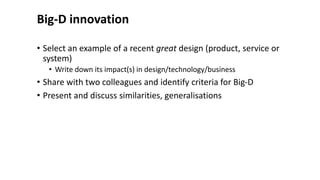
Big-D innovation
• Select an example of a recent great design (product, service or
system)
• Write down its impact(s) in design/technology/business
• Share with two colleagues and identify criteria for Big-D
• Present and discuss similarities, generalisations
Steve Jobs: One Person, One Computer (1980)
http://youtu.be/0lvMgMrNDlg?t=2m23s
02:23 – 13:05
“We had absolutely no idea that people would do
that…”
“We had some feeling that we were on to
something…”
“We are just starting to get the glimmerings of where
it’s going to go…”
“Our whole company, our whole philosophical base is
founded on one principle…”
“Right now if you buy a computer system and you want
to solve one of your problems, we immediately throw a
big problem right in the middle of you and your
problem”
http://boscutti.com/2013/02/24/boscuttis-steve-jobs-scene-12/
A
B
C
F K N R
S
http://www.goldcoastmodela.com/Early_Ford.pdf
http://www.mtfca.com/discus/messages/331880/347933.html?1363551928
http://25.media.tumblr.com/935fa0bd19cd7f4edfcb7528cffd21ad/tumblr_mga6unWcNt1rgmlf9o1_1280.jpg
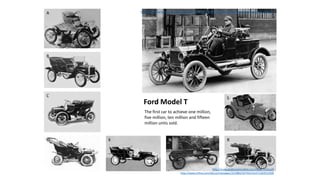
Ford Model T
The first car to achieve one million,
five million, ten million and fifteen
million units sold.
Henry Ford: “People seem to think that the big thing is the
factory or the store or the financial backing or the
management. The big thing is the product, and any hurry in
getting into fabrication before designs are completed is just
so much waste time. I spent twelve years before I had a
Model T that suited me.
I designed eight models in all before "Model T." They were:
"Model A," "Model B," "Model C," "Model F," "Model N,"
"Model R," "Model S," and "Model K."”
http://www.gutenberg.org/cache/epub/7213/pg7213.html
61:30 video: http://blog.intelligent.ly/2013/02/seth-godin-video/
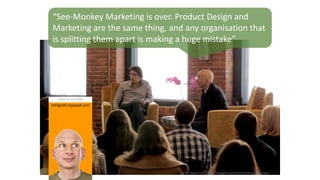
“See-Monkey Marketing is over. Product Design and
Marketing are the same thing, and any organisation that
is splitting them apart is making a huge mistake”
sethgodin.typepad.com
-Break-
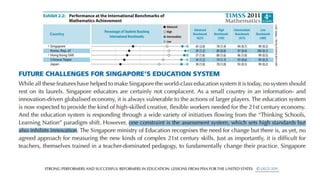
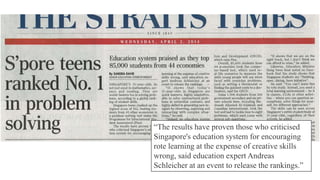
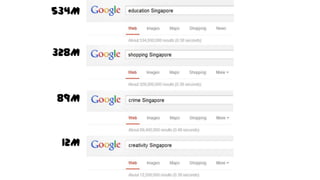
“The results have proven those who criticised
Singapore's education system for encouraging
rote learning at the expense of creative skills
wrong, said education expert Andreas
Schleicher at an event to release the rankings.”
534M
328M
89M
12M
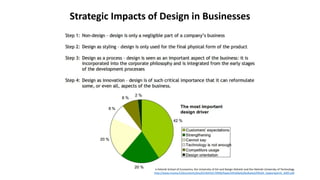
Strategic Impacts of Design in Businesses
e Helsinki School of Economics, the University of Art and Design Helsinki and the Helsinki University of Technology
http://www.muova.fi/documents/key20130416170946/Raportit%20ja%20julkaisut/MUSA_loppuraportti_2005.pdf
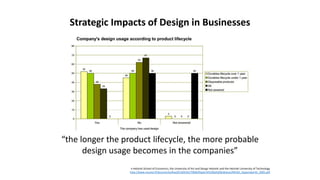
Strategic Impacts of Design in Businesses
e Helsinki School of Economics, the University of Art and Design Helsinki and the Helsinki University of Technology
http://www.muova.fi/documents/key20130416170946/Raportit%20ja%20julkaisut/MUSA_loppuraportti_2005.pdf
“the longer the product lifecycle, the more probable
design usage becomes in the companies”
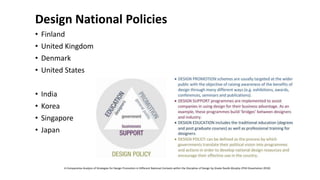
Design National Policies
• Finland
• United Kingdom
• Denmark
• United States
• India
• Korea
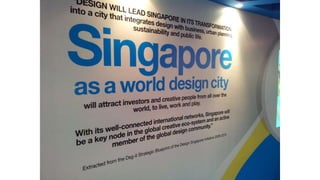
• Singapore
• Japan
A Comparative Analysis of Strategies for Design Promotion in Different National Contexts within the Discipline of Design by Gisele Raulik-Murphy (PhD Dissertation 2010)
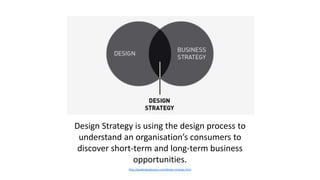
Design Strategy is using the design process to
understand an organisation’s consumers to
discover short-term and long-term business
opportunities.
http://gsadesignglossary.com/design-strategy.html
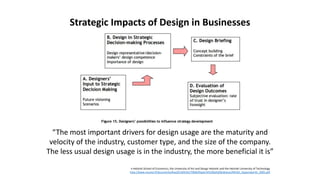
Strategic Impacts of Design in Businesses
e Helsinki School of Economics, the University of Art and Design Helsinki and the Helsinki University of Technology
http://www.muova.fi/documents/key20130416170946/Raportit%20ja%20julkaisut/MUSA_loppuraportti_2005.pdf
“The most important drivers for design usage are the maturity and
velocity of the industry, customer type, and the size of the company.
The less usual design usage is in the industry, the more beneficial it is”
http://www.dubberly.com/wp-content/uploads/2012/11/Dubberly_Jobs-and-Ive.pdf
TheDesignExperience:TheRoleofDesignandDesignersintheTwenty-firstCentury
eHelsinkiSchoolofEconomics,theUniversityofArtandDesignHelsinkiandtheHelsinkiUniversityofTechnology
http://www.muova.fi/documents/key20130416170946/Raportit%20ja%20julkaisut/MUSA_loppuraportti_2005.pdf
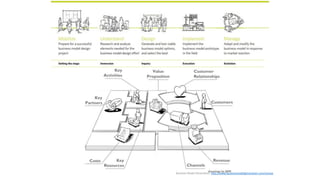
Business Model Generation: http://www.businessmodelgeneration.com/canvas
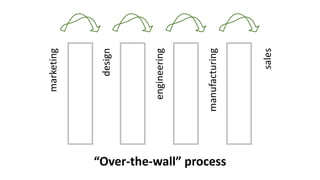
marketing
design
engineering
manufacturing
sales
“Over-the-wall” process
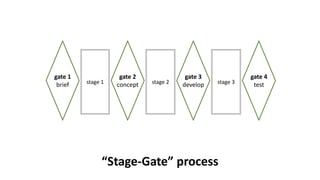
“Stage-Gate” process
stage 1 stage 2 stage 3
gate 1
brief
gate 2
concept
gate 3
develop
gate 4
test
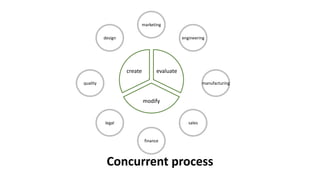
Concurrent process
marketing
evaluatecreate
modify
design engineering
finance
legal sales
quality manufacturing
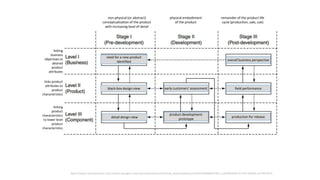
need for a new product
identified
black-box design view
detail design view
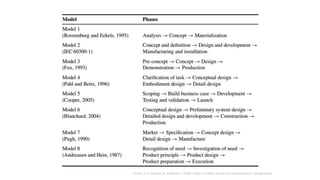
product development:
prototype
early customers’ assessment
production for release
field performance
overall business perspective
New Product Development: http://www.springer.com/cda/content/document/cda_downloaddocument/9781848002708-c1.pdf?SGWID=0-0-45-559603-p173817911
non-physical (or abstract)
conceptualization of the product
with increasing level of detail
physical embodiment
of the product
remainder of the product life
cycle (production, sale, use)
linking
business
objectives to
desired
product
attributes
links product
attributes to
product
characteristics
linking
product
characteristics
to lower level
product
characteristics
The innovation process by: http://www.tuhh.de/tim/downloads/arbeitspapiere/Arbeitspapier_4.pdf
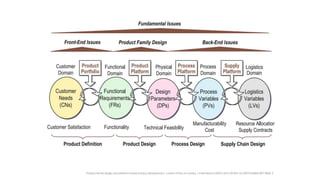
Product family design and platform-based product development: a state-of-the-art review. J Intell Manuf (2007) 18:5–29 DOI 10.1007/s10845-007-0003-2
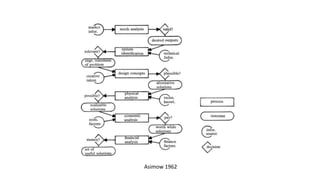
Asimow 1962
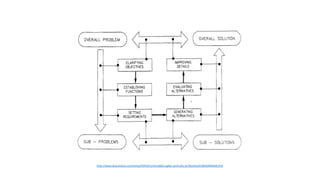
http://www.alvarestech.com/temp/PDP2011/emc6605.ogliari.prof.ufsc.br/Restrito/EVBUOMWAM.PDF
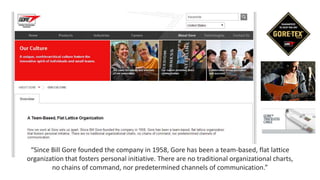
“Since Bill Gore founded the company in 1958, Gore has been a team-based, flat lattice
organization that fosters personal initiative. There are no traditional organizational charts,
no chains of command, nor predetermined channels of communication.”
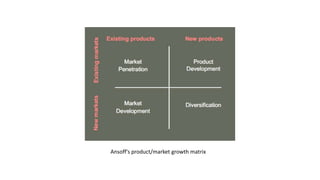
Ansoff's product/market growth matrix
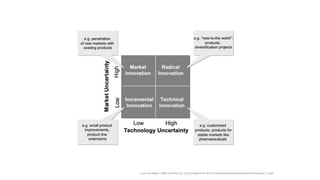
Lynn and Akgun 1998/ modified by: http://www.tuhh.de/tim/downloads/arbeitspapiere/Arbeitspapier_4.pdf
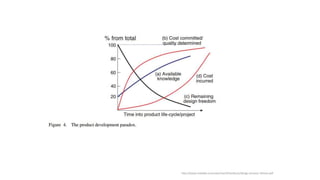
http://www.maelabs.ucsd.edu/mae3/handouts/design-process-Ullman.pdf
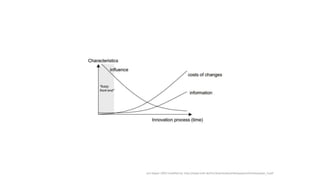
von Hippel 1993/ modified by: http://www.tuhh.de/tim/downloads/arbeitspapiere/Arbeitspapier_4.pdf
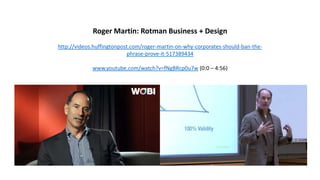
Roger Martin: Rotman Business + Design
http://videos.huffingtonpost.com/roger-martin-on-why-corporates-should-ban-the-
phrase-prove-it-517389434
www.youtube.com/watch?v=fNgBRcp0u7w (0:0 – 4:56)
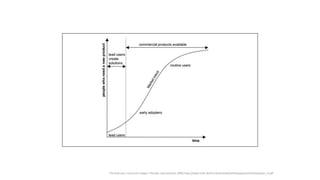
The lead user curve (von Hippel, Thomke, and Sonnack 1999) http://www.tuhh.de/tim/downloads/arbeitspapiere/Arbeitspapier_4.pdf
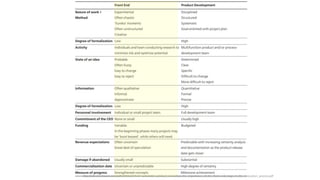
http://cdn.intechopen.com/pdfs/43555/InTech-Sustainable_product_innovation_the_importance_of_the_front_end_stage_in_the_innovation_process.pdf
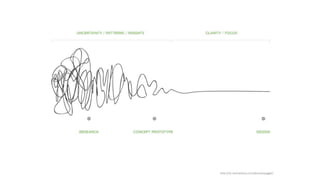
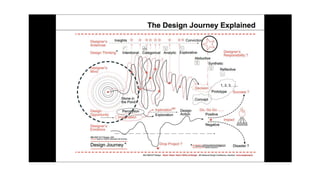
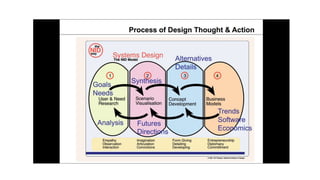
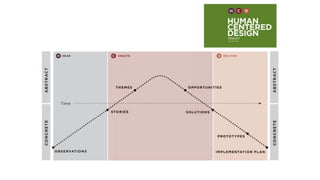
http://v2.centralstory.com/about/squiggle/
Murthy, D. P., Rausand, M., & Østerås, T. (2008). Product reliability: specification and performance. Springerverlag.
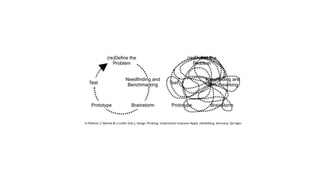
H Plattner, C Meinel & LJ Leifer (Eds.), Design Thinking: Understand–Improve–Apply. Heidelberg, Germany: Springer.
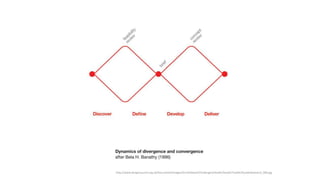
http://www.designcouncil.org.uk/Documents/Images/Our%20work/Challenges/Health/AandE/Toolkit/DoubleDiamond_580.jpg
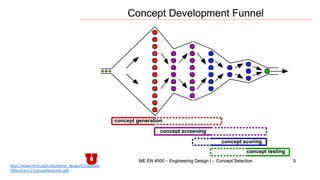
http://www.mech.utah.edu/senior_design/07/uploads
/Main/Lect12-ConceptSelection.pdf
Funnel –key ideas
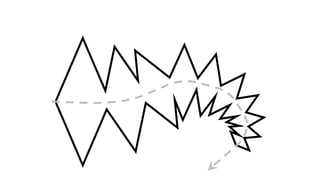
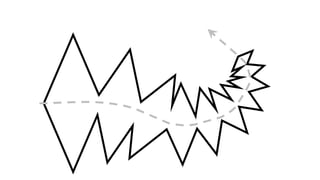
1. Temporary choices: Overall process is convergent (hence funnel),
but relies heavily on divergent decision-making
2. Successive approximations: Problem-solution coevolve together
3. Ideas are not light bulbs: Eureka! is less having the idea, and more
understanding it
4. Clear vision: but remain flexible (pivoting)
5. No right/wrong responses, but more/less appropriate
6. Abductive reasoning: ban the phrase “prove it!”
7. F4: Fail early, fail cheap, fail often, fail different
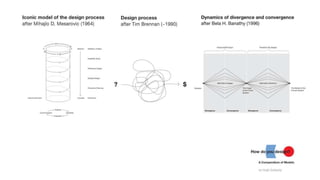
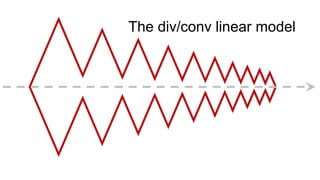
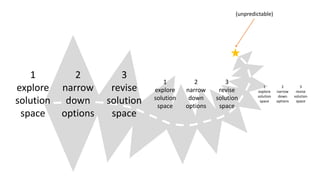
The div/conv linear model
1
explore
solution
space
2
narrow
down
options
3
revise
solution
space
1
explore
solution
space
2
narrow
down
options
3
revise
solution
space
1
explore
solution
space
2
narrow
down
options
3
revise
solution
space
(unpredictable)
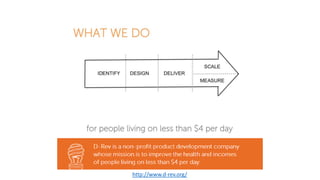
http://www.d-rev.org/
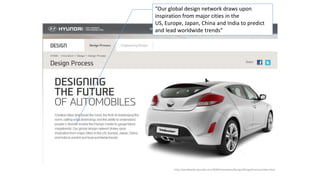
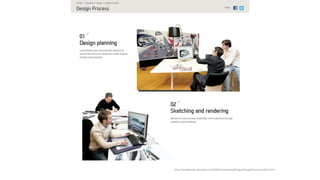
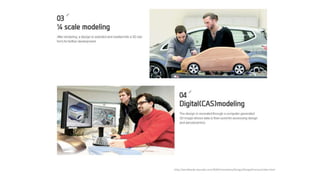
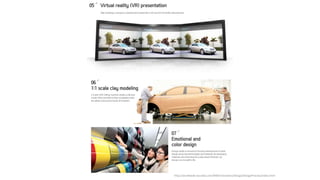
http://worldwide.hyundai.com/WW/Innovation/Design/DesignProcess/index.html
“Our global design network draws upon
inspiration from major cities in the
US, Europe, Japan, China and India to predict
and lead worldwide trends”
http://worldwide.hyundai.com/WW/Innovation/Design/DesignProcess/index.html
http://www.electrolux.com.sg/Innovation/Inside/Meet-the-designers/KIM-LIM/
http://www.kia.com/worldwide/experience-kia/design/
http://www.jamesdysonfoundation.com/design/process.asp
http://www.huffingtonpost.com/darby-roach/behind-the-scenes-at-nike_b_818132.html
http://www.zurb.com/word/design-processhttp://dm9barcelona.wordpress.com/2012/03/15/understanding-zaras-success/
http://www.design.philips.com/sites/philipsdesign/about/design/aboutus/approach/index.page
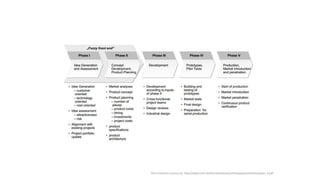
“Fuzzy Front End” Activity
• Make a quick diagram of the New Product Development process in
your company
• What has been your role in the ‘Fuzzy Front End’?
• Trigger insightful questions throughout the process
• Translator between different areas (costumers, technology, design)
• Raise awareness of needs and opportunities
• Facilitate processes across the team(s)
-Break-
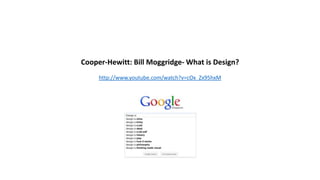
Cooper-Hewitt: Bill Moggridge- What is Design?
http://www.youtube.com/watch?v=cOx_Zx95hxM
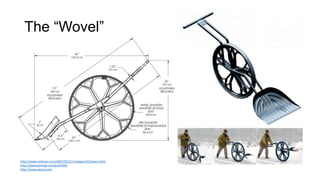
The “Wovel”
http://www.nytimes.com/2007/03/21/nyregion/21towns.html
http://www.gizmag.com/go/6490/
http://www.wovel.com
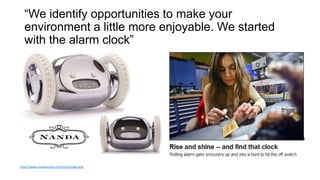
“We identify opportunities to make your
environment a little more enjoyable. We started
with the alarm clock”
http://www.nandahome.com/story/index.php
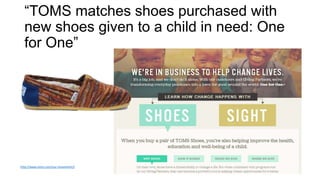
“TOMS matches shoes purchased with
new shoes given to a child in need: One
for One”
http://www.toms.com/our-movement/l
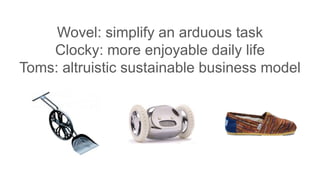
Wovel: simplify an arduous task
Clocky: more enjoyable daily life
Toms: altruistic sustainable business model
What is the problem?
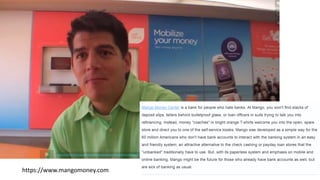
https://www.mangomoney.com
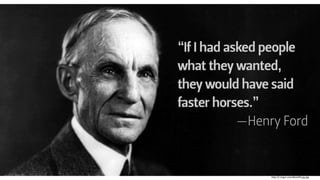
http://i.imgur.com/8oixIdR.jpg.jpg
Rule # 1: Don’t ask what people
want
Rule # 2: Don’t (only) ask people
Rule # 3: Don’t (only) listen to
people
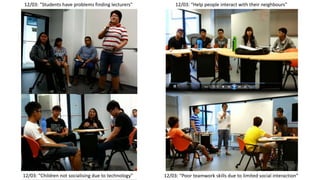
12/03: "Students have problems finding lecturers"
12/03: “Children not socialising due to technology"
12/03: “Help people interact with their neighbours"
12/03: “Poor teamwork skills due to limited social interaction”
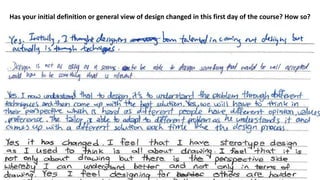
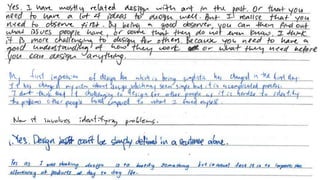
Has your initial definition or general view of design changed in this first day of the course? How so?
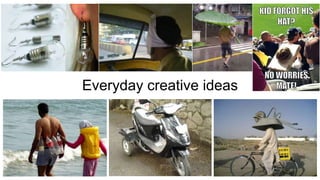
Everyday creative ideas
“… you have to begin designing without all the
information that you’ll eventually need”
“artistic skills are not necessary, but a shift in
the way you think about work may be
required…”
“… it goes from being a methodology to a mind-
set”
“… simply chart the moments and experiences
that comprise an entire day and find design
opportunities at every turn”

ACI Creativity and Design 2014 Day 1