Welcome!Welcome!Welcome!Welcome!
This design course offers a fresh perspective for students across disciplines to learn and apply
creative design skills in a hands-on learning experience. Our approach is different from
conventional design education in engineering, design and architecture schools. Our ultimate
goal is to help all types of technically-sound professionals to appreciate, understand and
apply creative design in their efforts to identify and solve problems that impact positively on
people’s lives.
Albert Einstein famously prioritised imagination over knowledge, “for knowledge is limited to
all we now know and understand, while imagination embraces the entire world, and all there
ever will be to know and understand”. 3.007 is designed to help a new generation of young
engineers and architects combine in innovative ways both imagination and knowledge.
We hope that you will enjoy this cross-disciplinary learning experience as much as we enjoy
preparing and running this course. Throughout the semester you will be exposed to very
diverse ways of conceiving and practicing design, and this may seem inconsistent and even
contradictory at times. Fret not! Design combines very different types of concepts, principles
and methods, from very explicit and systematic step-by-step processes all the way to very
intuitive and tacit experiences. Learn to appreciate the many ways of designing.
Introduction to Design 3.007
3.007 Introduction to Design
Singapore University of Technology and Design
Editor: Ricardo Sosa
With the contributions of: Kris Wood, Katja Hölttä-Otto,
Suranga Nanayakkara, Rajesh E. Mohan, Erik Wilhelm,
Foong Shaohui, Luo Jianxi, Hyowon Lee, Subhajit Datta,
Diana Moreno, Katherine Fu, Cassandra Telenko, Chong
Keng Hua, Stylianos Dristas, Oliver Heckman, Martin
Scoppa, Rizal Muslimin, Anna E. Chan, Asli Arpak, Victoria
Gerrard, Andre Chaszar, Sang-Gook Kim, John G. Brisson.
Student name: ____________________________
Student ID: _______________________________
Cohort: ______________ Team #: __________
Team name: ______________________________
design.sutd.edu.sg
learninglearninglearninglearningto design,
becomingbecomingbecomingbecominga designer
Experts agree that typical design education need to change:
“A cultural change is warranted in engineering, as is reform of the
established theory-based curricula; currently there is little emphasis on
experiential learning through design or the development of creativity. By
contrast, design pedagogy fosters creativity by developing and nurturing
problem solving skills and providing regular opportunities for students to
refine these skills through experiential project-based learning.”
(Ian de Vere, Swinburne)
"Today's designers are walking out into the world with more-or-less the
same tool sets as designers of 60 years ago“ (Ben Hopson, Core77)
“Engineering education is moving towards the development of engineers
who can both ask better questions and answer them more creatively.
Incorporating design thinking, prototyping skills are a key element in the
new paradigm.” (Micah J Lande, Stanford)
“In contemporary parlance ‘we have moved from the age of genius to
scenius’. Yet architectural education is still geared to producing the
solitary genius, rather than today’s collaborator” (Peter Buchanan, The
Architectural Review)
“Practical applications require tying together the knowledge of the many
specialties. They require generalists, people who have broad, integrated
understanding of the world. Moreover, the specialties are mostly about
science and engineering, but our new technologies impact people, lives,
cultures, and societies.” (Don Norman, jnd.org)
3.007 is a unique and innovative response to this call for action in design
education. To help improve, please share your comments and
suggestions; your instructors will be glad to learn from you.
This course introduces concepts of design at a variety of scales and
design disciplines. Participants will be exposed to core technology and
design themes including design principles, processes, modes of thinking
and analysis, and social and cultural aspects of design.
The subject introduces essential skills and mindset of innovation,
entrepreneurship, and methodologies in design including teamwork and
workflow organization, team building and leadership, written and oral
communication, graphic and analytical representation, and fabrication
techniques.
Student teams formulate and complete design projects, setting and
achieving milestones under a team of instructors composed of engineers
and architects.
For more information, see the “Additional resources” section including relevant precedents to teaching introductory design in Engineering, Product Design, Architecture and HCI.
Q. What’s different about 3.007?
A. Design in year one is different from other foundation courses:
1. In Science and Math, problems have correct answers, in Design part of the
problem is to define the problem and there are more/less appropriate
responses, but it is erroneous to reduce Design to problem solving.
2. Unlike most foundation courses in Design, here we integrate ideas and
techniques from different traditions and focus on a cross-domain
approach to design. We want you to develop a personal understanding of
design.
3. In most other subjects, learning is graded in individual tests and exams or
essays, whereas here students work in teams throughout the semester
and receive continuous feedback to assess both how and what they do
(process and outcome are equally important).
4. There is no textbook to teach you design; there are basic concepts,
methods and tools, but to learn design you have to do it. Learning by
doing is a hallmark of design, and it includes both explicit and tacit
knowledge.
5. This project-based course gives students control over their work: you will
gradually become responsible for structuring your learning, and
instructors will be there to support your creative efforts, don’t worry
about them telling you exactly what to do!
Q. Why teach design in year one?
A. Because we consider design to be a foundational component of your
education, and we want all students to experience design as early as possible to
prepare them for the future. Some may feel that it is premature to teach design
in year one, but we have seen first-hand how young students are capable of
producing extraordinary results in their projects. Not only their outcomes can be
humbling, this also gives them a new and wider perspective of what they need to
learn in their upcoming years, and why it is valuable to be well-versed in a range
of technical and human subjects that will enable them to dream of great
solutions and to implement them.
Q. Is this a journal, a diary, a workbook, lecture notes?
A. This A3-size document plays different roles: it summarises the key
ideas and concepts covered in lectures, it gives a semi-structured format
to help you document your decision-making and reflect as you learn and
practice design. You will see that activities start more ‘guided’ and
become more flexible and open, giving you the opportunity to decide
how do you feel more comfortable documenting your learning
experience. A few ground rules:
1. Students should not try to second-guess the instructors to find out
what they want you to do. Instead, great students challenge the
instructors’ expectations, go well beyond any instructions provided,
understand and transform constraints, demonstrate high motivation,
and back up their decisions with clear and convincing elements,
whether these are based on data, inspiration or argumentation.
2. Design processes are not recipes or check-lists, although some very
explicit techniques can be useful at several points. Design combines
science and art, so developing an awareness of when and how to use
different decision-making styles is one of the best lessons that
designers learn from day one and throughout their careers.
3. Feedback is useful, close communication with your instructors is
essential. This is why we ask you to hand in this journal on a weekly
basis, so they can develop a good understanding of your decisions
and progress.
Q. How innovative is this course?
A. Well, everything new has clear precedents. In our case this is the list of
sources that inspire, inform and guide us:
1. ‘Basic Design’ course at TU/Eindhoven and various MIT courses: 2.00, 2.00B,
2.007, 2.009, 4.021, 4.022, 4.023, 4.110…
2. van Boeijen, A.G.C. et al (2013) “Delft Design Guide” BIS Publishers
3. Otto, K. and Wood, K. (2001) “Product Design”, Pearson
4. Lean Startup meets Design Thinking: youtube.com/watch?v=bvFnHzU4_W8
Activity #1: Select 3 designs across disciplines that you consider great (products, technology, buildings, software, services, etc.). Depict them in these boxes (draw
them, paste a picture) and write down what specifically makes them great. Remember to cite your sources. Estimated time: 45 minutes.
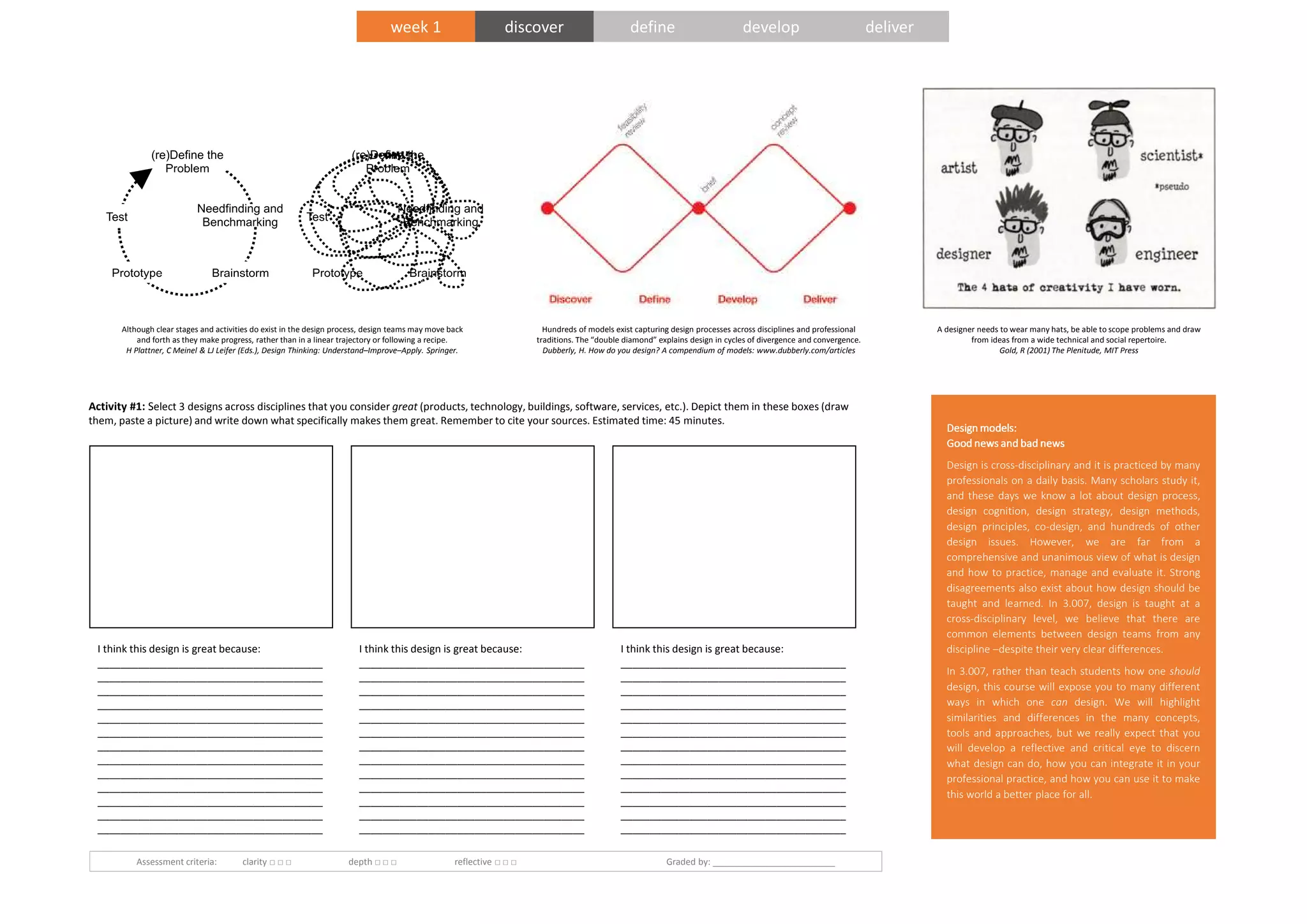
Although clear stages and activities do exist in the design process, design teams may move back
and forth as they make progress, rather than in a linear trajectory or following a recipe.
H Plattner, C Meinel & LJ Leifer (Eds.), Design Thinking: Understand–Improve–Apply. Springer.
Assessment criteria: clarity □ □ □ depth □ □ □ reflective □ □ □ Graded by: _________________________
Design models:Design models:Design models:Design models:
Good news and bad newsGood news and bad newsGood news and bad newsGood news and bad news
Design is cross-disciplinary and it is practiced by many
professionals on a daily basis. Many scholars study it,
and these days we know a lot about design process,
design cognition, design strategy, design methods,
design principles, co-design, and hundreds of other
design issues. However, we are far from a
comprehensive and unanimous view of what is design
and how to practice, manage and evaluate it. Strong
disagreements also exist about how design should be
taught and learned. In 3.007, design is taught at a
cross-disciplinary level, we believe that there are
common elements between design teams from any
discipline –despite their very clear differences.
In 3.007, rather than teach students how one should
design, this course will expose you to many different
ways in which one can design. We will highlight
similarities and differences in the many concepts,
tools and approaches, but we really expect that you
will develop a reflective and critical eye to discern
what design can do, how you can integrate it in your
professional practice, and how you can use it to make
this world a better place for all.
I think this design is great because:
_______________________________________
_______________________________________
_______________________________________
_______________________________________
_______________________________________
_______________________________________
_______________________________________
_______________________________________
_______________________________________
_______________________________________
_______________________________________
_______________________________________
_______________________________________
I think this design is great because:
_______________________________________
_______________________________________
_______________________________________
_______________________________________
_______________________________________
_______________________________________
_______________________________________
_______________________________________
_______________________________________
_______________________________________
_______________________________________
_______________________________________
_______________________________________
I think this design is great because:
_______________________________________
_______________________________________
_______________________________________
_______________________________________
_______________________________________
_______________________________________
_______________________________________
_______________________________________
_______________________________________
_______________________________________
_______________________________________
_______________________________________
_______________________________________
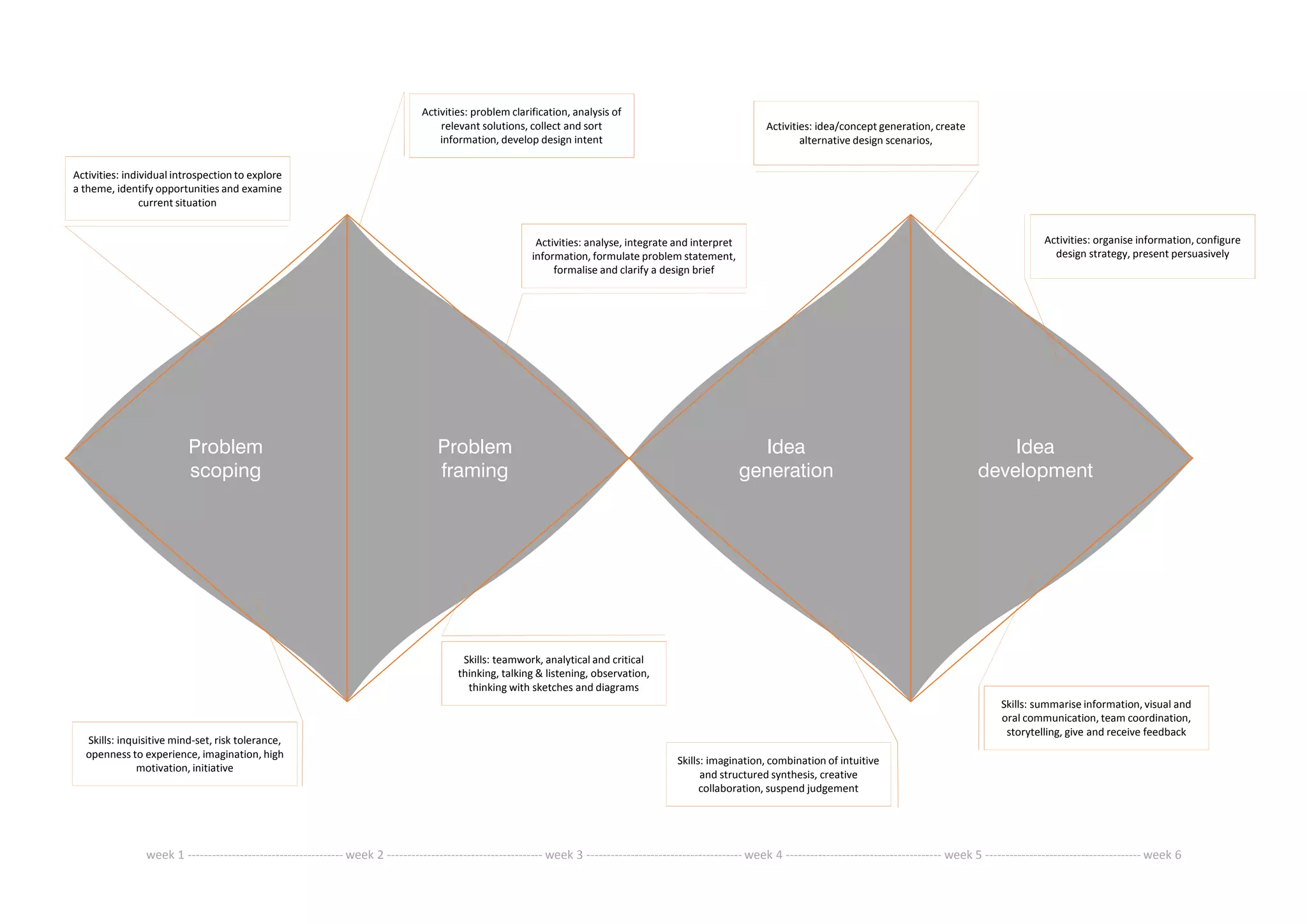
Hundreds of models exist capturing design processes across disciplines and professional
traditions. The “double diamond” explains design in cycles of divergence and convergence.
Dubberly, H. How do you design? A compendium of models: www.dubberly.com/articles
A designer needs to wear many hats, be able to scope problems and draw
from ideas from a wide technical and social repertoire.
Gold, R (2001) The Plenitude, MIT Press
week 1 discover define develop deliver
Activity #2: Capture here your initial thoughts about design, this course, and your expectations. We offer
these sample questions to get you thinking, but feel free to add/replace these with your own. Estimated
time: 45 minutes.
1. What may be the main challenges ahead for you in learning to design?
2. How has your intuitive definition of design starting to change this first week of the course?
3. What would you like to design by the end of this term? And before graduation? And in 20 years?
4. Here are 3 terms to read about: “satisficing” coined by Herbert Simon, “wicked problems” coined by
Horst Rittel, and “reflection-in-action” coined by Donald Schön. Look them up to frame your views.
________________________________________________________________________________________
________________________________________________________________________________________
________________________________________________________________________________________
________________________________________________________________________________________
________________________________________________________________________________________
________________________________________________________________________________________
________________________________________________________________________________________
________________________________________________________________________________________
________________________________________________________________________________________
________________________________________________________________________________________
________________________________________________________________________________________
________________________________________________________________________________________
________________________________________________________________________________________
________________________________________________________________________________________
________________________________________________________________________________________
________________________________________________________________________________________
________________________________________________________________________________________
________________________________________________________________________________________
________________________________________________________________________________________
________________________________________________________________________________________
________________________________________________________________________________________
________________________________________________________________________________________
________________________________________________________________________________________
________________________________________________________________________________________
________________________________________________________________________________________
________________________________________________________________________________________
________________________________________________________________________________________
________________________________________________________________________________________
________________________________________________________________________________________
A great building must begin with the unmeasurable, must go through measurable means when it is
being designed and in the end must be unmeasurable
Louis Kahn, architect (1901-1974)
Design is a funny word. Some people think design means how it looks. But of course,
if you dig deeper, it's really how it works.
Steven P. Jobs, entrepreneur (1955-2011)
Recognizing the need is the primary condition for design.
Charles O. Eames, designer (1907-1978)
What is design? It's where you stand with a foot in two worlds - the world of technology
and the world of people and human purposes - and you try to bring the two together.
Mitchell Kapor, entrepreneur (1950-)
To invent, you need a good imagination and a pile of junk.Thomas A. Edison, inventor (1847-1931)
A designer is an emerging synthesis of artist, inventor, mechanic, objective
economist and evolutionary strategist.
Richard Buckminster Fuller, architect,
designer and inventor (1895-1983)
Engineering, medicine, business, architecture and painting are concerned not with the necessary but with the contingent - not
with how things are but with how they might be - in short, with design.
Herbert A. Simon, economist, computer scientist (1916-2001)
Form follows function - that has been misunderstood.
Form and function should be one, joined in a spiritual union.
Frank Lloyd Wright, architect (1867-1959)
The practice of design is a very complicated business, involving contrasting skills and a wide field of disciplines. It has always
required an odd kind of hybrid to carry it successfully
Bruce Archer, engineer and designer (1922-2005)
Necessity is often not the mother of invention. When humans possess a tool, they excel at finding new
uses for it. The tool often exists before the problem to be solved
David E. Nye, historian (1946-)
Assessment criteria: introspective □ □ □ critical □ □ □ informed □ □ □ Graded by: ___________________
week 1 discover define develop deliver
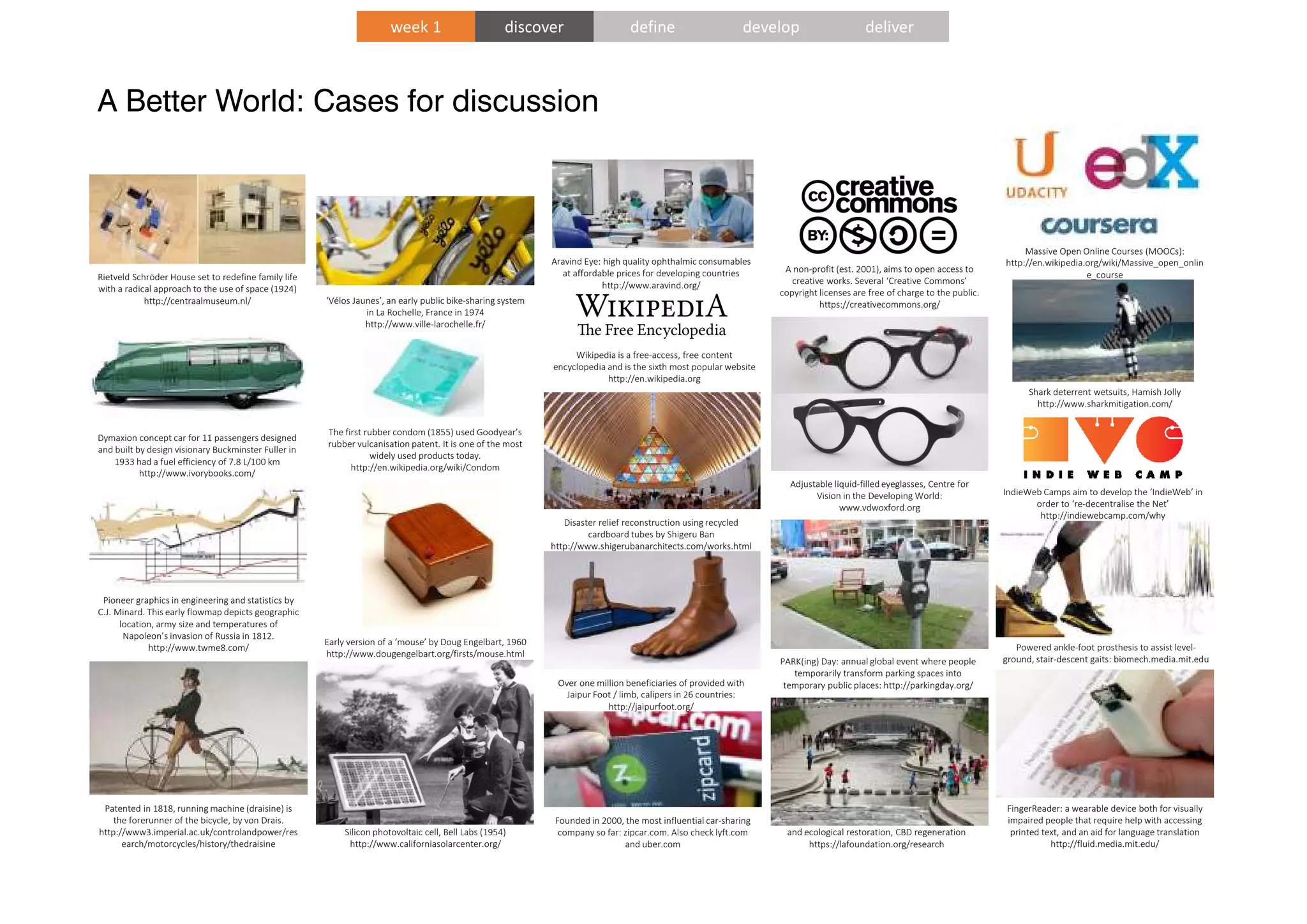
A Better World: Cases for discussion
Patented in 1818, running machine (draisine) is
the forerunner of the bicycle, by von Drais.
http://www3.imperial.ac.uk/controlandpower/res
earch/motorcycles/history/thedraisine
Dymaxion concept car for 11 passengers designed
and built by design visionary Buckminster Fuller in
1933 had a fuel efficiency of 7.8 L/100 km
http://www.ivorybooks.com/
Founded in 2000, the most influential car-sharing
company so far: zipcar.com. Also check lyft.com
and uber.com
Wikipedia is a free-access, free content
encyclopedia and is the sixth most popular website
http://en.wikipedia.org
Over one million beneficiaries of provided with
Jaipur Foot / limb, calipers in 26 countries:
http://jaipurfoot.org/
The first rubber condom (1855) used Goodyear’s
rubber vulcanisation patent. It is one of the most
widely used products today.
http://en.wikipedia.org/wiki/Condom
Silicon photovoltaic cell, Bell Labs (1954)
http://www.californiasolarcenter.org/
Early version of a ‘mouse’ by Doug Engelbart, 1960
http://www.dougengelbart.org/firsts/mouse.html
A non-profit (est. 2001), aims to open access to
creative works. Several ‘Creative Commons’
copyright licenses are free of charge to the public.
https://creativecommons.org/
Cheong Gye Cheon Urban Restoration (2005) historic
and ecological restoration, CBD regeneration
https://lafoundation.org/research
PARK(ing) Day: annual global event where people
temporarily transform parking spaces into
temporary public places: http://parkingday.org/
Adjustable liquid-filled eyeglasses, Centre for
Vision in the Developing World:
www.vdwoxford.org
Powered ankle-foot prosthesis to assist level-
ground, stair-descent gaits: biomech.media.mit.edu
FingerReader: a wearable device both for visually
impaired people that require help with accessing
printed text, and an aid for language translation
http://fluid.media.mit.edu/
Massive Open Online Courses (MOOCs):
http://en.wikipedia.org/wiki/Massive_open_onlin
e_course
IndieWeb Camps aim to develop the ‘IndieWeb’ in
order to ‘re-decentralise the Net’
http://indiewebcamp.com/why
Pioneer graphics in engineering and statistics by
C.J. Minard. This early flowmap depicts geographic
location, army size and temperatures of
Napoleon’s invasion of Russia in 1812.
http://www.twme8.com/
‘Vélos Jaunes’, an early public bike-sharing system
in La Rochelle, France in 1974
http://www.ville-larochelle.fr/
Rietveld Schröder House set to redefine family life
with a radical approach to the use of space (1924)
http://centraalmuseum.nl/
Shark deterrent wetsuits, Hamish Jolly
http://www.sharkmitigation.com/
Aravind Eye: high quality ophthalmic consumables
at affordable prices for developing countries
http://www.aravind.org/
Disaster relief reconstruction using recycled
cardboard tubes by Shigeru Ban
http://www.shigerubanarchitects.com/works.html
week 1 discover define develop deliver
A Better World: Game-changing Ideas
“A Better World” is the general theme for this course.
Design creates new possible future scenarios in order to
transform undesired situations into preferred ones with
positive impacts. There are many ways in which technology
and design have made our lives better –and many ways in
which they have created more problems or created
rubbish. This course raises some questions about Design
for a Better World: how can design help address pressing
challenges in our economy, society, environment, and in
our everyday life? How can design make a real difference?
These themes are for illustration to inspire you. Feel free
to select one or formulate your own questions.
1. Special populations
• Up until now, most of our built environment
(things, tools, spaces, information) has been
designed thinking of healthy adults. Only recent
designs across fields take into consideration
people with disabilities or the elderly as part of
the target populations (“Universal design”).
• Designing for special populations has produced
limited results, and more design teams are
adopting ‘design with’ approaches where
stakeholders are actively involved in the decision-
making processes.
2. Social issues
• Technology often embodies and promotes
behaviours that perpetuate unethical or unfair
social behaviours. Design can help raise awareness
and promote positive dynamics to address gender
equality, better governance, fair employment
practices, avoid racial or class discrimination, etc.
3. Health
• The future is “already here, just not very evenly
distributed” (William Gibson). How can design
extend access to diagnosis and treatment to wider
populations? Medication and rehabilitation
present big challenges too. Public health problems
include epidemics prevention and control. Doctors
insist that more should be done to advance
preventive medicine, how can design help? A
healthy diet and sleep habits are also areas of
concern.
4. Energy
• The transformation, distribution and consumption
of energy present many opportunities for
technology and design, from renewable sources to
higher efficiency.
• Radical energy solutions need to take ‘behavioural
economics’ principles to assist people build
awareness, develop habits, visualise impacts and
change expectations.
5. Disposable culture
• In the last 50 years, many products that used to
be reusable and washable became disposable and
today we take them for granted. But their impacts
are clearly negative. How can we maintain
convenience without damaging the environment?
6. Development
• What is a developed society, and what role can
design play in the myriad facets of development?
From poverty to hunger, education and
happiness, how can new designs help raise a more
sustainable well-being?
7. Peace
• From global scale wars and conflicts to domestic
violence and personal protection, design can
promote safe, courteous and kind relationships
bridging differences in everyday life.
8. Economy
• Unemployment, increasing income gaps, helping
people plan their retirement, creating new
income and revenue models. These are all
challenging areas that deserve careful
consideration by all specialists, and a design
approach can help address them across
disciplines.
9. Sustainable transportation
• At the personal level (“last mile”), urban scale and
long-range movement of people and goods,
innovations are needed to create alternatives to
the current modes of transportation.
10. Communication
• Information is critical in all aspects of life, yet
access is limited. How can design support
transparency, fairness and democracy?
• The “Internet of Things” refers to the possibilities
offered by connecting our environments and
devices to the existing Internet infrastructure.
What exciting opportunities lie ahead?
Assessment criteria: informed □ □ □ original □ □ □ clarity □ □ □ Graded by: ___________________
Activity #3: Make a list of 3 headlines from recent news articles. Choose one case from your list and do some research
about it. What is the big picture behind the story? What has led to it and why is it relevant news now? Is it part of a
trend or relates to other events? What social, technical or economic systems does the story exist within? Try to think
beyond the event and try to look at it from multiple angles –how would a different profession view the same story? Or
a mother? Or a child? Or someone from another country? Now try to identify the challenges that you see facing the
people affected by the story as they envision the Better World they wish to see. What barriers stand in their way?
What opportunities do they have for change? Imagine where design could make a difference to overcoming barriers or
realising opportunities. Even a small difference can have long-term impact to help make this a Better World.
Remember to cite your sources. Estimated time: 2 hours. For example:
- When a typhoon kills people, consider that most casualties in natural disasters are due to man-made factors,
including urban populations living in inappropriate conditions with roots in a dozen social, economic and political
factors. How can design help prevent, mitigate and respond to these catastrophes? How have individuals and
groups creatively responded in such emergency situations?
- Plastic bags are being banned in some countries: what are the real (deeper) problems with plastic bags, and how
would you differentiate symptoms from causes? Is banning a long-term solution? Consider that in the 1970s many
countries banned the use of CFCs, which has had a positive impact in stopping and reducing ozone depletion in the
atmosphere. When is banning desirable and effective? What alternatives can be offered?
week 1 discover define develop deliver
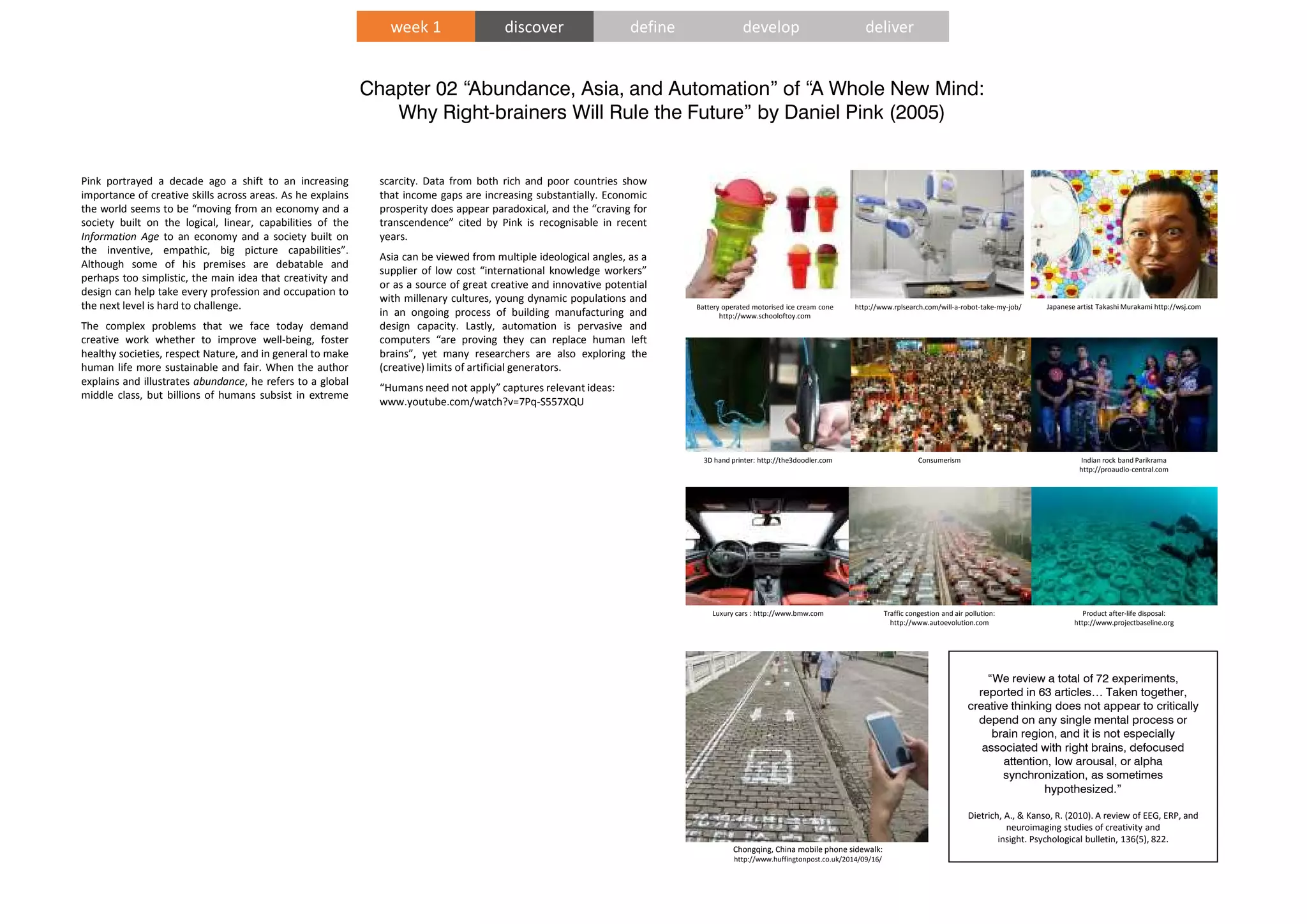
Chapter 02 “Abundance, Asia, and Automation” of “A Whole New Mind:
Why Right-brainers Will Rule the Future” by Daniel Pink (2005)
“We review a total of 72 experiments,
reported in 63 articles… Taken together,
creative thinking does not appear to critically
depend on any single mental process or
brain region, and it is not especially
associated with right brains, defocused
attention, low arousal, or alpha
synchronization, as sometimes
hypothesized.”
Dietrich, A., & Kanso, R. (2010). A review of EEG, ERP, and
neuroimaging studies of creativity and
insight. Psychological bulletin, 136(5), 822.
Pink portrayed a decade ago a shift to an increasing
importance of creative skills across areas. As he explains
the world seems to be “moving from an economy and a
society built on the logical, linear, capabilities of the
Information Age to an economy and a society built on
the inventive, empathic, big picture capabilities”.
Although some of his premises are debatable and
perhaps too simplistic, the main idea that creativity and
design can help take every profession and occupation to
the next level is hard to challenge.
The complex problems that we face today demand
creative work whether to improve well-being, foster
healthy societies, respect Nature, and in general to make
human life more sustainable and fair. When the author
explains and illustrates abundance, he refers to a global
middle class, but billions of humans subsist in extreme
scarcity. Data from both rich and poor countries show
that income gaps are increasing substantially. Economic
prosperity does appear paradoxical, and the “craving for
transcendence” cited by Pink is recognisable in recent
years.
Asia can be viewed from multiple ideological angles, as a
supplier of low cost “international knowledge workers”
or as a source of great creative and innovative potential
with millenary cultures, young dynamic populations and
in an ongoing process of building manufacturing and
design capacity. Lastly, automation is pervasive and
computers “are proving they can replace human left
brains”, yet many researchers are also exploring the
(creative) limits of artificial generators.
“Humans need not apply” captures relevant ideas:
www.youtube.com/watch?v=7Pq-S557XQU
Japanese artist Takashi Murakami http://wsj.comhttp://www.rplsearch.com/will-a-robot-take-my-job/
Indian rock band Parikrama
http://proaudio-central.com
Battery operated motorised ice cream cone
http://www.schooloftoy.com
Consumerism3D hand printer: http://the3doodler.com
Product after-life disposal:
http://www.projectbaseline.org
Traffic congestion and air pollution:
http://www.autoevolution.com
Luxury cars : http://www.bmw.com
week 1 discover define develop deliver
Chongqing, China mobile phone sidewalk:
http://www.huffingtonpost.co.uk/2014/09/16/
Entrepreneurial mind-set
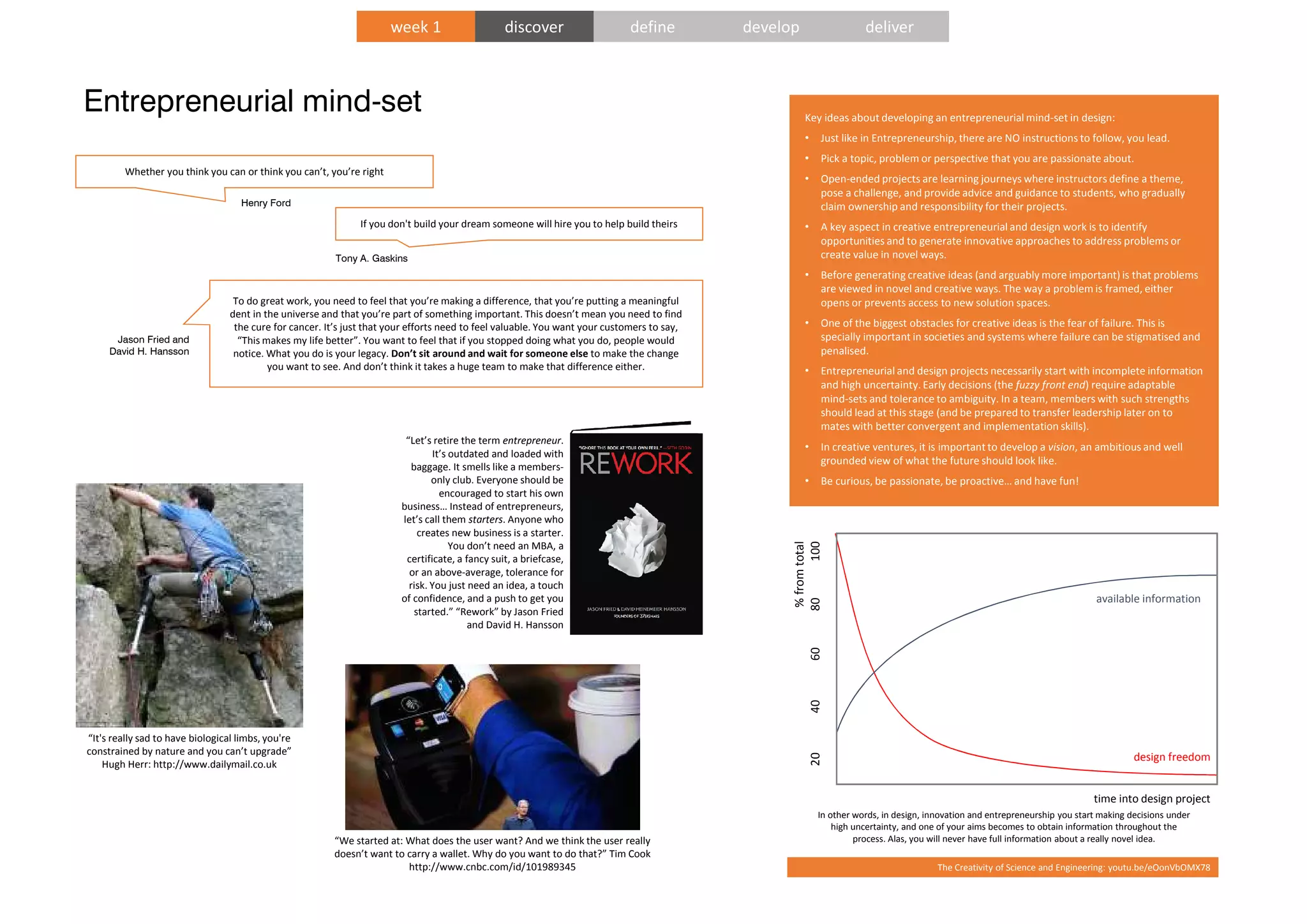
The Creativity of Science and Engineering: youtu.be/eOonVbOMX78
Whether you think you can or think you can’t, you’re right
Henry Ford
If you don't build your dream someone will hire you to help build theirs
Tony A. Gaskins
To do great work, you need to feel that you’re making a difference, that you’re putting a meaningful
dent in the universe and that you’re part of something important. This doesn’t mean you need to find
the cure for cancer. It’s just that your efforts need to feel valuable. You want your customers to say,
“This makes my life better”. You want to feel that if you stopped doing what you do, people would
notice. What you do is your legacy. Don’t sit around and wait for someone else to make the change
you want to see. And don’t think it takes a huge team to make that difference either.
Jason Fried and
David H. Hansson
Key ideas about developing an entrepreneurial mind-set in design:
• Just like in Entrepreneurship, there are NO instructions to follow, you lead.
• Pick a topic, problem or perspective that you are passionate about.
• Open-ended projects are learning journeys where instructors define a theme,
pose a challenge, and provide advice and guidance to students, who gradually
claim ownership and responsibility for their projects.
• A key aspect in creative entrepreneurial and design work is to identify
opportunities and to generate innovative approaches to address problems or
create value in novel ways.
• Before generating creative ideas (and arguably more important) is that problems
are viewed in novel and creative ways. The way a problem is framed, either
opens or prevents access to new solution spaces.
• One of the biggest obstacles for creative ideas is the fear of failure. This is
specially important in societies and systems where failure can be stigmatised and
penalised.
• Entrepreneurial and design projects necessarily start with incomplete information
and high uncertainty. Early decisions (the fuzzy front end) require adaptable
mind-sets and tolerance to ambiguity. In a team, members with such strengths
should lead at this stage (and be prepared to transfer leadership later on to
mates with better convergent and implementation skills).
• In creative ventures, it is important to develop a vision, an ambitious and well
grounded view of what the future should look like.
• Be curious, be passionate, be proactive… and have fun!
time into design project%fromtotal
20406080100
design freedom
available information
In other words, in design, innovation and entrepreneurship you start making decisions under
high uncertainty, and one of your aims becomes to obtain information throughout the
process. Alas, you will never have full information about a really novel idea.
week 1 discover define develop deliver
“It's really sad to have biological limbs, you're
constrained by nature and you can’t upgrade”
Hugh Herr: http://www.dailymail.co.uk
“We started at: What does the user want? And we think the user really
doesn’t want to carry a wallet. Why do you want to do that?” Tim Cook
http://www.cnbc.com/id/101989345
“Let’s retire the term entrepreneur.
It’s outdated and loaded with
baggage. It smells like a members-
only club. Everyone should be
encouraged to start his own
business… Instead of entrepreneurs,
let’s call them starters. Anyone who
creates new business is a starter.
You don’t need an MBA, a
certificate, a fancy suit, a briefcase,
or an above-average, tolerance for
risk. You just need an idea, a touch
of confidence, and a push to get you
started.” “Rework” by Jason Fried
and David H. Hansson
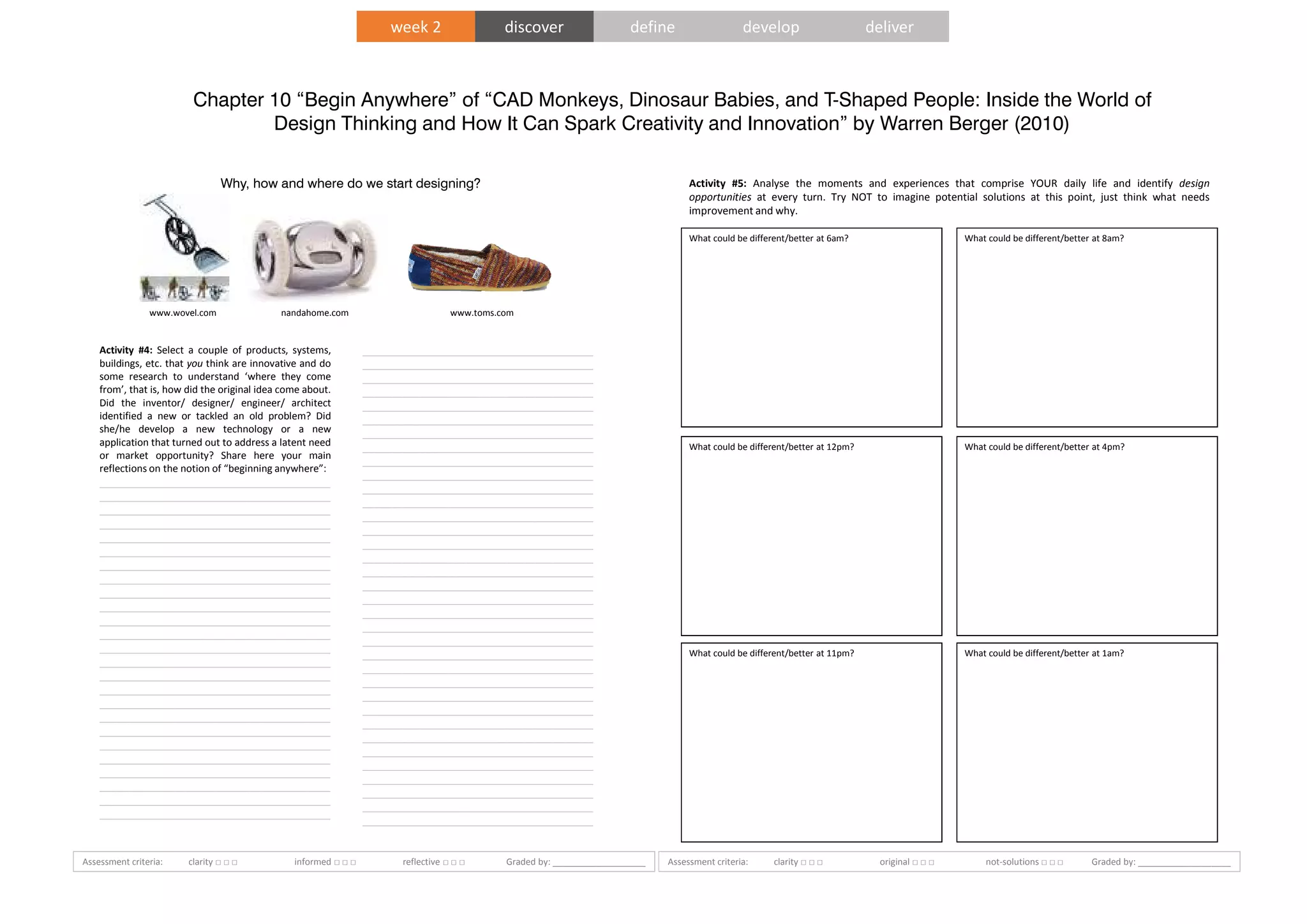
Chapter 10 “Begin Anywhere” of “CAD Monkeys, Dinosaur Babies, and T-Shaped People: Inside the World of
Design Thinking and How It Can Spark Creativity and Innovation” by Warren Berger (2010)
www.wovel.com nandahome.com www.toms.com
Why, how and where do we start designing?
Activity #4: Select a couple of products, systems,
buildings, etc. that you think are innovative and do
some research to understand ‘where they come
from’, that is, how did the original idea come about.
Did the inventor/ designer/ engineer/ architect
identified a new or tackled an old problem? Did
she/he develop a new technology or a new
application that turned out to address a latent need
or market opportunity? Share here your main
reflections on the notion of “beginning anywhere”:
________________________________________
________________________________________
________________________________________
________________________________________
________________________________________
________________________________________
________________________________________
________________________________________
________________________________________
________________________________________
________________________________________
________________________________________
________________________________________
________________________________________
________________________________________
________________________________________
________________________________________
________________________________________
________________________________________
________________________________________
________________________________________
________________________________________
________________________________________
________________________________________
________________________________________
________________________________________
________________________________________
________________________________________
________________________________________
________________________________________
________________________________________
________________________________________
________________________________________
________________________________________
________________________________________
________________________________________
________________________________________
________________________________________
________________________________________
________________________________________
________________________________________
________________________________________
________________________________________
________________________________________
________________________________________
________________________________________
________________________________________
________________________________________
________________________________________
________________________________________
________________________________________
________________________________________
________________________________________
________________________________________
________________________________________
________________________________________
________________________________________
________________________________________
________________________________________
________________________________________
Activity #5: Analyse the moments and experiences that comprise YOUR daily life and identify design
opportunities at every turn. Try NOT to imagine potential solutions at this point, just think what needs
improvement and why.
What could be different/better at 6am? What could be different/better at 8am?
What could be different/better at 12pm? What could be different/better at 4pm?
What could be different/better at 11pm? What could be different/better at 1am?
Assessment criteria: clarity □ □ □ original □ □ □ not-solutions □ □ □ Graded by: ___________________Assessment criteria: clarity □ □ □ informed □ □ □ reflective □ □ □ Graded by: ___________________
week 2 discover define develop deliver
Sample well-framed problems:
“We decide to tackle child obesity, since it is a
growing trend in many countries including Singapore
and will target one or more of the key factors involved:
sedentarism, eating disorders, stress, nutrition, food
preparation, advertising, genetics, and inherited
habits.”
“Doing laundry wastes too much water, requires too
much energy and generates unnecessary waste.
Something radically different needs to change to
reduce pollution and improve efficiency dramatically.”
“A new space is required for exhibition and work
activities. The design should reflect a forward-thinking
integration of technology and design. Allocated space
and budget are attached.”
“Studies A and B of creative teams report that existing
software applications don’t offer adequate support for
creative collaboration.”
Not so well-framed problems:
“I want to help people lower their energy
consumption by automating lights at home” (Jumps
straight to a specific solution)
“Students need a system to locate their lecturers
outside class hours” (Fails to inspect actual
problems and lacks a basic understanding of
teaching/learning dynamics)
“Buildings should promote courteous behaviours
between dwellers” (Based on personal biased
impressions, easy to challenge if no further baseline
data or concrete examples are given)
“We will design an electric baby stroller” (Why? Who
needs it?)
“The problem with poverty is people lack money”
(Not only a circular argument, also ignores a myriad
non-financial factors)
Problem scoping
Across disciplines, problems are identified, defined and initiated
differently. In some areas, the process is viewed as ‘messy’ and
undetermined, others follow more systematic approaches. In all
cases, information gathering and interpretation is crucial to become
familiar with the topic and to develop new ways of seeing the
problem. There are many ways to achieve this, and many ways of
judging the quality of how a problem is framed.
Asking people what problems they face is an obvious first step, and
specific techniques will come later, but in this initial design
experience, we suggest that you first develop a personal choice
about the topic or situation you would like to tackle. It is important
that you feel highly inspired and motivated to work on this project.
Studying the context and previous solutions can be revealing.
Precedents are important sources of knowledge since the impact of
existing buildings, products, vehicles and systems is clearer as time
progresses. “Precedents contain design knowledge that can be
accessed and reused in the context of the problem at hand” (Akin,
2002). By analysing the competition, firms build and update their
product strategy. In this initial stage of a project, individual work is
ideal to collect information and to analyse the many factors
influencing and approaches taken so far in relation to one or two
themes of your personal interest.
As you gather information and analyse precedents, your purpose is to
learn the vocabulary, extract principles, derive lessons learned and
develop heuristics from them. At this stage you may also bring your
own experiences or talk to experts in order to guide your search.
Architects tend to visit buildings, browse books, magazines and
catalogues, look at online collections, and read about the place,
dwellers, codes, and historical background. Roboticists look at videos
or directly at available technologies through catalogues and products
in order to survey the range of behaviours and performance of
current robots. In these and other areas, good designers maintain an
open eye and grow a rich repertoire of solutions, becoming
knowledgeable about the latest and the historical developments in
their domain(s) of interest.
Investigative work is required to analyse precedents, and for this it is
important to develop criteria to assess the quality of the information
(accuracy, veracity, validity, authority), and to compare multiple
sources. Good design starts with a thorough, meaningful and
reflective analysis of what has been done before.
Warning: it can be tempting to extend this stage indefinitely. Besides
being really selective and critical about the information you cite, a
key skill is to know when to suspend the search mode. Criteria you
can use include: time, intuition or a pre-established goal (i.e., “once I
find 3 weaknesses of existing solutions”). Your instructors will be a
helpful source of feedback to help you decide when to move on. But
don’t worry, your team will keep coming back to research mode
iteratively during the project.
Sample problem scoping techniques:Sample problem scoping techniques:Sample problem scoping techniques:Sample problem scoping techniques:
Precedent Analysis:
• Gather all available documentation about a set of exemplary
cases
• Investigate the problem addressed and the goals of the
designers
• Inspect the design techniques, tools and principles used
• Do a critique of how the final design responded to the original
goals
Patent landscaping:
• Identify the potential technologies relevant to your design
• Search patents initially by abstract or claims
• Make a short list of the most relevant patents and follow the
patents cited by them
• Identify patent classification codes if you need to narrow down
your search (US, European or International class codes exist)
• Assess reliability of the most relevant patents by searching for
products or commercial applications based on them
• You can use Google Patents or www.freepatentsonline.com
Jobs to be Done (JTBD):
• Distinguish means (activities) from ends (jobs): people drill holes
(low means) to hang pictures (higher means) to decorate a room
(the real “job” people want done)
• What are the various alternative designs involved in a “job”? List
their advantages and disadvantages and define a ‘pain point’
that to focus on
• Talk to people to find out how they perceive means and ends.
What trade-offs are they willing to make? What prevents them
from changing?
Life-cycle analysis (LCA):
Identify opportunities estimating how a design performs in:
• Materials and production: number of different materials,
sources (renewable, recycled), impact (hazardous,
recyclable), number of parts, easiness of disassembly, repair
or replacement, number and type of manufacturing or
building processes
• Distribution: environmental impact of transportation, type
and amount of primary and secondary packaging
• Use or operation: energy consumption under operation,
use of refills or consumables, energy use in standby or idle
mode, reliability, durability, upgradable
• End of life: reuse of components, refurbishment, recycling,
biodegradable, pollutants
• Existing alternatives: shared ownership, multi-function
products, rental services, digital alternatives
week 2 discover define develop deliver
Remember to ask a librarian or email to: library@sutd.edu.sg for assistance. Academic integrity: library.sutd.edu.sg/sulb/AcademicIntegrity.html
Theme(s) of initial interest:
Initial questions and issues:
Key information or precedents:
week 2 discover define develop deliver
Essential design questions:
Is the intersection the real problem?
Is it about the light timing, traffic, visibility, speed?
Where are the student going, why are they crossing the road?
When do they cross and how many?
Why do students jay walk?
Awareness
Background research and precedents are informative, but so is
to observe, that is, to pay close attention to our surroundings.
This is not a passive, easy or trivial process –we are used to
seeing but not to observe. A fundamental design skill is to
learn “to see the world with fresh eyes”. With the right
attitude, practice and investing enough time, you can learn
new and valuable things by observing your surroundings.
What are the light sources in the room? How does the
cafeteria layout influence our behaviour? Why are certain
items placed lower or higher on the supermarket shelves?
Why is information organised such way in that website? What
makes people choose that product over other competing
options? The response to such questions are not simple and
straightforward, and very often one can reveal quite
interesting insights by observing how products are used, how
spaces are inhabited, how people make choices and errors,
and how they behave and interact with others. Try to go
beyond ‘common sense’ explanations.
Passive methods like observation are useful throughout the
design process (you may also use them later when testing
prototypes). And in the initial stages, visual examination can
be a rich and powerful source of problem identification.
Some useful questions that an architect may ask include:
- What is the spatial structure of this place like?
- How do people behave in this place?
- What do they feel and think about this place?
A website developer may ask herself:
- What are the main types of visitors to this website?
- What information are visitors expecting to find?
- What is the time that this person has available?
- What causes people to get lost and frustrated when browsing
websites?
The designer of a museum exhibition is likely to focus on:
- What is the baseline knowledge of visitors about this theme?
- What inspires and triggers curiosity from existing exhibitions?
- How critical is accuracy/maintenance in this type of displays?
Lastly, an engineer developing a new pet robot may wonder:
- How are robotic pets safer than live dogs and cats?
- What are the latent needs that pet robots can address in five to
ten years from now?
- How do different family members become attached to pets?
Guidelines:Guidelines:Guidelines:Guidelines:
Dos:
1. Define a place or situation that you want to analyse. Write down a description of the
setting and the goals.
2. Make your initial assumptions explicit, and define criteria for analysis.
3. If possible, invite someone else to observe with you, and engage in a meaningful
discussion after to share and compare observations.
4. Observe how people are already identifying problems, how they cope with them and
how they adapt to them, improvise or solve them.
5. This is a passive method, so try to remain unobtrusive. If appropriate, do take a
photograph, a quick note or make a simple sketch to capture an idea.
6. Sit down and analyse the results. Compare to what you have read.
7. Be flexible and make adjustments as you go, but write down why you make changes
during the process.
Don’ts:
1. Don’t draw conclusions from this process, it’s a great source to discover and reveal
issues, not to establish any statistical correlations.
2. Don’t mix this with interviews. You can and should talk to people later in the design
process.
3. Remain safe and apply common sense, don’t make people uncomfortable.
4. Avoid the tendency to observe in order to confirm your assumptions and beliefs. Be
prepared for the unexpected.
Original customer problem statement:
“Reconfigure the intersection by of College Ave and
Educ Ln so the students can cross the road”
City of Collegetown
What people… Methods Knowledge
Say
Do
Know
and feel
Interviews
Observation
Generative
sessions
Explicit
Tacit
Latent
DeepSurface
Adapted from: maketools.com
Visualization of urban running paths using shoe sensors (yesyesno.com)
“Always design a thing by considering it in its next larger context - a chair in a room, a room in a house, a house in an environment, an environment in a city plan”
Eliel Saarinen
User adaptations and “chindogu” help reveal problems
week 2 discover define develop deliver
Assessment criteria: ________ □ □ □ ________ □ □ □ ________ □ □ □ Graded by: ___________________
Activity #6: Complete this table and add a sketch based on your observations. Indicate place and time of the day
week 2 discover define develop deliver
AEIOU Description (what is) Analysis (why it is) Questions, insights Comparison to
assumptions, to other
situations and to notes
by other observers
Activities
Environments
Interactions
Objects
Users
Assessment criteria: inventiveness □ □ □ idea sketching rules □ □ □ quantity/diversity □ □ □ Graded by: ___________________
Activity #7: Practice your idea sketching here using this challenge: imagine more than ten alternative and innovative ways of weighing an elephant without using/building a scale.
week 2 discover define develop deliver
Idea sketching is not about drawing
beautiful portraits or copying a
landscape artistically. It is a rapid way
to think and communicate ideas often
better than natural language.
Sketching helps understand the
physical and the conceptual worlds,
and is suitable for exploring spatial and
time events and relationships. Idea
sketching is NOT an artistic skill, it is a
universal tool to organise, clarify,
generate and communicate ideas.
Remember the ‘rules’: speed over
accuracy, think as you draw and draw
as you think, annotate doodles with
brief text, clarity over artistry, move
your elbow not your wrist.
ted.com/talks/tim_brown_on_creativity_and
_play
Thomas Edison
Frank Gehry
“Rapid Viz” by Larry Belliston and Kurt Hanks
Chapter 01 “The Psychopathology of everyday things” of
“The Design of Everyday Things” by Donald Norman (2013)
Assessment criteria: accuracy □ □ □ originality □ □ □ clarity □ □ □ Graded by: ___________________
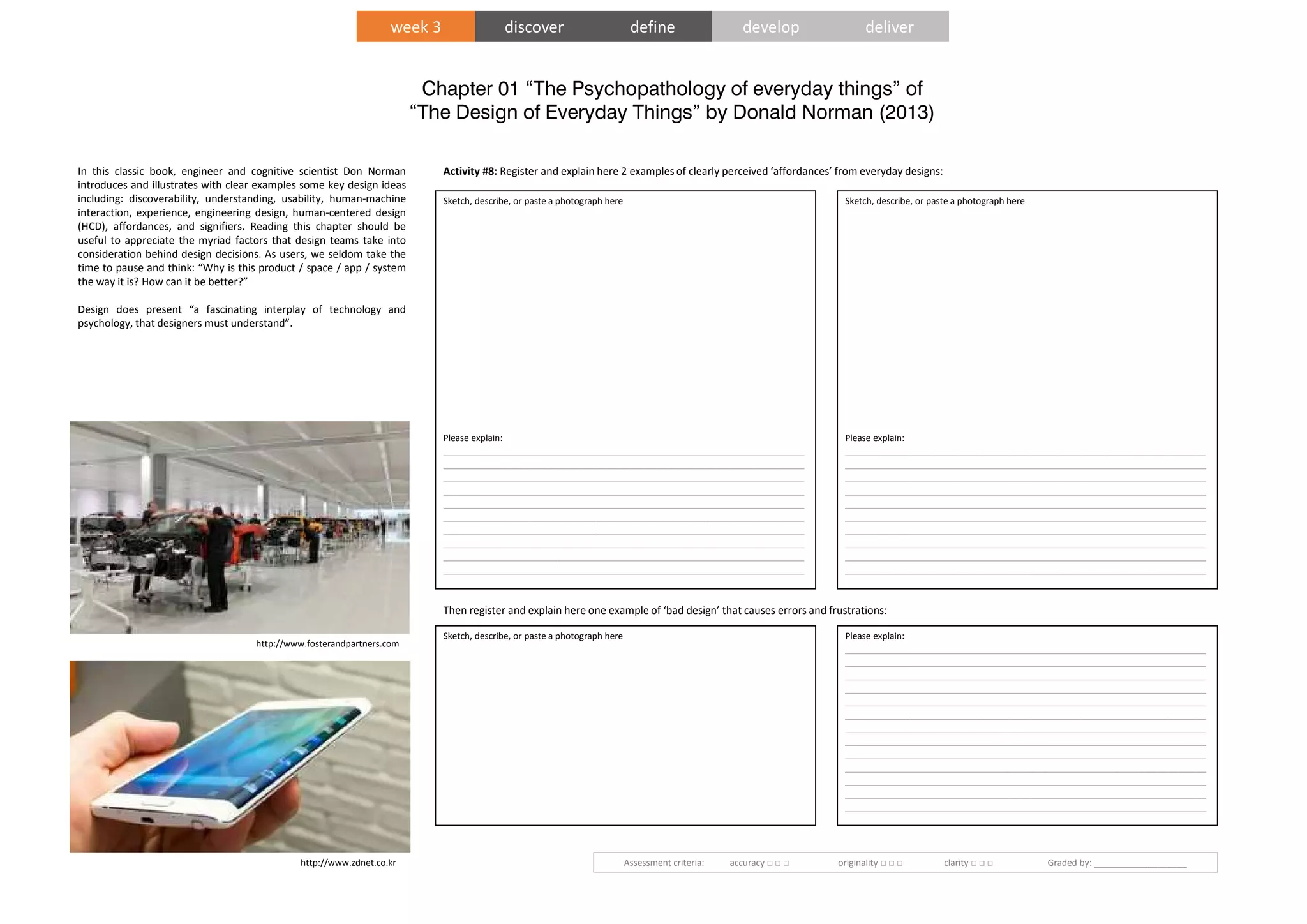
In this classic book, engineer and cognitive scientist Don Norman
introduces and illustrates with clear examples some key design ideas
including: discoverability, understanding, usability, human-machine
interaction, experience, engineering design, human-centered design
(HCD), affordances, and signifiers. Reading this chapter should be
useful to appreciate the myriad factors that design teams take into
consideration behind design decisions. As users, we seldom take the
time to pause and think: “Why is this product / space / app / system
the way it is? How can it be better?”
Design does present “a fascinating interplay of technology and
psychology, that designers must understand”.
Activity #8: Register and explain here 2 examples of clearly perceived ‘affordances’ from everyday designs:
Then register and explain here one example of ‘bad design’ that causes errors and frustrations:
Sketch, describe, or paste a photograph here
Please explain:
__________________________________________________________________
__________________________________________________________________
__________________________________________________________________
__________________________________________________________________
__________________________________________________________________
__________________________________________________________________
__________________________________________________________________
__________________________________________________________________
__________________________________________________________________
__________________________________________________________________
Sketch, describe, or paste a photograph here
Please explain:
__________________________________________________________________
__________________________________________________________________
__________________________________________________________________
__________________________________________________________________
__________________________________________________________________
__________________________________________________________________
__________________________________________________________________
__________________________________________________________________
__________________________________________________________________
__________________________________________________________________
Sketch, describe, or paste a photograph here Please explain:
__________________________________________________________________
__________________________________________________________________
__________________________________________________________________
__________________________________________________________________
__________________________________________________________________
__________________________________________________________________
__________________________________________________________________
__________________________________________________________________
__________________________________________________________________
__________________________________________________________________
__________________________________________________________________
__________________________________________________________________
__________________________________________________________________
week 3 discover define develop deliver
http://www.fosterandpartners.com
http://www.zdnet.co.kr
Creative teamwork
The “Marshmallow Challenge” is a hands-on experience on team dynamics intended to get you and your team actively thinking about
the great potential of collaboration, as well as the non-trivial challenges of coordination, communication and creative problem solving.
Activity #9: Capture here a summary of this experience and your reflections after doing this team activity.
Design is a creative team effort. Creative teamwork is much more than a
group of people operating together. As in all great teams, goals are shared by
members, they strive to collaborate and their skills complement each other,
and overall, they are seriously committed to give their best effort. In creative
teams, work gets even more challenging –and more rewarding. Edison
famously said that creativity is 1% inspiration and 99% perspiration, so
creative teams need to balance individual contributions and team synergies in
divergent as well as convergent work (see previous discussion on Design
Models in this book).
Many students have told us that creative teamwork is a highlight of this
course. For many, this is the very first time working in a term-long team
project. However, in many cases conflicts arise, and rather than avoid them, it
is important that your team learns how to use conflicts in positive ways, to
share and discuss openly, to listen and improve ideas.
RecommendationsRecommendationsRecommendationsRecommendations totototo workworkworkwork inininin creativecreativecreativecreative teamsteamsteamsteams::::
1. Identify the diversity of strengths in your team, and the different styles of
working; creative teams require a wide range of assets, so diversity is
paramount. This is useful to bid/assign roles and responsibilities, including
who should lead the team at certain phases.
2. Prepare individually before a team session, give your best effort during
team activities, and then reflect individually on how the team made
decisions. Ask for help if you need it, offer your help to others. Combine
individual and team activities in clever and efficient ways.
3. Avoid splitting tasks between teammates and then merely putting the
outcomes together before submission. Do establish internal roles and
deadlines, but share with your team how you are doing, so everyone gets
to improve what is being done.
4. Establish, follow and help enforce a list of ground rules for your team in
general and for specific activities in particular (ideation sessions, finances,
etc.). Is punctuality a top priority? What are the preferred ways of
communicating, the best time for all to meet? How will the team handle
potential misunderstandings and tensions?
5. Not everyone needs to build strong friendships, but do get to know well
your teammates, you will be surprised for how much you have in common
despite your apparent differences, and also how much you can learn from
each other despite your similarities.
6. Remain open and flexible. A great creative team cultivates a culture of
trust and comradeship that motivates contributions, learns from failure,
avoids criticisms, and discourages ‘idea ownership’ (truly awesome ideas
can’t be attributed to a single person, they grow in the right atmosphere).
7. Your ‘team’ can include other people: classmates, friends, experts, users,
etc. there are many people who can easily inform, inspire and teach you.
8. Enjoy the process, have fun and make sure your entire team has fun!
Assessment criteria: introspective □ □ □ clarity □ □ □ balanced □ □ □ Graded by: ___________________
week 3 discover define develop deliver
Empathy
Questions to ask yourself when planning an interview or a survey:
- Can I get this information in easier or more reliable ways? (Census, published studies, estimates)
- What do I want to find out with this activity?
- Who should we talk to? Am I avoiding sample biases?
- How can we approach people to build trust and obtain meaningful responses?
- How might the interviewee feel engaged or offended or interested in this dialogue?
- How would I feel if someone asked me these questions? How can my intent be misunderstood?
- What ethical risks am I taking? What assumptions are we making?
- How many people do we need to talk to?
- Have we piloted our questions? Are they clear?
- How can we critically analyse what people told us? What didn’t they tell us?
- Do the responses simply confirm my own biases and ideas? Or do they reveal new, unexpected issues?
- Why are these responses so consistent/inconsistent, short/long, clear/confusing, expected/unexpected?
- Are these responses useful to reveal and clarify issues, or can we justify conclusions from them?
Write down the 3 most important questions that you will use in your interviews:
I want to ask people: _________________________________________________________________________________
because ___________________________________________________________________________________________
__________________________________________________________________________________________________
__________________________________________________________________________________________________
__________________________________________________________________________________________________
I want to ask people: _________________________________________________________________________________
because ___________________________________________________________________________________________
__________________________________________________________________________________________________
__________________________________________________________________________________________________
__________________________________________________________________________________________________
I want to ask people: _________________________________________________________________________________
because ___________________________________________________________________________________________
__________________________________________________________________________________________________
__________________________________________________________________________________________________
__________________________________________________________________________________________________
Empathy can be developed by deconstructing the information provided and figuring out
appropriate questions to assist people to think through and articulate ideas. Powerful
questions generate curiosity in the listener, stimulate reflective conversation, are thought-
provoking, surface underlying assumptions, invite creativity and new possibilities, generate
energy and forward movement, channel attention and focus inquiry, stay with people,
touch a deep meaning, and evoke more questions.
Compare these questions:
- Are you satisfied with the current situation? (leads to a “yes/no” response)
- When have you been most/least satisfied with this situation?
- What is about this situation that you find the most/least satisfying?
- Why might it be that this situation has had its ups and downs?
Try to answer these sample questions yourself (or ask a classmate):
- Do you think it is important to be in class on time? Why? Why? Why?
Vogt, E.E., Brown, J. and Isaacs, D. (2003) The Art of Powerful Questions,
Whole Systems Associates. You can find the pdf online.
Surveys
Set of questions with multiple choice responses, or
open-ended to gauge people’s opinions and knowledge.
Typically administered to several (30+) people to obtain
statistically valid data.
The typical process includes background work in order
to select focus, select target audience and sample size,
design questions. Piloting is encouraged to clarify
questions. Prepare paper or online survey and
administer. Collect, analyse statistically and interpret
data. Identify similarities and differences, potential
errors and biases, potential population segments.
Present all data anonymously and in aggregate form. Be
careful when drawing conclusions from surveys, bear in
mind that very often correlations are artefacts of the
underlying assumptions and the framing of questions.
“Two creativity killers when talking to clients, users and teachers:
1. to ignore them, 2. to believe them. The secret is to interpret”
@designcomputing
Interviews
In-person user information gathering method that can
be used to explore an initial set of issues, help the
interviewee reflect and articulate their thoughts. Ranges
from open-ended dialogues to semi-structured
interviews to in-person surveys. In structured sessions, a
fixed set of questions is applied; in unstructured: a short
list of general topics is used to probe particular areas.
The typical process includes background work to define
type of interview, select focus and target audience
(typical users, lead users, etc.). Design questions or
interview guide and pilot it to improve the process.
Avoid questions with “yes/no” answers, prepare to ask
“why?” and “please tell me more”. Contact interviewees
and interview them. Record answers and seek
permission if you want to record conversation. Interpret,
organize and anonymise all data (use code names).
User opinion User behavior User beliefs
Surveys: ask large groups
to choose between
options
Focus group and review
sessions: enroll people to
evaluate or try out an
idea
Record and analyse
emotional responses to a
specific set of stimuli
(i.e., semantic differential
techniques)
Semi-structured
interviews: engage in a
dialogue to inspect a
specific topic
Generative sessions: give
people tools and
materials and ask them
to imagine and build
things
Record and analyse what
people say while solving
a structured task (i.e.,
think aloud methods)
Contextual dialogue:
spend time with people
in their natural context
and engage in
conversations
Ethnographic
observations: immerse
yourself in situations
where you can witness
issues of interest
Listen to people chat and
articulate their ideas in
their natural setting (i.e.,
conversation analysis)
Increasingdegreeofstructureandexplicitness
Increasing importance of ethical considerations
week 3 discover define develop deliver
Sanders, E. N. (2000). Generative tools for co-designing. In Collaborative Design (pp. 3-12). Springer London.
Activity #10: Use this space to reflect on your personal interviewing skills
Assessment criteria: ________ □ □ □ ________ □ □ □ ________ □ □ □ Graded by: ___________________
week 3 discover define develop deliver
“ It’s so fascinating to look and listen to people”
http://interviewproject.davidlynch.com
“HONY now provides a worldwide audience with daily glimpses
into the lives of strangers”
http://www.humansofnewyork.com
Co-design
SampleSampleSampleSample participatoryparticipatoryparticipatoryparticipatory methodsmethodsmethodsmethods::::
- Design charrettes: long and intense sessions where groups of people from
different walks of life or disciplines share views, build consensus, prepare a
design program or a brief, or generate design ideas coordinated by a
facilitator.
- World café: one of many hybrid techniques to shuffle views and ideas between
groups and across individuals. More: www.theworldcafe.com/principles.html
- Design probes: artifacts are used to help users elicit functional, emotional, and
personal responses. Useful to help people reflect on their context and to
understand their culture, views, beliefs and values.
- Shadowing: an observational technique suitable for public spaces or with
explicit consent from users, where the designer follows in close detail a
person’s actions while completing a specific task (for example supermarket
cashier). Ideal to explore and discover issues early in the process.
- Wizard of Oz testing: experimental setting where subjects interact with a
product or system that they believe or pretend to be fully functional, but
which is actually being operated or partially operated by a human being. Ideal
to expose people to early ideas, observe their reactions and ask for feedback.
- Focus groups: widely used across several fields, generally consist of organising
a gathering where people are exposed to ideas and their reactions, evaluations
and feedback are systematically captured.
- Empathic design: a set of role-playing techniques to ‘step into the user’s shoes’
and understand aspects of the user’s experience by simulating conditions such
as disabilities, etc.
- Message boards or graffiti walls: a way of collecting opinions, ideas and
responses to open-ended questions from large groups, usually at public spaces
where a board (or large paper sheets) and markers, chalk or pens are attached
inviting people to share their views, usually prompted by a powerful question
(such as the “Before I die…” installation by artist Candy Chang)
It is important to always consider the ethical dimension of participation. In
general, ask first, be respectful, humble and mindful, handle all information
confidentially and in anonymous formats, respect privacy, be aware of cultural,
gender and generational perceptions, build trust.
More:
- www.designpracticemethods.rmit.edu.au
- www.hcdconnect.org/toolkit/en
Design teams across multiple areas adopt and develop
participatory approaches as a way to open decision-making
in design to the people who are ultimately affected or
involved in the problems at hand.
A variety of methods and tools exist, most of them with
origins from development studies, anthropology, and action
research. Debates are common between designers in
regards to the effectiveness, the relevance and the limits of
participation. In principle, few would argue against taking
people’s views and concerns, the disagreements are mostly
about how and when to do it. An “expert mind-set” views
people as audience or informants who supply information
or feedback with which experts design for them. A
“participatory mind-set” views users as leading change and
design as a facilitation aid to help articulate, explore and
implement the solutions created by the people to address
their problems.
Between these two extremes, many variations and degrees
exist, for example the “voice of the customer” (VOC) is used
in different fields to capture user needs and preferences,
and to link them to product features and characteristics.
Open innovation (or ‘crowd sourcing’) techniques are used
to gather external ideas and identify external opportunities
to develop new technologies and new products.
As expected, ‘participation’ is interpreted differently across
design areas, teams and individuals. Current research
efforts in this area include: development and evaluation of
methods; power, trust and ethical matters; collaborative
creativity; impact evaluation; barriers and challenges;
modes of representation and decision-making; mutual
understanding and collaboration; etc. If you are interested
in participation in design, Opportunity Lab in SUTD runs
multiple practice and research initiatives where you can
learn and contribute.
Liz Sanders and her team use this map to present participatory approaches in design: http://www.maketools.com
week 3 discover define develop deliver
Use of diagrams to challenge the status quo –
example in hotel service design:
The green diagram on the left was constructed to
model the current customer experience of entering
a hotel where the guests, a family, arrives through
the entrance, splits during check in such that the
main person can check in and the rest of the family
can wait in the lobby; and finally where after check-
in the family goes to the hotel room together.
Challenging the existence of the areas (these could
be product functions or system components as well)
as well as the direction of the human flow can help
think of more interesting service concepts. For
example, as shown in the yellow diagram on the
right, reversing the main person flow from entrance
to the reception triggers an idea of having the
receptionist walk to the arriving family instead. This
can further lead to the idea of completing the check
in process in the hotel room and thus eliminating
the lobby function.
Functions and programs
Abstraction and various system diagrams are used in all
forms and phases of design. In particular, diagrams in
functions and programs are used to model the system
elements and their interactions in order to focus on what
the system should do rather than how it will achieve it.
There are numerous methods to do this.
Designs can be modelled as assemblies, subassemblies
and components; or as functions and sub-functions; or as
actors and activities; etc. The essence of such modelling
is the explicit model of all the elements and how they
interlink with one another. For example, an adjacency
matrix (top left) captures areas with specific purpose as
well as their adjacency. This information can also be
represented as a bubble diagram (top right). In both, size
and colour are used to communicate additional features
such as size or frequency of use. The interlinks can
represent also other things such as order of
communication or people flow. Similar to the bubble
diagram, one could also diagram the functions of a
product or a system in a functional model (bottom
picture). In this diagram the interactions between the
functions are the material, energy, and information flows
between these functions, including the flow direction.
A particular selection of a diagram to use depends on the
situation, discipline, goals, etc. In general, they can be
used at least in the following ways:
- Organization of the design process: Decomposing the
problem with clear boundaries between the system
elements, seeks to help organise design process by
reducing complexity and explicitly highlighting the
different parts of the system and their interrelationships.
- Help focus the project: Programming refers to “the
thorough and systematic evaluation of the interrelated
values, goals, facts, and needs of a client”. Architects use
programs to clarify goals and issues, and “to provide a
rational basis for design decision making”. Similarly other
designers can generate a diagram based on customer
needs and then use the model to ensure they are met.
Designers can also build programs to set goals, discover
related facts, and to develop a list of requirements.
- Enable more holistic design: They are many ways to do
this, but as an example, the bubble diagram could be
used to view the project thorough different lenses to
identify a range of values including human, cultural,
environmental, technological, temporal, economic,
aesthetic, and safety.
- Creative reasoning: Diagrams can help abstract the
problem and widen the scope of idea exploration. For
example, instead of focusing on components e.g. what
type of cooling fan to design, focusing on the function of
the fan (transmit thermal energy) enables many other
solutions from heat sinks to liquid cooling.
- Questioning the status quo: Related to the creative
reasoning, the diagrams can also be used to challenge
the status quo and reason about the resulting design.
Hershberger, R.G. (2000) The Architect’s Handbook of
Professional Practice, The American Institute of Architects
Space adjacency matrix of a building. The black dot represents primary adjacency and the white dot represents secondary
adjacency. In this bubble diagram no other line can cross a primary adjacency, but secondary adjacencies can cross each other:
http://carolynjeanmatthews.wordpress.com
Functional diagram of a popcorn (Otto and Wood, 2001). Can you identify the material in the bottom row of the diagram?
____ ____ ____ ________
week 3 discover define develop deliver
Reception
Entrance
Lobby
Hotel
room
Reception
Entrance
Hotel
room
Family
Rest
of the
family
Main person
Main
person
Family
Family
Family
Receptionist
Rizal Muslimin “Because function seems to derive from the designer’s intention, it has no clear, uniform, objective, and widely accepted definition”
Umeda, Y. and Tomiyama, T. (1997). Functional reasoning in design. IEEE Expert, 12(2), 42-48.
Activity #11a: Choose a mechanical device and draw a detailed functional model here –
including possible innovations that you can generate from this analysis.
Assessment criteria: accuracy □ □ □ detail □ □ □ analytical + generative □ □ □ Graded by: ___________________
week 3 discover define develop deliver
Activity #11b: Choose a service or a space and draw a detailed activity diagram here –including
possible innovations that you can generate using the diagram.
Design brief
In every design project, a ‘design brief’ is established as the
starting point or in the early stages of a project. Although
the term brief is commonly used, there is no agreement as
to what exactly it is and how it should be done. Briefs can
be seen in contracts when appointing an architect, in calls
for design competitions, and in requests in software
development. At the heart of a brief is the list of ‘design
requirements’, which also vary considerably in nature and
detail across disciplines and from one project to another.
Creative design briefs describe the nature of the project
(design, redesign, renovation, update, advertising),
establish the goals and needs to tackle, the list of
requirements, and ideally the set of evaluation criteria to
assess the final outcome of the project. In this case, we
have defined a basic set of grading rules for this course, but
your project requirements become part of your final
grading rubrics: how well does your final solution solve the
problem and meets the success criteria defined at the
beginning?
In some areas, requirements are also called ‘specs’, and
they are prescriptive when they specify valid value ranges
(for instance established by a norm), procedural when they
specify materials, processes or cost limits, and performance
when they specify desired behaviours or operation levels.
Some requirements are measurable in standard metric
units, whilst others call for creative ways to estimate them
(“how friendly is this product?”), and yet others escape any
form of objective assessment (“this design should represent
the company/city values”).
Requirements are the end of the convergent stage in
problem scoping and framing. While requirements should
not lead to specific solutions, they do give the necessary
focus and clarity in order to advance to the solution stage
of a project. A good brief gives a big picture, frames a
problem and establishes the criteria to guide and constrain,
yet simultaneously support the creative design process.
A design brief clarifies what is initially requested or
identified, the design team should now have a full
understanding of what the client and the users need and
expect from the resulting design.
Basic parts of a design brief:Basic parts of a design brief:Basic parts of a design brief:Basic parts of a design brief:
1. Goals and vision of the new design
2. Budget and schedule
3. Target audience and scope of the project
4. Analysis of precedents, functions, activities
5. Requirements
6. Constraints including resources and time
7. Deliverables and deadlines
webdesignerdepot.com
Sample requirements:Sample requirements:Sample requirements:Sample requirements:
- The product weight is under 1.5 kilograms
- The main target user is young working mothers
- The budget allocated for this lighting project is $100,000
- This toy is suitable for toddlers (18 to 24 mo)
- The final prototype is built by 05 December
- This product adheres to norms ISO 1234567
- The new bridge becomes an icon of this city
- The system allows users to upload pdf files
- The product follows Universal Design guidelines
- The new fridge door reduces costs in 30%
- The website appeals to our young clientele
- The joint allows oscillation at speeds of 20000RPM
- The final retail price per unit is less than $2
- Manufacturing processes available are injection
moulding and vacuum forming
- All materials used are biodegradable
www.sciencebuddies.org/engineering-design-
process/design-requirements-examples.shtml
Engineering Design and Communication. Principles and Practice. Yarnoff et al., Northwestern University
Storyboards are useful to elicit design requirements, they support breadth and
depth in examining issues related to a problem identified and to desired
situations.
Create storyboards to:
• Define the actors or users of the system and to develop a vision
• Inspect the surrounding settings and contexts
• Identify other people, systems, devices or solutions
• Analyse the current situation, conditions, and constraints
• Draw analogies from other problems, even from distant domains
• Analyse the target behaviour of users as they would interact in a future
system
• Imagine how such interactions may happen, show events, processes and
resources
• Show to people and get them to reflect and share ideas
adaptivepath.com
kellyangley.wordpress.com
week 4 discover define develop deliver
Activity #12: Document here your personal reflections on problem scoping and crafting a design brief:
Assessment criteria: clear □ □ □ reflective □ □ □ informed □ □ □ Graded by: ___________________
week 4 discover define develop deliver
Activity #13: Analyse these ‘design briefs’. Add and analyse a third design brief that you find in your area of interest or that is related to your project (studentcompetitions.com). Draw some conclusions for how YOUR design brief should be.
Assessment criteria: analysis □ □ □ clear □ □ □ conclusions □ □ □ Graded by: ___________________
Oakley Disruptive By Design Competition Brief:
“Create an innovative design that will disrupt elite sports performance in a way that hasn’t
been seen before. It needs to be an idea that's more than just an adaptation of an existing
approach. It needs to be something new and radical. Something that is truly Disruptive by
Design. The most disruptive ideas come from unfamiliar and unexpected places. Take
inspiration from the wider world: nature, aerospace, architecture, science fiction. There
should be no limits to your sources. There are also no restrictions on the format of the
design. It could be a product, a garment, a new way to use technology, a digital design, or
something entirely new that responds to or enhances elite sports performance. Prove that
you have what it takes to be one of the disruptors of the future, and you could win the
opportunity to immerse yourself in the R&D culture at Oakley’s Design HQ in California,
USA.” More: disruptivebydesign.com
ArchMedium Lisbon Open Room Competition:
“Since 2008, the world has been going through a tough financial crisis, which has
subsequently translated into a crisis of values. The big recession, which originated in the
United States, has its origins in the real state bubble burst and the resulting financial and
mortgage problems. The competition departs from the socioeconomic context of southern
Europe, more precisely from the delicate situation in Portugal. The country is rich in
culture, architecture and history but the cuts policies have reduced the call to carry out
public construction…
We propose a unique piece of architecture, which is described as a large container of
activities. Public investment is reduced to public equipment and the expense is optimized
by hosting as many events and creating as many uses for the building as possible. It is a hall
open to the citizens, activating the surrounding public space and articulating good
architecture with limited resources. It’s a container that aims to react to the magazine-
cover-like architecture that has been generated, instead relating to the historical context of
the place, the socioeconomic conditions and the moral sustainability of the proposal. It is
an architecture of values that seeks its referents in history, in vernacular architecture and
in the Portuguese masters. In the mouth of Río Tajo, seven hills shape the uneven city of
Lisbon. One of the elevations is the historical neighbourhood of La Alfama, the oldest
district in Portugal’s capital. As a former fishing suburb, La Alfama forms dens and compact
environments where different activities naturally intermingle.
Each team will submit only one din-A1 size (59,4, 84,1cm), landscape or portrait panel with
their proposal.” More: es.archmedium.com/Concursos/LOR/Descargas/LOR_Brief_en.pdf
week 4 discover define develop deliver
Creativity and Innovation
MythsMythsMythsMyths ofofofof creativitycreativitycreativitycreativity
1. Creative inspiration takes place on a flash
2. Creative talent is innate
3. Creative thinking is associated with intelligence
4. Creative ideas are unprecedented and completely unique
5. Higher incentives and total freedom guarantees creative ideas
6. Individuals are more creative than teams
7. Experts are more creative than novices
David Burkus, Assistant Professor of Management at Oral Roberts University explores
these and other myths in his books. Visit: davidburkus.com
SuggestionsSuggestionsSuggestionsSuggestions totototo cultivatecultivatecultivatecultivate creativitycreativitycreativitycreativity beyondbeyondbeyondbeyond thethethethe useuseuseuse ofofofof techniquestechniquestechniquestechniques::::
• Become an avid learner across traditional disciplines (and unlearn a few things, too)
• Make things, build stuff (and break apart others)
• Sketch and write down your ideas
• Cultivate analogical/metaphorical reasoning
• Be curious, inquisitive and persevere, question everything
• Identify your strengths, find your own way
• Learn to collaborate, find partners and accomplices
• Try new things once in a while, if possible visit or travel to unexpected places
• Talk to strangers, watch and read unfamiliar topics
• Improvise, be flexible, adapt and don’t be afraid to change your mind
• Ask questions, value feedback, learn to listen
• Learn a few techniques and practice, practice, practice
Creativity is finding novel and useful ideas, innovation is the implementation of these
ideas into workable solutions. 99u is a web portal dedicated to provide “the action-
oriented insights that you didn’t get in school, highlighting real-world best practices for
making ideas happen” 99u.com
Every design project is different and teams must learn to
explore and define problems in ways that focus their
creative efforts. Creativity requires problems that are well
defined and have clear and justified requirements and
constraints. A good balance between freedom and
restriction creates a conducive environment for creative
work. Too much freedom and the team will get lost, lose
focus and find themselves in unproductive discussions. Too
many restrictions, and no room is left for creative options.
As teams embark on idea generation, it also pays to be clear
about where and how much change is required. A common
mistake is to seek to reinvent the wheel.
Creative reasoning is not a talent of gifted individuals –that
is an obsolete idea where creation was considered a divine
gift. Although there are clear innate individual differences,
creativity requires a complex combination of different skills,
so diverse teams have a potential advantage to generate
creative ideas or concepts and to develop them into
innovative design solutions. This potential, of course, is
easily hampered by team problems including poor
communication, individual competition, disagreements, etc.
Divergent reasoning is central to creativity. It can be defined
as the mental process to produce as many different ideas as
possible in a give period. In divergent thinking there is no
“correct answer”. When teams genuinely collaborate, share
and build upon each other’s ideas, divergent thinking is an
effective (and fun) way of exploring the solution space.
Diversity is important in divergence, since teammates can
bring different experiences, interests and knowledge to the
table. Ideation sessions require careful planning, and need
to be short (30 minutes max.). Several ideation techniques
and approaches can be used individually or in teams. Not
every ideation session yields the expected outcomes,
perseverance is a critical factor of creativity.
Creativity is often associated with artistic activities, this is
clearly a misconception since it is valuable to explore new
ideas to address complex problems across disciplines. In a
recent creativity workshop with Singaporean managers in
an MBA programme, we collected these views:
- “I have a new definition of creativity [it] is not just artistic
outputs but also learning from failure, perseverance and lots
of luck in the long journey towards success. I need to reframe
to see failure as a (necessary) platform to ultimate creative
success. This probably means I need to be less kiasu!”
- “Growing up in a family of engineers, I never would have
associated creativity with engineering. In a similar vein, I
never imagined myself to be creative, because I wasn’t
artistic. I realize that I actually am creative, as I reflect on my
strengths.”
- “I realised that I always had a narrow perception of what
“creativity” means. From the class, it dawned to me that
actually, creativity covers a broader dimension in that it
includes any phenomenon whereby something new and
valuable is created such as an idea, a painting, a solution, an
invention etc.”
“a bestselling book on
creativity for people who
do not like books on
creativity”
You cannot prove from past data whether any new thing in the world – any new idea or
innovation – will work. Managers are inclined when someone puts forth with a new idea to
respond, “Prove it in order for me to go forward”. That’s what a good manager does these days –
he or she is analytical and asks for proof. But since you can’t prove a new idea in advance, all the
new ideas are viewed as dangerous and problematic because they aren’t provable.
Roger Martin,
Dean of Rotman School of Management
Some books about creativity based on evidence from research and practice. Be careful, there are a lot of dubious resources on this topic
week 4 discover define develop deliver
Concept generation
Brainstorming
An intuitive divergent thinking process, established as a structured
technique by A.F. Osborn in the book Applied Imagination (1953). Today
it is widely used with mixed results, often due to inadequate facilitation.
The main guidelines are:
- Maximise quantity
- Defer evaluation
- Build on the ideas of others: combine and improve ideas (1+1=3)
- Prioritise unusual, wild, crazy ideas
- Decompose ideas
- Capture ideas, keep focus and observe time
C-Sketch (6-3-5)
Collaborative Sketch (C-Sketch) or Brainwriting builds on the classic
cadavre exquis (exquisite corpse) technique and consists of a sequence of
silent sketching periods after which individuals exchange their drawings
to build on each other’s ideas.
Six individuals form a team, they sketch 3 ideas on a large format paper
and pass their drawings every 5 minutes, hence 6-3-5 (Bernd Rohrbach).
Participants are encouraged to draw on others' ideas for inspiration, thus
stimulating the creative process. Ambiguity, re-interpretation and re-
representation are supported by this technique. After 6 rounds in 30
minutes the team has thought up over one hundred ideas.
Mind-mapping
Diagramming technique to visually arrange information using tree and
radial layouts. It is useful to organise new ideas and concepts, to look at
their relationships, and to identify opportunities to inform and guide idea
generation processes. Suggested guidelines include:
• Combine images, symbols, words. Start in the middle of the page
• Use colours to code types of ideas and relations
• Ideas are described in single words/images and on a separate branch
• 7 +/- 2 initial branches from the central image or word
• Generate as many sub-branches as possible, focusing on empty spaces
• Keep mind maps visible in your working space (pinned up to the wall)
• Use hierarchies, emphasis and associations in your mind map
Register here your experience using Brainstorming (make sure that
each session doesn’t exceed 30 minutes):
Register here your experience using C-Sketch (you may try alternative
rules, but do keep it a silent activity):
Register here your experience using Mind-mapping (you may want to
try mind-mapping software and apps):
week 4 discover define develop deliver
Activity #14: Draw an individual mind map with the main ideas produced in your own individual and team ideation sessions.
Assessment criteria: ________ □ □ □ ________ □ □ □ ________ □ □ □ Graded by: ___________________
week 4 discover define develop deliver
Concept generation (2)
S.C.A.M.P.E.R.
Another classic technique known under different names and generally
attributed to Osborn. It is a mnemonic or acronym for “Substitute,
Combine, Adapt, Modify, Put to other uses, Eliminate and Reverse”. Such
‘idea checklists’ can be adapted for the domain and type of problem at
hand. The main idea is to apply general self-directed questions to
stimulate idea generation.
For example, in “Substitute” you can ask what parts of this problem can
be exchanged with other similar problems? or what component, principle
or rule can be replaced? What if the user, context, purpose, scale, or
materials could be changed?
Bio-inspiration
“Design by Analogy” is a general approach to build connections between
seemingly unrelated problems and situations. Source cases and examples
can be taken from previous designs in the same or a related field, or from
Nature. Biomimicry seeks to emulate natural patterns, principles and
strategies, i.e., ‘velcro’ from the small hooks found in burr needles, an
effective attachment strategy for seed dispersion.
A recent and very useful tool to apply bio-inspiration is organised by the
Biomimicry Institute at www.asknature.org, where bio-inspired
applications and natural phenomena are organised by function.
___________________________________
Register here your experience using S.C.A.M.P.E.R. (feel free to create
your own ‘idea checklist’ and mnemonic):
Register here your experience using bio-inspiration (check
biomimicry.net/about/biomimicry/a-biomimicry-primer):
Find another creativity technique and capture here your experience
using it. (www.mycoted.com/Category:Creativity_Techniques)
week 4 discover define develop deliver
Activity #15: What have you learned from your initial experience using these ideation techniques? What can you and your team do differently to improve your creative productivity?
Assessment criteria: ________ □ □ □ ________ □ □ □ ________ □ □ □ Graded by: ___________________
week 4 discover define develop deliver
Communicate and persuade
Communication formats and practices change
considerably across design areas and even between
communities of practice and cultures. In some cases,
concise and well-defined formats are the norm, mainly to
summarise objective data and results, such as those
obtained in experiments, surveys, etc. In other cases, as
Marshall McLuhan said, “the medium is the message”
and the visual format plays a central role in design
communication.
Project reviews in engineering tend to define a common
template that students follow to organise their
information, findings and conclusions. In architecture
design pin-ups, students are free to generate their own
layouts, visual materials, and typographic elements
creating a unique visual identity for the project or for the
design team. In robotics and human-computer
interaction design, it is customary (and often required) to
submit a short video that showcases the designs,
explains the design process, or demonstrates the
performance of the artefact or interface. Although
practices vary, there are five types of communication
that are critical across design areas, and are useful
elements in any professional career:
1. Written: reports, proposals, meeting minutes, cover
letters.
2. Oral: meetings, design reviews, ideation sessions,
project presentations.
3. Visual: idea sketches, diagrams, posters, slides,
portfolio, video.
4. Scientific: mathematical equations, diagrams,
notation, statistical analysis.
5. Interpersonal: teamwork, client meetings, interviews.
To design visual media (posters, video) plan your content
using the guidelines shown here, then choose a grid to
organise a layout, colour scheme, graphic elements, font
types and sizes according to the hierarchy of
information, and try as many alternatives as feasible.
Engineers market their skill through the ability to communicate
A. Ertas and J. Jones
open-building.orgEngineering and Communication course, Northwestern University z3333129.blogspot.com
Plan:Plan:Plan:Plan:
• Content:Content:Content:Content: What is your key message? What are the
premises and the arguments? Do you need data and
numbers? What are the conclusions?
• Composition:Composition:Composition:Composition: What is the purpose of this
communication? Why now? What for? How are you
presenting? What is the storyline?How do others
present? What format and language will you use?
Why? Why not other?
• CrowdCrowdCrowdCrowd: Who is your audience? What do they
already know? What do they expect to learn/see?
Why do they care?
Review:Review:Review:Review:
• Did you show it to someone outside the team? Did
they get the main idea without a lot of explaining?
Produce:Produce:Produce:Produce:
• What are available tools? Did you know that the
tool itself doesn’t add much value Did you pay
attention to details?
week 5 discover define develop deliver
Use this space to sketch and annotate ideas for organising information in a poster/video format
Sample resourcesSample resourcesSample resourcesSample resources
1. Good slide design:
presentationzen.blogs.com/presentationzen/2005/09/whats_go
od_powe.html
2. Common visual design errors: www.articulate.com/rapid-
elearning/5-common-visual-design-mistakes/
3. Ten slide design tips: www.garrreynolds.com/preso-tips/design/
4. Visual design articles: www.ethos3.com/category/design/
5. Charts and diagrams tutorials:
flowingdata.com/category/tutorials/
6. Visual design tutorials: support.canva.com/hc/en-
us/sections/200193900-Design-Tutorials
7. Visual design articles: www.nngroup.com/topic/visual-design/
8. Video showcase (CHI 2013): chi2013.acm.org/program/by-
venues/video-showcase/
9. Video tutorials: vimeo.com/videoschool
10. Video editing for non-professionals:
www.adobe.com/inspire/2013/11/screencast-premiere-pro.html
week 5 discover define develop deliver
Activity #16: Practice here abstraction: the process of gradually stripping away details to keep what conveys the essence of
an idea, figure or concept.
Assessment criteria: effort □ □ □ ________ □ □ □ ________ □ □ □ Graded by: ___________________
Pablo Picasso turned a highly literal (realistic) bull into a series of abstract elements that make up an expressive
representation. The last image is a simple line that still effectively conveys a bull: www.artyfactory.com
week 5 discover define develop deliver
“Design strategy”
We use the term “design strategy” to signal the transition between
problem definition and the synthesis of design solutions. At this
critical stage, design teams have a vision, or a clear understanding of
what problem they are tackling, and how they will be tackling that
problem. Therefore, a “design strategy” should be conveyed in a
concise statement that convincingly justifies the framing of a
problem, demonstrates a sound understanding of the main issues,
and presents a vision or a direction of how (and why) the team
chooses to tackle the problem in particular ways.
As with other aspects of design, there is no predefined way of
crafting a design strategy in a correct way; there is no formula, recipe
or instructions to follow. It is useful to look at examples, and to
discuss with your team, with your instructors, and with other people
including outside experts. Generally speaking, if a problem deserves
attention, it means that previous solutions have failed, so it makes
sense to revise the strategy adopted.
Strategies can be more or less ambitious, promising, inspiring,
compelling, interesting, unusual, etc. When a strategy is too general,
it fails to narrow down the focus to a specific problem and leaves
things way too open to a specific approach. Strategies that over-
constrain a problem and lead to a particular type of solutions are too
specific. The goldilocks-type of strategy achieves a balance of ‘focus
of problem and freedom of solutions’, which is necessary to
transition to the next stage. Go ahead and develop a mantra.
1. Child obesity in Singapore
2. People want to optimise energy usage but find current solutions difficult to install and use
3. To help youngsters develop teamwork skills
4. Reduce water consumption in washing machines for the home
5. Many elderly suffer social isolation
6. Incentivise courteous behaviour in the subway (MRT)
How would your strategy look ‘too general’? ____________________________________________
________________________________________________________________________________
________________________________________________________________________________
Strategies that are too general:
1. To design a GPS-enabled game to make children do exercise
2. ‘DIY plug-and-play’ sensors to automate lights eliminating need of expensive installations
3. Design fun activities (games) to teach youngsters teamwork
4. Design a waterless and ozone-based laundry system for the home
5. Make elderly go out and socialise more
6. Use augmented reality to promote proper use of reserved seating in the subway (MRT)
How would your strategy look ‘too specific’? _________________________________________
________________________________________________________________________________
________________________________________________________________________________
Strategies that are too specific
1. Combine and extend video games with physical challenges to motivate children to exercise
2. Integrate sensing and feedback to increase home energy use awareness
3. Apply game theory concepts to design puzzles where teams must cooperate to solve
4. Design laundry solutions for the home that support efficient and sustainable washing practices
5. Help elderly, family and friends maintain and increase meaningful interactions
6. Use behavioural economics to ‘nudge’ positive social interactions in public transportation
How would your strategy look ‘just right’? ____________________________________________
________________________________________________________________________________
________________________________________________________________________________
‘Goldilocks’ strategies (just right)
“…when I first entered the company I often said that I
wanted to make the sort of games you could play with your
grandmother. I had an image of games not feeling out of
place in the living room. Of course, this could have been
around the fireplace, at the dining table, the coffee table, or
anywhere. I just wanted to make a game that would be fun
for the entire family. I've found myself sitting all alone,
starting up a game and feeling a bit cut off from the world. I
wanted to change this. That is, I wanted to make gaming a
little less lonely. In my mind, the Wii Remote belongs on the
coffee table. I spent a long time discussing with a whole
range of people about what we could do to achieve this”
“Ford kinetic design philosophy”: the form language is
communicated through bold, dynamic lines and full surfaces.
When you look at kinetic Design, you can see that it visualises
energy in motion.” It’s this ‘energy in motion’ that expresses
the design language. That’s why with just a glimpse, the cars
look like they’re moving even when they’re standing still.
www.ford.co.uk/experience-ford/KineticDesign
“Our whole company, our whole philosophical base is
founded on one principle: right now if you buy a
computer system and you want to solve one of your
problems, we immediately throw a big problem right in
the middle of you and your problem”
Steve Jobs (1980) youtu.be/0lvMgMrNDlg
Listening to everyone here talk about Wii reminds me that
the most important thing was clearly defining our vision.
Even if it was a vision without a precedent.”
iwataasks.nintendo.com/interviews/#/wii/wii_channels/0/0
“I was convinced that a new building in such a position as to
be seen from all sides, had to be a large sculptural building…
Another source of inspiration I got from an early visit to the
Yucatan Peninsula in Mexico [where temples] were often
placed on a large platform with wide stairs leading to the top
of the jungle canopy.”
Jorn Utzon’s vision for the Sydney Opera House
week 5 discover define develop deliver
Mid-term feedback
Instructors’ review 1 feedback (A)
Instructors’ review 1 feedback (B)
Activity #17: How did you contribute in your team?:
___________________________________________
___________________________________________
___________________________________________
___________________________________________
___________________________________________
___________________________________________
___________________________________________
___________________________________________
___________________________________________
___________________________________________
___________________________________________
___________________________________________
___________________________________________
___________________________________________
What changes need to be in your team?:
___________________________________________
___________________________________________
___________________________________________
___________________________________________
___________________________________________
___________________________________________
___________________________________________
___________________________________________
___________________________________________
___________________________________________
___________________________________________
___________________________________________
___________________________________________
What is the most important design concept or
principle that you have learned so far?:
___________________________________________
___________________________________________
___________________________________________
___________________________________________
___________________________________________
___________________________________________
___________________________________________
___________________________________________
___________________________________________
___________________________________________
___________________________________________
___________________________________________
___________________________________________
___________________________________________
___________________________________________
What is the most important idea that you have had or
learned so far related to your project?:
___________________________________________
___________________________________________
___________________________________________
___________________________________________
___________________________________________
___________________________________________
___________________________________________
___________________________________________
___________________________________________
___________________________________________
___________________________________________
___________________________________________
___________________________________________
___________________________________________
Your comments:
___________________________________________
___________________________________________
___________________________________________
___________________________________________
___________________________________________
___________________________________________
___________________________________________
___________________________________________
___________________________________________
___________________________________________
___________________________________________
___________________________________________
___________________________________________
___________________________________________
___________________________________________
___________________________________________
___________________________________________
___________________________________________
___________________________________________
___________________________________________
___________________________________________
___________________________________________
___________________________________________
___________________________________________
___________________________________________
___________________________________________
__
Assessment criteria: ________ □ □ □ ________ □ □ □ Graded by: ___________________
week 6 discover define develop deliver
Problem
scoping
Activities: individual introspection to explore
a theme, identify opportunities and examine
current situation
Problem
framing
Idea
generation
Idea
development
Skills: inquisitive mind-set, risk tolerance,
openness to experience, imagination, high
motivation, initiative
Skills: imagination, combination of intuitive
and structured synthesis, creative
collaboration, suspend judgement
Skills: teamwork, analytical and critical
thinking, talking & listening, observation,
thinking with sketches and diagrams
Activities: problem clarification, analysis of
relevant solutions, collect and sort
information, develop design intent
Activities: analyse, integrate and interpret
information, formulate problem statement,
formalise and clarify a design brief
Activities: idea/concept generation, create
alternative design scenarios,
Activities: organise information, configure
design strategy, present persuasively
Skills: summarise information, visual and
oral communication, team coordination,
storytelling, give and receive feedback
week 1 --------------------------------------- week 2 --------------------------------------- week 3 --------------------------------------- week 4 --------------------------------------- week 5 --------------------------------------- week 6
Studio
Use this space to write down ideas and questions during recess week.
“Studio-based learning can be highly engaging for students, enabling them to
develop capabilities in a holistic and authentic way. It situates learning in
quasi-professional activities that enable students to integrate, reflect on and
apply their learning, and thereby learn more deeply. We now recognize
collaboration as being important to creativity in a professional context, and
see creativity as being enacted and valued as much in a particular disciplinary
context as in an interdisciplinary one.”
“Studio-based learning also encourages dispositional attributes such as risk-
taking and curiosity, and such generic skills as communication, problem-
solving, team-work, project management and independent learning. Teachers
can incorporate these related capabilities, along with the development of
discipline-based knowledge and technical skills, within an integrated and
holistic design.”
“The desk critique, or crit, is a traditional unique component of design studio,
a one-on-one dialogue between the student and studio instructor which acts
as a form of critical feedback on both the student’s process and product in
addressing assigned design problems. Studio instructors may often suggest
revisions that they feel will better solve a particular aspect of the problem. As
a follow-up to the desk crit, the student is generally expected to more fully
explore and test these options and suggestions by revisiting his or her
solution. The studio instructor will generally critique the quality of the
student’s process of investigation and ability to reflect on his or her own
process of designing and employing design strategies and thought processes.
Faculty may employ this method of teaching in individual ways, some on a
daily basis, and some more occasionally in deference to more general group
discussions, but a general rule is that a student not present in studio during
studio hours will not receive desk criticism.”
Seleim, S. I. M., & Mahmoud, W. A. N. (2013). Using Studio-Based Learning for Enhancing
EFL Preservice Teachers. Journal of Education and Practice, 4(25), 107-121.
UNSW “Assessing Studio-Based Learning” https://teaching.unsw.edu.au/printpdf/966
Studio Culture Policy, Department of Architecture Cornell University
“Studio-based learning is typically used in the fields of architecture, design,
engineering, and creative and performing arts. Although diverse in its forms,
studio-based learning always focuses on learning through action and developing an
assessable creative and/or design process, performance or product. Studio-based
assessment is suitable when outcomes include the ability to design and develop a
creative product of any kind. The "studio" is normally a dedicated classroom,
design or performance space, but may also be a constructed social environment in
a virtual space, or a personal space.
The point of using studio-based learning is to mirror professional practice in
creative fields. Ensure that task design and learning environment, as well as the
mode of assessment, are as authentic as possible — that is, that they resemble as
closely as possible actual tasks that you will encounter in the profession.”
https://teaching.unsw.edu.au
week 6 discover define develop deliver
week .
Use this space to document your individual work this week.
Properly gaining control of the design process tends to feel like one is
losing control of the design process.
week .
week .
Your process:
Instructor’s comments:
Sketch models
Model-making receives many names including “3D
sketching” and “low fidelity (lo-fi) prototyping”. As in
the case of idea sketching, the goal here is not to
produce artistic objects or sculptural forms per se;
the goals include to develop an awareness for hands-
on work as a way to stimulate creative thinking, and
to practice the skill of making rapid, low-cost and
intuitive models to explore, translate and share
ideas.
Folding paper and cardboard is a rather simple yet
potentially sophisticated and widely used technique
to transform two-dimensional surfaces into
structural, volumetric three-dimensional forms.
Folding creates new possibilities for material
efficiency and affect, giving structural integrity and
rigidity to thin materials by simply manipulating the
surface. The results are light and potentially beautiful
structures that are efficient in their construction and
economical in their use of material resources.
Folding also gives access to sketchy and ‘incomplete’
models, that have some characteristics of the target
design but are otherwise simple, usually in order to
quickly embody, communicate and test broad
concepts. These tangible and testable models help in
the ‘idea-crystallisation’ process and their usefulness
to provoke innovation and improvement is well-
documented.
It is recommended that model-making starts early in
the ideation process. A tinkering and playful attitude
is valuable when exploring ideas folding paper. Other
materials and techniques can be used to stimulate
ideation including wire bending and clay modelling.
Sketch models are:
• Evocative and suggestive
• Exploratory and tentative
• Question and propose
• Provocative and stimulating
• Disposable and modifiable
• Playful and noncommittal
• Shared and annotated
• Tested and experimented with
• (And should be documented in a sequence and
reflected upon)
Sketching User Experiences by Bill Buxton
week .
A good designer isn’t afraid to throw away a good idea.
week .
week .
Over 20 centuries ago, Vitruvius a Roman architect established
that a design must have the qualities of firmitas, utilitas,
venustas (solid, useful, and beautiful). More recently, this is
embodied in the ‘three lenses’ of Human-Centred Design as a
triad of criteria that can be used to evaluate design ideas:
- Desirability: Do people care about this design? Is this a
meaningful design for people? Do people want to use this
design?
- Feasibility: Is this design realistic, workable? Is it functional?
Are these the optimal characteristics for this design? Is the
technology possible and appropriate?
- Viability: Does this design make sense from an economic
perspective? Is it sustainable? Does it promote positive
behaviours and practices in its lifecycle?
It is impossible to achieve a right balance between these three
criteria at once. Designers tend to shift their lenses iteratively,
focusing on one of these aspects first, then switching to evaluate
and adjust the ideas using a different mind-set. Design teams
should rotate leadership in order to benefit from a diverse set of
skills and a wide range of views and experiences. The evaluation
and refinement process is gradual, until the design team reaches
a solution that is desirable, feasible and viable.
Design decision-making
Many techniques exist to support the synthesis of ideas, comparatively few tools are
available to evaluate and select the needles from a haystack of ideas. Various approaches
are practiced across design cultures, ranging from intuitive to structured. On the intuitive
side, voting can be useful or persuasion can be used to champion promising ideas. On the
structured side, evaluation matrices can help guide the comparison of alternatives.
“Design critiques” or “crits” are used in architecture, product, graphic and interface
design and consist of sessions where students present their ideas, findings and designs,
and peers as well as experts respond and provide feedback. Good quality feedback is at
the heart of a design crit. Guidelines for good ‘crits’ include:
- Feedback is not personal, should focus on the ideas presented
- Respect, honesty and clarity are essential; discard egos
- Idea evaluation should be combined with positive suggestions and contributions
- Make explicit and explain personal statements/judgements
- Make a real effort, avoid design apathy
- Praise effort, build trust, ask why and remain positive
- Listen, take all comments positively and with ‘a pinch of salt’
Bad feedback example: “This sucks and it’s ugly”. Good: “Well, if the goal is to make this
feel friendly, black and flaming red doesn’t convey that to me.”
Bad feedback example: “How could anyone figure that out?” Good: “I think there’s
something missing between step 3 and 4. It’s not clear to me what the sequence of
operations is. How do you expect people to know where to click?”
scottberkun.com/essays/23-how-to-run-a-design-critique
Decisions about which idea or concept to pursue are made constantly during
the design process. Several approaches have been developed to support the
decision making in the different stages of the process. In general, you may find
that the more high level methods or evaluation criteria, such as the triad of
criteria in the lower right hand corner, may be more suitable early in the
process and more detailed approach may be more suitable toward the end of
the process when more information is available.
A Pugh chart and other similar evaluation matrices are widely used in design
for preliminary concept improvement and selection when information is
limited and only partly reliable. The essence of using a Pugh chart is to define
the evaluation criteria based on your requirements, assess a selected set of
concepts against those criteria, discuss the assessment and results as a team,
improve the concepts by attacking the negatives and finally select one or few
concepts for further exploration. For this early rating , it is advisable to start
with a minimal ranking scale of {+, 0, -} and compare the concepts against a
‘datum’ (usually a competitor’s product or the current solution).
Once you have moved further along in the process, you will know more about
your concept(s). At this stage, you may find that you can use more detail in
your ratings. Some criteria will allow use of clear units such as time, speed, or
cost. However, other criteria, such as comfort or safety, are much harder to
use and require more careful thinking how to rate against those. When the
team finds disagreement, special attention should be paid and the alternatives
and the criteria should be closely scrutinised. Ambiguous, uncertain or
insufficient information to rate an alternative is a good opportunity to identify
what needs to be prototyped and tested next.
A good solution hits the overlap of these three lenses
- IDEO HCD toolkit
Preliminary concept rating using a Pugh chart including adding a new concept after “attacking the negatives”
Desirability
ViabilityFeasibility
Qualitative mind-set
How did you evaluate ideas qualitatively?
. . . . . . . . . . . . . . . . . . . . . . . . . . . . . . . . . . . . . . . . . . . . . . . . . . . . . . . . . .
. . . . . . . . . . . . . . . . . . . . . . . . . . . . . . . . . . . . . . . . . . . . . . . . . . . . . . . . . .
. . . . . . . . . . . . . . . . . . . . . . . . . . . . . . . . . . . . . . . . . . . . . . . . . . . . . . . . . .
. . . . . . . . . . . . . . . . . . . . . . . . . . . . . . . . . . . . . . . . . . . . . . . . . . . . . . . . . .
. . . . . . . . . . . . . . . . . . . . . . . . . . . . . . . . . . . . . . . . . . . . . . . . . . . . . . . . . .
. . . . . . . . . . . . . . . . . . . . . . . . . . . . . . . . . . . . . . . . . . . . . . . . . . . . . . . . . .
. . . . . . . . . . . . . . . . . . . . . . . . . . . . . . . . . . . . . . . . . . . . . . . . . . . . . . . . . .
. . . . . . . . . . . . . . . . . . . . . . . . . . . . . . . . . . . . . . . . . . . . . . . . . . . . . . . . . .
. . . . . . . . . . . . . . . . . . . . . . . . . . . . . . . . . . . . . . . . . . . . . . . . . . . . . . . . . .
. . . . . . . . . . . . . . . . . . . . . . . . . . . . . . . . . . . . . . . . . . . . . . . . . . . . . . . . . .
. . . . . . . . . . . . . . . . . . . . . . . . . . . . . . . . . . . . . . . . . . . . . . . . . . . . . . . . . .
. . . . . . . . . . . . . . . . . . . . . . . . . . . . . . . . . . . . . . . . . . . . . . . . . . . . . . . . . .
. . . . . . . . . . . . . . . . . . . . . . . . . . . . . . . . . . . . . . . . . . . . . . . . . . . . . . . . . .
. . . . . . . . . . . . . . . . . . . . . . . . . . . . . . . . . . . . . . . . . . . . . . . . . . . . . . . . . .
. . . . . . . . . . . . . . . . . . . . . . . . . . . . . . . . . . . . . . . . . . . . . . . . . . . . . . . . . .
. . . . . . . . . . . . . . . . . . . . . . . . . . . . . . . . . . . . . . . . . . . . . . . . . . . . . . . . . .
. . . . . . . . . . . . . . . . . . . . . . . . . . . . . . . . . . . . . . . . . . . . . . . . . . . . . . . . . .
. . . . . . . . . . . . . . . . . . . . . . . . . . . . . . . . . . . . . . . . . . . . . . . . . . . . . . . . . .
. . . . . . . . . . . . . . . . . . . . . . . . . . . . . . . . . . . . . . . . . . . . . . . . . . . . . . . . . .
. . . . . . . . . . . . . . . . . . . . . . . . . . . . . . . . . . . . . . . . . . . . . . . . . . . . . . . . . .
. . . . . . . . . . . . . . . . . . . . . . . . . . . . . . . . . . . . . . . . . . . . . . . . . . . . . . . . . .
. . . . . . . . . . . . . . . . . . . . . . . . . . . . . . . . . . . . . . . . . . . . . . . . . . . . . . . . . .
. . . . . . . . . . . . . . . . . . . . . . . . . . . . . . . . . . . . . . . . . . . . . . . . . . . . . . . . . .
. . . . . . . . . . . . . . . . . . . . . . . . . . . . . . . . . . . . . . . . . . . . . . . . . . . . . . . . . .
. . . . . . . . . . . . . . . . . . . . . . . . . . . . . . . . . . . . . . . . . . . . . . . . . . . . . . . . . .
. . . . . . . . . . . . . . . . . . . . . . . . . . . . . . . . . . . . . . . . . . . . . . . . . . . . . . . . . .
. . . . . . . . . . . . . . . . . . . . . . . . . . . . . . . . . . . . . . . . . . . . . . . . . . . . . . . . . .
. . . . . . . . . . . . . . . . . . . . . . . . . . . . . . . . . . . . . . . . . . . . . . . . . . . . . . . . . .
. . . . . . . . . . . . . . . . . . . . . . . . . . . . . . . . . . . . . . . . . . . . . . . . . . . . . . . . . .
. . . . . . . . . . . . . . . . . . . . . . . . . . . . . . . . . . . . . . . . . . . . . . . . . . . . . . . . . .
. . . . . . . . . . . . . . . . . . . . . . . . . . . . . . . . . . . . . . . . . . . . . . . . . . . . . . . . . .
. . . . . . . . . . . . . . . . . . . . . . . . . . . . . . . . . . . . . . . . . . . . . . . . . . . . . . . . . .
. . . . . . . . . . . . . . . . . . . . . . . . . . . . . . . . . . . . . . . . . . . . . . . . . . . . . . . . . .
. . . . . . . . . . . . . . . . . . . . . . . . . . . . . . . . . . . . . . . . . . . . . . . . . . . . . . . . . .
. . . . . . . . . . . . . . . . . . . . . . . . . . . . . . . . . . . . . . . . . . . . . . . . . . . . . . . . . .
. . . . . . . . . . . . . . . . . . . . . . . . . . . . . . . . . . . . . . . . . . . . . . . . . . . . . . . . . .
. . . . . . . . . . . . . . . . . . . . . . . . . . . . . . . . . . . . . . . . . . . . . . . . . . . . . . . . . .
. . . . . . . . . . . . . . . . . . . . . . . . . . . . . . . . . . . . . . . . . . . . . . . . . . . . . . . . . .
. . . . . . . . . . . . . . . . . . . . . . . . . . . . . . . . . . . . . . . . . . . . . . . . . . . . . . . . . .
. . . . . . . . . . . . . . . . . . . . . . . . . . . . . . . . . . . . . . . . . . . . . . . . . . . . . . . . . .
. . . . . . . . . . . . . . . . . . . . . . . . . . . . . . . . . . . . . . . . . . . . . . . . . . . . . . . . . .
. . . . . . . . . . . . . . . . . . . . . . . . . . . . . . . . . . . . . . . . . . . . . . . . . . . . . . . . . .
. . . . . . . . . . . . . . . . . . . . . . . . . . . . . . . . . . . . . . . . . . . . . . . . . . . . . . . . . .
. . . . . . . . . . . . . . . . . . . . . . . . . . . . . . . . . . . . . . . . . . . . . . . . . . . . . . . . . .
. . . . . . . . . . . . . . . . . . . . . . . . . . . . . . .
Quantitative mind-set
How did you evaluate ideas quantitatively?
. . . . . . . . . . . . . . . . . . . . . . . . . . . . . . . . . . . . . . . . . . . . . . . . . . . . . . . . . .
. . . . . . . . . . . . . . . . . . . . . . . . . . . . . . . . . . . . . . . . . . . . . . . . . . . . . . . . . .
. . . . . . . . . . . . . . . . . . . . . . . . . . . . . . . . . . . . . . . . . . . . . . . . . . . . . . . . . .
. . . . . . . . . . . . . . . . . . . . . . . . . . . . . . . . . . . . . . . . . . . . . . . . . . . . . . . . . .
. . . . . . . . . . . . . . . . . . . . . . . . . . . . . . . . . . . . . . . . . . . . . . . . . . . . . . . . . .
. . . . . . . . . . . . . . . . . . . . . . . . . . . . . . . . . . . . . . . . . . . . . . . . . . . . . . . . . .
. . . . . . . . . . . . . . . . . . . . . . . . . . . . . . . . . . . . . . . . . . . . . . . . . . . . . . . . . .
. . . . . . . . . . . . . . . . . . . . . . . . . . . . . . . . . . . . . . . . . . . . . . . . . . . . . . . . . .
. . . . . . . . . . . . . . . . . . . . . . . . . . . . . . . . . . . . . . . . . . . . . . . . . . . . . . . . . .
. . . . . . . . . . . . . . . . . . . . . . . . . . . . . . . . . . . . . . . . . . . . . . . . . . . . . . . . . .
. . . . . . . . . . . . . . . . . . . . . . . . . . . . . . . . . . . . . . . . . . . . . . . . . . . . . . . . . .
. . . . . . . . . . . . . . . . . . . . . . . . . . . . . . . . . . . . . . . . . . . . . . . . . . . . . . . . . .
. . . . . . . . . . . . . . . . . . . . . . . . . . . . . . . . . . . . . . . . . . . . . . . . . . . . . . . . . .
. . . . . . . . . . . . . . . . . . . . . . . . . . . . . . . . . . . . . . . . . . . . . . . . . . . . . . . . . .
. . . . . . . . . . . . . . . . . . . . . . . . . . . . . . . . . . . . . . . . . . . . . . . . . . . . . . . . . .
. . . . . . . . . . . . . . . . . . . . . . . . . . . . . . . . . . . . . . . . . . . . . . . . . . . . . . . . . .
. . . . . . . . . . . . . . . . . . . . . . . . . . . . . . . . . . . . . . . . . . . . . . . . . . . . . . . . . .
. . . . . . . . . . . . . . . . . . . . . . . . . . . . . . . . . . . . . . . . . . . . . . . . . . . . . . . . . .
. . . . . . . . . . . . . . . . . . . . . . . . . . . . . . . . . . . . . . . . . . . . . . . . . . . . . . . . . .
. . . . . . . . . . . . . . . . . . . . . . . . . . . . . . . . . . . . . . . . . . . . . . . . . . . . . . . . . .
. . . . . . . . . . . . . . . . . . . . . . . . . . . . . . . . . . . . . . . . . . . . . . . . . . . . . . . . . .
. . . . . . . . . . . . . . . . . . . . . . . . . . . . . . . . . . . . . . . . . . . . . . . . . . . . . . . . . .
. . . . . . . . . . . . . . . . . . . . . . . . . . . . . . . . . . . . . . . . . . . . . . . . . . . . . . . . . .
. . . . . . . . . . . . . . . . . . . . . . . . . . . . . . . . . . . . . . . . . . . . . . . . . . . . . . . . . .
. . . . . . . . . . . . . . . . . . . . . . . . . . . . . . . . . . . . . . . . . . . . . . . . . . . . . . . . . .
. . . . . . . . . . . . . . . . . . . . . . . . . . . . . . . . . . . . . . . . . . . . . . . . . . . . . . . . . .
. . . . . . . . . . . . . . . . . . . . . . . . . . . . . . . . . . . . . . . . . . . . . . . . . . . . . . . . . .
. . . . . . . . . . . . . . . . . . . . . . . . . . . . . . . . . . . . . . . . . . . . . . . . . . . . . . . . . .
. . . . . . . . . . . . . . . . . . . . . . . . . . . . . . . . . . . . . . . . . . . . . . . . . . . . . . . . . .
. . . . . . . . . . . . . . . . . . . . . . . . . . . . . . . . . . . . . . . . . . . . . . . . . . . . . . . . . .
. . . . . . . . . . . . . . . . . . . . . . . . . . . . . . . . . . . . . . . . . . . . . . . . . . . . . . . . . .
. . . . . . . . . . . . . . . . . . . . . . . . . . . . . . . . . . . . . . . . . . . . . . . . . . . . . . . . . .
. . . . . . . . . . . . . . . . . . . . . . . . . . . . . . . . . . . . . . . . . . . . . . . . . . . . . . . . . .
. . . . . . . . . . . . . . . . . . . . . . . . . . . . . . . . . . . . . . . . . . . . . . . . . . . . . . . . . .
. . . . . . . . . . . . . . . . . . . . . . . . . . . . . . . . . . . . . . . . . . . . . . . . . . . . . . . . . .
. . . . . . . . . . . . . . . . . . . . . . . . . . . . . . . . . . . . . . . . . . . . . . . . . . . . . . . . . .
. . . . . . . . . . . . . . . . . . . . . . . . . . . . . . . . . . . . . . . . . . . . . . . . . . . . . . . . . .
. . . . . . . . . . . . . . . . . . . . . . . . . . . . . . . . . . . . . . . . . . . . . . . . . . . . . . . . . .
. . . . . . . . . . . . . . . . . . . . . . . . . . . . . . . . . . . . . . . . . . . . . . . . . . . . . . . . . .
. . . . . . . . . . . . . . . . . . . . . . . . . . . . . . . . . . . . . . . . . . . . . . . . . . . . . . . . . .
. . . . . . . . . . . . . . . . . . . . . . . . . . . . . . . . . . . . . . . . . . . . . . . . . . . . . . . . . .
. . . . . . . . . . . . . . . . . . . . . . . . . . . . . . . . . . . . . . . . . . . . . . . . . . . . . . . . . .
. . . . . . . . . . . . . . . . . . . . . . . . . . . . . . . . . . . . . . . . . . . . . . . . . . . . . . . . . .
. . . . . . . . . . . . . . . . . . . . . . . . . . . . . . . . . . . . . . . . . . . . . . . . . . . . . . . . . .
. . . . . . . . . . . . . . . . . . . . . . . . . . . . . . .
Instructors’ comments
Design reasoning
week .
Any design decision should be justified in at
least two ways.
week .
week .
Across design areas, building and testing is an important
source of learning and improvement. Architects and
engineers learn to translate early drawings and sketch
models into more complete physical structures to
simulate and analyse several alternatives as they
approach the final specification. Software designers
have a long tradition of prototyping their systems and
interfaces (beta testing) before releasing the final
version. More recently, testing continues after apps or
websites are released, for example by trying out new
ideas with a small ratio of users to gather feedback
before introducing the change more widely.
Prototypes can be built to communicate and present a
final design, but way before that, prototypes are
valuable to evaluate and iterate ideas, to make informed
decisions and to test specific parts, subcomponents or
details of a design solution. Some of the questions that
design teams ask themselves (or users) as they engage in
several rounds of prototyping are:
1. Usability and scale. Is my design (or a specific
component) really accessible, reachable, visible to
my target users? Do they perceive and understand
what my design is and does?
2. Function. Does my design work? Can it work better,
cheaper, be more efficient, be optimised? What
evidence can I collect to show how good is its
performance? Are the needs specified in the design
brief met by my design?
3. Materials and configuration. What is the best
material for my design? Have I compared and tried
other materials? Are there better ways to assemble
or to arrange the elements of my design? Did I test
other geometries, other layouts? Does my design
offer adequate durability, efficient material usage,
suitable life, adequate stability, resistance, etc.
4. Energy and motion. Have I tried different sources of
energy, actuators, movement? What if I remove or
add a feature or a component? Does my design
move the way I assumed in the sketches and early
models?
5. Safety. Have I considered all factors affecting safety
of the user, components, operation, etc.? How else
could I test the safety of my design? How can I
‘design for error’ or misuse?
6. Ergonomics/human factors. What evidence have I
collected to be sure that my design is appropriate
from an anthropomorphic viewpoint? Is it too
heavy, comfortable, confusing, etc.?
7. Costs. Is my design viable? Have I tried to reduce
costs while maintaining or even improving
performance and safety? Can the user afford to buy,
to operate, to maintain my design? Will my design
increase production or building costs unnecessarily?
Now, as you can imagine from even this short list of
questions, not all prototypes are the same. The first step
is to decide what questions are you asking when building
and testing a prototype. The most common error is to
start building without having a clear idea why. That was
the best way to generate ideas (just start), but to
prototype is a different game and requires careful
planning –you don’t want to run out of time or budget.
First, key information may be obtained by a ‘virtual
prototype’ (a simulation, a CAD model, Excel scenario
calculations), further info can be obtained easily from
‘hacking’ an existing design or assembling existing parts,
and at other times you will indeed need to build from
scratch. But do not try to build one prototype to answer
all your questions! It’s wiser to view prototyping as an
ongoing activity where you start with simple prototypes
and, as you open the ‘black boxes’ of your solution, you
progress to build more complete, time-consuming and
costly prototypes in order to support your decisions.
The goal in the end is to be able to justify your design
with all sorts of evidence from prototyping. Instead of
saying “I believe that users will like this feature of my
design”, you will be able to say “I tested this feature of
my design and obtained this and that evidence which
shows that it is an appropriate design”. It’d be difficult to
disagree with that!
• ID Cards:
www.lboro.ac.uk/media/wwwlboroacuk/content/lds/
downloads/research/researchgroups/designpractice/
id-cards.pdf
Your notes, questions and reflections on the process of ‘thinking in prototypes’:
Prototyping
“Fail Early, Fail Fast and
Fail Often”
week .
“Always design a thing by considering it in its next larger
context – a chair in a room, a room in a house, a house in an
environment, an environment in a city plan.”
– Eliel Saarinen
week .
week .
TASK WEEK 9 WEEK 10 WEEK 11 WEEK 12 WEEK 13
Cardboard scale model
Machine ABS arms
Test analytical model
CAD models
Finite element analysis
Purchase gears
Test scale ABS prototype
Photos/video ABS protot.
Machine steel arms
Order custom motor
Decide optimal gears
Assemble mechanisms
Purchase metal rods
Process rods in FabLab
Build scale steel prototype
Photos/video steel protot.
Cardboard 1:1 model
Photos/video cardboard 1:1
CAD renders
Photoshop renders
Draft portfolio
Prepare portfolio
Prepare final exhibition
Buffer time
Project planning
The final stage of the design process requires a
different type of leadership in a design team.
The pace of work increases, decisions now
become convergent and there is an increased
need to execute and implement ideas quickly.
This does not mean that creativity or careful
planning are not required in the late stages –
both are crucial.
Managing time and budget is a fundamental
design skill. Expenses need to be planned,
justified and documented. Priorities need to be
clear across the team, and coordination is
important to optimise everyone’s minds and
everyone’s hands. Tasks need to be delegated,
but this should not create gaps where one or
two people ‘own’ a process, instead
coordination responsibilities should be
assigned across the team, and decisions should
be discussed, integrated and as consensual as
possible. At the very least, everyone in the
team must be kept ‘in the loop’ and
information should be shared.
Although planning starts from day one in a
design project, it becomes decisive as the final
deadline approaches. Students often make the
mistake of putting too much of their time in
tasks that add little value to the project. A
good design team plans and manages well
because great solutions one day after the
deadline are of no value at all.
To plan things adequately, create a Gantt
chart: Start from the end date and define your
goals: what are the deliverables and what type
of result would the team be proud of?
Visualise the final result of your work and
develop a team consensus on what should be
achieved. Then proceed back, first week by
week then day by day asking: what needs to be
done before? For example, in the table on the
right, a scale model is first planned in
cardboard to test some geometry or
ergonomic alternatives. Then a scale plastic
model is built (ABS) while CAD and analytical
models are being built to calculate structural
properties. Because these two actions don’t
depend on each other, they can take place
simultaneously. Photographs and video are
taken when testing this prototype, which
informs the characteristics of the final scale
prototype built in metal. The team decides to
also build a 1:1 (real size) cardboard model and
use it together with the CAD renders
(produced when the workload decreases) to
prepare the visual elements of the portfolio
(which is drafted days in advance). The team
designates the last 3 days as ‘buffer time’
because they know that plans change, yet
planning helps coordinate great teamwork.
“In project management, a death
march is a project where the
members feel it is destined to fail
and/or requires a stretch of
unsustainable overwork.”
I enjoy delivering a finished design, even though it almost hurts me to part with it.
One can refine a product forever. The art is to know where to stop
Henning Andreasen
Some resources:
- Time management techniques: www.mindtools.com
- Useful techniques and tools: 99u.com/articles
- Note-taking tool: evernote.com
- “GanttMan” (Android app) is useful to create Gantt charts
- Personal task manager: www.omnigroup.com/omnifocus
- Web and mobile app to support teamwork: asana.com
10 time management tips
0. Make sure that you love what you do
1. Establish clear priorities
2. Allocate estimated times to tasks
3. Work first on what matters most
4. Sleep and eat well
5. Revise plans periodically
6. Communicate continuously with your team
7. Leave a buffer-time between tasks
8. Create ‘plans-B’ for things beyond your
team’s control (purchases…)
9. Work less, work smarter
10. Less gaming, social networks, and TV
Time
Money
Effort
In project management you need to
decide what to maximise: effort, time or
money. Since time and money are fixed
in 3.007, the quality of your design
entirely depends on how much effort
your team decides to put.
week .
“I enjoy delivering a finished design, even though it almost
hurts me to part with it. One can refine a product forever.
The art is to know where to stop.”
– Henning Andreasen
week .
As proposed by the project sponsor As specified in the project proposal As designed by the senior designer
As produced by manufacturing As installed at the user’s site What the user really wanted
week .
week .
If you can’t explain your ideas to your grandmother in terms
that she understands, you don’t know your subject well
enough.
Chapter “When Good is Better than Best” from the book “The Evolution of Useful Things” by H. Petroski
Activity: Capture here your main reflection points and questions (if any) from this reading:
Assessment criteria: ________ □ □ □ ________ □ □ □ ________ □ □ □ Graded by: ___________________
Henry Petroski collects here various designs across time and
areas: fast food packaging, wheelbarrows, automobile styling,
shared bathroom doors, and plastic trash bags. Through these
cases, he analyses “the spectrum of forces at work pushing and
pulling” the design of everything.
The lessons for design teams include: to look beyond the
immediate goals of a project, to understand why things are the
way they are now and to study their origins and evolution, to
avoid simplistic reasoning and assumptions about people, to learn
as much and as quick as possible from prototyping, and to
consider potential indirect consequences and future changes.
Activity #29. What can go wrong in the future with the following designs and technologies considered today
as successful and promising by many experts?
3D printing (aggregate manufacturing):
High-rise public housing:
E-Commerce:
Some sources of constant change in design:
- New materials, new processes, new
technology, cost reduction
- Changes in public perception, opinion,
expectations, taste, and habits
- Evidence of positive/negative effects in
environment, social and political factors
- Heritage, historical origins, traditions
- Influences from successful designs
within and across areas and disciplines
- Scale effects, new behaviours supported
by the design itself, new revenue
models, miniaturisation, scarcity
Your ethical concerns and questions:
Ethics
As a creative activity involved in the shaping
of the world around us, design is concerned
with a long list of ethical dimensions. Here
we briefly mention a few, hoping to stir your
thinking:
- Roles and responsibilities: what are the
appropriate roles for domain experts in
design decision-making? How can users best
be involved throughout the process? As
more diverse groups of stakeholders are
involved in design, differences of opinion
and conflicting interests are more likely to
emerge.
- When designing products, systems or
spaces, trade-offs and compromises need to
be made. Design teams often make such
decisions on behalf of others (or the
environment) without a clear awareness and
relevant information. When would individual
or short-term gains of a ‘user-centred’
approach justify collective or environmental
costs?
- Planned obsolescence is the deliberate
planning of limited useful life to cause its
obsolescence in order to generate short life-
cycles, prevent maintenance and increase
sales.
- Many designs have large societal and
environmental impacts during their use and
disposal stages. Design teams used to ignore
such impacts, or consider that it was
someone else’s responsibility. Today, a
higher awareness makes designers consider
indirect and long-term consequences.
Designers can also rethink the negative
impacts of their design processes and adopt
behaviours to minimise wastage, optimise
and reuse resources, etc. In 3.007, student
groups have organised collection points to
recycle and reuse materials.
- Design teams can challenge the status-quo
across industries and adopt novel schemas
such as shared ownership and other ways to
optimise function and materials, and reduce
negative impacts.
- Design teams should make explicit
distinctions between the needs and wants of
users and clients.
- An increasing number of policies are being
created and enforced to distribute and
manage resources, and to restrict access.
What are the challenges and opportunities
for innovative design solutions?
- Automation has increased efficiency and
productivity, but a major negative cost is job
destruction not only of manual tasks but also
skilled professions. Designers of future
systems need to strike a balance.
- “Small is beautiful” is one of the many
strategies to develop sustainable solutions, it
refers to the general principle of
championing simple and appropriate
solutions and technologies to empower
people (Schumacher 1973).
- Design Manifestos are collections of ethical
and political statements crafted by design
and technology groups. Many manifestos are
motivated by user rights and sustainability
ideals (The Designers Accord).
- In design, as in other creative activities,
plagiarism is a recursive problem. A young
Steve Jobs cited Picasso’s famous aphorism
“good artists copy, great artists steal”.
Current intellectual property systems have
also been challenged by ‘copyleft’ advocates
such as Lawrence Lessig.
- Teamwork is another source of ethical
problems. Some individuals choose to ‘free-
ride’ at the expense of others, so teams
need to develop ground rules to promote
appropriate conduct.
Ethical dilemmas can be pervasive. A general
recommendation is to be aware of
consequences in decision-making and
establish ‘safety’ measures to make sure
that decision makers do not find themselves
in tempting or paradoxical situations.
http://ethicsandtechnology.eu/research-
theme/moral-issues-in-engineering-design-
and-r-and-d/
Final project review
Instructors’ review feedback (A)
Instructors’ review feedback (B)
Activity #30: Your comments on process and final design
Assessment criteria: ________ □ □ □ ________ □ □ □ ________ □ □ □ Graded by: ___________________
Design
development
Activities: evolve potential solutions from 2D
to 3D representations; playful exploration
building rapid sketch models
Design
specification
Skills: model-making; qualitative and
quantitative decision making; integrate and
develop design concepts
Skills: modelling (analytical, appearance,
functional, scale, geometric, kinematic,
etc.); project planning
Activities: refine and improve design
solution; build specifications;
prepare portfolio and exhibition deliverables
Activities: address instructors’ feedback,
gather as much information about your
design as possible; justify your choices
Activities: organise, sort, compare, evaluate,
combine, improve and complement ideas
and concepts to form a design solution
Skills: meeting deadlines; design of portfolio
and exhibition; reflective practice; prepare
and deliver a design pitch
week 8 --------------------------------- week 9 --------------------------------- week 10 --------------------------------- week 11 --------------------------------- week 12 --------------------------------- week 13
Skills: prototyping; design of experiments;
develop evaluation criteria; story-telling;
technical drawings
Additional resources
Papers used to prepare 3.007:
Design pedagogy:
- Dutton, T. A. (1987). Design and studio pedagogy. Journal of
Architectural Educ, 41(1), 16-25.
- Dally, J. W., & Zhang, G. M. (1993). A freshman engineering design
course. J of Eng Educ, 82(2), 83-91.
- Brady, D. A. (1996). The education of an architect: continuity and
change. J of Arch Educ, 50(1), 32-49.
- Sheppard, S., Jenison, R., Agogino, A., Brereton, M., Bocciarelli, L.,
Dally, J., & Faste, R. (1997). Examples of freshman design
education. Int J of Eng Educ, 13(4), 248-261.
- Burton, J. D., & White, D. M. (1999). Selecting a model for freshman
engineering design. J of Eng Educ, 88(3), 327-332.
- Dym, C. L. (1999). Learning Engineering: design, languages, and
experiences. J of Eng Educ, 88(2), 145-148.
- Little, P., & Cardenas, M. (2001). Use of “studio” methods in the
introductory engineering design curriculum. J of Eng Educ, 90(3),
309-318.
- Kuhn, S. (2001). Learning from the architecture studio: Implications
for project-based pedagogy. Int J of Eng Educ, 17(4/5), 349-352.
- Wood, K. L., Jensen, D., Bezdek, J., & Otto, K. N. (2001). Reverse
engineering and redesign: courses to incrementally and
systematically teach design. J of Eng Educ, 90(3), 363-374.
- Atman, C. J., Cardella, M. E., Turns, J., & Adams, R. (2005).
Comparing freshman and senior engineering design processes: an
in-depth follow-up study. Design Studies, 26(4), 325-357.
- Wang, T. (2010). A new paradigm for design studio education.
International Journal of Art & Design Educ, 29(2), 173-183.
- Frascara, J., & Noël, G. (2012). What's Missing in Design Educ
Today?. Visible Language, 46.
- Friedman, K. (2012). Models of Design: Envisioning a Future Design
Educ. Visible Language, 46.
- Froyd, J. E., Wankat, P. C., & Smith, K. A. (2012). Five major shifts in
100 years of engineering education. Proceedings of the IEEE, 1344-
1360.
Cross-disciplinary design:
- Howard, J. (1997). In Search of the Sweet Spot: Engineering, Arts,
and Society in Design Curricula. Department of Science and
Technology Studies, Rensselaer Polytechnic Institute.
- Schumacher, J., & Gabriele, G. A. (1999). Product design and
innovation: a new curriculum combining the humanities and
engineering. Frontiers in Educ Conf. (V1, 11A6-19). IEEE.
- Hirsch, P. L., Shwom, B. L., Yarnoff, C., Anderson, J. C., Kelso, D. M.,
Olson, G. B., & Colgate, J. E. (2001). Engineering design and
communication: The case for interdisciplinary collaboration. Int J of
Eng Educ, 17(4/5), 343-348.
- Bronet, F., Eglash, R., Gabriele, G., Hess, D., & Kagan, L. (2003).
Product design and innovation: evolution of an interdisciplinary
design curriculum. Int J of Eng Educ, 19(1), 183-191.
- Reimer, Y. J., & Douglas, S. A. (2003). Teaching HCI design with the
studio approach. Computer Science Educ, 13(3), 191-205.
- Goff, R. M., Vernon, M. R., Green, W. R., & Vorster, C. R. (2004,
October). Using design-build projects to promote interdisciplinary
design. In Frontiers in Educ, 2004. FIE 2004. 34th Annual (pp. S3C-
27). IEEE.
- Ollis, D. F. (2004). Basic elements of multidisciplinary design
courses and projects. Int J of Eng Educ, 20(3), 391-397.
- D'souza, N. S. (2006). Design intelligences: a case for multiple
intelligences in architectural design (PhD dissertation, University of
Wisconsin-M).
- Greenberg, S. (2009). Embedding a design studio course in a
conventional computer science program. In Creativity and HCI:
From Experience to Design in Educ (pp. 23-41). Springer US.
- De Vere, I., Melles, G., & Kapoor, A. (2010). Product design
engineering–a global education trend in multidisciplinary training
for creative product design. European Journal of Engineering Educ,
35(1), 33-43.
- Cennamo, K., Brandt, C., Scott, B., Douglas, S., McGrath, M.,
Reimer, Y., & Vernon, M. (2011). Managing the Complexity of
Design Problems through Studio-based Learning. Interdisciplinary
Journal of Problem-based Learning, 5(2).
Design methods and teams:
- Hitchings, G., & Cox, S. (1991). Designing a Course in Design
Methods. Journal of Engineering Design, 2(4), 337-349.
- Atman, C. J., & Bursic, K. M. (1996). Teaching engineering design:
Can reading a textbook make a difference?. Research in
Engineering Design, 8(4), 240-250.
- Jensen, D. D., Murphy, M. D., & Wood, K. L. (1998). Evaluation and
refinement of a restructured introduction to engineering design
course using student surveys and MBTI data. ASEE Annual Conf.
- Sachs, A. (1999). ‘Stuckness’ in the design studio. Design Studies,
20(2), 195-209.
- Atman, C. J., Chimka, J. R., Bursic, K. M., & Nachtmann, H. L. (1999).
A comparison of freshman and senior engineering design
processes. Design Studies, 20(2), 131-152.
- Ogot, M., & Okudan, G. E. (2006). Integrating systematic creativity
into first-year engineering design. Int J of Eng Educ, 22(1), 109.
- Hirsch, P. L., & McKenna, A. F. (2008). Using reflection to promote
teamwork understanding in engineering design education. Int J of
Eng Educ, 24(2), 377-385.
- Atman, C. J., Kilgore, D., & McKenna, A. (2008). Characterizing
design learning: A mixed-methods study. J of Eng Educ, 97(3), 309-
326.
- Sosa, R. and Albarran, D. (2008) Supporting idea generation in
design teams, Engineering and Product Design Educ (EPDE’08).
Design reviews, crits and assessments:
- Shannon, S. J. (1995). The studio critique in architectural education
(Doctoral dissertation, University of Adelaide).
- Uluoǧlu, B. (2000). Design knowledge communicated in studio
critiques. Design Studies, 21(1), 33-58.
- Sara, R., & Parnell, R. (2004). The review process. Transactions,
1(2), 56-69.
- Thompson, A., Sattler, B., & Turns, J. (2011, October).
Understanding a studio environment: A complex system approach
to a community of practice. In Frontiers in Educ Conference (FIE),
2011 (pp. F3H-1). IEEE.
- Dannels, D. P., & Martin, K. N. (2008). Critiquing critiques a genre
analysis of feedback across novice to expert design studios. Journal
of Business and Technical Communication, 22(2), 135-159.
- Charyton, C., & Merrill, J. A. (2009). Assessing general creativity and
creative engineering design in first year engineering students.
Journal of Engineering Educ, 98(2), 145-156.
- Goldschmidt, G., Hochman, H., & Dafni, I. (2010). The design studio
“crit”: Teacher–student communication. Artificial Intelligence for
Engineering Design, Analysis and Manufacturing, 24(3), 285-302.
- Strickfaden, M., & Heylighen, A. (2010). Scrutinizing design
educators' perceptions of the design process. Artificial Intelligence
for Engineering Design, Analysis and Manufacturing, 24(3), 357-
366.
Design methods, techniques and tutorials:
- Hanington, B. and Martin, B. (2012) Universal Methods of Design,
Rockport
- Dym, C.L. and Little, P. (2009) Engineering Design, John Wiley & Sons
- Kumar, V. (2013) 101 Design Methods, John Wiley & Sons
- Sanders, E. and Jan Stappers, P. (2012) Convivial Toolbox, BIS Publishers
- Smulders, F., Brehmer, M. and van der Meer, H. (2014) Teamworks by
students, for students, Mosaic.
- Human-centred design toolkit by IDEO
- Experience Workbook, California College of the Arts
- Design Council UK methods: www.designcouncil.org.uk/news-
opinion/introducing-design-methods
- Design and Communication course at Northwestern
- Google Design Sprint: www.gv.com/lib/the-product-design-sprint-a-five-
day-recipe-for-startups
- Design Manifestos: backspace.com/notes/2009/07/design-manifestos.php
- Design: Creation of artifacts in society by Karl T. Ulrich, University of
Pennsylvania, 2011
- The Design of Design: Essays from a Computer Scientist by Frederick P.
Brooks Jr., Addison-Wesley Professional, 2010
- MindTools techniques: mindtools.com
- Design Methods: dschool.stanford.edu/use-our-methods
- Folding Techniques for Designers: From Sheet to Form. Paul Jackson
Inspiring talks:
- David Goldberg engineering education: youtu.be/Rp9PfqUQ8a4
- Plus-ing: www.edutopia.org/randy-nelson-school-to-career-video
- Learn to pivot: www.fastcompany.com/1836238/how-eric-ries-coined-
pivot-and-what-your-business-can-learn-it
- The Story of stuff: www.storyofstuff.org
- Ken Robinson on creativity: www.ted.com/speakers/sir_ken_robinson
- Bran Ferren art and engineering: www.ted.com/speakers/bran_ferren
- C. Downey design with the blind in mind: ted.com/speakers/chris_downey
- John Maeda art, design and technology: ted.com/speakers/john_maeda
- Alastair Parvin WikiHouse: www.wikihouse.cc
- J. Hockenberry we are all designers: ted.com/speakers/john_hockenberry
Design apps, portals and resources:
- Massive Change Network: www.massivechangenetwork.com
- Aviary: www.aviary.com
- Blender 3D: blender.org
- SketchUp 3D: sketchup.com
- Architecture for humanity: architectureforhumanity.org
- Product design articles: www.core77.com/reactor
- 99% perspiration: 99u.com/articles
- Architectural Digest: www.architecturaldigest.com
- Lean Startup Meets Design Thinking:
youtube.com/watch?v=bvFnHzU4_W8
- Recommended apps:
- Color Scheme Generator by wanobano
- Color Harmonizer by Brandon Burton
- 6 Thinking Hats by Zmok
- IdeaCard by crevatelab
- Create-O-Mat by gagarin
- Idea Growr by Julius Huijnk
- Patent Search Free by CRinUS
- GanttMan by Martin doudera
- Alarm Clock Plus by Binary Tactics
- Studio Design by Overlay
- Moldiv by JellyBus
- iD Cards by Loughborough University
- Design Dimensions by Arc Mist
- Evernote by Evernote Corp
- SwatchMatic by AppBaan
- Designmuseum Danmark by Designmuseum
- VideoShow by X-Video Studio
Notes
Usearuler,penknifeorscissorstocutastrip,thenfillitin(anonymously)andshareyour
feedbackwiththeinstructors,whowilladdresstheclass’concernspromptly
MostimportantthingIlearnedthisweek:________________________________________________________________________________________________________________
________________________________________________________________________________________________________________
Thispartofthecoursecouldbeimprovedif:______________________________________________________________________________________________________________
________________________________________________________________________________________________________________
ToimprovemylearningexperienceIneedto:_____________________________________________________________________________________________________________
________________________________________________________________________________________________________________
MostimportantthingIlearnedthisweek:________________________________________________________________________________________________________________
________________________________________________________________________________________________________________
Thispartofthecoursecouldbeimprovedif:______________________________________________________________________________________________________________
________________________________________________________________________________________________________________
ToimprovemylearningexperienceIneedto:_____________________________________________________________________________________________________________
________________________________________________________________________________________________________________
MostimportantthingIlearnedthisweek:________________________________________________________________________________________________________________
________________________________________________________________________________________________________________
Thispartofthecoursecouldbeimprovedif:______________________________________________________________________________________________________________
________________________________________________________________________________________________________________
ToimprovemylearningexperienceIneedto:_____________________________________________________________________________________________________________
________________________________________________________________________________________________________________
MostimportantthingIlearnedthisweek:________________________________________________________________________________________________________________
________________________________________________________________________________________________________________
Thispartofthecoursecouldbeimprovedif:______________________________________________________________________________________________________________
________________________________________________________________________________________________________________
ToimprovemylearningexperienceIneedto:_____________________________________________________________________________________________________________
________________________________________________________________________________________________________________
MostimportantthingIlearnedthisweek:________________________________________________________________________________________________________________
________________________________________________________________________________________________________________
Thispartofthecoursecouldbeimprovedif:______________________________________________________________________________________________________________
________________________________________________________________________________________________________________
ToimprovemylearningexperienceIneedto:_____________________________________________________________________________________________________________
________________________________________________________________________________________________________________
MostimportantthingIlearnedthisweek:________________________________________________________________________________________________________________
________________________________________________________________________________________________________________
Thispartofthecoursecouldbeimprovedif:______________________________________________________________________________________________________________
________________________________________________________________________________________________________________
ToimprovemylearningexperienceIneedto:_____________________________________________________________________________________________________________
________________________________________________________________________________________________________________
MostimportantthingIlearnedthisweek:________________________________________________________________________________________________________________
________________________________________________________________________________________________________________
Thispartofthecoursecouldbeimprovedif:______________________________________________________________________________________________________________
________________________________________________________________________________________________________________
ToimprovemylearningexperienceIneedto:_____________________________________________________________________________________________________________
________________________________________________________________________________________________________________
MostimportantthingIlearnedthisweek:________________________________________________________________________________________________________________
________________________________________________________________________________________________________________
Thispartofthecoursecouldbeimprovedif:______________________________________________________________________________________________________________
________________________________________________________________________________________________________________
ToimprovemylearningexperienceIneedto:_____________________________________________________________________________________________________________
________________________________________________________________________________________________________________
MostimportantthingIlearnedthisweek:________________________________________________________________________________________________________________
________________________________________________________________________________________________________________
Thispartofthecoursecouldbeimprovedif:______________________________________________________________________________________________________________
________________________________________________________________________________________________________________
ToimprovemylearningexperienceIneedto:_____________________________________________________________________________________________________________
________________________________________________________________________________________________________________
MostimportantthingIlearnedthisweek:________________________________________________________________________________________________________________
________________________________________________________________________________________________________________
Thispartofthecoursecouldbeimprovedif:______________________________________________________________________________________________________________
________________________________________________________________________________________________________________
ToimprovemylearningexperienceIneedto:_____________________________________________________________________________________________________________
________________________________________________________________________________________________________________

Design journal

  • 1.
    Welcome!Welcome!Welcome!Welcome! This design courseoffers a fresh perspective for students across disciplines to learn and apply creative design skills in a hands-on learning experience. Our approach is different from conventional design education in engineering, design and architecture schools. Our ultimate goal is to help all types of technically-sound professionals to appreciate, understand and apply creative design in their efforts to identify and solve problems that impact positively on people’s lives. Albert Einstein famously prioritised imagination over knowledge, “for knowledge is limited to all we now know and understand, while imagination embraces the entire world, and all there ever will be to know and understand”. 3.007 is designed to help a new generation of young engineers and architects combine in innovative ways both imagination and knowledge. We hope that you will enjoy this cross-disciplinary learning experience as much as we enjoy preparing and running this course. Throughout the semester you will be exposed to very diverse ways of conceiving and practicing design, and this may seem inconsistent and even contradictory at times. Fret not! Design combines very different types of concepts, principles and methods, from very explicit and systematic step-by-step processes all the way to very intuitive and tacit experiences. Learn to appreciate the many ways of designing. Introduction to Design 3.007 3.007 Introduction to Design Singapore University of Technology and Design Editor: Ricardo Sosa With the contributions of: Kris Wood, Katja Hölttä-Otto, Suranga Nanayakkara, Rajesh E. Mohan, Erik Wilhelm, Foong Shaohui, Luo Jianxi, Hyowon Lee, Subhajit Datta, Diana Moreno, Katherine Fu, Cassandra Telenko, Chong Keng Hua, Stylianos Dristas, Oliver Heckman, Martin Scoppa, Rizal Muslimin, Anna E. Chan, Asli Arpak, Victoria Gerrard, Andre Chaszar, Sang-Gook Kim, John G. Brisson. Student name: ____________________________ Student ID: _______________________________ Cohort: ______________ Team #: __________ Team name: ______________________________ design.sutd.edu.sg learninglearninglearninglearningto design, becomingbecomingbecomingbecominga designer
  • 2.
    Experts agree thattypical design education need to change: “A cultural change is warranted in engineering, as is reform of the established theory-based curricula; currently there is little emphasis on experiential learning through design or the development of creativity. By contrast, design pedagogy fosters creativity by developing and nurturing problem solving skills and providing regular opportunities for students to refine these skills through experiential project-based learning.” (Ian de Vere, Swinburne) "Today's designers are walking out into the world with more-or-less the same tool sets as designers of 60 years ago“ (Ben Hopson, Core77) “Engineering education is moving towards the development of engineers who can both ask better questions and answer them more creatively. Incorporating design thinking, prototyping skills are a key element in the new paradigm.” (Micah J Lande, Stanford) “In contemporary parlance ‘we have moved from the age of genius to scenius’. Yet architectural education is still geared to producing the solitary genius, rather than today’s collaborator” (Peter Buchanan, The Architectural Review) “Practical applications require tying together the knowledge of the many specialties. They require generalists, people who have broad, integrated understanding of the world. Moreover, the specialties are mostly about science and engineering, but our new technologies impact people, lives, cultures, and societies.” (Don Norman, jnd.org) 3.007 is a unique and innovative response to this call for action in design education. To help improve, please share your comments and suggestions; your instructors will be glad to learn from you. This course introduces concepts of design at a variety of scales and design disciplines. Participants will be exposed to core technology and design themes including design principles, processes, modes of thinking and analysis, and social and cultural aspects of design. The subject introduces essential skills and mindset of innovation, entrepreneurship, and methodologies in design including teamwork and workflow organization, team building and leadership, written and oral communication, graphic and analytical representation, and fabrication techniques. Student teams formulate and complete design projects, setting and achieving milestones under a team of instructors composed of engineers and architects. For more information, see the “Additional resources” section including relevant precedents to teaching introductory design in Engineering, Product Design, Architecture and HCI. Q. What’s different about 3.007? A. Design in year one is different from other foundation courses: 1. In Science and Math, problems have correct answers, in Design part of the problem is to define the problem and there are more/less appropriate responses, but it is erroneous to reduce Design to problem solving. 2. Unlike most foundation courses in Design, here we integrate ideas and techniques from different traditions and focus on a cross-domain approach to design. We want you to develop a personal understanding of design. 3. In most other subjects, learning is graded in individual tests and exams or essays, whereas here students work in teams throughout the semester and receive continuous feedback to assess both how and what they do (process and outcome are equally important). 4. There is no textbook to teach you design; there are basic concepts, methods and tools, but to learn design you have to do it. Learning by doing is a hallmark of design, and it includes both explicit and tacit knowledge. 5. This project-based course gives students control over their work: you will gradually become responsible for structuring your learning, and instructors will be there to support your creative efforts, don’t worry about them telling you exactly what to do! Q. Why teach design in year one? A. Because we consider design to be a foundational component of your education, and we want all students to experience design as early as possible to prepare them for the future. Some may feel that it is premature to teach design in year one, but we have seen first-hand how young students are capable of producing extraordinary results in their projects. Not only their outcomes can be humbling, this also gives them a new and wider perspective of what they need to learn in their upcoming years, and why it is valuable to be well-versed in a range of technical and human subjects that will enable them to dream of great solutions and to implement them. Q. Is this a journal, a diary, a workbook, lecture notes? A. This A3-size document plays different roles: it summarises the key ideas and concepts covered in lectures, it gives a semi-structured format to help you document your decision-making and reflect as you learn and practice design. You will see that activities start more ‘guided’ and become more flexible and open, giving you the opportunity to decide how do you feel more comfortable documenting your learning experience. A few ground rules: 1. Students should not try to second-guess the instructors to find out what they want you to do. Instead, great students challenge the instructors’ expectations, go well beyond any instructions provided, understand and transform constraints, demonstrate high motivation, and back up their decisions with clear and convincing elements, whether these are based on data, inspiration or argumentation. 2. Design processes are not recipes or check-lists, although some very explicit techniques can be useful at several points. Design combines science and art, so developing an awareness of when and how to use different decision-making styles is one of the best lessons that designers learn from day one and throughout their careers. 3. Feedback is useful, close communication with your instructors is essential. This is why we ask you to hand in this journal on a weekly basis, so they can develop a good understanding of your decisions and progress. Q. How innovative is this course? A. Well, everything new has clear precedents. In our case this is the list of sources that inspire, inform and guide us: 1. ‘Basic Design’ course at TU/Eindhoven and various MIT courses: 2.00, 2.00B, 2.007, 2.009, 4.021, 4.022, 4.023, 4.110… 2. van Boeijen, A.G.C. et al (2013) “Delft Design Guide” BIS Publishers 3. Otto, K. and Wood, K. (2001) “Product Design”, Pearson 4. Lean Startup meets Design Thinking: youtube.com/watch?v=bvFnHzU4_W8
  • 3.
    Activity #1: Select3 designs across disciplines that you consider great (products, technology, buildings, software, services, etc.). Depict them in these boxes (draw them, paste a picture) and write down what specifically makes them great. Remember to cite your sources. Estimated time: 45 minutes. Although clear stages and activities do exist in the design process, design teams may move back and forth as they make progress, rather than in a linear trajectory or following a recipe. H Plattner, C Meinel & LJ Leifer (Eds.), Design Thinking: Understand–Improve–Apply. Springer. Assessment criteria: clarity □ □ □ depth □ □ □ reflective □ □ □ Graded by: _________________________ Design models:Design models:Design models:Design models: Good news and bad newsGood news and bad newsGood news and bad newsGood news and bad news Design is cross-disciplinary and it is practiced by many professionals on a daily basis. Many scholars study it, and these days we know a lot about design process, design cognition, design strategy, design methods, design principles, co-design, and hundreds of other design issues. However, we are far from a comprehensive and unanimous view of what is design and how to practice, manage and evaluate it. Strong disagreements also exist about how design should be taught and learned. In 3.007, design is taught at a cross-disciplinary level, we believe that there are common elements between design teams from any discipline –despite their very clear differences. In 3.007, rather than teach students how one should design, this course will expose you to many different ways in which one can design. We will highlight similarities and differences in the many concepts, tools and approaches, but we really expect that you will develop a reflective and critical eye to discern what design can do, how you can integrate it in your professional practice, and how you can use it to make this world a better place for all. I think this design is great because: _______________________________________ _______________________________________ _______________________________________ _______________________________________ _______________________________________ _______________________________________ _______________________________________ _______________________________________ _______________________________________ _______________________________________ _______________________________________ _______________________________________ _______________________________________ I think this design is great because: _______________________________________ _______________________________________ _______________________________________ _______________________________________ _______________________________________ _______________________________________ _______________________________________ _______________________________________ _______________________________________ _______________________________________ _______________________________________ _______________________________________ _______________________________________ I think this design is great because: _______________________________________ _______________________________________ _______________________________________ _______________________________________ _______________________________________ _______________________________________ _______________________________________ _______________________________________ _______________________________________ _______________________________________ _______________________________________ _______________________________________ _______________________________________ Hundreds of models exist capturing design processes across disciplines and professional traditions. The “double diamond” explains design in cycles of divergence and convergence. Dubberly, H. How do you design? A compendium of models: www.dubberly.com/articles A designer needs to wear many hats, be able to scope problems and draw from ideas from a wide technical and social repertoire. Gold, R (2001) The Plenitude, MIT Press week 1 discover define develop deliver
  • 4.
    Activity #2: Capturehere your initial thoughts about design, this course, and your expectations. We offer these sample questions to get you thinking, but feel free to add/replace these with your own. Estimated time: 45 minutes. 1. What may be the main challenges ahead for you in learning to design? 2. How has your intuitive definition of design starting to change this first week of the course? 3. What would you like to design by the end of this term? And before graduation? And in 20 years? 4. Here are 3 terms to read about: “satisficing” coined by Herbert Simon, “wicked problems” coined by Horst Rittel, and “reflection-in-action” coined by Donald Schön. Look them up to frame your views. ________________________________________________________________________________________ ________________________________________________________________________________________ ________________________________________________________________________________________ ________________________________________________________________________________________ ________________________________________________________________________________________ ________________________________________________________________________________________ ________________________________________________________________________________________ ________________________________________________________________________________________ ________________________________________________________________________________________ ________________________________________________________________________________________ ________________________________________________________________________________________ ________________________________________________________________________________________ ________________________________________________________________________________________ ________________________________________________________________________________________ ________________________________________________________________________________________ ________________________________________________________________________________________ ________________________________________________________________________________________ ________________________________________________________________________________________ ________________________________________________________________________________________ ________________________________________________________________________________________ ________________________________________________________________________________________ ________________________________________________________________________________________ ________________________________________________________________________________________ ________________________________________________________________________________________ ________________________________________________________________________________________ ________________________________________________________________________________________ ________________________________________________________________________________________ ________________________________________________________________________________________ ________________________________________________________________________________________ A great building must begin with the unmeasurable, must go through measurable means when it is being designed and in the end must be unmeasurable Louis Kahn, architect (1901-1974) Design is a funny word. Some people think design means how it looks. But of course, if you dig deeper, it's really how it works. Steven P. Jobs, entrepreneur (1955-2011) Recognizing the need is the primary condition for design. Charles O. Eames, designer (1907-1978) What is design? It's where you stand with a foot in two worlds - the world of technology and the world of people and human purposes - and you try to bring the two together. Mitchell Kapor, entrepreneur (1950-) To invent, you need a good imagination and a pile of junk.Thomas A. Edison, inventor (1847-1931) A designer is an emerging synthesis of artist, inventor, mechanic, objective economist and evolutionary strategist. Richard Buckminster Fuller, architect, designer and inventor (1895-1983) Engineering, medicine, business, architecture and painting are concerned not with the necessary but with the contingent - not with how things are but with how they might be - in short, with design. Herbert A. Simon, economist, computer scientist (1916-2001) Form follows function - that has been misunderstood. Form and function should be one, joined in a spiritual union. Frank Lloyd Wright, architect (1867-1959) The practice of design is a very complicated business, involving contrasting skills and a wide field of disciplines. It has always required an odd kind of hybrid to carry it successfully Bruce Archer, engineer and designer (1922-2005) Necessity is often not the mother of invention. When humans possess a tool, they excel at finding new uses for it. The tool often exists before the problem to be solved David E. Nye, historian (1946-) Assessment criteria: introspective □ □ □ critical □ □ □ informed □ □ □ Graded by: ___________________ week 1 discover define develop deliver
  • 5.
    A Better World:Cases for discussion Patented in 1818, running machine (draisine) is the forerunner of the bicycle, by von Drais. http://www3.imperial.ac.uk/controlandpower/res earch/motorcycles/history/thedraisine Dymaxion concept car for 11 passengers designed and built by design visionary Buckminster Fuller in 1933 had a fuel efficiency of 7.8 L/100 km http://www.ivorybooks.com/ Founded in 2000, the most influential car-sharing company so far: zipcar.com. Also check lyft.com and uber.com Wikipedia is a free-access, free content encyclopedia and is the sixth most popular website http://en.wikipedia.org Over one million beneficiaries of provided with Jaipur Foot / limb, calipers in 26 countries: http://jaipurfoot.org/ The first rubber condom (1855) used Goodyear’s rubber vulcanisation patent. It is one of the most widely used products today. http://en.wikipedia.org/wiki/Condom Silicon photovoltaic cell, Bell Labs (1954) http://www.californiasolarcenter.org/ Early version of a ‘mouse’ by Doug Engelbart, 1960 http://www.dougengelbart.org/firsts/mouse.html A non-profit (est. 2001), aims to open access to creative works. Several ‘Creative Commons’ copyright licenses are free of charge to the public. https://creativecommons.org/ Cheong Gye Cheon Urban Restoration (2005) historic and ecological restoration, CBD regeneration https://lafoundation.org/research PARK(ing) Day: annual global event where people temporarily transform parking spaces into temporary public places: http://parkingday.org/ Adjustable liquid-filled eyeglasses, Centre for Vision in the Developing World: www.vdwoxford.org Powered ankle-foot prosthesis to assist level- ground, stair-descent gaits: biomech.media.mit.edu FingerReader: a wearable device both for visually impaired people that require help with accessing printed text, and an aid for language translation http://fluid.media.mit.edu/ Massive Open Online Courses (MOOCs): http://en.wikipedia.org/wiki/Massive_open_onlin e_course IndieWeb Camps aim to develop the ‘IndieWeb’ in order to ‘re-decentralise the Net’ http://indiewebcamp.com/why Pioneer graphics in engineering and statistics by C.J. Minard. This early flowmap depicts geographic location, army size and temperatures of Napoleon’s invasion of Russia in 1812. http://www.twme8.com/ ‘Vélos Jaunes’, an early public bike-sharing system in La Rochelle, France in 1974 http://www.ville-larochelle.fr/ Rietveld Schröder House set to redefine family life with a radical approach to the use of space (1924) http://centraalmuseum.nl/ Shark deterrent wetsuits, Hamish Jolly http://www.sharkmitigation.com/ Aravind Eye: high quality ophthalmic consumables at affordable prices for developing countries http://www.aravind.org/ Disaster relief reconstruction using recycled cardboard tubes by Shigeru Ban http://www.shigerubanarchitects.com/works.html week 1 discover define develop deliver
  • 6.
    A Better World:Game-changing Ideas “A Better World” is the general theme for this course. Design creates new possible future scenarios in order to transform undesired situations into preferred ones with positive impacts. There are many ways in which technology and design have made our lives better –and many ways in which they have created more problems or created rubbish. This course raises some questions about Design for a Better World: how can design help address pressing challenges in our economy, society, environment, and in our everyday life? How can design make a real difference? These themes are for illustration to inspire you. Feel free to select one or formulate your own questions. 1. Special populations • Up until now, most of our built environment (things, tools, spaces, information) has been designed thinking of healthy adults. Only recent designs across fields take into consideration people with disabilities or the elderly as part of the target populations (“Universal design”). • Designing for special populations has produced limited results, and more design teams are adopting ‘design with’ approaches where stakeholders are actively involved in the decision- making processes. 2. Social issues • Technology often embodies and promotes behaviours that perpetuate unethical or unfair social behaviours. Design can help raise awareness and promote positive dynamics to address gender equality, better governance, fair employment practices, avoid racial or class discrimination, etc. 3. Health • The future is “already here, just not very evenly distributed” (William Gibson). How can design extend access to diagnosis and treatment to wider populations? Medication and rehabilitation present big challenges too. Public health problems include epidemics prevention and control. Doctors insist that more should be done to advance preventive medicine, how can design help? A healthy diet and sleep habits are also areas of concern. 4. Energy • The transformation, distribution and consumption of energy present many opportunities for technology and design, from renewable sources to higher efficiency. • Radical energy solutions need to take ‘behavioural economics’ principles to assist people build awareness, develop habits, visualise impacts and change expectations. 5. Disposable culture • In the last 50 years, many products that used to be reusable and washable became disposable and today we take them for granted. But their impacts are clearly negative. How can we maintain convenience without damaging the environment? 6. Development • What is a developed society, and what role can design play in the myriad facets of development? From poverty to hunger, education and happiness, how can new designs help raise a more sustainable well-being? 7. Peace • From global scale wars and conflicts to domestic violence and personal protection, design can promote safe, courteous and kind relationships bridging differences in everyday life. 8. Economy • Unemployment, increasing income gaps, helping people plan their retirement, creating new income and revenue models. These are all challenging areas that deserve careful consideration by all specialists, and a design approach can help address them across disciplines. 9. Sustainable transportation • At the personal level (“last mile”), urban scale and long-range movement of people and goods, innovations are needed to create alternatives to the current modes of transportation. 10. Communication • Information is critical in all aspects of life, yet access is limited. How can design support transparency, fairness and democracy? • The “Internet of Things” refers to the possibilities offered by connecting our environments and devices to the existing Internet infrastructure. What exciting opportunities lie ahead? Assessment criteria: informed □ □ □ original □ □ □ clarity □ □ □ Graded by: ___________________ Activity #3: Make a list of 3 headlines from recent news articles. Choose one case from your list and do some research about it. What is the big picture behind the story? What has led to it and why is it relevant news now? Is it part of a trend or relates to other events? What social, technical or economic systems does the story exist within? Try to think beyond the event and try to look at it from multiple angles –how would a different profession view the same story? Or a mother? Or a child? Or someone from another country? Now try to identify the challenges that you see facing the people affected by the story as they envision the Better World they wish to see. What barriers stand in their way? What opportunities do they have for change? Imagine where design could make a difference to overcoming barriers or realising opportunities. Even a small difference can have long-term impact to help make this a Better World. Remember to cite your sources. Estimated time: 2 hours. For example: - When a typhoon kills people, consider that most casualties in natural disasters are due to man-made factors, including urban populations living in inappropriate conditions with roots in a dozen social, economic and political factors. How can design help prevent, mitigate and respond to these catastrophes? How have individuals and groups creatively responded in such emergency situations? - Plastic bags are being banned in some countries: what are the real (deeper) problems with plastic bags, and how would you differentiate symptoms from causes? Is banning a long-term solution? Consider that in the 1970s many countries banned the use of CFCs, which has had a positive impact in stopping and reducing ozone depletion in the atmosphere. When is banning desirable and effective? What alternatives can be offered? week 1 discover define develop deliver
  • 7.
    Chapter 02 “Abundance,Asia, and Automation” of “A Whole New Mind: Why Right-brainers Will Rule the Future” by Daniel Pink (2005) “We review a total of 72 experiments, reported in 63 articles… Taken together, creative thinking does not appear to critically depend on any single mental process or brain region, and it is not especially associated with right brains, defocused attention, low arousal, or alpha synchronization, as sometimes hypothesized.” Dietrich, A., & Kanso, R. (2010). A review of EEG, ERP, and neuroimaging studies of creativity and insight. Psychological bulletin, 136(5), 822. Pink portrayed a decade ago a shift to an increasing importance of creative skills across areas. As he explains the world seems to be “moving from an economy and a society built on the logical, linear, capabilities of the Information Age to an economy and a society built on the inventive, empathic, big picture capabilities”. Although some of his premises are debatable and perhaps too simplistic, the main idea that creativity and design can help take every profession and occupation to the next level is hard to challenge. The complex problems that we face today demand creative work whether to improve well-being, foster healthy societies, respect Nature, and in general to make human life more sustainable and fair. When the author explains and illustrates abundance, he refers to a global middle class, but billions of humans subsist in extreme scarcity. Data from both rich and poor countries show that income gaps are increasing substantially. Economic prosperity does appear paradoxical, and the “craving for transcendence” cited by Pink is recognisable in recent years. Asia can be viewed from multiple ideological angles, as a supplier of low cost “international knowledge workers” or as a source of great creative and innovative potential with millenary cultures, young dynamic populations and in an ongoing process of building manufacturing and design capacity. Lastly, automation is pervasive and computers “are proving they can replace human left brains”, yet many researchers are also exploring the (creative) limits of artificial generators. “Humans need not apply” captures relevant ideas: www.youtube.com/watch?v=7Pq-S557XQU Japanese artist Takashi Murakami http://wsj.comhttp://www.rplsearch.com/will-a-robot-take-my-job/ Indian rock band Parikrama http://proaudio-central.com Battery operated motorised ice cream cone http://www.schooloftoy.com Consumerism3D hand printer: http://the3doodler.com Product after-life disposal: http://www.projectbaseline.org Traffic congestion and air pollution: http://www.autoevolution.com Luxury cars : http://www.bmw.com week 1 discover define develop deliver Chongqing, China mobile phone sidewalk: http://www.huffingtonpost.co.uk/2014/09/16/
  • 8.
    Entrepreneurial mind-set The Creativityof Science and Engineering: youtu.be/eOonVbOMX78 Whether you think you can or think you can’t, you’re right Henry Ford If you don't build your dream someone will hire you to help build theirs Tony A. Gaskins To do great work, you need to feel that you’re making a difference, that you’re putting a meaningful dent in the universe and that you’re part of something important. This doesn’t mean you need to find the cure for cancer. It’s just that your efforts need to feel valuable. You want your customers to say, “This makes my life better”. You want to feel that if you stopped doing what you do, people would notice. What you do is your legacy. Don’t sit around and wait for someone else to make the change you want to see. And don’t think it takes a huge team to make that difference either. Jason Fried and David H. Hansson Key ideas about developing an entrepreneurial mind-set in design: • Just like in Entrepreneurship, there are NO instructions to follow, you lead. • Pick a topic, problem or perspective that you are passionate about. • Open-ended projects are learning journeys where instructors define a theme, pose a challenge, and provide advice and guidance to students, who gradually claim ownership and responsibility for their projects. • A key aspect in creative entrepreneurial and design work is to identify opportunities and to generate innovative approaches to address problems or create value in novel ways. • Before generating creative ideas (and arguably more important) is that problems are viewed in novel and creative ways. The way a problem is framed, either opens or prevents access to new solution spaces. • One of the biggest obstacles for creative ideas is the fear of failure. This is specially important in societies and systems where failure can be stigmatised and penalised. • Entrepreneurial and design projects necessarily start with incomplete information and high uncertainty. Early decisions (the fuzzy front end) require adaptable mind-sets and tolerance to ambiguity. In a team, members with such strengths should lead at this stage (and be prepared to transfer leadership later on to mates with better convergent and implementation skills). • In creative ventures, it is important to develop a vision, an ambitious and well grounded view of what the future should look like. • Be curious, be passionate, be proactive… and have fun! time into design project%fromtotal 20406080100 design freedom available information In other words, in design, innovation and entrepreneurship you start making decisions under high uncertainty, and one of your aims becomes to obtain information throughout the process. Alas, you will never have full information about a really novel idea. week 1 discover define develop deliver “It's really sad to have biological limbs, you're constrained by nature and you can’t upgrade” Hugh Herr: http://www.dailymail.co.uk “We started at: What does the user want? And we think the user really doesn’t want to carry a wallet. Why do you want to do that?” Tim Cook http://www.cnbc.com/id/101989345 “Let’s retire the term entrepreneur. It’s outdated and loaded with baggage. It smells like a members- only club. Everyone should be encouraged to start his own business… Instead of entrepreneurs, let’s call them starters. Anyone who creates new business is a starter. You don’t need an MBA, a certificate, a fancy suit, a briefcase, or an above-average, tolerance for risk. You just need an idea, a touch of confidence, and a push to get you started.” “Rework” by Jason Fried and David H. Hansson
  • 9.
    Chapter 10 “BeginAnywhere” of “CAD Monkeys, Dinosaur Babies, and T-Shaped People: Inside the World of Design Thinking and How It Can Spark Creativity and Innovation” by Warren Berger (2010) www.wovel.com nandahome.com www.toms.com Why, how and where do we start designing? Activity #4: Select a couple of products, systems, buildings, etc. that you think are innovative and do some research to understand ‘where they come from’, that is, how did the original idea come about. Did the inventor/ designer/ engineer/ architect identified a new or tackled an old problem? Did she/he develop a new technology or a new application that turned out to address a latent need or market opportunity? Share here your main reflections on the notion of “beginning anywhere”: ________________________________________ ________________________________________ ________________________________________ ________________________________________ ________________________________________ ________________________________________ ________________________________________ ________________________________________ ________________________________________ ________________________________________ ________________________________________ ________________________________________ ________________________________________ ________________________________________ ________________________________________ ________________________________________ ________________________________________ ________________________________________ ________________________________________ ________________________________________ ________________________________________ ________________________________________ ________________________________________ ________________________________________ ________________________________________ ________________________________________ ________________________________________ ________________________________________ ________________________________________ ________________________________________ ________________________________________ ________________________________________ ________________________________________ ________________________________________ ________________________________________ ________________________________________ ________________________________________ ________________________________________ ________________________________________ ________________________________________ ________________________________________ ________________________________________ ________________________________________ ________________________________________ ________________________________________ ________________________________________ ________________________________________ ________________________________________ ________________________________________ ________________________________________ ________________________________________ ________________________________________ ________________________________________ ________________________________________ ________________________________________ ________________________________________ ________________________________________ ________________________________________ ________________________________________ ________________________________________ Activity #5: Analyse the moments and experiences that comprise YOUR daily life and identify design opportunities at every turn. Try NOT to imagine potential solutions at this point, just think what needs improvement and why. What could be different/better at 6am? What could be different/better at 8am? What could be different/better at 12pm? What could be different/better at 4pm? What could be different/better at 11pm? What could be different/better at 1am? Assessment criteria: clarity □ □ □ original □ □ □ not-solutions □ □ □ Graded by: ___________________Assessment criteria: clarity □ □ □ informed □ □ □ reflective □ □ □ Graded by: ___________________ week 2 discover define develop deliver
  • 10.
    Sample well-framed problems: “Wedecide to tackle child obesity, since it is a growing trend in many countries including Singapore and will target one or more of the key factors involved: sedentarism, eating disorders, stress, nutrition, food preparation, advertising, genetics, and inherited habits.” “Doing laundry wastes too much water, requires too much energy and generates unnecessary waste. Something radically different needs to change to reduce pollution and improve efficiency dramatically.” “A new space is required for exhibition and work activities. The design should reflect a forward-thinking integration of technology and design. Allocated space and budget are attached.” “Studies A and B of creative teams report that existing software applications don’t offer adequate support for creative collaboration.” Not so well-framed problems: “I want to help people lower their energy consumption by automating lights at home” (Jumps straight to a specific solution) “Students need a system to locate their lecturers outside class hours” (Fails to inspect actual problems and lacks a basic understanding of teaching/learning dynamics) “Buildings should promote courteous behaviours between dwellers” (Based on personal biased impressions, easy to challenge if no further baseline data or concrete examples are given) “We will design an electric baby stroller” (Why? Who needs it?) “The problem with poverty is people lack money” (Not only a circular argument, also ignores a myriad non-financial factors) Problem scoping Across disciplines, problems are identified, defined and initiated differently. In some areas, the process is viewed as ‘messy’ and undetermined, others follow more systematic approaches. In all cases, information gathering and interpretation is crucial to become familiar with the topic and to develop new ways of seeing the problem. There are many ways to achieve this, and many ways of judging the quality of how a problem is framed. Asking people what problems they face is an obvious first step, and specific techniques will come later, but in this initial design experience, we suggest that you first develop a personal choice about the topic or situation you would like to tackle. It is important that you feel highly inspired and motivated to work on this project. Studying the context and previous solutions can be revealing. Precedents are important sources of knowledge since the impact of existing buildings, products, vehicles and systems is clearer as time progresses. “Precedents contain design knowledge that can be accessed and reused in the context of the problem at hand” (Akin, 2002). By analysing the competition, firms build and update their product strategy. In this initial stage of a project, individual work is ideal to collect information and to analyse the many factors influencing and approaches taken so far in relation to one or two themes of your personal interest. As you gather information and analyse precedents, your purpose is to learn the vocabulary, extract principles, derive lessons learned and develop heuristics from them. At this stage you may also bring your own experiences or talk to experts in order to guide your search. Architects tend to visit buildings, browse books, magazines and catalogues, look at online collections, and read about the place, dwellers, codes, and historical background. Roboticists look at videos or directly at available technologies through catalogues and products in order to survey the range of behaviours and performance of current robots. In these and other areas, good designers maintain an open eye and grow a rich repertoire of solutions, becoming knowledgeable about the latest and the historical developments in their domain(s) of interest. Investigative work is required to analyse precedents, and for this it is important to develop criteria to assess the quality of the information (accuracy, veracity, validity, authority), and to compare multiple sources. Good design starts with a thorough, meaningful and reflective analysis of what has been done before. Warning: it can be tempting to extend this stage indefinitely. Besides being really selective and critical about the information you cite, a key skill is to know when to suspend the search mode. Criteria you can use include: time, intuition or a pre-established goal (i.e., “once I find 3 weaknesses of existing solutions”). Your instructors will be a helpful source of feedback to help you decide when to move on. But don’t worry, your team will keep coming back to research mode iteratively during the project. Sample problem scoping techniques:Sample problem scoping techniques:Sample problem scoping techniques:Sample problem scoping techniques: Precedent Analysis: • Gather all available documentation about a set of exemplary cases • Investigate the problem addressed and the goals of the designers • Inspect the design techniques, tools and principles used • Do a critique of how the final design responded to the original goals Patent landscaping: • Identify the potential technologies relevant to your design • Search patents initially by abstract or claims • Make a short list of the most relevant patents and follow the patents cited by them • Identify patent classification codes if you need to narrow down your search (US, European or International class codes exist) • Assess reliability of the most relevant patents by searching for products or commercial applications based on them • You can use Google Patents or www.freepatentsonline.com Jobs to be Done (JTBD): • Distinguish means (activities) from ends (jobs): people drill holes (low means) to hang pictures (higher means) to decorate a room (the real “job” people want done) • What are the various alternative designs involved in a “job”? List their advantages and disadvantages and define a ‘pain point’ that to focus on • Talk to people to find out how they perceive means and ends. What trade-offs are they willing to make? What prevents them from changing? Life-cycle analysis (LCA): Identify opportunities estimating how a design performs in: • Materials and production: number of different materials, sources (renewable, recycled), impact (hazardous, recyclable), number of parts, easiness of disassembly, repair or replacement, number and type of manufacturing or building processes • Distribution: environmental impact of transportation, type and amount of primary and secondary packaging • Use or operation: energy consumption under operation, use of refills or consumables, energy use in standby or idle mode, reliability, durability, upgradable • End of life: reuse of components, refurbishment, recycling, biodegradable, pollutants • Existing alternatives: shared ownership, multi-function products, rental services, digital alternatives week 2 discover define develop deliver Remember to ask a librarian or email to: library@sutd.edu.sg for assistance. Academic integrity: library.sutd.edu.sg/sulb/AcademicIntegrity.html
  • 11.
    Theme(s) of initialinterest: Initial questions and issues: Key information or precedents: week 2 discover define develop deliver
  • 12.
    Essential design questions: Isthe intersection the real problem? Is it about the light timing, traffic, visibility, speed? Where are the student going, why are they crossing the road? When do they cross and how many? Why do students jay walk? Awareness Background research and precedents are informative, but so is to observe, that is, to pay close attention to our surroundings. This is not a passive, easy or trivial process –we are used to seeing but not to observe. A fundamental design skill is to learn “to see the world with fresh eyes”. With the right attitude, practice and investing enough time, you can learn new and valuable things by observing your surroundings. What are the light sources in the room? How does the cafeteria layout influence our behaviour? Why are certain items placed lower or higher on the supermarket shelves? Why is information organised such way in that website? What makes people choose that product over other competing options? The response to such questions are not simple and straightforward, and very often one can reveal quite interesting insights by observing how products are used, how spaces are inhabited, how people make choices and errors, and how they behave and interact with others. Try to go beyond ‘common sense’ explanations. Passive methods like observation are useful throughout the design process (you may also use them later when testing prototypes). And in the initial stages, visual examination can be a rich and powerful source of problem identification. Some useful questions that an architect may ask include: - What is the spatial structure of this place like? - How do people behave in this place? - What do they feel and think about this place? A website developer may ask herself: - What are the main types of visitors to this website? - What information are visitors expecting to find? - What is the time that this person has available? - What causes people to get lost and frustrated when browsing websites? The designer of a museum exhibition is likely to focus on: - What is the baseline knowledge of visitors about this theme? - What inspires and triggers curiosity from existing exhibitions? - How critical is accuracy/maintenance in this type of displays? Lastly, an engineer developing a new pet robot may wonder: - How are robotic pets safer than live dogs and cats? - What are the latent needs that pet robots can address in five to ten years from now? - How do different family members become attached to pets? Guidelines:Guidelines:Guidelines:Guidelines: Dos: 1. Define a place or situation that you want to analyse. Write down a description of the setting and the goals. 2. Make your initial assumptions explicit, and define criteria for analysis. 3. If possible, invite someone else to observe with you, and engage in a meaningful discussion after to share and compare observations. 4. Observe how people are already identifying problems, how they cope with them and how they adapt to them, improvise or solve them. 5. This is a passive method, so try to remain unobtrusive. If appropriate, do take a photograph, a quick note or make a simple sketch to capture an idea. 6. Sit down and analyse the results. Compare to what you have read. 7. Be flexible and make adjustments as you go, but write down why you make changes during the process. Don’ts: 1. Don’t draw conclusions from this process, it’s a great source to discover and reveal issues, not to establish any statistical correlations. 2. Don’t mix this with interviews. You can and should talk to people later in the design process. 3. Remain safe and apply common sense, don’t make people uncomfortable. 4. Avoid the tendency to observe in order to confirm your assumptions and beliefs. Be prepared for the unexpected. Original customer problem statement: “Reconfigure the intersection by of College Ave and Educ Ln so the students can cross the road” City of Collegetown What people… Methods Knowledge Say Do Know and feel Interviews Observation Generative sessions Explicit Tacit Latent DeepSurface Adapted from: maketools.com Visualization of urban running paths using shoe sensors (yesyesno.com) “Always design a thing by considering it in its next larger context - a chair in a room, a room in a house, a house in an environment, an environment in a city plan” Eliel Saarinen User adaptations and “chindogu” help reveal problems week 2 discover define develop deliver
  • 13.
    Assessment criteria: ________□ □ □ ________ □ □ □ ________ □ □ □ Graded by: ___________________ Activity #6: Complete this table and add a sketch based on your observations. Indicate place and time of the day week 2 discover define develop deliver AEIOU Description (what is) Analysis (why it is) Questions, insights Comparison to assumptions, to other situations and to notes by other observers Activities Environments Interactions Objects Users
  • 14.
    Assessment criteria: inventiveness□ □ □ idea sketching rules □ □ □ quantity/diversity □ □ □ Graded by: ___________________ Activity #7: Practice your idea sketching here using this challenge: imagine more than ten alternative and innovative ways of weighing an elephant without using/building a scale. week 2 discover define develop deliver Idea sketching is not about drawing beautiful portraits or copying a landscape artistically. It is a rapid way to think and communicate ideas often better than natural language. Sketching helps understand the physical and the conceptual worlds, and is suitable for exploring spatial and time events and relationships. Idea sketching is NOT an artistic skill, it is a universal tool to organise, clarify, generate and communicate ideas. Remember the ‘rules’: speed over accuracy, think as you draw and draw as you think, annotate doodles with brief text, clarity over artistry, move your elbow not your wrist. ted.com/talks/tim_brown_on_creativity_and _play Thomas Edison Frank Gehry “Rapid Viz” by Larry Belliston and Kurt Hanks
  • 15.
    Chapter 01 “ThePsychopathology of everyday things” of “The Design of Everyday Things” by Donald Norman (2013) Assessment criteria: accuracy □ □ □ originality □ □ □ clarity □ □ □ Graded by: ___________________ In this classic book, engineer and cognitive scientist Don Norman introduces and illustrates with clear examples some key design ideas including: discoverability, understanding, usability, human-machine interaction, experience, engineering design, human-centered design (HCD), affordances, and signifiers. Reading this chapter should be useful to appreciate the myriad factors that design teams take into consideration behind design decisions. As users, we seldom take the time to pause and think: “Why is this product / space / app / system the way it is? How can it be better?” Design does present “a fascinating interplay of technology and psychology, that designers must understand”. Activity #8: Register and explain here 2 examples of clearly perceived ‘affordances’ from everyday designs: Then register and explain here one example of ‘bad design’ that causes errors and frustrations: Sketch, describe, or paste a photograph here Please explain: __________________________________________________________________ __________________________________________________________________ __________________________________________________________________ __________________________________________________________________ __________________________________________________________________ __________________________________________________________________ __________________________________________________________________ __________________________________________________________________ __________________________________________________________________ __________________________________________________________________ Sketch, describe, or paste a photograph here Please explain: __________________________________________________________________ __________________________________________________________________ __________________________________________________________________ __________________________________________________________________ __________________________________________________________________ __________________________________________________________________ __________________________________________________________________ __________________________________________________________________ __________________________________________________________________ __________________________________________________________________ Sketch, describe, or paste a photograph here Please explain: __________________________________________________________________ __________________________________________________________________ __________________________________________________________________ __________________________________________________________________ __________________________________________________________________ __________________________________________________________________ __________________________________________________________________ __________________________________________________________________ __________________________________________________________________ __________________________________________________________________ __________________________________________________________________ __________________________________________________________________ __________________________________________________________________ week 3 discover define develop deliver http://www.fosterandpartners.com http://www.zdnet.co.kr
  • 16.
    Creative teamwork The “MarshmallowChallenge” is a hands-on experience on team dynamics intended to get you and your team actively thinking about the great potential of collaboration, as well as the non-trivial challenges of coordination, communication and creative problem solving. Activity #9: Capture here a summary of this experience and your reflections after doing this team activity. Design is a creative team effort. Creative teamwork is much more than a group of people operating together. As in all great teams, goals are shared by members, they strive to collaborate and their skills complement each other, and overall, they are seriously committed to give their best effort. In creative teams, work gets even more challenging –and more rewarding. Edison famously said that creativity is 1% inspiration and 99% perspiration, so creative teams need to balance individual contributions and team synergies in divergent as well as convergent work (see previous discussion on Design Models in this book). Many students have told us that creative teamwork is a highlight of this course. For many, this is the very first time working in a term-long team project. However, in many cases conflicts arise, and rather than avoid them, it is important that your team learns how to use conflicts in positive ways, to share and discuss openly, to listen and improve ideas. RecommendationsRecommendationsRecommendationsRecommendations totototo workworkworkwork inininin creativecreativecreativecreative teamsteamsteamsteams:::: 1. Identify the diversity of strengths in your team, and the different styles of working; creative teams require a wide range of assets, so diversity is paramount. This is useful to bid/assign roles and responsibilities, including who should lead the team at certain phases. 2. Prepare individually before a team session, give your best effort during team activities, and then reflect individually on how the team made decisions. Ask for help if you need it, offer your help to others. Combine individual and team activities in clever and efficient ways. 3. Avoid splitting tasks between teammates and then merely putting the outcomes together before submission. Do establish internal roles and deadlines, but share with your team how you are doing, so everyone gets to improve what is being done. 4. Establish, follow and help enforce a list of ground rules for your team in general and for specific activities in particular (ideation sessions, finances, etc.). Is punctuality a top priority? What are the preferred ways of communicating, the best time for all to meet? How will the team handle potential misunderstandings and tensions? 5. Not everyone needs to build strong friendships, but do get to know well your teammates, you will be surprised for how much you have in common despite your apparent differences, and also how much you can learn from each other despite your similarities. 6. Remain open and flexible. A great creative team cultivates a culture of trust and comradeship that motivates contributions, learns from failure, avoids criticisms, and discourages ‘idea ownership’ (truly awesome ideas can’t be attributed to a single person, they grow in the right atmosphere). 7. Your ‘team’ can include other people: classmates, friends, experts, users, etc. there are many people who can easily inform, inspire and teach you. 8. Enjoy the process, have fun and make sure your entire team has fun! Assessment criteria: introspective □ □ □ clarity □ □ □ balanced □ □ □ Graded by: ___________________ week 3 discover define develop deliver
  • 17.
    Empathy Questions to askyourself when planning an interview or a survey: - Can I get this information in easier or more reliable ways? (Census, published studies, estimates) - What do I want to find out with this activity? - Who should we talk to? Am I avoiding sample biases? - How can we approach people to build trust and obtain meaningful responses? - How might the interviewee feel engaged or offended or interested in this dialogue? - How would I feel if someone asked me these questions? How can my intent be misunderstood? - What ethical risks am I taking? What assumptions are we making? - How many people do we need to talk to? - Have we piloted our questions? Are they clear? - How can we critically analyse what people told us? What didn’t they tell us? - Do the responses simply confirm my own biases and ideas? Or do they reveal new, unexpected issues? - Why are these responses so consistent/inconsistent, short/long, clear/confusing, expected/unexpected? - Are these responses useful to reveal and clarify issues, or can we justify conclusions from them? Write down the 3 most important questions that you will use in your interviews: I want to ask people: _________________________________________________________________________________ because ___________________________________________________________________________________________ __________________________________________________________________________________________________ __________________________________________________________________________________________________ __________________________________________________________________________________________________ I want to ask people: _________________________________________________________________________________ because ___________________________________________________________________________________________ __________________________________________________________________________________________________ __________________________________________________________________________________________________ __________________________________________________________________________________________________ I want to ask people: _________________________________________________________________________________ because ___________________________________________________________________________________________ __________________________________________________________________________________________________ __________________________________________________________________________________________________ __________________________________________________________________________________________________ Empathy can be developed by deconstructing the information provided and figuring out appropriate questions to assist people to think through and articulate ideas. Powerful questions generate curiosity in the listener, stimulate reflective conversation, are thought- provoking, surface underlying assumptions, invite creativity and new possibilities, generate energy and forward movement, channel attention and focus inquiry, stay with people, touch a deep meaning, and evoke more questions. Compare these questions: - Are you satisfied with the current situation? (leads to a “yes/no” response) - When have you been most/least satisfied with this situation? - What is about this situation that you find the most/least satisfying? - Why might it be that this situation has had its ups and downs? Try to answer these sample questions yourself (or ask a classmate): - Do you think it is important to be in class on time? Why? Why? Why? Vogt, E.E., Brown, J. and Isaacs, D. (2003) The Art of Powerful Questions, Whole Systems Associates. You can find the pdf online. Surveys Set of questions with multiple choice responses, or open-ended to gauge people’s opinions and knowledge. Typically administered to several (30+) people to obtain statistically valid data. The typical process includes background work in order to select focus, select target audience and sample size, design questions. Piloting is encouraged to clarify questions. Prepare paper or online survey and administer. Collect, analyse statistically and interpret data. Identify similarities and differences, potential errors and biases, potential population segments. Present all data anonymously and in aggregate form. Be careful when drawing conclusions from surveys, bear in mind that very often correlations are artefacts of the underlying assumptions and the framing of questions. “Two creativity killers when talking to clients, users and teachers: 1. to ignore them, 2. to believe them. The secret is to interpret” @designcomputing Interviews In-person user information gathering method that can be used to explore an initial set of issues, help the interviewee reflect and articulate their thoughts. Ranges from open-ended dialogues to semi-structured interviews to in-person surveys. In structured sessions, a fixed set of questions is applied; in unstructured: a short list of general topics is used to probe particular areas. The typical process includes background work to define type of interview, select focus and target audience (typical users, lead users, etc.). Design questions or interview guide and pilot it to improve the process. Avoid questions with “yes/no” answers, prepare to ask “why?” and “please tell me more”. Contact interviewees and interview them. Record answers and seek permission if you want to record conversation. Interpret, organize and anonymise all data (use code names). User opinion User behavior User beliefs Surveys: ask large groups to choose between options Focus group and review sessions: enroll people to evaluate or try out an idea Record and analyse emotional responses to a specific set of stimuli (i.e., semantic differential techniques) Semi-structured interviews: engage in a dialogue to inspect a specific topic Generative sessions: give people tools and materials and ask them to imagine and build things Record and analyse what people say while solving a structured task (i.e., think aloud methods) Contextual dialogue: spend time with people in their natural context and engage in conversations Ethnographic observations: immerse yourself in situations where you can witness issues of interest Listen to people chat and articulate their ideas in their natural setting (i.e., conversation analysis) Increasingdegreeofstructureandexplicitness Increasing importance of ethical considerations week 3 discover define develop deliver Sanders, E. N. (2000). Generative tools for co-designing. In Collaborative Design (pp. 3-12). Springer London.
  • 18.
    Activity #10: Usethis space to reflect on your personal interviewing skills Assessment criteria: ________ □ □ □ ________ □ □ □ ________ □ □ □ Graded by: ___________________ week 3 discover define develop deliver “ It’s so fascinating to look and listen to people” http://interviewproject.davidlynch.com “HONY now provides a worldwide audience with daily glimpses into the lives of strangers” http://www.humansofnewyork.com
  • 19.
    Co-design SampleSampleSampleSample participatoryparticipatoryparticipatoryparticipatory methodsmethodsmethodsmethods:::: -Design charrettes: long and intense sessions where groups of people from different walks of life or disciplines share views, build consensus, prepare a design program or a brief, or generate design ideas coordinated by a facilitator. - World café: one of many hybrid techniques to shuffle views and ideas between groups and across individuals. More: www.theworldcafe.com/principles.html - Design probes: artifacts are used to help users elicit functional, emotional, and personal responses. Useful to help people reflect on their context and to understand their culture, views, beliefs and values. - Shadowing: an observational technique suitable for public spaces or with explicit consent from users, where the designer follows in close detail a person’s actions while completing a specific task (for example supermarket cashier). Ideal to explore and discover issues early in the process. - Wizard of Oz testing: experimental setting where subjects interact with a product or system that they believe or pretend to be fully functional, but which is actually being operated or partially operated by a human being. Ideal to expose people to early ideas, observe their reactions and ask for feedback. - Focus groups: widely used across several fields, generally consist of organising a gathering where people are exposed to ideas and their reactions, evaluations and feedback are systematically captured. - Empathic design: a set of role-playing techniques to ‘step into the user’s shoes’ and understand aspects of the user’s experience by simulating conditions such as disabilities, etc. - Message boards or graffiti walls: a way of collecting opinions, ideas and responses to open-ended questions from large groups, usually at public spaces where a board (or large paper sheets) and markers, chalk or pens are attached inviting people to share their views, usually prompted by a powerful question (such as the “Before I die…” installation by artist Candy Chang) It is important to always consider the ethical dimension of participation. In general, ask first, be respectful, humble and mindful, handle all information confidentially and in anonymous formats, respect privacy, be aware of cultural, gender and generational perceptions, build trust. More: - www.designpracticemethods.rmit.edu.au - www.hcdconnect.org/toolkit/en Design teams across multiple areas adopt and develop participatory approaches as a way to open decision-making in design to the people who are ultimately affected or involved in the problems at hand. A variety of methods and tools exist, most of them with origins from development studies, anthropology, and action research. Debates are common between designers in regards to the effectiveness, the relevance and the limits of participation. In principle, few would argue against taking people’s views and concerns, the disagreements are mostly about how and when to do it. An “expert mind-set” views people as audience or informants who supply information or feedback with which experts design for them. A “participatory mind-set” views users as leading change and design as a facilitation aid to help articulate, explore and implement the solutions created by the people to address their problems. Between these two extremes, many variations and degrees exist, for example the “voice of the customer” (VOC) is used in different fields to capture user needs and preferences, and to link them to product features and characteristics. Open innovation (or ‘crowd sourcing’) techniques are used to gather external ideas and identify external opportunities to develop new technologies and new products. As expected, ‘participation’ is interpreted differently across design areas, teams and individuals. Current research efforts in this area include: development and evaluation of methods; power, trust and ethical matters; collaborative creativity; impact evaluation; barriers and challenges; modes of representation and decision-making; mutual understanding and collaboration; etc. If you are interested in participation in design, Opportunity Lab in SUTD runs multiple practice and research initiatives where you can learn and contribute. Liz Sanders and her team use this map to present participatory approaches in design: http://www.maketools.com week 3 discover define develop deliver
  • 20.
    Use of diagramsto challenge the status quo – example in hotel service design: The green diagram on the left was constructed to model the current customer experience of entering a hotel where the guests, a family, arrives through the entrance, splits during check in such that the main person can check in and the rest of the family can wait in the lobby; and finally where after check- in the family goes to the hotel room together. Challenging the existence of the areas (these could be product functions or system components as well) as well as the direction of the human flow can help think of more interesting service concepts. For example, as shown in the yellow diagram on the right, reversing the main person flow from entrance to the reception triggers an idea of having the receptionist walk to the arriving family instead. This can further lead to the idea of completing the check in process in the hotel room and thus eliminating the lobby function. Functions and programs Abstraction and various system diagrams are used in all forms and phases of design. In particular, diagrams in functions and programs are used to model the system elements and their interactions in order to focus on what the system should do rather than how it will achieve it. There are numerous methods to do this. Designs can be modelled as assemblies, subassemblies and components; or as functions and sub-functions; or as actors and activities; etc. The essence of such modelling is the explicit model of all the elements and how they interlink with one another. For example, an adjacency matrix (top left) captures areas with specific purpose as well as their adjacency. This information can also be represented as a bubble diagram (top right). In both, size and colour are used to communicate additional features such as size or frequency of use. The interlinks can represent also other things such as order of communication or people flow. Similar to the bubble diagram, one could also diagram the functions of a product or a system in a functional model (bottom picture). In this diagram the interactions between the functions are the material, energy, and information flows between these functions, including the flow direction. A particular selection of a diagram to use depends on the situation, discipline, goals, etc. In general, they can be used at least in the following ways: - Organization of the design process: Decomposing the problem with clear boundaries between the system elements, seeks to help organise design process by reducing complexity and explicitly highlighting the different parts of the system and their interrelationships. - Help focus the project: Programming refers to “the thorough and systematic evaluation of the interrelated values, goals, facts, and needs of a client”. Architects use programs to clarify goals and issues, and “to provide a rational basis for design decision making”. Similarly other designers can generate a diagram based on customer needs and then use the model to ensure they are met. Designers can also build programs to set goals, discover related facts, and to develop a list of requirements. - Enable more holistic design: They are many ways to do this, but as an example, the bubble diagram could be used to view the project thorough different lenses to identify a range of values including human, cultural, environmental, technological, temporal, economic, aesthetic, and safety. - Creative reasoning: Diagrams can help abstract the problem and widen the scope of idea exploration. For example, instead of focusing on components e.g. what type of cooling fan to design, focusing on the function of the fan (transmit thermal energy) enables many other solutions from heat sinks to liquid cooling. - Questioning the status quo: Related to the creative reasoning, the diagrams can also be used to challenge the status quo and reason about the resulting design. Hershberger, R.G. (2000) The Architect’s Handbook of Professional Practice, The American Institute of Architects Space adjacency matrix of a building. The black dot represents primary adjacency and the white dot represents secondary adjacency. In this bubble diagram no other line can cross a primary adjacency, but secondary adjacencies can cross each other: http://carolynjeanmatthews.wordpress.com Functional diagram of a popcorn (Otto and Wood, 2001). Can you identify the material in the bottom row of the diagram? ____ ____ ____ ________ week 3 discover define develop deliver Reception Entrance Lobby Hotel room Reception Entrance Hotel room Family Rest of the family Main person Main person Family Family Family Receptionist Rizal Muslimin “Because function seems to derive from the designer’s intention, it has no clear, uniform, objective, and widely accepted definition” Umeda, Y. and Tomiyama, T. (1997). Functional reasoning in design. IEEE Expert, 12(2), 42-48.
  • 21.
    Activity #11a: Choosea mechanical device and draw a detailed functional model here – including possible innovations that you can generate from this analysis. Assessment criteria: accuracy □ □ □ detail □ □ □ analytical + generative □ □ □ Graded by: ___________________ week 3 discover define develop deliver Activity #11b: Choose a service or a space and draw a detailed activity diagram here –including possible innovations that you can generate using the diagram.
  • 22.
    Design brief In everydesign project, a ‘design brief’ is established as the starting point or in the early stages of a project. Although the term brief is commonly used, there is no agreement as to what exactly it is and how it should be done. Briefs can be seen in contracts when appointing an architect, in calls for design competitions, and in requests in software development. At the heart of a brief is the list of ‘design requirements’, which also vary considerably in nature and detail across disciplines and from one project to another. Creative design briefs describe the nature of the project (design, redesign, renovation, update, advertising), establish the goals and needs to tackle, the list of requirements, and ideally the set of evaluation criteria to assess the final outcome of the project. In this case, we have defined a basic set of grading rules for this course, but your project requirements become part of your final grading rubrics: how well does your final solution solve the problem and meets the success criteria defined at the beginning? In some areas, requirements are also called ‘specs’, and they are prescriptive when they specify valid value ranges (for instance established by a norm), procedural when they specify materials, processes or cost limits, and performance when they specify desired behaviours or operation levels. Some requirements are measurable in standard metric units, whilst others call for creative ways to estimate them (“how friendly is this product?”), and yet others escape any form of objective assessment (“this design should represent the company/city values”). Requirements are the end of the convergent stage in problem scoping and framing. While requirements should not lead to specific solutions, they do give the necessary focus and clarity in order to advance to the solution stage of a project. A good brief gives a big picture, frames a problem and establishes the criteria to guide and constrain, yet simultaneously support the creative design process. A design brief clarifies what is initially requested or identified, the design team should now have a full understanding of what the client and the users need and expect from the resulting design. Basic parts of a design brief:Basic parts of a design brief:Basic parts of a design brief:Basic parts of a design brief: 1. Goals and vision of the new design 2. Budget and schedule 3. Target audience and scope of the project 4. Analysis of precedents, functions, activities 5. Requirements 6. Constraints including resources and time 7. Deliverables and deadlines webdesignerdepot.com Sample requirements:Sample requirements:Sample requirements:Sample requirements: - The product weight is under 1.5 kilograms - The main target user is young working mothers - The budget allocated for this lighting project is $100,000 - This toy is suitable for toddlers (18 to 24 mo) - The final prototype is built by 05 December - This product adheres to norms ISO 1234567 - The new bridge becomes an icon of this city - The system allows users to upload pdf files - The product follows Universal Design guidelines - The new fridge door reduces costs in 30% - The website appeals to our young clientele - The joint allows oscillation at speeds of 20000RPM - The final retail price per unit is less than $2 - Manufacturing processes available are injection moulding and vacuum forming - All materials used are biodegradable www.sciencebuddies.org/engineering-design- process/design-requirements-examples.shtml Engineering Design and Communication. Principles and Practice. Yarnoff et al., Northwestern University Storyboards are useful to elicit design requirements, they support breadth and depth in examining issues related to a problem identified and to desired situations. Create storyboards to: • Define the actors or users of the system and to develop a vision • Inspect the surrounding settings and contexts • Identify other people, systems, devices or solutions • Analyse the current situation, conditions, and constraints • Draw analogies from other problems, even from distant domains • Analyse the target behaviour of users as they would interact in a future system • Imagine how such interactions may happen, show events, processes and resources • Show to people and get them to reflect and share ideas adaptivepath.com kellyangley.wordpress.com week 4 discover define develop deliver
  • 23.
    Activity #12: Documenthere your personal reflections on problem scoping and crafting a design brief: Assessment criteria: clear □ □ □ reflective □ □ □ informed □ □ □ Graded by: ___________________ week 4 discover define develop deliver
  • 24.
    Activity #13: Analysethese ‘design briefs’. Add and analyse a third design brief that you find in your area of interest or that is related to your project (studentcompetitions.com). Draw some conclusions for how YOUR design brief should be. Assessment criteria: analysis □ □ □ clear □ □ □ conclusions □ □ □ Graded by: ___________________ Oakley Disruptive By Design Competition Brief: “Create an innovative design that will disrupt elite sports performance in a way that hasn’t been seen before. It needs to be an idea that's more than just an adaptation of an existing approach. It needs to be something new and radical. Something that is truly Disruptive by Design. The most disruptive ideas come from unfamiliar and unexpected places. Take inspiration from the wider world: nature, aerospace, architecture, science fiction. There should be no limits to your sources. There are also no restrictions on the format of the design. It could be a product, a garment, a new way to use technology, a digital design, or something entirely new that responds to or enhances elite sports performance. Prove that you have what it takes to be one of the disruptors of the future, and you could win the opportunity to immerse yourself in the R&D culture at Oakley’s Design HQ in California, USA.” More: disruptivebydesign.com ArchMedium Lisbon Open Room Competition: “Since 2008, the world has been going through a tough financial crisis, which has subsequently translated into a crisis of values. The big recession, which originated in the United States, has its origins in the real state bubble burst and the resulting financial and mortgage problems. The competition departs from the socioeconomic context of southern Europe, more precisely from the delicate situation in Portugal. The country is rich in culture, architecture and history but the cuts policies have reduced the call to carry out public construction… We propose a unique piece of architecture, which is described as a large container of activities. Public investment is reduced to public equipment and the expense is optimized by hosting as many events and creating as many uses for the building as possible. It is a hall open to the citizens, activating the surrounding public space and articulating good architecture with limited resources. It’s a container that aims to react to the magazine- cover-like architecture that has been generated, instead relating to the historical context of the place, the socioeconomic conditions and the moral sustainability of the proposal. It is an architecture of values that seeks its referents in history, in vernacular architecture and in the Portuguese masters. In the mouth of Río Tajo, seven hills shape the uneven city of Lisbon. One of the elevations is the historical neighbourhood of La Alfama, the oldest district in Portugal’s capital. As a former fishing suburb, La Alfama forms dens and compact environments where different activities naturally intermingle. Each team will submit only one din-A1 size (59,4, 84,1cm), landscape or portrait panel with their proposal.” More: es.archmedium.com/Concursos/LOR/Descargas/LOR_Brief_en.pdf week 4 discover define develop deliver
  • 25.
    Creativity and Innovation MythsMythsMythsMythsofofofof creativitycreativitycreativitycreativity 1. Creative inspiration takes place on a flash 2. Creative talent is innate 3. Creative thinking is associated with intelligence 4. Creative ideas are unprecedented and completely unique 5. Higher incentives and total freedom guarantees creative ideas 6. Individuals are more creative than teams 7. Experts are more creative than novices David Burkus, Assistant Professor of Management at Oral Roberts University explores these and other myths in his books. Visit: davidburkus.com SuggestionsSuggestionsSuggestionsSuggestions totototo cultivatecultivatecultivatecultivate creativitycreativitycreativitycreativity beyondbeyondbeyondbeyond thethethethe useuseuseuse ofofofof techniquestechniquestechniquestechniques:::: • Become an avid learner across traditional disciplines (and unlearn a few things, too) • Make things, build stuff (and break apart others) • Sketch and write down your ideas • Cultivate analogical/metaphorical reasoning • Be curious, inquisitive and persevere, question everything • Identify your strengths, find your own way • Learn to collaborate, find partners and accomplices • Try new things once in a while, if possible visit or travel to unexpected places • Talk to strangers, watch and read unfamiliar topics • Improvise, be flexible, adapt and don’t be afraid to change your mind • Ask questions, value feedback, learn to listen • Learn a few techniques and practice, practice, practice Creativity is finding novel and useful ideas, innovation is the implementation of these ideas into workable solutions. 99u is a web portal dedicated to provide “the action- oriented insights that you didn’t get in school, highlighting real-world best practices for making ideas happen” 99u.com Every design project is different and teams must learn to explore and define problems in ways that focus their creative efforts. Creativity requires problems that are well defined and have clear and justified requirements and constraints. A good balance between freedom and restriction creates a conducive environment for creative work. Too much freedom and the team will get lost, lose focus and find themselves in unproductive discussions. Too many restrictions, and no room is left for creative options. As teams embark on idea generation, it also pays to be clear about where and how much change is required. A common mistake is to seek to reinvent the wheel. Creative reasoning is not a talent of gifted individuals –that is an obsolete idea where creation was considered a divine gift. Although there are clear innate individual differences, creativity requires a complex combination of different skills, so diverse teams have a potential advantage to generate creative ideas or concepts and to develop them into innovative design solutions. This potential, of course, is easily hampered by team problems including poor communication, individual competition, disagreements, etc. Divergent reasoning is central to creativity. It can be defined as the mental process to produce as many different ideas as possible in a give period. In divergent thinking there is no “correct answer”. When teams genuinely collaborate, share and build upon each other’s ideas, divergent thinking is an effective (and fun) way of exploring the solution space. Diversity is important in divergence, since teammates can bring different experiences, interests and knowledge to the table. Ideation sessions require careful planning, and need to be short (30 minutes max.). Several ideation techniques and approaches can be used individually or in teams. Not every ideation session yields the expected outcomes, perseverance is a critical factor of creativity. Creativity is often associated with artistic activities, this is clearly a misconception since it is valuable to explore new ideas to address complex problems across disciplines. In a recent creativity workshop with Singaporean managers in an MBA programme, we collected these views: - “I have a new definition of creativity [it] is not just artistic outputs but also learning from failure, perseverance and lots of luck in the long journey towards success. I need to reframe to see failure as a (necessary) platform to ultimate creative success. This probably means I need to be less kiasu!” - “Growing up in a family of engineers, I never would have associated creativity with engineering. In a similar vein, I never imagined myself to be creative, because I wasn’t artistic. I realize that I actually am creative, as I reflect on my strengths.” - “I realised that I always had a narrow perception of what “creativity” means. From the class, it dawned to me that actually, creativity covers a broader dimension in that it includes any phenomenon whereby something new and valuable is created such as an idea, a painting, a solution, an invention etc.” “a bestselling book on creativity for people who do not like books on creativity” You cannot prove from past data whether any new thing in the world – any new idea or innovation – will work. Managers are inclined when someone puts forth with a new idea to respond, “Prove it in order for me to go forward”. That’s what a good manager does these days – he or she is analytical and asks for proof. But since you can’t prove a new idea in advance, all the new ideas are viewed as dangerous and problematic because they aren’t provable. Roger Martin, Dean of Rotman School of Management Some books about creativity based on evidence from research and practice. Be careful, there are a lot of dubious resources on this topic week 4 discover define develop deliver
  • 26.
    Concept generation Brainstorming An intuitivedivergent thinking process, established as a structured technique by A.F. Osborn in the book Applied Imagination (1953). Today it is widely used with mixed results, often due to inadequate facilitation. The main guidelines are: - Maximise quantity - Defer evaluation - Build on the ideas of others: combine and improve ideas (1+1=3) - Prioritise unusual, wild, crazy ideas - Decompose ideas - Capture ideas, keep focus and observe time C-Sketch (6-3-5) Collaborative Sketch (C-Sketch) or Brainwriting builds on the classic cadavre exquis (exquisite corpse) technique and consists of a sequence of silent sketching periods after which individuals exchange their drawings to build on each other’s ideas. Six individuals form a team, they sketch 3 ideas on a large format paper and pass their drawings every 5 minutes, hence 6-3-5 (Bernd Rohrbach). Participants are encouraged to draw on others' ideas for inspiration, thus stimulating the creative process. Ambiguity, re-interpretation and re- representation are supported by this technique. After 6 rounds in 30 minutes the team has thought up over one hundred ideas. Mind-mapping Diagramming technique to visually arrange information using tree and radial layouts. It is useful to organise new ideas and concepts, to look at their relationships, and to identify opportunities to inform and guide idea generation processes. Suggested guidelines include: • Combine images, symbols, words. Start in the middle of the page • Use colours to code types of ideas and relations • Ideas are described in single words/images and on a separate branch • 7 +/- 2 initial branches from the central image or word • Generate as many sub-branches as possible, focusing on empty spaces • Keep mind maps visible in your working space (pinned up to the wall) • Use hierarchies, emphasis and associations in your mind map Register here your experience using Brainstorming (make sure that each session doesn’t exceed 30 minutes): Register here your experience using C-Sketch (you may try alternative rules, but do keep it a silent activity): Register here your experience using Mind-mapping (you may want to try mind-mapping software and apps): week 4 discover define develop deliver
  • 27.
    Activity #14: Drawan individual mind map with the main ideas produced in your own individual and team ideation sessions. Assessment criteria: ________ □ □ □ ________ □ □ □ ________ □ □ □ Graded by: ___________________ week 4 discover define develop deliver
  • 28.
    Concept generation (2) S.C.A.M.P.E.R. Anotherclassic technique known under different names and generally attributed to Osborn. It is a mnemonic or acronym for “Substitute, Combine, Adapt, Modify, Put to other uses, Eliminate and Reverse”. Such ‘idea checklists’ can be adapted for the domain and type of problem at hand. The main idea is to apply general self-directed questions to stimulate idea generation. For example, in “Substitute” you can ask what parts of this problem can be exchanged with other similar problems? or what component, principle or rule can be replaced? What if the user, context, purpose, scale, or materials could be changed? Bio-inspiration “Design by Analogy” is a general approach to build connections between seemingly unrelated problems and situations. Source cases and examples can be taken from previous designs in the same or a related field, or from Nature. Biomimicry seeks to emulate natural patterns, principles and strategies, i.e., ‘velcro’ from the small hooks found in burr needles, an effective attachment strategy for seed dispersion. A recent and very useful tool to apply bio-inspiration is organised by the Biomimicry Institute at www.asknature.org, where bio-inspired applications and natural phenomena are organised by function. ___________________________________ Register here your experience using S.C.A.M.P.E.R. (feel free to create your own ‘idea checklist’ and mnemonic): Register here your experience using bio-inspiration (check biomimicry.net/about/biomimicry/a-biomimicry-primer): Find another creativity technique and capture here your experience using it. (www.mycoted.com/Category:Creativity_Techniques) week 4 discover define develop deliver
  • 29.
    Activity #15: Whathave you learned from your initial experience using these ideation techniques? What can you and your team do differently to improve your creative productivity? Assessment criteria: ________ □ □ □ ________ □ □ □ ________ □ □ □ Graded by: ___________________ week 4 discover define develop deliver
  • 30.
    Communicate and persuade Communicationformats and practices change considerably across design areas and even between communities of practice and cultures. In some cases, concise and well-defined formats are the norm, mainly to summarise objective data and results, such as those obtained in experiments, surveys, etc. In other cases, as Marshall McLuhan said, “the medium is the message” and the visual format plays a central role in design communication. Project reviews in engineering tend to define a common template that students follow to organise their information, findings and conclusions. In architecture design pin-ups, students are free to generate their own layouts, visual materials, and typographic elements creating a unique visual identity for the project or for the design team. In robotics and human-computer interaction design, it is customary (and often required) to submit a short video that showcases the designs, explains the design process, or demonstrates the performance of the artefact or interface. Although practices vary, there are five types of communication that are critical across design areas, and are useful elements in any professional career: 1. Written: reports, proposals, meeting minutes, cover letters. 2. Oral: meetings, design reviews, ideation sessions, project presentations. 3. Visual: idea sketches, diagrams, posters, slides, portfolio, video. 4. Scientific: mathematical equations, diagrams, notation, statistical analysis. 5. Interpersonal: teamwork, client meetings, interviews. To design visual media (posters, video) plan your content using the guidelines shown here, then choose a grid to organise a layout, colour scheme, graphic elements, font types and sizes according to the hierarchy of information, and try as many alternatives as feasible. Engineers market their skill through the ability to communicate A. Ertas and J. Jones open-building.orgEngineering and Communication course, Northwestern University z3333129.blogspot.com Plan:Plan:Plan:Plan: • Content:Content:Content:Content: What is your key message? What are the premises and the arguments? Do you need data and numbers? What are the conclusions? • Composition:Composition:Composition:Composition: What is the purpose of this communication? Why now? What for? How are you presenting? What is the storyline?How do others present? What format and language will you use? Why? Why not other? • CrowdCrowdCrowdCrowd: Who is your audience? What do they already know? What do they expect to learn/see? Why do they care? Review:Review:Review:Review: • Did you show it to someone outside the team? Did they get the main idea without a lot of explaining? Produce:Produce:Produce:Produce: • What are available tools? Did you know that the tool itself doesn’t add much value Did you pay attention to details? week 5 discover define develop deliver
  • 31.
    Use this spaceto sketch and annotate ideas for organising information in a poster/video format Sample resourcesSample resourcesSample resourcesSample resources 1. Good slide design: presentationzen.blogs.com/presentationzen/2005/09/whats_go od_powe.html 2. Common visual design errors: www.articulate.com/rapid- elearning/5-common-visual-design-mistakes/ 3. Ten slide design tips: www.garrreynolds.com/preso-tips/design/ 4. Visual design articles: www.ethos3.com/category/design/ 5. Charts and diagrams tutorials: flowingdata.com/category/tutorials/ 6. Visual design tutorials: support.canva.com/hc/en- us/sections/200193900-Design-Tutorials 7. Visual design articles: www.nngroup.com/topic/visual-design/ 8. Video showcase (CHI 2013): chi2013.acm.org/program/by- venues/video-showcase/ 9. Video tutorials: vimeo.com/videoschool 10. Video editing for non-professionals: www.adobe.com/inspire/2013/11/screencast-premiere-pro.html week 5 discover define develop deliver
  • 32.
    Activity #16: Practicehere abstraction: the process of gradually stripping away details to keep what conveys the essence of an idea, figure or concept. Assessment criteria: effort □ □ □ ________ □ □ □ ________ □ □ □ Graded by: ___________________ Pablo Picasso turned a highly literal (realistic) bull into a series of abstract elements that make up an expressive representation. The last image is a simple line that still effectively conveys a bull: www.artyfactory.com week 5 discover define develop deliver
  • 33.
    “Design strategy” We usethe term “design strategy” to signal the transition between problem definition and the synthesis of design solutions. At this critical stage, design teams have a vision, or a clear understanding of what problem they are tackling, and how they will be tackling that problem. Therefore, a “design strategy” should be conveyed in a concise statement that convincingly justifies the framing of a problem, demonstrates a sound understanding of the main issues, and presents a vision or a direction of how (and why) the team chooses to tackle the problem in particular ways. As with other aspects of design, there is no predefined way of crafting a design strategy in a correct way; there is no formula, recipe or instructions to follow. It is useful to look at examples, and to discuss with your team, with your instructors, and with other people including outside experts. Generally speaking, if a problem deserves attention, it means that previous solutions have failed, so it makes sense to revise the strategy adopted. Strategies can be more or less ambitious, promising, inspiring, compelling, interesting, unusual, etc. When a strategy is too general, it fails to narrow down the focus to a specific problem and leaves things way too open to a specific approach. Strategies that over- constrain a problem and lead to a particular type of solutions are too specific. The goldilocks-type of strategy achieves a balance of ‘focus of problem and freedom of solutions’, which is necessary to transition to the next stage. Go ahead and develop a mantra. 1. Child obesity in Singapore 2. People want to optimise energy usage but find current solutions difficult to install and use 3. To help youngsters develop teamwork skills 4. Reduce water consumption in washing machines for the home 5. Many elderly suffer social isolation 6. Incentivise courteous behaviour in the subway (MRT) How would your strategy look ‘too general’? ____________________________________________ ________________________________________________________________________________ ________________________________________________________________________________ Strategies that are too general: 1. To design a GPS-enabled game to make children do exercise 2. ‘DIY plug-and-play’ sensors to automate lights eliminating need of expensive installations 3. Design fun activities (games) to teach youngsters teamwork 4. Design a waterless and ozone-based laundry system for the home 5. Make elderly go out and socialise more 6. Use augmented reality to promote proper use of reserved seating in the subway (MRT) How would your strategy look ‘too specific’? _________________________________________ ________________________________________________________________________________ ________________________________________________________________________________ Strategies that are too specific 1. Combine and extend video games with physical challenges to motivate children to exercise 2. Integrate sensing and feedback to increase home energy use awareness 3. Apply game theory concepts to design puzzles where teams must cooperate to solve 4. Design laundry solutions for the home that support efficient and sustainable washing practices 5. Help elderly, family and friends maintain and increase meaningful interactions 6. Use behavioural economics to ‘nudge’ positive social interactions in public transportation How would your strategy look ‘just right’? ____________________________________________ ________________________________________________________________________________ ________________________________________________________________________________ ‘Goldilocks’ strategies (just right) “…when I first entered the company I often said that I wanted to make the sort of games you could play with your grandmother. I had an image of games not feeling out of place in the living room. Of course, this could have been around the fireplace, at the dining table, the coffee table, or anywhere. I just wanted to make a game that would be fun for the entire family. I've found myself sitting all alone, starting up a game and feeling a bit cut off from the world. I wanted to change this. That is, I wanted to make gaming a little less lonely. In my mind, the Wii Remote belongs on the coffee table. I spent a long time discussing with a whole range of people about what we could do to achieve this” “Ford kinetic design philosophy”: the form language is communicated through bold, dynamic lines and full surfaces. When you look at kinetic Design, you can see that it visualises energy in motion.” It’s this ‘energy in motion’ that expresses the design language. That’s why with just a glimpse, the cars look like they’re moving even when they’re standing still. www.ford.co.uk/experience-ford/KineticDesign “Our whole company, our whole philosophical base is founded on one principle: right now if you buy a computer system and you want to solve one of your problems, we immediately throw a big problem right in the middle of you and your problem” Steve Jobs (1980) youtu.be/0lvMgMrNDlg Listening to everyone here talk about Wii reminds me that the most important thing was clearly defining our vision. Even if it was a vision without a precedent.” iwataasks.nintendo.com/interviews/#/wii/wii_channels/0/0 “I was convinced that a new building in such a position as to be seen from all sides, had to be a large sculptural building… Another source of inspiration I got from an early visit to the Yucatan Peninsula in Mexico [where temples] were often placed on a large platform with wide stairs leading to the top of the jungle canopy.” Jorn Utzon’s vision for the Sydney Opera House week 5 discover define develop deliver
  • 34.
    Mid-term feedback Instructors’ review1 feedback (A) Instructors’ review 1 feedback (B) Activity #17: How did you contribute in your team?: ___________________________________________ ___________________________________________ ___________________________________________ ___________________________________________ ___________________________________________ ___________________________________________ ___________________________________________ ___________________________________________ ___________________________________________ ___________________________________________ ___________________________________________ ___________________________________________ ___________________________________________ ___________________________________________ What changes need to be in your team?: ___________________________________________ ___________________________________________ ___________________________________________ ___________________________________________ ___________________________________________ ___________________________________________ ___________________________________________ ___________________________________________ ___________________________________________ ___________________________________________ ___________________________________________ ___________________________________________ ___________________________________________ What is the most important design concept or principle that you have learned so far?: ___________________________________________ ___________________________________________ ___________________________________________ ___________________________________________ ___________________________________________ ___________________________________________ ___________________________________________ ___________________________________________ ___________________________________________ ___________________________________________ ___________________________________________ ___________________________________________ ___________________________________________ ___________________________________________ ___________________________________________ What is the most important idea that you have had or learned so far related to your project?: ___________________________________________ ___________________________________________ ___________________________________________ ___________________________________________ ___________________________________________ ___________________________________________ ___________________________________________ ___________________________________________ ___________________________________________ ___________________________________________ ___________________________________________ ___________________________________________ ___________________________________________ ___________________________________________ Your comments: ___________________________________________ ___________________________________________ ___________________________________________ ___________________________________________ ___________________________________________ ___________________________________________ ___________________________________________ ___________________________________________ ___________________________________________ ___________________________________________ ___________________________________________ ___________________________________________ ___________________________________________ ___________________________________________ ___________________________________________ ___________________________________________ ___________________________________________ ___________________________________________ ___________________________________________ ___________________________________________ ___________________________________________ ___________________________________________ ___________________________________________ ___________________________________________ ___________________________________________ ___________________________________________ __ Assessment criteria: ________ □ □ □ ________ □ □ □ Graded by: ___________________ week 6 discover define develop deliver
  • 35.
    Problem scoping Activities: individual introspectionto explore a theme, identify opportunities and examine current situation Problem framing Idea generation Idea development Skills: inquisitive mind-set, risk tolerance, openness to experience, imagination, high motivation, initiative Skills: imagination, combination of intuitive and structured synthesis, creative collaboration, suspend judgement Skills: teamwork, analytical and critical thinking, talking & listening, observation, thinking with sketches and diagrams Activities: problem clarification, analysis of relevant solutions, collect and sort information, develop design intent Activities: analyse, integrate and interpret information, formulate problem statement, formalise and clarify a design brief Activities: idea/concept generation, create alternative design scenarios, Activities: organise information, configure design strategy, present persuasively Skills: summarise information, visual and oral communication, team coordination, storytelling, give and receive feedback week 1 --------------------------------------- week 2 --------------------------------------- week 3 --------------------------------------- week 4 --------------------------------------- week 5 --------------------------------------- week 6
  • 36.
    Studio Use this spaceto write down ideas and questions during recess week. “Studio-based learning can be highly engaging for students, enabling them to develop capabilities in a holistic and authentic way. It situates learning in quasi-professional activities that enable students to integrate, reflect on and apply their learning, and thereby learn more deeply. We now recognize collaboration as being important to creativity in a professional context, and see creativity as being enacted and valued as much in a particular disciplinary context as in an interdisciplinary one.” “Studio-based learning also encourages dispositional attributes such as risk- taking and curiosity, and such generic skills as communication, problem- solving, team-work, project management and independent learning. Teachers can incorporate these related capabilities, along with the development of discipline-based knowledge and technical skills, within an integrated and holistic design.” “The desk critique, or crit, is a traditional unique component of design studio, a one-on-one dialogue between the student and studio instructor which acts as a form of critical feedback on both the student’s process and product in addressing assigned design problems. Studio instructors may often suggest revisions that they feel will better solve a particular aspect of the problem. As a follow-up to the desk crit, the student is generally expected to more fully explore and test these options and suggestions by revisiting his or her solution. The studio instructor will generally critique the quality of the student’s process of investigation and ability to reflect on his or her own process of designing and employing design strategies and thought processes. Faculty may employ this method of teaching in individual ways, some on a daily basis, and some more occasionally in deference to more general group discussions, but a general rule is that a student not present in studio during studio hours will not receive desk criticism.” Seleim, S. I. M., & Mahmoud, W. A. N. (2013). Using Studio-Based Learning for Enhancing EFL Preservice Teachers. Journal of Education and Practice, 4(25), 107-121. UNSW “Assessing Studio-Based Learning” https://teaching.unsw.edu.au/printpdf/966 Studio Culture Policy, Department of Architecture Cornell University “Studio-based learning is typically used in the fields of architecture, design, engineering, and creative and performing arts. Although diverse in its forms, studio-based learning always focuses on learning through action and developing an assessable creative and/or design process, performance or product. Studio-based assessment is suitable when outcomes include the ability to design and develop a creative product of any kind. The "studio" is normally a dedicated classroom, design or performance space, but may also be a constructed social environment in a virtual space, or a personal space. The point of using studio-based learning is to mirror professional practice in creative fields. Ensure that task design and learning environment, as well as the mode of assessment, are as authentic as possible — that is, that they resemble as closely as possible actual tasks that you will encounter in the profession.” https://teaching.unsw.edu.au week 6 discover define develop deliver
  • 37.
    week . Use thisspace to document your individual work this week. Properly gaining control of the design process tends to feel like one is losing control of the design process.
  • 38.
  • 39.
  • 40.
    Your process: Instructor’s comments: Sketchmodels Model-making receives many names including “3D sketching” and “low fidelity (lo-fi) prototyping”. As in the case of idea sketching, the goal here is not to produce artistic objects or sculptural forms per se; the goals include to develop an awareness for hands- on work as a way to stimulate creative thinking, and to practice the skill of making rapid, low-cost and intuitive models to explore, translate and share ideas. Folding paper and cardboard is a rather simple yet potentially sophisticated and widely used technique to transform two-dimensional surfaces into structural, volumetric three-dimensional forms. Folding creates new possibilities for material efficiency and affect, giving structural integrity and rigidity to thin materials by simply manipulating the surface. The results are light and potentially beautiful structures that are efficient in their construction and economical in their use of material resources. Folding also gives access to sketchy and ‘incomplete’ models, that have some characteristics of the target design but are otherwise simple, usually in order to quickly embody, communicate and test broad concepts. These tangible and testable models help in the ‘idea-crystallisation’ process and their usefulness to provoke innovation and improvement is well- documented. It is recommended that model-making starts early in the ideation process. A tinkering and playful attitude is valuable when exploring ideas folding paper. Other materials and techniques can be used to stimulate ideation including wire bending and clay modelling. Sketch models are: • Evocative and suggestive • Exploratory and tentative • Question and propose • Provocative and stimulating • Disposable and modifiable • Playful and noncommittal • Shared and annotated • Tested and experimented with • (And should be documented in a sequence and reflected upon) Sketching User Experiences by Bill Buxton
  • 41.
    week . A gooddesigner isn’t afraid to throw away a good idea.
  • 42.
  • 43.
  • 44.
    Over 20 centuriesago, Vitruvius a Roman architect established that a design must have the qualities of firmitas, utilitas, venustas (solid, useful, and beautiful). More recently, this is embodied in the ‘three lenses’ of Human-Centred Design as a triad of criteria that can be used to evaluate design ideas: - Desirability: Do people care about this design? Is this a meaningful design for people? Do people want to use this design? - Feasibility: Is this design realistic, workable? Is it functional? Are these the optimal characteristics for this design? Is the technology possible and appropriate? - Viability: Does this design make sense from an economic perspective? Is it sustainable? Does it promote positive behaviours and practices in its lifecycle? It is impossible to achieve a right balance between these three criteria at once. Designers tend to shift their lenses iteratively, focusing on one of these aspects first, then switching to evaluate and adjust the ideas using a different mind-set. Design teams should rotate leadership in order to benefit from a diverse set of skills and a wide range of views and experiences. The evaluation and refinement process is gradual, until the design team reaches a solution that is desirable, feasible and viable. Design decision-making Many techniques exist to support the synthesis of ideas, comparatively few tools are available to evaluate and select the needles from a haystack of ideas. Various approaches are practiced across design cultures, ranging from intuitive to structured. On the intuitive side, voting can be useful or persuasion can be used to champion promising ideas. On the structured side, evaluation matrices can help guide the comparison of alternatives. “Design critiques” or “crits” are used in architecture, product, graphic and interface design and consist of sessions where students present their ideas, findings and designs, and peers as well as experts respond and provide feedback. Good quality feedback is at the heart of a design crit. Guidelines for good ‘crits’ include: - Feedback is not personal, should focus on the ideas presented - Respect, honesty and clarity are essential; discard egos - Idea evaluation should be combined with positive suggestions and contributions - Make explicit and explain personal statements/judgements - Make a real effort, avoid design apathy - Praise effort, build trust, ask why and remain positive - Listen, take all comments positively and with ‘a pinch of salt’ Bad feedback example: “This sucks and it’s ugly”. Good: “Well, if the goal is to make this feel friendly, black and flaming red doesn’t convey that to me.” Bad feedback example: “How could anyone figure that out?” Good: “I think there’s something missing between step 3 and 4. It’s not clear to me what the sequence of operations is. How do you expect people to know where to click?” scottberkun.com/essays/23-how-to-run-a-design-critique Decisions about which idea or concept to pursue are made constantly during the design process. Several approaches have been developed to support the decision making in the different stages of the process. In general, you may find that the more high level methods or evaluation criteria, such as the triad of criteria in the lower right hand corner, may be more suitable early in the process and more detailed approach may be more suitable toward the end of the process when more information is available. A Pugh chart and other similar evaluation matrices are widely used in design for preliminary concept improvement and selection when information is limited and only partly reliable. The essence of using a Pugh chart is to define the evaluation criteria based on your requirements, assess a selected set of concepts against those criteria, discuss the assessment and results as a team, improve the concepts by attacking the negatives and finally select one or few concepts for further exploration. For this early rating , it is advisable to start with a minimal ranking scale of {+, 0, -} and compare the concepts against a ‘datum’ (usually a competitor’s product or the current solution). Once you have moved further along in the process, you will know more about your concept(s). At this stage, you may find that you can use more detail in your ratings. Some criteria will allow use of clear units such as time, speed, or cost. However, other criteria, such as comfort or safety, are much harder to use and require more careful thinking how to rate against those. When the team finds disagreement, special attention should be paid and the alternatives and the criteria should be closely scrutinised. Ambiguous, uncertain or insufficient information to rate an alternative is a good opportunity to identify what needs to be prototyped and tested next. A good solution hits the overlap of these three lenses - IDEO HCD toolkit Preliminary concept rating using a Pugh chart including adding a new concept after “attacking the negatives” Desirability ViabilityFeasibility
  • 45.
    Qualitative mind-set How didyou evaluate ideas qualitatively? . . . . . . . . . . . . . . . . . . . . . . . . . . . . . . . . . . . . . . . . . . . . . . . . . . . . . . . . . . . . . . . . . . . . . . . . . . . . . . . . . . . . . . . . . . . . . . . . . . . . . . . . . . . . . . . . . . . . . . . . . . . . . . . . . . . . . . . . . . . . . . . . . . . . . . . . . . . . . . . . . . . . . . . . . . . . . . . . . . . . . . . . . . . . . . . . . . . . . . . . . . . . . . . . . . . . . . . . . . . . . . . . . . . . . . . . . . . . . . . . . . . . . . . . . . . . . . . . . . . . . . . . . . . . . . . . . . . . . . . . . . . . . . . . . . . . . . . . . . . . . . . . . . . . . . . . . . . . . . . . . . . . . . . . . . . . . . . . . . . . . . . . . . . . . . . . . . . . . . . . . . . . . . . . . . . . . . . . . . . . . . . . . . . . . . . . . . . . . . . . . . . . . . . . . . . . . . . . . . . . . . . . . . . . . . . . . . . . . . . . . . . . . . . . . . . . . . . . . . . . . . . . . . . . . . . . . . . . . . . . . . . . . . . . . . . . . . . . . . . . . . . . . . . . . . . . . . . . . . . . . . . . . . . . . . . . . . . . . . . . . . . . . . . . . . . . . . . . . . . . . . . . . . . . . . . . . . . . . . . . . . . . . . . . . . . . . . . . . . . . . . . . . . . . . . . . . . . . . . . . . . . . . . . . . . . . . . . . . . . . . . . . . . . . . . . . . . . . . . . . . . . . . . . . . . . . . . . . . . . . . . . . . . . . . . . . . . . . . . . . . . . . . . . . . . . . . . . . . . . . . . . . . . . . . . . . . . . . . . . . . . . . . . . . . . . . . . . . . . . . . . . . . . . . . . . . . . . . . . . . . . . . . . . . . . . . . . . . . . . . . . . . . . . . . . . . . . . . . . . . . . . . . . . . . . . . . . . . . . . . . . . . . . . . . . . . . . . . . . . . . . . . . . . . . . . . . . . . . . . . . . . . . . . . . . . . . . . . . . . . . . . . . . . . . . . . . . . . . . . . . . . . . . . . . . . . . . . . . . . . . . . . . . . . . . . . . . . . . . . . . . . . . . . . . . . . . . . . . . . . . . . . . . . . . . . . . . . . . . . . . . . . . . . . . . . . . . . . . . . . . . . . . . . . . . . . . . . . . . . . . . . . . . . . . . . . . . . . . . . . . . . . . . . . . . . . . . . . . . . . . . . . . . . . . . . . . . . . . . . . . . . . . . . . . . . . . . . . . . . . . . . . . . . . . . . . . . . . . . . . . . . . . . . . . . . . . . . . . . . . . . . . . . . . . . . . . . . . . . . . . . . . . . . . . . . . . . . . . . . . . . . . . . . . . . . . . . . . . . . . . . . . . . . . . . . . . . . . . . . . . . . . . . . . . . . . . . . . . . . . . . . . . . . . . . . . . . . . . . . . . . . . . . . . . . . . . . . . . . . . . . . . . . . . . . . . . . . . . . . . . . . . . . . . . . . . . . . . . . . . . . . . . . . . . . . . . . . . . . . . . . . . . . . . . . . . . . . . . . . . . . . . . . . . . . . . . . . . . . . . . . . . . . . . . . . . . . . . . . . . . . . . . . . . . . . . . . . . . . . . . . . . . . . . . . . . . . . . . . . . . . . . . . . . . . . . . . . . . . . . . . . . . . . . . . . . . . . . . . . . . . . . . . . . . . . . . . . . . . . . . . . . . . . . . . . . . . . . . . . . . . . . . . . . . . . . . . . . . . . . . . . . . . . . . . . . . . . . . . . . . . . . . . . . . . . . . . . . . . . . . . . . . . . . . . . . . . . . . . . . . . . . . . . . . . . . . . . . . . . . . . . . . . . . . . . . . . . . . . . . . . . . . . . . . . . . . . . . . . . . . . . . . . . . . . . . . . . . . . . . . . . . . . . . . . . . . . . . . . . . . . . . . . . . . . . . . . . . . . . . . . . . . . . . . . . . . . . . . . . . . . . . . . . . . . . . . . . . . . . . . . . . . . . . . . . . . . . . . . . . . . . . . . . . . . . . . . . . . . . . . . . . . . . . . . . . . . . . . . . . . . . . . . . . . . . . . . . . . . . . . . . . . . . . . . . . . . . . . . . . . . . . . . . . . . . . . . . . . . . . . . . . . . . . . . . . . . . . . . . . . . . . . . . . . . . . . . . . . . . . . . . . . . . . . . . . . . . . . . . . . . . . . . . . . . . . . . . . . . . . . . . . . . . . . . . . . . . . . . . . . . . . . . . . . . . . . . . . . . . . . . . . . . . . . . . . . . . . . . . . . . . . . . . . . . . . . . . . . . . . . . . . . . . . . . . . . . . . . . . . . . . . . . . . . . . . . . . . . . . . . . . . . . . . . . . . . . . . . . . . . . . . . . . . . . . . . . . . . . . . . . . . . . . . . . . . . . . . . . . . . . . . . . . . . . . . . . . . . . . . . . . . . . . . . . . . . . . . . . . . . . . . . . . . . . . . . . . . . . . . . . . . . . . . . . . . . . . . . . . . . . . . . . . . . . . . . . . . . . . . . . . . . . . . . . . . . . . . . . . . . . . . . . . . . . . . . . . . . . . . . . . . . . . . . . . . . . . . . . . . . . . . . . . . . . . . . . . . . . . . . . . . . . . . . . . . . . . . . . . . . . . . . . . . . . . . . . . . . . . . . . . . . . . . . . . . . . . . . . . . . . . . . . . . . . . . . . . . . . . . . . . . . . . . . . . . . . . . . . . . . . . . . . . . . . . . . . . . . . . . . . . . . . . . . . . . . . . . . . . . . . . . . . . . . . . . . . . . . . . . . . . . . . . . . . . . . . . . . . . . . . . . . . . . . . . . . . . . . . . . . . . . . . . . . . . . . . . . . . . . . . . . . . . . . . . . . . . . . . . . . . . Quantitative mind-set How did you evaluate ideas quantitatively? . . . . . . . . . . . . . . . . . . . . . . . . . . . . . . . . . . . . . . . . . . . . . . . . . . . . . . . . . . . . . . . . . . . . . . . . . . . . . . . . . . . . . . . . . . . . . . . . . . . . . . . . . . . . . . . . . . . . . . . . . . . . . . . . . . . . . . . . . . . . . . . . . . . . . . . . . . . . . . . . . . . . . . . . . . . . . . . . . . . . . . . . . . . . . . . . . . . . . . . . . . . . . . . . . . . . . . . . . . . . . . . . . . . . . . . . . . . . . . . . . . . . . . . . . . . . . . . . . . . . . . . . . . . . . . . . . . . . . . . . . . . . . . . . . . . . . . . . . . . . . . . . . . . . . . . . . . . . . . . . . . . . . . . . . . . . . . . . . . . . . . . . . . . . . . . . . . . . . . . . . . . . . . . . . . . . . . . . . . . . . . . . . . . . . . . . . . . . . . . . . . . . . . . . . . . . . . . . . . . . . . . . . . . . . . . . . . . . . . . . . . . . . . . . . . . . . . . . . . . . . . . . . . . . . . . . . . . . . . . . . . . . . . . . . . . . . . . . . . . . . . . . . . . . . . . . . . . . . . . . . . . . . . . . . . . . . . . . . . . . . . . . . . . . . . . . . . . . . . . . . . . . . . . . . . . . . . . . . . . . . . . . . . . . . . . . . . . . . . . . . . . . . . . . . . . . . . . . . . . . . . . . . . . . . . . . . . . . . . . . . . . . . . . . . . . . . . . . . . . . . . . . . . . . . . . . . . . . . . . . . . . . . . . . . . . . . . . . . . . . . . . . . . . . . . . . . . . . . . . . . . . . . . . . . . . . . . . . . . . . . . . . . . . . . . . . . . . . . . . . . . . . . . . . . . . . . . . . . . . . . . . . . . . . . . . . . . . . . . . . . . . . . . . . . . . . . . . . . . . . . . . . . . . . . . . . . . . . . . . . . . . . . . . . . . . . . . . . . . . . . . . . . . . . . . . . . . . . . . . . . . . . . . . . . . . . . . . . . . . . . . . . . . . . . . . . . . . . . . . . . . . . . . . . . . . . . . . . . . . . . . . . . . . . . . . . . . . . . . . . . . . . . . . . . . . . . . . . . . . . . . . . . . . . . . . . . . . . . . . . . . . . . . . . . . . . . . . . . . . . . . . . . . . . . . . . . . . . . . . . . . . . . . . . . . . . . . . . . . . . . . . . . . . . . . . . . . . . . . . . . . . . . . . . . . . . . . . . . . . . . . . . . . . . . . . . . . . . . . . . . . . . . . . . . . . . . . . . . . . . . . . . . . . . . . . . . . . . . . . . . . . . . . . . . . . . . . . . . . . . . . . . . . . . . . . . . . . . . . . . . . . . . . . . . . . . . . . . . . . . . . . . . . . . . . . . . . . . . . . . . . . . . . . . . . . . . . . . . . . . . . . . . . . . . . . . . . . . . . . . . . . . . . . . . . . . . . . . . . . . . . . . . . . . . . . . . . . . . . . . . . . . . . . . . . . . . . . . . . . . . . . . . . . . . . . . . . . . . . . . . . . . . . . . . . . . . . . . . . . . . . . . . . . . . . . . . . . . . . . . . . . . . . . . . . . . . . . . . . . . . . . . . . . . . . . . . . . . . . . . . . . . . . . . . . . . . . . . . . . . . . . . . . . . . . . . . . . . . . . . . . . . . . . . . . . . . . . . . . . . . . . . . . . . . . . . . . . . . . . . . . . . . . . . . . . . . . . . . . . . . . . . . . . . . . . . . . . . . . . . . . . . . . . . . . . . . . . . . . . . . . . . . . . . . . . . . . . . . . . . . . . . . . . . . . . . . . . . . . . . . . . . . . . . . . . . . . . . . . . . . . . . . . . . . . . . . . . . . . . . . . . . . . . . . . . . . . . . . . . . . . . . . . . . . . . . . . . . . . . . . . . . . . . . . . . . . . . . . . . . . . . . . . . . . . . . . . . . . . . . . . . . . . . . . . . . . . . . . . . . . . . . . . . . . . . . . . . . . . . . . . . . . . . . . . . . . . . . . . . . . . . . . . . . . . . . . . . . . . . . . . . . . . . . . . . . . . . . . . . . . . . . . . . . . . . . . . . . . . . . . . . . . . . . . . . . . . . . . . . . . . . . . . . . . . . . . . . . . . . . . . . . . . . . . . . . . . . . . . . . . . . . . . . . . . . . . . . . . . . . . . . . . . . . . . . . . . . . . . . . . . . . . . . . . . . . . . . . . . . . . . . . . . . . . . . . . . . . . . . . . . . . . . . . . . . . . . . . . . . . . . . . . . . . . . . . . . . . . . . . . . . . . . . . . . . . . . . . . . . . . . . . . . . . . . . . . . . . . . . . . . . . . . . . . . . . . . . . . . . . . . . . . . . . . . . . . . . . . . . . . . . . . . . . . . . . . . . . . . . . . . . . . . . . . . . . . . . . . . . . . . . . . . . . . . . . . . . . . . . . . . . . . . . . . . . . . . . . . . . . . . . . . . . . . . . . . . . . . . . . . . . . . . . . . . . . . . . . . . . . . . . . . . . . . . . . . . . . . . . . . . . . . . . . . . . . . . . . . . . . . . . . . . . . . . . . . . . . . . . . . . . . . . . . . . . . . . . . . . . . . . . . . . . . . . . . . . . . . . . . . . . . . . . . . . . . . . . . . . . . . . . . . . . . . . . . . . . . . . . . . . . . . . . . . . . . . . . . . . . . . . . . . . . . . . . . . . . . . . . . . . . . . . . . . . . . . . . . . . . . . . . . . . . . . . . . . . . . . . . . . . . . . . . . . . . . . . . . . . . . . . . . . . . . . . . . . . . . . . . . . . . . . . . . . . . . . . . . . . . . . . . . . . . . . . . . . . . . . . . . . . . . . . . . . . . . . . . . . . . . . . . . . . . . . . . . . . . . . . . . . . . Instructors’ comments Design reasoning
  • 46.
    week . Any designdecision should be justified in at least two ways.
  • 47.
  • 48.
  • 49.
    Across design areas,building and testing is an important source of learning and improvement. Architects and engineers learn to translate early drawings and sketch models into more complete physical structures to simulate and analyse several alternatives as they approach the final specification. Software designers have a long tradition of prototyping their systems and interfaces (beta testing) before releasing the final version. More recently, testing continues after apps or websites are released, for example by trying out new ideas with a small ratio of users to gather feedback before introducing the change more widely. Prototypes can be built to communicate and present a final design, but way before that, prototypes are valuable to evaluate and iterate ideas, to make informed decisions and to test specific parts, subcomponents or details of a design solution. Some of the questions that design teams ask themselves (or users) as they engage in several rounds of prototyping are: 1. Usability and scale. Is my design (or a specific component) really accessible, reachable, visible to my target users? Do they perceive and understand what my design is and does? 2. Function. Does my design work? Can it work better, cheaper, be more efficient, be optimised? What evidence can I collect to show how good is its performance? Are the needs specified in the design brief met by my design? 3. Materials and configuration. What is the best material for my design? Have I compared and tried other materials? Are there better ways to assemble or to arrange the elements of my design? Did I test other geometries, other layouts? Does my design offer adequate durability, efficient material usage, suitable life, adequate stability, resistance, etc. 4. Energy and motion. Have I tried different sources of energy, actuators, movement? What if I remove or add a feature or a component? Does my design move the way I assumed in the sketches and early models? 5. Safety. Have I considered all factors affecting safety of the user, components, operation, etc.? How else could I test the safety of my design? How can I ‘design for error’ or misuse? 6. Ergonomics/human factors. What evidence have I collected to be sure that my design is appropriate from an anthropomorphic viewpoint? Is it too heavy, comfortable, confusing, etc.? 7. Costs. Is my design viable? Have I tried to reduce costs while maintaining or even improving performance and safety? Can the user afford to buy, to operate, to maintain my design? Will my design increase production or building costs unnecessarily? Now, as you can imagine from even this short list of questions, not all prototypes are the same. The first step is to decide what questions are you asking when building and testing a prototype. The most common error is to start building without having a clear idea why. That was the best way to generate ideas (just start), but to prototype is a different game and requires careful planning –you don’t want to run out of time or budget. First, key information may be obtained by a ‘virtual prototype’ (a simulation, a CAD model, Excel scenario calculations), further info can be obtained easily from ‘hacking’ an existing design or assembling existing parts, and at other times you will indeed need to build from scratch. But do not try to build one prototype to answer all your questions! It’s wiser to view prototyping as an ongoing activity where you start with simple prototypes and, as you open the ‘black boxes’ of your solution, you progress to build more complete, time-consuming and costly prototypes in order to support your decisions. The goal in the end is to be able to justify your design with all sorts of evidence from prototyping. Instead of saying “I believe that users will like this feature of my design”, you will be able to say “I tested this feature of my design and obtained this and that evidence which shows that it is an appropriate design”. It’d be difficult to disagree with that! • ID Cards: www.lboro.ac.uk/media/wwwlboroacuk/content/lds/ downloads/research/researchgroups/designpractice/ id-cards.pdf Your notes, questions and reflections on the process of ‘thinking in prototypes’: Prototyping “Fail Early, Fail Fast and Fail Often”
  • 50.
    week . “Always designa thing by considering it in its next larger context – a chair in a room, a room in a house, a house in an environment, an environment in a city plan.” – Eliel Saarinen
  • 51.
  • 52.
  • 53.
    TASK WEEK 9WEEK 10 WEEK 11 WEEK 12 WEEK 13 Cardboard scale model Machine ABS arms Test analytical model CAD models Finite element analysis Purchase gears Test scale ABS prototype Photos/video ABS protot. Machine steel arms Order custom motor Decide optimal gears Assemble mechanisms Purchase metal rods Process rods in FabLab Build scale steel prototype Photos/video steel protot. Cardboard 1:1 model Photos/video cardboard 1:1 CAD renders Photoshop renders Draft portfolio Prepare portfolio Prepare final exhibition Buffer time Project planning The final stage of the design process requires a different type of leadership in a design team. The pace of work increases, decisions now become convergent and there is an increased need to execute and implement ideas quickly. This does not mean that creativity or careful planning are not required in the late stages – both are crucial. Managing time and budget is a fundamental design skill. Expenses need to be planned, justified and documented. Priorities need to be clear across the team, and coordination is important to optimise everyone’s minds and everyone’s hands. Tasks need to be delegated, but this should not create gaps where one or two people ‘own’ a process, instead coordination responsibilities should be assigned across the team, and decisions should be discussed, integrated and as consensual as possible. At the very least, everyone in the team must be kept ‘in the loop’ and information should be shared. Although planning starts from day one in a design project, it becomes decisive as the final deadline approaches. Students often make the mistake of putting too much of their time in tasks that add little value to the project. A good design team plans and manages well because great solutions one day after the deadline are of no value at all. To plan things adequately, create a Gantt chart: Start from the end date and define your goals: what are the deliverables and what type of result would the team be proud of? Visualise the final result of your work and develop a team consensus on what should be achieved. Then proceed back, first week by week then day by day asking: what needs to be done before? For example, in the table on the right, a scale model is first planned in cardboard to test some geometry or ergonomic alternatives. Then a scale plastic model is built (ABS) while CAD and analytical models are being built to calculate structural properties. Because these two actions don’t depend on each other, they can take place simultaneously. Photographs and video are taken when testing this prototype, which informs the characteristics of the final scale prototype built in metal. The team decides to also build a 1:1 (real size) cardboard model and use it together with the CAD renders (produced when the workload decreases) to prepare the visual elements of the portfolio (which is drafted days in advance). The team designates the last 3 days as ‘buffer time’ because they know that plans change, yet planning helps coordinate great teamwork. “In project management, a death march is a project where the members feel it is destined to fail and/or requires a stretch of unsustainable overwork.” I enjoy delivering a finished design, even though it almost hurts me to part with it. One can refine a product forever. The art is to know where to stop Henning Andreasen Some resources: - Time management techniques: www.mindtools.com - Useful techniques and tools: 99u.com/articles - Note-taking tool: evernote.com - “GanttMan” (Android app) is useful to create Gantt charts - Personal task manager: www.omnigroup.com/omnifocus - Web and mobile app to support teamwork: asana.com 10 time management tips 0. Make sure that you love what you do 1. Establish clear priorities 2. Allocate estimated times to tasks 3. Work first on what matters most 4. Sleep and eat well 5. Revise plans periodically 6. Communicate continuously with your team 7. Leave a buffer-time between tasks 8. Create ‘plans-B’ for things beyond your team’s control (purchases…) 9. Work less, work smarter 10. Less gaming, social networks, and TV Time Money Effort In project management you need to decide what to maximise: effort, time or money. Since time and money are fixed in 3.007, the quality of your design entirely depends on how much effort your team decides to put.
  • 54.
    week . “I enjoydelivering a finished design, even though it almost hurts me to part with it. One can refine a product forever. The art is to know where to stop.” – Henning Andreasen
  • 55.
  • 56.
    As proposed bythe project sponsor As specified in the project proposal As designed by the senior designer As produced by manufacturing As installed at the user’s site What the user really wanted week .
  • 57.
    week . If youcan’t explain your ideas to your grandmother in terms that she understands, you don’t know your subject well enough.
  • 58.
    Chapter “When Goodis Better than Best” from the book “The Evolution of Useful Things” by H. Petroski Activity: Capture here your main reflection points and questions (if any) from this reading: Assessment criteria: ________ □ □ □ ________ □ □ □ ________ □ □ □ Graded by: ___________________ Henry Petroski collects here various designs across time and areas: fast food packaging, wheelbarrows, automobile styling, shared bathroom doors, and plastic trash bags. Through these cases, he analyses “the spectrum of forces at work pushing and pulling” the design of everything. The lessons for design teams include: to look beyond the immediate goals of a project, to understand why things are the way they are now and to study their origins and evolution, to avoid simplistic reasoning and assumptions about people, to learn as much and as quick as possible from prototyping, and to consider potential indirect consequences and future changes. Activity #29. What can go wrong in the future with the following designs and technologies considered today as successful and promising by many experts? 3D printing (aggregate manufacturing): High-rise public housing: E-Commerce: Some sources of constant change in design: - New materials, new processes, new technology, cost reduction - Changes in public perception, opinion, expectations, taste, and habits - Evidence of positive/negative effects in environment, social and political factors - Heritage, historical origins, traditions - Influences from successful designs within and across areas and disciplines - Scale effects, new behaviours supported by the design itself, new revenue models, miniaturisation, scarcity
  • 59.
    Your ethical concernsand questions: Ethics As a creative activity involved in the shaping of the world around us, design is concerned with a long list of ethical dimensions. Here we briefly mention a few, hoping to stir your thinking: - Roles and responsibilities: what are the appropriate roles for domain experts in design decision-making? How can users best be involved throughout the process? As more diverse groups of stakeholders are involved in design, differences of opinion and conflicting interests are more likely to emerge. - When designing products, systems or spaces, trade-offs and compromises need to be made. Design teams often make such decisions on behalf of others (or the environment) without a clear awareness and relevant information. When would individual or short-term gains of a ‘user-centred’ approach justify collective or environmental costs? - Planned obsolescence is the deliberate planning of limited useful life to cause its obsolescence in order to generate short life- cycles, prevent maintenance and increase sales. - Many designs have large societal and environmental impacts during their use and disposal stages. Design teams used to ignore such impacts, or consider that it was someone else’s responsibility. Today, a higher awareness makes designers consider indirect and long-term consequences. Designers can also rethink the negative impacts of their design processes and adopt behaviours to minimise wastage, optimise and reuse resources, etc. In 3.007, student groups have organised collection points to recycle and reuse materials. - Design teams can challenge the status-quo across industries and adopt novel schemas such as shared ownership and other ways to optimise function and materials, and reduce negative impacts. - Design teams should make explicit distinctions between the needs and wants of users and clients. - An increasing number of policies are being created and enforced to distribute and manage resources, and to restrict access. What are the challenges and opportunities for innovative design solutions? - Automation has increased efficiency and productivity, but a major negative cost is job destruction not only of manual tasks but also skilled professions. Designers of future systems need to strike a balance. - “Small is beautiful” is one of the many strategies to develop sustainable solutions, it refers to the general principle of championing simple and appropriate solutions and technologies to empower people (Schumacher 1973). - Design Manifestos are collections of ethical and political statements crafted by design and technology groups. Many manifestos are motivated by user rights and sustainability ideals (The Designers Accord). - In design, as in other creative activities, plagiarism is a recursive problem. A young Steve Jobs cited Picasso’s famous aphorism “good artists copy, great artists steal”. Current intellectual property systems have also been challenged by ‘copyleft’ advocates such as Lawrence Lessig. - Teamwork is another source of ethical problems. Some individuals choose to ‘free- ride’ at the expense of others, so teams need to develop ground rules to promote appropriate conduct. Ethical dilemmas can be pervasive. A general recommendation is to be aware of consequences in decision-making and establish ‘safety’ measures to make sure that decision makers do not find themselves in tempting or paradoxical situations. http://ethicsandtechnology.eu/research- theme/moral-issues-in-engineering-design- and-r-and-d/
  • 60.
    Final project review Instructors’review feedback (A) Instructors’ review feedback (B) Activity #30: Your comments on process and final design Assessment criteria: ________ □ □ □ ________ □ □ □ ________ □ □ □ Graded by: ___________________ Assessment criteria: ________ □ □ □ ________ □ □ □ ________ □ □ □ Graded by: ___________________
  • 61.
    Design development Activities: evolve potentialsolutions from 2D to 3D representations; playful exploration building rapid sketch models Design specification Skills: model-making; qualitative and quantitative decision making; integrate and develop design concepts Skills: modelling (analytical, appearance, functional, scale, geometric, kinematic, etc.); project planning Activities: refine and improve design solution; build specifications; prepare portfolio and exhibition deliverables Activities: address instructors’ feedback, gather as much information about your design as possible; justify your choices Activities: organise, sort, compare, evaluate, combine, improve and complement ideas and concepts to form a design solution Skills: meeting deadlines; design of portfolio and exhibition; reflective practice; prepare and deliver a design pitch week 8 --------------------------------- week 9 --------------------------------- week 10 --------------------------------- week 11 --------------------------------- week 12 --------------------------------- week 13 Skills: prototyping; design of experiments; develop evaluation criteria; story-telling; technical drawings
  • 62.
    Additional resources Papers usedto prepare 3.007: Design pedagogy: - Dutton, T. A. (1987). Design and studio pedagogy. Journal of Architectural Educ, 41(1), 16-25. - Dally, J. W., & Zhang, G. M. (1993). A freshman engineering design course. J of Eng Educ, 82(2), 83-91. - Brady, D. A. (1996). The education of an architect: continuity and change. J of Arch Educ, 50(1), 32-49. - Sheppard, S., Jenison, R., Agogino, A., Brereton, M., Bocciarelli, L., Dally, J., & Faste, R. (1997). Examples of freshman design education. Int J of Eng Educ, 13(4), 248-261. - Burton, J. D., & White, D. M. (1999). Selecting a model for freshman engineering design. J of Eng Educ, 88(3), 327-332. - Dym, C. L. (1999). Learning Engineering: design, languages, and experiences. J of Eng Educ, 88(2), 145-148. - Little, P., & Cardenas, M. (2001). Use of “studio” methods in the introductory engineering design curriculum. J of Eng Educ, 90(3), 309-318. - Kuhn, S. (2001). Learning from the architecture studio: Implications for project-based pedagogy. Int J of Eng Educ, 17(4/5), 349-352. - Wood, K. L., Jensen, D., Bezdek, J., & Otto, K. N. (2001). Reverse engineering and redesign: courses to incrementally and systematically teach design. J of Eng Educ, 90(3), 363-374. - Atman, C. J., Cardella, M. E., Turns, J., & Adams, R. (2005). Comparing freshman and senior engineering design processes: an in-depth follow-up study. Design Studies, 26(4), 325-357. - Wang, T. (2010). A new paradigm for design studio education. International Journal of Art & Design Educ, 29(2), 173-183. - Frascara, J., & Noël, G. (2012). What's Missing in Design Educ Today?. Visible Language, 46. - Friedman, K. (2012). Models of Design: Envisioning a Future Design Educ. Visible Language, 46. - Froyd, J. E., Wankat, P. C., & Smith, K. A. (2012). Five major shifts in 100 years of engineering education. Proceedings of the IEEE, 1344- 1360. Cross-disciplinary design: - Howard, J. (1997). In Search of the Sweet Spot: Engineering, Arts, and Society in Design Curricula. Department of Science and Technology Studies, Rensselaer Polytechnic Institute. - Schumacher, J., & Gabriele, G. A. (1999). Product design and innovation: a new curriculum combining the humanities and engineering. Frontiers in Educ Conf. (V1, 11A6-19). IEEE. - Hirsch, P. L., Shwom, B. L., Yarnoff, C., Anderson, J. C., Kelso, D. M., Olson, G. B., & Colgate, J. E. (2001). Engineering design and communication: The case for interdisciplinary collaboration. Int J of Eng Educ, 17(4/5), 343-348. - Bronet, F., Eglash, R., Gabriele, G., Hess, D., & Kagan, L. (2003). Product design and innovation: evolution of an interdisciplinary design curriculum. Int J of Eng Educ, 19(1), 183-191. - Reimer, Y. J., & Douglas, S. A. (2003). Teaching HCI design with the studio approach. Computer Science Educ, 13(3), 191-205. - Goff, R. M., Vernon, M. R., Green, W. R., & Vorster, C. R. (2004, October). Using design-build projects to promote interdisciplinary design. In Frontiers in Educ, 2004. FIE 2004. 34th Annual (pp. S3C- 27). IEEE. - Ollis, D. F. (2004). Basic elements of multidisciplinary design courses and projects. Int J of Eng Educ, 20(3), 391-397. - D'souza, N. S. (2006). Design intelligences: a case for multiple intelligences in architectural design (PhD dissertation, University of Wisconsin-M). - Greenberg, S. (2009). Embedding a design studio course in a conventional computer science program. In Creativity and HCI: From Experience to Design in Educ (pp. 23-41). Springer US. - De Vere, I., Melles, G., & Kapoor, A. (2010). Product design engineering–a global education trend in multidisciplinary training for creative product design. European Journal of Engineering Educ, 35(1), 33-43. - Cennamo, K., Brandt, C., Scott, B., Douglas, S., McGrath, M., Reimer, Y., & Vernon, M. (2011). Managing the Complexity of Design Problems through Studio-based Learning. Interdisciplinary Journal of Problem-based Learning, 5(2). Design methods and teams: - Hitchings, G., & Cox, S. (1991). Designing a Course in Design Methods. Journal of Engineering Design, 2(4), 337-349. - Atman, C. J., & Bursic, K. M. (1996). Teaching engineering design: Can reading a textbook make a difference?. Research in Engineering Design, 8(4), 240-250. - Jensen, D. D., Murphy, M. D., & Wood, K. L. (1998). Evaluation and refinement of a restructured introduction to engineering design course using student surveys and MBTI data. ASEE Annual Conf. - Sachs, A. (1999). ‘Stuckness’ in the design studio. Design Studies, 20(2), 195-209. - Atman, C. J., Chimka, J. R., Bursic, K. M., & Nachtmann, H. L. (1999). A comparison of freshman and senior engineering design processes. Design Studies, 20(2), 131-152. - Ogot, M., & Okudan, G. E. (2006). Integrating systematic creativity into first-year engineering design. Int J of Eng Educ, 22(1), 109. - Hirsch, P. L., & McKenna, A. F. (2008). Using reflection to promote teamwork understanding in engineering design education. Int J of Eng Educ, 24(2), 377-385. - Atman, C. J., Kilgore, D., & McKenna, A. (2008). Characterizing design learning: A mixed-methods study. J of Eng Educ, 97(3), 309- 326. - Sosa, R. and Albarran, D. (2008) Supporting idea generation in design teams, Engineering and Product Design Educ (EPDE’08). Design reviews, crits and assessments: - Shannon, S. J. (1995). The studio critique in architectural education (Doctoral dissertation, University of Adelaide). - Uluoǧlu, B. (2000). Design knowledge communicated in studio critiques. Design Studies, 21(1), 33-58. - Sara, R., & Parnell, R. (2004). The review process. Transactions, 1(2), 56-69. - Thompson, A., Sattler, B., & Turns, J. (2011, October). Understanding a studio environment: A complex system approach to a community of practice. In Frontiers in Educ Conference (FIE), 2011 (pp. F3H-1). IEEE. - Dannels, D. P., & Martin, K. N. (2008). Critiquing critiques a genre analysis of feedback across novice to expert design studios. Journal of Business and Technical Communication, 22(2), 135-159. - Charyton, C., & Merrill, J. A. (2009). Assessing general creativity and creative engineering design in first year engineering students. Journal of Engineering Educ, 98(2), 145-156. - Goldschmidt, G., Hochman, H., & Dafni, I. (2010). The design studio “crit”: Teacher–student communication. Artificial Intelligence for Engineering Design, Analysis and Manufacturing, 24(3), 285-302. - Strickfaden, M., & Heylighen, A. (2010). Scrutinizing design educators' perceptions of the design process. Artificial Intelligence for Engineering Design, Analysis and Manufacturing, 24(3), 357- 366. Design methods, techniques and tutorials: - Hanington, B. and Martin, B. (2012) Universal Methods of Design, Rockport - Dym, C.L. and Little, P. (2009) Engineering Design, John Wiley & Sons - Kumar, V. (2013) 101 Design Methods, John Wiley & Sons - Sanders, E. and Jan Stappers, P. (2012) Convivial Toolbox, BIS Publishers - Smulders, F., Brehmer, M. and van der Meer, H. (2014) Teamworks by students, for students, Mosaic. - Human-centred design toolkit by IDEO - Experience Workbook, California College of the Arts - Design Council UK methods: www.designcouncil.org.uk/news- opinion/introducing-design-methods - Design and Communication course at Northwestern - Google Design Sprint: www.gv.com/lib/the-product-design-sprint-a-five- day-recipe-for-startups - Design Manifestos: backspace.com/notes/2009/07/design-manifestos.php - Design: Creation of artifacts in society by Karl T. Ulrich, University of Pennsylvania, 2011 - The Design of Design: Essays from a Computer Scientist by Frederick P. Brooks Jr., Addison-Wesley Professional, 2010 - MindTools techniques: mindtools.com - Design Methods: dschool.stanford.edu/use-our-methods - Folding Techniques for Designers: From Sheet to Form. Paul Jackson Inspiring talks: - David Goldberg engineering education: youtu.be/Rp9PfqUQ8a4 - Plus-ing: www.edutopia.org/randy-nelson-school-to-career-video - Learn to pivot: www.fastcompany.com/1836238/how-eric-ries-coined- pivot-and-what-your-business-can-learn-it - The Story of stuff: www.storyofstuff.org - Ken Robinson on creativity: www.ted.com/speakers/sir_ken_robinson - Bran Ferren art and engineering: www.ted.com/speakers/bran_ferren - C. Downey design with the blind in mind: ted.com/speakers/chris_downey - John Maeda art, design and technology: ted.com/speakers/john_maeda - Alastair Parvin WikiHouse: www.wikihouse.cc - J. Hockenberry we are all designers: ted.com/speakers/john_hockenberry Design apps, portals and resources: - Massive Change Network: www.massivechangenetwork.com - Aviary: www.aviary.com - Blender 3D: blender.org - SketchUp 3D: sketchup.com - Architecture for humanity: architectureforhumanity.org - Product design articles: www.core77.com/reactor - 99% perspiration: 99u.com/articles - Architectural Digest: www.architecturaldigest.com - Lean Startup Meets Design Thinking: youtube.com/watch?v=bvFnHzU4_W8 - Recommended apps: - Color Scheme Generator by wanobano - Color Harmonizer by Brandon Burton - 6 Thinking Hats by Zmok - IdeaCard by crevatelab - Create-O-Mat by gagarin - Idea Growr by Julius Huijnk - Patent Search Free by CRinUS - GanttMan by Martin doudera - Alarm Clock Plus by Binary Tactics - Studio Design by Overlay - Moldiv by JellyBus - iD Cards by Loughborough University - Design Dimensions by Arc Mist - Evernote by Evernote Corp - SwatchMatic by AppBaan - Designmuseum Danmark by Designmuseum - VideoShow by X-Video Studio
  • 63.
  • 64.
    Usearuler,penknifeorscissorstocutastrip,thenfillitin(anonymously)andshareyour feedbackwiththeinstructors,whowilladdresstheclass’concernspromptly MostimportantthingIlearnedthisweek:________________________________________________________________________________________________________________ ________________________________________________________________________________________________________________ Thispartofthecoursecouldbeimprovedif:______________________________________________________________________________________________________________ ________________________________________________________________________________________________________________ ToimprovemylearningexperienceIneedto:_____________________________________________________________________________________________________________ ________________________________________________________________________________________________________________ MostimportantthingIlearnedthisweek:________________________________________________________________________________________________________________ ________________________________________________________________________________________________________________ Thispartofthecoursecouldbeimprovedif:______________________________________________________________________________________________________________ ________________________________________________________________________________________________________________ ToimprovemylearningexperienceIneedto:_____________________________________________________________________________________________________________ ________________________________________________________________________________________________________________ MostimportantthingIlearnedthisweek:________________________________________________________________________________________________________________ ________________________________________________________________________________________________________________ Thispartofthecoursecouldbeimprovedif:______________________________________________________________________________________________________________ ________________________________________________________________________________________________________________ ToimprovemylearningexperienceIneedto:_____________________________________________________________________________________________________________ ________________________________________________________________________________________________________________ MostimportantthingIlearnedthisweek:________________________________________________________________________________________________________________ ________________________________________________________________________________________________________________ Thispartofthecoursecouldbeimprovedif:______________________________________________________________________________________________________________ ________________________________________________________________________________________________________________ ToimprovemylearningexperienceIneedto:_____________________________________________________________________________________________________________ ________________________________________________________________________________________________________________ MostimportantthingIlearnedthisweek:________________________________________________________________________________________________________________ ________________________________________________________________________________________________________________ Thispartofthecoursecouldbeimprovedif:______________________________________________________________________________________________________________ ________________________________________________________________________________________________________________ ToimprovemylearningexperienceIneedto:_____________________________________________________________________________________________________________ ________________________________________________________________________________________________________________ MostimportantthingIlearnedthisweek:________________________________________________________________________________________________________________ ________________________________________________________________________________________________________________ Thispartofthecoursecouldbeimprovedif:______________________________________________________________________________________________________________ ________________________________________________________________________________________________________________ ToimprovemylearningexperienceIneedto:_____________________________________________________________________________________________________________ ________________________________________________________________________________________________________________ MostimportantthingIlearnedthisweek:________________________________________________________________________________________________________________ ________________________________________________________________________________________________________________ Thispartofthecoursecouldbeimprovedif:______________________________________________________________________________________________________________ ________________________________________________________________________________________________________________ ToimprovemylearningexperienceIneedto:_____________________________________________________________________________________________________________ ________________________________________________________________________________________________________________ MostimportantthingIlearnedthisweek:________________________________________________________________________________________________________________ ________________________________________________________________________________________________________________ Thispartofthecoursecouldbeimprovedif:______________________________________________________________________________________________________________ ________________________________________________________________________________________________________________ ToimprovemylearningexperienceIneedto:_____________________________________________________________________________________________________________ ________________________________________________________________________________________________________________ MostimportantthingIlearnedthisweek:________________________________________________________________________________________________________________ ________________________________________________________________________________________________________________ Thispartofthecoursecouldbeimprovedif:______________________________________________________________________________________________________________ ________________________________________________________________________________________________________________ ToimprovemylearningexperienceIneedto:_____________________________________________________________________________________________________________ ________________________________________________________________________________________________________________ MostimportantthingIlearnedthisweek:________________________________________________________________________________________________________________ ________________________________________________________________________________________________________________ Thispartofthecoursecouldbeimprovedif:______________________________________________________________________________________________________________ ________________________________________________________________________________________________________________ ToimprovemylearningexperienceIneedto:_____________________________________________________________________________________________________________ ________________________________________________________________________________________________________________