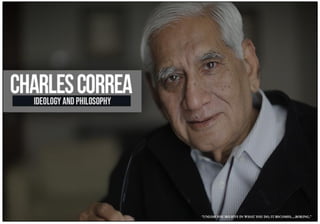
“UNLESS YOU BELIEVE IN WHAT YOU DO, IT BECOMES…..BORING,”
● India is a land of “ABUNDANT SUN” AND “PLENTIFUL
LABOUR”
● “OPEN-TO-SKY” and “TUBE DWELLING”
● Stepped INTERLOCKING OF SPACES.
● High climatic responsive building
● Caters to the “SOCIO-ECONOMIC”
● CORREA’S work in india shows a careful development,
understanding and adaptation of MODERNISM to a
non-western culture.
● CORREA’S early work attempt to explore a local vernacular
within a modern environment.
● CORREA’S land-use planning and community projects
continually try to go beyond typical solutions to third world
problems.
➢ CHARLES CORREA IDEAS AND PHILOSOPHY : ➢ CHARLES CORREA PRINCIPLES :
OPEN TO SKY CONCEPT
COURTYARD AND
TERRACES
PATHWAYS
WORK SPACES
THE MACHINE FOR
LIVING
CHARLES CORREA CONCEPTS
● INCREMENTALITY: In simple words, the incremental design is to split the design
problem into small problems and work on these problems one by one, while making
improvements in the solutions by getting feedback from the customer.
● PLURALISM: “Building pluralism” means designing for a respectful inclusion of
different cultural needs, practices, and traditions.
● PARTICIPATION:Participatory design (originally co-operative design, now often
co-design) is an approach to design attempting to actively involve all stakeholders (e.g.
employees, partners, customers, citizens, end users) in the design process to help ensure
the result meets their needs and is usable.
● OPEN TO SKY SPACE:Open to Sky (OTS) is an enclosed space within the building area
which is open to the sky as the name itself suggests. These spaces are called enclosed
because it is surrounded by the building units such as living room, kitchen and bedroom
from all the sides.
● DISAGGREGATION: It refers to breakdown of spaces into hierarchy .
● EQUITY: Equity means offering equal conditions for different users.
● INCOME GENERATION:It refers to designing a space providing socio economic spaces
which create a commercial space for users.
KALA ACADEMY
● Building Type : Institution Site Area : 6.3acres
● Site Gradient : Gentle Slope
● Venue of international film festival of India.Established in 1969 - prime institution for promotion of art and culture in Goa.
● Site is divided into main building service building, muktangan, parking
area, the exhibition space
● BUILDING STYLE AND CHARACTER
● Designed by ar. Charles correa.
● Importance to the process of moving through the spaces in a building.
● Built form has been kept low ranging from one to three floors.
● This is further enhanced by the use of parapet walls for upper floors,
which emphasize horizontally.
● The 'pergola 'above the entrance acts as an extension to the foyer of the
main auditorium and amphitheatre. Use of wafer slabs and parapet walls
● Extensive use of specially designed seating
● Interior walls are painted with pictures mostly depicting Konkanise
culture and create illusion.
● BUILDING LEVEL ZONING ‡ Building is divided into three zones:
Public, Administration, Academic
● Provided at different levels so as to avoid conflict between these zones
● Ground floor includes facilities like auditorium, Preview Theater,
amphitheatre, art gallery, and canteen etc, where public entry is invited
● First and second floors include academic and administration facilities.
● 3 groups of people using the building: Staff, students, audience
● Circulation linked to the zoning and has been segregated by separating
them through levels
● ground floor for audience functions and first and second floor for staff and
students with a necessary degree of inter linking.
CONCLUSION:
● The important part of his work is to get the locals involved by working with material they are familiar and benefiting from their knowledge on how to work with certain materials.
● He combines vernacular and modern concepts to create designs that support the cultural identity of a place and community and eventually lead to sustainable architecture.
● In his designs which range from low income high density housing to entire town ships. He pays special attention to air ventilation and to provide humane living environments in
india. The urban population is increasing twice as fast as in its rural area. He takes on this challenge and designs homes. Both for low and high incomes in mumbai . but even
designing small spaces within this high density environment. He incorporates a high level of privacy and also shapes and contributes to the community life within an apartment
building .
● He focused a lot on relationship between climate , material and culture .
● His work was distinguished by standard symmetrical rooms , modernist use of materials , distinctive concrete forms in various locations.
● He always places a higher value on traditional or vernacular architecture.
● The structures has modular simplicity by using simple materials stone floors, brick walls , wooden doors , lowered windows without glass and pitched roof.
● He connected the spaces with its rich cultural history while moving towards further in pathways , corridors, etc.

CHARLES CORREA.pdf

  • 1.
    “UNLESS YOU BELIEVEIN WHAT YOU DO, IT BECOMES…..BORING,”
  • 2.
    ● India isa land of “ABUNDANT SUN” AND “PLENTIFUL LABOUR” ● “OPEN-TO-SKY” and “TUBE DWELLING” ● Stepped INTERLOCKING OF SPACES. ● High climatic responsive building ● Caters to the “SOCIO-ECONOMIC” ● CORREA’S work in india shows a careful development, understanding and adaptation of MODERNISM to a non-western culture. ● CORREA’S early work attempt to explore a local vernacular within a modern environment. ● CORREA’S land-use planning and community projects continually try to go beyond typical solutions to third world problems. ➢ CHARLES CORREA IDEAS AND PHILOSOPHY : ➢ CHARLES CORREA PRINCIPLES : OPEN TO SKY CONCEPT COURTYARD AND TERRACES PATHWAYS WORK SPACES THE MACHINE FOR LIVING CHARLES CORREA CONCEPTS ● INCREMENTALITY: In simple words, the incremental design is to split the design problem into small problems and work on these problems one by one, while making improvements in the solutions by getting feedback from the customer. ● PLURALISM: “Building pluralism” means designing for a respectful inclusion of different cultural needs, practices, and traditions. ● PARTICIPATION:Participatory design (originally co-operative design, now often co-design) is an approach to design attempting to actively involve all stakeholders (e.g. employees, partners, customers, citizens, end users) in the design process to help ensure the result meets their needs and is usable. ● OPEN TO SKY SPACE:Open to Sky (OTS) is an enclosed space within the building area which is open to the sky as the name itself suggests. These spaces are called enclosed because it is surrounded by the building units such as living room, kitchen and bedroom from all the sides. ● DISAGGREGATION: It refers to breakdown of spaces into hierarchy . ● EQUITY: Equity means offering equal conditions for different users. ● INCOME GENERATION:It refers to designing a space providing socio economic spaces which create a commercial space for users.
  • 3.
    KALA ACADEMY ● BuildingType : Institution Site Area : 6.3acres ● Site Gradient : Gentle Slope ● Venue of international film festival of India.Established in 1969 - prime institution for promotion of art and culture in Goa. ● Site is divided into main building service building, muktangan, parking area, the exhibition space ● BUILDING STYLE AND CHARACTER ● Designed by ar. Charles correa. ● Importance to the process of moving through the spaces in a building. ● Built form has been kept low ranging from one to three floors. ● This is further enhanced by the use of parapet walls for upper floors, which emphasize horizontally. ● The 'pergola 'above the entrance acts as an extension to the foyer of the main auditorium and amphitheatre. Use of wafer slabs and parapet walls ● Extensive use of specially designed seating ● Interior walls are painted with pictures mostly depicting Konkanise culture and create illusion. ● BUILDING LEVEL ZONING ‡ Building is divided into three zones: Public, Administration, Academic ● Provided at different levels so as to avoid conflict between these zones ● Ground floor includes facilities like auditorium, Preview Theater, amphitheatre, art gallery, and canteen etc, where public entry is invited ● First and second floors include academic and administration facilities. ● 3 groups of people using the building: Staff, students, audience ● Circulation linked to the zoning and has been segregated by separating them through levels ● ground floor for audience functions and first and second floor for staff and students with a necessary degree of inter linking.
  • 5.
    CONCLUSION: ● The importantpart of his work is to get the locals involved by working with material they are familiar and benefiting from their knowledge on how to work with certain materials. ● He combines vernacular and modern concepts to create designs that support the cultural identity of a place and community and eventually lead to sustainable architecture. ● In his designs which range from low income high density housing to entire town ships. He pays special attention to air ventilation and to provide humane living environments in india. The urban population is increasing twice as fast as in its rural area. He takes on this challenge and designs homes. Both for low and high incomes in mumbai . but even designing small spaces within this high density environment. He incorporates a high level of privacy and also shapes and contributes to the community life within an apartment building . ● He focused a lot on relationship between climate , material and culture . ● His work was distinguished by standard symmetrical rooms , modernist use of materials , distinctive concrete forms in various locations. ● He always places a higher value on traditional or vernacular architecture. ● The structures has modular simplicity by using simple materials stone floors, brick walls , wooden doors , lowered windows without glass and pitched roof. ● He connected the spaces with its rich cultural history while moving towards further in pathways , corridors, etc.