 Is a phase a few years (around 3-4 years) after
the establishment of an educational institution
wherein government authorization to conduct
programs of study is granted for an indefinite
period of time
 Follows the PERMIT phase or the initial
government authorization given to the
educational institution upon establishment,
when all the minimum requirements for
operations have been complied with
 For Basic Education
 2010 Revised Manual of Regulations for Private
Schools in Basic Education
 Had some amendments in DepEd Order No. 11
series of 2011
 For Higher Education
 2008 Manual of Regulations for Private Higher
Education
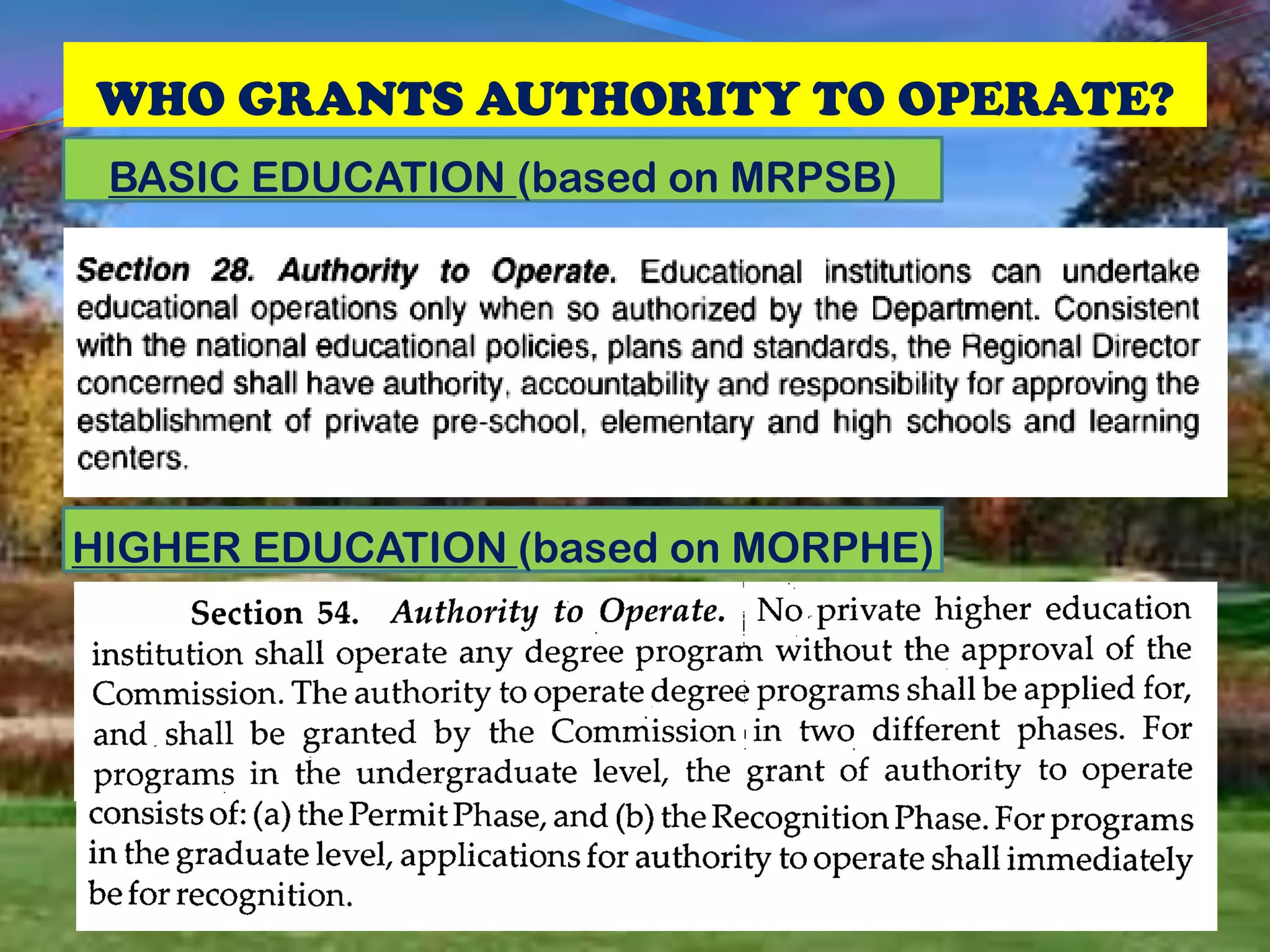
WHO GRANTS AUTHORITY TO OPERATE?
BASIC EDUCATION (based on MRPSB)
HIGHER EDUCATION (based on MORPHE)
PERMIT AND RECOGNITION
COMPARED
MRPSB, IV Section 29
Issuance of Permit in Basic Education
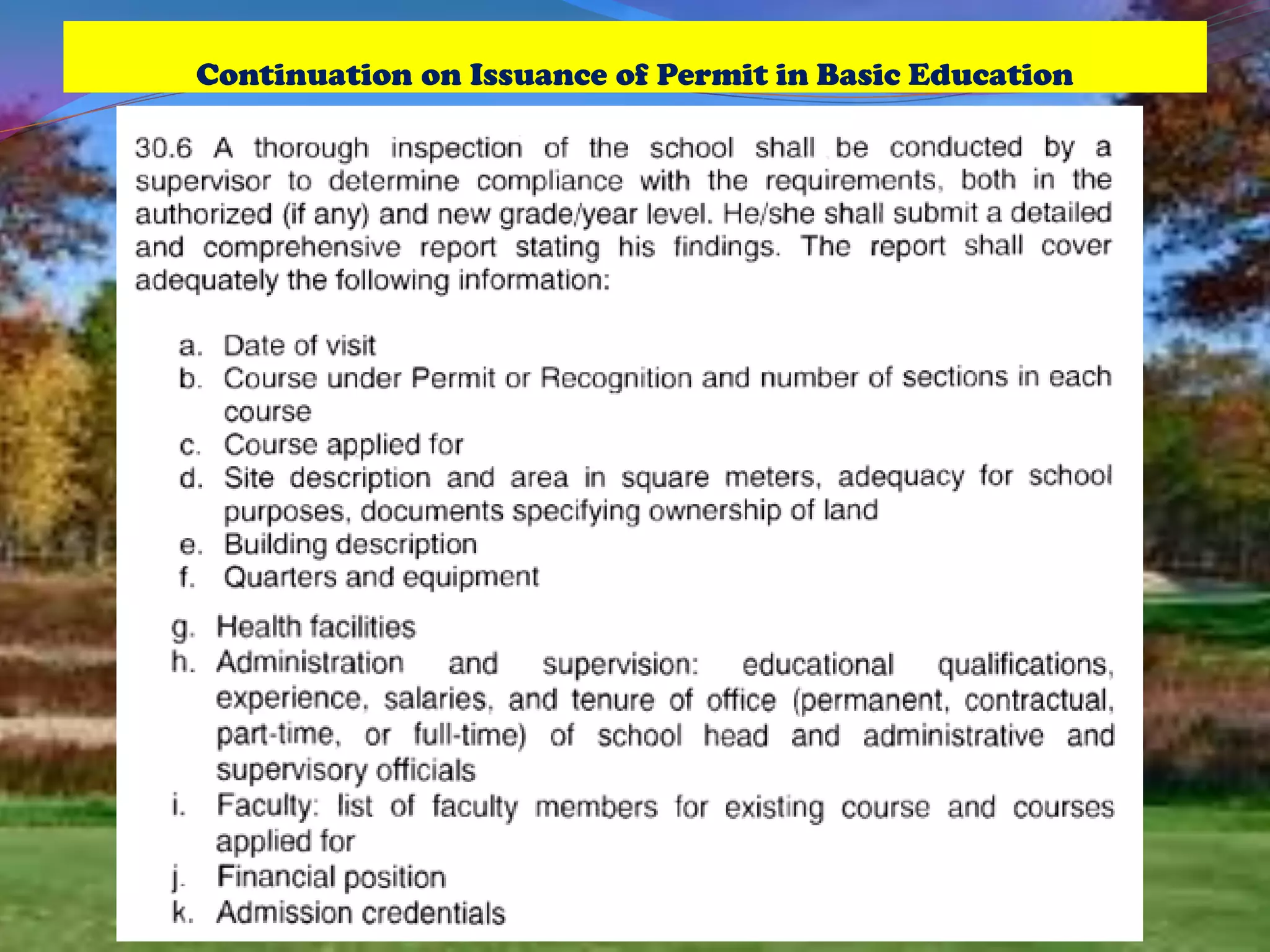
Continuation on Issuance of Permit in Basic Education
Grant and Effects of Recognition
Permit Phase in Higher Education
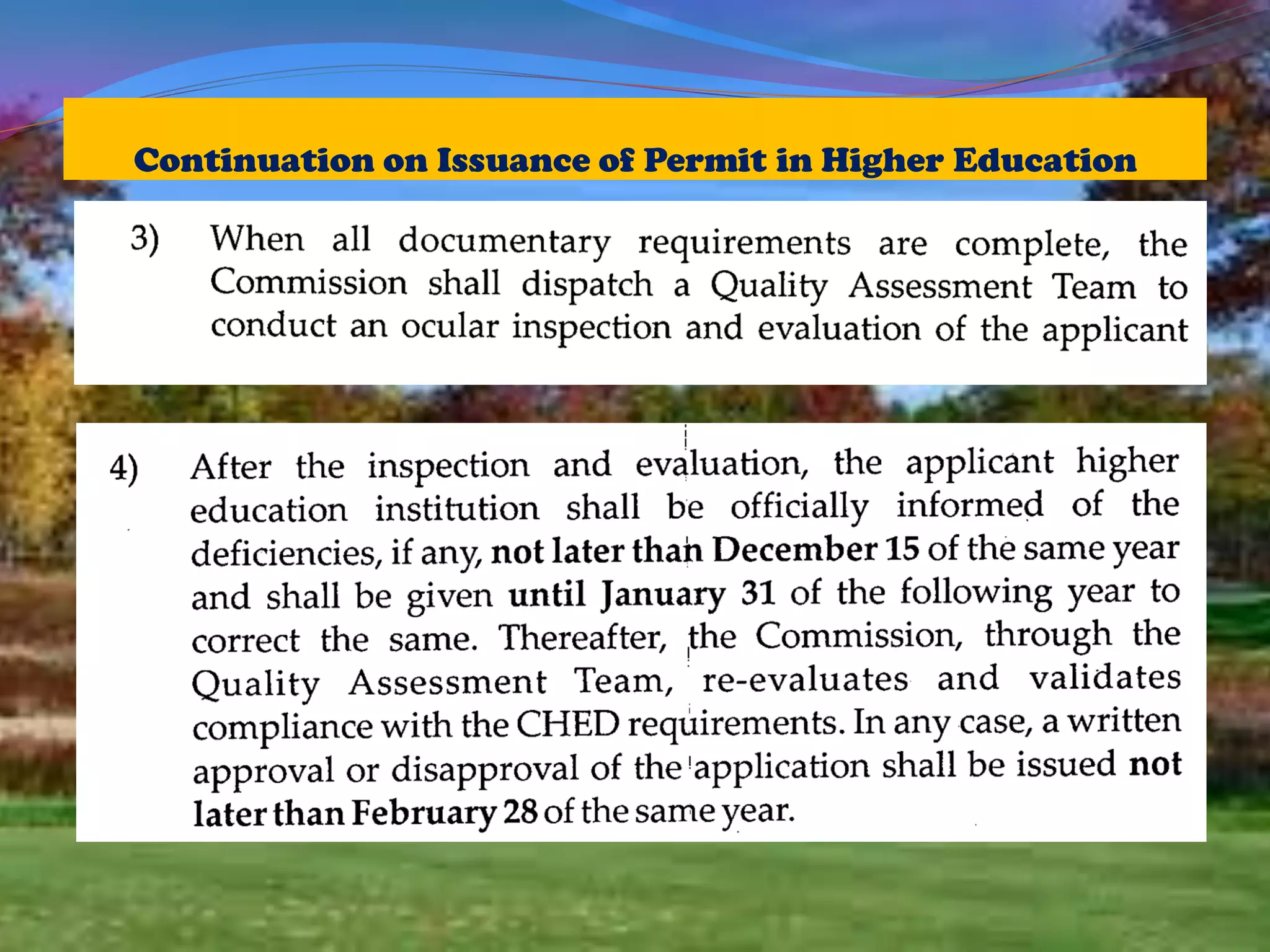
Continuation on Issuance of Permit in Higher Education
Recognition Phase
 Letter of Intent
 Valid SEC Registration, Articles of Incorporation, Business Permit, Proof of
Building Ownership, Fire Safety
 Feasibility Study
 Faculty Line-Up
 Dean should be doctorate degree holder in the field
 50% post-graduate degree holders in field of specialization to teach major
subjects
 with valid evidence of credentials
 Curriculum
 with prospectus with courses patterned after relevant CMO, course
descriptions, syllabi in prescribed format
 Library Holdings
 minimum of 5,000 books, journal subscriptions, internet connection for online
access
 with licensed librarian
 Accommodate 15% of population
 Room Provisions
 Classrooms, offices, student lounge, NSTP office
 Student Services
 provision for OSAS with VMG per office
 licensed physician, nurse and guidance counselors (1 per 1,000 students)
Recognition Phase:
Minimum Requirements
Effects of Recognition
for Private HEIs
WHAT IS ACCREDITATION?
 Accreditation is a concept of self-regulation which focuses on
self-study and evaluation and on the continuing improvement
of educational quality. It is both a process and a result.
 As a process, it is a form of peer review in which an association
of schools and colleges establishes sets of criteria and
procedures to encourage high maintenance of standards of
education among its affiliate members.
 As a result, it is a form of certification granted by a recognized
and authorized accrediting agency to an educational program
or to an educational institution as possessing certain
standards of quality which are over and above those
prescribed as minimum requirements for government
recognition. Accreditation is based upon an analysis of the
merits of educational operations in the context of the
institution's philosophy and objectives.
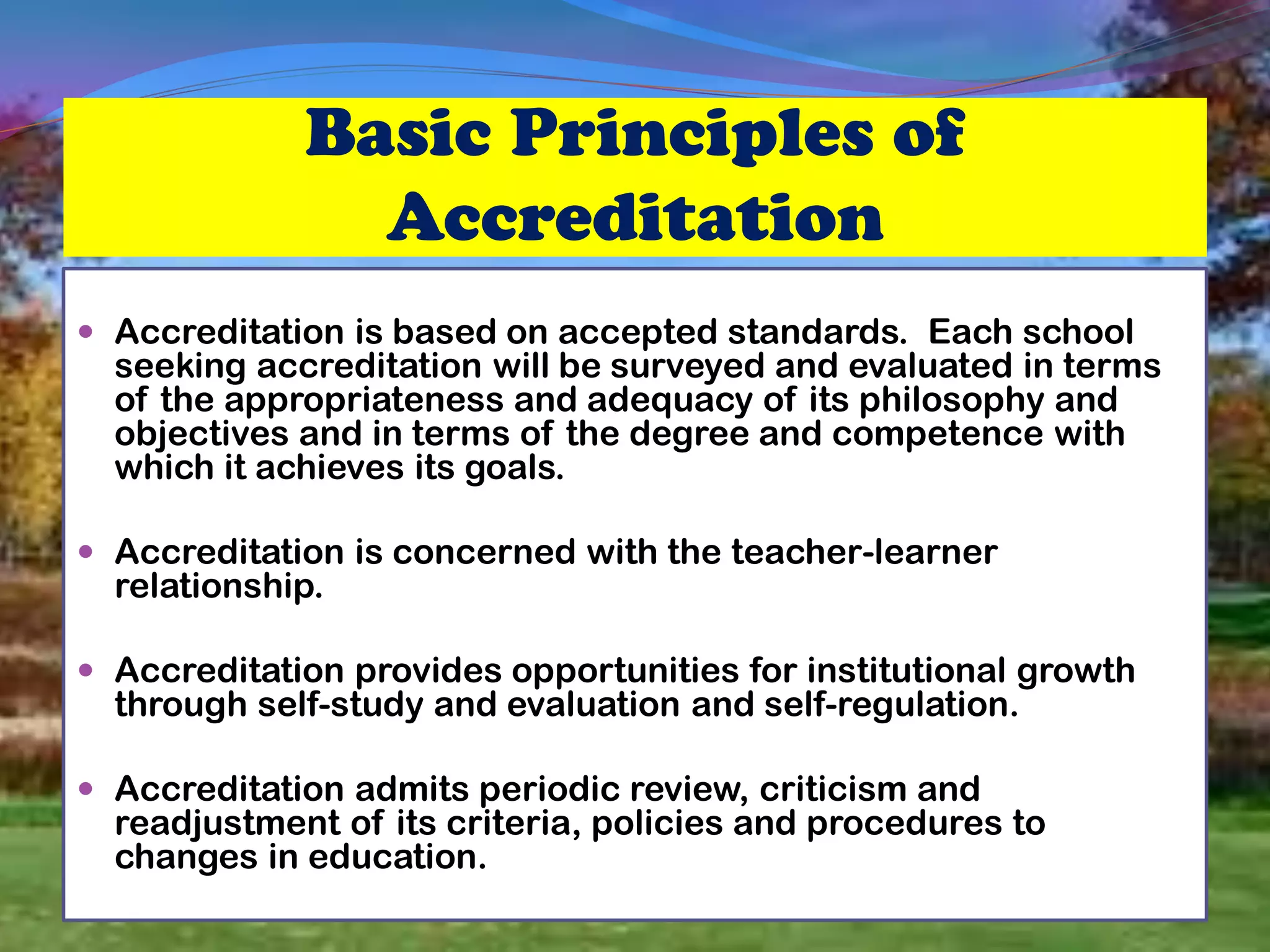
Basic Principles of
Accreditation
 Accreditation is based on accepted standards. Each school
seeking accreditation will be surveyed and evaluated in terms
of the appropriateness and adequacy of its philosophy and
objectives and in terms of the degree and competence with
which it achieves its goals.
 Accreditation is concerned with the teacher-learner
relationship.
 Accreditation provides opportunities for institutional growth
through self-study and evaluation and self-regulation.
 Accreditation admits periodic review, criticism and
readjustment of its criteria, policies and procedures to
changes in education.
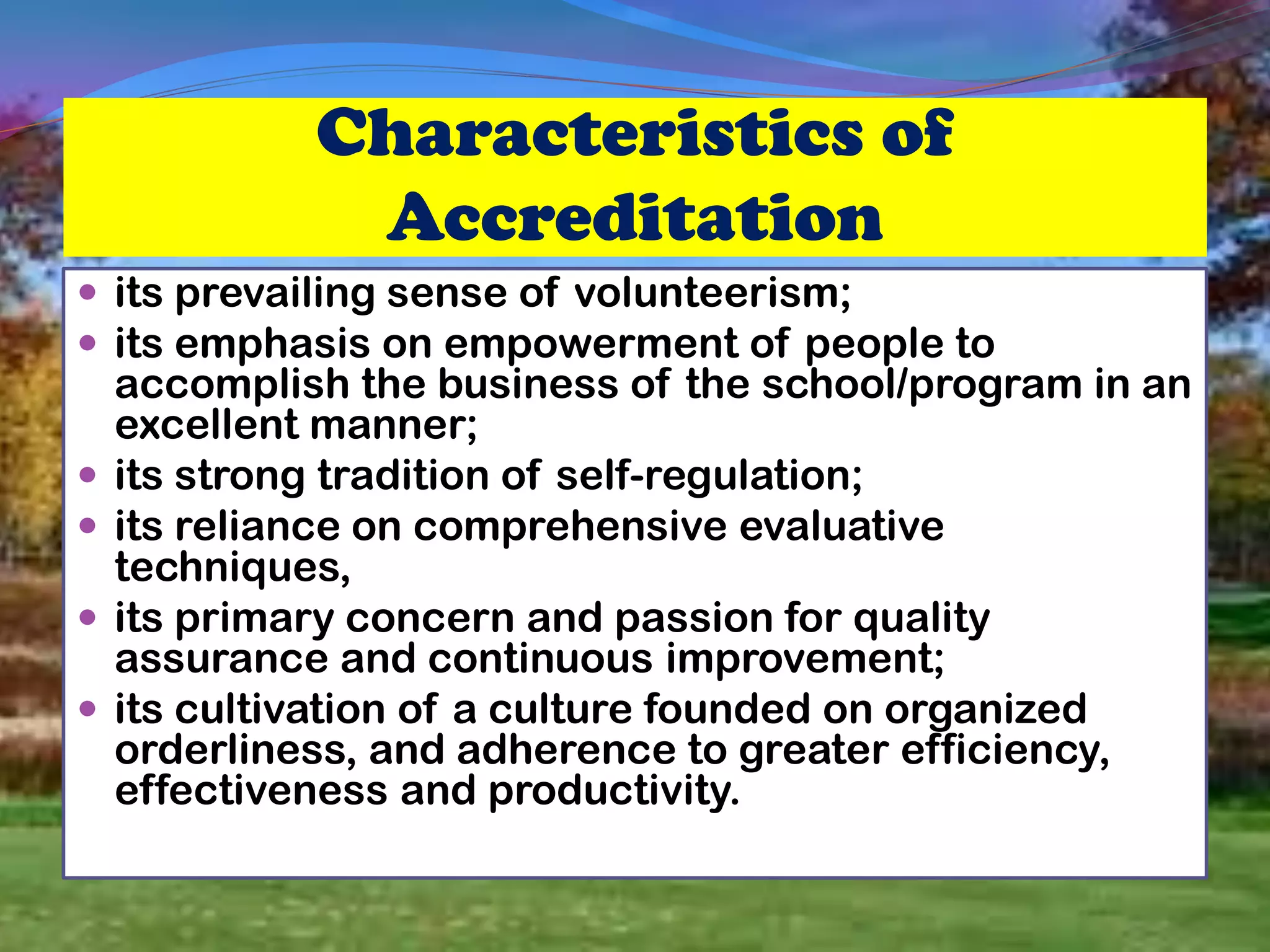
Characteristics of
Accreditation
 its prevailing sense of volunteerism;
 its emphasis on empowerment of people to
accomplish the business of the school/program in an
excellent manner;
 its strong tradition of self-regulation;
 its reliance on comprehensive evaluative
techniques,
 its primary concern and passion for quality
assurance and continuous improvement;
 its cultivation of a culture founded on organized
orderliness, and adherence to greater efficiency,
effectiveness and productivity.
Requirements for
Accreditation
 To be accredited by an authorized accrediting agency, an
educational institution must demonstrate that it satisfies
the following requirements:
 it has formally adopted an appropriate vision and mission;
 it offers educational programs (or curricula) consistent with
its vision and mission;
 it has a viable number of students actively pursuing courses
at the time of evaluation;
 it has a charter or legitimate authority to award certificates,
diplomas or degrees to each person who has successfully
complied with the requirements of an educational program;
 it has formally designated a chief executive officer or has
formally organized and staffed a chief executive office;
Requirements for
Accreditation
 it has a duly constituted governing board
 it has documented its funding base, financial resources and
plans for financial development, adequate to carry out its
stated purposes;
 it has financial statements that are externally audited on a
regular schedule by a certified public accountant or agency;
 it makes freely available to all interested persons accurate,
fair, and substantially complete description of its program,
activities and procedures; and
 it has graduated at least three batches before the evaluation
for accredited status.
Legal Bases and History of Accreditation
in the Philippines
 In 1970, the Presidential Commission to Survey Philippine Education (PCSPE)
submitted policy recommendations to improve and strengthen higher
education.
 Among others, it recommended that schools be encouraged to join or organize
accrediting associations, and that a Federation of Accrediting Agencies (FAAP)
be established.
 The Commission Report better known as the Integrated Reorganization Plan
(IRP), was approved by President Marcos in his PD 201 and subsequently
issued Presidential Decree 6-A, otherwise known as the Educational
Development Act of 1972, making accreditation one of the means of upgrading
standards of education in the Philippines and providing therein a program of
financial assistance.
 Laws and regulations have been issued to articulate the government’s policy
on accreditation. BATAS PAMBANSA 232;R.A. 7722, Creating the Commission
on Higher Education (CHED): DepEd Order 32, s 2005; CHED Order 1, s 2005
and the 2008 Manual of Regulations for Private Higher Education and 2010
Manual of Regulations for Private Schools in Basic Education, have stipulated
voluntary accreditation as means of ensuring quality education.
 Recently, DepEd Order No. 20 series of 2013 was released to provide
guidelines for the Philippine Accreditation System for Basic Education
(PASBE), an effort to promote the quality of education in public schools as
much as in the private schools
ACCREDITATION
IN BASIC EDUCATION
ACCREDITATION
IN BASIC EDUCATION
ACCREDITATION
IN BASIC EDUCATION
ACCREDITATION
IN BASIC EDUCATION
Accreditation Process (PASBE)
PASBE Accreditation Levels
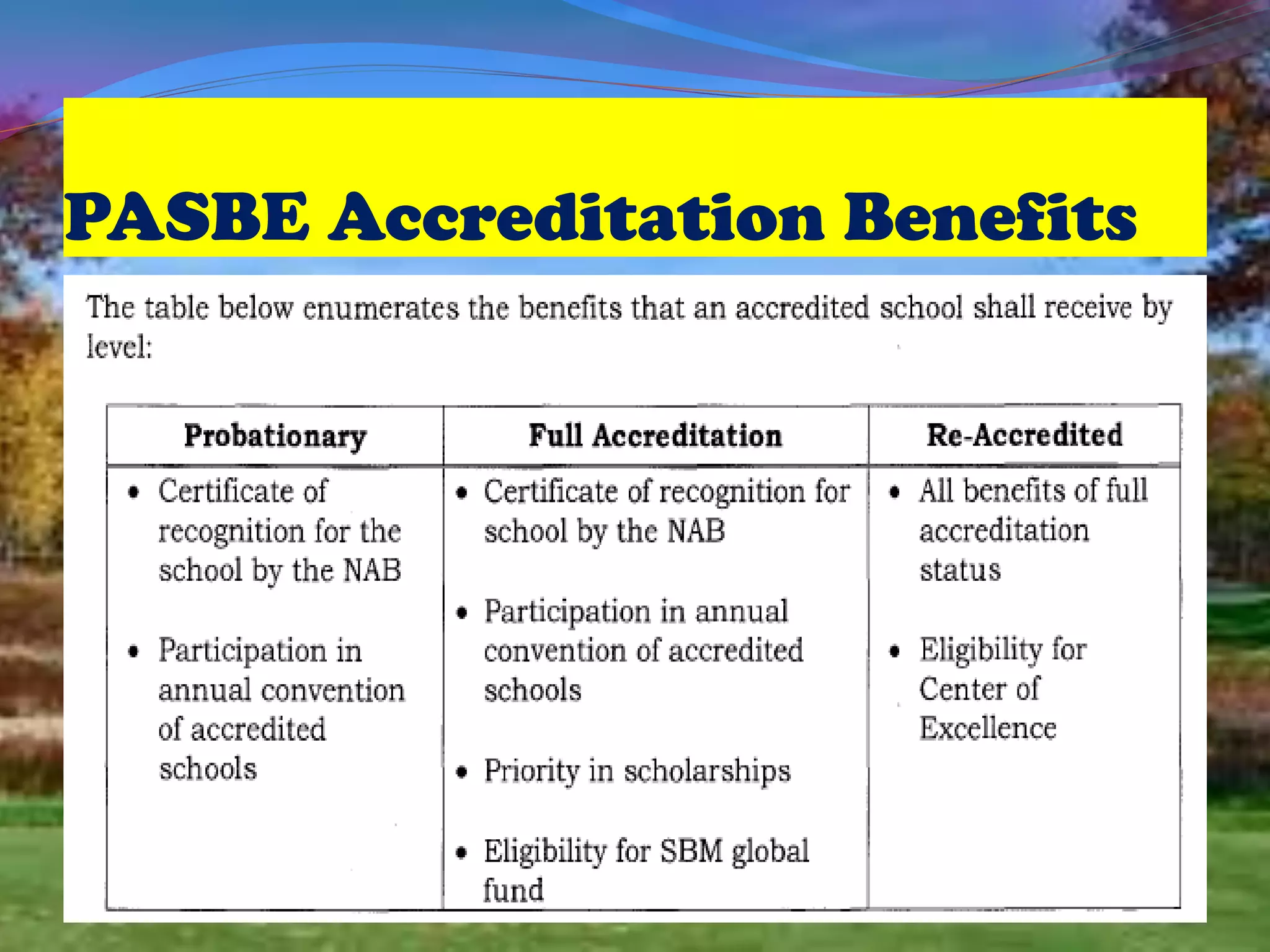
PASBE Accreditation Benefits
ACCREDITATION
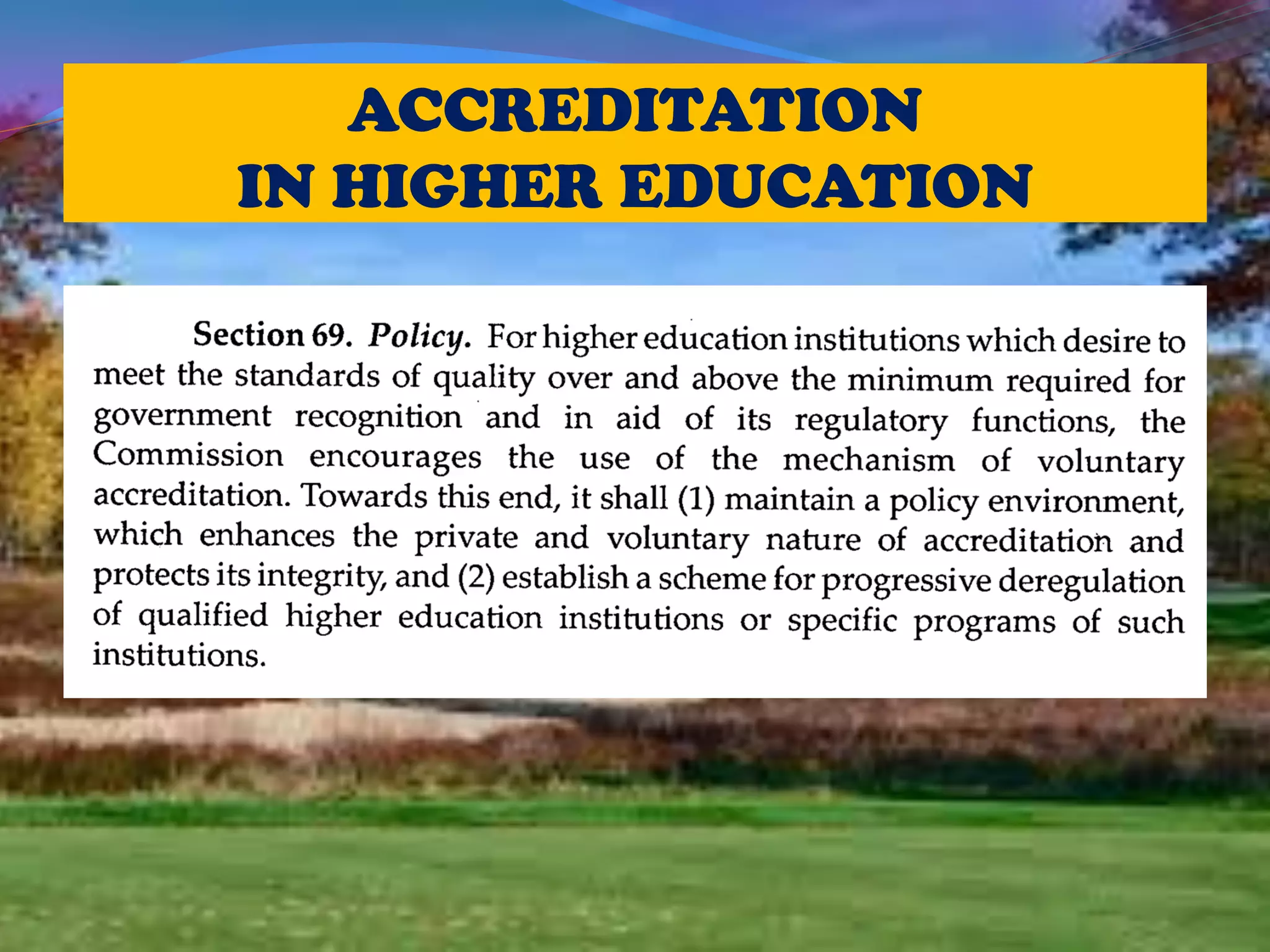
IN HIGHER EDUCATION
ACCREDITATION
IN HIGHER EDUCATION
Other Certifying Agencies
 Accrediting Agency of Chartered Colleges and
Universities in the Philippines (AACCUP), Inc.
 Association of Local Colleges and Universities
Commission on Accreditation, Inc. (ALCUCOA)
 PAASCU and AACUP are members of the
International Network for Quality Assurance Agencies
in Higher Education (INQAAHE)
 AACUP AND ALCUCOA are members of the National
Network of Quality Assurance Agencies, Inc.
(NNQAA)
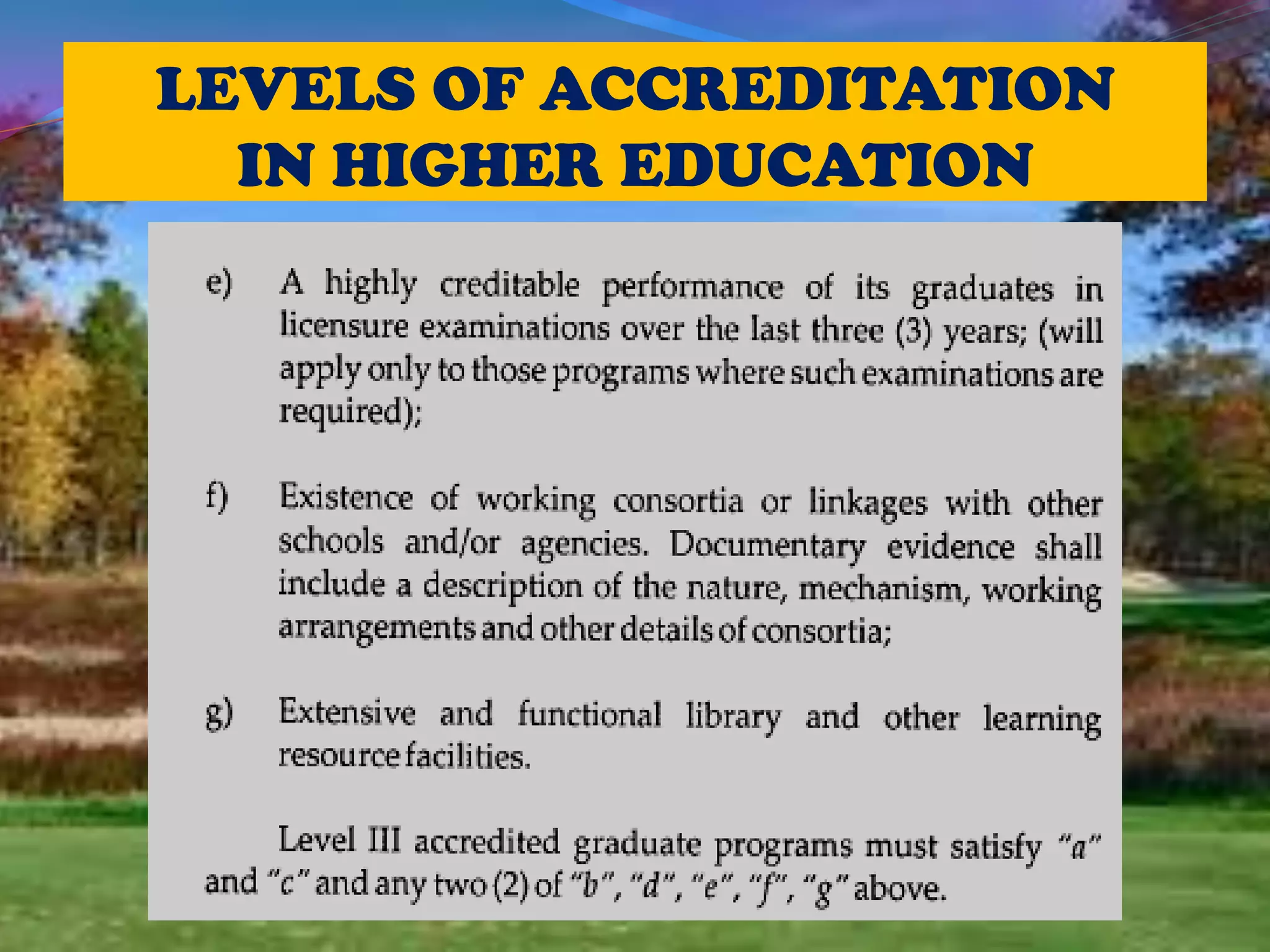
LEVELS OF ACCREDITATION
IN HIGHER EDUCATION
LEVELS OF ACCREDITATION
IN HIGHER EDUCATION
LEVELS OF ACCREDITATION
IN HIGHER EDUCATION
LEVELS OF ACCREDITATION
IN HIGHER EDUCATION
LEVELS OF ACCREDITATION
IN HIGHER EDUCATION
LEVELS OF ACCREDITATION
IN HIGHER EDUCATION
BENEFITS OF
ACCREDITATION
 Candidate Status
 No special benefits
 Level I/Level II: Accredited Status
 a. full administrative deregulation,
 b. financial deregulation in terms of setting of tuition
and other fees and charges
 c. authority to revise the curriculum without CHED
approval
 d. priority in the awards of grants/subsidies or funding
assistance from CHED/DEPED
BENEFITS OF
ACCREDITATION
 LEVEL III: Reaccredited Status
 a. all the benefits for level I/II
 b. authority to offer new courses allied to existing level
III courses without need for prior approval
 c. privilege to offer new graduate programs
 d. privilege to offer open learning/distance education
 e. privilege to offer extension classes and transnational
education
BENEFITS OF
ACCREDITATION
 LEVEL IV: Accredited Status
 a. all the benefits for level I,II and III
 b. Grant of full autonomy for the program for the
duration of its Level IV accredited status.
 c. Authority to offer new graduate programs allied to
existing Level IV courses, open learning/distance
education and extension classes without need for prior
approval by CHED provided that the concerned
CHEDRO is duly informed.

Recognition and accreditation

  • 2.
     Is aphase a few years (around 3-4 years) after the establishment of an educational institution wherein government authorization to conduct programs of study is granted for an indefinite period of time  Follows the PERMIT phase or the initial government authorization given to the educational institution upon establishment, when all the minimum requirements for operations have been complied with
  • 3.
     For BasicEducation  2010 Revised Manual of Regulations for Private Schools in Basic Education  Had some amendments in DepEd Order No. 11 series of 2011  For Higher Education  2008 Manual of Regulations for Private Higher Education
  • 4.
    WHO GRANTS AUTHORITYTO OPERATE? BASIC EDUCATION (based on MRPSB) HIGHER EDUCATION (based on MORPHE)
  • 5.
  • 6.
    Issuance of Permitin Basic Education
  • 7.
    Continuation on Issuanceof Permit in Basic Education
  • 8.
    Continuation on Issuanceof Permit in Basic Education
  • 9.
    Continuation on Issuanceof Permit in Basic Education
  • 10.
    Continuation on Issuanceof Permit in Basic Education
  • 11.
    Grant and Effectsof Recognition
  • 12.
    Permit Phase inHigher Education
  • 13.
    Continuation on Issuanceof Permit in Higher Education
  • 14.
    Continuation on Issuanceof Permit in Higher Education
  • 15.
  • 16.
     Letter ofIntent  Valid SEC Registration, Articles of Incorporation, Business Permit, Proof of Building Ownership, Fire Safety  Feasibility Study  Faculty Line-Up  Dean should be doctorate degree holder in the field  50% post-graduate degree holders in field of specialization to teach major subjects  with valid evidence of credentials  Curriculum  with prospectus with courses patterned after relevant CMO, course descriptions, syllabi in prescribed format  Library Holdings  minimum of 5,000 books, journal subscriptions, internet connection for online access  with licensed librarian  Accommodate 15% of population  Room Provisions  Classrooms, offices, student lounge, NSTP office  Student Services  provision for OSAS with VMG per office  licensed physician, nurse and guidance counselors (1 per 1,000 students) Recognition Phase: Minimum Requirements
  • 17.
  • 18.
    WHAT IS ACCREDITATION? Accreditation is a concept of self-regulation which focuses on self-study and evaluation and on the continuing improvement of educational quality. It is both a process and a result.  As a process, it is a form of peer review in which an association of schools and colleges establishes sets of criteria and procedures to encourage high maintenance of standards of education among its affiliate members.  As a result, it is a form of certification granted by a recognized and authorized accrediting agency to an educational program or to an educational institution as possessing certain standards of quality which are over and above those prescribed as minimum requirements for government recognition. Accreditation is based upon an analysis of the merits of educational operations in the context of the institution's philosophy and objectives.
  • 19.
    Basic Principles of Accreditation Accreditation is based on accepted standards. Each school seeking accreditation will be surveyed and evaluated in terms of the appropriateness and adequacy of its philosophy and objectives and in terms of the degree and competence with which it achieves its goals.  Accreditation is concerned with the teacher-learner relationship.  Accreditation provides opportunities for institutional growth through self-study and evaluation and self-regulation.  Accreditation admits periodic review, criticism and readjustment of its criteria, policies and procedures to changes in education.
  • 20.
    Characteristics of Accreditation  itsprevailing sense of volunteerism;  its emphasis on empowerment of people to accomplish the business of the school/program in an excellent manner;  its strong tradition of self-regulation;  its reliance on comprehensive evaluative techniques,  its primary concern and passion for quality assurance and continuous improvement;  its cultivation of a culture founded on organized orderliness, and adherence to greater efficiency, effectiveness and productivity.
  • 21.
    Requirements for Accreditation  Tobe accredited by an authorized accrediting agency, an educational institution must demonstrate that it satisfies the following requirements:  it has formally adopted an appropriate vision and mission;  it offers educational programs (or curricula) consistent with its vision and mission;  it has a viable number of students actively pursuing courses at the time of evaluation;  it has a charter or legitimate authority to award certificates, diplomas or degrees to each person who has successfully complied with the requirements of an educational program;  it has formally designated a chief executive officer or has formally organized and staffed a chief executive office;
  • 22.
    Requirements for Accreditation  ithas a duly constituted governing board  it has documented its funding base, financial resources and plans for financial development, adequate to carry out its stated purposes;  it has financial statements that are externally audited on a regular schedule by a certified public accountant or agency;  it makes freely available to all interested persons accurate, fair, and substantially complete description of its program, activities and procedures; and  it has graduated at least three batches before the evaluation for accredited status.
  • 23.
    Legal Bases andHistory of Accreditation in the Philippines  In 1970, the Presidential Commission to Survey Philippine Education (PCSPE) submitted policy recommendations to improve and strengthen higher education.  Among others, it recommended that schools be encouraged to join or organize accrediting associations, and that a Federation of Accrediting Agencies (FAAP) be established.  The Commission Report better known as the Integrated Reorganization Plan (IRP), was approved by President Marcos in his PD 201 and subsequently issued Presidential Decree 6-A, otherwise known as the Educational Development Act of 1972, making accreditation one of the means of upgrading standards of education in the Philippines and providing therein a program of financial assistance.  Laws and regulations have been issued to articulate the government’s policy on accreditation. BATAS PAMBANSA 232;R.A. 7722, Creating the Commission on Higher Education (CHED): DepEd Order 32, s 2005; CHED Order 1, s 2005 and the 2008 Manual of Regulations for Private Higher Education and 2010 Manual of Regulations for Private Schools in Basic Education, have stipulated voluntary accreditation as means of ensuring quality education.  Recently, DepEd Order No. 20 series of 2013 was released to provide guidelines for the Philippine Accreditation System for Basic Education (PASBE), an effort to promote the quality of education in public schools as much as in the private schools
  • 24.
  • 25.
  • 26.
  • 27.
  • 28.
  • 29.
  • 30.
  • 31.
  • 32.
  • 33.
    Other Certifying Agencies Accrediting Agency of Chartered Colleges and Universities in the Philippines (AACCUP), Inc.  Association of Local Colleges and Universities Commission on Accreditation, Inc. (ALCUCOA)  PAASCU and AACUP are members of the International Network for Quality Assurance Agencies in Higher Education (INQAAHE)  AACUP AND ALCUCOA are members of the National Network of Quality Assurance Agencies, Inc. (NNQAA)
  • 34.
  • 35.
  • 36.
  • 37.
  • 38.
  • 39.
  • 40.
    BENEFITS OF ACCREDITATION  CandidateStatus  No special benefits  Level I/Level II: Accredited Status  a. full administrative deregulation,  b. financial deregulation in terms of setting of tuition and other fees and charges  c. authority to revise the curriculum without CHED approval  d. priority in the awards of grants/subsidies or funding assistance from CHED/DEPED
  • 41.
    BENEFITS OF ACCREDITATION  LEVELIII: Reaccredited Status  a. all the benefits for level I/II  b. authority to offer new courses allied to existing level III courses without need for prior approval  c. privilege to offer new graduate programs  d. privilege to offer open learning/distance education  e. privilege to offer extension classes and transnational education
  • 42.
    BENEFITS OF ACCREDITATION  LEVELIV: Accredited Status  a. all the benefits for level I,II and III  b. Grant of full autonomy for the program for the duration of its Level IV accredited status.  c. Authority to offer new graduate programs allied to existing Level IV courses, open learning/distance education and extension classes without need for prior approval by CHED provided that the concerned CHEDRO is duly informed.