Supriya Chougule, 
Assistant Professor, 
D.R.K. College of Commerce, Kolhapur
 Today in the era of globalisation the nations are changing their 
scenario in many ways and we are part of that change. As From 1st 
April, 2011 we had accepted to converge our Indian Accounting 
Standards into International Financial Reporting Standards. Now it 
is at the first stage because this convergence process is at beginning. 
IFRS is applicable to listed entities at Nifty and Sensex in India and 
Companies whose shares or other securities listed on stock 
exchange outside India and lastly on companies whether listed or 
not who have net worth in excess of Rs. 1000 crores.
 In the present paper attempt has been made to highlight 
challenges before accountancy teachers due to implementation 
of IFRS in India.
 Increasing complexity of business operations and 
globalisation of capital markets make mandatory a single set 
of high quality reporting standards. The government has 
adopted a policy of enabling disclosure of company accounts 
in a transparent manner at par with widely accepted 
international practices, through a process of convergence with 
International Financial Reporting Standards (IFRS).
 IFRS is a single set of high quality, understandable and 
enforceable global accounting standards. It is a "principles 
based" set of standards which are drafted lucidly and are easy 
to understand and apply.
 Convergence means harmonisation of national GAAP with 
IFRS through design and maintenance of accounting standards 
in a way that financial statements prepared with national 
accounting standards are in compliance with IFRS.
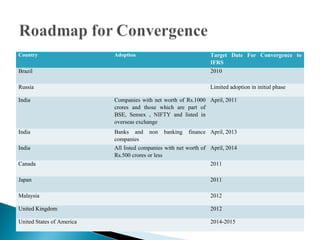
Country Adoption Target Date For Convergence to 
IFRS 
Brazil 2010 
Russia Limited adoption in initial phase 
India Companies with net worth of Rs.1000 
crores and those which are part of 
BSE, Sensex , NIFTY and listed in 
overseas exchange 
April, 2011 
India Banks and non banking finance 
companies 
April, 2013 
India All listed companies with net worth of 
Rs.500 crores or less 
April, 2014 
Canada 2011 
Japan 2011 
Malaysia 2012 
United Kingdom 2012 
United States of America 2014-2015
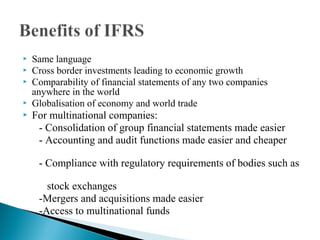
 Same language 
 Cross border investments leading to economic growth 
 Comparability of financial statements of any two companies 
anywhere in the world 
 Globalisation of economy and world trade 
 For multinational companies: 
- Consolidation of group financial statements made easier 
- Accounting and audit functions made easier and cheaper 
- Compliance with regulatory requirements of bodies such as 
stock exchanges 
-Mergers and acquisitions made easier 
-Access to multinational funds
 The job of governments and standard setters in the developing 
countries made easier 
 The job of tax authorities made easier 
 Time and money saved by international professional accounting firms 
in planning and execution of accounting and audits. 
 Benefits for national regulatory bodies 
- Improved regulatory oversight and enforcement 
- A higher standard of financial disclosure 
- Better information for market participants to underpin 
disclosure based regulation 
- Better ability to attract and monitor listings by foreign 
companies Administrative
 Reduction in Costs of accessing the capital markets around the 
world 
 Benefits for policy makers 
-Strengthened and more effective Indian capital market 
-Better access to the global capital markets 
-Promotion of cross-border investments
 Need to bring changes in Curriculum/ Syllabi 
 Create Awareness 
 Need for Training to teachers 
 Need to consider practical application of IFRS 
 How to get Information?
 Industry Liasioning 
 Non availability of study Material 
 Less costly online courses 
 Need to bring healthy coordination between Educational 
Institutes and ICAI 
 Huge need for Research and Development
 Yet there is lack of understanding about impact of IFRS on 
financial statements. Hence it is responsibility of educational 
faculty to come out with some writings to facilitate 
information about IFRS. 
 Separate courses should be started in the universities and 
affiliated college on the International Financial Reporting 
Standards. 
 Separate text books containing case studies along with some 
practical examples should be prepared by the academicians.
 There is need to undertake the projects for the research work on IFRS and 
universities, UGC should give some funds on the research work of IFRS. 
 Universities and colleges should revise their syllabi and curriculum at 
various levels like B.Com, M.Com, M.B.A. and other Accounting Courses 
and include IFRS as a part of syllabus. 
 Academic institutes should organise the conferences, seminars, workshops 
on IFRS and related issues along with interaction or with the coordination 
of ICAI. 
 There is huge need to train the accountancy teachers, students, and 
officials so, training camps should be organised by the authority bodies. 
 Educational material should be prepared focussing on important issues 
related to IFRS.
Thank You

IFRS ppt

  • 1.
    Supriya Chougule, AssistantProfessor, D.R.K. College of Commerce, Kolhapur
  • 2.
     Today inthe era of globalisation the nations are changing their scenario in many ways and we are part of that change. As From 1st April, 2011 we had accepted to converge our Indian Accounting Standards into International Financial Reporting Standards. Now it is at the first stage because this convergence process is at beginning. IFRS is applicable to listed entities at Nifty and Sensex in India and Companies whose shares or other securities listed on stock exchange outside India and lastly on companies whether listed or not who have net worth in excess of Rs. 1000 crores.
  • 3.
     In thepresent paper attempt has been made to highlight challenges before accountancy teachers due to implementation of IFRS in India.
  • 4.
     Increasing complexityof business operations and globalisation of capital markets make mandatory a single set of high quality reporting standards. The government has adopted a policy of enabling disclosure of company accounts in a transparent manner at par with widely accepted international practices, through a process of convergence with International Financial Reporting Standards (IFRS).
  • 5.
     IFRS isa single set of high quality, understandable and enforceable global accounting standards. It is a "principles based" set of standards which are drafted lucidly and are easy to understand and apply.
  • 6.
     Convergence meansharmonisation of national GAAP with IFRS through design and maintenance of accounting standards in a way that financial statements prepared with national accounting standards are in compliance with IFRS.
  • 7.
    Country Adoption TargetDate For Convergence to IFRS Brazil 2010 Russia Limited adoption in initial phase India Companies with net worth of Rs.1000 crores and those which are part of BSE, Sensex , NIFTY and listed in overseas exchange April, 2011 India Banks and non banking finance companies April, 2013 India All listed companies with net worth of Rs.500 crores or less April, 2014 Canada 2011 Japan 2011 Malaysia 2012 United Kingdom 2012 United States of America 2014-2015
  • 8.
     Same language  Cross border investments leading to economic growth  Comparability of financial statements of any two companies anywhere in the world  Globalisation of economy and world trade  For multinational companies: - Consolidation of group financial statements made easier - Accounting and audit functions made easier and cheaper - Compliance with regulatory requirements of bodies such as stock exchanges -Mergers and acquisitions made easier -Access to multinational funds
  • 9.
     The jobof governments and standard setters in the developing countries made easier  The job of tax authorities made easier  Time and money saved by international professional accounting firms in planning and execution of accounting and audits.  Benefits for national regulatory bodies - Improved regulatory oversight and enforcement - A higher standard of financial disclosure - Better information for market participants to underpin disclosure based regulation - Better ability to attract and monitor listings by foreign companies Administrative
  • 10.
     Reduction inCosts of accessing the capital markets around the world  Benefits for policy makers -Strengthened and more effective Indian capital market -Better access to the global capital markets -Promotion of cross-border investments
  • 11.
     Need tobring changes in Curriculum/ Syllabi  Create Awareness  Need for Training to teachers  Need to consider practical application of IFRS  How to get Information?
  • 12.
     Industry Liasioning  Non availability of study Material  Less costly online courses  Need to bring healthy coordination between Educational Institutes and ICAI  Huge need for Research and Development
  • 13.
     Yet thereis lack of understanding about impact of IFRS on financial statements. Hence it is responsibility of educational faculty to come out with some writings to facilitate information about IFRS.  Separate courses should be started in the universities and affiliated college on the International Financial Reporting Standards.  Separate text books containing case studies along with some practical examples should be prepared by the academicians.
  • 14.
     There isneed to undertake the projects for the research work on IFRS and universities, UGC should give some funds on the research work of IFRS.  Universities and colleges should revise their syllabi and curriculum at various levels like B.Com, M.Com, M.B.A. and other Accounting Courses and include IFRS as a part of syllabus.  Academic institutes should organise the conferences, seminars, workshops on IFRS and related issues along with interaction or with the coordination of ICAI.  There is huge need to train the accountancy teachers, students, and officials so, training camps should be organised by the authority bodies.  Educational material should be prepared focussing on important issues related to IFRS.
  • 15.