FOCUS ON SETUP SHOP & DOING BUSINESS
TABLE OF CONTENT
SU M MA R Y …… … …… …… … …… … …… … …… …… … …… … …… … …… …… … …… … …..                                                                              5

KE Y F A C TS ...... ..... ...... .. ........ ...... ...... ...... ...... ... ........ ...... ...... ...... ...... . .. ........ ...... ...... .   8


SO CI A L

               INT R OD U C TIO N … … … …… … …… … …… … …… …… … …… … …… … …… …… …..                                                                 10

               HIS T OR Y O VE R VIE W … …… … …… … …… … …… …… … …… … …… … …… …… …..                                                                11

               DE M O GR APH I CS … …… …… … …… … …… … …… …… … …… … …… … …… …… ….                                                                   12

               GE O G R APHI C AL SE T TIN G … …… … …… … …… … …… … …… … …… … …… …… ….                                                              15

               MIN RA L RE SO U R CE S … …… … …… … …… … …… …… … …… … …… … …… …… ….                                                                 16

               CO MM UN IC A TI ON S YS TE M … … …… … …… … … …… … …… … …… … …… …… ….                                                               17

               SO CI AL IN S T I TU T ION … …… … …… … …… … …… …… … …… … …… … …… …… …                                                               18

               E DU C A TI ON …… … …… …… … …… … …… … …… …… … …… … …… … …… …… …                                                                     19

               POL T IC AL S Y S TE M … … …… … …… … …… … …… …… … …… … …… … …… …… ….                                                                21

               LE G AL S Y S TE M … …… … …… … …… … …… … …… …… … …… … …… … …… …… …                                                                  23

               HU MAN AN D THE UN IVE RSE … …… … …… … …… …… … …… … …… … …… …… …                                                                    24

               LIV IN G CON DI T ION S … …… … …… … …… … …… …… … …… … …… … …… …… ….                                                                 26

               BU SI N E S S C US T OM S AN D P RA C TI CE S …… … …… …… … …… … …… … …… …… …                                                        27

               CON C LU SI ON …… … … …… … …… … …… … …… …… … …… … …… … …… …… …..                                                                    28


EC ON OM Y

GE O R GI A PE R FO RM AN CE … …… … …… … …… … …… … …… … …… … …… …… … …… … …..                                                                      30

               E CON O MI C A C TI VI T Y … …… … …… … …… … …… …… … …… … …… … …… …… ….                                                              31

               FO RE I GN DI RE C T IN VE S T ME N T …… … …… … …… …… … …… … …… … …… …… …                                                           34

               T RD AE IN DI C A TIO R S … …… … …… … …… … …… …… … …… … …… … …… …… ….                                                               36

               T RD AE R E S T RI CA T ION S …… … …… … …… … …… …… … …… … …… … …… …… ….                                                             40

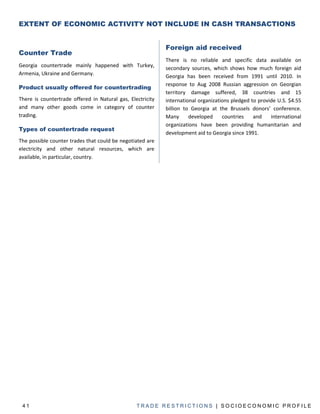
               E X TE N T O F E CO N O MI C A C TI VI T Y N O T IN CL U DE I N C ASH TR ANS A C TI ON … …… …                                       41

               DE VE LO PME N T IN SC IE N CE AND TE CH NOL O G Y … …… … …… … …… … …… …… …                                                         42


A PP EN D IC E S

               APPE N DI X -1 D OIN G B US I N E SS IN GE OR G IA … … …… … …… … …… … …… …… …. .                                                    43
APPE N DI X -2 HI S TO R Y TI ME LINE : GE OR G IA … … …… … …… … …… … …… …… … ..   45

            APPE N DI X -3 M AP OF C O UN TR Y … … …… … …… …… … …… … …… … …… …… …..            49

RE FE RE N CE …… … …… …… … …… … …… … …… …… … …… … …… … …… …… … …… … …..                        50


TABLE INDEX
TABLE 1         DEMOGRAPHICAS INDICATORS ……………………………………………………………….                             12
TABLE 1.2       DISTRIBUTION OF POPULATION ………………………………………………………………                            13
TABLE 2         MINERAL RESOURCES …………………………………………………………………………                                 16
TABLE 3         COMMUNICATION MEDIUMS ………………………………………………………………...                              17
TABLE 4         SCHOOL ENROLMENT …………………………………………………………………………                                  20
TABLE 5         POLITICAL STRUCTURE ………………………………………………………………………..                              21
TABLE 5.1       MAIN POLITICAL PARTIES IN GEORGIA ………………………………………………………..                      22
TABLE 6         ECONOMIC STATISTICS ………………………………………………………………………..                              31
TABLE 6.1       PRINCIPLE INDUSTRY ………………………………………………………………………….                               32
TABLE 7         FDI FLOW IN ECONOMIC SECTORS ……………………………………………………………                           34
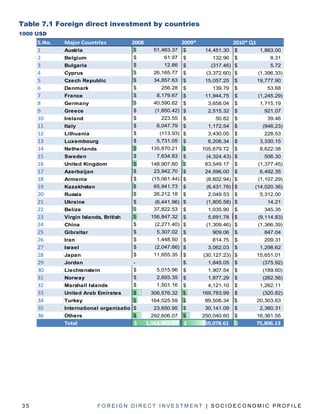
TABLE 7.1       FOREIGN DIRECT INVESTMENT BY COUNTRIES ……………………………………………….                     35
TABLE 8         GEORGIAN TOP EXPORTS BY COUNTRIES IN 2009 ……………………………………………                    36
TABLE 8.1       TOP PRODUCT EXPORTED IN 2009 ……………………………………………………………                           36
TABLE 8.2       GEORGIAN TOP IMPORTS BY COUNTRIES IN 2009 ……………………………………………                    37
TABLE 8.3       TOP PRODUCT IMPORTED IN 2009 ……………………………………………………………                           37
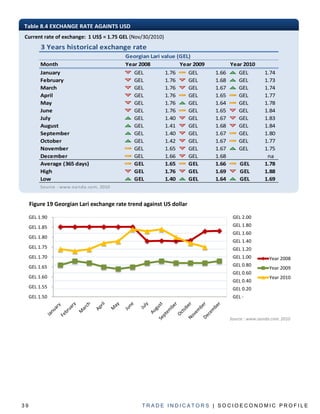
TABLE 8.4       EXCHANGE RATE AGAINTS USD ……………………………………………………………….                            39
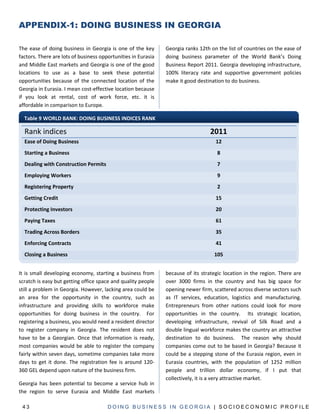
TABLE 9         WORLD BANK: DOING BUSINESS INDICES RANK ……………………………………………...                   43

CHART INDEX
FIGURE 1        MIGRATION AND GROWTH RATE …………………………………………………………….                             12
FIGURE 2        SEX RATION ……………………………………………………………………………………                                    12
FIGURE 3        ETHNIC GROUP DISTRIBUTION IN TOTAL POPULATION ………………………………………                  13
FIGURE 4        LANGUAGE DISTRIBUTION IN TOTAL POPULATION …………………………………………..                   13
FIGURE 5        POPULATION: RELIGION ………………………………………………………………………                               14
FIGURE 6        GROSS DOMESTIC PRODUCTION GROWTH …………………………………………………..                         31
FIGURE 7        INCOME PER CAPITA GROWTH RATE …………………………………………………………                           31
FIGURE 8        INFLATION RATE ………………………………………………………………………………                                  32
FIGURE 9        UNEMPLOYMENT RATE ……………………………………………………………………….                                 32
FIGURE 10       GDP STRUCTURE BY SECTOR CONTRIBUTION ………………………………………………..                      33
FIGURE 11       INDUSTRY VALUE ADDED GROWTH RATE …………………………………………………….                         33
FIGURE 12       FDI NET INFLOW OF GDP ……………………………………………………………………...                            34
FIGURE 13       FDI BY ECONOMIC SECTORS …………………………………………………………………..                            34
FIGURE 14       GEORGIAN TOP EXPORTER CONTRIES ………………………………………………………...                        36
FIGURE 15       TOP PRODUCT EXPORTED IN 2009 ……………………………………………………………                           36
FIGURE 16       GEORGIA TOP IMPORTER COUNTRIES ………………………………………………………..                         37
FIGURE 17       TOP PRODUCT IMPORTED IN 2009 ……………………………………………………………                           37
FIGURE 18       EXTERNAL TRADE OF GEORGIA (BOP) ………………………………………………………...                       38
FIGURE 19       GEORGIAN LARI EXCHANGE RATE TREND AGAINST US DOLLAR ……………………………...             39
SUMMARY

    The objective of this study is to make country        there are many political parties. Country is still in
    profile, in order to draw some conclusions            shift phase to develop a better democratic
    regarding doing business. While observing this        country, recent amendment in Georgian law, shift
    information, caution must be taken to interpret       the power from President to Prime minister. It is
    the meaning of this information, and understand       a good sign for become a full-fledged democratic
    the target country reaction. That is, the exercise    republic country.
    centers on the search as to whether the market
    will be suitable for doing business.                  Georgia has made significant progress since the
                                                          2003 "Rose Revolution" in the quality of
    Georgia is a small country of 4.6 million people,     governance and business environment. On the
    located on the southern flanks of the Caucasus        different international organization rank indices,
    Mountains with a land area of 69,700 square           Georgia scored really very well such as doing
    kilometers. It shares borders with Russia in the      business 12th out of 180 nations in 2011
    north, Turkey and Armenia in the south,               comparisons to other region countries. Rapid
    Azerbaijan in the east and has a coastline on the     reforms and new legislation have liberalized the
    Black Sea in the west. Georgia's location between     economy and created favorable conditions for
    the Black Sea, Russia, Armenia, Azerbaijan, and       industry development and investment. Low Tax,
    Turkey gives it strategic importance as a transit     liberal trade regimes, simplified licensing and
    corridor. It is developing as the gateway from the    permitting     procedure,      and     developing
    Black Sea to the Caucasus and the Caspian basin.      infrastructure made the Georgia best possible
    Population of Georgia is the very good indication     country for doing business and investment.
    to develop international expatriate business
    society in compare to land area and existing          Economic growth in Georgia is on track to reach
    business opportunity. Lower birth rate is a           4.5 percent next year, and it could be double that
    serious issue for the country as a country can face   by 2012-2013 as tourism, the banking sector and
    the ageing problems within 30 years. Georgia’s        exports advance and foreign direct investment
    recorded history date back more than 2500 years       grow. Georgia had become a regional investment
    old, which consist of many facts about the            hub during 2005-2007. Private investors are
    country and impacted on Georgian present day          seeking to expand from Georgia into the
                                                          Caucasus, central Asia, Ukraine, Turkey but
    society.
                                                          foreign direct investment decreased over the
    Georgian people have a relationship oriented          past two years because of the worldwide
    approach. Country has rich resources of mineral,      financial crisis and conflict with Russia. The falls
    which could also be another opportunity for           were being compensated by investment coming
    investment in a mining sector. Agricultural land      in through international institutions. This helped
    and weather make its added gain to produce            keep the country’s currency stable. Lari is the
    organic food, which is quite demandable in a          most stable currency in the region from last five
    western market as well as in Asian market.            years instead of global financial crisis effect on it.
    Political situation is now more stable, although


5                                                            SUMMARY | SOCIOECONOMIC PROFILE
Foreign direct investment decreased because of         which plans to buy natural gas from Azerbaijan
    the worldwide financial crisis and Russian             and transport it across Georgia to the Black Sea.
    conflict, but there is a serious increase in the       Georgia is no more relied on an aggressive
    inflows,” International financial institutions such    neighbor country for it energy need. There is gas
    as the World Bank, the European Bank for               flowing from north to south, crossing Georgia
    Reconstruction and Development and the Asian           from east to west 1.5 percent of the world’s total
    Development Bank, which are investing in               oil consumption crosses Georgia, and Georgia
    projects such as hydro power plants and                electricity exporters to all neighboring countries,
    highways, were important drivers of this               including Russia.
    increase.
                                                           Country has a strong presence in an international
    Relations between Georgia and neighboring              organization as Georgia is a member of the UN,
    Russia reached a low in 2008, when the two             OSCE, World Bank, IMF, EBRD, World Trade
    countries fought a five-day war over the Georgian      Organization (WTO), Council of Europe, and
    region of South Ossetia. However, Georgia is now       Organization for Democracy and Economic
    politically stable, and a recent deal with Bulgaria,   Development-GUAM.


6                                                             SUMMARY | SOCIOECONOMIC PROFILE
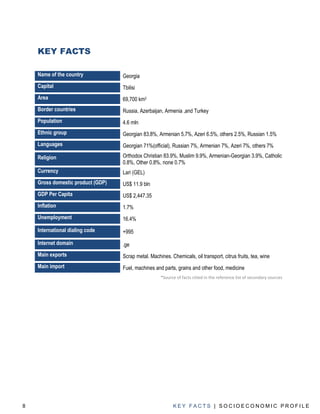
KEY FACTS

    Name of the country            Georgia
    Capital                        Tbilisi
    Area                           69,700 km2
    Border countries               Russia, Azerbaijan, Armenia ,and Turkey
    Population                     4.6 mln
    Ethnic group                   Georgian 83.8%, Armenian 5.7%, Azeri 6.5%, others 2.5%, Russian 1.5%
    Languages                      Georgian 71%(official), Russian 7%, Armenian 7%, Azeri 7%, others 7%

    Religion                       Orthodox Christian 83.9%, Muslim 9.9%, Armenian-Georgian 3.9%, Catholic
                                   0.8%, Other 0.8%, none 0.7%
    Currency                       Lari (GEL)
    Gross domestic product (GDP)   US$ 11.9 bln
    GDP Per Capita                 US$ 2,447.35
    Inflation                      1.7%
    Unemployment                   16.4%
    International dialing code     +995
    Internet domain                .ge
    Main exports                   Scrap metal. Machines. Chemicals, oil transport, citrus fruits, tea, wine
    Main import                    Fuel, machines and parts, grains and other food, medicine
                                                     *Source of facts citied in the reference list of secondary sources


8                                                          KEY FACTS | SOCIOECONOMIC PROFILE
FOCUS ON SETUP SHOP & DOING BUSINESS
INTRODUCTION

Georgia known officially from 1991 as the Republic of         and they think of          themselves    as   an    Eastern
Georgia, until 1990 it was Soviet Union state. It absorbed    Mediterranean culture.
into Russian Empire in the 19th century. It has been
independent of three years (1918-1921) following the          Georgia has attracted the attention of a range of other
Russian revolution, and it was forcibly incorporated into     countries, with different interests and ambitions. It seeks
the USSR until the Soviet Union dissolved in 1991.            to strengthen a republic and achieve greater economic
Georgia was an ancient kingdom of Colchis and                 stability. It has a potential to come to be an important
Kartlilberia. In the first century A.D., it came under an     and developed economy of the black sea & Eurasia
influence of Roman, and Christianity became the country       region. Coming years appears very prosperous in business
the state religion in the 330 AD. It was the second           and social growth of the country because its future on the
country to adopt Christianity. Georgia dominated by           restoration of the ancient Silk Road economies as a
                                                              Eurasian transportation system corridor, using Georgia's
Persian, Arabs, Mongol and Turks.
                                                              geography as a bridge for the transit of goods, including
Georgia is strategically located at crossroads between        oil and gas, between Europe and Asia. Georgians are
Europe and Asia (Eurasia). Georgia is bordered to the         renowned for their hospitality and artistry in dance,
west by the black sea, to the north by Russia, to the south   theater, music, and design. Georgian Government has
by Turkey and Armenia, and the east by Azerbaijan. Most       been taken affirmative action after 2003 Rose revolution,
of Georgia is located in the South Caucasus, while a          toward economic and social reforms, making significant
portion lies in North Caucasus. Throughout the centuries,     impact in country society as well as on the economy. It
it has been dominated and settled by Greeks, Romans,          could become most important service hub in the region
Persians, and Turkish tribes, Arabs, Mongols and              because of access in Europe and Asia, though finding
Russians. Georgia was also on one of the branches of the      trained talent is still a problem in country, but govt. step
Silk Road, which carried trade from China and India to        toward vocational studies making shift in order to ease in
Europe hence the Georgian people have been influenced         find talent. As the country adopted free market economy
by many cultures, both Asian and European. The                model like Singapore and doing business in the country
Georgians resembles Greeks and Turks in appearances,          become easy gives to attractive invest ground for FDI.


 10                                                       INTRODUCTION | SOCIOECONOMIC PROFILE
HISTORY OVERVIEW

Georgia’s recorded history dates back more than 2500          Georgia was absorbed into the Russian Empire in the 19th
years old. Georgia has historically found itself on the       century, Independent for three years (1918-1921)
edges of great empires, and Georgians have lived              following the Russian revolution. It was forcibly absorbed
together in a unified state for only a small fraction of      into USSR until Soviet Union disintegrated in 1991 and
their existence as people. Much of Georgia's territory was    Georgia restored independence from Russia same year.
fought over by Persian, Roman, Byzantine, Arab, Mongol,       Present-day Georgia is rapidly growing economy.
and Turkish armies from at least the 1st century B.C.         Progress on market reforms and democratization has
through the 18th century. The zenith of Georgia's power       been made in the year since independence but progress
as an independent kingdom came in the 11th and 12th           has been complicated by Russia assistance and support to
centuries, during the reigns of King David the Builder and    the breakaway regions of Abkhazia and South Ossetia.
Queen Tamara, who still ranks among the most                  After a series of Russian and separatist provocations in
celebrated for all Georgian rulers. In 1783 the king of       summer 2008, Russian troops pulled back from most
Kartli (in eastern Georgia) signed the Treaty of Georgievsk   occupied the breakaway areas, but large portions of
with the Russians, by which Russia agreed to take the         Georgia proper as well. Russian unilaterally recognized
kingdom as its protectorate. In 1801, the Russian empire      the independence of Abkhazia and South Ossetia. This
began the piecemeal process of unifying and acquiring         action was strongly condiment by most of the world
Georgian territory, and for most of the next two centuries    nations and international organizations.
(1801-1991), Georgia found itself ruled from St.
Petersburg and Moscow.

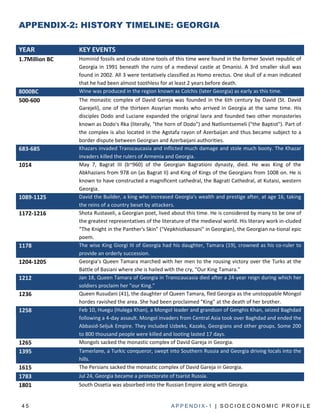
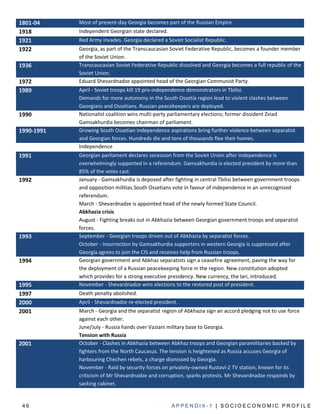
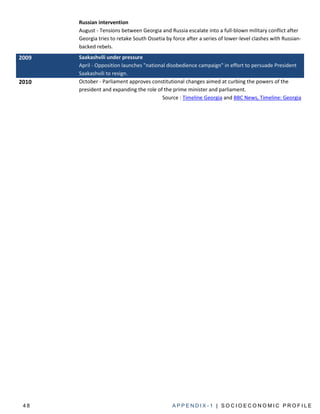
Note: Appendix -2 History timeline of Georgia


 11                                                 HISTORY OVERVIEW | SOCIOECONOMIC PROFILE
DEMOGRAPHICS

Table 1 Demographic indicators
Total population                               4.6 million (2010 est.)
Growth Rate                                    -1.08%
Birth Rate                                     10.66 births/1,000 population
Death Rate                                     9.65 deaths/1,000 population
Migration Rate                                 -4.26 migrant(s)/1,000 population
Urbanization                                   53% of total population (2008 est.)
Rate of urbanization                           -0.6% annual rate of change (2005-10 est.)
Literacy rate                                  100%


     Figure 1 Migration and growth rate
       -4                                                                                                                     -1
     -4.1       2004                    2005           2006             2007                2008               2009
                                                                                                                              -1.05
     -4.2
     -4.3                                                                                                                     -1.1
     -4.4
     -4.5                                                                                                                     -1.15
     -4.6
                                                                                                                              -1.2
     -4.7
     -4.8                                                                                                                     -1.25
                                                 Migration rate(%)            Growth rate(%)


      Figure 2 Sex ratio


                                                                                 1616234
                              2000000                                1503360

                              1500000
                 Population


                              1000000
                                           395929                                                           453110
                                                      345071                                    302103
                               500000

                                    0
                                               0-14                   15-64                65 years and over

                                                           Male       Female
                                                                                               Source: CIA - The World Facts, 2010


12                                                                DEMOGRAPHICS | SOCIOECONOMIC PROFILE
Table 1.2 Distribution of population
 Age                             0-14 years: 16.1% (Male 395,929/Female 345,071)
                                 15-64 years: 67.6% (Male 1,503,360/Female 1,616,234)
                                 65 years and over: 16.4% (Male 302,103/Female 453,110) (2010 est.)
 Sex                             at birth: 1.127 male(s)/female
                                 under 15 years: 1.15 male(s)/female
                                 15-64 years: 0.93 male(s)/female
                                 65 years and over: 0.66 male(s)/female
                                 Total population: 0.91 male(s)/female (2010 est.)
 Ethnic Group                    Georgian                    83.8%
                                 Azeri                       6.5%
                                 Armenian                    5.7%
                                 Russian                     1.5%
                                 other                       2.5% (2002 census)
 Language                        Georgian                    71% (official)
                                 Russian                     9%
                                 Armenian                    7%
                                 Azeri                       6%
                                 other                       7%
 Religions                       Orthodox Christian          83.9%,
                                 Muslim                      9.9%,
                                 Armenian-Gregorian          3.9%
                                 Catholic                    0.8%
                                 other                       0.8%
                                 none                        0.7% (2002 census)
 Geographical areas              Regions                                     Main City
                                 Guria                                       Tbilisi (Metro city)
                                 Imereti                                     Kutaisi
                                 Kakheti                                     Batumi
                                 Kvemo-Kartli                                Rustavi
                                 Mtskheta-Mtianeti                           Zugdidi
                                 Racha-Lechkhumi and Kvemo Svaneti           Gori
                                 Samegrelo-Zemo Svaneti                      Poti
                                 Samtskhe-Javakheti                          Akhaltsikhe
                                 Shida Kartli                                Sukhumi
                                                                             Samtredia
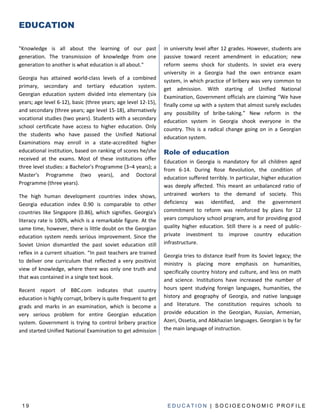
                                                                             Khashuri
                                                                             Senaki
                                                                             Telavi


Figure 3 Ethnic group distribution in total population              Figure 4 Language distribution in total population
     Georgian
       84%                                               Azeri                                                           Russian
                                                          6%                               Georgian                        9%
                                                                                             71%
                                                         Armenian
                                                            6%                                                          Armenian
                                                                                                                           7%
                                                     Russian
                                                                                                                    Azeri
                                                Other 1%
                                                 3%                                                           Other 6%
                                                                                                               7%
                                                                    Source: CIA - The World Facts, 2010


13                                                               DEMOGRAPHICS | SOCIOECONOMIC PROFILE
Observation: Georgian population growth trend is        Figure 5 Population: Religion
really negative. It appears within 30 years Georgia
could face the ageing crisis. Therefore, there is a     Orthodox
need of population growth. Compare to any Indian        Christian
city with the population of 5 million, Georgia has a      84%
big advantage to make faster growth to implement                                                           Muslim
reforms because of its literacy rate. In the ratio of                                                       10%
Area and population, there are very good
opportunities to build expatriate society, which                                                            Armenian-
                                                                                                             Georgian
could make pressure on international politics to
                                                                                           None                4%
secure country independence and from any future                                                       Catholic
                                                                                            0%    Other 1%
aggression from neighbor countries. This could be
                                                          Source: CIA - The World Facts,           1%
the best possible way to secure country future and
create more opportunities for everyone.

Language is another advantage of the country.
Georgian is a primary language of 4.2 million people
in country but still Russian is most spoken secondary
language in Georgia. Russian language is the
language for 180 million people, which give an idea
for expansion of business activity in other CIS
regions. Recently, the government adopted English
to become a mandatory language to be taught in
school from one grade, which is also a good
indication to produce a future international
workforce.


 14                                                        DEMOGRAPHICS | SOCIOECONOMIC PROFILE
GEOGRAPHICAL SETTING

Location                                                     Caucasus range. The Lesser Caucasus range, which runs
                                                             parallel to the Turkish and Armenian borders, and the
Georgia is situated on the Black Sea at the junction of
                                                             Surami and Imereti ranges, which connect the Caucasus
Eastern Europe and Asia. Georgia is a mountainous
                                                             Mountains, create natural barriers that are partially
country. The northern geographical boundaries run along
                                                             responsible for cultural and linguistic differences among
the Great Caucasian Range, which include the Main
                                                             regions. Because of their elevation and a poorly
Caucasian Range, and its other chains stretch to the
                                                             developed transportation infrastructure, many mountain
south. The southern boundary coincides with the
                                                             villages are virtually isolated from the outside world
mountainous system of the Minor Caucasus, including the
                                                             during the winter. Earthquakes and landslides in
Meskheti-Trialeti volcanic plateau, Southwestern Asia,
                                                             mountainous areas present a significant threat to life and
bordering the Black Sea, between Turkey and Russia, with
a sliver of land north of the Caucasus extending into        property.
Europe. Georgia share borders with Russia (723 km) to        Georgia has about several rivers, many of which use for
the north, Turkey (252 km) and Armenia (164 km) south        power small hydroelectric stations. Drainage is into the
west, Azerbaijan (322 km) to the south-east, and the         Black Sea to the west and through Azerbaijan to the
Black Sea to the west coast line (315 km).                   Caspian Sea to the east. Country longest river is the
                                                             Mtkvari (formerly known by its Azerbaijani name, Kura,
Climate                                                      which is still used in Azerbaijan), which flows 1,364
Georgia's climate is continental climate. Its climate        kilometers from the northeast Turkey across the plains of
affected by subtropical influences from the west and         eastern Georgia, through the capital, Tbilisi, and into the
Mediterranean influences from the east. The Greater          Caspian Sea. The Rioni River, second largest river in
Caucasus range moderates the local climate by serving as     western Georgia, rises in the Greater Caucasus and
a barrier against cold air from the north. Warm, moist air   empties into the Black Sea at the port of Poti. Soviet
from the Black Sea moves easily into the coastal lowlands    engineers turned the river lowlands along the Black Sea
from the west. Climatic zones are determined by distance     coast into a prime subtropical agricultural land,
from the Black Sea and by altitude. The plains of eastern    embanked and straightened many stretches of river, and
Georgia are shielded from the influence of the Black Sea     built an extensive system of canals. Deep mountain
by mountains that provide a more continental climate.        gorges forms topographical belts within the Greater
                                                             Caucasus.
Topography
In spite of its small area, Georgia has one of the most      Temperature
varied topographies of the former Soviet republics.          Country temperature recorded in summer average 20° C
Georgia lies mostly in the Caucasus Mountains, and its       to 24° C and winter 2° C to 4° C. Humidity is lower and
northern boundary is partly defined by the Greater           rainfall averages 500 to 800 millimeters per year.


15                                       GEGOGRAPHICAL SETTING | SOCIOECONOMIC PROFILE
MINERAL RESOURCES

Georgia is rich country in minerals, and it has significant   for ferro alloys' production. Categorized list of minerals
minerals resources reserve. There are many kinds of           found in Georgia given below.
economic mineral mined during soviet era, as fall of
USSR, the Georgian minerals mining decline. A range of        Georgia has a main role in the world minerals. Georgia is
mineral commodities were mined in Georgia, including          a transportation route for oil and gas shipments out of
                                                              the Caspian region to world market. Therefore, it is a
arsenic, barite, bentonite, coal, copper, diatomite, lead,
manganese, zeolite, and zinc, among others. The country       significant country. Three large gas and oil exported
had been a major producer of high-grade manganese ore         pipeline constructed in the region pass through Georgia.
for about a century, and ore reserves were significantly      These include the Baku-Tbilisi-Ceyhan (BTC) pipeline, the
depleted. Part of the manganese was used within Georgia       Baku-Tbilisi-Erzurum (BTE) pipeline for gas and oil
                                                              transport.


  Table 2 Mineral resources
  Energy mineral resources                Oil, Coal, Dark coal and Hydropower
  Metallic mineral resources              Bentonite, Copper, Iron, Manganese, Zinc, Gold, Silver, Lead, Barit,
                                          Molybdenum and Strychnine
  Non-metallic mineral resources          Diatomite, Arsenic, Barite, Zeolite, Chalcedony, Agate, Talc, Dolomite,
                                          Fluxing limestone, Kaolin, Fireproof clays, Hydrargyrum, Benthonic clays,
                                          Glauber’s salt, Cement, Quartz sand, Gypsum and anhydride, Tuff, lavas and
                                          marbles
  Water and Gas mineral resources         Mineral waters, Peat and Treatment muds
  Land resources                          Forests- and woodland- 34%, Arable land-9%, permanent crops-4%,
                                          Permanent pastures-25% and other- 28%


Georgia seemed to have potential resources for gold           market economy standards for evaluating reserves and,
mining. It had not obtained the investment backing            therefore, should be considered only highly prospective
required to sustain a major mining venture. The Georgian      for precious metals". Georgia has been able to attract a
State Geology Committee announced that, based on              limited number of international investors, and the future
Soviet records, the country had reserves of 8 million troy    prospects for mineral development will depend on the
ounces (almost 250 t) of gold, and 48 million troy ounces     government prospect to allow the foreign firms for
(almost 1,500 t) of silver.                                   independent exploration. To some extent, this could give a
                                                              country valuable promotion to attract additional FDI.
A March 2007 report by the London based Hardman & Co.
stated that "Georgia had never been explored using


 16                                               MINERAL RESOURCES | SOCIOECONOMIC PROFILE
COMMUNICATION SYSTEMS

Recently, telecommunication industry, especially mobile     information technology operation in Georgia. Increased
communication experienced robust growth now in              usage of the internet also introduces many technological-
Georgia, more than 6 fold telecommunication                 related investment opportunities.
penetrations growth recorded in the country. Many
companies already tapped market but there is still space    The mobile communication has become important for
                                                            Georgia because of its geographical settings. Fixed-line
available for new entrants in telecommunication industry.
Domestic and International services are increasingly        networks in many places out dated and a mobile phone
accessible for private use. Country has extensive fiber     represents the only means of communication, specifically
optic network, 3. 5G system has been introduced in the      as mobile coverage has been provided for virtually in the
country, 17% mobile user using a 3G technology, which       whole Georgia. A telecommunication has become one of
appeared good perspective for a private company to start    the fastest growing sectors in the Georgian economy


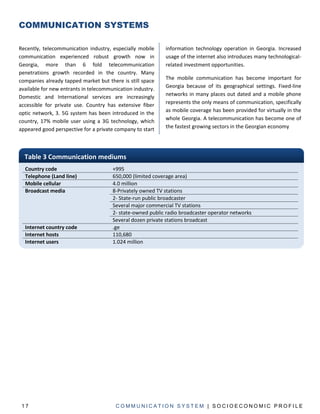
  Table 3 Communication mediums
  Country code                         +995
  Telephone (Land line)                650,000 (limited coverage area)
  Mobile cellular                      4.0 million
  Broadcast media                      8-Privately owned TV stations
                                       2- State-run public broadcaster
                                       Several major commercial TV stations
                                       2- state-owned public radio broadcaster operator networks
                                       Several dozen private stations broadcast
  Internet country code                .ge
  Internet hosts                       110,680
  Internet users                       1.024 million


 17                                     COMMUNICATION SYSTEM | SOCIOECONOMIC PROFILE
SOCIAL INSTITUTION

Georgians share many social attitudes with neighboring        In the event of divorce, the law stipulates that mothers
Mediterranean cultures. Tradition, loyalty to friends and     given custody of children. Recent trend show in urban
family, and generosity toward guests are viewed as            areas in nuclear families, people prefer hire nanny for
important values. Nepotism—the system by which                children take care because of both working parents.
relatives help each other get jobs—is considered              Nevertheless, in complex family structure, women have
honorable. Important relationships might help a child         been more responsible for brought up their child or if
enter a university, gain a promotion for a family member,     there are elder people in family then they help in taking
or give a close friend a new business opportunity.            caring of children.
According to a Georgian proverb, "A guest is sent by
God." Guests are always treated generously in a Georgian      Marriage and Courtship
home, even if the host cannot really afford it. Guests        Georgian constitution requires the free consent of both
usually bring a symbolic gift, such as flowers or             spouses for marriage, the minimum age for marriage at
chocolates, when they visit. Even if an enemy crosses a       18 years for both men and women. In exceptional
Georgian threshold, he or she must be treated well and        circumstances, marriage may be authorized from age of
not harmed. The best way to show respect for guests is to     16 years. According to United Nation, report estimated
honor them with a keipi , or feast. The keipi is a central    16% of Georgian girls between 15 and 19 years of age
part of Georgian social life.                                 were married, divorced or widowed. There are cases of
                                                              arranged marriages in rural areas, which usually found in
Family                                                        Muslim community in country and practice in old
In urban area, Georgian family structure follows nuclear      conventional family.
family structure. Increasing unemployment in a past two
                                                              Female/Male roles
decade had also compelled people to move in cities, and
                                                              The constitution of Georgia supports the principle of
adopting smaller ways of life. From last two decades,
                                                              equal right for men and women. However, the current
there has been significant changing in a traditional way of
                                                              situation in the country creates many challenges for
life. Despite this fact, only half of Georgian families
                                                              women. Women’s lives have changed dramatically after
adhere to the nuclear structure, and 50% families are still
                                                              collapsed of Soviet Union in 1991. Georgia faced into a
following complex or joint family structures.
                                                              period of internal politics conflict, until 1994 Georgian
Dynamics of family                                            GDP contracted by 72%. Nevertheless, from 1995 the
                                                              economy began to recover. Until 2006, 51% Georgian
Parental roles                                                were living below the official poverty line. Following
Georgian constitution gives guarantees an equal right for     economic changes affected social atmosphere, poverty
both men and women in parental authority. Traditionally,      and unemployment have been a persistent problem in
women do domestic chores and men exert authority              Georgia. As most emigrants were men, increasing
within the family, but attitudes are changing. In urban       numbers of women are now the sole provider for their
areas, many women work and some earn higher earnings          families. About 50% of Georgian women are unemployed;
than their husband does. As a result, parental authority      those who do work earn, on average, only half as much as
within the family is increasingly shared by both spouses.     men.


 18                                               SOCIAL INSTITUTION | SOCIOECONOMIC PROFILE
EDUCATION

"Knowledge is all about the learning of our past                in university level after 12 grades. However, students are
generation. The transmission of knowledge from one              passive toward recent amendment in education; new
generation to another is what education is all about."          reform seems shock for students. In soviet era every
                                                                university in a Georgia had the own entrance exam
Georgia has attained world-class levels of a combined           system, in which practice of bribery was very common to
primary, secondary and tertiary education system.
                                                                get admission. With starting of Unified National
Georgian education system divided into elementary (six          Examination, Government officials are claiming “We have
years; age level 6-12), basic (three years; age level 12-15),   finally come up with a system that almost surely excludes
and secondary (three years; age level 15-18), alternatively     any possibility of bribe-taking.” New reform in the
vocational studies (two years). Students with a secondary       education system in Georgia shook everyone in the
school certificate have access to higher education. Only        country. This is a radical change going on in a Georgian
the students who have passed the Unified National
                                                                education system.
Examinations may enroll in a state-accredited higher
educational institution, based on ranking of scores he/she      Role of education
received at the exams. Most of these institutions offer
                                                                Education in Georgia is mandatory for all children aged
three level studies: a Bachelor's Programme (3–4 years); a
                                                                from 6-14. During Rose Revolution, the condition of
Master's Programme (two years), and Doctoral
                                                                education suffered terribly. In particular, higher education
Programme (three years).
                                                                was deeply affected. This meant an unbalanced ratio of
The high human development countries index shows,               untrained workers to the demand of society. This
Georgia education index 0.90 is comparable to other             deficiency was identified, and the government
countries like Singapore (0.86), which signifies. Georgia's     commitment to reform was reinforced by plans for 12
literacy rate is 100%, which is a remarkable figure. At the     years compulsory school program, and for providing good
same time, however, there is little doubt on the Georgian       quality higher education. Still there is a need of public-
education system needs serious improvement. Since the           private investment to improve country education
Soviet Union dismantled the past soviet education still         infrastructure.
reflex in a current situation. “In past teachers are trained
                                                                Georgia tries to distance itself from its Soviet legacy; the
to deliver one curriculum that reflected a very positivist
                                                                ministry is placing more emphasis on humanities,
view of knowledge, where there was only one truth and
                                                                specifically country history and culture, and less on math
that was contained in a single text book.
                                                                and science. Institutions have increased the number of
Recent report of BBC.com indicates that country                 hours spent studying foreign languages, humanities, the
education is highly corrupt, bribery is quite frequent to get   history and geography of Georgia, and native language
grads and marks in an examination, which is become a            and literature. The constitution requires schools to
very serious problem for entire Georgian education              provide education in the Georgian, Russian, Armenian,
system. Government is trying to control bribery practice        Azeri, Ossetia, and Abkhazian languages. Georgian is by far
and started Unified National Examination to get admission       the main language of instruction.


 19                                                              EDUCATION | SOCIOECONOMIC PROFILE
Table 4 School Enrolment


Primary education                                             The school days for basic, or the lower level of secondary
The Georgian government works to develop the                  education, are five to six hours per day; for the higher
personality of children through pre-school programs.          level, it is six to seven hours per day. Most students also
There are two types of preschool programs: nursery            have two or more hours of homework. History,
schools for baby age 1-2 and kindergarten for children        geography, biology, physics, chemistry, and foreign
age 3-6. Student in primary grads studied about seven         languages are studied at the secondary level and, at the
subjects. Primary school subjects include native language     higher level; students choose an emphasis to study. The
study, math, fine arts, music, physical education, natural    choices include humanities, physics and math, chemistry
studies, Russian, and literature. The school day is           and biology, vocational education, or language. High
approximately three hours in the primary grades.              school is the highest level of education before students
                                                              reach eligibility for entering higher education.
Secondary education
In 1997-1998, there were about 275,000 students in the        Higher Education
country's two divisions of secondary education. The lower     University studies typically provide highly specialized,
division is called basic, or secondary. The higher level is   rigid training focusing on a single area of study. Law and
called upper secondary, or high school. The basic level       medicine students do not attend regular university, but
consists of grades 7 through 9, and higher level is grades    go directly to law and medical school from high school.
10 and 11. There is some hope of adding a twelfth grade       Law school takes five years to complete and medical
in the future.                                                schools seven, plus two to three years of ordinatura,
                                                              which is comparable to an internship.


 20                                                            EDUCATION | SOCIOECONOMIC PROFILE
POLITICAL SYSTEM

Georgia is still not a full-fledged democracy. The Georgian    ranging from transforming the country into a
political system is a presidential republic. The Parliament    parliamentary republic to re-establishing the monarchy.
consists of a unicameral Republican Council (commonly          Observers note the deficit of trust in relations between
referred to as Parliament) with 235 seats. Members are         the Government and the opposition. Different opinions
elected by a popular vote for a four-year term, 150 seats      exist regarding the degree of political freedom in Georgia.
are determined by proportional representation and 75           President Saakashvili believes that the country is
represent single-seat constituencies.                          essentially free; many opposition leaders claim that
                                                               Georgia is a dictatorship, and Freedom House puts
The political system remains in the process of transition,     Georgia in the group of somewhat free countries, along
with frequent adjustments to the balance of power
                                                               with countries like Turkey, Venezuela and Bosnia.
between the President and Parliament, and proposals


  Table 5 Political structure
  Form of state                                Democratic republic of nine region
  Legal system                                 Based on constitution adopted 24 August 1995
  National Legislature                         Unicameral Parliament (also known as Supreme Council or Umaghlesi
                                               Sabcho) (150 seats; 75 members elected by proportional
                                               representation, 75 from single-seat constituencies; members to
                                               serve five-year terms)
  Electoral system                             Universal direct suffrage age 18 years
  National elections                           President elected by popular vote for a five-year term (eligible for a
                                               second term); election last held on 5 January 2008 (next to be held in
                                               January 2013)
  Head of state                                The president is the chief of state and serves as head of government
                                               for the power ministries of internal affairs and defense
  National Government                          The prime minister is head of government for all the ministries of
                                               government except the power ministries of internal affairs and
                                               defense


Observation: Georgia is an extremely politicized society.      seem blocked in separate mindset ideology. All the main
There are hundreds of political parties, of which many are     parties have different objective and vision, yet everyone
unregistered. There is no single party represent the           is unhappy with the economic and political situation.
society through main parties’ leaders from coalition. They


 21                                                   POLITICAL SYSTEM | SOCIOECONOMIC PROFILE
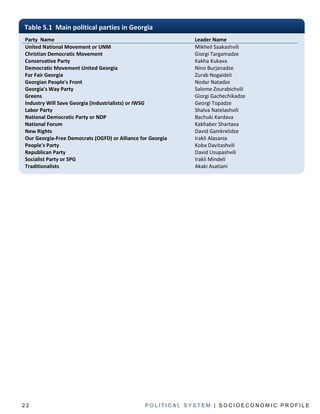
Table 5.1 Main political parties in Georgia
Party Name                                                  Leader Name
United National Movement or UNM                             Mikheil Saakashvili
Christian Democratic Movement                               Giorgi Targamadze
Conservative Party                                          Kakha Kukava
Democratic Movement United Georgia                          Nino Burjanadze
For Fair Georgia                                            Zurab Nogaideli
Georgian People's Front                                     Nodar Natadze
Georgia's Way Party                                         Salome Zourabichvili
Greens                                                      Giorgi Gachechikadze
Industry Will Save Georgia (Industrialists) or IWSG         Georgi Topadze
Labor Party                                                 Shalva Natelashvili
National Democratic Party or NDP                            Bachuki Kardava
National Forum                                              Kakhaber Shartava
New Rights                                                  David Gamkrelidze
Our Georgia-Free Democrats (OGFD) or Alliance for Georgia   Irakli Alasania
People's Party                                              Koba Davitashvili
Republican Party                                            David Usupashvili
Socialist Party or SPG                                      Irakli Mindeli
Traditionalists                                             Akaki Asatiani


22                                              POLITICAL SYSTEM | SOCIOECONOMIC PROFILE
LEGAL SYSTEM

The Georgian legal system is structured in hierarchical            The Supreme Court of Georgia represents the court of the
layers. The Judiciary System of Georgia consists of three          highest and final instance for justice administration in the
stages:                                                            country, which was established in 2005 as a purely the
                                                                   cassation instance court. It oversees the administration of
        District (City) Court                                     justice at common courts of Georgia, and its activities are
        Court of Appeal                                           guided by the principles of legality, equality of parties and
        Court of Cassation (Supreme Court).                       competitiveness, as well as irreplaceable inviolability and
                                                                   independence of justices.


  Legal Structure
                                                    Supreme Court: Tbilisi
  Jurisdiction: The Supreme Court is envisioned as the highest appellate court, but it also hears some capital cases and appeals
  from the Central Electoral Commission.
                                          Court of Appeal (court of the second instance)
  Jurisdiction: Appeal against first-instance decision by the regional court.
  District court                                          Regional Court
  Jurisdiction: District courts hear petty criminal and   Jurisdiction: Regional courts of appeal have original and appellate
  civil cases.                                            jurisdiction. They try major criminal and civil cases, review cases, and
                                                          can remand cases to the lower court for retrial.


Civil Code
Georgian civil code created during 992-997, with                   Book two: Law of Things (Property Law) – regulates
collaborative efforts of Georgian and foreign experts              possession, ownership, property rights, measures for
(especially- German). The code has incorporated the best           securing claim (security interest, mortgage), rules of
idea developed in civil law. Therefore, expert rate                acquiring and loss of ownership.
Georgian civil code along with the new Netherlands civil
                                                                   Book three: Law of Obligations, given its significance and
code, as one of the most refined and modern statues.
Historically, the country law has been part of continental         magnitude, is the heart of the civil law system, through
European family of law. The Civil code of Georgia consists         which the freedom of contract is exercised.
of five books.                                                     Book four: It regulates family relations.
Book one: General part is a set of common rules that               Book five and last book: It governs the law of
govern the entire Private Law and strengthen its                   inheritance. The Georgia civil code regulates all the key
underlying institutions, such as the doctrine of subjects of       issues from person’s birth until its death. Therefore, the
law, doctrine of transactions, exercise of rights, periods of      utmost importance of this statute is undisputable.
time, limitations (prescription).


23                                                              LEGAL SYSTEM | SOCIOECONOMIC PROFILE
HUMAN AND THE UNIVERSE: PHILOSOPHY AND RELIGION

    Religion and Belief system


Georgian people practice Orthodox Christianity. Georgia        There are small groups of Yezid Kurds, Russian Molokans
was the second after Armenia to accept Christianity as         and Dukhobors, and Jews.
the established religion in 326 A.D. Despite the huge
influence of Christianity in Georgia. They are very tolerant   Many of the popular beliefs and rituals regarding death
and respectful of the representatives of other religions.      and afterlife stem from a mixture of Christians and pagan
There are a lot of Muslims. Some Abkhazians and                concepts, with many superstitions and cultural
Georgians from southern and southwest area practice            borrowings. Respecting the deceased is a very important
                                                               part of social life, and much time is spent attending
Sunni Islam. Azerbaijanis, Assyrians and Kurds are
Muslims. In Georgia, there is also a small number of           funerals and wakes and caring for graves. Although
Catholics. Several Protestant churches are active, with        people believe in an eternal afterlife, there is no clear
the Baptists being the most successful. The most ethnic        understanding of its nature; people observe rules and try
Armenians belong to the Gregorian Christian Church.            to reduce their grief by ritualizing the mourning process.


Aesthetics
                                                               Georgian folk songs are often centered on feasts called
Art                                                            supra, where songs and toasts to God, fatherland, long
Literature: Literature is in a dire condition because of the   life, love and other topics. Traditional feast songs include
political and economic crisis that started long before         "Zamtari", which is about winter and is sung to
independence. There are only a few young talented              commemorate ancestors, and "Mravalzhamier", a joyous
writers, poets, and almost none from the older                 hymn. Work songs are also widespread. There is
generation. The literary market is dominated by                moreover a distinct and rich tradition of Georgian sacred
translations of bestsellers, detective stories, and erotica.   music, both settings of hymns for the Orthodox Church,
                                                               and folk hymns and ritual songs that contain a great deal
Graphic Arts: Graphic arts are popular, and many young
                                                               of "pagans".
artists are demonstrating high levels of creativity and
skill. Many artists sell their work in the West.               Folk music styles from different regions of Georgia differ
                                                               very widely, which makes it difficult to speak of
Performance Arts: The performance arts are in a crisis
                                                               characteristics of "Georgian folk music" as a monolithic
because limitations imposed by language hinder the art
                                                               whole. Table songs from Kakheti in eastern Georgia
from finding a wider audience. Several ballet dancers,
                                                               usually feature a simple, drone-like bass part with two
opera singers, and theater directors have achieved
                                                               soloists singing the top two parts. Kakhetian melodies
success in other countries. However, in Tbilisi,
                                                               sound like recitative part of the time (with great
performance art and dramatic art are alive and rich.
                                                               emphasis on the words, which are highly poetic), and
Music                                                          then break into series of ornate, cascading ornaments.
The music of Georgia has a long history. Georgian folk         The two melody parts do play off each other, but there is
music possesses the oldest tradition of polyphonic music       not the type of complicated back-and-forth between the
in the world, predating the introduction of Christianity.      parts that one hears in Gurian trio songs. Perhaps the
Georgian folk remains vibrant across the country, while        most well-known example of music in Kakhetian style is
modern rock and pop also exists.                               the patriotic "Chakrulo", which was chosen to accompany
                                                               the Voyager spacecraft in 1977.


 24                                       HUMAN AND THE UNIVERSE | SOCIOECONOMIC PROFILE
In Rach'a and Ajara, male singers accompany themselves      men's and women's backs always remain straight and
on a bagpipe. Dissonance is prominent in the west, in       motionless. In Georgia, there is such a concept as
Mingrelia and Guria, which also features high pitches and   “dancing dialect”. It means that each region of Georgia
outrageous, yodelling-like vocals called krimanchuli.       has its special manner of dancing such as Kakhetian,
Svaneti's traditions are perhaps the oldest and most        Kartalian, Svanetian, Mingrelian, Imeretin, Gurian,
traditional due to the region's isolation. Svan harmonies   Adzharian, Mtiulian, etc.
are irregular and angular, and the middle voice leads two
supporting vocals, all with a narrow range. The 20th        Georgian singing and dancing culture is rich in genres.
century has seen professional choirs achieve renown in      The national performing style and the traditions, which
Georgia, especially Anzor Erkomaishvili's Rustavi Choir.    were passed from generation to generation, have been in
                                                            formation for many centuries.
Georgia is home to a form of urban music with
sentimental, lovelorn lyrics, as well as a rougher and      Today Georgia is proud of such temples of musical and
                                                            dancing art as the Georgian Opera and Ballet Theatre
crude urban music featuring clarinets, doli and duduks.
                                                            (founded in 1851), and the Theatre of Musical Comedy.
Traditional dance and Performance                           Tbilisi Conservatory has deserved the reputation of
Georgian dances are divided into solo, twosome and          educational institution training great performers of
group. Women move gracefully in short steps. Men show       classical music. The State Symphony Orchestra and a
the eagerness to fight, which is expressed in fast          number of folk song and dance ensembles such as
movements, high jumps and courageous pirouettes. Both       “Erisioni” and "Rustavi" are known all over the world.


 25                                     HUMAN AND THE UNIVERSE | SOCIOECONOMIC PROFILE
LIVING CONDITIONS

Georgia is going through rapid economy and social               A typical festive table ( supra) might consist of puréed
reform. When Georgia was part of the U.S.S.R. (from             beets, and spinach sprinkled with pomegranate seeds,
1921 to 1991), people lived well, although their incomes        khachapuri (a baked cheese bread), satsivi (chicken in
were small. Services such as health care and education          walnut sauce), chanakhi (a lamb and vegetable stew),
were free. Most people in cities paid very little for rent      tolma (minced meat wrapped in vine leaves), and
and utilities, and food was cheap. The switch to a market-      badrizhani nivrit (eggplant with garlic). Wine is an
based economy, which began in 1991, Georgians become            essential part of any meal. Georgians make a wide variety
much more self-reliant.                                         of red wines (such as Mukuzani ) and white wines (such
                                                                as Tsinandali ). Regional differences in cuisine are
In recent years, living condition in a country has been         pronounced. In the west, one is more likely to eat mchadi
changing dramatically. The cost of living in Georgia is         (cornbread) and cheese bread such as Acharuli, which has
moderate. Alcohol & Tobacco, Clothing, education,
                                                                an egg baked in the middle of the cheese and dough.
transport is expensive and Communication, furniture &
appliance, grocery, healthcare relative less expensive in       Recreational Activity
comparison to any other country based on 13 services
                                                                Georgians love going to the theater and classical
and goods basket. The switch to a free market based
                                                                concerts. A favorite Georgian pastime is sitting around a
economy; Georgia is now much more self-reliant.                 table with friends and singing. Some of the popular songs
                                                                are Suliko, Mravalzamier (Be long living), and Shen khar
Clothing
                                                                venakhi (You are the vine). Most young people are fans of
Georgians have always had a reputation for being stylish        Western rock bands. Many have their own rock bands as
dressers. Today they wear casual clothes and follow the
                                                                well.
latest fashions. However, on special occasions they wear
traditional costumes. The chokha is the man's tunic. It is      Language and Minority Groups
usually magenta or white, is belted at the waist, and has
                                                                There are mainly four ethnic groups in Georgia. Azeri and
decorative cartridge pouches on the chest. The kartuli
                                                                Armenia people from the largest, numbering and making
kaba is the traditional female costume. It consists of a silk
                                                                up 12% percent of the country's population. Other
veil and a long, embroidered dress having wide sleeves
                                                                minorities contribute only 4% percent in Georgian
and gathered at the waist.
                                                                population. The Azeri people live all over the country but
There are also costumes associated with various regions         their compact communities are in the eastern region in
and professions. The women in Khevsureti are well               the country. Armenian minority was once dominating
known for their tsinda-pachich , Thick knee-length socks        country economic and the political conditions. The
colored with natural dyes. In the mountains, shepherds          minority nationalities constitute 16% of the country's
still wear the nabadi. This is a black felt cloak with stiff    total population, and they live mainly in the border
wide shoulders that can be used for shelter in winter           regions.
weather.                                                        Georgian is considered a single national language.
                                                                Georgian     government      policies   encourage the
Food
                                                                development and learning other languages with the
Georgian food combines Turkish, Greek, Arabic, and even         native language to understand and create a better
Indian influences. It is often spicy, flavored, especially      qualified workforce in the region; recently the
with coriander, tarragon, and khmeli suneli (a mixture of       government has introduced English as important
spices). Hot and cold dishes are served with side dishes of     language to learn in school to college for adopting
tomatoes, cucumber, spring onions, sulguni (a cheese),
                                                                internationalized standards of country workforce.
and puri (unleavened bread baked in an open brick oven).

 26                                                     LIVING CONDITION | SOCIOECONOMIC PROFILE
BUSINESS CUSTOMS AND PRACTICES
                                                             •   Similarly, Georgians can be emotive speakers. When
Meeting and Greeting                                             discussing a topic, voices may become raised and
• Georgian business culture is noticeably less formal            hand gestures increased.
  than in other countries.                                   •   Direct eye contact conveys trust. Estonians will
• Shake hands with everyone upon arriving and leaving.           generally maintain eye contact throughout a
• Maintain eye contact during the greeting.                      discussion. Looking away or making intermittent eye
• The person of the higher status should initiate the            contact may be misinterpreted as a sign that you are
  handshake.                                                     not telling the truth.
• It is polite to wait for a woman to extend her hand.       •   Although Georgia has a relationship orientated
• Academic and professional titles are commonly used             culture, they can also be very direct.
  with the surname.
• Always wait until invited before moving to a first-        Business Meetings
  name basis.                                                • At the beginning of meetings, introductions are the
                                                               norm. These are generally made in order of seniority
Business Card Etiquette                                        although women are often introduced first. Be
                                                               prepared to give an overview of your background,
•     Business cards are exchanged without any formal
                                                               experience and general purpose for your visit.
      ritual.
                                                             • It can also prove fruitful to send a full biography of
•     It is a nice touch to have one side of your business
                                                               everyone who will attend the meeting beforehand to
      card translated into Georgian or Russian.
                                                               save time and also offer a more thorough
Communication Style                                            introduction.
• Georgians are very relationship orientated in their        • A first meeting is often more about seeing if doing
  outlook.                                                     business together is possible. Do not expect any
• This means that people's feelings take precedence            contracts to be signed on a first meeting. Time and
  over facts. It is important to appreciate that you may       patience are needed.
  not the whole truth if there is bad news. Similarly,       • Meetings may continue over a lunch or dinner. The
  you should be sensitive when communicating difficult         topic of conversation will shift away from business
  information.                                                 but this should be used as the time to let the
• Similarly, in an eagerness to establish a business           Georgian hosts get to know you on a personal level.
  relationship, Georgians may offer an affirmative           • In most cases, decisions are made at the top of a
  response, even if they know it is far from the truth.        company. Unless you are meeting with the boss or
• One way in which this cultural influence manifests is        owner bear in mind that all your meeting will achieve
  in asking questions in a negative fashion so that the        is getting across the key points that will then be
  person responding may give a positive response for a         passed upwards to the decision maker. Meetings can
  negative answer.                                             be frequently interrupted. Do not interpret this as a
• Georgians are not afraid to express their emotions no        sign of disinterest but Georgians will not see any
  matter how bad. Do not be surprised if people do             issues with dealing with more than one issue at a
  display anger or extreme disappointment during               time.
  business.


 27                        BUSINESS CUSTOM AND PRACTICES | SOCIOECONOMIC PROFILE
CONCLUSION
The world is becoming increasingly internationalized. However, cultures have not converged to one way of thinking.
Rather, markets remain to be characterized by idiosyncrasies. Before considering doing business and setup shop in the
country, the conscientious manager must conquer a comprehensive understanding of the cultural facets of a country.

Following on, and economic profile is the next stage in checking a country to determine its viability for future ventures
and doing business in Georgia.


 28                                                            CONCLUSION | SOCIOECONOMIC PROFILE
FOCUS ON SETUP SHOP & DOING BUSINESS
GEORGIA PERFORMANCE

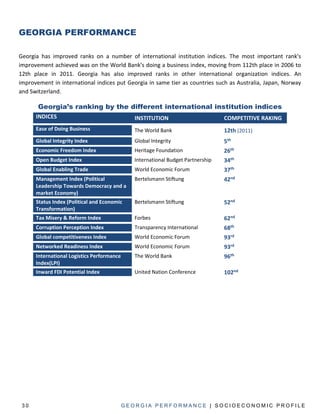
Georgia has improved ranks on a number of international institution indices. The most important rank's
improvement achieved was on the World Bank’s doing a business index, moving from 112th place in 2006 to
12th place in 2011. Georgia has also improved ranks in other international organization indices. An
improvement in international indices put Georgia in same tier as countries such as Australia, Japan, Norway
and Switzerland.

       Georgia’s ranking by the different international institution indices
      INDICES                                  INSTITUTION                        COMPETITIVE RAKING
      Ease of Doing Business                   The World Bank                     12th (2011)
      Global Integrity Index                   Global Integrity                   5th
      Economic Freedom Index                   Heritage Foundation                26th
      Open Budget Index                        International Budget Partnership   34th
      Global Enabling Trade                    World Economic Forum               37th
      Management Index (Political              Bertelsmann Stiftung               42nd
      Leadership Towards Democracy and a
      market Economy)
      Status Index (Political and Economic     Bertelsmann Stiftung               52nd
      Transformation)
      Tax Misery & Reform Index                Forbes                             62nd
      Corruption Perception Index              Transparency International         68th
      Global competitiveness Index             World Economic Forum               93rd
      Networked Readiness Index                World Economic Forum               93rd
      International Logistics Performance      The World Bank                     96th
      Index(LPI)
      Inward FDI Potential Index               United Nation Conference           102nd


 30                                         GEORGIA PERFORMANCE | SOCIOECONOMIC PROFILE
ECONOMIC ACTIVITY

Table 6 ECONOMIC STATISTICS
GDP (US$)                                         $11.9 billion (2009 est.)
GDP rate of growth                                -4.0% (2009 est.)
Income per capita                                 $2,447.35 (2009 est.)
Family Income – Gini index                        40.8           Lowest 10%: 1.9%, Highest 10%: 30.6%
                                                  (2005)
Population below poverty line                     31% (2006)
Unemployment rate                                 16.4%
Labor force                                       1.918 million (2007)
Labor force – by occupation                       Agriculture            56.6%
                                                  Industry               8.9%
                                                  Services:              35.5%
Inflation rate                                    1.7%


      Figure 6 Gross domestic production growth
      14.00%                                                                                                    $14,000,000,000.00
      12.00%                                                            12.34%
                                   9.59%                                                                        $12,000,000,000.00
      10.00%                                            9.38%
       8.00%                                                                                                    $10,000,000,000.00
       6.00%                                                                                                    $8,000,000,000.00
                      5.86%
       4.00%
       2.00%                                                                            2.31%                   $6,000,000,000.00
       0.00%                                                                                                    $4,000,000,000.00
      -2.00%
                                                                                                                $2,000,000,000.00
      -4.00%                                                                                           -4.00%
      -6.00%                                                                                                    $-
                   2004           2005           2006            2007            2008           2009
                                                                                                        Source: World Bank, 2010


      Figure 7 Income per capita growth rate
       $3,500.00                                                            12.58%                                 14.00%
                                                                                          $2,917.93                12.00%
       $3,000.00
                                         8.51%           8.47%                                        $2,447.35    10.00%
       $2,500.00                                                         $2,318.12
                          6.11%                                                                                    8.00%
       $2,000.00                                     $1,761.11                                                     6.00%
                                    $1,469.97                                                                      4.00%
       $1,500.00    $1,186.97                                                                   2.42%              2.00%
       $1,000.00                                                                                                   0.00%
                                                                                                                   -2.00%
        $500.00
                                                                                                            -4.07% -4.00%
           $0.00                                                                                                   -6.00%
                      2004               2005            2006              2007             2008        2009
                                                                                                       Source: World Bank, 2010


31                                                      ECONOMIC ACTIVITY | SOCIOECONOMIC PROFILE
Observation: Georgian GDP growth during 2006-2007              condition for the creditor, because they were paid back
was 9-10%, which is a good sign for investment and             with the more value for the same money. Somehow, it is
setting business in the country, although Aug 2008             related with increased unemployment rate in the
Russian aggression on Georgian territory and global            country, because of few available qualified workforces.
financial crisis slowed the country growth, and economy
contracted by 4% but GDP growth for 2010 in                     Figure 8 Inflation rate (annual %)
conservatively estimated at up to range from 5%. As the         12.00%
response of conflict with the Russia, 38 countries and 15                                        9.16%      9.24%
                                                                10.00%                                                   9.99%
international organization pledge to provide US$ 4.5bln
                                                                 8.00%
to Georgia for maintain economic condition and societal                                 8.27%
sovereignty. There are positive impressions for stead            6.00%
                                                                 4.00%         5.70%
growth of economy as Government commitment to the
free market based economy. Therefore, privatization in           2.00%
public sector seems excellent opportunities for                  0.00%                                                       1.72%
investment. GDP structure by industry sectors showed,                       2004    2005      2006       2007     2008     2009
Georgia, became primarily service based economy.
                                                                                                         Source: World Bank, 2010
Unemployment rate: Unemployment rate increasing
progressively because of demand of qualified workforce.
As a country adopted, free economy based model.
                                                                Figure 9 Unemployment rate
Therefore, demand for qualified worker increases and
                                                                20.00%
lack of qualification to get work done is a serious problem                                                                 16.40%
in Georgia though people are educated but not qualified                                 13.80%
                                                                15.00%
to do the specific task related to job. Which could an
                                                                                                 13.60% 13.30%           13.80%
opportunity for investment in the education sector,             10.00%       12.60%
opening private schools, college and starting a new
course that concentrates on providing technical                  5.00%
knowledge?
                                                                 0.00%
Inflation: Inflation decreased, which shows that it is a                    2004       2005     2006      2007      2008     2009
disinflation situation in Georgia, considerable rise in                                                   Source: World Bank, 2010
income while a low rise in cost of goods. It is a good


  Table 6.1 PRINCIPLE INDUSTRY
  Principle Industry                           Steel, Aircraft, machine tools, electrical appliances, mining
                                               (manganese and copper), chemicals, wood products and wine.
  Industry value added growth rate             -2.0%
  GDP contribution by each industry            Agriculture 12.2% Products: Citrus, Grapes, Tea, Hazelnuts,
                                                                       Vegetables and Livestock
                                               Industry       26%      Types: Steel, machine tools, mining, chemicals,
                                                                       wine, construction and wood products
                                               Service        61.8%      Types: Trade, Hotels, Social services, Education
                                                                         and professional services.


 32                                                 ECONOMIC ACTIVITY | SOCIOECONOMIC PROFILE
Figure 10 GDP Structure by sector contribution


                                             34%
                                                                                      Agriculture, forestry and fishing
                  11%
                                                                  10%                 Industry
                                                                                      Trade
               13%
                                                                                      Transport and communication
                                                            16%
                                                                                      Public administration
                                  16%
                                                                                      Other sectors


                                                                                                 Source: Geostat, 2010

                                                            Figure 11 Industry value added growth rate
      Ratio of publicly owned industries
                                                            15.00%                12.34%              13.39%
      After 2003 Rose revolution, privatizations become
                                                            10.00%       12.84%            13.47%
      necessary for a country to be established as a free
      market economy, investment is the main engine          5.00%
      for Georgian economy therefore selling of the
                                                             0.00%                                                     -2.00%
      majority of all companies demanded, today more
                                                                        2004   2005    2006       2007     2008       2009
      of the companies are privately owned or                -5.00%
      government supported with main service                                                                 -5.48%
                                                            -10.00%
      regulated by the government.
                                                                                                   Source: World Bank, 2010


33                                                 ECONOMIC ACTIVITY | SOCIOECONOMIC PROFILE
FOREIGN DIRECT INVESTMENT


 Table 7 FDI INFLOW IN ECONOMIC SECTORS
 FDI to Georgia in 2009                                $759.1 million
 Sectors (1000 USD)                                    Agriculture, Fishing                                  8,833.1
                                                       Industry                                              204,145.7
                                                       Energy                                                -1,138.9
                                                       Construction                                          79,701.3
                                                       Transport and Communication                           153,571.2
                                                       Real estate                                           132,043.5
                                                       Financial Sector                                      45,290.2
                                                       Other Services                                        124,632.3
 As a result of privatization                          Not Stated**                                          12,000.1


Figure 12 FDI net inflow of GDP (US$ )
 20.00%                                                                                                                         $2,000,000,000.00
                                                                                        17.20%
 15.00%                                                            15.10%                                                       $1,500,000,000.00
                                                                                                        12.22%
 10.00%                     9.60%                                                                                               $1,000,000,000.00

                                               7.06%                                                                    7.11%
  5.00%                                                                                                                         $500,000,000.00


  0.00%                                                                                                                         $-
                  2004                  2005                2006                 2007            2008            2009

Source: World Bank, 2010                           Investment in US$                    Net inflows (% of GDP)


Figure 13 FDI by Economic Sectors                                                   Observation: Foreign direct investment is most
                                                                                    important source of capital for Georgian, Georgia has a
                  Financial
                                                         Not stated**
                   sector
                                                              2%
                                                                                    diverse sector for investment. Last five-year statistic data
                     6%              Other
                                    services                      Agriculture,      demonstrate increase inflow of FDI in the country.
                                      16%                           fishing
                                                                      1%            Telecommunication, transport, real estate and hydro
              Real estate
                 17%                                                                power sector attracted most of the FDI inflow in the
                                                           Industry
                                                             27%                    country during 2005-07. Following the Russian aggression
                                                                                    on Georgia FDI fell to US$ 759.1 million, down from US$
                                                                                    1.56 billion in 2007.
 Transports
    and
communicati                               Construction      Energy sector
    ons                                      11%                 0%
    20%                                           Source: Geostat, 2010


34                                             FOREIGN DIRECT INVESTMENT | SOCIOECONOMIC PROFILE
Table 7.1 Foreign direct investment by countries
1000 USD
     S.No.   Major Countries           2008                  2009*                2010* Q1
     1       Austria                   $         51,463.37   $        14,451.30   $           1,863.00
     2       Belgium                   $            61.97    $           132.96   $               8.31
     3       Bulgaria                  $            12.66    $          (317.46) $                5.72
     4       Cyprus                    $         26,165.77   $        (3,372.60) $           (1,396.33)
     5       Czech Republic            $         34,857.63   $        15,057.25   $          19,777.90
     6       Denmark                   $           256.28    $           139.79   $              53.68
     7       France                    $          8,179.67   $        11,944.75   $          (1,245.29)
     8       Germany                   $         40,590.62  $          3,658.04   $           1,715.19
     9       Greece                    $         (1,850.42) $          2,515.32   $            921.07
     10      Ireland                   $            223.55 $              50.82   $              39.46
     11      Italy                     $          6,047.79  $          1,172.54   $            (946.23)
     12      Lithuania                 $           (113.93) $          3,430.05   $            228.53
     13      Luxembourg                $          5,731.05 $           6,206.34   $           3,330.15
     14      Netherlands               $       135,870.21    $       105,679.72   $           8,622.38
     15      Sweden                    $          7,634.83   $        (4,324.43) $             506.30
     16      United Kingdom            $       148,907.60    $        63,549.17   $          (1,377.45)
     17      Azerbaijan                $        23,942.70    $        24,596.00   $           6,492.35
     18      Armenia                   $        (15,061.44) $         (8,602.94) $           (1,107.29)
     19      Kazakhstan                $         65,941.73 $          (6,431.78) $       (14,020.36)
     20      Russia                    $         26,212.18   $         2,049.53   $           5,312.00
     21      Ukraine                   $        (6,441.96) $          (1,805.58) $               14.21
     22      Belize                    $        37,822.53 $            1,035.90   $            345.35
     23      Virgin Islands, British   $       156,847.32 $            5,691.78   $          (9,114.83)
     24      China                     $         (2,271.40) $         (1,309.46) $           (1,366.39)
     25      Gibraltar                 $          5,307.02 $             909.06   $            847.04
     26      Iran                      $          1,448.50 $             814.75   $            209.31
     27      Israel                    $         (2,047.66) $          3,062.03   $           1,298.62
     28      Japan                     $         11,655.35 $         (30,127.23) $           15,651.01
     29      Jordan                    -                     $         1,845.05   $            (375.92)
     30      Liechtenstein             $          5,015.96   $         1,907.54   $            (189.60)
     31      Norway                    $          2,693.35   $         1,877.29   $            (262.56)
     32      Marshall Islands          $          1,501.16   $         4,121.10   $           1,262.11
     33      United Arab Emirates      $       306,576.32    $       169,783.99   $            (320.82)
     34      Turkey                    $       164,525.59    $        89,506.34   $          20,303.63
     35      International organizations
                                       $         23,650.95   $        30,141.09   $           2,360.31
     36      Others                    $       292,606.07    $       250,040.60   $          16,361.55
             Total                     $      1,563,962.92   $       759,078.61   $          75,806.13


35                         FOREIGN DIRECT INVESTMENT | SOCIOECONOMIC PROFILE
TRADE INDICATORS

Georgian Export
Table 8 Georgian top Exports by Countries in 2009 (Thsd. USD)         Figure 14 Georgian top Exporter countries
Country                  Trade Value    Share (%)      CAGR (% 5yr)
Turkey                   225,768.66       19.97%          16.67%
Azerbaijan               165,633.84       14.65%          18.70%
Canada                   117,224.11       10.37%          34.67%                                                  Azerbaijan
Armenia                   88,941.67        7.87%          22.34%                                                                     Canada
Ukraine                   83,955.02        7.43%          22.78%                         Turkey
Bulgaria                  82,290.64        7.28%          17.72%                                                                          Armenia
United States             36,933.89        3.27%           8.40%
Italy                     23,282.15        2.06%          -8.73%                                                                    Ukraine
Germany                   23,025.39        2.04%          -5.13%                                                        Bulgaria
Kazakhstan                20,455.31        1.81%          20.20%           Kazakhstan
Total annual exports    1130555.351                                               Germany
                                                                                                   Italy
                                                                                                     United States                         Source: Geostat, 2010
Table 8.1 Top product exported in 2009 (Thsd. USD)                    Figure 15 Top producted exported in 2009
Name of products                              Trade value Share (%)                                    Pearls, precious or
                                                                                                                                       Edible fruit and nuts;
                                                                                                          semi-precious
Iron and steel                                 197,049.9   17.43%                                      stones, and articles
                                                                                                                                        Peel of melons or
                                                                                                                                               citrus
Beverages, spirits and vinegar                 123,776.4   10.95%                                            thereof
                                                                              Beverages, spirits                                                                Vehicles other than
Pearls, precious or semi-precious stones,      117,792.2   10.42%               and vinegar                                                                     railway or tramway
and articles thereof                                                                                                                                             rolling-stock, and
Edible fruit and nuts; Peel of melons or       90,087.8    7.97%                                                                                                    parts thereof
citrus
                                                                                                                                         Ores, slag and ash
Vehicles other than railway or tramway         84,354.0    7.46%
rolling-stock, and parts thereof                                                        Iron and steel                                       Fertilizers
Ores, slag and ash                             67,518.2    5.97%
Fertilizers                                    60,213.9    5.33%
Mineral fuels and products of their            41,451.7    3.67%
distillation; Bituminous substances; Waxes
                                                                                                                                                                 Mineral fuels and
Live animals                                   33,984.8    3.01%                                                                                                 products of their
Pharmaceutical products                        25,385.7    2.25%                                                   Pharmaceutical   Live animals                    distillation;
                                                                                                                      products                                     Bituminous
                                                                                                                                                                substances; Waxes
                                                                       Source: Geostat, 2010


36                                                                                      TRADE INDICATORS | SOCIOECONOMIC PROFILE
Georgian Import
Table 8.2 Georgian top Imports by Countries in 2009 (Thsd. USD)          Figure 16 Georgian top Importer countries
Country                        2009        Share (%)   CAGR (% 5yr)
Turkey                      787,616.73      18.03%          29.16%
                                                                                                                         Ukraine
Ukraine                     418,313.83      9.57%           17.51%
Azerbaijan                  376,432.90      8.62%           12.69%                                                                    Azerbaijan
                                                                                              Turkey
Germany                     301,382.46      6.90%            9.88%                                                                               Germany
Russia                      288,944.67      6.61%           -6.83%
United States               223,725.17      5.12%           11.10%
China                                                                                                                                            Russia
                            174,669.07      4.00%           39.06%
Bulgaria                    152,840.03      3.50%           20.59%
Italy                                                                                                                    China
                            127,686.36      2.92%           18.65%       United Arab
Romania                     113,864.51      2.61%           29.33%        Emirates
United Arab Emirates        110,344.77      2.53%           10.89%         Romania            Italy
Total Imports              4369496.477                                                                                                   United States
                                                                                                          Bulgaria
                                                                                                                                       Source: Geostat, 2010

                                                                         Figure 17 Top producted exported in 2009                                                         Mineral fuels
Table 8.3 Top products imported in 2009                                                                                             Articles of iron or
                                                                                                                                                                               and
                                                                                               Plastics and articles                                      Paper and        products of
Name of products                              Trade value    Share (%)                                thereof
                                                                                                                                           steel
                                                                             Pharmaceutical                                                           paperboard; Articles    their
Mineral fuels and products of their            772,396.1      17.68%                                                     Cereals
                                                                                products                                                                    thereof        distillation;
distillation; Bituminous substances;                                                                                                                                       Bituminous
Waxes                                                                                                                                                                      substances;
                                                                           Electrical
Nuclear reactors, boilers, machinery and       372,984.3      8.54%                                                                                                           Waxes
                                                                          machinery
mechanical appliances; Parts thereof                                          and
Vehicles other than railway or tramway         340,106.2      7.78%       equipment
rolling-stock, and parts thereof                                           and parts
Other products                                                              thereof      Other products
                                               303,431.8      6.94%
Electrical machinery and equipment and         297,579.8      6.81%
parts thereof
Pharmaceutical products                        194,298.5      4.45%
Plastics and articles thereof                  131,335.0      3.01%
Cereals                                        116,992.8      2.68%                                                                                              Nuclear reactors,
Articles of iron or steel                      94,433.6       2.16%               Vehicles other than                                                           boilers, machinery
                                                                                  railway or tramway                                                              and mechanical
Paper and paperboard; Articles thereof         86,740.9       1.99%                rolling-stock, and                                                            appliances; Parts
                                                                                      parts thereof                    Source: Geostat, 2010                          thereof


37                                                                                        TRADE INDICATORS | SOCIOECONOMIC PROFILE
BALANCE OF PAYMENT
  Surplus of deficit    $-3,238.9 million (2009, Geostat)
  Trend: Georgia’s balance of payment shows a permanent deficit and widen progressively. Georgia's export
  success leads to noticeable improvement but Aug 2008 Russian aggression on Georgia and global financial crisis
  made a negative impact on economy and trade.


      Figure 18 External Trade of Georgia (BOP)


           $8,000.00

           $6,000.00

           $4,000.00

           $2,000.00

                  $-
                             2005             2006             2007               2008           2009
          $(2,000.00)

          $(4,000.00)

          $(6,000.00)
                                  Export (FOB)Mil. US$     Import (CIF) Mil US$      Balance

                                                                                               Source: Geostat, 2010


Observation: Trade is most important activity in               technology in Georgian though it is more expensive than
Georgia's economy, as the country depends upon many            Asian countries, so there are good opportunity lies for
things from other nations. A lot of products Georgia buys      technological firms to export and import technology. Asian
from other nations, Georgian trade with other nations and      countries could become a better import export partner for
its trading practice have changed greatly over the years in    raw materials to produce technology within the country as
order the function the best, and to benefit the Georgia to     it would be cheaper than Europe and any other country as
the greatest degree. Instead of strong inflow of FDI, the      the Asian raw product is much lower cost than any other
Georgian trade deficit widened progressively.                  continent same product. This could also help Georgia to
                                                               decrease trade deficit and increase industry production.
Georgia has a sizeable trade relation with several different   Asian countries have the biggest consumer base in the
countries with the majority being within the CIS and           world. Therefore, Government must look at Asia to
European countries. US became in important partner in          strength Georgian trade activity.
Georgian trade. This could well be because of the limited


38                                                   TRADE INDICATORS | SOCIOECONOMIC PROFILE
Table 8.4 EXCHANGE RATE AGAINTS USD
Current rate of exchange: 1 US$ = 1.75 GEL (Nov/30/2010)


     Figure 19 Georgian Lari exchange rate trend against US dollar

     GEL 1.90                                                         GEL 2.00
     GEL 1.85                                                         GEL 1.80
                                                                      GEL 1.60
     GEL 1.80
                                                                      GEL 1.40
     GEL 1.75                                                         GEL 1.20
     GEL 1.70                                                         GEL 1.00         Year 2008
     GEL 1.65                                                         GEL 0.80
                                                                                       Year 2009
                                                                      GEL 0.60
     GEL 1.60                                                                          Year 2010
                                                                      GEL 0.40
     GEL 1.55                                                         GEL 0.20
     GEL 1.50                                                         GEL -


                                                                     Source : www.oanda.com, 2010


39                                              TRADE INDICATORS | SOCIOECONOMIC PROFILE
TRADE RESTRICTIONS
                                                              Preferential Tariffs with the USA, Canada,
Embargoes                                                     Switzerland and Japan
There is no such country which Austria restricted for trade   MFN tariffs with other WTO members, Georgia also
but there are few commodities like medical products,          benefits from a Generalized System of Preferences (GSP)
firearms, explosives, radioactive substances, industrial      when trading with the USA, Canada, Switzerland and
waste and few types of agricultural chemical products are     Japan. Accordingly, lower tariffs are applied on goods
subject to import/export licensing.                           exported from Georgia to those countries.
Quotas                                                        One of Only Two Countries in the CIS enjoying
Georgia has no quantitative quotas on trade.                  GSP Plus with the EU and Turkey
                                                              In July 2005, Georgia became one of the only two
Import taxes
                                                              beneficiaries (besides Moldova and Turkey) of the new EU
Rates of duty on imported goods fall into three bands, 0%,
                                                              GSP Plus scheme in the entire CIS and one of the 15
5% and 12%. Nearly 90 percent of goods benefited from a
                                                              beneficiaries in the world. This is an important factor in
zero rate of duty. An 18% Value Added Tax (VAT) applies
                                                              terms of facilitating export from Georgia. After being
to import goods. Fixed excise tax rates apply to be certain
                                                              granted the GSP Plus beneficiary status, Georgia can
goods such as alcoholic drinks, ethyl alcohol, ethyl petrol
                                                              import 7200 products to the EU market duty free.
for cars, cigarettes, etc.
                                                              Licensing
Import of goods for personal use of total value of up to
GEL 300 by land (at the border) and up to USD 1500 by air     Only medical products, firearms, explosives, radioactive
                                                              substances, industrial waste and a few types of
(at the airport) of total 50 kilograms is free from customs
                                                              agricultural chemical products are subject to
duty.
                                                              import/export licensing.
Tariffs
                                                              Custom duties
MFN Tariffs with WTO Members                                  The rates of customs duty are 5% or 12% of customs,
Most of Georgia’s trade partners are the members of the       value of goods depends to the type of goods and specific
World Trade Organization (WTO). Trade relations with          rates of customs duty apply to alcoholic drinks.
them are based on the Most Favored Nation (MFN) trade
status, which provides lower tariffs for WTO members.


 40                                               TRADE RESTRICTIONS | SOCIOECONOMIC PROFILE
EXTENT OF ECONOMIC ACTIVITY NOT INCLUDE IN CASH TRANSACTIONS


                                                            Foreign aid received
Counter Trade
                                                            There is no reliable and specific data available on
Georgia countertrade mainly happened with Turkey,           secondary sources, which shows how much foreign aid
Armenia, Ukraine and Germany.                               Georgia has been received from 1991 until 2010. In
                                                            response to Aug 2008 Russian aggression on Georgian
Product usually offered for countertrading
                                                            territory damage suffered, 38 countries and 15
There is countertrade offered in Natural gas, Electricity   international organizations pledged to provide U.S. $4.55
and many other goods come in category of counter            billion to Georgia at the Brussels donors’ conference.
trading.                                                    Many      developed     countries    and    international
                                                            organizations have been providing humanitarian and
Types of countertrade request
                                                            development aid to Georgia since 1991.
The possible counter trades that could be negotiated are
electricity and other natural resources, which are
available, in particular, country.


 41                                              TRADE RESTRICTIONS | SOCIOECONOMIC PROFILE
DEVELOPMENT IN SCIENCE AND TECHNOLOGY

The Ministry of Education and Science of Georgia (MES)       Technological skills of the labor
aims at establishing modern and innovative educational
and scientific environment in close cooperation with civil
                                                             force and general population
society and introduces best practices of developing          General population is lacking in skills set in relation to the
countries. With the help of European Union fund, MES is      skill requirement of the current technology and market.
making framework for science administration and              There is a great deficit appropriately qualified and skilled
intellectual property for patent technology in the           workforce in Georgia. The most the lowest quality of
country. The S&T sector of Georgian universities is in the   officially qualified workforce is working in every sector of
process of reorganization and actually. The budget for       industry. Even if there are a number of people with
research activities is shaped by the national as well as     certificates in the relevant field of activity, they turn out
international competitive grants.                            to be unskilled to perform specific duties associated with
                                                             the given field activity. Therefore, finding skilled worker
MES and GNSF endeavor to create friendly environments        still a big challenge in the country, govt. has been started
for research and industry cooperation. Implement diverse     the vocational study programme for general population
targeted programmes and actions to offer an incentive        to produce skilled workers but the process of instruction
for research commercialization (e.g. cooperative calls in    still conventional, which makes doubt on skills of workers
the frame of business partnership programme STEP             in the context to perform specific tasks related to the
organizes jointly by US Civil Research and Development       technological field.
Foundation – CRDF and GNSF in 2007 and 2008), launch
discussion with local stakeholders and invited experts on    Observation: Current Technology available in Georgia
expediency of establishment technology incubators and        but new product development is low within Georgia
science parks in Georgia. Georgian government supports       instead of 100% literacy. Investment on new
cooperation of local scientists and engineers with           development in science and technology is very low,
international S&T community and thus improves a state-       mostly Georgia relies on foreign partner to produce and
of-art of Georgian science.                                  implement technological development. Training of
                                                             people is to use technology very rare within Georgia
Available current technology                                 because of lack in well qualified technological workforce
Georgia is far behind in technology advancement and          and trainer. Therefore, people/students move out of the
innovation. New product development is zero in the           country to further their education and then don’t
country, though its literacy rate is 100%, new technology    returning due to better opportunities outside the
development still in the way to go ahead.                    country.

                                                             Technological skills are low in the general public due to
Percentage of investment in
                                                             an amateur trainer to provide skills. This could well be an
research and development                                     area for investment so that the general public could be
By the international grant and funding institutions, such    well-versed with the technology and development of
as EU, FPS, NATO STS, ISTC, CRDF, etc. make in average       science and technology could improve.
15-25% whole science and technology budget of Georgia.


 42         DEVELOPMENT IN SCIENCE AND TECHNOLOGY | SOCIOECONOMIC PROFILE
APPENDIX-1: DOING BUSINESS IN GEORGIA

The ease of doing business in Georgia is one of the key        Georgia ranks 12th on the list of countries on the ease of
factors. There are lots of business opportunities in Eurasia   doing business parameter of the World Bank’s Doing
and Middle East markets and Georgia is one of the good         Business Report 2011. Georgia developing infrastructure,
locations to use as a base to seek these potential             100% literacy rate and supportive government policies
opportunities because of the connected location of the         make it good destination to do business.
Georgia in Eurasia. I mean cost-effective location because
if you look at rental, cost of work force, etc. it is
affordable in comparison to Europe.

  Table 9 WORLD BANK: DOING BUSINESS INDICES RANK

  Rank indices                                                                    2011
  Ease of Doing Business                                                            12
  Starting a Business                                                                8
  Dealing with Construction Permits                                                  7
  Employing Workers                                                                  9
  Registering Property                                                               2
  Getting Credit                                                                    15
  Protecting Investors                                                              20
  Paying Taxes                                                                      61
  Trading Across Borders                                                            35
  Enforcing Contracts                                                               41
  Closing a Business                                                               105


It is small developing economy, starting a business from       because of its strategic location in the region. There are
scratch is easy but getting office space and quality people    over 3000 firms in the country and has big space for
still a problem in Georgia. However, lacking area could be     opening newer firm, scattered across diverse sectors such
an area for the opportunity in the country, such as            as IT services, education, logistics and manufacturing.
infrastructure and providing skills to workforce make          Entrepreneurs from other nations could look for more
opportunities for doing business in the country. For           opportunities in the country. Its strategic location,
registering a business, you would need a resident director     developing infrastructure, revival of Silk Road and a
to register company in Georgia. The resident does not          double lingual workforce makes the country an attractive
have to be a Georgian. Once that information is ready,         destination to do business. The reason why should
most companies would be able to register the company           companies come out to be based in Georgia? Because it
fairly within seven days, sometime companies take more         could be a stepping stone of the Eurasia region, even in
days to get it done. The registration fee is around 120-       Eurasia countries, with the population of 1252 million
360 GEL depend upon nature of the business firm.               people and trillion dollar economy, if I put that
                                                               collectively, it is a very attractive market.
Georgia has been potential to become a service hub in
the region to serve Eurasia and Middle East markets

 43                                    DOING BUSINESS IN GEORGIA | SOCIOECONOMIC PROFILE
The key interest could be for the foreign companies the      entrepreneur ideas and renovated management practices
use of Georgia as a base to tap the region. There are        to produce a solution and product that could be
many new areas where companies can explore                   eventually marketed to the world. Therefore,
opportunities such as Infrastructure, Information            Government is more open to test new innovation
technology,     telecommunication,      education     and    solutions that companies might bring forward, which
Manpower development, urban solutions and health and         could eventually use Georgia as a reference point to
wellness. Looking for some of the Georgian statistics and    target other markets in the world. A supportive
macro trends, half of the Georgian population is going to    government policy and an access to Eurasia and Middle
be moving into cities, it needed solutions for mobility or   East markets make Georgia an excellent destination for
transport, security and environment. I am positioning        doing business.
Georgia as a ground of innovation to develop the


 44                                DOING BUSINESS IN GEORGIA | SOCIOECONOMIC PROFILE
APPENDIX-2: HISTORY TIMELINE: GEORGIA

YEAR            KEY EVENTS
1.7Million BC   Hominid fossils and crude stone tools of this time were found in the former Soviet republic of
                Georgia in 1991 beneath the ruins of a medieval castle at Dmanisi. A 3rd smaller skull was
                found in 2002. All 3 were tentatively classified as Homo erectus. One skull of a man indicated
                that he had been almost toothless for at least 2 years before death.
8000BC          Wine was produced in the region known as Colchis (later Georgia) as early as this time.
500-600         The monastic complex of David Gareja was founded in the 6th century by David (St. David
                Garejeli), one of the thirteen Assyrian monks who arrived in Georgia at the same time. His
                disciples Dodo and Luciane expanded the original lavra and founded two other monasteries
                known as Dodo's Rka (literally, "the horn of Dodo") and Natlismtsemeli ("the Baptist"). Part of
                the complex is also located in the Agstafa rayon of Azerbaijan and thus became subject to a
                border dispute between Georgian and Azerbaijani authorities.
683-685         Khazars invaded Transcaucasia and inflicted much damage and stole much booty. The Khazar
                invaders killed the rulers of Armenia and Georgia.
1014            May 7, Bagrat III (b~960) of the Georgian Bagrationi dynasty, died. He was King of the
                Abkhazians from 978 on (as Bagrat II) and King of Kings of the Georgians from 1008 on. He is
                known to have constructed a magnificent cathedral, the Bagrati Cathedral, at Kutaisi, western
                Georgia.
1089-1125       David the Builder, a king who increased Georgia's wealth and prestige after, at age 16, taking
                the reins of a country beset by attackers.
1172-1216       Shota Rustaveli, a Georgian poet, lived about this time. He is considered by many to be one of
                the greatest representatives of the literature of the medieval world. His literary work in-cluded
                “The Knight in the Panther's Skin” ("Vepkhistkaosani" in Georgian), the Georgian na-tional epic
                poem.
1178            The wise King Giorgi III of Georgia had his daughter, Tamara (19), crowned as his co-ruler to
                provide an orderly succession.
1204-1205       Georgia’s Queen Tamara marched with her men to the rousing victory over the Turks at the
                Battle of Basiani where she is hailed with the cry, "Our King Tamara."
1212            Jan 18, Queen Tamara of Georgia in Transcaucasia died after a 24-year reign during which her
                soldiers proclaim her "our King."
1236            Queen Rusudani (41), the daughter of Queen Tamara, fled Georgia as the unstoppable Mongol
                hordes ravished the area. She had been proclaimed "King" at the death of her brother.
1258            Feb 10, Huegu (Hulega Khan), a Mongol leader and grandson of Genghis Khan, seized Baghdad
                following a 4-day assault. Mongol invaders from Central Asia took over Baghdad and ended the
                Abbasid-Seljuk Empire. They included Uzbeks, Kazaks, Georgians and other groups. Some 200
                to 800 thousand people were killed and looting lasted 17 days.
1265            Mongols sacked the monastic complex of David Gareja in Georgia.
1395            Tamerlane, a Turkic conqueror, swept into Southern Russia and Georgia driving locals into the
                hills.
1615            The Persians sacked the monastic complex of David Gareja in Georgia.
1783            Jul 24, Georgia became a protectorate of tsarist Russia.
1801            South Ossetia was absorbed into the Russian Empire along with Georgia.


 45                                                     APPENDIX-1 | SOCIOECONOMIC PROFILE
1801-04     Most of present-day Georgia becomes part of the Russian Empire.
1918        Independent Georgian state declared.
1921        Red Army invades. Georgia declared a Soviet Socialist Republic.
1922        Georgia, as part of the Transcaucasian Soviet Federative Republic, becomes a founder member
            of the Soviet Union.
1936        Transcaucasian Soviet Federative Republic dissolved and Georgia becomes a full republic of the
            Soviet Union.
1972        Eduard Shevardnadze appointed head of the Georgian Communist Party.
1989        April - Soviet troops kill 19 pro-independence demonstrators in Tbilisi.
            Demands for more autonomy in the South Ossetia region lead to violent clashes between
            Georgians and Ossetians. Russian peacekeepers are deployed.
1990        Nationalist coalition wins multi-party parliamentary elections; former dissident Zviad
            Gamsakhurdia becomes chairman of parliament.
1990-1991   Growing South Ossetian independence aspirations bring further violence between separatist
            and Georgian forces. Hundreds die and tens of thousands flee their homes.
            Independence
1991        Georgian parliament declares secession from the Soviet Union after independence is
            overwhelmingly supported in a referendum. Gamsakhurdia is elected president by more than
            85% of the votes cast.
1992        January - Gamsakhurdia is deposed after fighting in central Tbilisi between government troops
            and opposition militias.South Ossetians vote in favour of independence in an unrecognized
            referendum.
            March - Shevardnadze is appointed head of the newly formed State Council.
            Abkhazia crisis
            August - Fighting breaks out in Abkhazia between Georgian government troops and separatist
            forces.
1993        September - Georgian troops driven out of Abkhazia by separatist forces.
            October - Insurrection by Gamsakhurdia supporters in western Georgia is suppressed after
            Georgia agrees to join the CIS and receives help from Russian troops.
1994        Georgian government and Abkhaz separatists sign a ceasefire agreement, paving the way for
            the deployment of a Russian peacekeeping force in the region. New constitution adopted
            which provides for a strong executive presidency. New currency, the lari, introduced.
1995        November - Shevardnadze wins elections to the restored post of president.
1997        Death penalty abolished.
2000        April - Shevardnadze re-elected president.
2001        March - Georgia and the separatist region of Abkhazia sign an accord pledging not to use force
            against each other.
            June/July - Russia hands over Vaziani military base to Georgia.
            Tension with Russia
2001        October - Clashes in Abkhazia between Abkhaz troops and Georgian paramilitaries backed by
            fighters from the North Caucasus. The tension is heightened as Russia accuses Georgia of
            harbouring Chechen rebels, a charge dismissed by Georgia.
            November - Raid by security forces on privately-owned Rustavi-2 TV station, known for its
            criticism of Mr Shevardnadze and corruption, sparks protests. Mr Shevardnadze responds by
            sacking cabinet.


 46                                                APPENDIX-1 | SOCIOECONOMIC PROFILE
2002   April/May - US special forces arrive to train and equip Georgian forces for counterterrorist
       operations
       September - Russian President Putin warns of military action if Georgia fails to deal with
       Chechen militants which, Moscow says, Georgia is harbouring in Pankisi Gorge.

2003   May - Work begins on laying Georgian section of oil pipeline to run from Baku in Azerbaijan
       through Georgia to Ceyhan in Turkey.
       Shevardnadze ousted
       November - Shevardnadze is toppled in a bloodless "Rose Revolution" triggered by opposition
       allegations of irregularities in parliamentary elections.
2004   January - Mikhail Saakashvili wins presidential election.
       March - Amid rising tension with the leadership of the autonomous region of Ajaria, Tbilisi
       briefly imposes sanctions and closes the border. Mr Saakashvili's National Movement-
       Democratic Front wins overwhelming majority of seats in parliament in re-run of
       parliamentary elections.
       South Ossetia, Abkhazia troubles
       May - South Ossetia holds parliamentary elections, which are not recognised by Tbilisi.

       August - Several deaths are reported in clashes between Georgian and South Ossetian forces.
       October - Sergei Bagapsh declared winner of Abkhaz presidential elections, which are not
       recognised by Tbilisi. Abkhaz court orders rerun after protestes by opposition supporters.
2005   January - Sergei Bagapsh wins rerun of Abkhaz presidential elections after doing a deal with his
       main rival, Raul Khadzhimba, who becomes vice president.
       President Saakashvili unveils proposals on autonomy within Georgia for South Ossetia, whose
       leadership rejects them, repeating demand for full independence.
       February - Prime Minister Zurab Zhvania is found dead in a Tbilisi flat, apparently from gas
       poisoning. Zurab Noghaideli, hitherto finance minister, becomes premier.
       July - Russia starts to withdraw its troops from two Soviet-era bases under the terms of a deal
       reached in May. The pull-out is due to be completed by late 2008.
2006   Pipeline blasts
       January - Explosions on Russian side of border cut gas supplies and disrupt electricity supplies
       from Russia. Russia says it suspects North Caucasus insurgents but President Saakashvili
       accuses Moscow of sabotage.
       Georgia receives gas from Iran via recently-repaired pipeline running through Azerbaijan.


       July - Baku-Tbilisi-Ceyhan pipeline formally opened after Caspian oil starts flowing along it.
       Georgia announces plan to establish Abkhazia government-in-exile in gorge.

       November - South Ossetians vote in favour of independence in an unrecognised referendum.


2007   Anti-Saakashvili protests
       September - Former defence minister Irakli Okruashvili accuses Mr Saakashvili of corruption
       and plotting a murder, sparking a wave of protests.
2008   January - Saakashvili re-elected in snap election.
       March - Separatist government in Abkhazia asks United Nations to recognise independence.

 47                                             APPENDIX-1 | SOCIOECONOMIC PROFILE
Russian intervention
       August - Tensions between Georgia and Russia escalate into a full-blown military conflict after
       Georgia tries to retake South Ossetia by force after a series of lower-level clashes with Russian-
       backed rebels.
2009   Saakashvili under pressure
       April - Opposition launches "national disobedience campaign" in effort to persuade President
       Saakashvili to resign.
2010   October - Parliament approves constitutional changes aimed at curbing the powers of the
       president and expanding the role of the prime minister and parliament.
                                           Source : Timeline Georgia and BBC News, Timeline: Georgia


 48                                             APPENDIX-1 | SOCIOECONOMIC PROFILE
APPENDIX-3: MAP OF COUNTRY


                                               Source: Invest in Georgia


49                           APPENDIX-2 | SOCIOECONOMIC PROFILE
REFERENCE

 1.    http://news.bbc.co.uk/2/hi/europe/7683413.stm, Retrieved 15/10/2010
 2.    http://www.reliefweb.int/rw/RWB.NSF/db900SID/RMOI-HD4XX?OpenDocumentwww.activeconnect.in, Retrieved
       15/10/2010
 3.    http://www.eeca-ict.eu/EECA_Documents/research_information_docs/Research_Information_Georgia.pdf, Retrieved
       15/10/2010
 4.    http://www.altiusdirectory.com/Travel/georgia-geography.php, Retrieved 16/10/2010
 5.    http://www.ond.vlaanderen.be/hogeronderwijs/bologna/actionlines/documents/Employability_Georgia.pdf, Retrieved
       16/10/2010
 6.    http://www.geowel.org/files/vet_mismatch_study_english.pdf, Retrieved 17/10/2010
 7.    http://documents.wfp.org/stellent/groups/public/documents/ena/wfp178374.pdf, Retrieved 18/10/2010
 8.    http://www.nato.int/acad/fellow/95-97/gachechi.pdf, Retrieved 18/10/2010
 9.    http://www.dfat.gov.au/geo/georgia/georgia_brief.html, Retrieved 18/10/2010
 10.   http://en.wikipedia.org/wiki/Georgia_%28country%29, Retrieved 18/10/2010
 11.   http://www.europeanforum.net/country/georgia, Retrieved 18/10/2010
 12.   http://www.austrade.gov.au/Georgia/default.aspx, Retrieved 21/10/2010
 13.   http://www.mfa.gov.ge/index.php?sec_id=74&lang_id=ENG, Retrieved 21/10/2010
 14.   http://www.mof.ge/common/get_doc.aspx?doc_id=5834, Retrieved 21/10/2010
 15.   http://en.wikipedia.org/wiki/Georgia_%28country%29, Retrieved 22/10/2010
 16.   https://www.cia.gov/library/publications/the-world-factbook/geos/gg.html#top, Retrieved 23/10/2010
 17.   http://www.kwintessential.co.uk/resources/global-etiquette/georgia.html, Retrieved 23/10/2010
 18.   http://www.advantour.com/georgia/religion.htm, Retrieved 23/10/2010
 19.   http://www.everyculture.com/Ge-It/Georgia.html, Retrieved 23/10/2010
 20.   http://www.georgiacaucasus.com/, Retrieved 23/10/2010
 21.   http://en.wikipedia.org/wiki/Music_of_Georgia, Retrieved 23/10/2010
 22.   http://www.guardian.co.uk/environment/datablog/2009/sep/02/meat-consumption-per-capita-climate-change, Retrieved
       27/10/2010
 23.   http://earthtrends.wri.org/searchable_db/index.php?step=countries&cID[]=68&allcountries=checkbox&theme=8ariable_ID
       =192&action=select_years , Retrieved 27/10/2010
 24.   http://www.bmbureau.com/eng/business_resources_georgia_links_directory.aspx, Retrieved 27/10/2010
 25.   http://www.fdi.net/country/sub_index.cfm?countrynum=74, Retrieved 27/10/2010
 26.   http://www.concordtravel.ge/portal/alias__concordtravel/lang__en/tabid__1413/default.aspx, Retrieved 27/10/2010
 27.   http://www.oecexhibitions.com/gioge1.htm, Retrieved 02/11/2010
 28.   http://www.mongabay.com/reference/country_studies/georgia/GEOGRAPHY.html, Retrieved 02/11/2010
 29.   http://www.ceroi.net/reports/tbilisi/background/geograph.htm#topography, Retrieved 02/11/2010
 30.   http://data.worldbank.org/country, Retrieved 02/11/2010
 31.   http://www.nationmaster.com/country/gg-georgia/eco-economy, Retrieved 02/11/2010
 32.   http://www.everyculture.com/Ge-It/Georgia.html, Retrieved 05/11/2010
 33.   http://www.advantour.com/georgia/culture.htm, Retrieved 05/11/2010
 34.   http://www.experiencefestival.com/a/Culture_of_Georgia/id/2032102, Retrieved 05/11/2010
 35.   http://www.culturecrossing.net/basics_business_student.php?id=78, Retrieved 06/11/2010
 36.   http://www.euroeducation.net/prof/goergco.htm, Retrieved 06/11/2010
 37.   http://hdrstats.undp.org/en/countries/country_fact_sheets/cty_fs_GEO.ht, Retrieved 30/10/2010,ml
 38.   http://www.agbdc.com/, Retrieved 06/11/2010
 39.   http://www.state.gov/p/sca/ci/, Retrieved 06/11/2010
 40.   http://www.investingeorgia.org/?70/, Retrieved 06/11/2010
 41.   http://www.doingbusiness.org/ExploreEconomies/?economyid=74, Retrieved 10/11/2010
 42.   http://www.fitchratings.com/creditdesk/ratings/issr_rtng.cfm?issr_id=85877873, Retrieved 10/11/2010
 43.   http://www.gbc.ge/index.php?m=about_gbc, Retrieved 11/11/2010
 44.   http://www.georgia.gov.ge/, Retrieved 14/11/2010
 45.   http://mfa.gov.ge/index.php?lang_id=ENG&sec_id=1, Retrieved 15/11/2010
 46.   http://www.export.gov/georgiasummit/, Retrieved 15/11/2010
 47.   http://education.stateuniversity.com/pages/512/Georgia-HIGHER-EDUCATION.html, Retrieved 15/11/2010
 48.   http://www.workpermits.in/finding_jobs_in_georgia.htm, Retrieved 15/11/2010


50                                                            REFERENCE | SOCIOECONOMIC PROFILE
49.   http://www.heritage.org/index/Country/Georgia#business-freedom¸ Retrieved 16/11/2010
 50.   http://www.heritage.org/index/ranking.aspx Retrieved 16/11/2010
 51.   http://yell.ge/orgns.php?id=15&lan=2, Retrieved 16/11/2010
 52.   http://www.market.ge/directory/consulting.html, Retrieved 17/11/2010
 53.   http://export.gov/, Retrieved 17/11/2010
 54.   http://www.guardian.co.uk/business/datablog/2010/sep/09/global-competitiveness-index-data-wef, Retrieved 17/11/2010
 55.   http://news.bbc.co.uk/2/hi/europe/country_profiles/1102477.stm#overview, Retrieved 17/11/2010
 56.   http://www.state.gov/r/pa/ei/bgn/5253.htm, Retrieved 18/11/2010
 57.   http://www.trade.gov/cs/, Retrieved 18/11/2010
 58.   http://georgia.travel/culture/history/, Retrieved 18/11/2010
 59.   http://globaledge.msu.edu/countries/georgia/rankings/, Retrieved 18/11/2010
 60.   http://madb.europa.eu/mkaccdb2/indexPubli.htm, Retrieved 18/11/2010
 61.   http://www.associatepublisher.com/e/c/co/commonwealth_of_independent_states.htm, Retrieved 18/11/2010
 62.   http://www.brain-source.ge/index.php?a=more_vacanc&lang=en&vid=4c2dd508ae1b9, Retrieved 18/11/2010
 63.   http://www.enterprisesurveys.org/ResearchPapers/, Retrieved 18/11/2010
 64.   http://data.un.org/Search.aspx?q=Georgia, Retrieved 20/11/2010
 65.   http://countrystudies.us/georgia/, Retrieved 20/11/2010
 66.   http://www.nato-pa.int/default.asp?SHORTCUT=1171, Retrieved 22/11/2010
 67.   http://www.guardian.co.uk/environment/datablog/2009/sep/02/meat-consumption-per-capita-climate-change, Retrieved
       23/11/2010
 68.   http://earthtrends.wri.org/searchable_db/index.php?step=countries&cID%5B%5D=68&allcountries=checkbox&theme=8&v
       ariable_ID=192&action=select_years, Retrieved 23/11/2010
 69.   http://www.xpatulator.com/outside.cfm?lid=80, Retrieved 23/11/2010
 70.   http://www.coface.com/CofacePortal/COM_en_EN/pages/home/risks_home, Retrieved 23/11/2010
 71.   http://www.eurasianet.org/resource/georgia?page=1, Retrieved 25/11/2010
 72.   http://www.gfi-israel.co.il/index.php?lang_id=ENG&sec_id=6, Retrieved 25/11/2010
 73.   http://www.government.gov.ge/index.php?lang_id=ENG, Retrieved 25/11/2010
 74.   http://www.itdc.ge/index.php?lang_id=ENG&sec_id=1, Retrieved 26/11/2010
 75.   http://www.supremecourt.ge/default.aspx?sec_id=39&lang=1, Retrieved 26/11/2010
 76.   http://www.sakpatenti.org.ge/index.php?lang_id=GEO&sec_id=16&lang_id=ENG, Retrieved 27/11/2010
 77.   http://www.undp.org.ge/, Retrieved 27/11/2010
 78.   http://www.control.ge/eng/, Retrieved 27/11/2010
 79.   http://www.metro.ge/, Retrieved 27/11/2010
 80.   http://www.eugbc.net/, Retrieved 01/12/2010
 81.   http://www.parliament.ge/index.php?lang_id=ENG&sec_id=1, Retrieved 01/12/2010
 82.   http://ec.europa.eu/delegations/georgia/index_en.htm, Retrieved 01/12/2010
 83.   http://www.transparency.ge/en, Retrieved 01/12/2010
 84.   http://www.alpe.ge/en/main/, Retrieved 01/12/2010
 85.   http://timelines.ws/countries/GEORGIA.HTML, Retrieved 01/12/2010
 86.   http://www.tlg.gov.ge/content.php?id=95&lang=eng, Retrieved 02/12/2010
 87.   http://www.cnbc.com/id/39554884/, Retrieved 02/12/2010
 88.   http://www.oanda.com/account/, Retrieved 04/12/2010


51                                                             REFERENCE | SOCIOECONOMIC PROFILE
Georgia Profile

Georgia Profile

  • 1.
    FOCUS ON SETUPSHOP & DOING BUSINESS
  • 2.
    FOCUS ON SETUPSHOP & DOING BUSINESS
  • 3.
    TABLE OF CONTENT SUM MA R Y …… … …… …… … …… … …… … …… …… … …… … …… … …… …… … …… … ….. 5 KE Y F A C TS ...... ..... ...... .. ........ ...... ...... ...... ...... ... ........ ...... ...... ...... ...... . .. ........ ...... ...... . 8 SO CI A L INT R OD U C TIO N … … … …… … …… … …… … …… …… … …… … …… … …… …… ….. 10 HIS T OR Y O VE R VIE W … …… … …… … …… … …… …… … …… … …… … …… …… ….. 11 DE M O GR APH I CS … …… …… … …… … …… … …… …… … …… … …… … …… …… …. 12 GE O G R APHI C AL SE T TIN G … …… … …… … …… … …… … …… … …… … …… …… …. 15 MIN RA L RE SO U R CE S … …… … …… … …… … …… …… … …… … …… … …… …… …. 16 CO MM UN IC A TI ON S YS TE M … … …… … …… … … …… … …… … …… … …… …… …. 17 SO CI AL IN S T I TU T ION … …… … …… … …… … …… …… … …… … …… … …… …… … 18 E DU C A TI ON …… … …… …… … …… … …… … …… …… … …… … …… … …… …… … 19 POL T IC AL S Y S TE M … … …… … …… … …… … …… …… … …… … …… … …… …… …. 21 LE G AL S Y S TE M … …… … …… … …… … …… … …… …… … …… … …… … …… …… … 23 HU MAN AN D THE UN IVE RSE … …… … …… … …… …… … …… … …… … …… …… … 24 LIV IN G CON DI T ION S … …… … …… … …… … …… …… … …… … …… … …… …… …. 26 BU SI N E S S C US T OM S AN D P RA C TI CE S …… … …… …… … …… … …… … …… …… … 27 CON C LU SI ON …… … … …… … …… … …… … …… …… … …… … …… … …… …… ….. 28 EC ON OM Y GE O R GI A PE R FO RM AN CE … …… … …… … …… … …… … …… … …… … …… …… … …… … ….. 30 E CON O MI C A C TI VI T Y … …… … …… … …… … …… …… … …… … …… … …… …… …. 31 FO RE I GN DI RE C T IN VE S T ME N T …… … …… … …… …… … …… … …… … …… …… … 34 T RD AE IN DI C A TIO R S … …… … …… … …… … …… …… … …… … …… … …… …… …. 36 T RD AE R E S T RI CA T ION S …… … …… … …… … …… …… … …… … …… … …… …… …. 40 E X TE N T O F E CO N O MI C A C TI VI T Y N O T IN CL U DE I N C ASH TR ANS A C TI ON … …… … 41 DE VE LO PME N T IN SC IE N CE AND TE CH NOL O G Y … …… … …… … …… … …… …… … 42 A PP EN D IC E S APPE N DI X -1 D OIN G B US I N E SS IN GE OR G IA … … …… … …… … …… … …… …… …. . 43
  • 4.
    APPE N DIX -2 HI S TO R Y TI ME LINE : GE OR G IA … … …… … …… … …… … …… …… … .. 45 APPE N DI X -3 M AP OF C O UN TR Y … … …… … …… …… … …… … …… … …… …… ….. 49 RE FE RE N CE …… … …… …… … …… … …… … …… …… … …… … …… … …… …… … …… … ….. 50 TABLE INDEX TABLE 1 DEMOGRAPHICAS INDICATORS ………………………………………………………………. 12 TABLE 1.2 DISTRIBUTION OF POPULATION ……………………………………………………………… 13 TABLE 2 MINERAL RESOURCES ………………………………………………………………………… 16 TABLE 3 COMMUNICATION MEDIUMS ………………………………………………………………... 17 TABLE 4 SCHOOL ENROLMENT ………………………………………………………………………… 20 TABLE 5 POLITICAL STRUCTURE ……………………………………………………………………….. 21 TABLE 5.1 MAIN POLITICAL PARTIES IN GEORGIA ……………………………………………………….. 22 TABLE 6 ECONOMIC STATISTICS ……………………………………………………………………….. 31 TABLE 6.1 PRINCIPLE INDUSTRY …………………………………………………………………………. 32 TABLE 7 FDI FLOW IN ECONOMIC SECTORS …………………………………………………………… 34 TABLE 7.1 FOREIGN DIRECT INVESTMENT BY COUNTRIES ………………………………………………. 35 TABLE 8 GEORGIAN TOP EXPORTS BY COUNTRIES IN 2009 …………………………………………… 36 TABLE 8.1 TOP PRODUCT EXPORTED IN 2009 …………………………………………………………… 36 TABLE 8.2 GEORGIAN TOP IMPORTS BY COUNTRIES IN 2009 …………………………………………… 37 TABLE 8.3 TOP PRODUCT IMPORTED IN 2009 …………………………………………………………… 37 TABLE 8.4 EXCHANGE RATE AGAINTS USD ………………………………………………………………. 39 TABLE 9 WORLD BANK: DOING BUSINESS INDICES RANK ……………………………………………... 43 CHART INDEX FIGURE 1 MIGRATION AND GROWTH RATE ……………………………………………………………. 12 FIGURE 2 SEX RATION …………………………………………………………………………………… 12 FIGURE 3 ETHNIC GROUP DISTRIBUTION IN TOTAL POPULATION ……………………………………… 13 FIGURE 4 LANGUAGE DISTRIBUTION IN TOTAL POPULATION ………………………………………….. 13 FIGURE 5 POPULATION: RELIGION ……………………………………………………………………… 14 FIGURE 6 GROSS DOMESTIC PRODUCTION GROWTH ………………………………………………….. 31 FIGURE 7 INCOME PER CAPITA GROWTH RATE ………………………………………………………… 31 FIGURE 8 INFLATION RATE ……………………………………………………………………………… 32 FIGURE 9 UNEMPLOYMENT RATE ………………………………………………………………………. 32 FIGURE 10 GDP STRUCTURE BY SECTOR CONTRIBUTION ……………………………………………….. 33 FIGURE 11 INDUSTRY VALUE ADDED GROWTH RATE ……………………………………………………. 33 FIGURE 12 FDI NET INFLOW OF GDP ……………………………………………………………………... 34 FIGURE 13 FDI BY ECONOMIC SECTORS ………………………………………………………………….. 34 FIGURE 14 GEORGIAN TOP EXPORTER CONTRIES ………………………………………………………... 36 FIGURE 15 TOP PRODUCT EXPORTED IN 2009 …………………………………………………………… 36 FIGURE 16 GEORGIA TOP IMPORTER COUNTRIES ……………………………………………………….. 37 FIGURE 17 TOP PRODUCT IMPORTED IN 2009 …………………………………………………………… 37 FIGURE 18 EXTERNAL TRADE OF GEORGIA (BOP) ………………………………………………………... 38 FIGURE 19 GEORGIAN LARI EXCHANGE RATE TREND AGAINST US DOLLAR ……………………………... 39
  • 5.
    SUMMARY The objective of this study is to make country there are many political parties. Country is still in profile, in order to draw some conclusions shift phase to develop a better democratic regarding doing business. While observing this country, recent amendment in Georgian law, shift information, caution must be taken to interpret the power from President to Prime minister. It is the meaning of this information, and understand a good sign for become a full-fledged democratic the target country reaction. That is, the exercise republic country. centers on the search as to whether the market will be suitable for doing business. Georgia has made significant progress since the 2003 "Rose Revolution" in the quality of Georgia is a small country of 4.6 million people, governance and business environment. On the located on the southern flanks of the Caucasus different international organization rank indices, Mountains with a land area of 69,700 square Georgia scored really very well such as doing kilometers. It shares borders with Russia in the business 12th out of 180 nations in 2011 north, Turkey and Armenia in the south, comparisons to other region countries. Rapid Azerbaijan in the east and has a coastline on the reforms and new legislation have liberalized the Black Sea in the west. Georgia's location between economy and created favorable conditions for the Black Sea, Russia, Armenia, Azerbaijan, and industry development and investment. Low Tax, Turkey gives it strategic importance as a transit liberal trade regimes, simplified licensing and corridor. It is developing as the gateway from the permitting procedure, and developing Black Sea to the Caucasus and the Caspian basin. infrastructure made the Georgia best possible Population of Georgia is the very good indication country for doing business and investment. to develop international expatriate business society in compare to land area and existing Economic growth in Georgia is on track to reach business opportunity. Lower birth rate is a 4.5 percent next year, and it could be double that serious issue for the country as a country can face by 2012-2013 as tourism, the banking sector and the ageing problems within 30 years. Georgia’s exports advance and foreign direct investment recorded history date back more than 2500 years grow. Georgia had become a regional investment old, which consist of many facts about the hub during 2005-2007. Private investors are country and impacted on Georgian present day seeking to expand from Georgia into the Caucasus, central Asia, Ukraine, Turkey but society. foreign direct investment decreased over the Georgian people have a relationship oriented past two years because of the worldwide approach. Country has rich resources of mineral, financial crisis and conflict with Russia. The falls which could also be another opportunity for were being compensated by investment coming investment in a mining sector. Agricultural land in through international institutions. This helped and weather make its added gain to produce keep the country’s currency stable. Lari is the organic food, which is quite demandable in a most stable currency in the region from last five western market as well as in Asian market. years instead of global financial crisis effect on it. Political situation is now more stable, although 5 SUMMARY | SOCIOECONOMIC PROFILE
  • 6.
    Foreign direct investmentdecreased because of which plans to buy natural gas from Azerbaijan the worldwide financial crisis and Russian and transport it across Georgia to the Black Sea. conflict, but there is a serious increase in the Georgia is no more relied on an aggressive inflows,” International financial institutions such neighbor country for it energy need. There is gas as the World Bank, the European Bank for flowing from north to south, crossing Georgia Reconstruction and Development and the Asian from east to west 1.5 percent of the world’s total Development Bank, which are investing in oil consumption crosses Georgia, and Georgia projects such as hydro power plants and electricity exporters to all neighboring countries, highways, were important drivers of this including Russia. increase. Country has a strong presence in an international Relations between Georgia and neighboring organization as Georgia is a member of the UN, Russia reached a low in 2008, when the two OSCE, World Bank, IMF, EBRD, World Trade countries fought a five-day war over the Georgian Organization (WTO), Council of Europe, and region of South Ossetia. However, Georgia is now Organization for Democracy and Economic politically stable, and a recent deal with Bulgaria, Development-GUAM. 6 SUMMARY | SOCIOECONOMIC PROFILE
  • 8.
    KEY FACTS Name of the country Georgia Capital Tbilisi Area 69,700 km2 Border countries Russia, Azerbaijan, Armenia ,and Turkey Population 4.6 mln Ethnic group Georgian 83.8%, Armenian 5.7%, Azeri 6.5%, others 2.5%, Russian 1.5% Languages Georgian 71%(official), Russian 7%, Armenian 7%, Azeri 7%, others 7% Religion Orthodox Christian 83.9%, Muslim 9.9%, Armenian-Georgian 3.9%, Catholic 0.8%, Other 0.8%, none 0.7% Currency Lari (GEL) Gross domestic product (GDP) US$ 11.9 bln GDP Per Capita US$ 2,447.35 Inflation 1.7% Unemployment 16.4% International dialing code +995 Internet domain .ge Main exports Scrap metal. Machines. Chemicals, oil transport, citrus fruits, tea, wine Main import Fuel, machines and parts, grains and other food, medicine *Source of facts citied in the reference list of secondary sources 8 KEY FACTS | SOCIOECONOMIC PROFILE
  • 9.
    FOCUS ON SETUPSHOP & DOING BUSINESS
  • 10.
    INTRODUCTION Georgia known officiallyfrom 1991 as the Republic of and they think of themselves as an Eastern Georgia, until 1990 it was Soviet Union state. It absorbed Mediterranean culture. into Russian Empire in the 19th century. It has been independent of three years (1918-1921) following the Georgia has attracted the attention of a range of other Russian revolution, and it was forcibly incorporated into countries, with different interests and ambitions. It seeks the USSR until the Soviet Union dissolved in 1991. to strengthen a republic and achieve greater economic Georgia was an ancient kingdom of Colchis and stability. It has a potential to come to be an important Kartlilberia. In the first century A.D., it came under an and developed economy of the black sea & Eurasia influence of Roman, and Christianity became the country region. Coming years appears very prosperous in business the state religion in the 330 AD. It was the second and social growth of the country because its future on the country to adopt Christianity. Georgia dominated by restoration of the ancient Silk Road economies as a Eurasian transportation system corridor, using Georgia's Persian, Arabs, Mongol and Turks. geography as a bridge for the transit of goods, including Georgia is strategically located at crossroads between oil and gas, between Europe and Asia. Georgians are Europe and Asia (Eurasia). Georgia is bordered to the renowned for their hospitality and artistry in dance, west by the black sea, to the north by Russia, to the south theater, music, and design. Georgian Government has by Turkey and Armenia, and the east by Azerbaijan. Most been taken affirmative action after 2003 Rose revolution, of Georgia is located in the South Caucasus, while a toward economic and social reforms, making significant portion lies in North Caucasus. Throughout the centuries, impact in country society as well as on the economy. It it has been dominated and settled by Greeks, Romans, could become most important service hub in the region Persians, and Turkish tribes, Arabs, Mongols and because of access in Europe and Asia, though finding Russians. Georgia was also on one of the branches of the trained talent is still a problem in country, but govt. step Silk Road, which carried trade from China and India to toward vocational studies making shift in order to ease in Europe hence the Georgian people have been influenced find talent. As the country adopted free market economy by many cultures, both Asian and European. The model like Singapore and doing business in the country Georgians resembles Greeks and Turks in appearances, become easy gives to attractive invest ground for FDI. 10 INTRODUCTION | SOCIOECONOMIC PROFILE
  • 11.
    HISTORY OVERVIEW Georgia’s recordedhistory dates back more than 2500 Georgia was absorbed into the Russian Empire in the 19th years old. Georgia has historically found itself on the century, Independent for three years (1918-1921) edges of great empires, and Georgians have lived following the Russian revolution. It was forcibly absorbed together in a unified state for only a small fraction of into USSR until Soviet Union disintegrated in 1991 and their existence as people. Much of Georgia's territory was Georgia restored independence from Russia same year. fought over by Persian, Roman, Byzantine, Arab, Mongol, Present-day Georgia is rapidly growing economy. and Turkish armies from at least the 1st century B.C. Progress on market reforms and democratization has through the 18th century. The zenith of Georgia's power been made in the year since independence but progress as an independent kingdom came in the 11th and 12th has been complicated by Russia assistance and support to centuries, during the reigns of King David the Builder and the breakaway regions of Abkhazia and South Ossetia. Queen Tamara, who still ranks among the most After a series of Russian and separatist provocations in celebrated for all Georgian rulers. In 1783 the king of summer 2008, Russian troops pulled back from most Kartli (in eastern Georgia) signed the Treaty of Georgievsk occupied the breakaway areas, but large portions of with the Russians, by which Russia agreed to take the Georgia proper as well. Russian unilaterally recognized kingdom as its protectorate. In 1801, the Russian empire the independence of Abkhazia and South Ossetia. This began the piecemeal process of unifying and acquiring action was strongly condiment by most of the world Georgian territory, and for most of the next two centuries nations and international organizations. (1801-1991), Georgia found itself ruled from St. Petersburg and Moscow. Note: Appendix -2 History timeline of Georgia 11 HISTORY OVERVIEW | SOCIOECONOMIC PROFILE
  • 12.
    DEMOGRAPHICS Table 1 Demographicindicators Total population 4.6 million (2010 est.) Growth Rate -1.08% Birth Rate 10.66 births/1,000 population Death Rate 9.65 deaths/1,000 population Migration Rate -4.26 migrant(s)/1,000 population Urbanization 53% of total population (2008 est.) Rate of urbanization -0.6% annual rate of change (2005-10 est.) Literacy rate 100% Figure 1 Migration and growth rate -4 -1 -4.1 2004 2005 2006 2007 2008 2009 -1.05 -4.2 -4.3 -1.1 -4.4 -4.5 -1.15 -4.6 -1.2 -4.7 -4.8 -1.25 Migration rate(%) Growth rate(%) Figure 2 Sex ratio 1616234 2000000 1503360 1500000 Population 1000000 395929 453110 345071 302103 500000 0 0-14 15-64 65 years and over Male Female Source: CIA - The World Facts, 2010 12 DEMOGRAPHICS | SOCIOECONOMIC PROFILE
  • 13.
    Table 1.2 Distributionof population Age 0-14 years: 16.1% (Male 395,929/Female 345,071) 15-64 years: 67.6% (Male 1,503,360/Female 1,616,234) 65 years and over: 16.4% (Male 302,103/Female 453,110) (2010 est.) Sex at birth: 1.127 male(s)/female under 15 years: 1.15 male(s)/female 15-64 years: 0.93 male(s)/female 65 years and over: 0.66 male(s)/female Total population: 0.91 male(s)/female (2010 est.) Ethnic Group Georgian 83.8% Azeri 6.5% Armenian 5.7% Russian 1.5% other 2.5% (2002 census) Language Georgian 71% (official) Russian 9% Armenian 7% Azeri 6% other 7% Religions Orthodox Christian 83.9%, Muslim 9.9%, Armenian-Gregorian 3.9% Catholic 0.8% other 0.8% none 0.7% (2002 census) Geographical areas Regions Main City Guria Tbilisi (Metro city) Imereti Kutaisi Kakheti Batumi Kvemo-Kartli Rustavi Mtskheta-Mtianeti Zugdidi Racha-Lechkhumi and Kvemo Svaneti Gori Samegrelo-Zemo Svaneti Poti Samtskhe-Javakheti Akhaltsikhe Shida Kartli Sukhumi Samtredia Khashuri Senaki Telavi Figure 3 Ethnic group distribution in total population Figure 4 Language distribution in total population Georgian 84% Azeri Russian 6% Georgian 9% 71% Armenian 6% Armenian 7% Russian Azeri Other 1% 3% Other 6% 7% Source: CIA - The World Facts, 2010 13 DEMOGRAPHICS | SOCIOECONOMIC PROFILE
  • 14.
    Observation: Georgian populationgrowth trend is Figure 5 Population: Religion really negative. It appears within 30 years Georgia could face the ageing crisis. Therefore, there is a Orthodox need of population growth. Compare to any Indian Christian city with the population of 5 million, Georgia has a 84% big advantage to make faster growth to implement Muslim reforms because of its literacy rate. In the ratio of 10% Area and population, there are very good opportunities to build expatriate society, which Armenian- Georgian could make pressure on international politics to None 4% secure country independence and from any future Catholic 0% Other 1% aggression from neighbor countries. This could be Source: CIA - The World Facts, 1% the best possible way to secure country future and create more opportunities for everyone. Language is another advantage of the country. Georgian is a primary language of 4.2 million people in country but still Russian is most spoken secondary language in Georgia. Russian language is the language for 180 million people, which give an idea for expansion of business activity in other CIS regions. Recently, the government adopted English to become a mandatory language to be taught in school from one grade, which is also a good indication to produce a future international workforce. 14 DEMOGRAPHICS | SOCIOECONOMIC PROFILE
  • 15.
    GEOGRAPHICAL SETTING Location Caucasus range. The Lesser Caucasus range, which runs parallel to the Turkish and Armenian borders, and the Georgia is situated on the Black Sea at the junction of Surami and Imereti ranges, which connect the Caucasus Eastern Europe and Asia. Georgia is a mountainous Mountains, create natural barriers that are partially country. The northern geographical boundaries run along responsible for cultural and linguistic differences among the Great Caucasian Range, which include the Main regions. Because of their elevation and a poorly Caucasian Range, and its other chains stretch to the developed transportation infrastructure, many mountain south. The southern boundary coincides with the villages are virtually isolated from the outside world mountainous system of the Minor Caucasus, including the during the winter. Earthquakes and landslides in Meskheti-Trialeti volcanic plateau, Southwestern Asia, mountainous areas present a significant threat to life and bordering the Black Sea, between Turkey and Russia, with a sliver of land north of the Caucasus extending into property. Europe. Georgia share borders with Russia (723 km) to Georgia has about several rivers, many of which use for the north, Turkey (252 km) and Armenia (164 km) south power small hydroelectric stations. Drainage is into the west, Azerbaijan (322 km) to the south-east, and the Black Sea to the west and through Azerbaijan to the Black Sea to the west coast line (315 km). Caspian Sea to the east. Country longest river is the Mtkvari (formerly known by its Azerbaijani name, Kura, Climate which is still used in Azerbaijan), which flows 1,364 Georgia's climate is continental climate. Its climate kilometers from the northeast Turkey across the plains of affected by subtropical influences from the west and eastern Georgia, through the capital, Tbilisi, and into the Mediterranean influences from the east. The Greater Caspian Sea. The Rioni River, second largest river in Caucasus range moderates the local climate by serving as western Georgia, rises in the Greater Caucasus and a barrier against cold air from the north. Warm, moist air empties into the Black Sea at the port of Poti. Soviet from the Black Sea moves easily into the coastal lowlands engineers turned the river lowlands along the Black Sea from the west. Climatic zones are determined by distance coast into a prime subtropical agricultural land, from the Black Sea and by altitude. The plains of eastern embanked and straightened many stretches of river, and Georgia are shielded from the influence of the Black Sea built an extensive system of canals. Deep mountain by mountains that provide a more continental climate. gorges forms topographical belts within the Greater Caucasus. Topography In spite of its small area, Georgia has one of the most Temperature varied topographies of the former Soviet republics. Country temperature recorded in summer average 20° C Georgia lies mostly in the Caucasus Mountains, and its to 24° C and winter 2° C to 4° C. Humidity is lower and northern boundary is partly defined by the Greater rainfall averages 500 to 800 millimeters per year. 15 GEGOGRAPHICAL SETTING | SOCIOECONOMIC PROFILE
  • 16.
    MINERAL RESOURCES Georgia isrich country in minerals, and it has significant for ferro alloys' production. Categorized list of minerals minerals resources reserve. There are many kinds of found in Georgia given below. economic mineral mined during soviet era, as fall of USSR, the Georgian minerals mining decline. A range of Georgia has a main role in the world minerals. Georgia is mineral commodities were mined in Georgia, including a transportation route for oil and gas shipments out of the Caspian region to world market. Therefore, it is a arsenic, barite, bentonite, coal, copper, diatomite, lead, manganese, zeolite, and zinc, among others. The country significant country. Three large gas and oil exported had been a major producer of high-grade manganese ore pipeline constructed in the region pass through Georgia. for about a century, and ore reserves were significantly These include the Baku-Tbilisi-Ceyhan (BTC) pipeline, the depleted. Part of the manganese was used within Georgia Baku-Tbilisi-Erzurum (BTE) pipeline for gas and oil transport. Table 2 Mineral resources Energy mineral resources Oil, Coal, Dark coal and Hydropower Metallic mineral resources Bentonite, Copper, Iron, Manganese, Zinc, Gold, Silver, Lead, Barit, Molybdenum and Strychnine Non-metallic mineral resources Diatomite, Arsenic, Barite, Zeolite, Chalcedony, Agate, Talc, Dolomite, Fluxing limestone, Kaolin, Fireproof clays, Hydrargyrum, Benthonic clays, Glauber’s salt, Cement, Quartz sand, Gypsum and anhydride, Tuff, lavas and marbles Water and Gas mineral resources Mineral waters, Peat and Treatment muds Land resources Forests- and woodland- 34%, Arable land-9%, permanent crops-4%, Permanent pastures-25% and other- 28% Georgia seemed to have potential resources for gold market economy standards for evaluating reserves and, mining. It had not obtained the investment backing therefore, should be considered only highly prospective required to sustain a major mining venture. The Georgian for precious metals". Georgia has been able to attract a State Geology Committee announced that, based on limited number of international investors, and the future Soviet records, the country had reserves of 8 million troy prospects for mineral development will depend on the ounces (almost 250 t) of gold, and 48 million troy ounces government prospect to allow the foreign firms for (almost 1,500 t) of silver. independent exploration. To some extent, this could give a country valuable promotion to attract additional FDI. A March 2007 report by the London based Hardman & Co. stated that "Georgia had never been explored using 16 MINERAL RESOURCES | SOCIOECONOMIC PROFILE
  • 17.
    COMMUNICATION SYSTEMS Recently, telecommunicationindustry, especially mobile information technology operation in Georgia. Increased communication experienced robust growth now in usage of the internet also introduces many technological- Georgia, more than 6 fold telecommunication related investment opportunities. penetrations growth recorded in the country. Many companies already tapped market but there is still space The mobile communication has become important for Georgia because of its geographical settings. Fixed-line available for new entrants in telecommunication industry. Domestic and International services are increasingly networks in many places out dated and a mobile phone accessible for private use. Country has extensive fiber represents the only means of communication, specifically optic network, 3. 5G system has been introduced in the as mobile coverage has been provided for virtually in the country, 17% mobile user using a 3G technology, which whole Georgia. A telecommunication has become one of appeared good perspective for a private company to start the fastest growing sectors in the Georgian economy Table 3 Communication mediums Country code +995 Telephone (Land line) 650,000 (limited coverage area) Mobile cellular 4.0 million Broadcast media 8-Privately owned TV stations 2- State-run public broadcaster Several major commercial TV stations 2- state-owned public radio broadcaster operator networks Several dozen private stations broadcast Internet country code .ge Internet hosts 110,680 Internet users 1.024 million 17 COMMUNICATION SYSTEM | SOCIOECONOMIC PROFILE
  • 18.
    SOCIAL INSTITUTION Georgians sharemany social attitudes with neighboring In the event of divorce, the law stipulates that mothers Mediterranean cultures. Tradition, loyalty to friends and given custody of children. Recent trend show in urban family, and generosity toward guests are viewed as areas in nuclear families, people prefer hire nanny for important values. Nepotism—the system by which children take care because of both working parents. relatives help each other get jobs—is considered Nevertheless, in complex family structure, women have honorable. Important relationships might help a child been more responsible for brought up their child or if enter a university, gain a promotion for a family member, there are elder people in family then they help in taking or give a close friend a new business opportunity. caring of children. According to a Georgian proverb, "A guest is sent by God." Guests are always treated generously in a Georgian Marriage and Courtship home, even if the host cannot really afford it. Guests Georgian constitution requires the free consent of both usually bring a symbolic gift, such as flowers or spouses for marriage, the minimum age for marriage at chocolates, when they visit. Even if an enemy crosses a 18 years for both men and women. In exceptional Georgian threshold, he or she must be treated well and circumstances, marriage may be authorized from age of not harmed. The best way to show respect for guests is to 16 years. According to United Nation, report estimated honor them with a keipi , or feast. The keipi is a central 16% of Georgian girls between 15 and 19 years of age part of Georgian social life. were married, divorced or widowed. There are cases of arranged marriages in rural areas, which usually found in Family Muslim community in country and practice in old In urban area, Georgian family structure follows nuclear conventional family. family structure. Increasing unemployment in a past two Female/Male roles decade had also compelled people to move in cities, and The constitution of Georgia supports the principle of adopting smaller ways of life. From last two decades, equal right for men and women. However, the current there has been significant changing in a traditional way of situation in the country creates many challenges for life. Despite this fact, only half of Georgian families women. Women’s lives have changed dramatically after adhere to the nuclear structure, and 50% families are still collapsed of Soviet Union in 1991. Georgia faced into a following complex or joint family structures. period of internal politics conflict, until 1994 Georgian Dynamics of family GDP contracted by 72%. Nevertheless, from 1995 the economy began to recover. Until 2006, 51% Georgian Parental roles were living below the official poverty line. Following Georgian constitution gives guarantees an equal right for economic changes affected social atmosphere, poverty both men and women in parental authority. Traditionally, and unemployment have been a persistent problem in women do domestic chores and men exert authority Georgia. As most emigrants were men, increasing within the family, but attitudes are changing. In urban numbers of women are now the sole provider for their areas, many women work and some earn higher earnings families. About 50% of Georgian women are unemployed; than their husband does. As a result, parental authority those who do work earn, on average, only half as much as within the family is increasingly shared by both spouses. men. 18 SOCIAL INSTITUTION | SOCIOECONOMIC PROFILE
  • 19.
    EDUCATION "Knowledge is allabout the learning of our past in university level after 12 grades. However, students are generation. The transmission of knowledge from one passive toward recent amendment in education; new generation to another is what education is all about." reform seems shock for students. In soviet era every university in a Georgia had the own entrance exam Georgia has attained world-class levels of a combined system, in which practice of bribery was very common to primary, secondary and tertiary education system. get admission. With starting of Unified National Georgian education system divided into elementary (six Examination, Government officials are claiming “We have years; age level 6-12), basic (three years; age level 12-15), finally come up with a system that almost surely excludes and secondary (three years; age level 15-18), alternatively any possibility of bribe-taking.” New reform in the vocational studies (two years). Students with a secondary education system in Georgia shook everyone in the school certificate have access to higher education. Only country. This is a radical change going on in a Georgian the students who have passed the Unified National education system. Examinations may enroll in a state-accredited higher educational institution, based on ranking of scores he/she Role of education received at the exams. Most of these institutions offer Education in Georgia is mandatory for all children aged three level studies: a Bachelor's Programme (3–4 years); a from 6-14. During Rose Revolution, the condition of Master's Programme (two years), and Doctoral education suffered terribly. In particular, higher education Programme (three years). was deeply affected. This meant an unbalanced ratio of The high human development countries index shows, untrained workers to the demand of society. This Georgia education index 0.90 is comparable to other deficiency was identified, and the government countries like Singapore (0.86), which signifies. Georgia's commitment to reform was reinforced by plans for 12 literacy rate is 100%, which is a remarkable figure. At the years compulsory school program, and for providing good same time, however, there is little doubt on the Georgian quality higher education. Still there is a need of public- education system needs serious improvement. Since the private investment to improve country education Soviet Union dismantled the past soviet education still infrastructure. reflex in a current situation. “In past teachers are trained Georgia tries to distance itself from its Soviet legacy; the to deliver one curriculum that reflected a very positivist ministry is placing more emphasis on humanities, view of knowledge, where there was only one truth and specifically country history and culture, and less on math that was contained in a single text book. and science. Institutions have increased the number of Recent report of BBC.com indicates that country hours spent studying foreign languages, humanities, the education is highly corrupt, bribery is quite frequent to get history and geography of Georgia, and native language grads and marks in an examination, which is become a and literature. The constitution requires schools to very serious problem for entire Georgian education provide education in the Georgian, Russian, Armenian, system. Government is trying to control bribery practice Azeri, Ossetia, and Abkhazian languages. Georgian is by far and started Unified National Examination to get admission the main language of instruction. 19 EDUCATION | SOCIOECONOMIC PROFILE
  • 20.
    Table 4 SchoolEnrolment Primary education The school days for basic, or the lower level of secondary The Georgian government works to develop the education, are five to six hours per day; for the higher personality of children through pre-school programs. level, it is six to seven hours per day. Most students also There are two types of preschool programs: nursery have two or more hours of homework. History, schools for baby age 1-2 and kindergarten for children geography, biology, physics, chemistry, and foreign age 3-6. Student in primary grads studied about seven languages are studied at the secondary level and, at the subjects. Primary school subjects include native language higher level; students choose an emphasis to study. The study, math, fine arts, music, physical education, natural choices include humanities, physics and math, chemistry studies, Russian, and literature. The school day is and biology, vocational education, or language. High approximately three hours in the primary grades. school is the highest level of education before students reach eligibility for entering higher education. Secondary education In 1997-1998, there were about 275,000 students in the Higher Education country's two divisions of secondary education. The lower University studies typically provide highly specialized, division is called basic, or secondary. The higher level is rigid training focusing on a single area of study. Law and called upper secondary, or high school. The basic level medicine students do not attend regular university, but consists of grades 7 through 9, and higher level is grades go directly to law and medical school from high school. 10 and 11. There is some hope of adding a twelfth grade Law school takes five years to complete and medical in the future. schools seven, plus two to three years of ordinatura, which is comparable to an internship. 20 EDUCATION | SOCIOECONOMIC PROFILE
  • 21.
    POLITICAL SYSTEM Georgia isstill not a full-fledged democracy. The Georgian ranging from transforming the country into a political system is a presidential republic. The Parliament parliamentary republic to re-establishing the monarchy. consists of a unicameral Republican Council (commonly Observers note the deficit of trust in relations between referred to as Parliament) with 235 seats. Members are the Government and the opposition. Different opinions elected by a popular vote for a four-year term, 150 seats exist regarding the degree of political freedom in Georgia. are determined by proportional representation and 75 President Saakashvili believes that the country is represent single-seat constituencies. essentially free; many opposition leaders claim that Georgia is a dictatorship, and Freedom House puts The political system remains in the process of transition, Georgia in the group of somewhat free countries, along with frequent adjustments to the balance of power with countries like Turkey, Venezuela and Bosnia. between the President and Parliament, and proposals Table 5 Political structure Form of state Democratic republic of nine region Legal system Based on constitution adopted 24 August 1995 National Legislature Unicameral Parliament (also known as Supreme Council or Umaghlesi Sabcho) (150 seats; 75 members elected by proportional representation, 75 from single-seat constituencies; members to serve five-year terms) Electoral system Universal direct suffrage age 18 years National elections President elected by popular vote for a five-year term (eligible for a second term); election last held on 5 January 2008 (next to be held in January 2013) Head of state The president is the chief of state and serves as head of government for the power ministries of internal affairs and defense National Government The prime minister is head of government for all the ministries of government except the power ministries of internal affairs and defense Observation: Georgia is an extremely politicized society. seem blocked in separate mindset ideology. All the main There are hundreds of political parties, of which many are parties have different objective and vision, yet everyone unregistered. There is no single party represent the is unhappy with the economic and political situation. society through main parties’ leaders from coalition. They 21 POLITICAL SYSTEM | SOCIOECONOMIC PROFILE
  • 22.
    Table 5.1 Mainpolitical parties in Georgia Party Name Leader Name United National Movement or UNM Mikheil Saakashvili Christian Democratic Movement Giorgi Targamadze Conservative Party Kakha Kukava Democratic Movement United Georgia Nino Burjanadze For Fair Georgia Zurab Nogaideli Georgian People's Front Nodar Natadze Georgia's Way Party Salome Zourabichvili Greens Giorgi Gachechikadze Industry Will Save Georgia (Industrialists) or IWSG Georgi Topadze Labor Party Shalva Natelashvili National Democratic Party or NDP Bachuki Kardava National Forum Kakhaber Shartava New Rights David Gamkrelidze Our Georgia-Free Democrats (OGFD) or Alliance for Georgia Irakli Alasania People's Party Koba Davitashvili Republican Party David Usupashvili Socialist Party or SPG Irakli Mindeli Traditionalists Akaki Asatiani 22 POLITICAL SYSTEM | SOCIOECONOMIC PROFILE
  • 23.
    LEGAL SYSTEM The Georgianlegal system is structured in hierarchical The Supreme Court of Georgia represents the court of the layers. The Judiciary System of Georgia consists of three highest and final instance for justice administration in the stages: country, which was established in 2005 as a purely the cassation instance court. It oversees the administration of  District (City) Court justice at common courts of Georgia, and its activities are  Court of Appeal guided by the principles of legality, equality of parties and  Court of Cassation (Supreme Court). competitiveness, as well as irreplaceable inviolability and independence of justices. Legal Structure Supreme Court: Tbilisi Jurisdiction: The Supreme Court is envisioned as the highest appellate court, but it also hears some capital cases and appeals from the Central Electoral Commission. Court of Appeal (court of the second instance) Jurisdiction: Appeal against first-instance decision by the regional court. District court Regional Court Jurisdiction: District courts hear petty criminal and Jurisdiction: Regional courts of appeal have original and appellate civil cases. jurisdiction. They try major criminal and civil cases, review cases, and can remand cases to the lower court for retrial. Civil Code Georgian civil code created during 992-997, with Book two: Law of Things (Property Law) – regulates collaborative efforts of Georgian and foreign experts possession, ownership, property rights, measures for (especially- German). The code has incorporated the best securing claim (security interest, mortgage), rules of idea developed in civil law. Therefore, expert rate acquiring and loss of ownership. Georgian civil code along with the new Netherlands civil Book three: Law of Obligations, given its significance and code, as one of the most refined and modern statues. Historically, the country law has been part of continental magnitude, is the heart of the civil law system, through European family of law. The Civil code of Georgia consists which the freedom of contract is exercised. of five books. Book four: It regulates family relations. Book one: General part is a set of common rules that Book five and last book: It governs the law of govern the entire Private Law and strengthen its inheritance. The Georgia civil code regulates all the key underlying institutions, such as the doctrine of subjects of issues from person’s birth until its death. Therefore, the law, doctrine of transactions, exercise of rights, periods of utmost importance of this statute is undisputable. time, limitations (prescription). 23 LEGAL SYSTEM | SOCIOECONOMIC PROFILE
  • 24.
    HUMAN AND THEUNIVERSE: PHILOSOPHY AND RELIGION Religion and Belief system Georgian people practice Orthodox Christianity. Georgia There are small groups of Yezid Kurds, Russian Molokans was the second after Armenia to accept Christianity as and Dukhobors, and Jews. the established religion in 326 A.D. Despite the huge influence of Christianity in Georgia. They are very tolerant Many of the popular beliefs and rituals regarding death and respectful of the representatives of other religions. and afterlife stem from a mixture of Christians and pagan There are a lot of Muslims. Some Abkhazians and concepts, with many superstitions and cultural Georgians from southern and southwest area practice borrowings. Respecting the deceased is a very important part of social life, and much time is spent attending Sunni Islam. Azerbaijanis, Assyrians and Kurds are Muslims. In Georgia, there is also a small number of funerals and wakes and caring for graves. Although Catholics. Several Protestant churches are active, with people believe in an eternal afterlife, there is no clear the Baptists being the most successful. The most ethnic understanding of its nature; people observe rules and try Armenians belong to the Gregorian Christian Church. to reduce their grief by ritualizing the mourning process. Aesthetics Georgian folk songs are often centered on feasts called Art supra, where songs and toasts to God, fatherland, long Literature: Literature is in a dire condition because of the life, love and other topics. Traditional feast songs include political and economic crisis that started long before "Zamtari", which is about winter and is sung to independence. There are only a few young talented commemorate ancestors, and "Mravalzhamier", a joyous writers, poets, and almost none from the older hymn. Work songs are also widespread. There is generation. The literary market is dominated by moreover a distinct and rich tradition of Georgian sacred translations of bestsellers, detective stories, and erotica. music, both settings of hymns for the Orthodox Church, and folk hymns and ritual songs that contain a great deal Graphic Arts: Graphic arts are popular, and many young of "pagans". artists are demonstrating high levels of creativity and skill. Many artists sell their work in the West. Folk music styles from different regions of Georgia differ very widely, which makes it difficult to speak of Performance Arts: The performance arts are in a crisis characteristics of "Georgian folk music" as a monolithic because limitations imposed by language hinder the art whole. Table songs from Kakheti in eastern Georgia from finding a wider audience. Several ballet dancers, usually feature a simple, drone-like bass part with two opera singers, and theater directors have achieved soloists singing the top two parts. Kakhetian melodies success in other countries. However, in Tbilisi, sound like recitative part of the time (with great performance art and dramatic art are alive and rich. emphasis on the words, which are highly poetic), and Music then break into series of ornate, cascading ornaments. The music of Georgia has a long history. Georgian folk The two melody parts do play off each other, but there is music possesses the oldest tradition of polyphonic music not the type of complicated back-and-forth between the in the world, predating the introduction of Christianity. parts that one hears in Gurian trio songs. Perhaps the Georgian folk remains vibrant across the country, while most well-known example of music in Kakhetian style is modern rock and pop also exists. the patriotic "Chakrulo", which was chosen to accompany the Voyager spacecraft in 1977. 24 HUMAN AND THE UNIVERSE | SOCIOECONOMIC PROFILE
  • 25.
    In Rach'a andAjara, male singers accompany themselves men's and women's backs always remain straight and on a bagpipe. Dissonance is prominent in the west, in motionless. In Georgia, there is such a concept as Mingrelia and Guria, which also features high pitches and “dancing dialect”. It means that each region of Georgia outrageous, yodelling-like vocals called krimanchuli. has its special manner of dancing such as Kakhetian, Svaneti's traditions are perhaps the oldest and most Kartalian, Svanetian, Mingrelian, Imeretin, Gurian, traditional due to the region's isolation. Svan harmonies Adzharian, Mtiulian, etc. are irregular and angular, and the middle voice leads two supporting vocals, all with a narrow range. The 20th Georgian singing and dancing culture is rich in genres. century has seen professional choirs achieve renown in The national performing style and the traditions, which Georgia, especially Anzor Erkomaishvili's Rustavi Choir. were passed from generation to generation, have been in formation for many centuries. Georgia is home to a form of urban music with sentimental, lovelorn lyrics, as well as a rougher and Today Georgia is proud of such temples of musical and dancing art as the Georgian Opera and Ballet Theatre crude urban music featuring clarinets, doli and duduks. (founded in 1851), and the Theatre of Musical Comedy. Traditional dance and Performance Tbilisi Conservatory has deserved the reputation of Georgian dances are divided into solo, twosome and educational institution training great performers of group. Women move gracefully in short steps. Men show classical music. The State Symphony Orchestra and a the eagerness to fight, which is expressed in fast number of folk song and dance ensembles such as movements, high jumps and courageous pirouettes. Both “Erisioni” and "Rustavi" are known all over the world. 25 HUMAN AND THE UNIVERSE | SOCIOECONOMIC PROFILE
  • 26.
    LIVING CONDITIONS Georgia isgoing through rapid economy and social A typical festive table ( supra) might consist of puréed reform. When Georgia was part of the U.S.S.R. (from beets, and spinach sprinkled with pomegranate seeds, 1921 to 1991), people lived well, although their incomes khachapuri (a baked cheese bread), satsivi (chicken in were small. Services such as health care and education walnut sauce), chanakhi (a lamb and vegetable stew), were free. Most people in cities paid very little for rent tolma (minced meat wrapped in vine leaves), and and utilities, and food was cheap. The switch to a market- badrizhani nivrit (eggplant with garlic). Wine is an based economy, which began in 1991, Georgians become essential part of any meal. Georgians make a wide variety much more self-reliant. of red wines (such as Mukuzani ) and white wines (such as Tsinandali ). Regional differences in cuisine are In recent years, living condition in a country has been pronounced. In the west, one is more likely to eat mchadi changing dramatically. The cost of living in Georgia is (cornbread) and cheese bread such as Acharuli, which has moderate. Alcohol & Tobacco, Clothing, education, an egg baked in the middle of the cheese and dough. transport is expensive and Communication, furniture & appliance, grocery, healthcare relative less expensive in Recreational Activity comparison to any other country based on 13 services Georgians love going to the theater and classical and goods basket. The switch to a free market based concerts. A favorite Georgian pastime is sitting around a economy; Georgia is now much more self-reliant. table with friends and singing. Some of the popular songs are Suliko, Mravalzamier (Be long living), and Shen khar Clothing venakhi (You are the vine). Most young people are fans of Georgians have always had a reputation for being stylish Western rock bands. Many have their own rock bands as dressers. Today they wear casual clothes and follow the well. latest fashions. However, on special occasions they wear traditional costumes. The chokha is the man's tunic. It is Language and Minority Groups usually magenta or white, is belted at the waist, and has There are mainly four ethnic groups in Georgia. Azeri and decorative cartridge pouches on the chest. The kartuli Armenia people from the largest, numbering and making kaba is the traditional female costume. It consists of a silk up 12% percent of the country's population. Other veil and a long, embroidered dress having wide sleeves minorities contribute only 4% percent in Georgian and gathered at the waist. population. The Azeri people live all over the country but There are also costumes associated with various regions their compact communities are in the eastern region in and professions. The women in Khevsureti are well the country. Armenian minority was once dominating known for their tsinda-pachich , Thick knee-length socks country economic and the political conditions. The colored with natural dyes. In the mountains, shepherds minority nationalities constitute 16% of the country's still wear the nabadi. This is a black felt cloak with stiff total population, and they live mainly in the border wide shoulders that can be used for shelter in winter regions. weather. Georgian is considered a single national language. Georgian government policies encourage the Food development and learning other languages with the Georgian food combines Turkish, Greek, Arabic, and even native language to understand and create a better Indian influences. It is often spicy, flavored, especially qualified workforce in the region; recently the with coriander, tarragon, and khmeli suneli (a mixture of government has introduced English as important spices). Hot and cold dishes are served with side dishes of language to learn in school to college for adopting tomatoes, cucumber, spring onions, sulguni (a cheese), internationalized standards of country workforce. and puri (unleavened bread baked in an open brick oven). 26 LIVING CONDITION | SOCIOECONOMIC PROFILE
  • 27.
    BUSINESS CUSTOMS ANDPRACTICES • Similarly, Georgians can be emotive speakers. When Meeting and Greeting discussing a topic, voices may become raised and • Georgian business culture is noticeably less formal hand gestures increased. than in other countries. • Direct eye contact conveys trust. Estonians will • Shake hands with everyone upon arriving and leaving. generally maintain eye contact throughout a • Maintain eye contact during the greeting. discussion. Looking away or making intermittent eye • The person of the higher status should initiate the contact may be misinterpreted as a sign that you are handshake. not telling the truth. • It is polite to wait for a woman to extend her hand. • Although Georgia has a relationship orientated • Academic and professional titles are commonly used culture, they can also be very direct. with the surname. • Always wait until invited before moving to a first- Business Meetings name basis. • At the beginning of meetings, introductions are the norm. These are generally made in order of seniority Business Card Etiquette although women are often introduced first. Be prepared to give an overview of your background, • Business cards are exchanged without any formal experience and general purpose for your visit. ritual. • It can also prove fruitful to send a full biography of • It is a nice touch to have one side of your business everyone who will attend the meeting beforehand to card translated into Georgian or Russian. save time and also offer a more thorough Communication Style introduction. • Georgians are very relationship orientated in their • A first meeting is often more about seeing if doing outlook. business together is possible. Do not expect any • This means that people's feelings take precedence contracts to be signed on a first meeting. Time and over facts. It is important to appreciate that you may patience are needed. not the whole truth if there is bad news. Similarly, • Meetings may continue over a lunch or dinner. The you should be sensitive when communicating difficult topic of conversation will shift away from business information. but this should be used as the time to let the • Similarly, in an eagerness to establish a business Georgian hosts get to know you on a personal level. relationship, Georgians may offer an affirmative • In most cases, decisions are made at the top of a response, even if they know it is far from the truth. company. Unless you are meeting with the boss or • One way in which this cultural influence manifests is owner bear in mind that all your meeting will achieve in asking questions in a negative fashion so that the is getting across the key points that will then be person responding may give a positive response for a passed upwards to the decision maker. Meetings can negative answer. be frequently interrupted. Do not interpret this as a • Georgians are not afraid to express their emotions no sign of disinterest but Georgians will not see any matter how bad. Do not be surprised if people do issues with dealing with more than one issue at a display anger or extreme disappointment during time. business. 27 BUSINESS CUSTOM AND PRACTICES | SOCIOECONOMIC PROFILE
  • 28.
    CONCLUSION The world isbecoming increasingly internationalized. However, cultures have not converged to one way of thinking. Rather, markets remain to be characterized by idiosyncrasies. Before considering doing business and setup shop in the country, the conscientious manager must conquer a comprehensive understanding of the cultural facets of a country. Following on, and economic profile is the next stage in checking a country to determine its viability for future ventures and doing business in Georgia. 28 CONCLUSION | SOCIOECONOMIC PROFILE
  • 29.
    FOCUS ON SETUPSHOP & DOING BUSINESS
  • 30.
    GEORGIA PERFORMANCE Georgia hasimproved ranks on a number of international institution indices. The most important rank's improvement achieved was on the World Bank’s doing a business index, moving from 112th place in 2006 to 12th place in 2011. Georgia has also improved ranks in other international organization indices. An improvement in international indices put Georgia in same tier as countries such as Australia, Japan, Norway and Switzerland. Georgia’s ranking by the different international institution indices INDICES INSTITUTION COMPETITIVE RAKING Ease of Doing Business The World Bank 12th (2011) Global Integrity Index Global Integrity 5th Economic Freedom Index Heritage Foundation 26th Open Budget Index International Budget Partnership 34th Global Enabling Trade World Economic Forum 37th Management Index (Political Bertelsmann Stiftung 42nd Leadership Towards Democracy and a market Economy) Status Index (Political and Economic Bertelsmann Stiftung 52nd Transformation) Tax Misery & Reform Index Forbes 62nd Corruption Perception Index Transparency International 68th Global competitiveness Index World Economic Forum 93rd Networked Readiness Index World Economic Forum 93rd International Logistics Performance The World Bank 96th Index(LPI) Inward FDI Potential Index United Nation Conference 102nd 30 GEORGIA PERFORMANCE | SOCIOECONOMIC PROFILE
  • 31.
    ECONOMIC ACTIVITY Table 6ECONOMIC STATISTICS GDP (US$) $11.9 billion (2009 est.) GDP rate of growth -4.0% (2009 est.) Income per capita $2,447.35 (2009 est.) Family Income – Gini index 40.8 Lowest 10%: 1.9%, Highest 10%: 30.6% (2005) Population below poverty line 31% (2006) Unemployment rate 16.4% Labor force 1.918 million (2007) Labor force – by occupation Agriculture 56.6% Industry 8.9% Services: 35.5% Inflation rate 1.7% Figure 6 Gross domestic production growth 14.00% $14,000,000,000.00 12.00% 12.34% 9.59% $12,000,000,000.00 10.00% 9.38% 8.00% $10,000,000,000.00 6.00% $8,000,000,000.00 5.86% 4.00% 2.00% 2.31% $6,000,000,000.00 0.00% $4,000,000,000.00 -2.00% $2,000,000,000.00 -4.00% -4.00% -6.00% $- 2004 2005 2006 2007 2008 2009 Source: World Bank, 2010 Figure 7 Income per capita growth rate $3,500.00 12.58% 14.00% $2,917.93 12.00% $3,000.00 8.51% 8.47% $2,447.35 10.00% $2,500.00 $2,318.12 6.11% 8.00% $2,000.00 $1,761.11 6.00% $1,469.97 4.00% $1,500.00 $1,186.97 2.42% 2.00% $1,000.00 0.00% -2.00% $500.00 -4.07% -4.00% $0.00 -6.00% 2004 2005 2006 2007 2008 2009 Source: World Bank, 2010 31 ECONOMIC ACTIVITY | SOCIOECONOMIC PROFILE
  • 32.
    Observation: Georgian GDPgrowth during 2006-2007 condition for the creditor, because they were paid back was 9-10%, which is a good sign for investment and with the more value for the same money. Somehow, it is setting business in the country, although Aug 2008 related with increased unemployment rate in the Russian aggression on Georgian territory and global country, because of few available qualified workforces. financial crisis slowed the country growth, and economy contracted by 4% but GDP growth for 2010 in Figure 8 Inflation rate (annual %) conservatively estimated at up to range from 5%. As the 12.00% response of conflict with the Russia, 38 countries and 15 9.16% 9.24% 10.00% 9.99% international organization pledge to provide US$ 4.5bln 8.00% to Georgia for maintain economic condition and societal 8.27% sovereignty. There are positive impressions for stead 6.00% 4.00% 5.70% growth of economy as Government commitment to the free market based economy. Therefore, privatization in 2.00% public sector seems excellent opportunities for 0.00% 1.72% investment. GDP structure by industry sectors showed, 2004 2005 2006 2007 2008 2009 Georgia, became primarily service based economy. Source: World Bank, 2010 Unemployment rate: Unemployment rate increasing progressively because of demand of qualified workforce. As a country adopted, free economy based model. Figure 9 Unemployment rate Therefore, demand for qualified worker increases and 20.00% lack of qualification to get work done is a serious problem 16.40% in Georgia though people are educated but not qualified 13.80% 15.00% to do the specific task related to job. Which could an 13.60% 13.30% 13.80% opportunity for investment in the education sector, 10.00% 12.60% opening private schools, college and starting a new course that concentrates on providing technical 5.00% knowledge? 0.00% Inflation: Inflation decreased, which shows that it is a 2004 2005 2006 2007 2008 2009 disinflation situation in Georgia, considerable rise in Source: World Bank, 2010 income while a low rise in cost of goods. It is a good Table 6.1 PRINCIPLE INDUSTRY Principle Industry Steel, Aircraft, machine tools, electrical appliances, mining (manganese and copper), chemicals, wood products and wine. Industry value added growth rate -2.0% GDP contribution by each industry Agriculture 12.2% Products: Citrus, Grapes, Tea, Hazelnuts, Vegetables and Livestock Industry 26% Types: Steel, machine tools, mining, chemicals, wine, construction and wood products Service 61.8% Types: Trade, Hotels, Social services, Education and professional services. 32 ECONOMIC ACTIVITY | SOCIOECONOMIC PROFILE
  • 33.
    Figure 10 GDPStructure by sector contribution 34% Agriculture, forestry and fishing 11% 10% Industry Trade 13% Transport and communication 16% Public administration 16% Other sectors Source: Geostat, 2010 Figure 11 Industry value added growth rate Ratio of publicly owned industries 15.00% 12.34% 13.39% After 2003 Rose revolution, privatizations become 10.00% 12.84% 13.47% necessary for a country to be established as a free market economy, investment is the main engine 5.00% for Georgian economy therefore selling of the 0.00% -2.00% majority of all companies demanded, today more 2004 2005 2006 2007 2008 2009 of the companies are privately owned or -5.00% government supported with main service -5.48% -10.00% regulated by the government. Source: World Bank, 2010 33 ECONOMIC ACTIVITY | SOCIOECONOMIC PROFILE
  • 34.
    FOREIGN DIRECT INVESTMENT Table 7 FDI INFLOW IN ECONOMIC SECTORS FDI to Georgia in 2009 $759.1 million Sectors (1000 USD) Agriculture, Fishing 8,833.1 Industry 204,145.7 Energy -1,138.9 Construction 79,701.3 Transport and Communication 153,571.2 Real estate 132,043.5 Financial Sector 45,290.2 Other Services 124,632.3 As a result of privatization Not Stated** 12,000.1 Figure 12 FDI net inflow of GDP (US$ ) 20.00% $2,000,000,000.00 17.20% 15.00% 15.10% $1,500,000,000.00 12.22% 10.00% 9.60% $1,000,000,000.00 7.06% 7.11% 5.00% $500,000,000.00 0.00% $- 2004 2005 2006 2007 2008 2009 Source: World Bank, 2010 Investment in US$ Net inflows (% of GDP) Figure 13 FDI by Economic Sectors Observation: Foreign direct investment is most important source of capital for Georgian, Georgia has a Financial Not stated** sector 2% diverse sector for investment. Last five-year statistic data 6% Other services Agriculture, demonstrate increase inflow of FDI in the country. 16% fishing 1% Telecommunication, transport, real estate and hydro Real estate 17% power sector attracted most of the FDI inflow in the Industry 27% country during 2005-07. Following the Russian aggression on Georgia FDI fell to US$ 759.1 million, down from US$ 1.56 billion in 2007. Transports and communicati Construction Energy sector ons 11% 0% 20% Source: Geostat, 2010 34 FOREIGN DIRECT INVESTMENT | SOCIOECONOMIC PROFILE
  • 35.
    Table 7.1 Foreigndirect investment by countries 1000 USD S.No. Major Countries 2008 2009* 2010* Q1 1 Austria $ 51,463.37 $ 14,451.30 $ 1,863.00 2 Belgium $ 61.97 $ 132.96 $ 8.31 3 Bulgaria $ 12.66 $ (317.46) $ 5.72 4 Cyprus $ 26,165.77 $ (3,372.60) $ (1,396.33) 5 Czech Republic $ 34,857.63 $ 15,057.25 $ 19,777.90 6 Denmark $ 256.28 $ 139.79 $ 53.68 7 France $ 8,179.67 $ 11,944.75 $ (1,245.29) 8 Germany $ 40,590.62 $ 3,658.04 $ 1,715.19 9 Greece $ (1,850.42) $ 2,515.32 $ 921.07 10 Ireland $ 223.55 $ 50.82 $ 39.46 11 Italy $ 6,047.79 $ 1,172.54 $ (946.23) 12 Lithuania $ (113.93) $ 3,430.05 $ 228.53 13 Luxembourg $ 5,731.05 $ 6,206.34 $ 3,330.15 14 Netherlands $ 135,870.21 $ 105,679.72 $ 8,622.38 15 Sweden $ 7,634.83 $ (4,324.43) $ 506.30 16 United Kingdom $ 148,907.60 $ 63,549.17 $ (1,377.45) 17 Azerbaijan $ 23,942.70 $ 24,596.00 $ 6,492.35 18 Armenia $ (15,061.44) $ (8,602.94) $ (1,107.29) 19 Kazakhstan $ 65,941.73 $ (6,431.78) $ (14,020.36) 20 Russia $ 26,212.18 $ 2,049.53 $ 5,312.00 21 Ukraine $ (6,441.96) $ (1,805.58) $ 14.21 22 Belize $ 37,822.53 $ 1,035.90 $ 345.35 23 Virgin Islands, British $ 156,847.32 $ 5,691.78 $ (9,114.83) 24 China $ (2,271.40) $ (1,309.46) $ (1,366.39) 25 Gibraltar $ 5,307.02 $ 909.06 $ 847.04 26 Iran $ 1,448.50 $ 814.75 $ 209.31 27 Israel $ (2,047.66) $ 3,062.03 $ 1,298.62 28 Japan $ 11,655.35 $ (30,127.23) $ 15,651.01 29 Jordan - $ 1,845.05 $ (375.92) 30 Liechtenstein $ 5,015.96 $ 1,907.54 $ (189.60) 31 Norway $ 2,693.35 $ 1,877.29 $ (262.56) 32 Marshall Islands $ 1,501.16 $ 4,121.10 $ 1,262.11 33 United Arab Emirates $ 306,576.32 $ 169,783.99 $ (320.82) 34 Turkey $ 164,525.59 $ 89,506.34 $ 20,303.63 35 International organizations $ 23,650.95 $ 30,141.09 $ 2,360.31 36 Others $ 292,606.07 $ 250,040.60 $ 16,361.55 Total $ 1,563,962.92 $ 759,078.61 $ 75,806.13 35 FOREIGN DIRECT INVESTMENT | SOCIOECONOMIC PROFILE
  • 36.
    TRADE INDICATORS Georgian Export Table8 Georgian top Exports by Countries in 2009 (Thsd. USD) Figure 14 Georgian top Exporter countries Country Trade Value Share (%) CAGR (% 5yr) Turkey 225,768.66 19.97% 16.67% Azerbaijan 165,633.84 14.65% 18.70% Canada 117,224.11 10.37% 34.67% Azerbaijan Armenia 88,941.67 7.87% 22.34% Canada Ukraine 83,955.02 7.43% 22.78% Turkey Bulgaria 82,290.64 7.28% 17.72% Armenia United States 36,933.89 3.27% 8.40% Italy 23,282.15 2.06% -8.73% Ukraine Germany 23,025.39 2.04% -5.13% Bulgaria Kazakhstan 20,455.31 1.81% 20.20% Kazakhstan Total annual exports 1130555.351 Germany Italy United States Source: Geostat, 2010 Table 8.1 Top product exported in 2009 (Thsd. USD) Figure 15 Top producted exported in 2009 Name of products Trade value Share (%) Pearls, precious or Edible fruit and nuts; semi-precious Iron and steel 197,049.9 17.43% stones, and articles Peel of melons or citrus Beverages, spirits and vinegar 123,776.4 10.95% thereof Beverages, spirits Vehicles other than Pearls, precious or semi-precious stones, 117,792.2 10.42% and vinegar railway or tramway and articles thereof rolling-stock, and Edible fruit and nuts; Peel of melons or 90,087.8 7.97% parts thereof citrus Ores, slag and ash Vehicles other than railway or tramway 84,354.0 7.46% rolling-stock, and parts thereof Iron and steel Fertilizers Ores, slag and ash 67,518.2 5.97% Fertilizers 60,213.9 5.33% Mineral fuels and products of their 41,451.7 3.67% distillation; Bituminous substances; Waxes Mineral fuels and Live animals 33,984.8 3.01% products of their Pharmaceutical products 25,385.7 2.25% Pharmaceutical Live animals distillation; products Bituminous substances; Waxes Source: Geostat, 2010 36 TRADE INDICATORS | SOCIOECONOMIC PROFILE
  • 37.
    Georgian Import Table 8.2Georgian top Imports by Countries in 2009 (Thsd. USD) Figure 16 Georgian top Importer countries Country 2009 Share (%) CAGR (% 5yr) Turkey 787,616.73 18.03% 29.16% Ukraine Ukraine 418,313.83 9.57% 17.51% Azerbaijan 376,432.90 8.62% 12.69% Azerbaijan Turkey Germany 301,382.46 6.90% 9.88% Germany Russia 288,944.67 6.61% -6.83% United States 223,725.17 5.12% 11.10% China Russia 174,669.07 4.00% 39.06% Bulgaria 152,840.03 3.50% 20.59% Italy China 127,686.36 2.92% 18.65% United Arab Romania 113,864.51 2.61% 29.33% Emirates United Arab Emirates 110,344.77 2.53% 10.89% Romania Italy Total Imports 4369496.477 United States Bulgaria Source: Geostat, 2010 Figure 17 Top producted exported in 2009 Mineral fuels Table 8.3 Top products imported in 2009 Articles of iron or and Plastics and articles Paper and products of Name of products Trade value Share (%) thereof steel Pharmaceutical paperboard; Articles their Mineral fuels and products of their 772,396.1 17.68% Cereals products thereof distillation; distillation; Bituminous substances; Bituminous Waxes substances; Electrical Nuclear reactors, boilers, machinery and 372,984.3 8.54% Waxes machinery mechanical appliances; Parts thereof and Vehicles other than railway or tramway 340,106.2 7.78% equipment rolling-stock, and parts thereof and parts Other products thereof Other products 303,431.8 6.94% Electrical machinery and equipment and 297,579.8 6.81% parts thereof Pharmaceutical products 194,298.5 4.45% Plastics and articles thereof 131,335.0 3.01% Cereals 116,992.8 2.68% Nuclear reactors, Articles of iron or steel 94,433.6 2.16% Vehicles other than boilers, machinery railway or tramway and mechanical Paper and paperboard; Articles thereof 86,740.9 1.99% rolling-stock, and appliances; Parts parts thereof Source: Geostat, 2010 thereof 37 TRADE INDICATORS | SOCIOECONOMIC PROFILE
  • 38.
    BALANCE OF PAYMENT Surplus of deficit $-3,238.9 million (2009, Geostat) Trend: Georgia’s balance of payment shows a permanent deficit and widen progressively. Georgia's export success leads to noticeable improvement but Aug 2008 Russian aggression on Georgia and global financial crisis made a negative impact on economy and trade. Figure 18 External Trade of Georgia (BOP) $8,000.00 $6,000.00 $4,000.00 $2,000.00 $- 2005 2006 2007 2008 2009 $(2,000.00) $(4,000.00) $(6,000.00) Export (FOB)Mil. US$ Import (CIF) Mil US$ Balance Source: Geostat, 2010 Observation: Trade is most important activity in technology in Georgian though it is more expensive than Georgia's economy, as the country depends upon many Asian countries, so there are good opportunity lies for things from other nations. A lot of products Georgia buys technological firms to export and import technology. Asian from other nations, Georgian trade with other nations and countries could become a better import export partner for its trading practice have changed greatly over the years in raw materials to produce technology within the country as order the function the best, and to benefit the Georgia to it would be cheaper than Europe and any other country as the greatest degree. Instead of strong inflow of FDI, the the Asian raw product is much lower cost than any other Georgian trade deficit widened progressively. continent same product. This could also help Georgia to decrease trade deficit and increase industry production. Georgia has a sizeable trade relation with several different Asian countries have the biggest consumer base in the countries with the majority being within the CIS and world. Therefore, Government must look at Asia to European countries. US became in important partner in strength Georgian trade activity. Georgian trade. This could well be because of the limited 38 TRADE INDICATORS | SOCIOECONOMIC PROFILE
  • 39.
    Table 8.4 EXCHANGERATE AGAINTS USD Current rate of exchange: 1 US$ = 1.75 GEL (Nov/30/2010) Figure 19 Georgian Lari exchange rate trend against US dollar GEL 1.90 GEL 2.00 GEL 1.85 GEL 1.80 GEL 1.60 GEL 1.80 GEL 1.40 GEL 1.75 GEL 1.20 GEL 1.70 GEL 1.00 Year 2008 GEL 1.65 GEL 0.80 Year 2009 GEL 0.60 GEL 1.60 Year 2010 GEL 0.40 GEL 1.55 GEL 0.20 GEL 1.50 GEL - Source : www.oanda.com, 2010 39 TRADE INDICATORS | SOCIOECONOMIC PROFILE
  • 40.
    TRADE RESTRICTIONS Preferential Tariffs with the USA, Canada, Embargoes Switzerland and Japan There is no such country which Austria restricted for trade MFN tariffs with other WTO members, Georgia also but there are few commodities like medical products, benefits from a Generalized System of Preferences (GSP) firearms, explosives, radioactive substances, industrial when trading with the USA, Canada, Switzerland and waste and few types of agricultural chemical products are Japan. Accordingly, lower tariffs are applied on goods subject to import/export licensing. exported from Georgia to those countries. Quotas One of Only Two Countries in the CIS enjoying Georgia has no quantitative quotas on trade. GSP Plus with the EU and Turkey In July 2005, Georgia became one of the only two Import taxes beneficiaries (besides Moldova and Turkey) of the new EU Rates of duty on imported goods fall into three bands, 0%, GSP Plus scheme in the entire CIS and one of the 15 5% and 12%. Nearly 90 percent of goods benefited from a beneficiaries in the world. This is an important factor in zero rate of duty. An 18% Value Added Tax (VAT) applies terms of facilitating export from Georgia. After being to import goods. Fixed excise tax rates apply to be certain granted the GSP Plus beneficiary status, Georgia can goods such as alcoholic drinks, ethyl alcohol, ethyl petrol import 7200 products to the EU market duty free. for cars, cigarettes, etc. Licensing Import of goods for personal use of total value of up to GEL 300 by land (at the border) and up to USD 1500 by air Only medical products, firearms, explosives, radioactive substances, industrial waste and a few types of (at the airport) of total 50 kilograms is free from customs agricultural chemical products are subject to duty. import/export licensing. Tariffs Custom duties MFN Tariffs with WTO Members The rates of customs duty are 5% or 12% of customs, Most of Georgia’s trade partners are the members of the value of goods depends to the type of goods and specific World Trade Organization (WTO). Trade relations with rates of customs duty apply to alcoholic drinks. them are based on the Most Favored Nation (MFN) trade status, which provides lower tariffs for WTO members. 40 TRADE RESTRICTIONS | SOCIOECONOMIC PROFILE
  • 41.
    EXTENT OF ECONOMICACTIVITY NOT INCLUDE IN CASH TRANSACTIONS Foreign aid received Counter Trade There is no reliable and specific data available on Georgia countertrade mainly happened with Turkey, secondary sources, which shows how much foreign aid Armenia, Ukraine and Germany. Georgia has been received from 1991 until 2010. In response to Aug 2008 Russian aggression on Georgian Product usually offered for countertrading territory damage suffered, 38 countries and 15 There is countertrade offered in Natural gas, Electricity international organizations pledged to provide U.S. $4.55 and many other goods come in category of counter billion to Georgia at the Brussels donors’ conference. trading. Many developed countries and international organizations have been providing humanitarian and Types of countertrade request development aid to Georgia since 1991. The possible counter trades that could be negotiated are electricity and other natural resources, which are available, in particular, country. 41 TRADE RESTRICTIONS | SOCIOECONOMIC PROFILE
  • 42.
    DEVELOPMENT IN SCIENCEAND TECHNOLOGY The Ministry of Education and Science of Georgia (MES) Technological skills of the labor aims at establishing modern and innovative educational and scientific environment in close cooperation with civil force and general population society and introduces best practices of developing General population is lacking in skills set in relation to the countries. With the help of European Union fund, MES is skill requirement of the current technology and market. making framework for science administration and There is a great deficit appropriately qualified and skilled intellectual property for patent technology in the workforce in Georgia. The most the lowest quality of country. The S&T sector of Georgian universities is in the officially qualified workforce is working in every sector of process of reorganization and actually. The budget for industry. Even if there are a number of people with research activities is shaped by the national as well as certificates in the relevant field of activity, they turn out international competitive grants. to be unskilled to perform specific duties associated with the given field activity. Therefore, finding skilled worker MES and GNSF endeavor to create friendly environments still a big challenge in the country, govt. has been started for research and industry cooperation. Implement diverse the vocational study programme for general population targeted programmes and actions to offer an incentive to produce skilled workers but the process of instruction for research commercialization (e.g. cooperative calls in still conventional, which makes doubt on skills of workers the frame of business partnership programme STEP in the context to perform specific tasks related to the organizes jointly by US Civil Research and Development technological field. Foundation – CRDF and GNSF in 2007 and 2008), launch discussion with local stakeholders and invited experts on Observation: Current Technology available in Georgia expediency of establishment technology incubators and but new product development is low within Georgia science parks in Georgia. Georgian government supports instead of 100% literacy. Investment on new cooperation of local scientists and engineers with development in science and technology is very low, international S&T community and thus improves a state- mostly Georgia relies on foreign partner to produce and of-art of Georgian science. implement technological development. Training of people is to use technology very rare within Georgia Available current technology because of lack in well qualified technological workforce Georgia is far behind in technology advancement and and trainer. Therefore, people/students move out of the innovation. New product development is zero in the country to further their education and then don’t country, though its literacy rate is 100%, new technology returning due to better opportunities outside the development still in the way to go ahead. country. Technological skills are low in the general public due to Percentage of investment in an amateur trainer to provide skills. This could well be an research and development area for investment so that the general public could be By the international grant and funding institutions, such well-versed with the technology and development of as EU, FPS, NATO STS, ISTC, CRDF, etc. make in average science and technology could improve. 15-25% whole science and technology budget of Georgia. 42 DEVELOPMENT IN SCIENCE AND TECHNOLOGY | SOCIOECONOMIC PROFILE
  • 43.
    APPENDIX-1: DOING BUSINESSIN GEORGIA The ease of doing business in Georgia is one of the key Georgia ranks 12th on the list of countries on the ease of factors. There are lots of business opportunities in Eurasia doing business parameter of the World Bank’s Doing and Middle East markets and Georgia is one of the good Business Report 2011. Georgia developing infrastructure, locations to use as a base to seek these potential 100% literacy rate and supportive government policies opportunities because of the connected location of the make it good destination to do business. Georgia in Eurasia. I mean cost-effective location because if you look at rental, cost of work force, etc. it is affordable in comparison to Europe. Table 9 WORLD BANK: DOING BUSINESS INDICES RANK Rank indices 2011 Ease of Doing Business 12 Starting a Business 8 Dealing with Construction Permits 7 Employing Workers 9 Registering Property 2 Getting Credit 15 Protecting Investors 20 Paying Taxes 61 Trading Across Borders 35 Enforcing Contracts 41 Closing a Business 105 It is small developing economy, starting a business from because of its strategic location in the region. There are scratch is easy but getting office space and quality people over 3000 firms in the country and has big space for still a problem in Georgia. However, lacking area could be opening newer firm, scattered across diverse sectors such an area for the opportunity in the country, such as as IT services, education, logistics and manufacturing. infrastructure and providing skills to workforce make Entrepreneurs from other nations could look for more opportunities for doing business in the country. For opportunities in the country. Its strategic location, registering a business, you would need a resident director developing infrastructure, revival of Silk Road and a to register company in Georgia. The resident does not double lingual workforce makes the country an attractive have to be a Georgian. Once that information is ready, destination to do business. The reason why should most companies would be able to register the company companies come out to be based in Georgia? Because it fairly within seven days, sometime companies take more could be a stepping stone of the Eurasia region, even in days to get it done. The registration fee is around 120- Eurasia countries, with the population of 1252 million 360 GEL depend upon nature of the business firm. people and trillion dollar economy, if I put that collectively, it is a very attractive market. Georgia has been potential to become a service hub in the region to serve Eurasia and Middle East markets 43 DOING BUSINESS IN GEORGIA | SOCIOECONOMIC PROFILE
  • 44.
    The key interestcould be for the foreign companies the entrepreneur ideas and renovated management practices use of Georgia as a base to tap the region. There are to produce a solution and product that could be many new areas where companies can explore eventually marketed to the world. Therefore, opportunities such as Infrastructure, Information Government is more open to test new innovation technology, telecommunication, education and solutions that companies might bring forward, which Manpower development, urban solutions and health and could eventually use Georgia as a reference point to wellness. Looking for some of the Georgian statistics and target other markets in the world. A supportive macro trends, half of the Georgian population is going to government policy and an access to Eurasia and Middle be moving into cities, it needed solutions for mobility or East markets make Georgia an excellent destination for transport, security and environment. I am positioning doing business. Georgia as a ground of innovation to develop the 44 DOING BUSINESS IN GEORGIA | SOCIOECONOMIC PROFILE
  • 45.
    APPENDIX-2: HISTORY TIMELINE:GEORGIA YEAR KEY EVENTS 1.7Million BC Hominid fossils and crude stone tools of this time were found in the former Soviet republic of Georgia in 1991 beneath the ruins of a medieval castle at Dmanisi. A 3rd smaller skull was found in 2002. All 3 were tentatively classified as Homo erectus. One skull of a man indicated that he had been almost toothless for at least 2 years before death. 8000BC Wine was produced in the region known as Colchis (later Georgia) as early as this time. 500-600 The monastic complex of David Gareja was founded in the 6th century by David (St. David Garejeli), one of the thirteen Assyrian monks who arrived in Georgia at the same time. His disciples Dodo and Luciane expanded the original lavra and founded two other monasteries known as Dodo's Rka (literally, "the horn of Dodo") and Natlismtsemeli ("the Baptist"). Part of the complex is also located in the Agstafa rayon of Azerbaijan and thus became subject to a border dispute between Georgian and Azerbaijani authorities. 683-685 Khazars invaded Transcaucasia and inflicted much damage and stole much booty. The Khazar invaders killed the rulers of Armenia and Georgia. 1014 May 7, Bagrat III (b~960) of the Georgian Bagrationi dynasty, died. He was King of the Abkhazians from 978 on (as Bagrat II) and King of Kings of the Georgians from 1008 on. He is known to have constructed a magnificent cathedral, the Bagrati Cathedral, at Kutaisi, western Georgia. 1089-1125 David the Builder, a king who increased Georgia's wealth and prestige after, at age 16, taking the reins of a country beset by attackers. 1172-1216 Shota Rustaveli, a Georgian poet, lived about this time. He is considered by many to be one of the greatest representatives of the literature of the medieval world. His literary work in-cluded “The Knight in the Panther's Skin” ("Vepkhistkaosani" in Georgian), the Georgian na-tional epic poem. 1178 The wise King Giorgi III of Georgia had his daughter, Tamara (19), crowned as his co-ruler to provide an orderly succession. 1204-1205 Georgia’s Queen Tamara marched with her men to the rousing victory over the Turks at the Battle of Basiani where she is hailed with the cry, "Our King Tamara." 1212 Jan 18, Queen Tamara of Georgia in Transcaucasia died after a 24-year reign during which her soldiers proclaim her "our King." 1236 Queen Rusudani (41), the daughter of Queen Tamara, fled Georgia as the unstoppable Mongol hordes ravished the area. She had been proclaimed "King" at the death of her brother. 1258 Feb 10, Huegu (Hulega Khan), a Mongol leader and grandson of Genghis Khan, seized Baghdad following a 4-day assault. Mongol invaders from Central Asia took over Baghdad and ended the Abbasid-Seljuk Empire. They included Uzbeks, Kazaks, Georgians and other groups. Some 200 to 800 thousand people were killed and looting lasted 17 days. 1265 Mongols sacked the monastic complex of David Gareja in Georgia. 1395 Tamerlane, a Turkic conqueror, swept into Southern Russia and Georgia driving locals into the hills. 1615 The Persians sacked the monastic complex of David Gareja in Georgia. 1783 Jul 24, Georgia became a protectorate of tsarist Russia. 1801 South Ossetia was absorbed into the Russian Empire along with Georgia. 45 APPENDIX-1 | SOCIOECONOMIC PROFILE
  • 46.
    1801-04 Most of present-day Georgia becomes part of the Russian Empire. 1918 Independent Georgian state declared. 1921 Red Army invades. Georgia declared a Soviet Socialist Republic. 1922 Georgia, as part of the Transcaucasian Soviet Federative Republic, becomes a founder member of the Soviet Union. 1936 Transcaucasian Soviet Federative Republic dissolved and Georgia becomes a full republic of the Soviet Union. 1972 Eduard Shevardnadze appointed head of the Georgian Communist Party. 1989 April - Soviet troops kill 19 pro-independence demonstrators in Tbilisi. Demands for more autonomy in the South Ossetia region lead to violent clashes between Georgians and Ossetians. Russian peacekeepers are deployed. 1990 Nationalist coalition wins multi-party parliamentary elections; former dissident Zviad Gamsakhurdia becomes chairman of parliament. 1990-1991 Growing South Ossetian independence aspirations bring further violence between separatist and Georgian forces. Hundreds die and tens of thousands flee their homes. Independence 1991 Georgian parliament declares secession from the Soviet Union after independence is overwhelmingly supported in a referendum. Gamsakhurdia is elected president by more than 85% of the votes cast. 1992 January - Gamsakhurdia is deposed after fighting in central Tbilisi between government troops and opposition militias.South Ossetians vote in favour of independence in an unrecognized referendum. March - Shevardnadze is appointed head of the newly formed State Council. Abkhazia crisis August - Fighting breaks out in Abkhazia between Georgian government troops and separatist forces. 1993 September - Georgian troops driven out of Abkhazia by separatist forces. October - Insurrection by Gamsakhurdia supporters in western Georgia is suppressed after Georgia agrees to join the CIS and receives help from Russian troops. 1994 Georgian government and Abkhaz separatists sign a ceasefire agreement, paving the way for the deployment of a Russian peacekeeping force in the region. New constitution adopted which provides for a strong executive presidency. New currency, the lari, introduced. 1995 November - Shevardnadze wins elections to the restored post of president. 1997 Death penalty abolished. 2000 April - Shevardnadze re-elected president. 2001 March - Georgia and the separatist region of Abkhazia sign an accord pledging not to use force against each other. June/July - Russia hands over Vaziani military base to Georgia. Tension with Russia 2001 October - Clashes in Abkhazia between Abkhaz troops and Georgian paramilitaries backed by fighters from the North Caucasus. The tension is heightened as Russia accuses Georgia of harbouring Chechen rebels, a charge dismissed by Georgia. November - Raid by security forces on privately-owned Rustavi-2 TV station, known for its criticism of Mr Shevardnadze and corruption, sparks protests. Mr Shevardnadze responds by sacking cabinet. 46 APPENDIX-1 | SOCIOECONOMIC PROFILE
  • 47.
    2002 April/May - US special forces arrive to train and equip Georgian forces for counterterrorist operations September - Russian President Putin warns of military action if Georgia fails to deal with Chechen militants which, Moscow says, Georgia is harbouring in Pankisi Gorge. 2003 May - Work begins on laying Georgian section of oil pipeline to run from Baku in Azerbaijan through Georgia to Ceyhan in Turkey. Shevardnadze ousted November - Shevardnadze is toppled in a bloodless "Rose Revolution" triggered by opposition allegations of irregularities in parliamentary elections. 2004 January - Mikhail Saakashvili wins presidential election. March - Amid rising tension with the leadership of the autonomous region of Ajaria, Tbilisi briefly imposes sanctions and closes the border. Mr Saakashvili's National Movement- Democratic Front wins overwhelming majority of seats in parliament in re-run of parliamentary elections. South Ossetia, Abkhazia troubles May - South Ossetia holds parliamentary elections, which are not recognised by Tbilisi. August - Several deaths are reported in clashes between Georgian and South Ossetian forces. October - Sergei Bagapsh declared winner of Abkhaz presidential elections, which are not recognised by Tbilisi. Abkhaz court orders rerun after protestes by opposition supporters. 2005 January - Sergei Bagapsh wins rerun of Abkhaz presidential elections after doing a deal with his main rival, Raul Khadzhimba, who becomes vice president. President Saakashvili unveils proposals on autonomy within Georgia for South Ossetia, whose leadership rejects them, repeating demand for full independence. February - Prime Minister Zurab Zhvania is found dead in a Tbilisi flat, apparently from gas poisoning. Zurab Noghaideli, hitherto finance minister, becomes premier. July - Russia starts to withdraw its troops from two Soviet-era bases under the terms of a deal reached in May. The pull-out is due to be completed by late 2008. 2006 Pipeline blasts January - Explosions on Russian side of border cut gas supplies and disrupt electricity supplies from Russia. Russia says it suspects North Caucasus insurgents but President Saakashvili accuses Moscow of sabotage. Georgia receives gas from Iran via recently-repaired pipeline running through Azerbaijan. July - Baku-Tbilisi-Ceyhan pipeline formally opened after Caspian oil starts flowing along it. Georgia announces plan to establish Abkhazia government-in-exile in gorge. November - South Ossetians vote in favour of independence in an unrecognised referendum. 2007 Anti-Saakashvili protests September - Former defence minister Irakli Okruashvili accuses Mr Saakashvili of corruption and plotting a murder, sparking a wave of protests. 2008 January - Saakashvili re-elected in snap election. March - Separatist government in Abkhazia asks United Nations to recognise independence. 47 APPENDIX-1 | SOCIOECONOMIC PROFILE
  • 48.
    Russian intervention August - Tensions between Georgia and Russia escalate into a full-blown military conflict after Georgia tries to retake South Ossetia by force after a series of lower-level clashes with Russian- backed rebels. 2009 Saakashvili under pressure April - Opposition launches "national disobedience campaign" in effort to persuade President Saakashvili to resign. 2010 October - Parliament approves constitutional changes aimed at curbing the powers of the president and expanding the role of the prime minister and parliament. Source : Timeline Georgia and BBC News, Timeline: Georgia 48 APPENDIX-1 | SOCIOECONOMIC PROFILE
  • 49.
    APPENDIX-3: MAP OFCOUNTRY Source: Invest in Georgia 49 APPENDIX-2 | SOCIOECONOMIC PROFILE
  • 50.
    REFERENCE 1. http://news.bbc.co.uk/2/hi/europe/7683413.stm, Retrieved 15/10/2010 2. http://www.reliefweb.int/rw/RWB.NSF/db900SID/RMOI-HD4XX?OpenDocumentwww.activeconnect.in, Retrieved 15/10/2010 3. http://www.eeca-ict.eu/EECA_Documents/research_information_docs/Research_Information_Georgia.pdf, Retrieved 15/10/2010 4. http://www.altiusdirectory.com/Travel/georgia-geography.php, Retrieved 16/10/2010 5. http://www.ond.vlaanderen.be/hogeronderwijs/bologna/actionlines/documents/Employability_Georgia.pdf, Retrieved 16/10/2010 6. http://www.geowel.org/files/vet_mismatch_study_english.pdf, Retrieved 17/10/2010 7. http://documents.wfp.org/stellent/groups/public/documents/ena/wfp178374.pdf, Retrieved 18/10/2010 8. http://www.nato.int/acad/fellow/95-97/gachechi.pdf, Retrieved 18/10/2010 9. http://www.dfat.gov.au/geo/georgia/georgia_brief.html, Retrieved 18/10/2010 10. http://en.wikipedia.org/wiki/Georgia_%28country%29, Retrieved 18/10/2010 11. http://www.europeanforum.net/country/georgia, Retrieved 18/10/2010 12. http://www.austrade.gov.au/Georgia/default.aspx, Retrieved 21/10/2010 13. http://www.mfa.gov.ge/index.php?sec_id=74&lang_id=ENG, Retrieved 21/10/2010 14. http://www.mof.ge/common/get_doc.aspx?doc_id=5834, Retrieved 21/10/2010 15. http://en.wikipedia.org/wiki/Georgia_%28country%29, Retrieved 22/10/2010 16. https://www.cia.gov/library/publications/the-world-factbook/geos/gg.html#top, Retrieved 23/10/2010 17. http://www.kwintessential.co.uk/resources/global-etiquette/georgia.html, Retrieved 23/10/2010 18. http://www.advantour.com/georgia/religion.htm, Retrieved 23/10/2010 19. http://www.everyculture.com/Ge-It/Georgia.html, Retrieved 23/10/2010 20. http://www.georgiacaucasus.com/, Retrieved 23/10/2010 21. http://en.wikipedia.org/wiki/Music_of_Georgia, Retrieved 23/10/2010 22. http://www.guardian.co.uk/environment/datablog/2009/sep/02/meat-consumption-per-capita-climate-change, Retrieved 27/10/2010 23. http://earthtrends.wri.org/searchable_db/index.php?step=countries&cID[]=68&allcountries=checkbox&theme=8ariable_ID =192&action=select_years , Retrieved 27/10/2010 24. http://www.bmbureau.com/eng/business_resources_georgia_links_directory.aspx, Retrieved 27/10/2010 25. http://www.fdi.net/country/sub_index.cfm?countrynum=74, Retrieved 27/10/2010 26. http://www.concordtravel.ge/portal/alias__concordtravel/lang__en/tabid__1413/default.aspx, Retrieved 27/10/2010 27. http://www.oecexhibitions.com/gioge1.htm, Retrieved 02/11/2010 28. http://www.mongabay.com/reference/country_studies/georgia/GEOGRAPHY.html, Retrieved 02/11/2010 29. http://www.ceroi.net/reports/tbilisi/background/geograph.htm#topography, Retrieved 02/11/2010 30. http://data.worldbank.org/country, Retrieved 02/11/2010 31. http://www.nationmaster.com/country/gg-georgia/eco-economy, Retrieved 02/11/2010 32. http://www.everyculture.com/Ge-It/Georgia.html, Retrieved 05/11/2010 33. http://www.advantour.com/georgia/culture.htm, Retrieved 05/11/2010 34. http://www.experiencefestival.com/a/Culture_of_Georgia/id/2032102, Retrieved 05/11/2010 35. http://www.culturecrossing.net/basics_business_student.php?id=78, Retrieved 06/11/2010 36. http://www.euroeducation.net/prof/goergco.htm, Retrieved 06/11/2010 37. http://hdrstats.undp.org/en/countries/country_fact_sheets/cty_fs_GEO.ht, Retrieved 30/10/2010,ml 38. http://www.agbdc.com/, Retrieved 06/11/2010 39. http://www.state.gov/p/sca/ci/, Retrieved 06/11/2010 40. http://www.investingeorgia.org/?70/, Retrieved 06/11/2010 41. http://www.doingbusiness.org/ExploreEconomies/?economyid=74, Retrieved 10/11/2010 42. http://www.fitchratings.com/creditdesk/ratings/issr_rtng.cfm?issr_id=85877873, Retrieved 10/11/2010 43. http://www.gbc.ge/index.php?m=about_gbc, Retrieved 11/11/2010 44. http://www.georgia.gov.ge/, Retrieved 14/11/2010 45. http://mfa.gov.ge/index.php?lang_id=ENG&sec_id=1, Retrieved 15/11/2010 46. http://www.export.gov/georgiasummit/, Retrieved 15/11/2010 47. http://education.stateuniversity.com/pages/512/Georgia-HIGHER-EDUCATION.html, Retrieved 15/11/2010 48. http://www.workpermits.in/finding_jobs_in_georgia.htm, Retrieved 15/11/2010 50 REFERENCE | SOCIOECONOMIC PROFILE
  • 51.
    49. http://www.heritage.org/index/Country/Georgia#business-freedom¸ Retrieved 16/11/2010 50. http://www.heritage.org/index/ranking.aspx Retrieved 16/11/2010 51. http://yell.ge/orgns.php?id=15&lan=2, Retrieved 16/11/2010 52. http://www.market.ge/directory/consulting.html, Retrieved 17/11/2010 53. http://export.gov/, Retrieved 17/11/2010 54. http://www.guardian.co.uk/business/datablog/2010/sep/09/global-competitiveness-index-data-wef, Retrieved 17/11/2010 55. http://news.bbc.co.uk/2/hi/europe/country_profiles/1102477.stm#overview, Retrieved 17/11/2010 56. http://www.state.gov/r/pa/ei/bgn/5253.htm, Retrieved 18/11/2010 57. http://www.trade.gov/cs/, Retrieved 18/11/2010 58. http://georgia.travel/culture/history/, Retrieved 18/11/2010 59. http://globaledge.msu.edu/countries/georgia/rankings/, Retrieved 18/11/2010 60. http://madb.europa.eu/mkaccdb2/indexPubli.htm, Retrieved 18/11/2010 61. http://www.associatepublisher.com/e/c/co/commonwealth_of_independent_states.htm, Retrieved 18/11/2010 62. http://www.brain-source.ge/index.php?a=more_vacanc&lang=en&vid=4c2dd508ae1b9, Retrieved 18/11/2010 63. http://www.enterprisesurveys.org/ResearchPapers/, Retrieved 18/11/2010 64. http://data.un.org/Search.aspx?q=Georgia, Retrieved 20/11/2010 65. http://countrystudies.us/georgia/, Retrieved 20/11/2010 66. http://www.nato-pa.int/default.asp?SHORTCUT=1171, Retrieved 22/11/2010 67. http://www.guardian.co.uk/environment/datablog/2009/sep/02/meat-consumption-per-capita-climate-change, Retrieved 23/11/2010 68. http://earthtrends.wri.org/searchable_db/index.php?step=countries&cID%5B%5D=68&allcountries=checkbox&theme=8&v ariable_ID=192&action=select_years, Retrieved 23/11/2010 69. http://www.xpatulator.com/outside.cfm?lid=80, Retrieved 23/11/2010 70. http://www.coface.com/CofacePortal/COM_en_EN/pages/home/risks_home, Retrieved 23/11/2010 71. http://www.eurasianet.org/resource/georgia?page=1, Retrieved 25/11/2010 72. http://www.gfi-israel.co.il/index.php?lang_id=ENG&sec_id=6, Retrieved 25/11/2010 73. http://www.government.gov.ge/index.php?lang_id=ENG, Retrieved 25/11/2010 74. http://www.itdc.ge/index.php?lang_id=ENG&sec_id=1, Retrieved 26/11/2010 75. http://www.supremecourt.ge/default.aspx?sec_id=39&lang=1, Retrieved 26/11/2010 76. http://www.sakpatenti.org.ge/index.php?lang_id=GEO&sec_id=16&lang_id=ENG, Retrieved 27/11/2010 77. http://www.undp.org.ge/, Retrieved 27/11/2010 78. http://www.control.ge/eng/, Retrieved 27/11/2010 79. http://www.metro.ge/, Retrieved 27/11/2010 80. http://www.eugbc.net/, Retrieved 01/12/2010 81. http://www.parliament.ge/index.php?lang_id=ENG&sec_id=1, Retrieved 01/12/2010 82. http://ec.europa.eu/delegations/georgia/index_en.htm, Retrieved 01/12/2010 83. http://www.transparency.ge/en, Retrieved 01/12/2010 84. http://www.alpe.ge/en/main/, Retrieved 01/12/2010 85. http://timelines.ws/countries/GEORGIA.HTML, Retrieved 01/12/2010 86. http://www.tlg.gov.ge/content.php?id=95&lang=eng, Retrieved 02/12/2010 87. http://www.cnbc.com/id/39554884/, Retrieved 02/12/2010 88. http://www.oanda.com/account/, Retrieved 04/12/2010 51 REFERENCE | SOCIOECONOMIC PROFILE