STOCK EXCHANGE
EASY WAY TO EARN MONEY,
EASY WAY TO LOOSE MONEY
      Presented BY
        Avinash.A
        Dinesh.R
WHAT IS STOCK EXCHANGE?


 Definition of Stock Exchange : The securities regulation act of 1956
defined stock exchange as “an association , organization , or a
individual which is established for for the purpose of assisting ,
regulating , and controlling business in buying ,selling and dealing
in securities.”
 Meaning : This comes under treasury sector ,which provides
service to stock brokers & traders to trade stocks ,bonds and
securities. Stock exchanges helps the companies to raise their fund.
Therefore the companies needs to list themselves in the Stock
Exchange and the shares will be issued which is known as equity or
a ordinary share and these shareholders are the real owners of the
company the Board Of Directors of the Company are elected out of
these Equity Shareholders only.
FEATURES OF STOCK EXCHANGE
   It is an organized market
   It is a securities market
   It is an important constituent of capital market i.e., market for long-
    term finance
   It is a voluntary association of persons desirous of dealing in securities
   Stock exchange is a voluntary association, its membership is not open to
    everybody
   In a stock exchange, only the members can deal in i.e., buy & sell
    securities
   The members of a stock exchange can buy and sell securities either as
    brokers for & on behalf of their clients
   The dealings in a stock exchange are under certain accepted code of
    conduct i.e., rules and regulations
IMPORTANT FUNCTION OF STOCK EXCHANGE
   Provide central and convenient meeting places for sellers and buyer of
    securities
   Increase the marketability and liquidity of securities
   Contribute to stability of prices of securities
   Equalization of price of securities
   Smoothen price movement
   Help the investors to know the worth of their holdings
   Promote the habit of saving and investment
   Help capital formation
   Help companies and government to raise funds from the investors
   Provide forecasting service
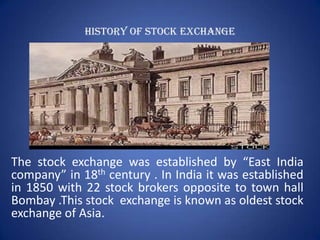
HISTORY OF STOCK EXCHANGE


The stock exchange was established by “East India
company” in 18th century . In India it was established
in 1850 with 22 stock brokers opposite to town hall
Bombay .This stock exchange is known as oldest stock
exchange of Asia.
Initial members who are
still running their business
   in stock exchange are
     D.S.Prabhudas &company
       Jamnadas Morarjee
      Champak lal Devidas
     Brymohan Laxminarayan
BROKER AND JOBBER
 BROKER: He is one acts as a intermidiary on
  behalf of others. A broker in a stock exchange ,is
  a commission agent who transacts business in
  securities on behalf of non members.
 JOBBER: He is not allowed to deal with the
  public directly .He deals with brokers who are
  engaged with the investors . Thus, the securities
  is bought by the jobber from members and sells
  to members who are operating on the stock
  exchange as broker.
DIFFERENCES BETWEEN A JOBBER AND A BROKER


           JOBBER                                   BROKER
   A jobber is an independent              A broker deals with the jobber
    dealer in securities, purchasing         on behalf of his clients. in other
    or selling securities on his own         words, a broker is a middleman
    account                                  between a jobber and clients
   A jobber deals only with the            A broker is merely an agent,
    brokers ,does not deal with the          buying or selling securities on
    general public                           behalf of his clients
   A jobber earns profit from his        A broker gets only
    operations i.e., buying and
    selling activities
                                           commission for his dealings
   Each jobber specializes in certain    The broker deals in all
    group of securities                    types of securities
SPECULATION AND SPECULATOR
 SPECULATION : It is the transaction of members to
  buy or sell securities on stock exchange with a view to
  make profits to anticipated raise or fall in price of
  securities.
 SPECULATOR : The dealer in stock exchange who
  indulge in speculation are called speculator . They do not
  take delivery of securities purchased or sold by them , but
  only pay or rescue the difference between the purchase
  price and sale price . The different types of speculators are
BULL
BEAR
STAG
LAME DUCK
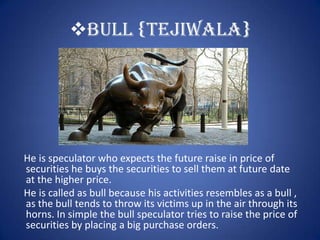
BULL {TEJIWALA}


He is speculator who expects the future raise in price of
securities he buys the securities to sell them at future date
at the higher price.
He is called as bull because his activities resembles as a bull ,
as the bull tends to throw its victims up in the air through its
horns. In simple the bull speculator tries to raise the price of
securities by placing a big purchase orders.
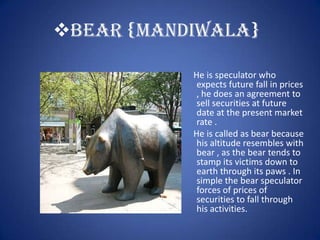
BEAR {MANDIWALA}

           He is speculator who
            expects future fall in prices
            , he does an agreement to
            sell securities at future
            date at the present market
            rate .
           He is called as bear because
            his altitude resembles with
            bear , as the bear tends to
            stamp its victims down to
            earth through its paws . In
            simple the bear speculator
            forces of prices of
            securities to fall through
            his activities.
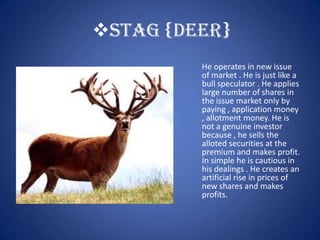
STAG {DEER}
         He operates in new issue
         of market . He is just like a
         bull speculator . He applies
         large number of shares in
         the issue market only by
         paying , application money
         , allotment money. He is
         not a genuine investor
         because , he sells the
         alloted securities at the
         premium and makes profit.
         In simple he is cautious in
         his dealings . He creates an
         artificial rise in prices of
         new shares and makes
         profits.
LAME DUCK
     He is speculator when the
     bear operator finds it
     difficult to deliver the
     securities to the consumer
     on a particular day as
     agreed upon , he struggles
     as a lame duck in fullfilling
     his commitment . This
     happens when the prices
     do not fall as expected by
     the bear and the other
     party is not willing to
     postpone the settlement to
     the next period.
Largest stock exchanges
IN THE WORLD                   IN INDIA
   LONDON STOCK EXCHANGE         NATIONAL STOCK EXCHANGE
   NEW YORK STOCK EXCHANGE       BOMBAY STOCK EXCHANGE
   SHANHAI STOCK EXCHANGE        CALCUTTA STOCK EXCHANGE
   AUSTRALIA STOCK EXCHANGE      COCHIN STOCK EXCHANGE
   TOKYO STOCK EXCHANGE
                                  MULTI COMMODITY
   HONG KONG STOCK                EXCHANGE
    EXCHANGE
   TORONTO STOCK EXCHANGE        DERIVATIVES EXCHANGE
   DEUTSCHE BORSE                OTC EXCHANGE
   BM&F BOVESPA                  PUNE STOCK EXCHANGE
   NASDAQ OMX STOCK              INTERCONNECTS EXCHANGE
    EXCHANGE
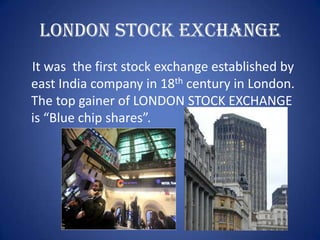
LONDON STOCK EXCHANGE
It was the first stock exchange established by
east India company in 18th century in London.
The top gainer of LONDON STOCK EXCHANGE
is “Blue chip shares”.
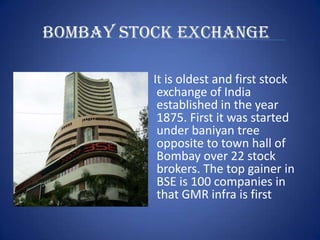
BOMBAY STOCK EXCHANGE

          It is oldest and first stock
           exchange of India
           established in the year
           1875. First it was started
           under baniyan tree
           opposite to town hall of
           Bombay over 22 stock
           brokers. The top gainer in
           BSE is 100 companies in
           that GMR infra is first
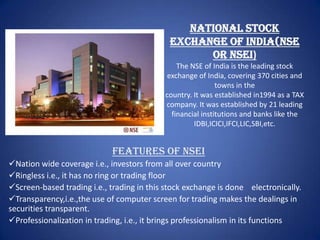
NATIONAL STOCK
                                             EXCHANGE OF INDIA(NSE
                                                   OR NSEI)
                                               The NSE of India is the leading stock
                                            exchange of India, covering 370 cities and
                                                            towns in the
                                           country. It was established in1994 as a TAX
                                           company. It was established by 21 leading
                                             financial institutions and banks like the
                                                    IDBI,ICICI,IFCI,LIC,SBI,etc.


                             Features of NSEI
Nation wide coverage i.e., investors from all over country
Ringless i.e., it has no ring or trading floor
Screen-based trading i.e., trading in this stock exchange is done electronically.
Transparency,i.e.,the use of computer screen for trading makes the dealings in
securities transparent.
Professionalization in trading, i.e., it brings professionalism in its functions
OVER-THE-COUNTER EXCHANGE
                               OF INDIA(OTCEI)
                         The OTCEI is a national,ringless and computerized stock
                        exchange. It was established in october,1990.it started its
                                      operation in september,1992.

                               Features of OTCEI
1.   It is a nation-wide stock exchange. Its operational areas cover entire India.
2.   It is a ringless stock exchange. The trading ring(i.e., trading place)commonly found in a
     traditional stock exchange is not found in the OTCEI.
3.   It is a computerized stock exchange
                            Advantages of OTCEI
1.   It helps the investors to have easy and direct access to the stock exchange
2.   It helps investors to get fair prices for their securities
3.   It provide safety to the investors
4.   To provide computerized trading system
5.   To provide investors a convenient,effcient and transparent mode of
     investment
SECURITIES AND EXCHANGE
                                BOARD OF INDIA(SEBI)
                             The SEBI was constituted on 12th April,1988 under a
                                resolution of the Government of India. On 31st
                              january,1992,it was made a statutory body by the
                               Securities and Exchange board of India Act,1992.
                           The Companies (Amendment) Act,2000 has given certain
                             powers to SEBI as regards the issues and transfer of
                                   securities and non-payment of dividend


                      Function Of SEBI
Regulating the business in stock exchange and any other securities
markets.
Promoting and regulating self-regulatory organization.
Registering and regulating the work of collective investment
scheme,incluing mutual funds.
Prohibiting fraudulent and unfair trade practices relating to
securities market.
Promoting education, and training of intermediaries of securities
market
Power of SEBI
Power to approve the bye-laws of stock exchange
Power to inspect the books of accounts
Power to grant license to any person for the purpose of dealing in certain areas.
Power to delegate powers exercisable by it.
Power to try directly the foliation of certain provision of the company Act
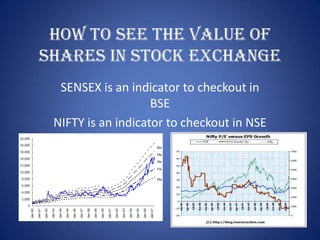
How to see the value of
shares in stock exchange
  SENSEX is an indicator to checkout in
                    BSE
 NIFTY is an indicator to checkout in NSE
Latest news of BSE and NSE
Most profitable company in BSE is GMR Infra
Most profitable company in NSE will be
  RELIANCE and ICICI
During last three months nearly only 26% of
  profit is earned by our stock exchanges the
  working hours will be
From 9:30 to 3:30 from Monday to Friday
The Daily graph of the
companies will be showed in
    following manner
How stock exchanges get
         money
   They get their money by listing fees
  paid by the corporation to have their
             company traded
HOW TO DEAL AND INVEST IN
         STOCK EXCHANGE
  In order to deal with a securities one as to have an
  account called Demat a/c or Trading a/c. It is just like a
  bank account. Same procedure of opening the bank
  account is followed to open the a/c. But all the banks
  does not give this facility of opening the account , only
  few banks provide this facility. After demat a/c or
  Trading a/s is opened then the securities is bought and
  sold. The banks which gives facility of demat a/c in
  India is
 ICICI Bank
 Citi Bank
 Bank of Baroda
HAPPY INVESTMENT WITH
   LOTS OF PROFITS
          END
      ************

Stock exchange simple ppt

  • 1.
    STOCK EXCHANGE EASY WAYTO EARN MONEY, EASY WAY TO LOOSE MONEY Presented BY Avinash.A Dinesh.R
  • 2.
    WHAT IS STOCKEXCHANGE? Definition of Stock Exchange : The securities regulation act of 1956 defined stock exchange as “an association , organization , or a individual which is established for for the purpose of assisting , regulating , and controlling business in buying ,selling and dealing in securities.” Meaning : This comes under treasury sector ,which provides service to stock brokers & traders to trade stocks ,bonds and securities. Stock exchanges helps the companies to raise their fund. Therefore the companies needs to list themselves in the Stock Exchange and the shares will be issued which is known as equity or a ordinary share and these shareholders are the real owners of the company the Board Of Directors of the Company are elected out of these Equity Shareholders only.
  • 3.
    FEATURES OF STOCKEXCHANGE  It is an organized market  It is a securities market  It is an important constituent of capital market i.e., market for long- term finance  It is a voluntary association of persons desirous of dealing in securities  Stock exchange is a voluntary association, its membership is not open to everybody  In a stock exchange, only the members can deal in i.e., buy & sell securities  The members of a stock exchange can buy and sell securities either as brokers for & on behalf of their clients  The dealings in a stock exchange are under certain accepted code of conduct i.e., rules and regulations
  • 4.
    IMPORTANT FUNCTION OFSTOCK EXCHANGE  Provide central and convenient meeting places for sellers and buyer of securities  Increase the marketability and liquidity of securities  Contribute to stability of prices of securities  Equalization of price of securities  Smoothen price movement  Help the investors to know the worth of their holdings  Promote the habit of saving and investment  Help capital formation  Help companies and government to raise funds from the investors  Provide forecasting service
  • 5.
    HISTORY OF STOCKEXCHANGE The stock exchange was established by “East India company” in 18th century . In India it was established in 1850 with 22 stock brokers opposite to town hall Bombay .This stock exchange is known as oldest stock exchange of Asia.
  • 6.
    Initial members whoare still running their business in stock exchange are D.S.Prabhudas &company Jamnadas Morarjee Champak lal Devidas Brymohan Laxminarayan
  • 7.
    BROKER AND JOBBER BROKER: He is one acts as a intermidiary on behalf of others. A broker in a stock exchange ,is a commission agent who transacts business in securities on behalf of non members.  JOBBER: He is not allowed to deal with the public directly .He deals with brokers who are engaged with the investors . Thus, the securities is bought by the jobber from members and sells to members who are operating on the stock exchange as broker.
  • 8.
    DIFFERENCES BETWEEN AJOBBER AND A BROKER JOBBER BROKER  A jobber is an independent  A broker deals with the jobber dealer in securities, purchasing on behalf of his clients. in other or selling securities on his own words, a broker is a middleman account between a jobber and clients  A jobber deals only with the  A broker is merely an agent, brokers ,does not deal with the buying or selling securities on general public behalf of his clients  A jobber earns profit from his  A broker gets only operations i.e., buying and selling activities commission for his dealings  Each jobber specializes in certain  The broker deals in all group of securities types of securities
  • 9.
    SPECULATION AND SPECULATOR SPECULATION : It is the transaction of members to buy or sell securities on stock exchange with a view to make profits to anticipated raise or fall in price of securities.  SPECULATOR : The dealer in stock exchange who indulge in speculation are called speculator . They do not take delivery of securities purchased or sold by them , but only pay or rescue the difference between the purchase price and sale price . The different types of speculators are BULL BEAR STAG LAME DUCK
  • 10.
    BULL {TEJIWALA} He isspeculator who expects the future raise in price of securities he buys the securities to sell them at future date at the higher price. He is called as bull because his activities resembles as a bull , as the bull tends to throw its victims up in the air through its horns. In simple the bull speculator tries to raise the price of securities by placing a big purchase orders.
  • 11.
    BEAR {MANDIWALA} He is speculator who expects future fall in prices , he does an agreement to sell securities at future date at the present market rate . He is called as bear because his altitude resembles with bear , as the bear tends to stamp its victims down to earth through its paws . In simple the bear speculator forces of prices of securities to fall through his activities.
  • 12.
    STAG {DEER} He operates in new issue of market . He is just like a bull speculator . He applies large number of shares in the issue market only by paying , application money , allotment money. He is not a genuine investor because , he sells the alloted securities at the premium and makes profit. In simple he is cautious in his dealings . He creates an artificial rise in prices of new shares and makes profits.
  • 13.
    LAME DUCK He is speculator when the bear operator finds it difficult to deliver the securities to the consumer on a particular day as agreed upon , he struggles as a lame duck in fullfilling his commitment . This happens when the prices do not fall as expected by the bear and the other party is not willing to postpone the settlement to the next period.
  • 14.
    Largest stock exchanges INTHE WORLD IN INDIA  LONDON STOCK EXCHANGE  NATIONAL STOCK EXCHANGE  NEW YORK STOCK EXCHANGE  BOMBAY STOCK EXCHANGE  SHANHAI STOCK EXCHANGE  CALCUTTA STOCK EXCHANGE  AUSTRALIA STOCK EXCHANGE  COCHIN STOCK EXCHANGE  TOKYO STOCK EXCHANGE  MULTI COMMODITY  HONG KONG STOCK EXCHANGE EXCHANGE  TORONTO STOCK EXCHANGE  DERIVATIVES EXCHANGE  DEUTSCHE BORSE  OTC EXCHANGE  BM&F BOVESPA  PUNE STOCK EXCHANGE  NASDAQ OMX STOCK  INTERCONNECTS EXCHANGE EXCHANGE
  • 15.
    LONDON STOCK EXCHANGE Itwas the first stock exchange established by east India company in 18th century in London. The top gainer of LONDON STOCK EXCHANGE is “Blue chip shares”.
  • 16.
    BOMBAY STOCK EXCHANGE It is oldest and first stock exchange of India established in the year 1875. First it was started under baniyan tree opposite to town hall of Bombay over 22 stock brokers. The top gainer in BSE is 100 companies in that GMR infra is first
  • 17.
    NATIONAL STOCK EXCHANGE OF INDIA(NSE OR NSEI) The NSE of India is the leading stock exchange of India, covering 370 cities and towns in the country. It was established in1994 as a TAX company. It was established by 21 leading financial institutions and banks like the IDBI,ICICI,IFCI,LIC,SBI,etc. Features of NSEI Nation wide coverage i.e., investors from all over country Ringless i.e., it has no ring or trading floor Screen-based trading i.e., trading in this stock exchange is done electronically. Transparency,i.e.,the use of computer screen for trading makes the dealings in securities transparent. Professionalization in trading, i.e., it brings professionalism in its functions
  • 18.
    OVER-THE-COUNTER EXCHANGE OF INDIA(OTCEI) The OTCEI is a national,ringless and computerized stock exchange. It was established in october,1990.it started its operation in september,1992. Features of OTCEI 1. It is a nation-wide stock exchange. Its operational areas cover entire India. 2. It is a ringless stock exchange. The trading ring(i.e., trading place)commonly found in a traditional stock exchange is not found in the OTCEI. 3. It is a computerized stock exchange Advantages of OTCEI 1. It helps the investors to have easy and direct access to the stock exchange 2. It helps investors to get fair prices for their securities 3. It provide safety to the investors 4. To provide computerized trading system 5. To provide investors a convenient,effcient and transparent mode of investment
  • 19.
    SECURITIES AND EXCHANGE BOARD OF INDIA(SEBI) The SEBI was constituted on 12th April,1988 under a resolution of the Government of India. On 31st january,1992,it was made a statutory body by the Securities and Exchange board of India Act,1992. The Companies (Amendment) Act,2000 has given certain powers to SEBI as regards the issues and transfer of securities and non-payment of dividend Function Of SEBI Regulating the business in stock exchange and any other securities markets. Promoting and regulating self-regulatory organization. Registering and regulating the work of collective investment scheme,incluing mutual funds. Prohibiting fraudulent and unfair trade practices relating to securities market. Promoting education, and training of intermediaries of securities market
  • 20.
    Power of SEBI Powerto approve the bye-laws of stock exchange Power to inspect the books of accounts Power to grant license to any person for the purpose of dealing in certain areas. Power to delegate powers exercisable by it. Power to try directly the foliation of certain provision of the company Act
  • 21.
    How to seethe value of shares in stock exchange SENSEX is an indicator to checkout in BSE NIFTY is an indicator to checkout in NSE
  • 22.
    Latest news ofBSE and NSE Most profitable company in BSE is GMR Infra Most profitable company in NSE will be RELIANCE and ICICI During last three months nearly only 26% of profit is earned by our stock exchanges the working hours will be From 9:30 to 3:30 from Monday to Friday
  • 23.
    The Daily graphof the companies will be showed in following manner
  • 24.
    How stock exchangesget money They get their money by listing fees paid by the corporation to have their company traded
  • 25.
    HOW TO DEALAND INVEST IN STOCK EXCHANGE In order to deal with a securities one as to have an account called Demat a/c or Trading a/c. It is just like a bank account. Same procedure of opening the bank account is followed to open the a/c. But all the banks does not give this facility of opening the account , only few banks provide this facility. After demat a/c or Trading a/s is opened then the securities is bought and sold. The banks which gives facility of demat a/c in India is  ICICI Bank  Citi Bank  Bank of Baroda
  • 26.
    HAPPY INVESTMENT WITH LOTS OF PROFITS END ************

Editor's Notes